
Teaching KS 3 Computing Session 4 Theory Boolean
Teaching KS 3 Computing Session 4 Theory: Boolean logic AND/OR/NOT Practical: Introducing loops
Today’s session 5: 00 – 6: 00 Understanding logical operators and why they are important 6. 00 – 7. 00 Programming with loops - iteration
Recap so far
Recap so far Theory side of course - Algorithms unplugged - Binary numbers 0 – 1 - Hexadecimal numbers 0 – F - Bits and Bytes Programming side of course - Using turtle graphics in Python - Sequence - Functions – writing and calling - If statements - Input and output – print and input() Homework – discuss in pairs what you have been working on. • Revise the last two week’s work on binary numbers, storing text, hexadecimal numbers etc. Come up with a lesson plan that you think would be appropriate for one of your KS 3 classes with a mixture of unplugged and paper exercises. • Work through the exercises in the Python handout and try to finish them all.
National curriculum at KS 3 understand simple Boolean logic [for example, AND, OR and NOT] and some of its uses in circuits and programming;
Activity 1: Boolean operators Follow the instructions!
Boolean operators AND Gives a TRUE result if both INPUTS are TRUE Otherwise gives a FALSE result OR Gives a TRUE result if one or both INPUTS are TRUE Otherwise gives a FALSE result NOT Gives a TRUE result if the (one) INPUT is FALSE Gives a FALSE result if the (one) INPUT is TRUE
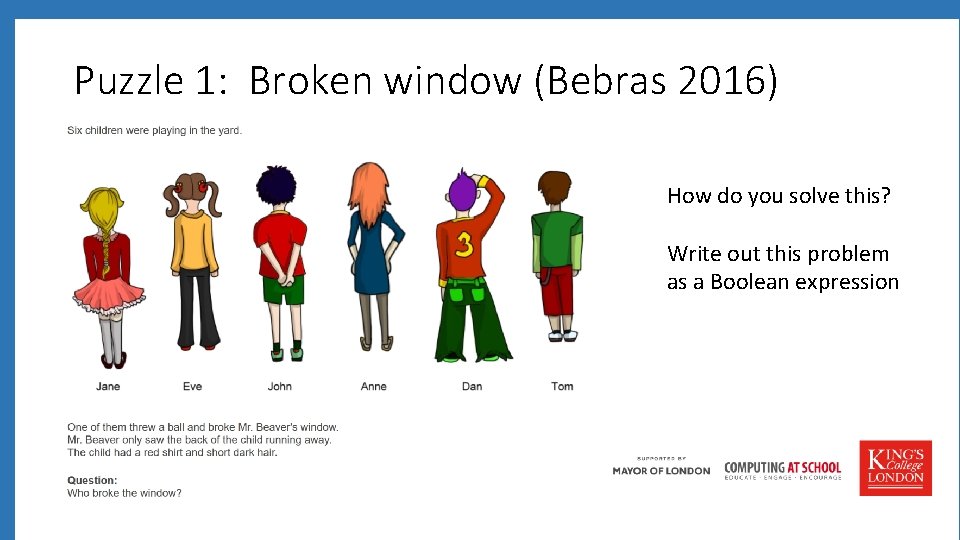
Puzzle 1: Broken window (Bebras 2016). How do you solve this? Write out this problem as a Boolean expression
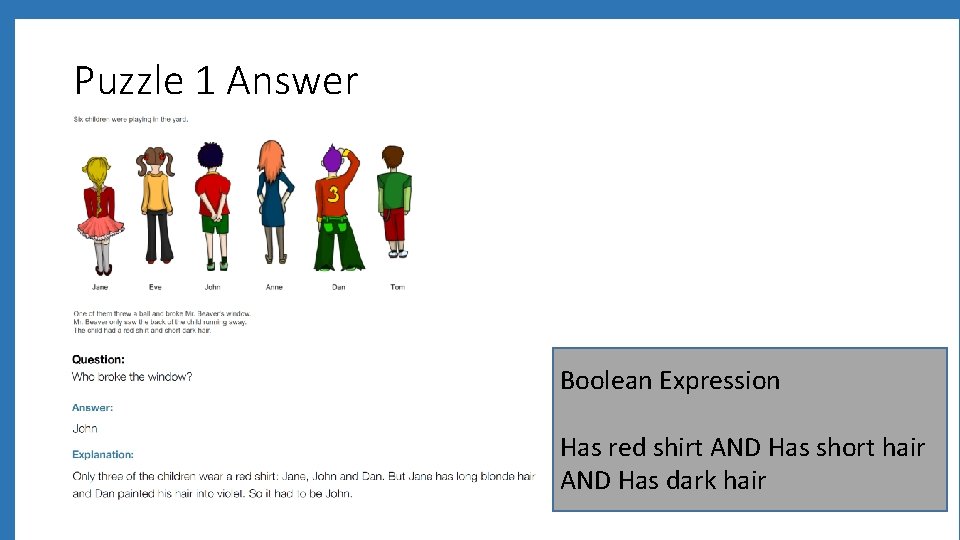
Puzzle 1 Answer Boolean Expression Has red shirt AND Has short hair AND Has dark hair
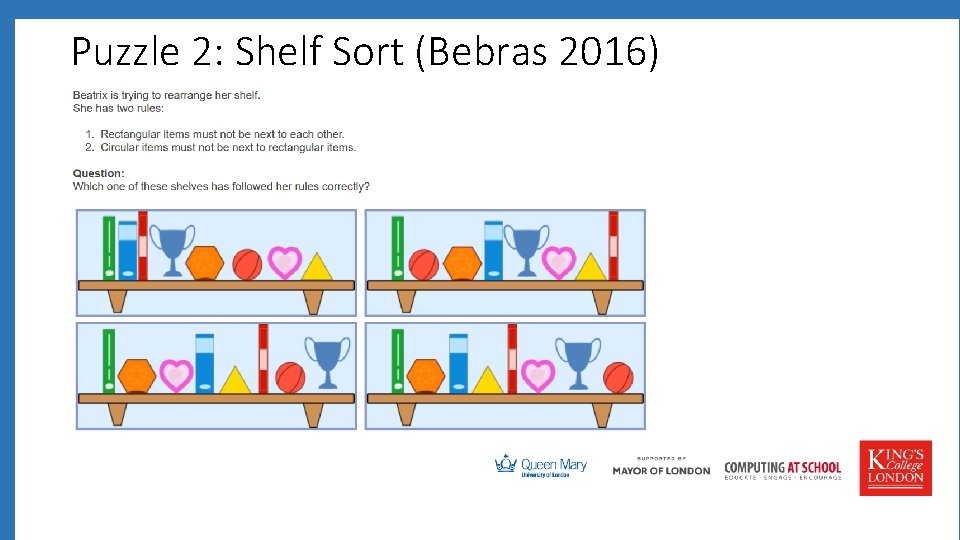
Puzzle 2: Shelf Sort (Bebras 2016)
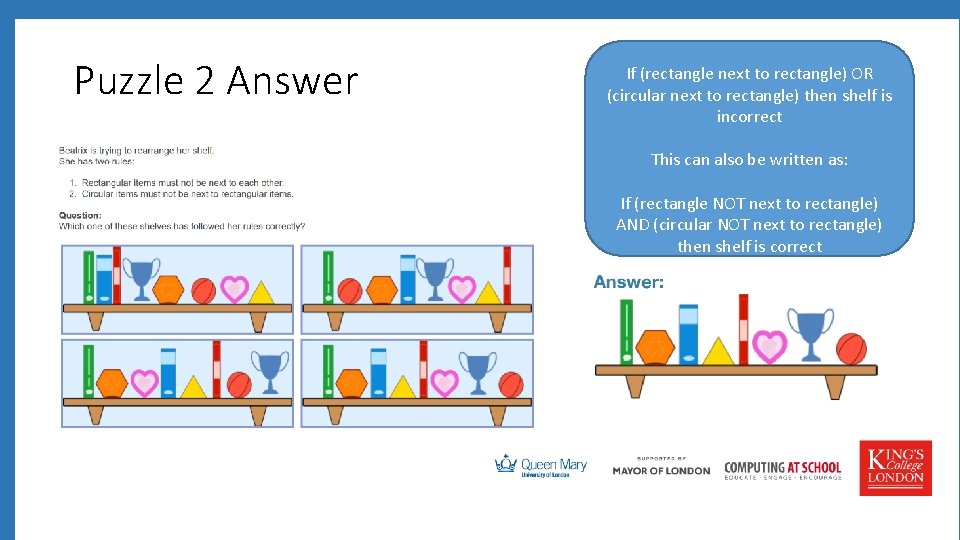
Here two rules are being applied Puzzle 2 Answer If (rectangle next to rectangle) OR (circular next to rectangle) then shelf is incorrect This can also be written as: If (rectangle NOT next to rectangle) AND (circular NOT next to rectangle) then shelf is correct
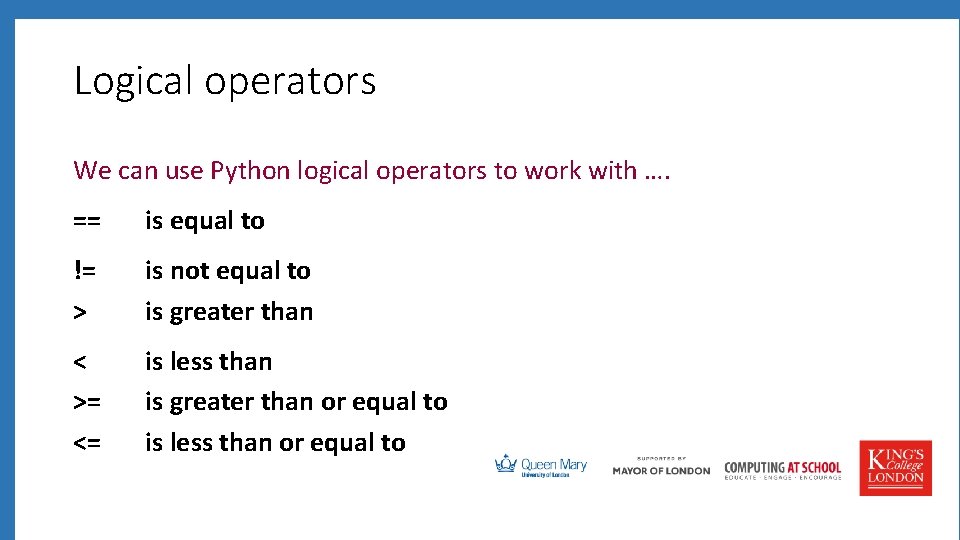
Logical operators We can use Python logical operators to work with …. == is equal to != > is not equal to is greater than < >= <= is less than is greater than or equal to is less than or equal to
Activity 2: Using operators Try the worksheet questions 1 -3 Extension – exercises 4 -6
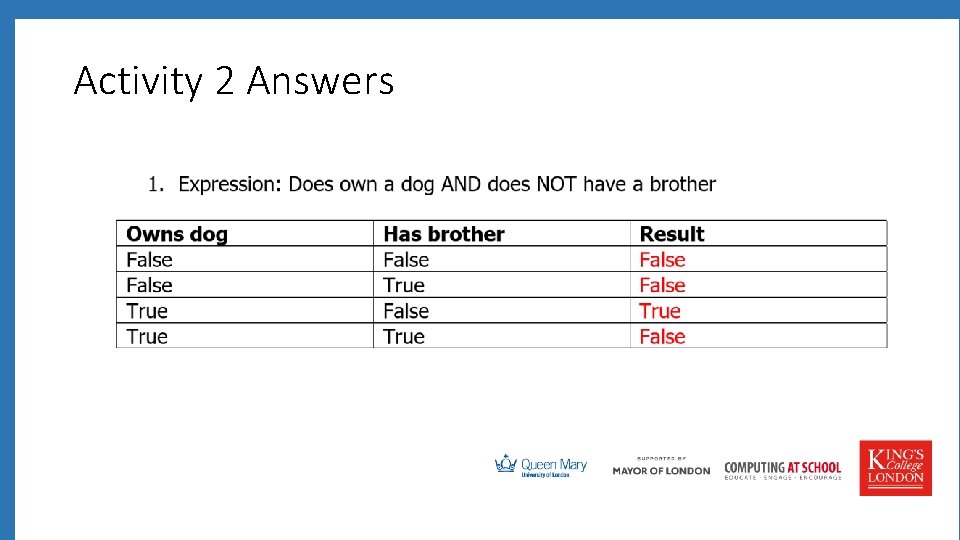
Activity 2 Answers
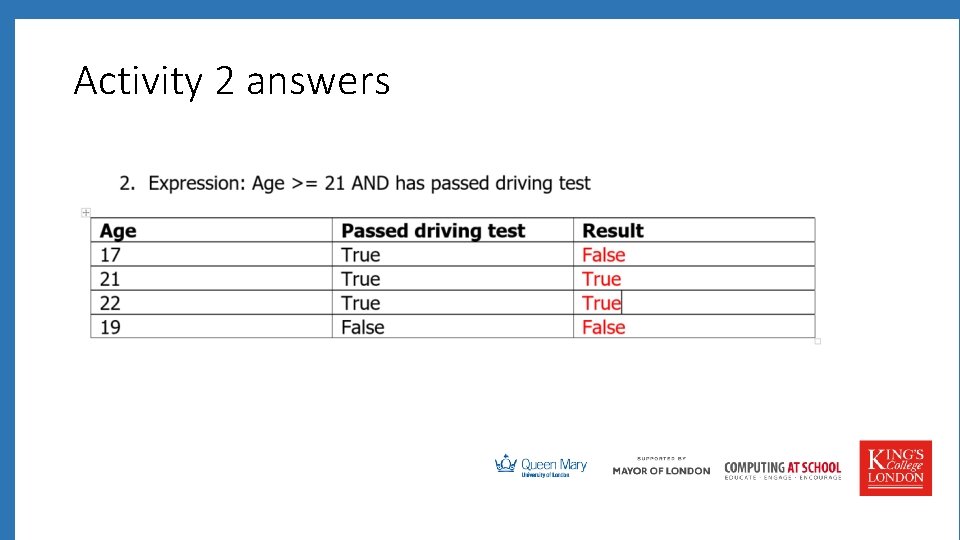
Activity 2 answers
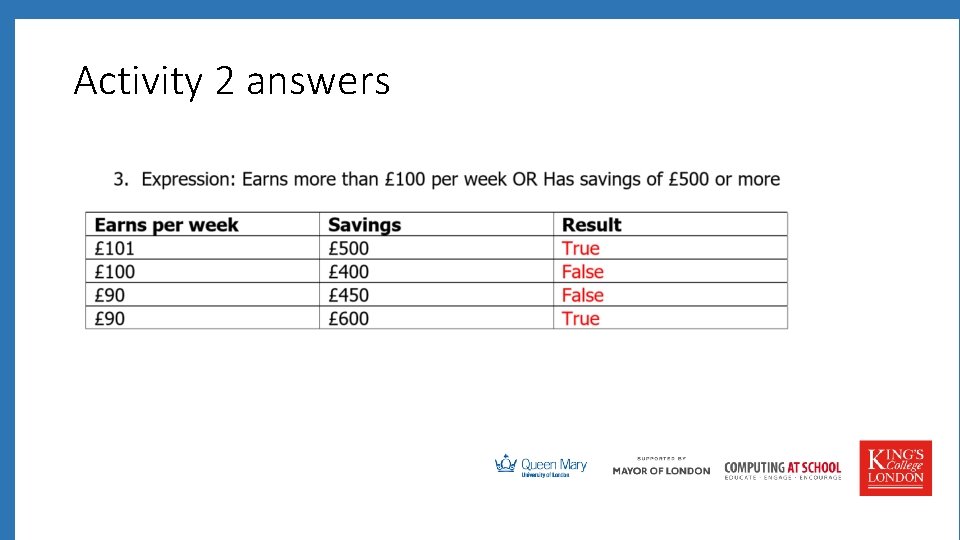
Activity 2 answers
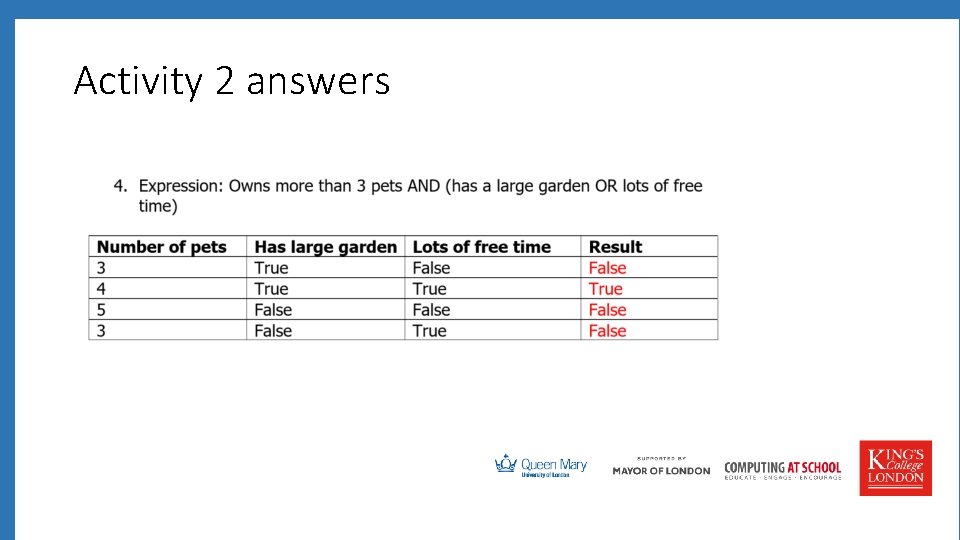
Activity 2 answers
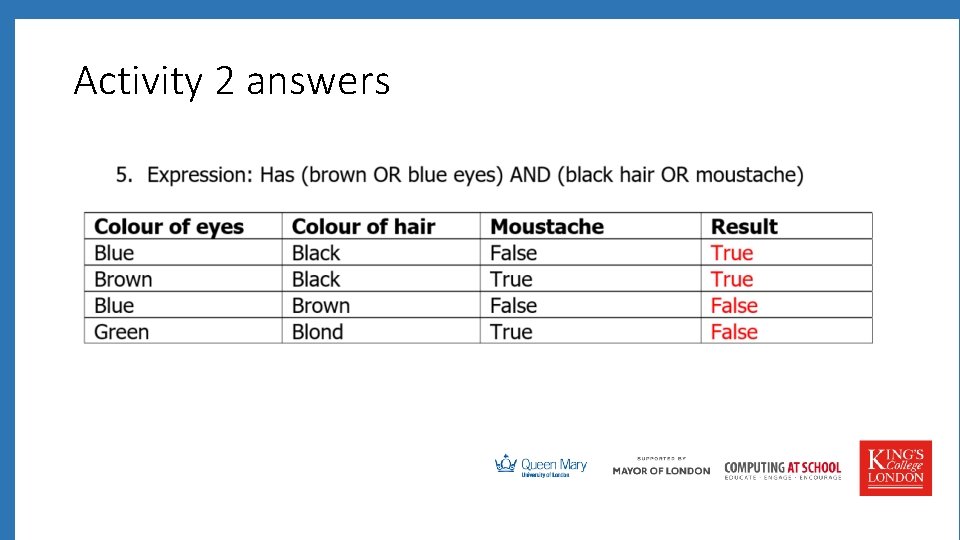
Activity 2 answers
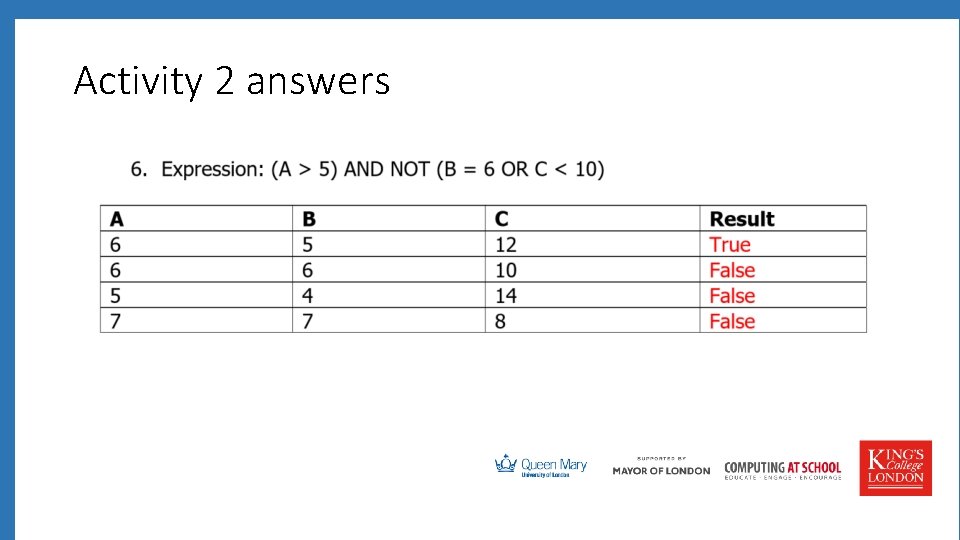
Activity 2 answers
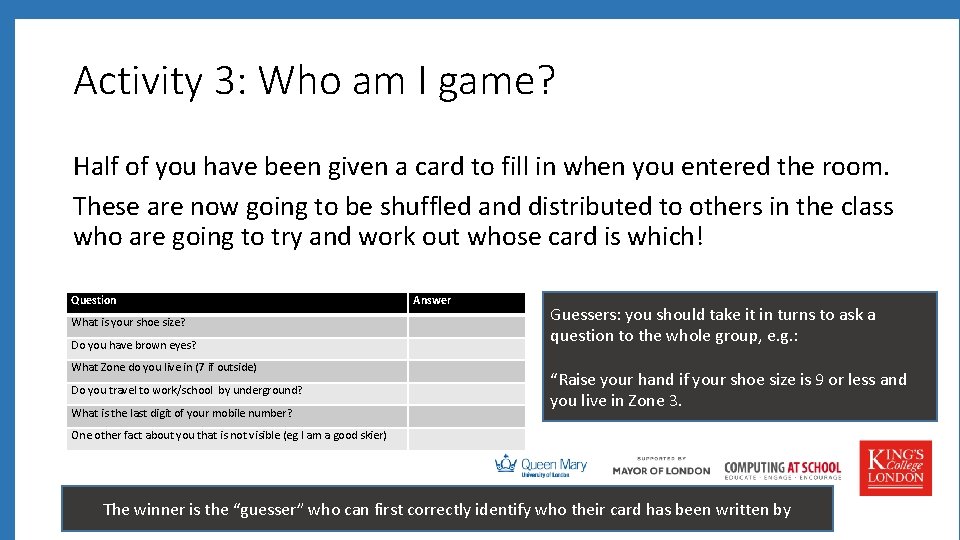
Activity 3: Who am I game? Half of you have been given a card to fill in when you entered the room. These are now going to be shuffled and distributed to others in the class who are going to try and work out whose card is which! Question What is your shoe size? Do you have brown eyes? What Zone do you live in (7 if outside) Do you travel to work/school by underground? What is the last digit of your mobile number? Answer Guessers: you should take it in turns to ask a question to the whole group, e. g. : “Raise your hand if your shoe size is 9 or less and you live in Zone 3. One other fact about you that is not visible (eg I am a good skier) The winner is the “guesser” who can first correctly identify who their card has been written by
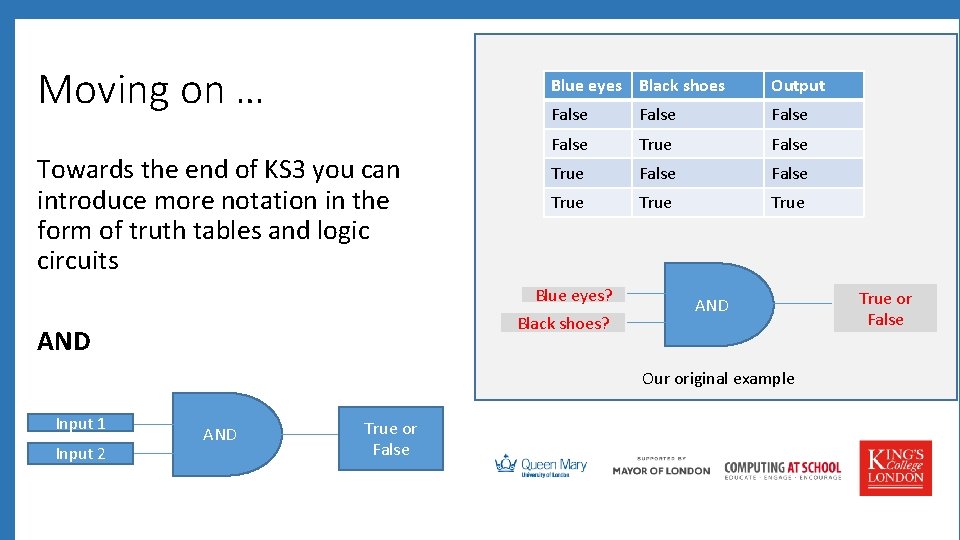
Moving on … Towards the end of KS 3 you can introduce more notation in the form of truth tables and logic circuits Blue eyes Black shoes Output False False True True Blue eyes? Black shoes? AND Our original example Input 1 Input 2 AND True or False
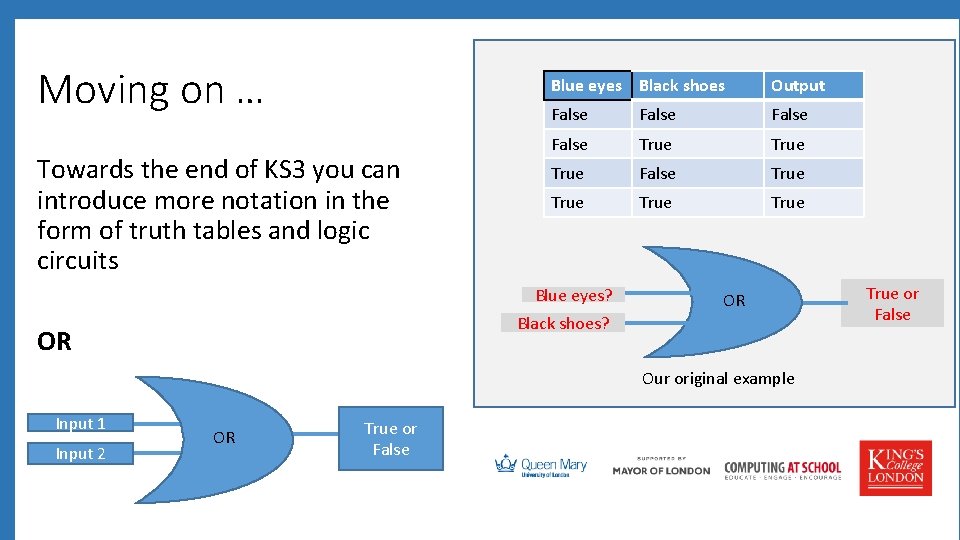
Moving on … Towards the end of KS 3 you can introduce more notation in the form of truth tables and logic circuits Blue eyes Black shoes Output False True False True Blue eyes? OR Black shoes? OR Our original example Input 1 Input 2 OR True or False
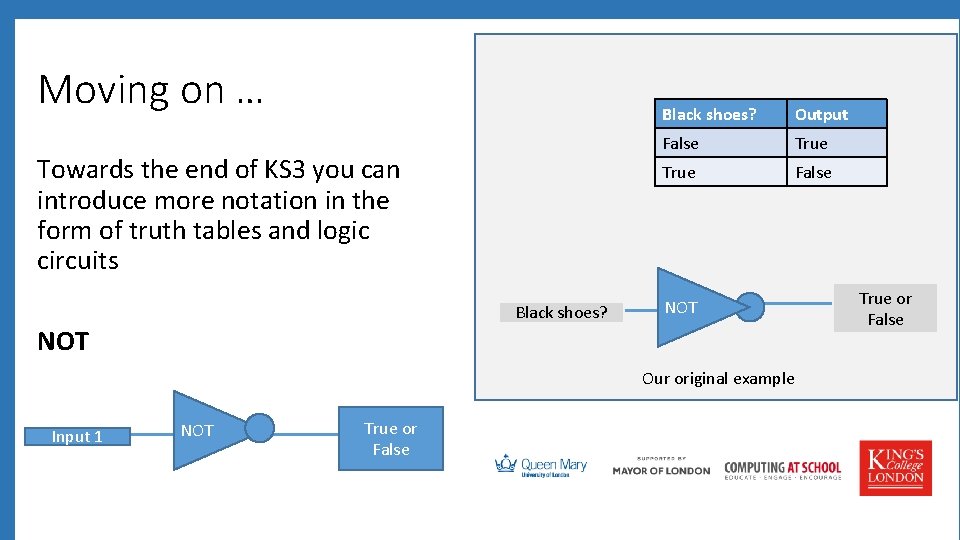
Moving on … Towards the end of KS 3 you can introduce more notation in the form of truth tables and logic circuits Black shoes? NOT Black shoes? Output False True False NOT Our original example Input 1 NOT True or False
Summary At KS 3 students should understand AND, OR and NOT, even in some complex expressions Towards the end of KS 3 they can be introduced to how Boolean expressions can be represented as circuits or truth tables They should also be able to use AND, OR and NOT in their programs, for example in IF statements

Break
- Slides: 25