
Teaching kit Exploring the material world ELECTRICITY Electricity
- Slides: 40
Teaching kit “Exploring the material world” ELECTRICITY
Electricity… The different aspects of the discovery of the material world can only be approached from real-life situations and observation satisfying children’s curiosity.
Activity 12 : Electric circuits n This activity can be performed with or without supervision. n In either case, the mediator will begin by presenting the relevant activity sheet.
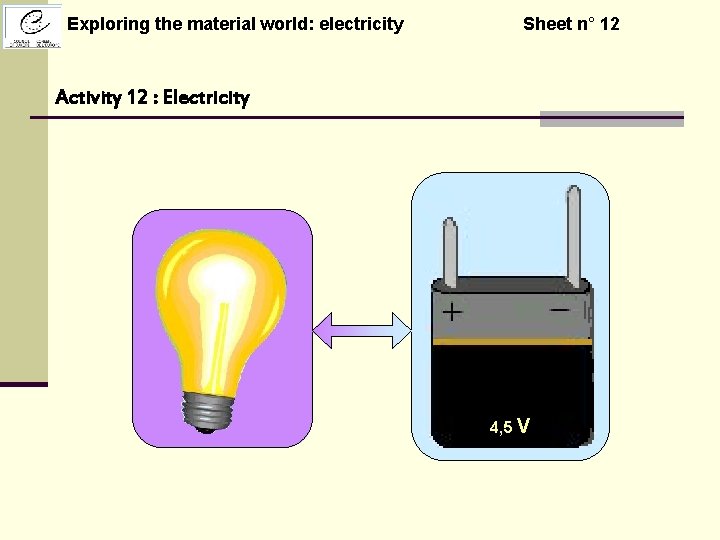
Exploring the material world: electricity Sheet n° 12 Activity 12 : Electricity 4, 5 V
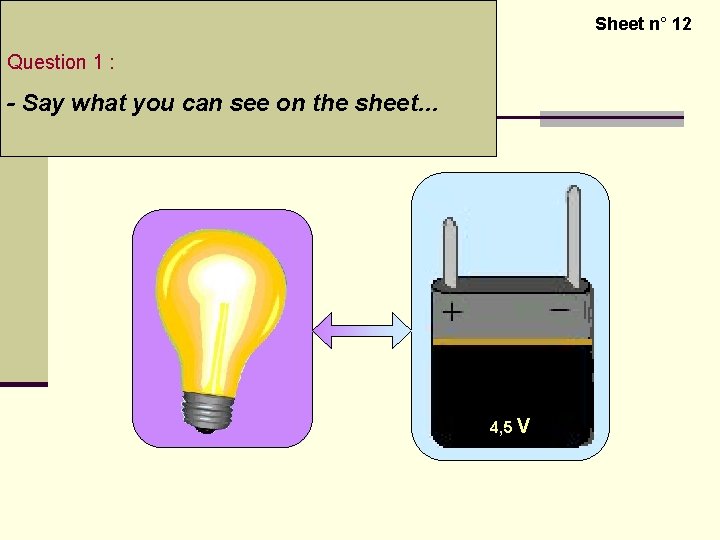
Question 1 : - Say what you can see on the sheet… 4, 5 V Sheet n° 12
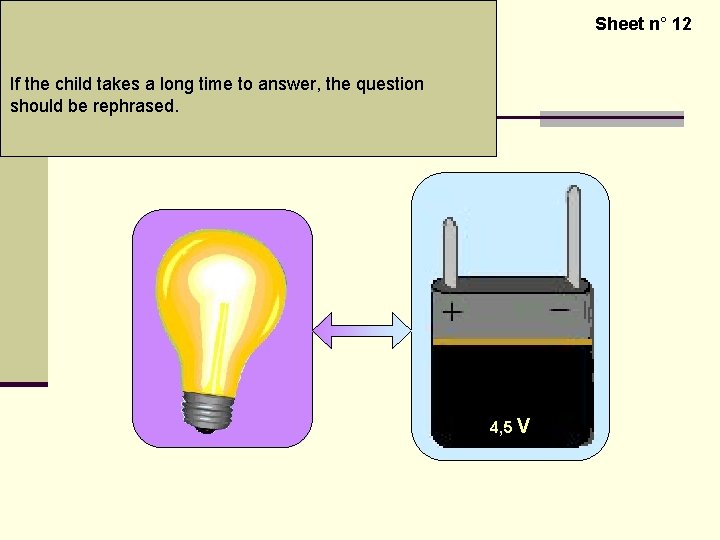
L’exploration du monde de la matière : l’électricité If the child takes a long time to answer, the question Activité 12 : L’électricité should be rephrased. 4, 5 V Sheet n° 12
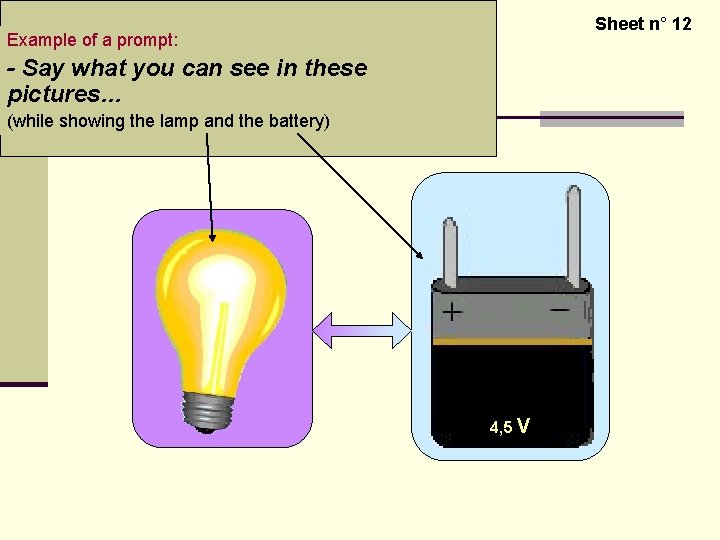
Example of a prompt: - Say what you can see in these pictures… (while showing the lamp and the battery) 4, 5 V Sheet n° 12
At nursery school, the important thing is that children should identify and name what they see.
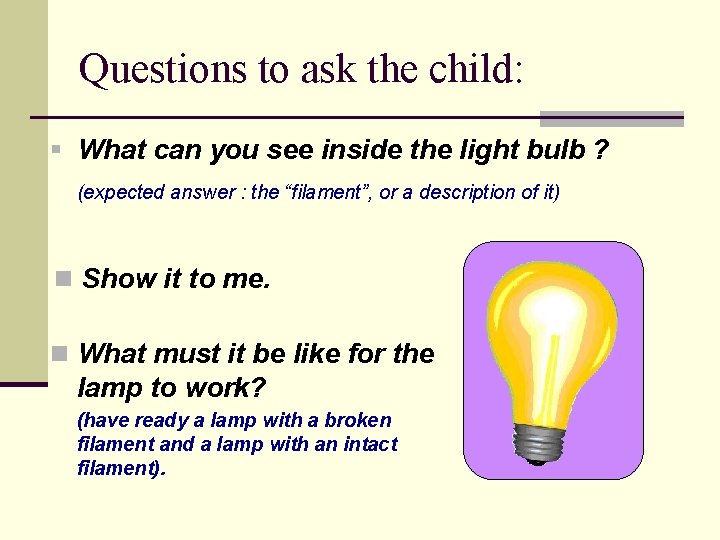
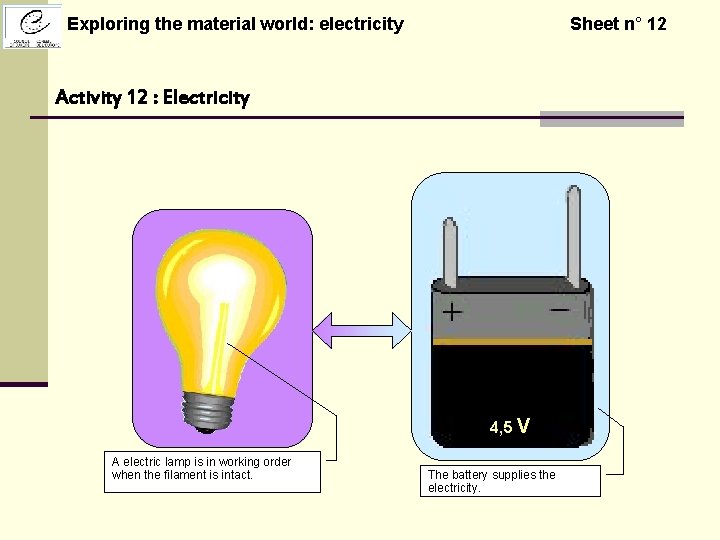
Questions to ask the child: What can you see inside the light bulb ? (expected answer : the “filament”, or a description of it) n Show it to me. n What must it be like for the lamp to work? (have ready a lamp with a broken filament and a lamp with an intact filament).
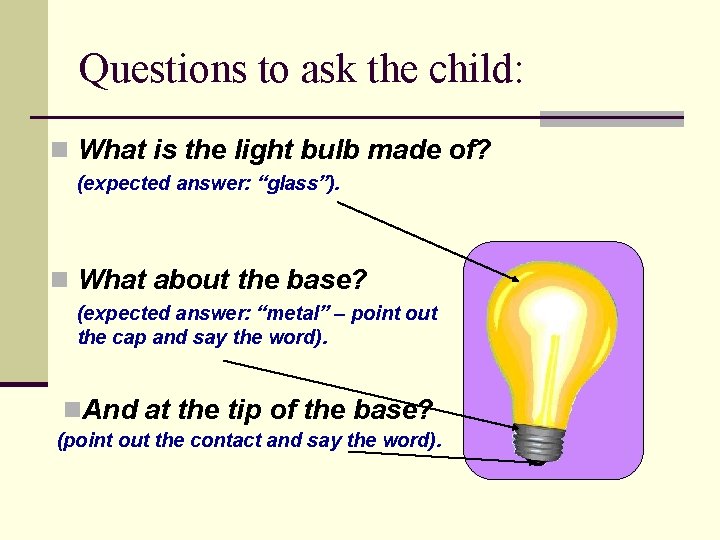
Questions to ask the child: n What is the light bulb made of? (expected answer: “glass”). n What about the base? (expected answer: “metal” – point out the cap and say the word). n. And at the tip of the base? (point out the contact and say the word).
Observation and description are the opportunity to draw attention to the functions of the different parts of the object being studied…
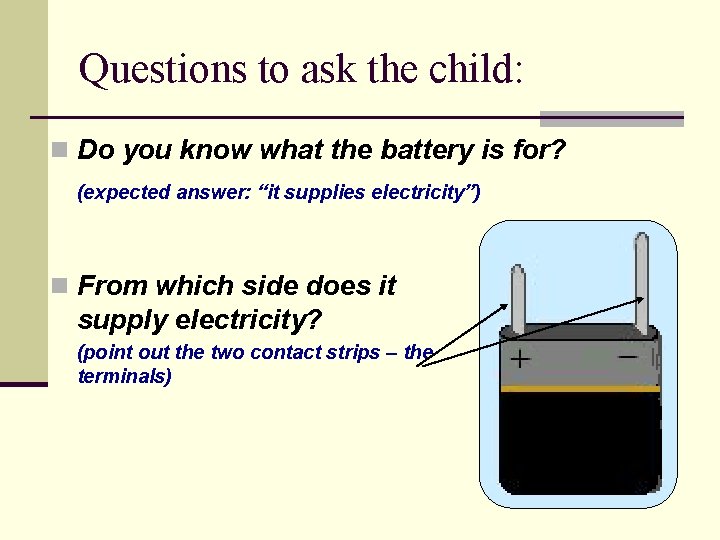
Questions to ask the child: n Do you know what the battery is for? (expected answer: “it supplies electricity”) n From which side does it supply electricity? (point out the two contact strips – the terminals)
Exploring the material world: electricity Sheet n° 12 Activity 12 : Electricity 4, 5 V A electric lamp is in working order when the filament is intact. The battery supplies the electricity.
The mediator will “read” each picture with the child… After the description of the lamp and the battery, the mediator should ask the child to turn the sheet over.
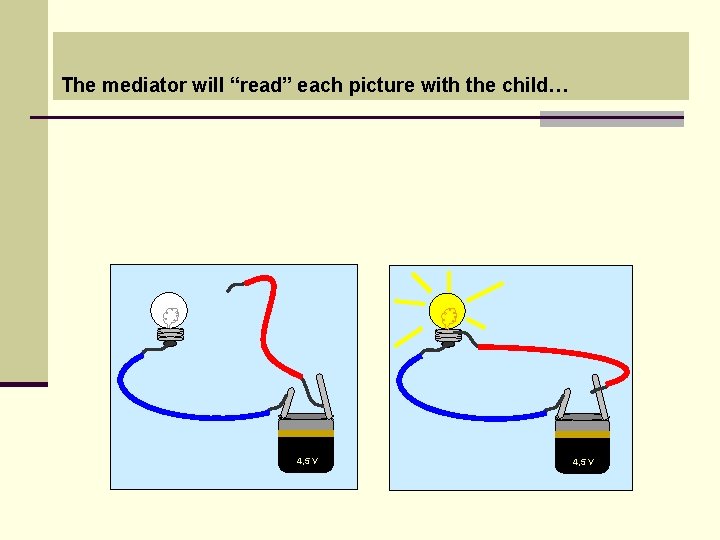
The mediator will “read” each picture with the child… 4, 5 V
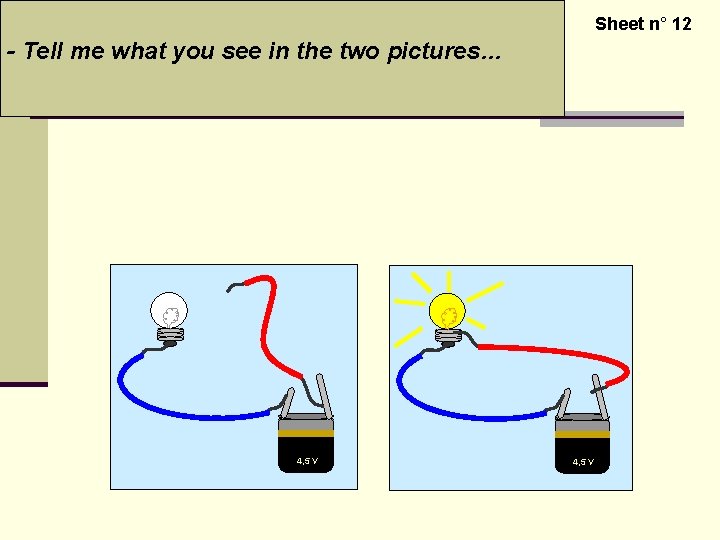
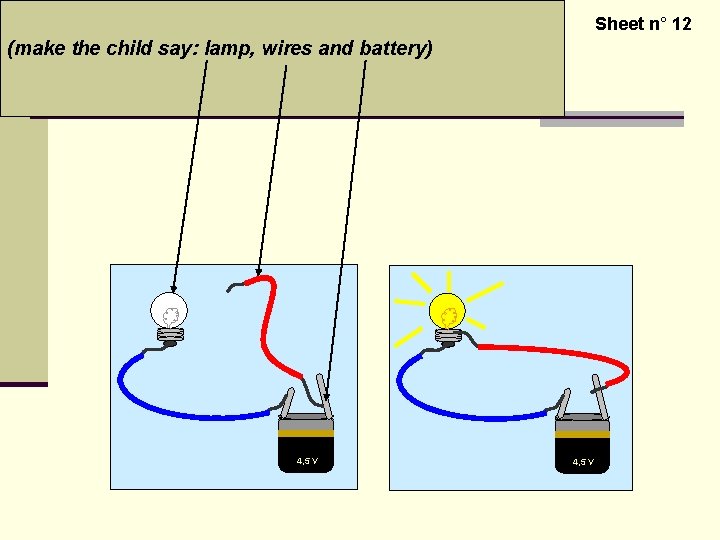
Sheet n° 12 - Tell me what you see in the two pictures… 4, 5 V
Sheet n° 12 (make the child say: lamp, wires and battery) 4, 5 V
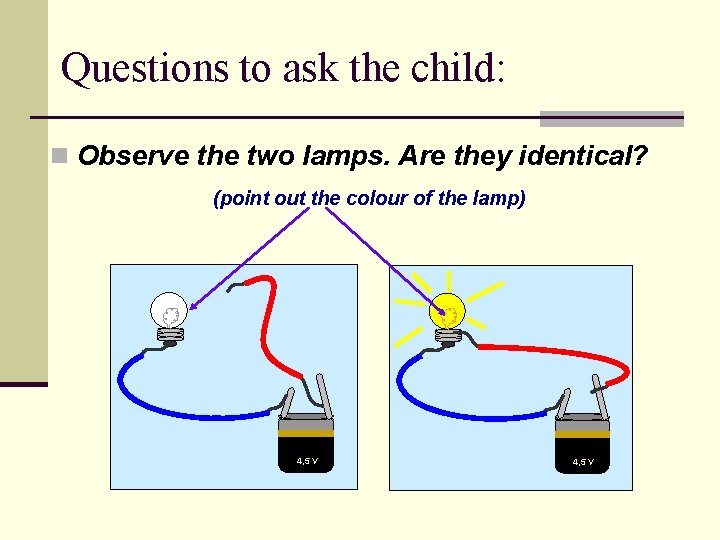
Questions to ask the child: n Observe the two lamps. Are they identical? (point out the colour of the lamp) 4, 5 V
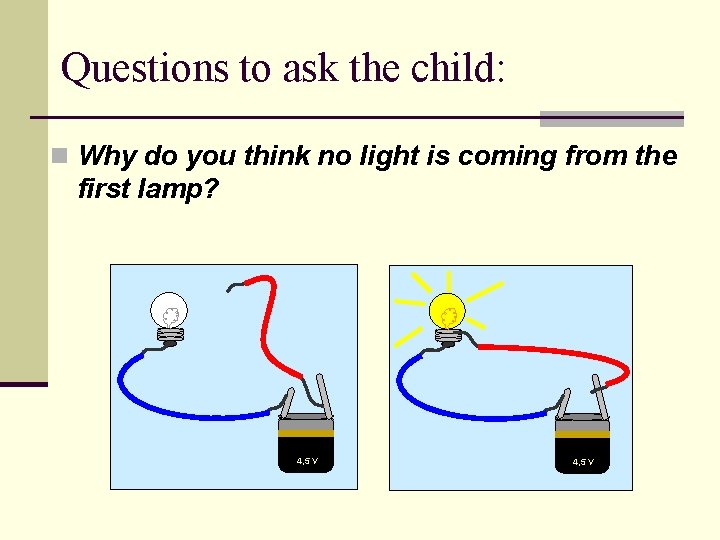
Questions to ask the child: n Why do you think no light is coming from the first lamp? 4, 5 V
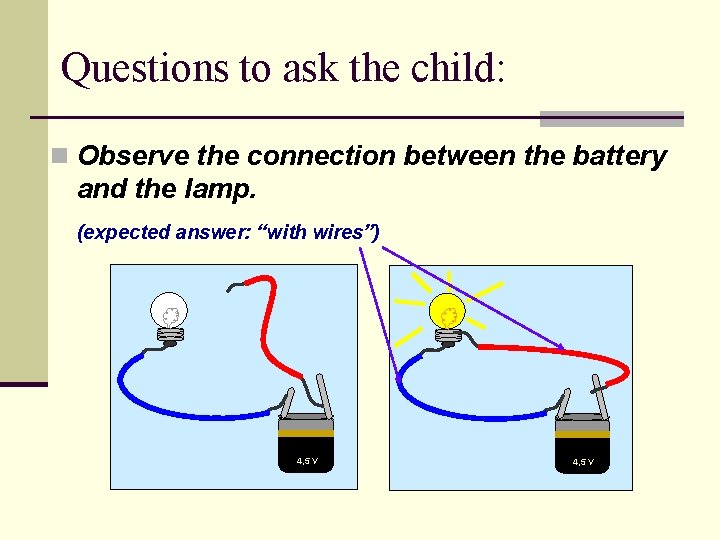
Questions to ask the child: n Observe the connection between the battery and the lamp. (expected answer: “with wires”) 4, 5 V
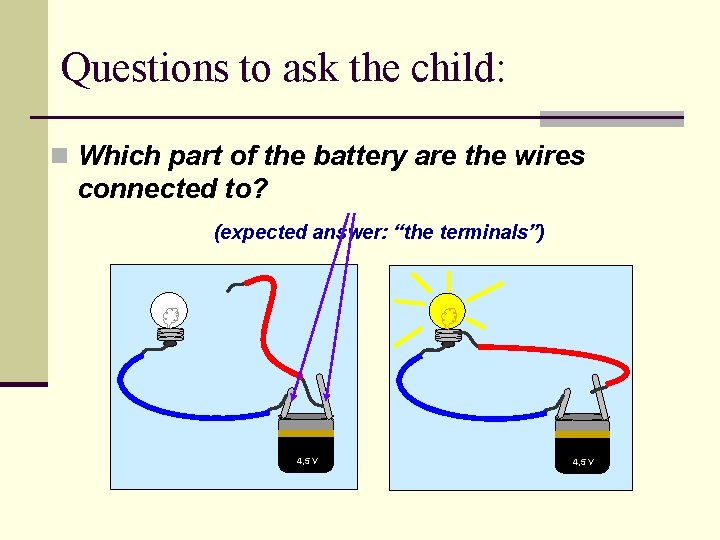
Questions to ask the child: n Which part of the battery are the wires connected to? (expected answer: “the terminals”) 4, 5 V
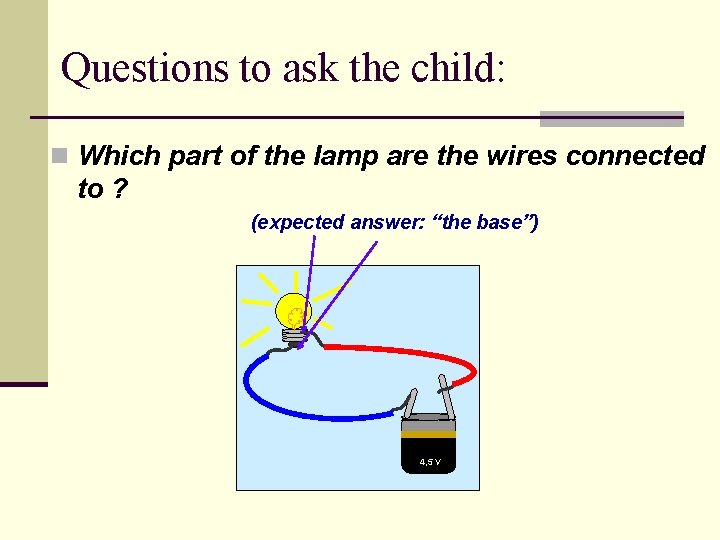
Questions to ask the child: n Which part of the lamp are the wires connected to ? (expected answer: “the base”) 4, 5 V
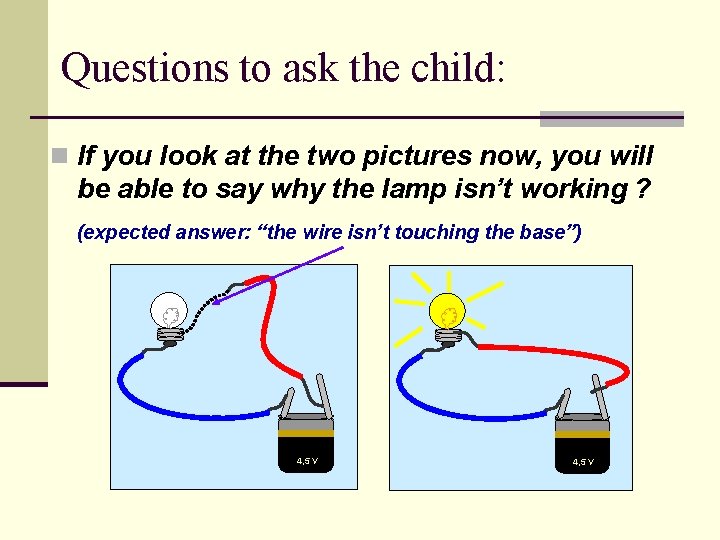
Questions to ask the child: n If you look at the two pictures now, you will be able to say why the lamp isn’t working ? (expected answer: “the wire isn’t touching the base”) 4, 5 V
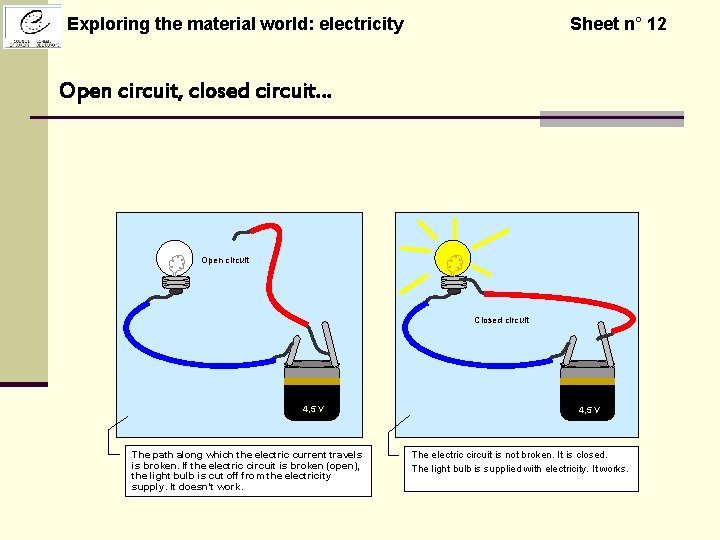
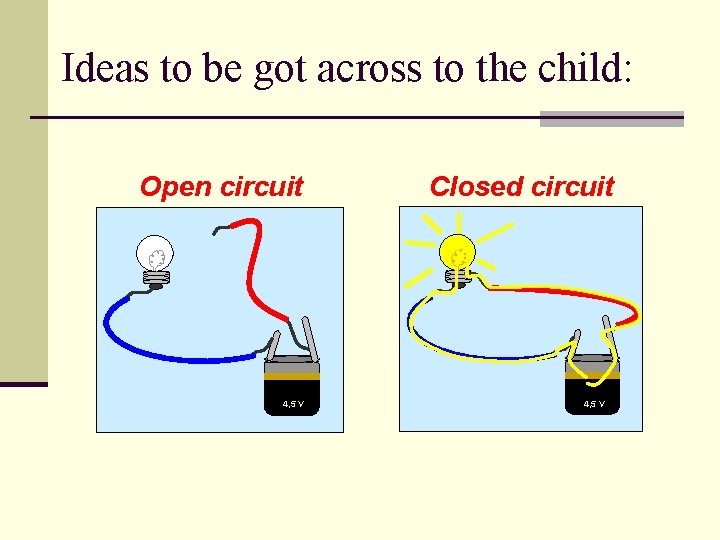
Exploring the material world: electricity Sheet n° 12 Open circuit, closed circuit… Open circuit Closed circuit 4, 5 V The path along which the electric current travels is broken. If the electric circuit is broken (open), the light bulb is cut off from the electricity supply. It doesn’t work. 4, 5 V The electric circuit is not broken. It is closed. The light bulb is supplied with electricity. It works.
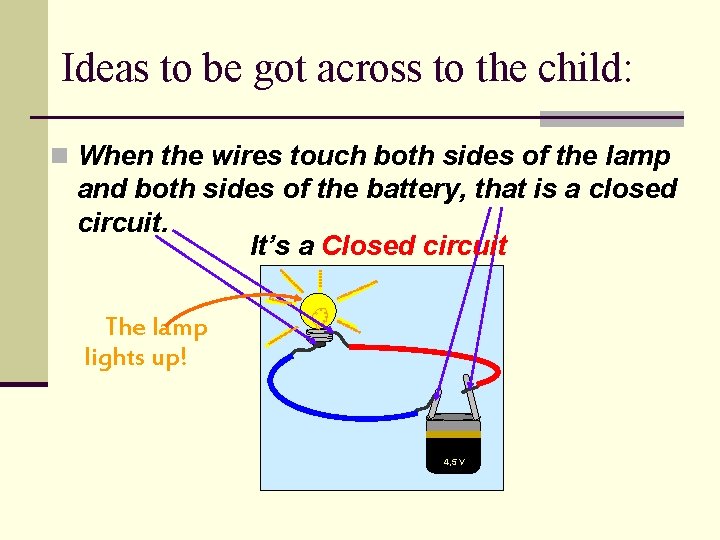
Ideas to be got across to the child: n When the wires touch both sides of the lamp and both sides of the battery, that is a closed circuit. It’s a Closed circuit The lamp lights up! 4, 5 V
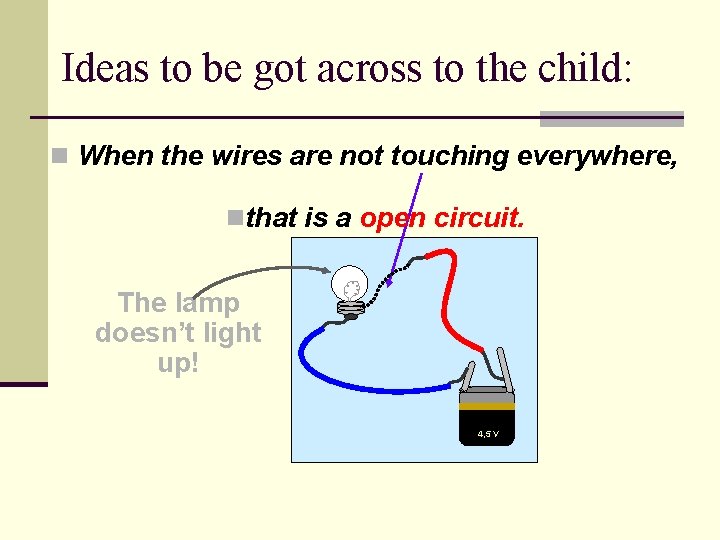
Ideas to be got across to the child: n When the wires are not touching everywhere, nthat is a open circuit. The lamp doesn’t light up! 4, 5 V
Ideas to be got across to the child: Open circuit 4, 5 V Closed circuit 4, 5 V
Activity not requiring supervision… This means that the activity can be started and carried out without the mediator being present. The activity can be performed by one or more children, with or without the help of the family.
Advice for performing the activity without supervision : 1. You can make open circuits and closed circuits by yourself or with the help of your parents… 2. Don’t forget to do everything necessary for the lamp to light up…
n 3. You can illustrate each stage in the experiment with drawings, notes, photos etc… (these notes and observations can sometimes be made with the mediator and sometimes independently)
All these experiments are aids to discussion and to attempts at representation (through drawing or photography), which are themselves new subjects of discussion.
The activities presented can be performed under the mediator’s supervision In conducting the experiments, the mediator will follow the guidelines set out in the mediator’s handbook.
Organising, looking after and observing things are a unique resource for verbal expression and interaction, even for the youngest and most reserved children.
At the next sessions… n We will make another circuit, using two lamps! n We will use three wires and then four wires… (cf series circuit and parallel circuit)
In the course of these exchanges with the adult, an orderly pattern of questioning, clear concepts and, ultimately, knowledge will take shape.
Make a notebook with the children n They will be able to note down the main stages for making a circuit - preparing the necessary equipment, - checking that the equipment works, - completing the circuit.
The written recording of observations (dictated to an adult) helps to memorise knowledge, become aware of relationships in space and time and identify causal links.
n They will be able to illustrate what they have learnt at each stage with drawings, notes and photos. (these notes and observations can sometimes be made with the mediator and sometimes independently)
All these experiments are aids to discussion and to attempts at representation (through drawing or photography), which are themselves new subjects of discussion.
On completion of the activity the child should be able to… - recognise when a lamp is in working order or not ; - make a simple circuit to light an electric lamp ; - draw an open circuit and a closed circuit.