
Teaching Kids To Help Design Out Crime Institute






- Slides: 38
Teaching Kids To Help Design Out Crime Institute for Criminal Justice Studies ©This TCLEOSE approved Crime Prevention Curriculum is the property of CSCS-ICJS CRIME PREVENTION II
Teaching Kids To Help Design Out Crime National Crime Prevention Council And Institute for Criminal Justice Studies National Crime Prevention Council 2
Foreword Now you have learned a lot about Crime Prevention Through Environmental Design (CPTED) from CPTED Part I and II. You can use this information to teach and win over the kids to help you in your crime prevention efforts.
TARGET AUDIENCE • Middle school children • High school children • College students – young adults
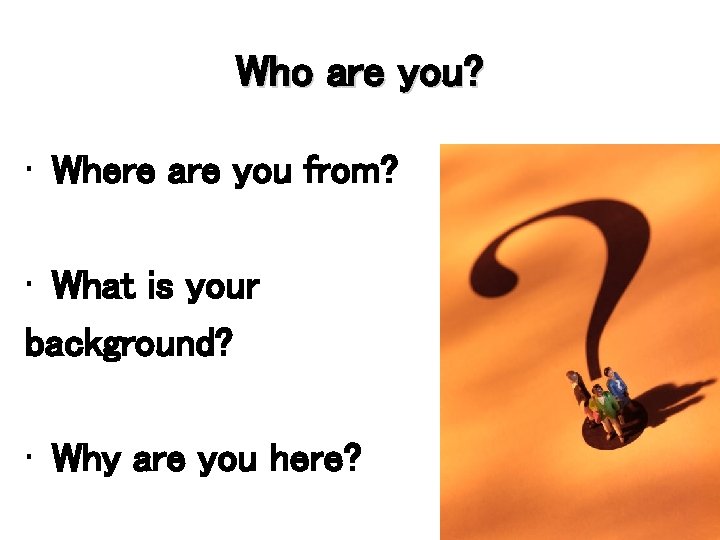
Who are you? • Where are you from? • What is your background? • Why are you here?
Objectives • Learn the definition of CPTED • Understand the four key CPTED principles • Learn how children and youth can be involved in CPTED
Objectives - continued • Identify the strengths of youth-adult partnerships • Learn CPTED activities for your community • Learn CPTED teaching strategies
What is Crime Prevention Through Environmental Design (CPTED)?
Formal Definition… (Review from previous lesson) Crime Prevention Through Environmental Design (CPTED) is the proper design of the physical environment to reduce fear and the incidence of crime and improve the quality of life.
Simply put… CPTED is using common sense to design and build an area so it feels safe and is safe. When CPTED principles are applied, people who use an area feel safer and would-be criminals are discouraged from committing crime.
Visioning Experience
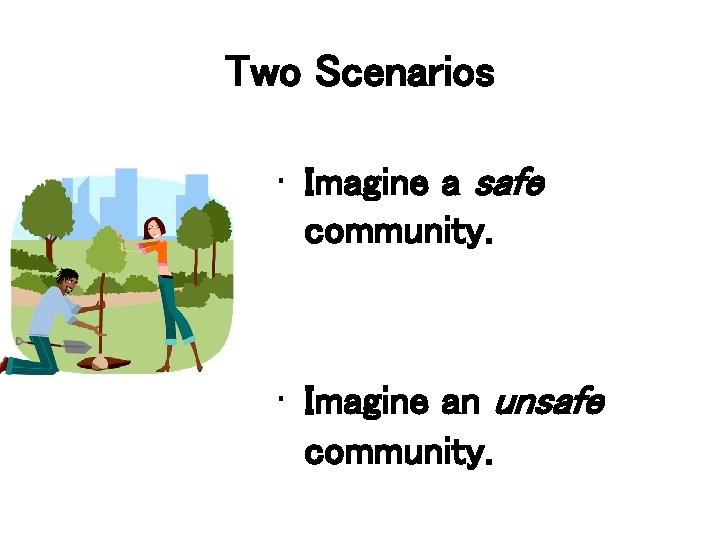
Two Scenarios • Imagine a safe community. • Imagine an unsafe community.
In order for a criminal to commit a crime… the following three factors are necessary: • The desire to commit the crime • The ability to do it • The opportunity to do it
By using CPTED strategies, we can start to design out crime by modifying… Manmade features Natural features
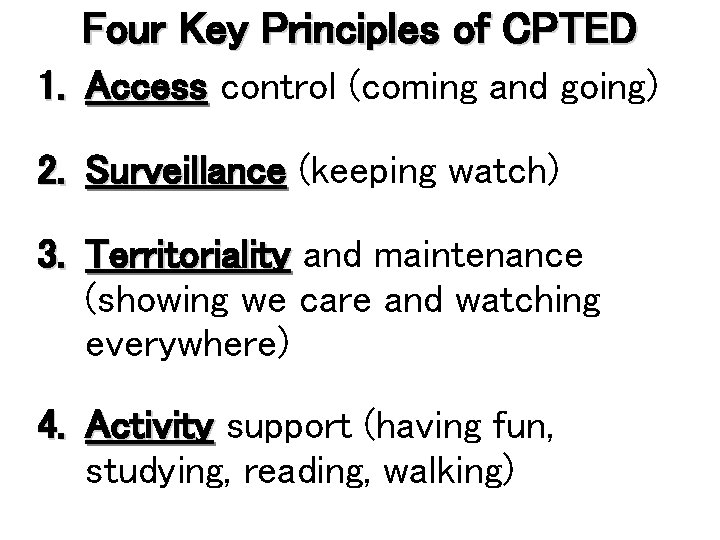
Four Key Principles of CPTED 1. Access control (coming and going) 2. Surveillance (keeping watch) 3. Territoriality and maintenance (showing we care and watching everywhere) 4. Activity support (having fun, studying, reading, walking)
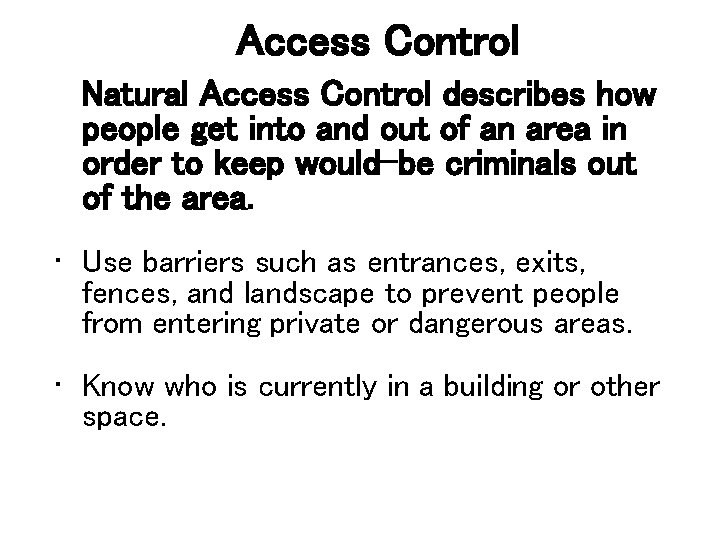
Access Control Natural Access Control describes how people get into and out of an area in order to keep would-be criminals out of the area. • Use barriers such as entrances, exits, fences, and landscape to prevent people from entering private or dangerous areas. • Know who is currently in a building or other space.
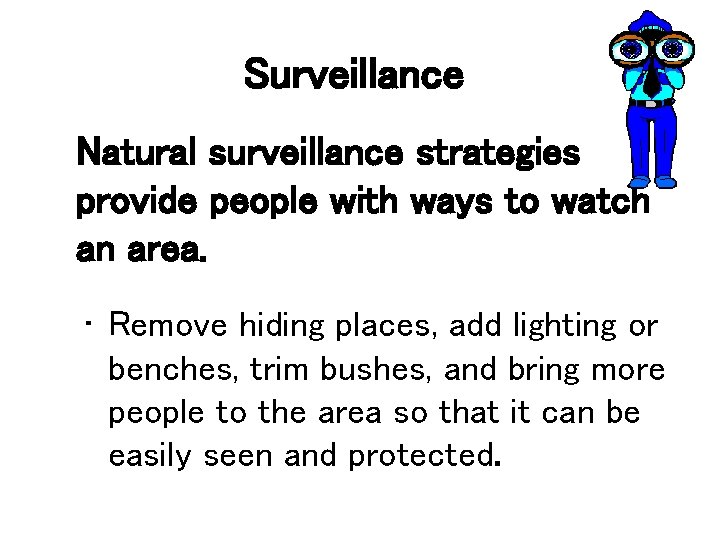
Surveillance Natural surveillance strategies provide people with ways to watch an area. • Remove hiding places, add lighting or benches, trim bushes, and bring more people to the area so that it can be easily seen and protected.
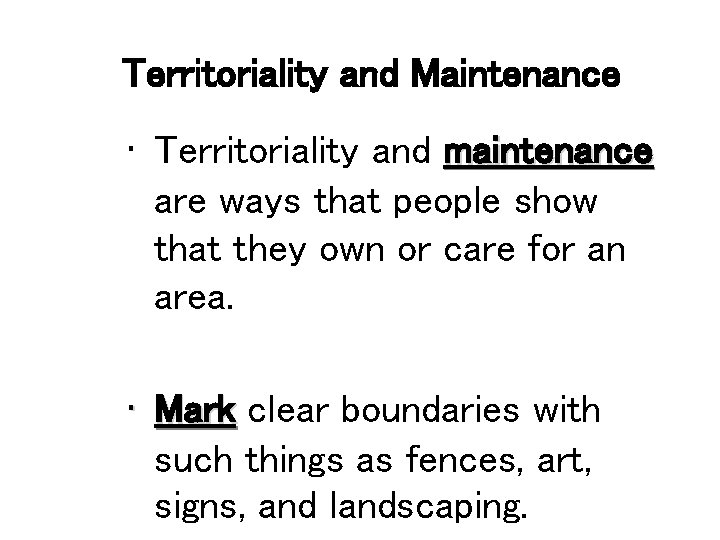
Territoriality and Maintenance • Territoriality and maintenance are ways that people show that they own or care for an area. • Mark clear boundaries with such things as fences, art, signs, and landscaping.
Territoriality and Maintenance continued • The way we say “this is our space and we care about it and who uses it. ”
Activity Support Activity support promotes positive and appropriate events and behavior in an area. • Play in a park, eat in a restaurant, park vehicles in a parking lot. • Have a clear idea of how space should be used to enable planners to decide what to put there.
Activity Support - continued • Remember, the way an area is used depends on what is in that area. • Some considerations could be?
What can kids do? Children and youth can contribute to CPTED efforts. • Children and youth have “insider” information. • Children and youth have a desire to help out and volunteer.
What can kids do? • Young people have the skills to do what needs to be done and can design and lead elements of community safety projects. • Children and youth can reach their peers.
What does every High School have you can tap into for student support? J. R. O. T. C.
Other considerations • Band club • PAL (Peer Assistance Leaders) • Latin club • Church youth • Boy Scouts
Who is walking the streets, playing in the parks, and using community facilities? facilities Children and Youth
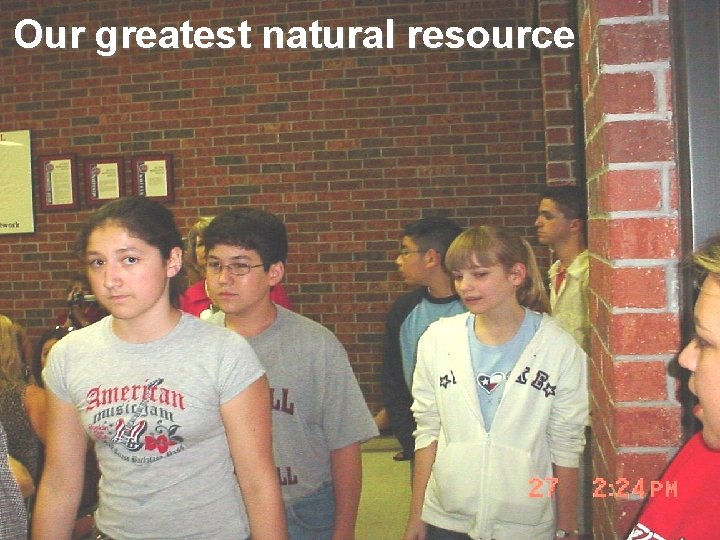
Our greatest natural resource
What are the benefits of youth and adults working together? • They learn new things about each other. • Each group contributes its own skills and knowledge base.
What are the benefits of youth and adults working together? • More ideas lead to better results. • It creates a dialog between children and adults about safe and unsafe places in the community.
What does this mean to you? Involvement = Ownership Do we make our youth feel a part of the community? Are we teaching the ownership And responsibility?
How To Involve Children and Youth in CPTED • Share the following ideas for involving young people in CPTEDbased safety efforts in your community: • Create a drawing exercise to teach about CPTED. • Conduct a walk-around safety search.
How To Involve Children and Youth in CPTED - continued • Join forces with Neighborhood Watch groups. • Create a check-in desk at a community center. • Petition for better lighting in a park or playground.
QUESTION WHAT CAN YOU DO IN YOUR LOCAL COMMUNITY TO INVOLVE YOUR YOUTH? Well there is hope!
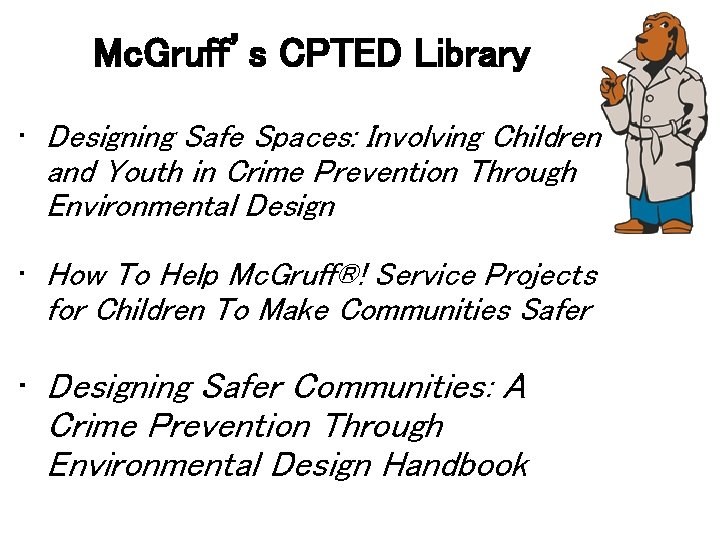
Mc. Gruff’s CPTED Library • Designing Safe Spaces: Involving Children and Youth in Crime Prevention Through Environmental Design • How To Help Mc. Gruff®! Service Projects for Children To Make Communities Safer • Designing Safer Communities: A Crime Prevention Through Environmental Design Handbook
TEAM PRACTICAL EXERCISE • Each TEAM will come up with ten (10) things you can do to involved your local youth with Crime Prevention Through Environmental Design.
Resources Youth Crime Watch of America – www. ycwa. org National Criminal Justice Reference Service – www. ncjrs. gov Bureau of Justice Assistance – www. usdoj. gov/BJA
National Crime Prevention Council 1000 Connecticut Avenue, NW Thirteenth Floor Washington, DC 20036 202 -466 -6272 www. ncpc. org
Presenter Contact Information 350 N. Guadalupe, Suite 140, PMB 164 San Marcos, Texas 78666. 877 -304 -2727 www. cscs. txstate. edu