
TEACHING IPM Using IPM as a Curriculum Element




- Slides: 39
TEACHING IPM (Using IPM as a Curriculum Element) Lesson 2 of 2 In-Person Education Module
Learning Objectives 2 1. 2. Describe how an IPM curriculum meets common core requirements for biology, biodiversity, ecology, evolution, problem solving, teamwork, etc. Describe a lesson plan that incorporates IPM into science-related curriculum Classroom educator training and lesson plan – Rebecca Baldwin, University of Florida http: //entnemdept. ufl. edu/bug_club/BBBB%20 Articulate%20 Published%202012/player. html
What is IPM? 3 IPM focuses on: investigating, discovering, and fixing the reasons why pests are a problem IPM is a sensible, science based, environment -friendly, and effective Active investigation and problem solving Cost-effective, sustainable, least possible risk
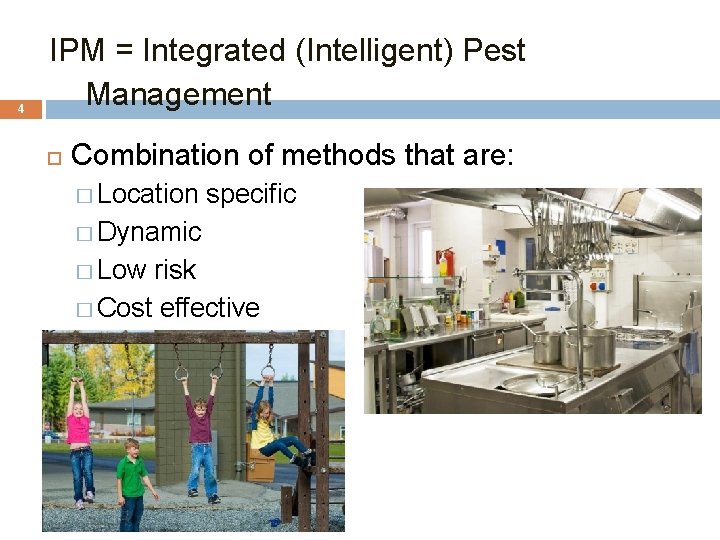
4 IPM = Integrated (Intelligent) Pest 1. Management Combination of methods that are: � Location specific � Dynamic � Low risk � Cost effective
5 IPM = Integrated (Intelligent) Pest 1. Management Pollution prevention strategy Risk reduction strategy Pesticide resistance strategy
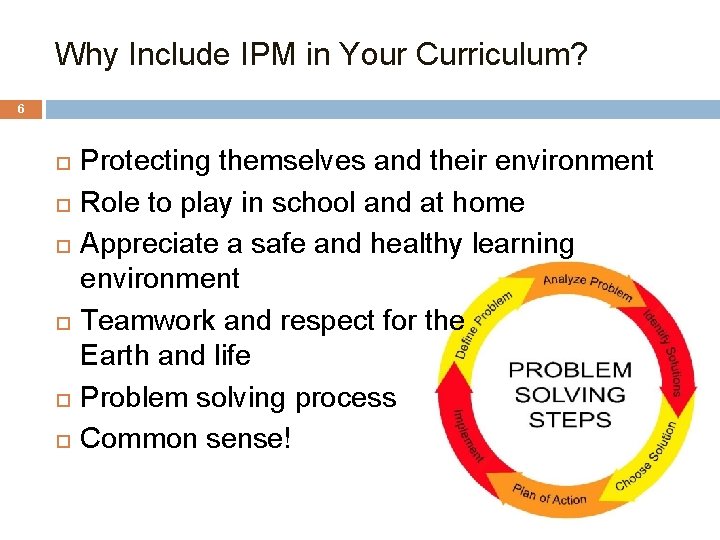
Why Include IPM in Your Curriculum? 6 Protecting themselves and their environment Role to play in school and at home Appreciate a safe and healthy learning environment Teamwork and respect for the Earth and life Problem solving process Common sense!
IPM in Your Curriculum 7 Common core requirements “Building on the best of existing state standards, the Common Core State Standards provide clear and consistent learning goals to help prepare students for college, career, and life. ” http: //www. corestandards. org/read-the-standards/
IPM in Your Curriculum 8 Does IPM fit common core requirements? ü Yes! ü science, ü math, ü language, ü arts ü social studies
1. IPM in Your Curriculum 9 IPM involves: Biology Environmental Science Chemistry Math Economics Psychology Ecology
1. IPM in Your Curriculum 10 Key elements of IPM Monitoring and inspection Identification Thresholds Preventing pests Action (least-risk) Keeping records Education, communication Constant evaluation
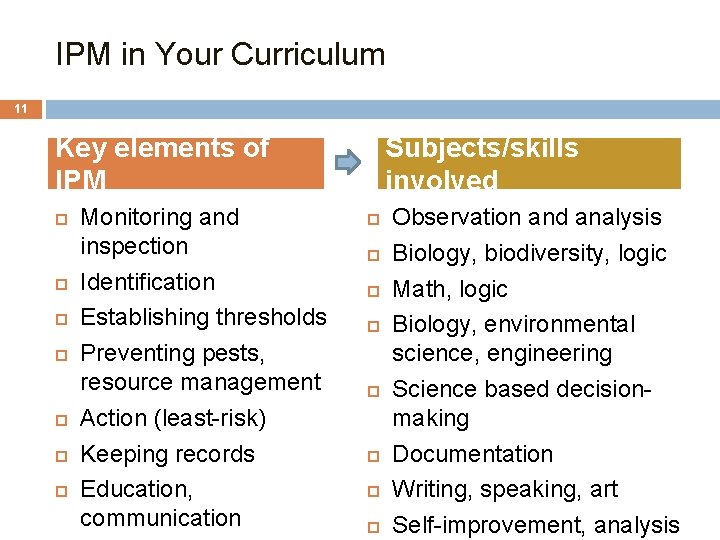
IPM in Your Curriculum 11 Key elements of IPM Monitoring and inspection Identification Establishing thresholds Preventing pests, resource management Action (least-risk) Keeping records Education, communication Subjects/skills involved Observation and analysis Biology, biodiversity, logic Math, logic Biology, environmental science, engineering Science based decisionmaking Documentation Writing, speaking, art Self-improvement, analysis
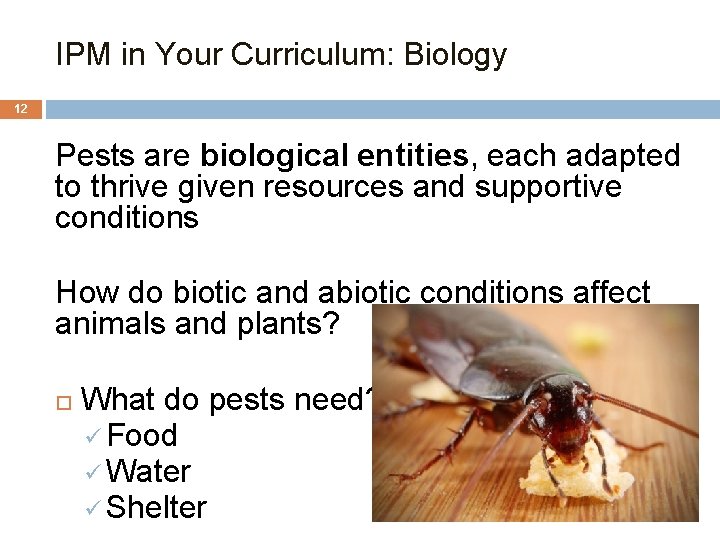
IPM in Your Curriculum: Biology 12 Pests are biological entities, each adapted to thrive given resources and supportive conditions How do biotic and abiotic conditions affect animals and plants? What do pests need? ü Food ü Water ü Shelter
IPM in Your Curriculum: Biology 13 Example 1: Grades K-2 students: Identify the different forms of life in and around your school? Where can you find them? What and how do they eat and drink? How are they beneficial? Can they be harmful? Characterize a fictitious lifeform
IPM in Your Curriculum: Biology, Problemsolving 14 Example 2: Grades K-2 students: Insect life cycles Different life stages of different insects Put them in developmental order Discuss where the insects are found and what they do
IPM in Your Curriculum: Biology/Biodiversity 15 Example 3: Grades 6 -8 students: Place monitoring traps around the school Explore the school and look at the trap catches Describe resources available Discuss life cycle requirements How the pests are managed
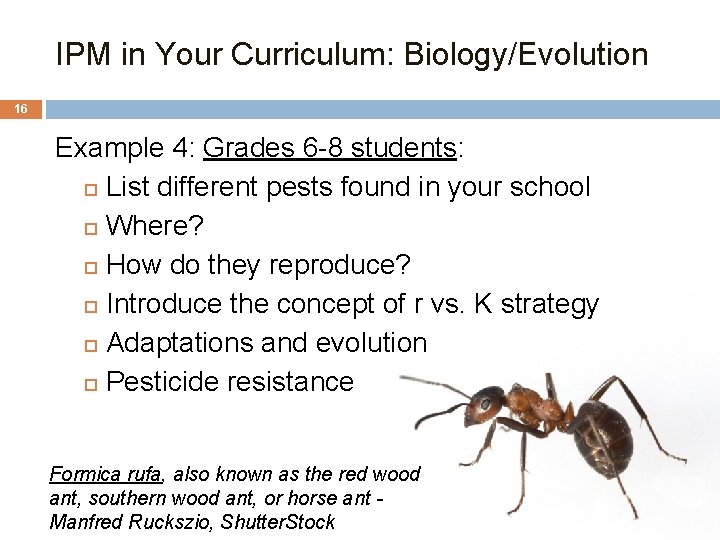
IPM in Your Curriculum: Biology/Evolution 16 Example 4: Grades 6 -8 students: List different pests found in your school Where? How do they reproduce? Introduce the concept of r vs. K strategy Adaptations and evolution Pesticide resistance Formica rufa, also known as the red wood ant, southern wood ant, or horse ant Manfred Ruckszio, Shutter. Stock
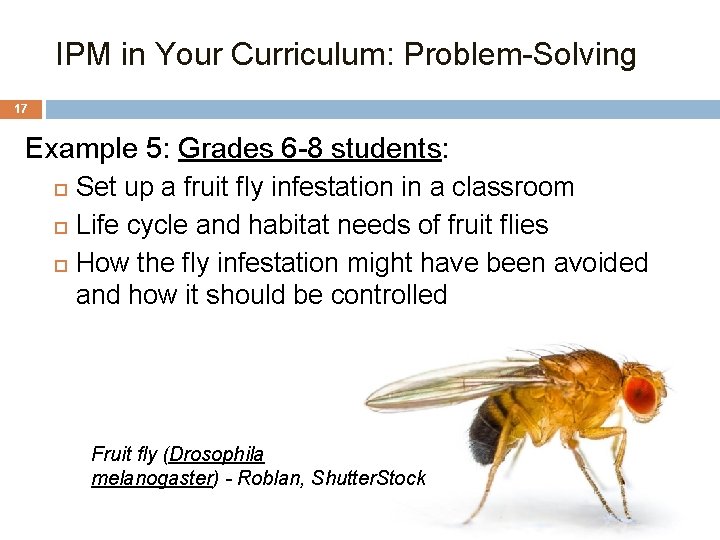
IPM in Your Curriculum: Problem-Solving 17 Example 5: Grades 6 -8 students: Set up a fruit fly infestation in a classroom Life cycle and habitat needs of fruit flies How the fly infestation might have been avoided and how it should be controlled Fruit fly (Drosophila melanogaster) - Roblan, Shutter. Stock
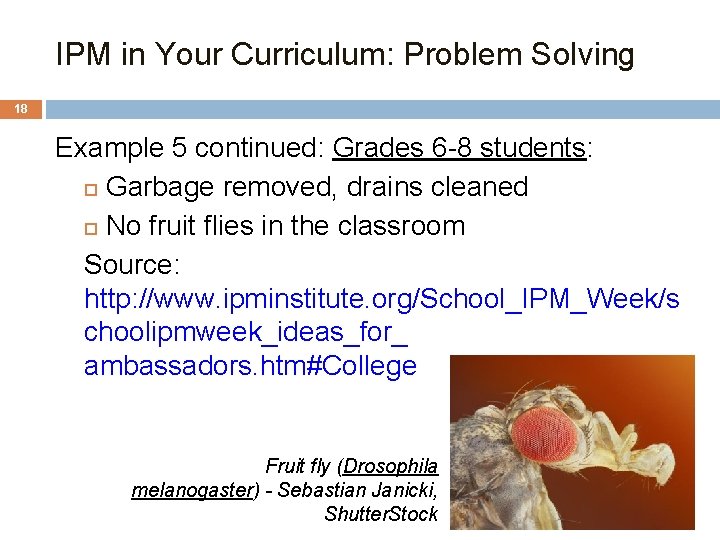
IPM in Your Curriculum: Problem Solving 18 Example 5 continued: Grades 6 -8 students: Garbage removed, drains cleaned No fruit flies in the classroom Source: http: //www. ipminstitute. org/School_IPM_Week/s choolipmweek_ideas_for_ ambassadors. htm#College Fruit fly (Drosophila melanogaster) - Sebastian Janicki, Shutter. Stock
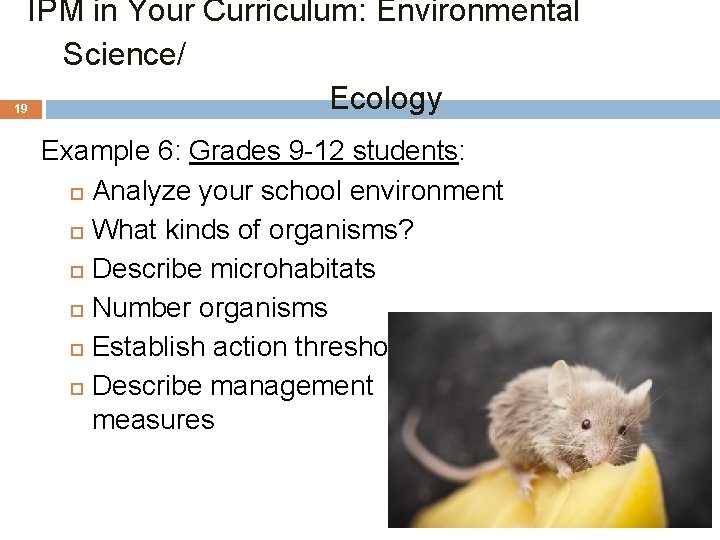
IPM in Your Curriculum: Environmental Science/ Ecology 19 Example 6: Grades 9 -12 students: Analyze your school environment What kinds of organisms? Describe microhabitats Number organisms Establish action thresholds Describe management measures
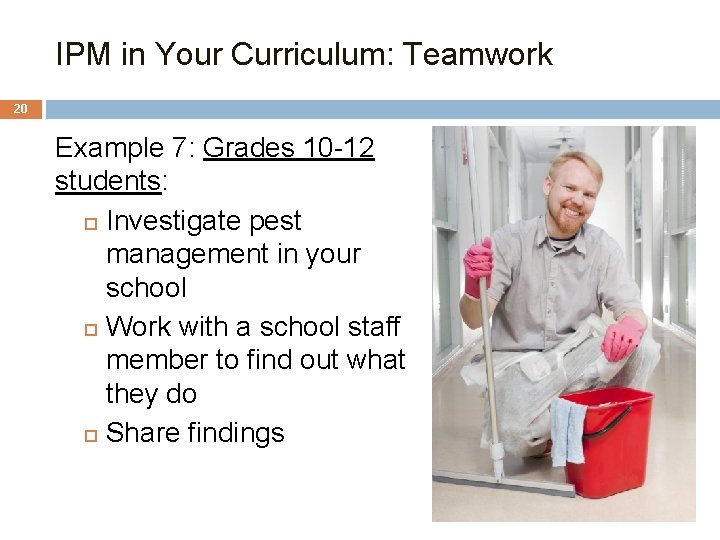
IPM in Your Curriculum: Teamwork 20 Example 7: Grades 10 -12 students: Investigate pest management in your school Work with a school staff member to find out what they do Share findings
IPM in Your Curriculum: Teamwork 21 Example 7: Grades 10 -12 students: Roles in IPM Cooperation Design a school IPM policy and plan Student credit for participating in Environmental Health committee
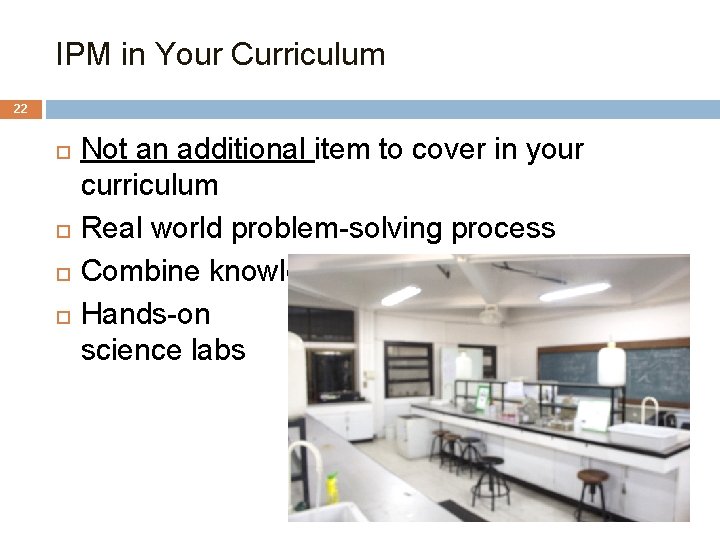
IPM in Your Curriculum 22 Not an additional item to cover in your curriculum Real world problem-solving process Combine knowledge from different subjects Hands-on science labs
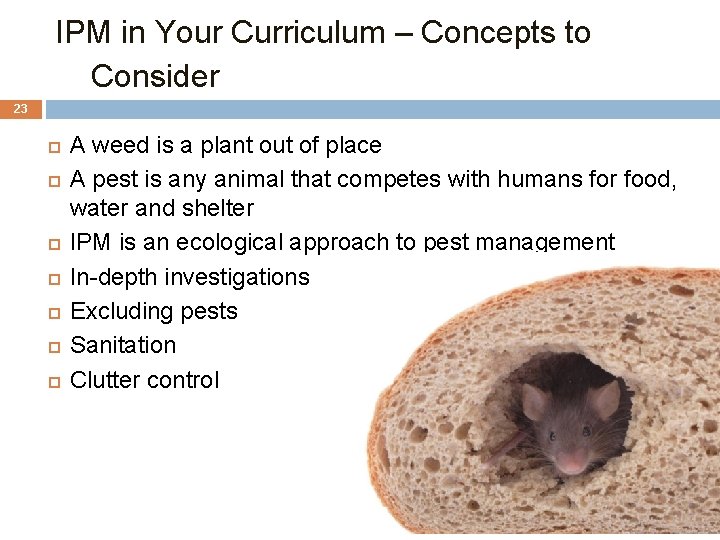
IPM in Your Curriculum – Concepts to Consider 23 A weed is a plant out of place A pest is any animal that competes with humans for food, water and shelter IPM is an ecological approach to pest management In-depth investigations Excluding pests Sanitation Clutter control
IPM in Your Curriculum 24 Current global issues Pesticide pollution Invasive species and biodiversity Environmental safety and health tradeoffs Food security Role of government in environmental decision -making Genetic engineering as a pest management tool Human and animal infectious diseases Quarantine Pesticide resistance problems and many more…
A Lesson Plan with IPM 25 Title: Human environmental impacts Grade level: 8 – 10 Two 50 -minute classes Lecture, discussion, student poster presentations Basic purpose of this lesson: Global issue focus Gather, interpret, evaluate and use information to explain phenomena in the
A Lesson Plan with IPM 26 Learning objectives: Identify different ways human activities influence the environment Environmental pollution - pesticides Increased pesticide use Judicious pesticide use, alternate methods and IPM
A Lesson Plan with IPM 27 Materials: Computer/internet Library Poster paper and boards Stationery Preparation: Students cover environmental science basics § § Basic plant and animal biology and ecology Read up about human environmental impacts
A Lesson Plan with IPM 28 Activity: 1. Teacher to introduce general human activities influencing the environment 2. Discussion 3. Teacher covers environmental pollution and specifically, pesticides
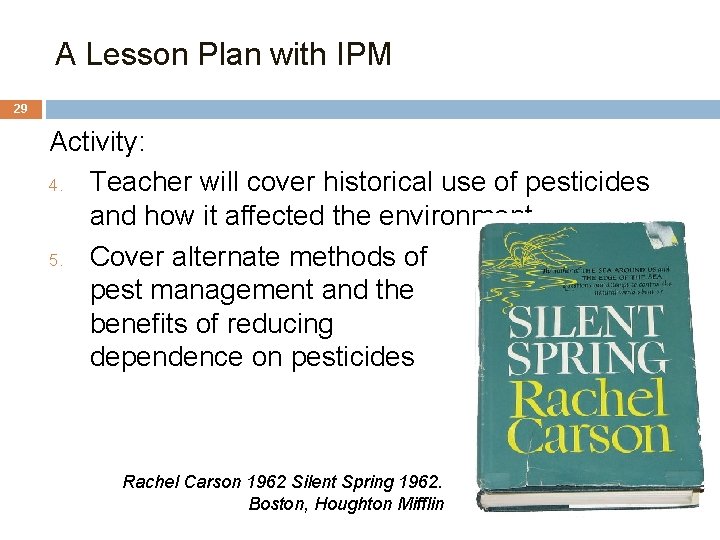
A Lesson Plan with IPM 29 Activity: 4. Teacher will cover historical use of pesticides and how it affected the environment 5. Cover alternate methods of pest management and the benefits of reducing dependence on pesticides Rachel Carson 1962 Silent Spring 1962. Boston, Houghton Mifflin
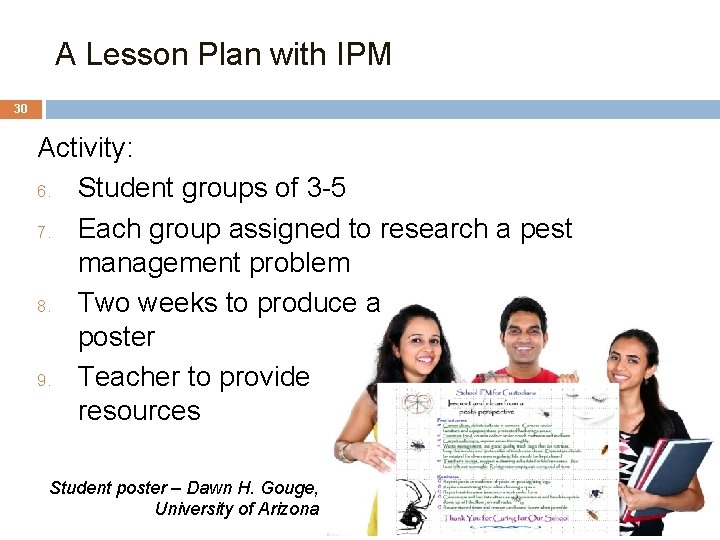
A Lesson Plan with IPM 30 Activity: 6. Student groups of 3 -5 7. Each group assigned to research a pest management problem 8. Two weeks to produce a poster 9. Teacher to provide resources Student poster – Dawn H. Gouge, University of Arizona
A Lesson Plan with IPM 31 Activity: 10. Poster presentations to classmates 11. Peers ask questions and provide feedback 12. IPM is a “human intervention” but generally less harmful on the environment since ecological impacts and sustainability are considered
A Lesson Plan with IPM 32 Safety: No safety issues Concept discovery: Introduction to IPM Independent activity: How to apply IPM concept? Homework assignment
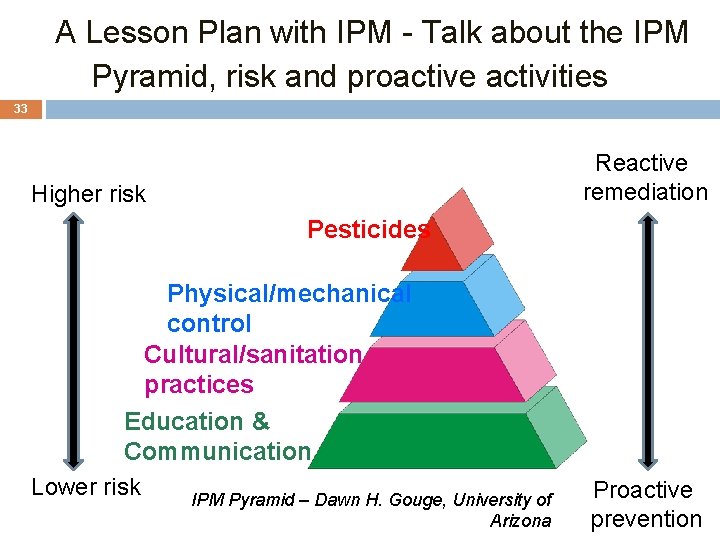
A Lesson Plan with IPM - Talk about the IPM Pyramid, risk and proactive activities 33 Reactive remediation Higher risk Pesticides Physical/mechanical control Cultural/sanitation practices Education & Communication Lower risk IPM Pyramid – Dawn H. Gouge, University of Arizona Proactive prevention
A Lesson Plan with IPM 34 Conclusion/wrapping up: The benefits of IPM Questions and answers Assessment/grading: Student grades based on content, teamwork, involvement
A Lesson Plan with IPM 35 Connections to other subjects: Social studies: economics, history, geography, health Math: calculate pest populations, direct cost benefits, indirect cost impacts, etc. Language arts: refine language skills, presentation skills, and artistic talents
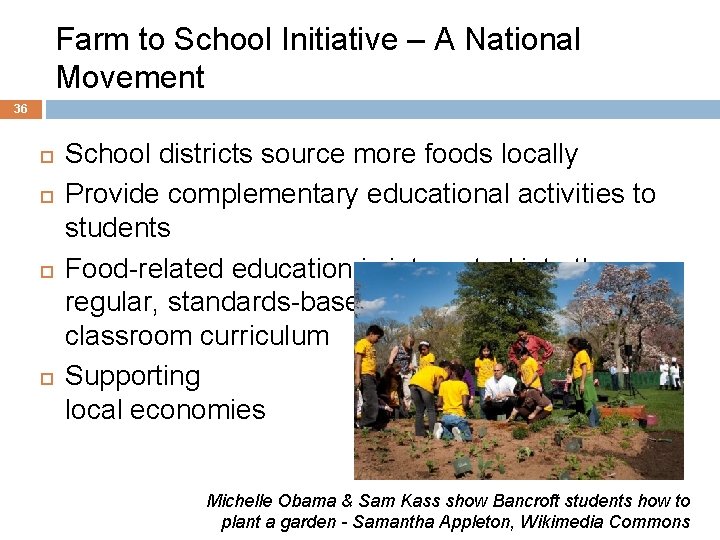
Farm to School Initiative – A National Movement 36 School districts source more foods locally Provide complementary educational activities to students Food-related education is integrated into the regular, standards-based classroom curriculum Supporting local economies Michelle Obama & Sam Kass show Bancroft students how to plant a garden - Samantha Appleton, Wikimedia Commons
Farm to School Initiative 37 United States Department of Agriculture (USDA) Farm to School Program � research � training � technical assistance � grants A list of regions, along with the names and contact information for regional and national USDA Farm to School Program staff, can be found at
Check In! 38 In this lesson you learned: 1. How IPM meets common core requirements for biology/biodiversity, ecology, evolution, problem solving, teamwork, etc. 2. Lesson plans that incorporate IPM into sciencerelated curriculum Congratulations, you have completed Using IPM as a Curriculum Element There are many other resources available see http: //maine. gov/dacf/php/integrated_pest_management/schoolipm-curricula/index. shtml
Resources 39 National School IPM Information Source: IPM for School Faculty and Staff. http: //schoolipm. ifas. ufl. edu/Florida/faculty. htm q IPM Institute of North America. Ideas for classroom activities. http: //www. ipminstitute. org/School_IPM_Week/schoolipmweek_ideas_for _ambassadors. htm#College q Texas A&M University. Insects in the classroom: Bugs as teaching tools for all ages. Lesson plans. http: //iitc. tamu. edu/1998 and 2000/lesson_plans. html q e. Xtension. (2014). School Integrated Pest Management for Teachers. http: //www. extension. org/pages/21012/school-integrated-pestmanagement-for-teachers#. U 9 h 98 r. HLNeo q Penn. State Extension. IPM for Teachers Curriculum. http: //extension. psu. edu/pests/ipm/schools/educators/curriculum/content s/whenisapest q University of Nebraska—Lincoln IPM Curricula and Resources for Teachers http: //pested. unl. edu/teachipm q