
Teaching introductory geophysics what our students dont know
- Slides: 26
Teaching introductory geophysics: what our students don’t know, need to, and what we can do Seth Stein Department of Earth and Planetary Sciences Northwestern University Evanston IL 60208 seth@earth. northwestern. edu This presentation at http: //www. earth. northwestern. edu/people/seth/Lectures/teachinggp. ppt
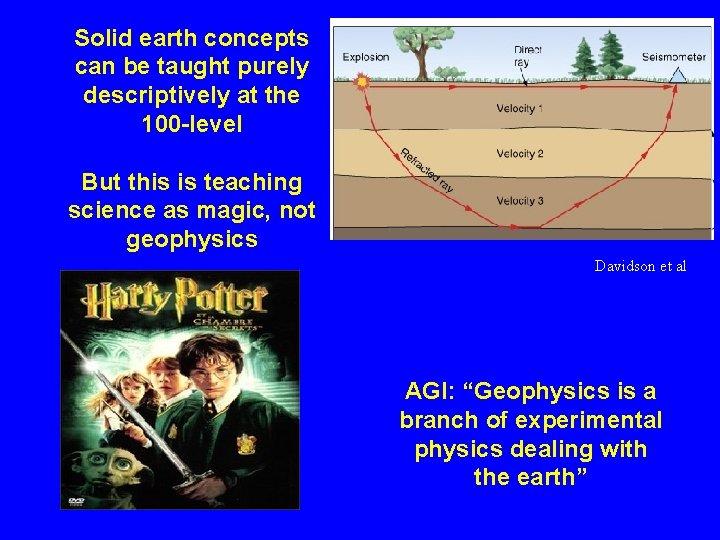
Solid earth concepts can be taught purely descriptively at the 100 -level But this is teaching science as magic, not geophysics Davidson et al AGI: “Geophysics is a branch of experimental physics dealing with the earth”
NU introductory geophysics: -First geophysics class (200 -level) for geology majors, engineers, or other science folk -Typically sophomores or juniors - Some have descriptive (100 -level) intro to earth science - Math, physics, chemistry prerequisite or corequisites - Global/planetary perspective - Course goes beyond descriptive - Try to challenge students & prepare them for higher level classes
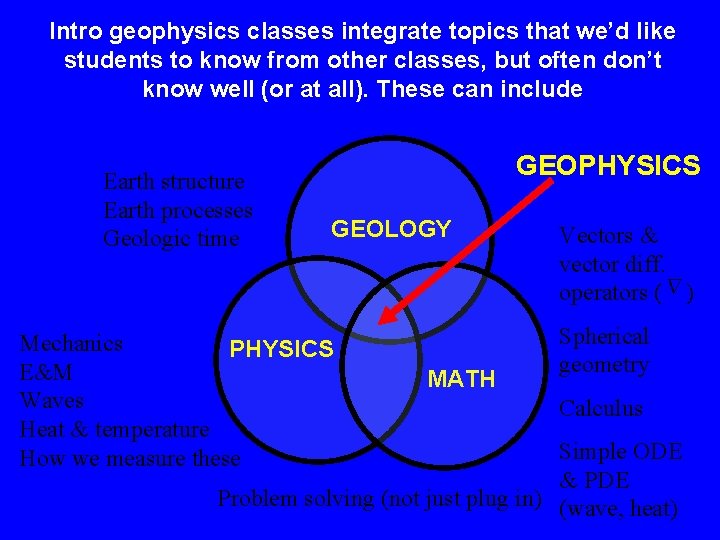
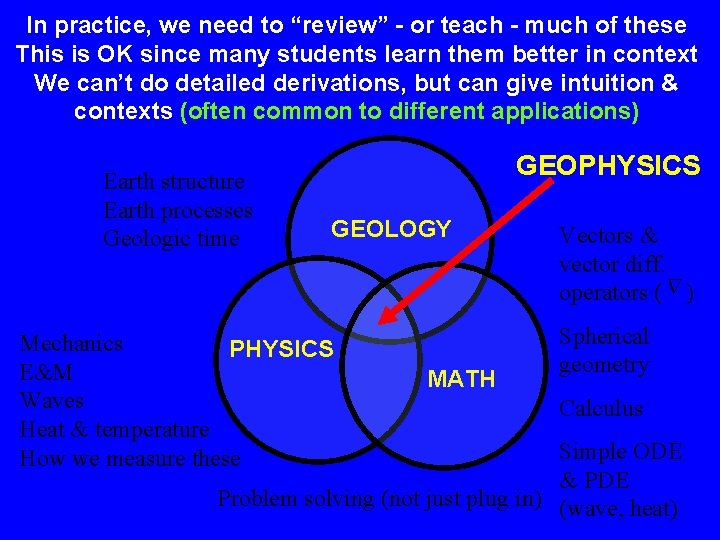
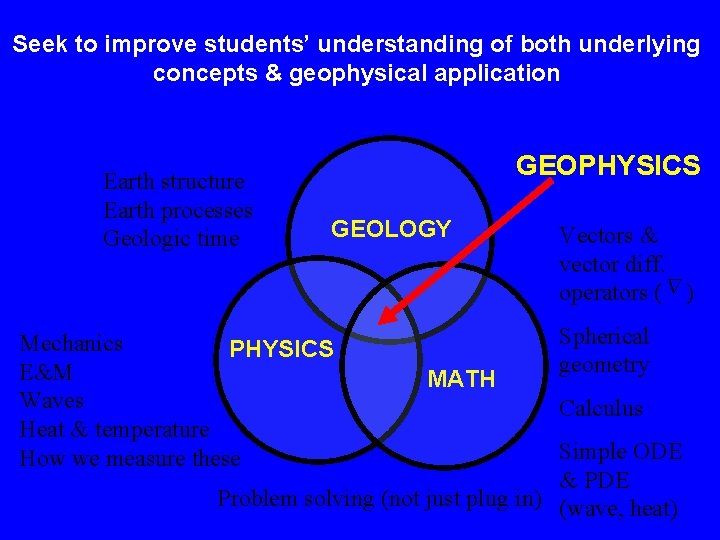
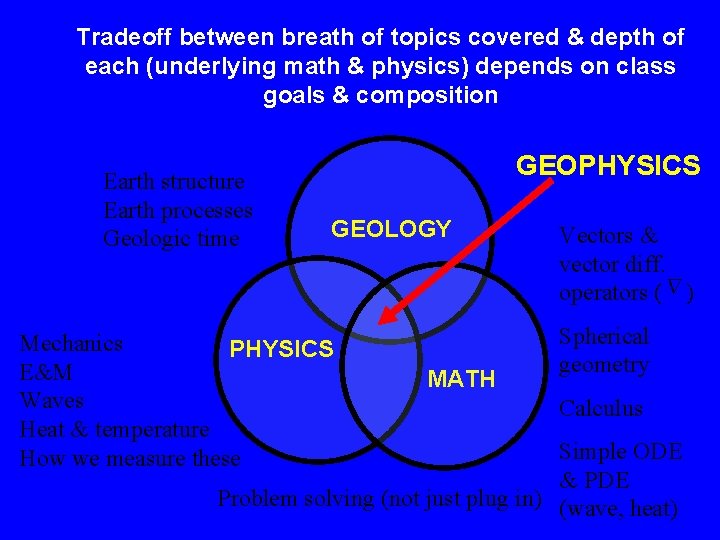
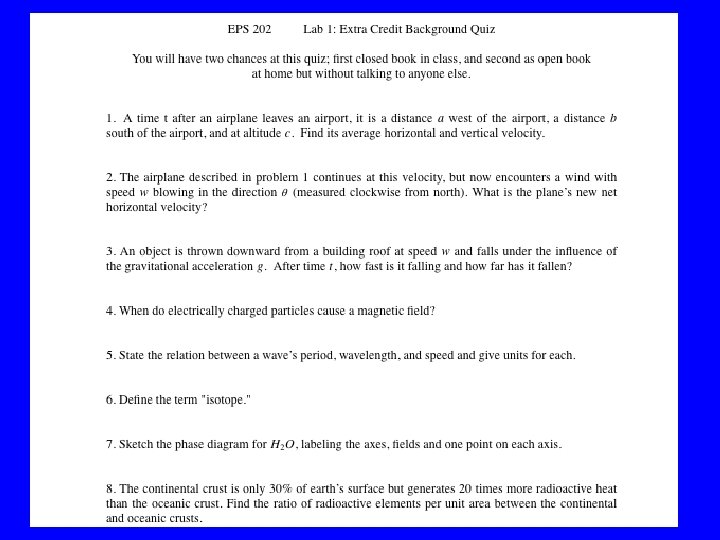
Intro geophysics classes integrate topics that we’d like students to know from other classes, but often don’t know well (or at all). These can include Earth structure Earth processes Geologic time GEOPHYSICS GEOLOGY Vectors & vector diff. operators ( ) ∆ Mechanics PHYSICS E&M Waves Heat & temperature How we measure these MATH Spherical geometry Calculus Simple ODE & PDE Problem solving (not just plug in) (wave, heat)
In practice, we need to “review” - or teach - much of these This is OK since many students learn them better in context We can’t do detailed derivations, but can give intuition & contexts (often common to different applications) Earth structure Earth processes Geologic time GEOPHYSICS GEOLOGY Vectors & vector diff. operators ( ) ∆ Mechanics PHYSICS E&M Waves Heat & temperature How we measure these MATH Spherical geometry Calculus Simple ODE & PDE Problem solving (not just plug in) (wave, heat)
Seek to improve students’ understanding of both underlying concepts & geophysical application Earth structure Earth processes Geologic time GEOPHYSICS GEOLOGY Vectors & vector diff. operators ( ) ∆ Mechanics PHYSICS E&M Waves Heat & temperature How we measure these MATH Spherical geometry Calculus Simple ODE & PDE Problem solving (not just plug in) (wave, heat)
Tradeoff between breath of topics covered & depth of each (underlying math & physics) depends on class goals & composition Earth structure Earth processes Geologic time GEOPHYSICS GEOLOGY Vectors & vector diff. operators ( ) ∆ Mechanics PHYSICS E&M Waves Heat & temperature How we measure these MATH Spherical geometry Calculus Simple ODE & PDE Problem solving (not just plug in) (wave, heat)
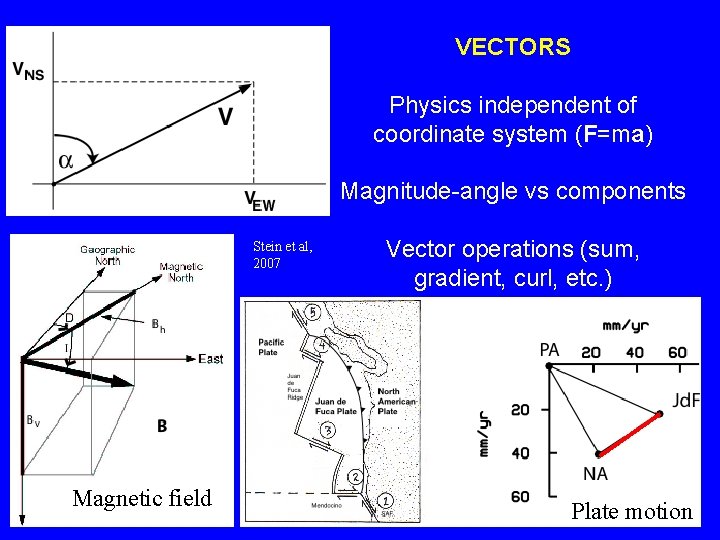
VECTORS Physics independent of coordinate system (F=ma) Magnitude-angle vs components Stein et al, 2007 Magnetic field Vector operations (sum, gradient, curl, etc. ) Plate motion
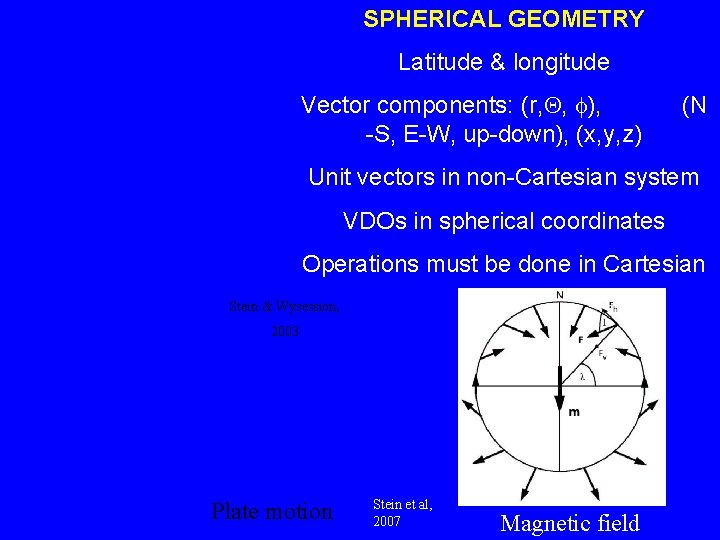
SPHERICAL GEOMETRY Latitude & longitude Vector components: (r, , ), -S, E-W, up-down), (x, y, z) (N Unit vectors in non-Cartesian system VDOs in spherical coordinates Operations must be done in Cartesian Stein & Wysession, 2003 Plate motion Stein et al, 2007 Magnetic field
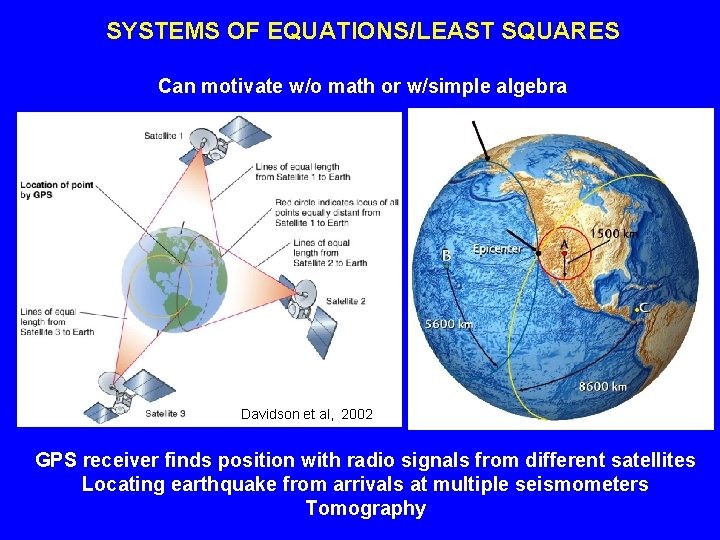
SYSTEMS OF EQUATIONS/LEAST SQUARES Can motivate w/o math or w/simple algebra Davidson et al, 2002 GPS receiver finds position with radio signals from different satellites Locating earthquake from arrivals at multiple seismometers Tomography
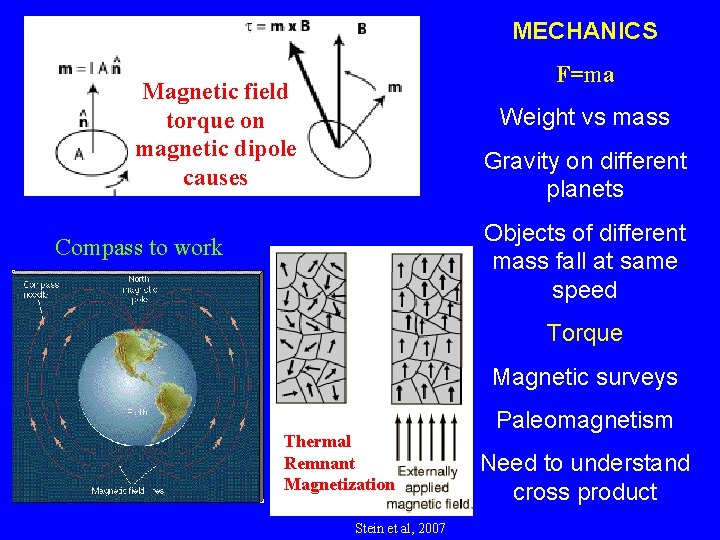
MECHANICS F=ma Magnetic field torque on magnetic dipole causes Weight vs mass Gravity on different planets Objects of different mass fall at same speed Compass to work Torque Magnetic surveys Thermal Remnant Magnetization Stein et al, 2007 Paleomagnetism Need to understand cross product
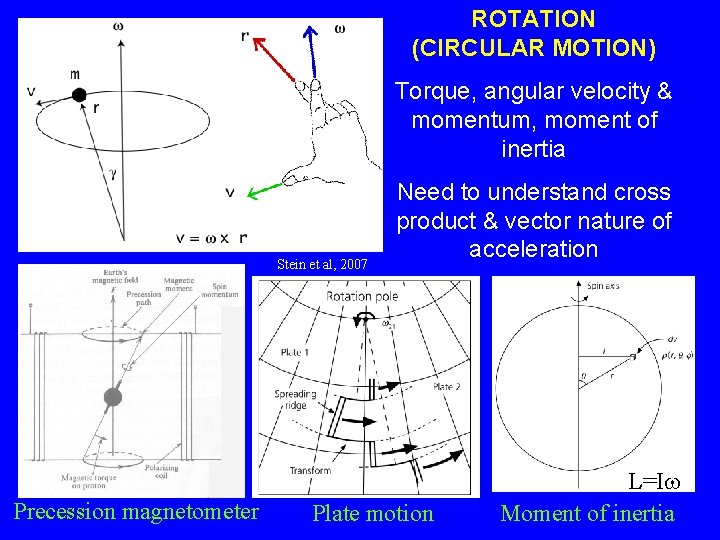
ROTATION (CIRCULAR MOTION) Torque, angular velocity & momentum, moment of inertia Stein et al, 2007 Precession magnetometer Need to understand cross product & vector nature of acceleration Plate motion L=I Moment of inertia
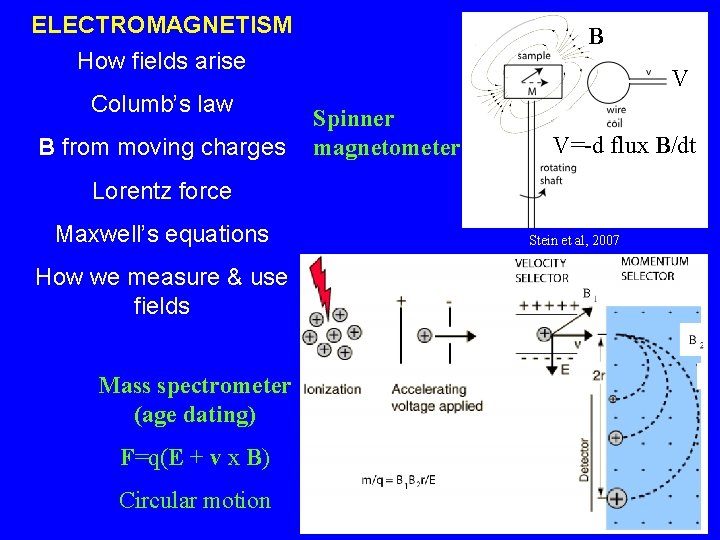
ELECTROMAGNETISM B How fields arise Columb’s law B from moving charges V Spinner magnetometer V=-d flux B/dt Lorentz force Maxwell’s equations How we measure & use fields Mass spectrometer (age dating) F=q(E + v x B) Circular motion Stein et al, 2007
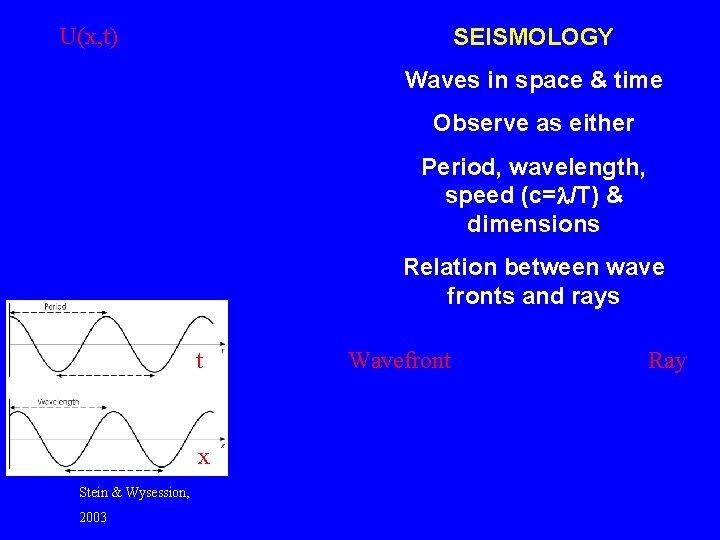
U(x, t) SEISMOLOGY Waves in space & time Observe as either Period, wavelength, speed (c= /T) & dimensions Relation between wave fronts and rays t x Stein & Wysession, 2003 Wavefront Ray
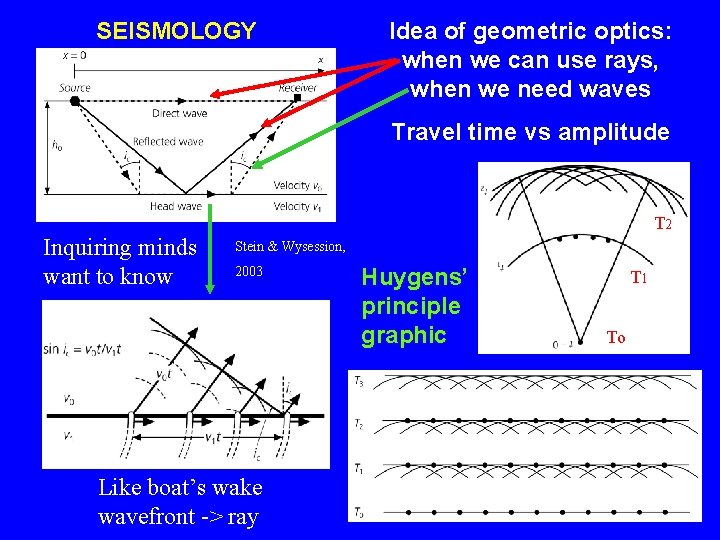
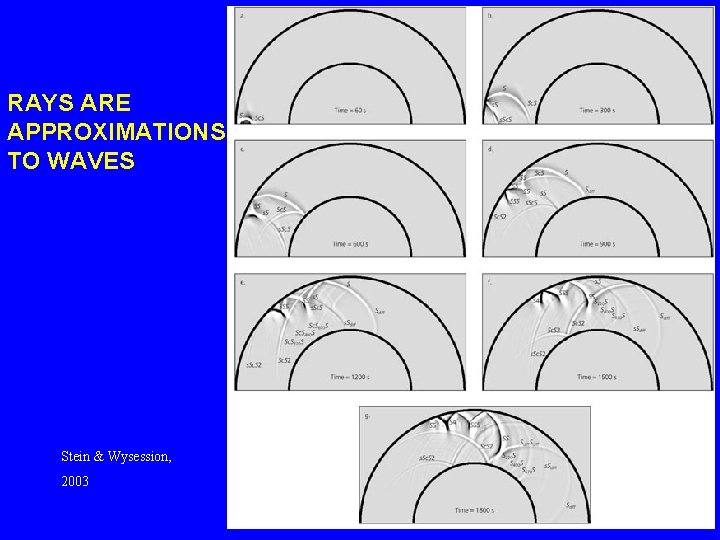
SEISMOLOGY Idea of geometric optics: when we can use rays, when we need waves Travel time vs amplitude T 2 Inquiring minds want to know Stein & Wysession, 2003 Like boat’s wake wavefront -> ray Huygens’ principle graphic T 1 To
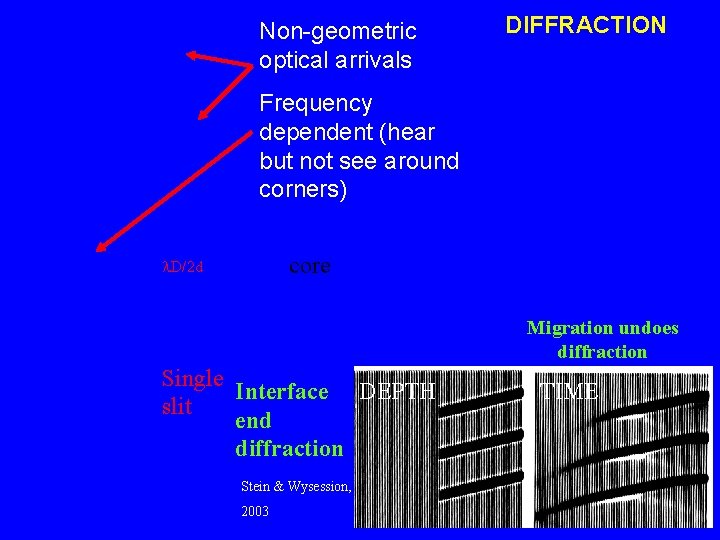
Non-geometric optical arrivals DIFFRACTION Frequency dependent (hear but not see around corners) core D/2 d Migration undoes diffraction Single Interface DEPTH slit end diffraction Stein & Wysession, 2003 TIME
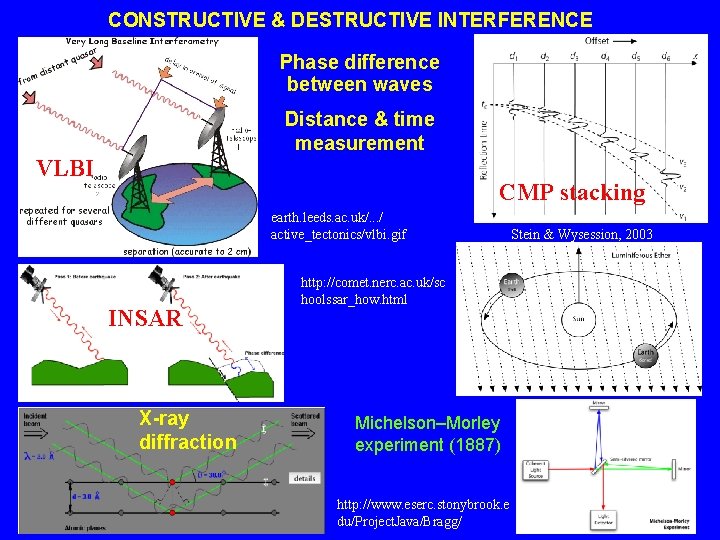
CONSTRUCTIVE & DESTRUCTIVE INTERFERENCE Phase difference between waves Distance & time measurement VLBI CMP stacking earth. leeds. ac. uk/. . . / active_tectonics/vlbi. gif INSAR X-ray diffraction http: //comet. nerc. ac. uk/sc hoolssar_how. html Michelson–Morley experiment (1887) http: //www. eserc. stonybrook. e du/Project. Java/Bragg/ Stein & Wysession, 2003
RAYS ARE APPROXIMATIONS TO WAVES Stein & Wysession, 2003
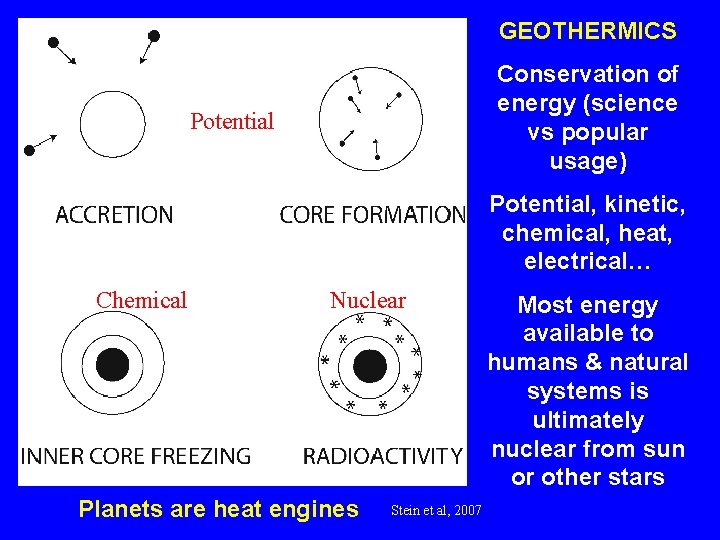
GEOTHERMICS Conservation of energy (science vs popular usage) Potential, kinetic, chemical, heat, electrical… Chemical Nuclear Planets are heat engines Stein et al, 2007 Most energy available to humans & natural systems is ultimately nuclear from sun or other stars
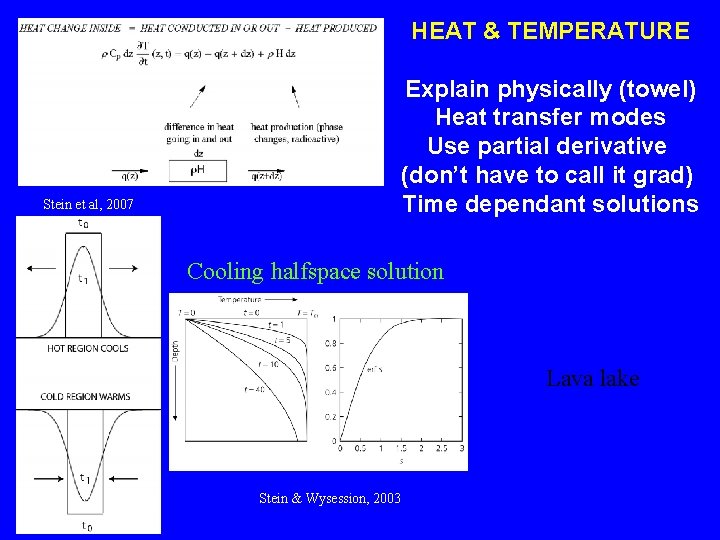
HEAT & TEMPERATURE Stein et al, 2007 Explain physically (towel) Heat transfer modes Use partial derivative (don’t have to call it grad) Time dependant solutions Cooling halfspace solution Lava lake Stein & Wysession, 2003
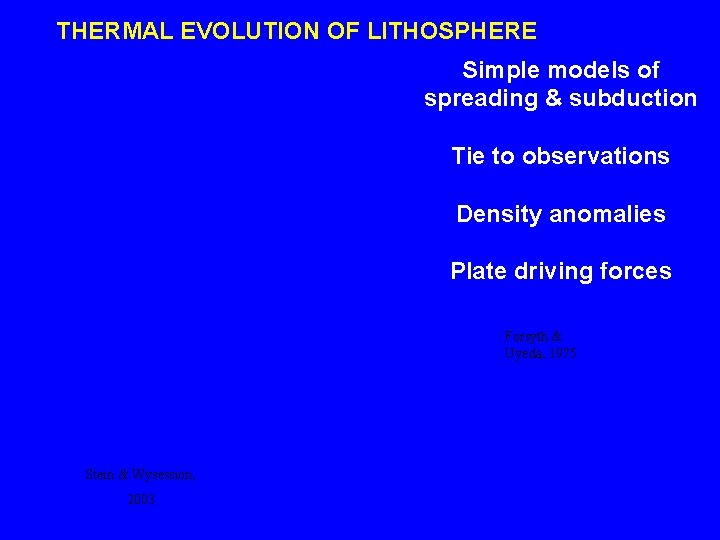
THERMAL EVOLUTION OF LITHOSPHERE Simple models of spreading & subduction Tie to observations Density anomalies Plate driving forces Forsyth & Uyeda, 1975 Stein & Wysession, 2003
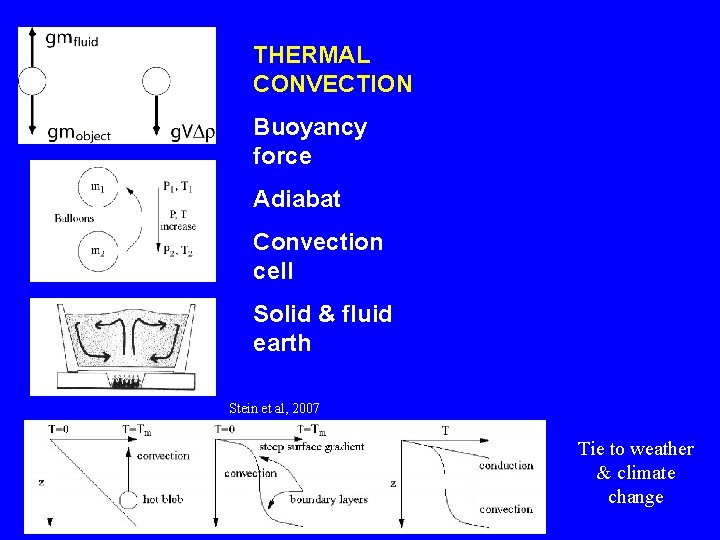
THERMAL CONVECTION Buoyancy force Adiabat Convection cell Solid & fluid earth Stein et al, 2007 Tie to weather & climate change
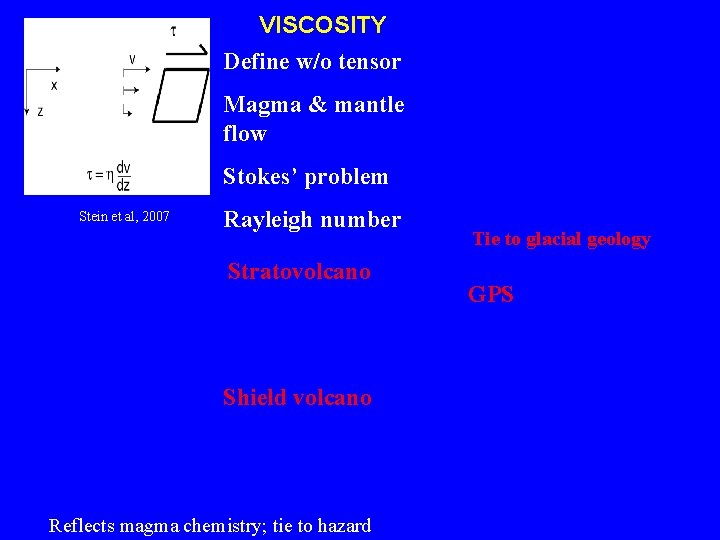
VISCOSITY Define w/o tensor Magma & mantle flow Stokes’ problem Stein et al, 2007 Rayleigh number Stratovolcano Shield volcano Reflects magma chemistry; tie to hazard Tie to glacial geology GPS
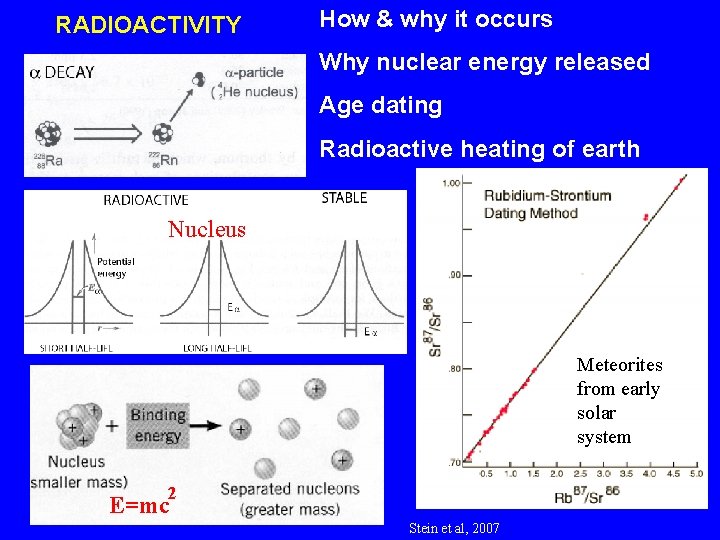
RADIOACTIVITY How & why it occurs Why nuclear energy released Age dating Radioactive heating of earth Nucleus Meteorites from early solar system 2 E=mc Stein et al, 2007
SUGGESTIONS Identify math, physics, chemistry concepts implicitly or explicitly needed in course Assess which students are shaky on “Review” - or teach - these at level suitable for class curriculum & composition Seek to improve students’ understanding of both underlying concepts & geophysical application Develop problems & labs for this goal Accept that some students will benefit more than others “You come in here with a skull full of mush and you leave thinking like a lawyer. ”