
TEACHING INTERVIEWING IN QUALITATIVE RESEARCH LEARNING FROM CINEMATIC
- Slides: 15
TEACHING INTERVIEWING IN QUALITATIVE RESEARCH: LEARNING FROM CINEMATIC SOCIETY Kathryn Roulston & Brigette Adair Herron University of Georgia
THE CONTEXT • Interviews are one of the most-used methods in qualitative research • The ubiquity of interviewing has led scholars to use the labels: • “The Interview Society” (Atkinson & Silverman, 1997) • “Post-postmodern cinematic interview society” (Denzin, 2018).
CINEMATIC SOCIETY • Adults need to be able to critically reflect on information We argue that through examining interviews in cinematic society learners develop skills to critically evaluate: • The information drawn from interviews • How interview data are co-constructed by speakers; and • Apply what is learned to their own practice as interviewers
TEACHING INTERVIEWING Constructivist approach to learning: • Focus on active learning • Destigmatizing mistakes • Centering learners’ needs • Facilitating opportunities for reflection, and • Acknowledging the importance of social experience in learning.
FOSTERING CRITICAL REFLECTION Brookfield’s (1990) approaches to fostering critical reflection: 1) autobiographical analysis, 2) decoding exercises, 3) content analysis, and 4) program construction.
THE INTERVIEW SOCIETY In research: • Documenting events and people’s lives • Exploring people’s attitudes and opinions • Gathering information to explore research topics In cinematic society: • Entertainment • Self-promotion and marketing of products • Re-setting narratives • Interrogations
STRATEGIES • Locating interviews: where are they found? • Asking questions of interviews • What is the source of the interview? • What is the purpose of the interview? • Are the interviewer's and interviewee's purposes aligned? If not, in what ways is their disagreement displayed? • What are the editing processes involved in the production of this interview that are invisible to the viewer?
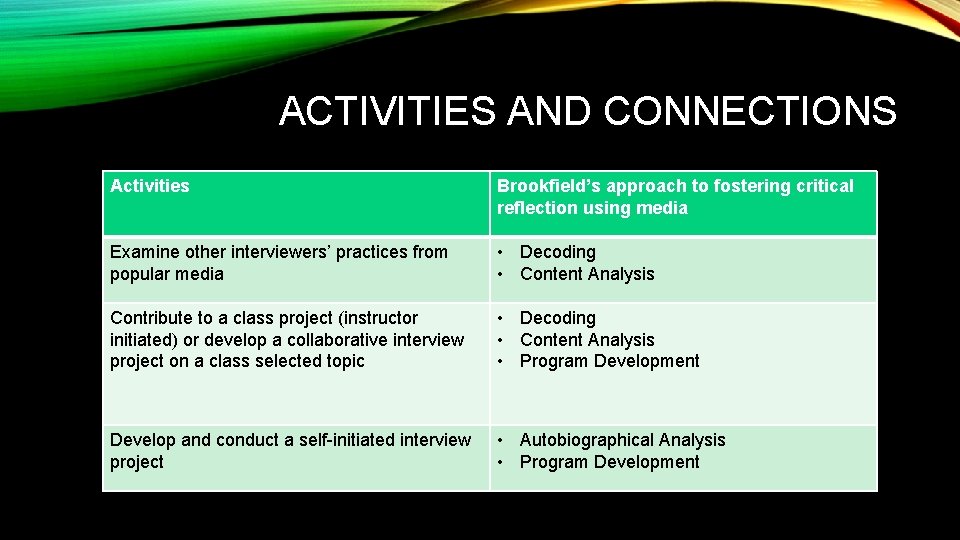
ACTIVITIES AND CONNECTIONS Activities Brookfield’s approach to fostering critical reflection using media Examine other interviewers’ practices from popular media • Decoding • Content Analysis Contribute to a class project (instructor initiated) or develop a collaborative interview project on a class selected topic • Decoding • Content Analysis • Program Development Develop and conduct a self-initiated interview project • Autobiographical Analysis • Program Development
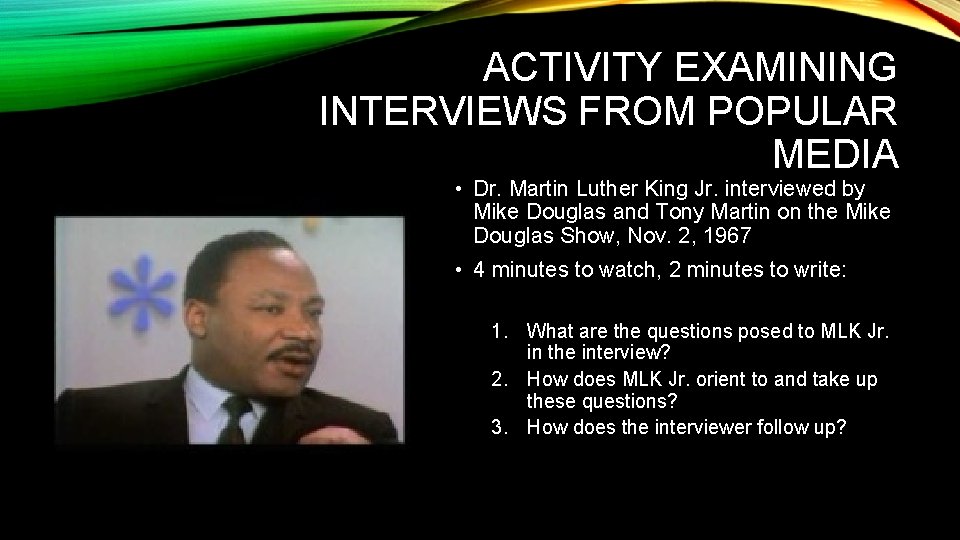
ACTIVITY EXAMINING INTERVIEWS FROM POPULAR MEDIA • Dr. Martin Luther King Jr. interviewed by Mike Douglas and Tony Martin on the Mike Douglas Show, Nov. 2, 1967 • 4 minutes to watch, 2 minutes to write: 1. What are the questions posed to MLK Jr. in the interview? 2. How does MLK Jr. orient to and take up these questions? 3. How does the interviewer follow up?
WRITE FOR 2 MINUTES 1. What are the questions posed to MLK Jr. in the interview? 2. How does MLK Jr. orient to and take up these questions? 3. How does the interviewer follow up?
STUDENT REFLECTION RESPONSES Undergraduate students commented on: • The changing tone across the interview interaction • How interruptions work in interviews • How interviewees orient to questioning (including aggressive lines of questioning) • How King declines to offer defensive responses to questions, using oratory skills to manage interview talk During his interview with Mike Douglas and Tony D. Martin, Martin Luther King Jr. is frequently on the defense concerning his actions involved with the African American community and the implications of these actions during the Civil Rights Movement…Whereas earlier in his interview Dr. King remains relatively impartial in his defenses and avoids both agreeing and disagreeing, a switch occurs in his response to this question. He immediately states, “I’m sorry to disagree, [but] I stand with my original statement that people who have been alienated as a result of standing against the war have been alienated anyways. ”
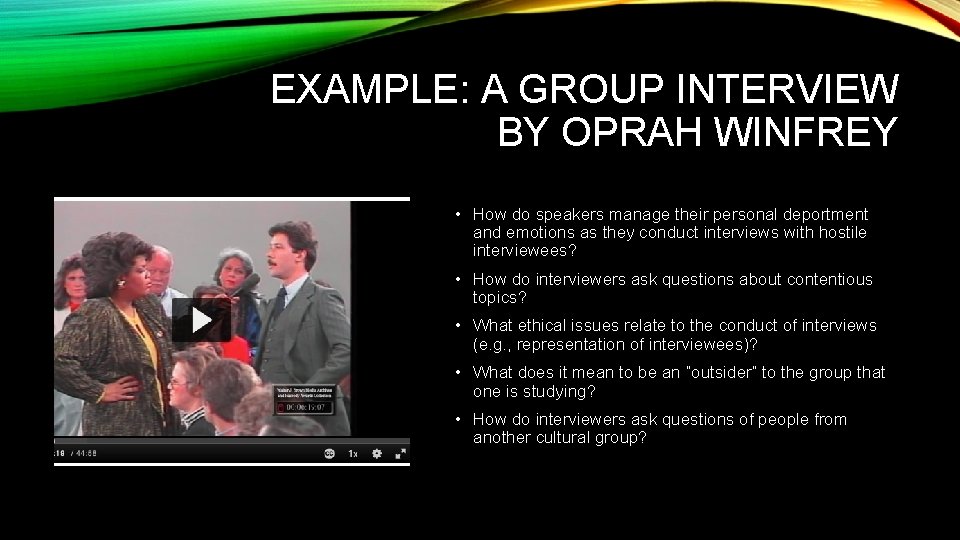
EXAMPLE: A GROUP INTERVIEW BY OPRAH WINFREY • How do speakers manage their personal deportment and emotions as they conduct interviews with hostile interviewees? • How do interviewers ask questions about contentious topics? • What ethical issues relate to the conduct of interviews (e. g. , representation of interviewees)? • What does it mean to be an “outsider” to the group that one is studying? • How do interviewers ask questions of people from another cultural group?
WHERE YOU CAN READ MORE • Roulston, K. , & Herron, B. A. (forthcoming, 2021). Teaching interviewing in qualitative research: Learning from Cinematic Society. In J. Richards, A. Skukauskaite, & R. Chenail, Learner-centered, socially constructed, qualitative research: Supporting students as active participants in their own learning. Brill/Sense. • Herron, B. A. , & Roulston, K. (Under Review, LEARNing Landscapes). Slowing down & digging deep: Teaching students to examine interview interactions in-depth.
REFERENCES • Atkinson, P. , & Silverman, D. (1997). Kundera's Immortality: The interview society and the invention of the self. Qualitative Inquiry, 3(3), 304 -325. • Brookfield, S. (1990). Analyzing the influence of media on learners’ perspectives. In J. Mezirow & Associates (Eds. ), Fostering critical reflection in adulthood: A guide to transformative and emancipatory learning (1 st ed. ) (pp. 235 -250). Jossey-Bass Publishers. • Denzin, N. K. (2018). Performance autoethnography: Critical pedagogy and the politics of culture (2 nd ed. ). Routledge. Martin Luther King Jr. interviewed on the Mike Douglas Show (1967) • Part 1: https: //www. youtube. com/watch? v=9 Sf. H 2 u. Mayks • Part 2: https: //www. youtube. com/watch? v=_FQIl. E-Wl. M 8&t=2 s • Part 3: https: //www. youtube. com/watch? v=tv. B 5 a 9_XJ 3 I Oprah Winfrey's episode on race in Forsyth County, Georgia (1987) • https: //kaltura. uga. edu/media/t/1_958 u 30 nt
QUESTIONS? Dr. Kathy Roulston roulston@uga. edu Dr. Brigette Herron brig 07@uga. edu