
Teaching Grammar to Heritage Learners Insights from Contact





- Slides: 41
Teaching Grammar to Heritage Learners Insights from Contact Linguistics, Sociolinguistics and Raciolinguistics Grammar Across the Curriculum Workshop LSA Institute 2017
Who is a heritage learner? • An individual who is raised in home where a non-English language is spoken. The student may speak or merely understand the heritage language and be, to some degree, bilingual in English and the heritage language Guadalupe Valdés, Guadalupe. (2000). Introduction. In AATSP professional development series handbook for teachers K-16. Vol. 1. Spanish for Native Speakers. AATSP, pp. 1 -20.
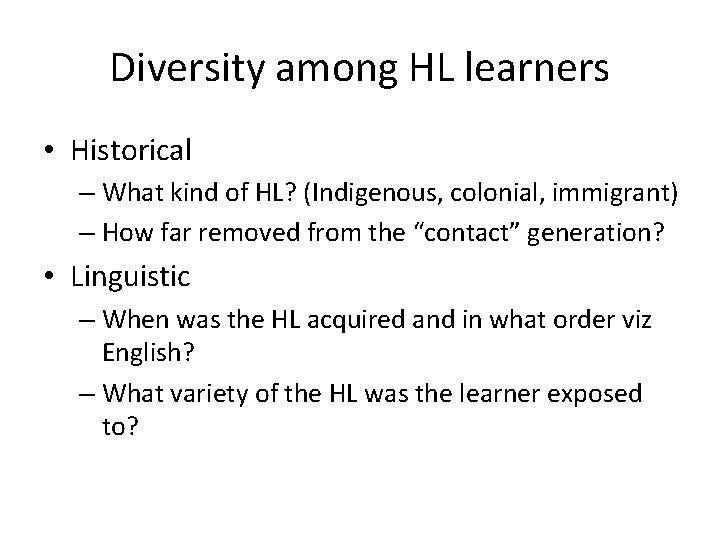
Diversity among HL learners • Historical – What kind of HL? (Indigenous, colonial, immigrant) – How far removed from the “contact” generation? • Linguistic – When was the HL acquired and in what order viz English? – What variety of the HL was the learner exposed to?
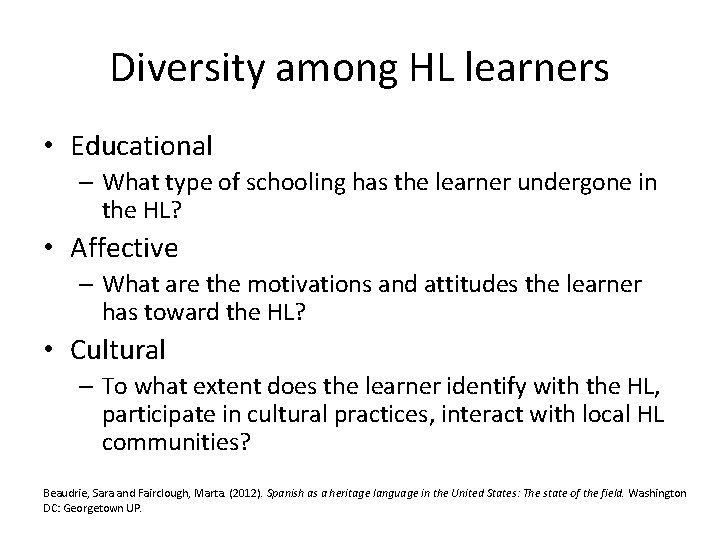
Diversity among HL learners • Educational – What type of schooling has the learner undergone in the HL? • Affective – What are the motivations and attitudes the learner has toward the HL? • Cultural – To what extent does the learner identify with the HL, participate in cultural practices, interact with local HL communities? Beaudrie, Sara and Fairclough, Marta. (2012). Spanish as a heritage language in the United States: The state of the field. Washington DC: Georgetown UP.
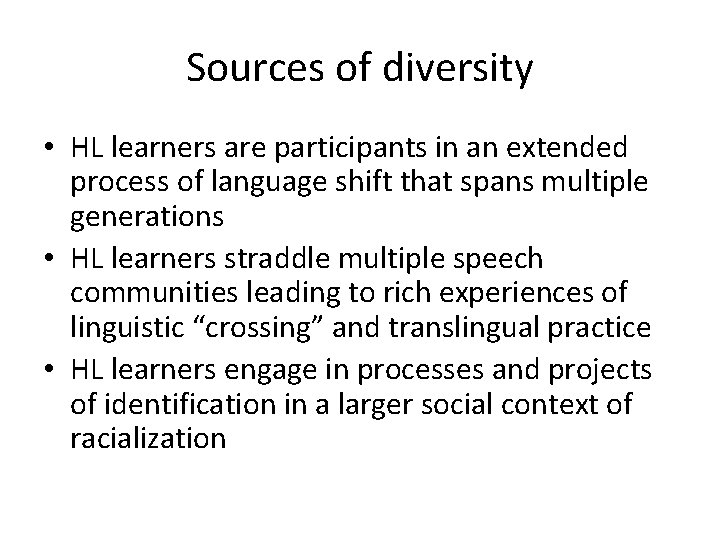
Sources of diversity • HL learners are participants in an extended process of language shift that spans multiple generations • HL learners straddle multiple speech communities leading to rich experiences of linguistic “crossing” and translingual practice • HL learners engage in processes and projects of identification in a larger social context of racialization
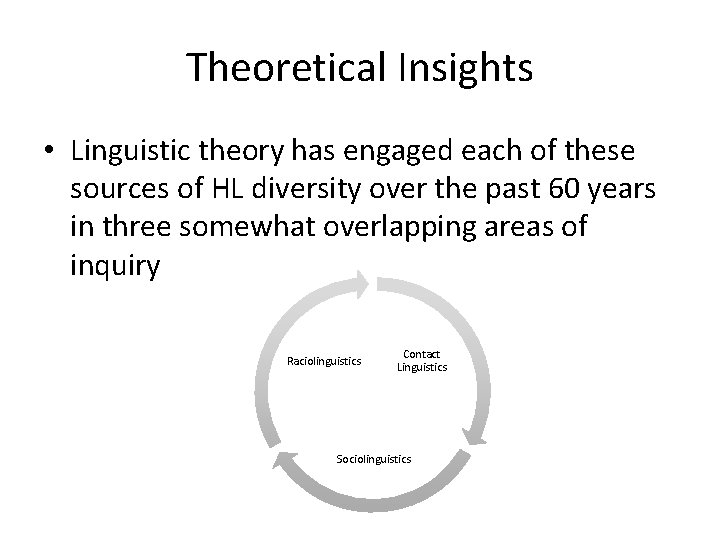
Theoretical Insights • Linguistic theory has engaged each of these sources of HL diversity over the past 60 years in three somewhat overlapping areas of inquiry Raciolinguistics Contact Linguistics Sociolinguistics
Contact Linguistics • Considers the impact of languages in contact – Linguistic impact • Transfer phenomena • Code-switching – Acquisition impact • Incomplete acquisition/Imperfect transmission • Bilingual acquisition
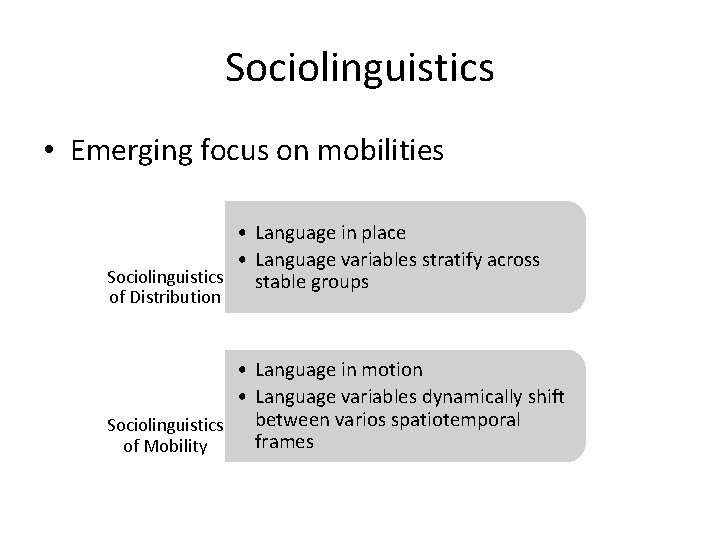
Sociolinguistics • Emerging focus on mobilities • Language in place • Language variables stratify across Sociolinguistics stable groups of Distribution • Language in motion • Language variables dynamically shift between varios spatiotemporal Sociolinguistics frames of Mobility
Sociolinguistics • According to Blommaert, the view of language as containable within a Saussurean synchrony must be replaced with “a view of language as something intrinsically and perpetually mobile, through space as well as time, and made for mobility. The finality of language is mobility, not immobility” • Pennycook (2010) makes a similar argument that we should focus on language in relation to temporal and spatial trajectories instead of temporal and spatial location. Blommaert, Jan. (2010). The Sociolinguistics of Globalization. Cambridge: Cambridge UP. Pennycook, Alasdair. (2010). Language as Local Practice. New York: Routledge.
Sociolinguistics • The emerging trend towards a sociolinguistics of mobility allows for a focus on dynamic processes such as – “Crossings” as described by Ben Rampton – “Translanguaging” practices as described by Ofelia García and Li Wei Rampton, Ben. (1995). Crossing: Language and ethnicity among adolescents. London: Longman. García, Ofelia and Li Wei. (2015). Translanguaging: Language, Bilingualism and Education. New York: Palgrave Macmillan.
Raciolinguistics • A more recent theoretical articulation that recognizes the fundamental role of language in shaping racial identity • Alim (2016) proposes a new field “that is dedicated to bringing to bear the diverse methods of linguistic analysis to ask and answer critical questions about the relations between language, race and power across diverse ethnoracial contexts and societies” Alim, Samy, Rickford, John and Ball, Arnetha. (2016). Raciolinguistics: How language shapes our ideas about race. Oxford: Oxford UP.
Raciolinguistics • Raciolinguistics gives special attention to the language experience of “People of Color” understanding the central role that language plays in social processes of racialization and on the relevance of race and racism in peoples lives. • Raciolinguistics proposes an analysis that always considers race and language together
Raciolinguistics • Flores and Rosa (2015) describe raciolinguistic ideologies as ideologies that “conflate certain racialized bodies with linguistic deficiency unrelated to any objective linguistic practices. That is, raciolinguistic ideologies produce racialized speaking subjects who are constructed as linguistically deviant even when engaging in linguistic practices positioned as normative or innovative when produced by privileged white subjects” • Raciolinguistics, in this way, pushes linguistics from a focus on the speaking subject to a broader focus on the listening subject as well Flores, Nelson and Rosa, Jonathan. (2015). Undoing appropriateness: Raciolinguistic ideologies and language diversity in education. Harvard Educational Review, 85, pp. 149 -171.
HL Grammar • “Grammar” is often identified as a significant problem area for HL learners. Frequent complaints from teachers include: – Lack of knowledge of basic grammatical categories (nouns, verbs, etc) – Failure to distinguish productively between grammatical oppositions (indicative vs. subjunctive) – Grammatical transfer (use of gerund as verbal subject – bailando es un pasatiempo muy divertido) – Production of non-standard grammatical variants (haiga vs. haya, traiba vs. traía)
HL Grammar • The teaching of grammar has thus become an important focal point in HL education • Some research suggests that teaching methods known to be successful in L 2 instruction also show promise for HL instruction, e. g. , processing instruction (Potowski, Jegerski & Morgan Short 2009) and negative evidence (Montrul and Bowles 2009, 2010). Potowski, K Jegerski, J and Morgan Short, K. (2009). The effects of instruction on subjunctive development among Spanish heritage language speakers. Language Learning 59, 537 -579. Montrul S and Bowles M. (2009). Back to basics: Differential object marking under incomplete acquisition in Spanish heritage speakers. Bilingualism: Language and Cognition 12, 363 -383.
HL Grammar • The consensus in the field remains, however, that HL learners require a different approach to grammar – Top down vs. bottom up instruction – Contrastive analysis – Error correction
HL Grammar • Drawing on theoretical insights drawn from contact linguistics, sociolinguistics and raciolinguistics, a “pedagogy of mobilities” could prove to be a powerful methodological approach to teaching grammar • Pedagogy of Mobilities – Recognizes the shifting contexts of language use among HLs – Identifies contexts conducive to the production of key grammatical forms – Encourages production across contexts
Pedagogy of Mobilities • In order to illustrate the pedagogy of mobilities, I will focus on three areas of grammar instruction: 1. Subject Pronoun Expression 2. Nominalization 3. Attitudes towards non-standard forms
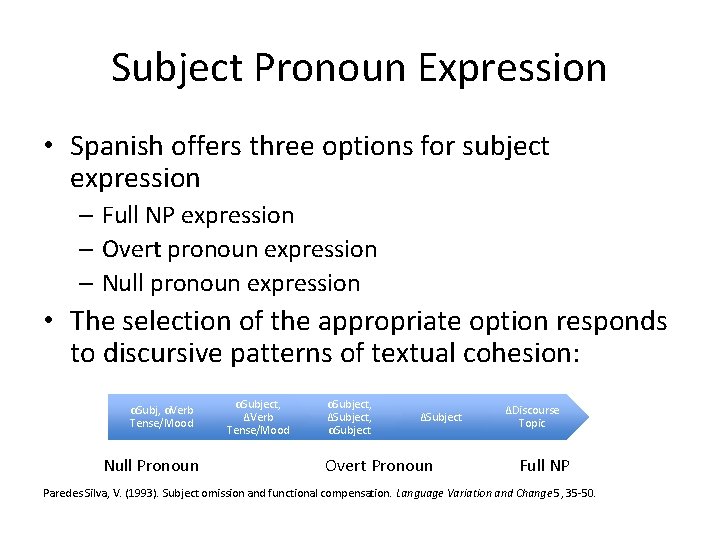
Subject Pronoun Expression • Spanish offers three options for subject expression – Full NP expression – Overt pronoun expression – Null pronoun expression • The selection of the appropriate option responds to discursive patterns of textual cohesion: αSubj, αVerb Tense/Mood Null Pronoun αSubject, ΔVerb Tense/Mood αSubject, ΔSubject, αSubject ΔSubject Overt Pronoun ΔDiscourse Topic Full NP Paredes Silva, V. (1993). Subject omission and functional compensation. Language Variation and Change 5, 35 -50.
Subject Pronoun Expression • HL learners tend to follow the discursive pattern in oral channels, but in written channels tend to overuse the Overt Pronoun option. • “Backwards biliteracy” • English orthographical rules (double consonants, capitalization rules) • Bare NPs in generic contexts (Inmigrantes necesitan apoyo vs. Los inmigrantes necesitan apoyo) • Overuse of overt subject pronouns García, O. (2002). Writing backwards across languages. In Schleppergrell, M and Colombi MC, eds. Developing advanced literacy in first and second languages. Mahwah NJ: Lawrence Erlbaum, 245 -260.
Subject Pronoun Expression • In Martinez (2007), I argue that the overuse of overt subject pronouns responds to the situation in which students are asked to write • When asked to write a formal composition for a grade, HL students used more overt subject pronouns • When asked to write an informal, non-graded composition, HL students tended to follow discursive patterns Martínez G (2007). Writing back and forth: The interplay of form and situation in heritage language composition. Language Teaching Research 11, 31 -41.
Subject Pronoun Expression • A pedagogy of mobility for subject pronoun expression – Identifies the contexts in which HL students utilize the target grammatical forms – Provides opportunities for students to produce the forms in those contexts – Encourages students to recognize their own production and transfer form one context to another context
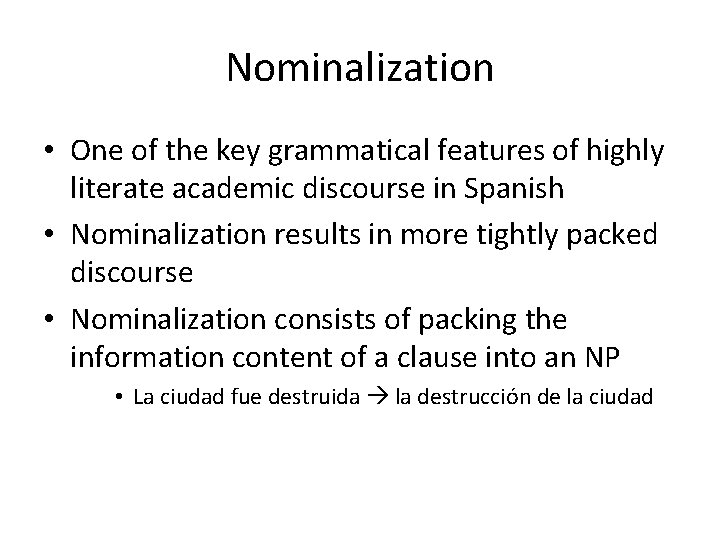
Nominalization • One of the key grammatical features of highly literate academic discourse in Spanish • Nominalization results in more tightly packed discourse • Nominalization consists of packing the information content of a clause into an NP • La ciudad fue destruida la destrucción de la ciudad
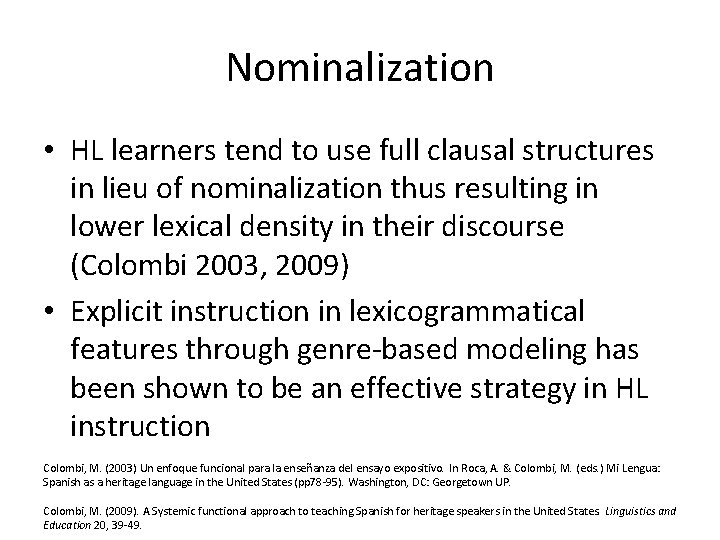
Nominalization • HL learners tend to use full clausal structures in lieu of nominalization thus resulting in lower lexical density in their discourse (Colombi 2003, 2009) • Explicit instruction in lexicogrammatical features through genre-based modeling has been shown to be an effective strategy in HL instruction Colombi, M. (2003) Un enfoque funcional para la enseñanza del ensayo expositivo. In Roca, A. & Colombi, M. (eds. ) Mi Lengua: Spanish as a heritage language in the United States (pp 78 -95). Washington, DC: Georgetown UP. Colombi, M. (2009). A Systemic functional approach to teaching Spanish for heritage speakers in the United States. Linguistics and Education 20, 39 -49.
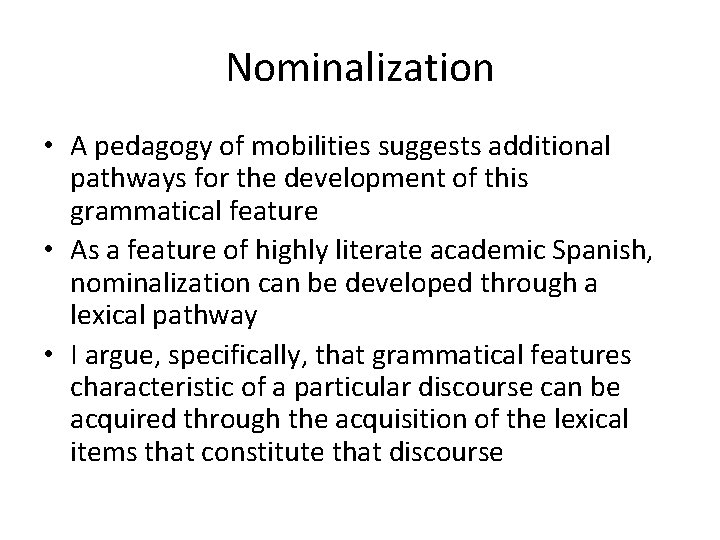
Nominalization • A pedagogy of mobilities suggests additional pathways for the development of this grammatical feature • As a feature of highly literate academic Spanish, nominalization can be developed through a lexical pathway • I argue, specifically, that grammatical features characteristic of a particular discourse can be acquired through the acquisition of the lexical items that constitute that discourse
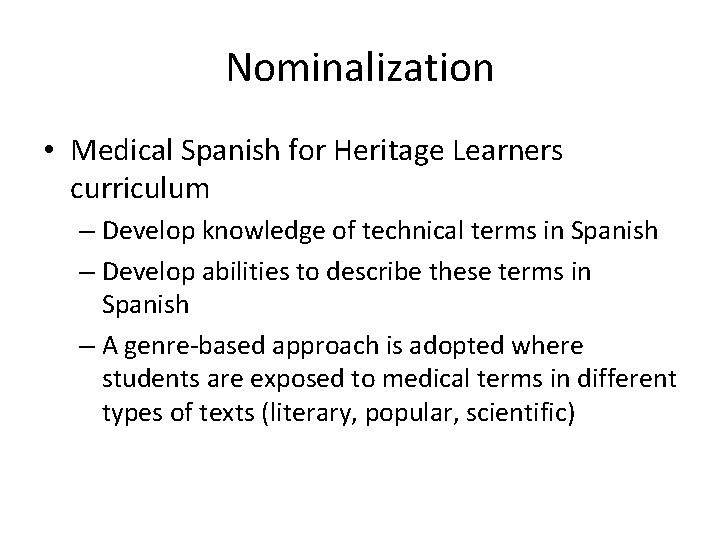
Nominalization • Medical Spanish for Heritage Learners curriculum – Develop knowledge of technical terms in Spanish – Develop abilities to describe these terms in Spanish – A genre-based approach is adopted where students are exposed to medical terms in different types of texts (literary, popular, scientific)
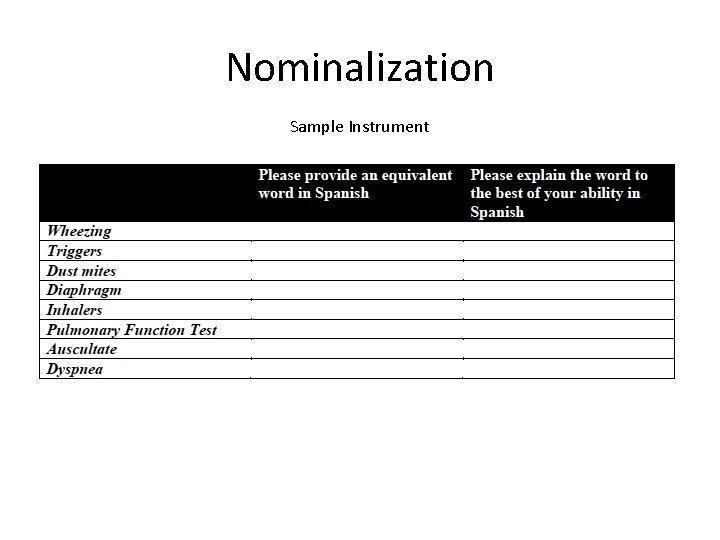
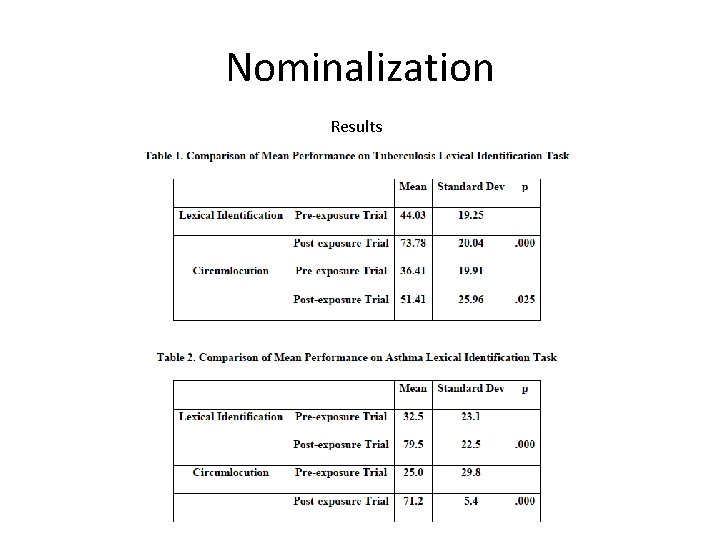
Nominalization • A pre/post assessment was conducted after two thematic lessons (tuberculosis and asthma) • The instrument required students to provide the Spanish equivalent of a medical term in English and provide a definition of the term in Spanish
Nominalization Sample Instrument
Nominalization Results
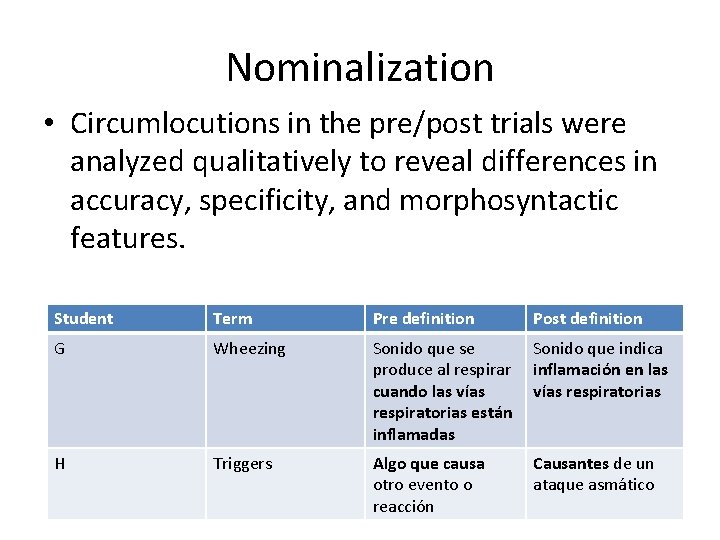
Nominalization • Circumlocutions in the pre/post trials were analyzed qualitatively to reveal differences in accuracy, specificity, and morphosyntactic features. Student Term Pre definition Post definition G Wheezing Sonido que se produce al respirar cuando las vías respiratorias están inflamadas Sonido que indica inflamación en las vías respiratorias H Triggers Algo que causa otro evento o reacción Causantes de un ataque asmático
Nominalization • A pedagogy of mobilities for the development of nominalization: 1. Connects grammatical forms to the development of a specialized lexicon 2. Builds lexical knowledge through exposure to a variety of genres 3. Provides opportunities for students to produce grammatical forms in connection with new lexical items
Attitudes towards Non-standard Features • A pedagogy of mobilities can also address key attitudes and ideologies that are important in teaching grammar to HL learners • Recent efforts in community service learning (CSL) for HL learners have demonstrated astonishing impacts on HL perceptions of their own language variety and the varieties spoken in their communities
Attitudes towards Non-standard features • CSL is defined by the National Commission on Service Learning as: A teaching and learning approach that integrates community service with academic study to enrich learning, teach civic responsibility, and strengthen communities
Attitudes towards Non-standard features • CSL activities for HL learners include: – After school academic enrichment programs (Leeman, Rabin and Román-Mendoza 2011) – Bilingual assistance in social service agencies (Hartfield-Mendez 2013) – Bilingual assistance in community health (Martínez and Schwartz 2012) Leeman, J. , Rabin, L. , & Román-Mendoza, E. (2011 a). Critical pedagogy beyond the classroom walls: Community service-learning and Spanish heritage language education. Heritage Language Journal, 8(3), http: //www. heritagelanguages. org/. Hartfield-Méndez V. (2013). Community-based learning, internationalization of the curriculum and university engagement with Latino communities. Hispania 96, 355 -368. Martínez, G. & Schwartz, A. (2012). Elevating “low” language for high stakes: A case for critical community-based learning in a Medical Spanish for heritage learners program. Heritage Language Journal. 9(2). http: //www. heritagelanguages. org/
Attitudes towards Non-standard features • Research on CSL activities consistently show that HL students increase confidence in their language abilities as a result of participating in these activities • It also suggests that CSL activities expand student understanding and acceptance of language variation
Attitudes toward Non-standard features • In Martínez and Schwartz (2012), for example, we demonstrate how students problematize and complicate the “standard” by perceiving a mobility between standard and non-standard features: They [staff nutritionists at NCDV] use the correct measurements in the written diet plan but when I heard them reading a diet plan out loud, they would estimate in a way where the patient would understand. For example, they would say dos cucharitas, medio vasito, etc.
Attitudes towards Non-standard features • We also found that the perception of “high stakes” had an impact on student perceptions of correct and incorrect language. Es tan importante cuidar las porciones para cada paciente que aun el especificar una cucharada sopera o cucharadita cafeteria o para el té es de suma importancia dependiendo de la enfermedad y la edad del paciente
Attitudes toward Non-standard features • A pedagogy of mobilities to address attitudes towards non-standard features 1. Moves language use (and its inherent variation) outside of the classroom 2. Provides opportunities for students to perceive mobilities between standard and non-standard forms 3. Elevates perceptions of “high stakes” associated with communication
Conclusions • HL learners pose a special challenge to teachers of grammar given their location in the dynamic processes of language maintenance, language shift and language revitalization • Theoretical perspectives around contact, mobility and ideology provide insights into these challenges • A pedagogy of mobilities seeks to embed the teaching of grammar in a dynamic state of motion that matches the (socio)linguistic reality of learners
QUESTIONS AND DISCUSSION
Contact Information Glenn Martinez Professor of Hispanic Linguistics and Director of the Center for Languages, Literatures and Cultures The Ohio State University martinez. 474@osu. edu