
Teaching for Learning Using Active Learning Strategies Cooperative










- Slides: 28
Teaching for Learning: Using Active Learning Strategies & Cooperative Student Groups to Promote Learning in Lecture Classes – Session 2 Kathleen O’Donovan Connie Tzenis Center for Teaching and Learning University of Minnesota Karl Smith Civil Engineering University of Minnesota Agricultural Exports and Rural Income (AERI) Midwest University Consortium for International Activities Faculty Workshop – July 2004 1
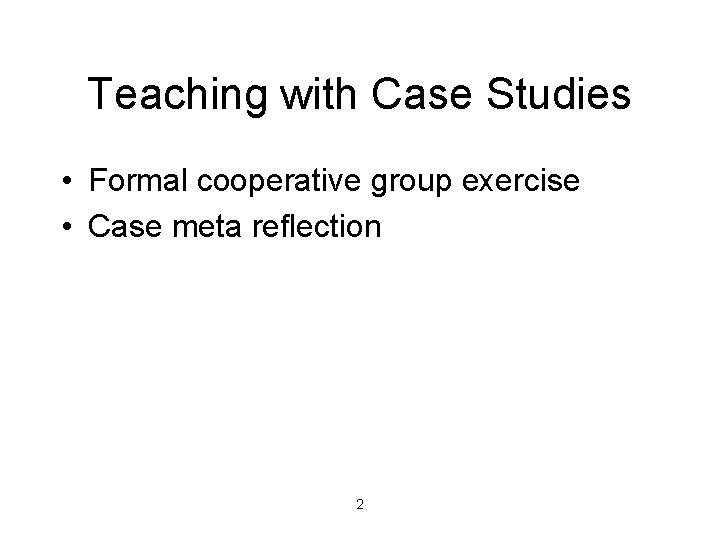
Teaching with Case Studies • Formal cooperative group exercise • Case meta reflection 2
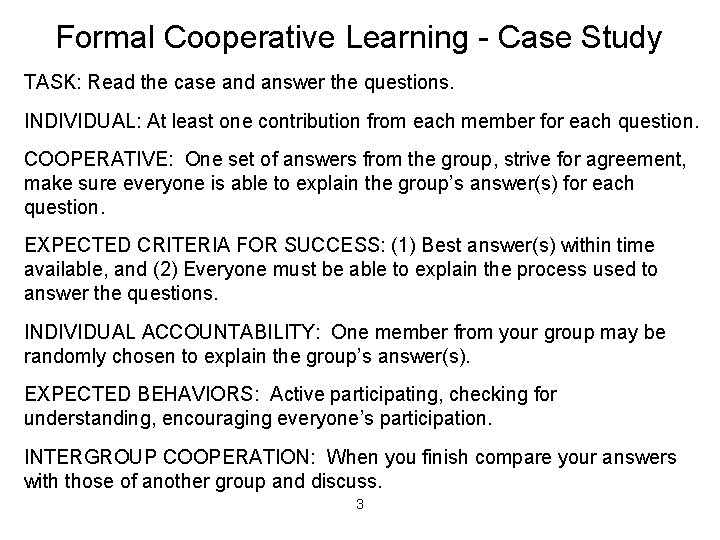
Formal Cooperative Learning - Case Study TASK: Read the case and answer the questions. INDIVIDUAL: At least one contribution from each member for each question. COOPERATIVE: One set of answers from the group, strive for agreement, make sure everyone is able to explain the group’s answer(s) for each question. EXPECTED CRITERIA FOR SUCCESS: (1) Best answer(s) within time available, and (2) Everyone must be able to explain the process used to answer the questions. INDIVIDUAL ACCOUNTABILITY: One member from your group may be randomly chosen to explain the group’s answer(s). EXPECTED BEHAVIORS: Active participating, checking for understanding, encouraging everyone’s participation. INTERGROUP COOPERATION: When you finish compare your answers with those of another group and discuss. 3
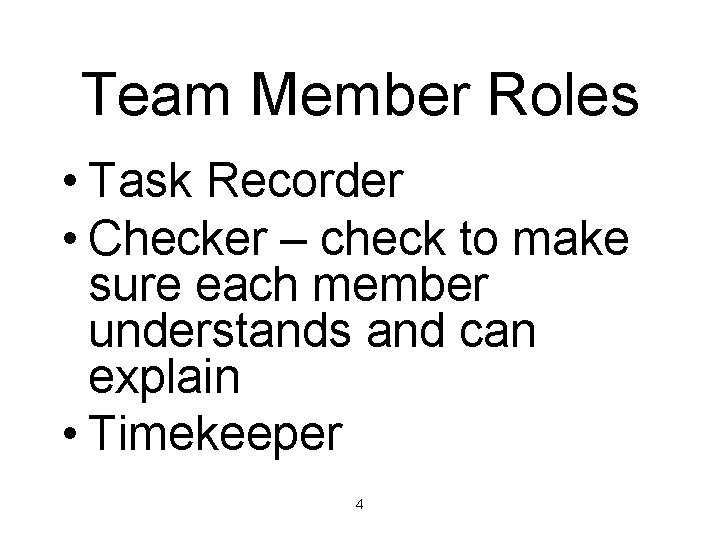
Team Member Roles • Task Recorder • Checker – check to make sure each member understands and can explain • Timekeeper 4
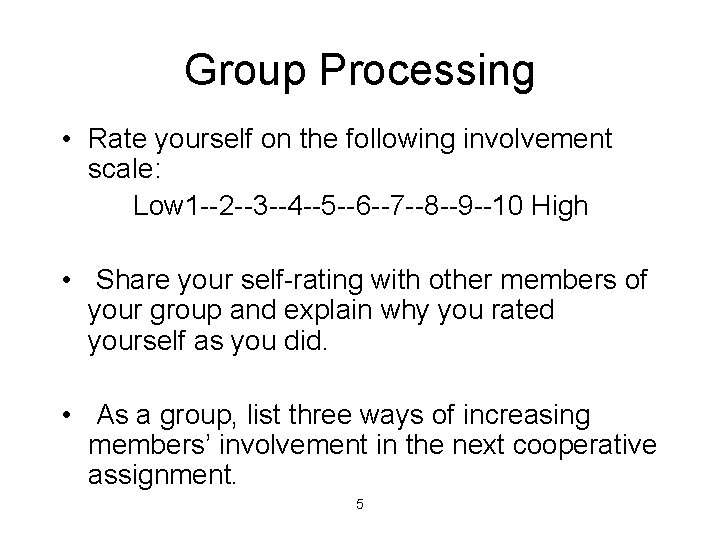
Group Processing • Rate yourself on the following involvement scale: Low 1 --2 --3 --4 --5 --6 --7 --8 --9 --10 High • Share your self-rating with other members of your group and explain why you rated yourself as you did. • As a group, list three ways of increasing members’ involvement in the next cooperative assignment. 5
Formal Cooperative Learning Task Groups
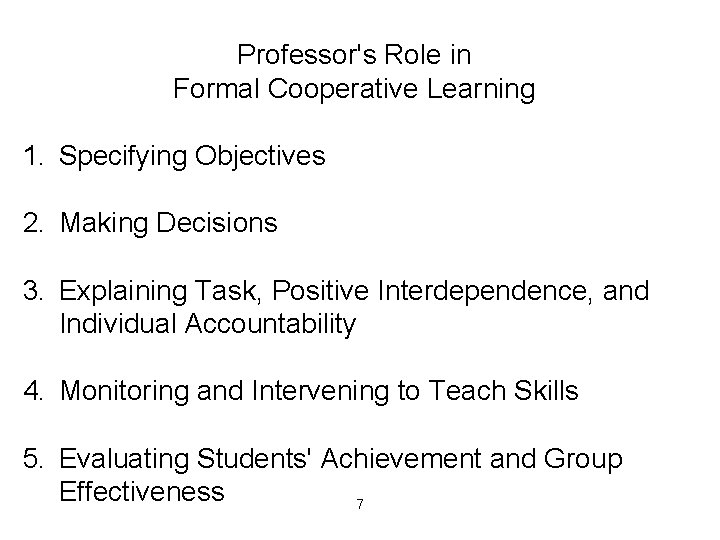
Professor's Role in Formal Cooperative Learning 1. Specifying Objectives 2. Making Decisions 3. Explaining Task, Positive Interdependence, and Individual Accountability 4. Monitoring and Intervening to Teach Skills 5. Evaluating Students' Achievement and Group Effectiveness 7
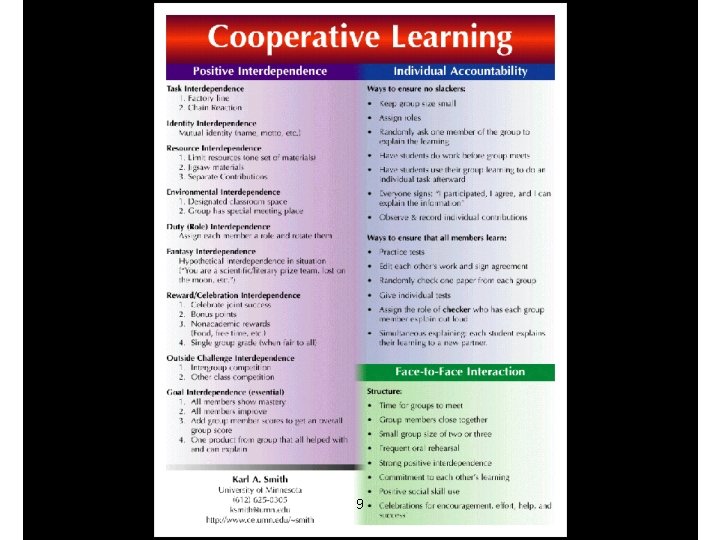
Cooperative Learning is instruction that involves people working in teams to accomplish a common goal, under conditions that involve both positive interdependence (all members must cooperate to complete the task) and individual and group accountability (each member is accountable for the complete final outcome). Key Concepts • Positive Interdependence • Individual and Group Accountability • Face-to-Face Promotive Interaction • Teamwork Skills • Group Processing
9
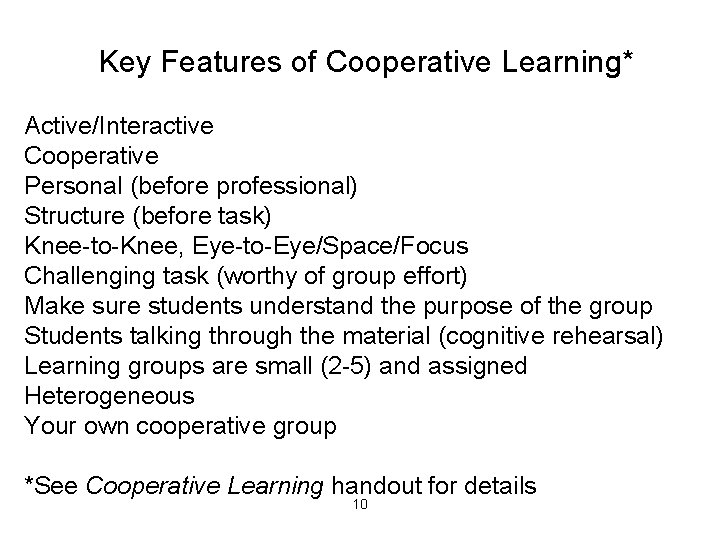
Key Features of Cooperative Learning* Active/Interactive Cooperative Personal (before professional) Structure (before task) Knee-to-Knee, Eye-to-Eye/Space/Focus Challenging task (worthy of group effort) Make sure students understand the purpose of the group Students talking through the material (cognitive rehearsal) Learning groups are small (2 -5) and assigned Heterogeneous Your own cooperative group *See Cooperative Learning handout for details 10
http: //clte. asu. edu/active 11
Rationale • Our stories – Kathleen/Connie/Karl • Research rationale – Active and Cooperative Learning • Other rationale – Astin, Light, Seven Principles for Good Practice in Undergraduate Education 12
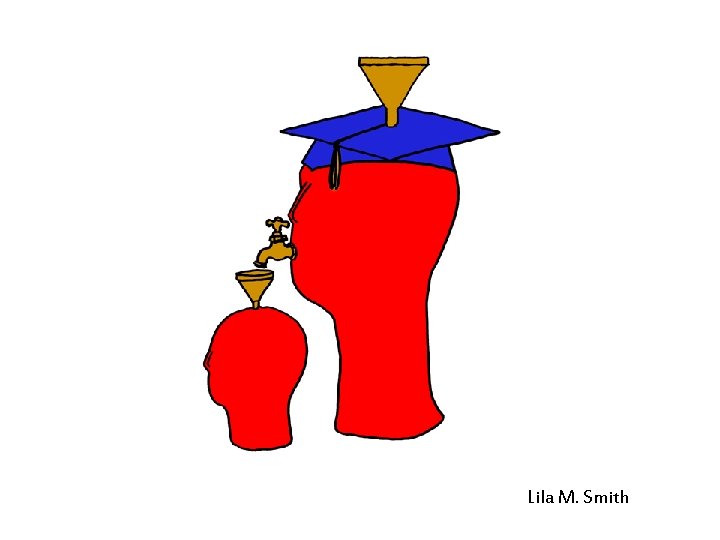
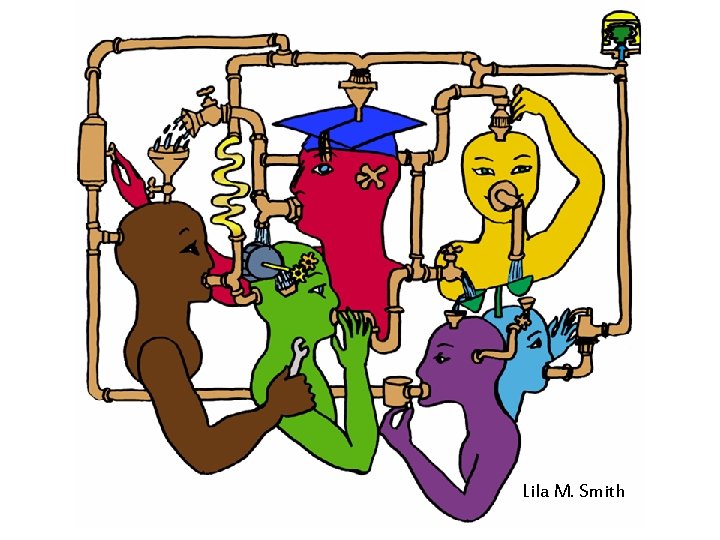
Lila M. Smith
Lila M. Smith
Cooperative Learning Research Support Johnson, D. W. , Johnson, R. T. , & Smith, K. A. 1998. Cooperative learning returns to college: What evidence is there that it works? Change, 30 (4), 26 -35. • Over 300 Experimental Studies • First study conducted in 1924 • High Generalizability • Multiple Outcomes 1. Achievement and retention 2. Critical thinking and higher-level reasoning 3. Differentiated views of others 4. Accurate understanding of others' perspectives 5. Liking for classmates and teacher 6. Liking for subject areas 7. Teamwork skills
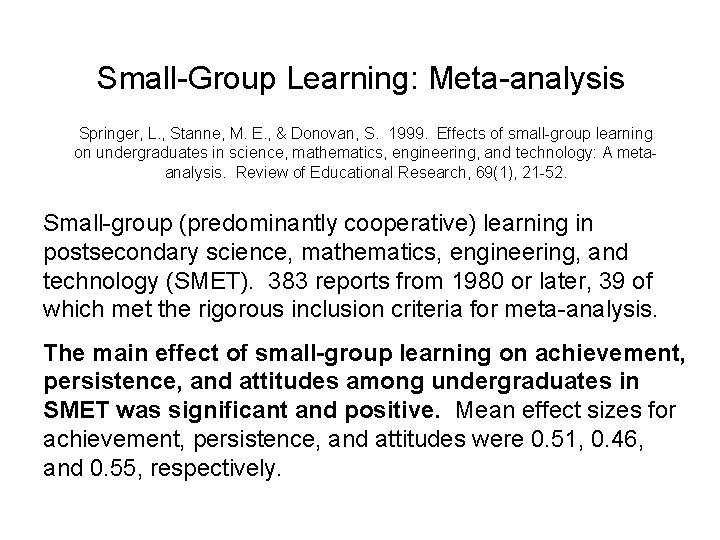
Small-Group Learning: Meta-analysis Springer, L. , Stanne, M. E. , & Donovan, S. 1999. Effects of small-group learning on undergraduates in science, mathematics, engineering, and technology: A metaanalysis. Review of Educational Research, 69(1), 21 -52. Small-group (predominantly cooperative) learning in postsecondary science, mathematics, engineering, and technology (SMET). 383 reports from 1980 or later, 39 of which met the rigorous inclusion criteria for meta-analysis. The main effect of small-group learning on achievement, persistence, and attitudes among undergraduates in SMET was significant and positive. Mean effect sizes for achievement, persistence, and attitudes were 0. 51, 0. 46, and 0. 55, respectively.
Strategies for Energizing Large Classes: From Small Groups to Learning Communities: Jean Mac. Gregor, James Cooper, Karl Smith, Pamela Robinson New Directions for Teaching and Learning, No. 81, 2000. Jossey- Bass
The Harvard Assessment Seminars B Richard J. Light All the specific findings point to, and illustrate, one main idea. It is that students who get the most out of college, who grow the most academically, and who are the happiest, organize their time to include interpersonal activities with faculty members, or with fellow students, built around substantive, academic work. Environmental Factors That Enhance Students= Academic and Personal Development and Satisfaction Alexander Astin in What matters in college: Four critical years revisited. Jossey-Bass, 1993. Student-student interaction Student-faculty interaction A faculty that is very student-oriented Discussing racial/ethnic issues with other students Hours devoted to studying B Time on task Tutoring other students Socializing with students of different race/ethnicity A student body that has high socioeconomic status An institutional emphasis on diversity A faculty that is positive about the general education program 18 A student body that values altruism and social activism
Principles for Good Practice in Undergraduate Education 1. Encourages Student-Faculty Contact 2. Encourages Cooperation Among Students 3. Encourages Active Learning 4. Gives Prompt Feedback 5. Emphasizes Time on Task 6. Communicates High Expectations 7. Respects Diverse Talents and Ways of Learning Chickering, A. W. & Gamson, Z. F. 1987. Seven principles for good practice in undergraduate education. The Wingspread Journal, 9(2). 19
New Paradigm • Defining educational objectives, facilitating development of critical and creative thinking and problem-solving skills • Active learning (individual and group activities in class) • Structured cooperative learning (including multidisciplinary teamwork and facilitating development of written and oral communication skills) • Writing and (multidisciplinary) design across the curriculum • Inquiry and discovery learning (problem-based, casebased) • Teaching to diversity (different learning styles, ethnicities, genders) • Appropriate use of technology (tools, simulation, exploration)
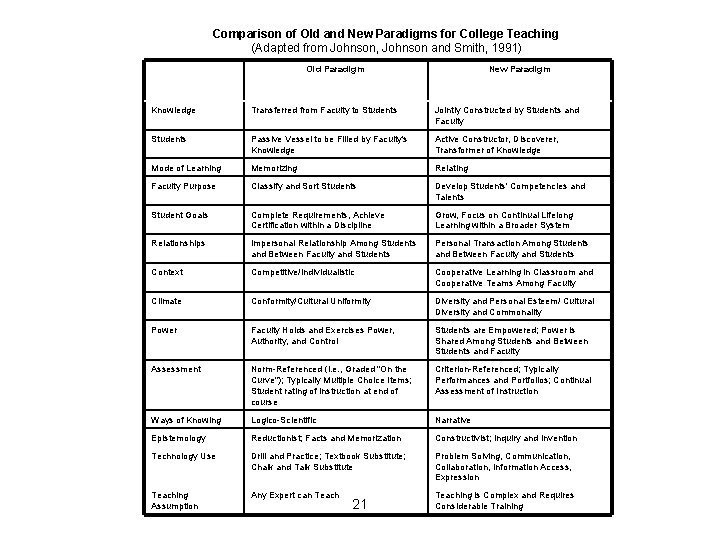
Comparison of Old and New Paradigms for College Teaching (Adapted from Johnson, Johnson and Smith, 1991) Old Paradigm New Paradigm Knowledge Transferred from Faculty to Students Jointly Constructed by Students and Faculty Students Passive Vessel to be Filled by Faculty's Knowledge Active Constructor, Discoverer, Transformer of Knowledge Mode of Learning Memorizing Relating Faculty Purpose Classify and Sort Students Develop Students' Competencies and Talents Student Goals Complete Requirements, Achieve Certification within a Discipline Grow, Focus on Continual Lifelong Learning within a Broader System Relationships Impersonal Relationship Among Students and Between Faculty and Students Personal Transaction Among Students and Between Faculty and Students Context Competitive/Individualistic Cooperative Learning in Classroom and Cooperative Teams Among Faculty Climate Conformity/Cultural Uniformity Diversity and Personal Esteem/ Cultural Diversity and Commonality Power Faculty Holds and Exercises Power, Authority, and Control Students are Empowered; Power is Shared Among Students and Between Students and Faculty Assessment Norm-Referenced (i. e. , Graded "On the Curve"); Typically Multiple Choice Items; Student rating of instruction at end of course Criterion-Referenced; Typically Performances and Portfolios; Continual Assessment of Instruction Ways of Knowing Logico-Scientific Narrative Epistemology Reductionist; Facts and Memorization Constructivist; Inquiry and Invention Technology Use Drill and Practice; Textbook Substitute; Chalk and Talk Substitute Problem Solving, Communication, Collaboration, Information Access, Expression Teaching Assumption Any Expert can Teaching is Complex and Requires Considerable Training 21
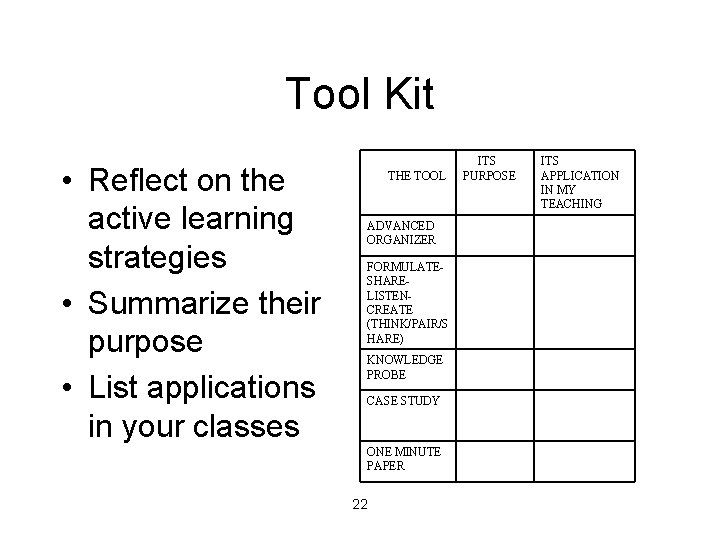
Tool Kit • Reflect on the active learning strategies • Summarize their purpose • List applications in your classes THE TOOL ADVANCED ORGANIZER FORMULATESHARELISTENCREATE (THINK/PAIR/S HARE) KNOWLEDGE PROBE CASE STUDY ONE MINUTE PAPER 22 ITS PURPOSE ITS APPLICATION IN MY TEACHING
Informal Cooperative Learning Groups Can be used at any time Can be short term and ad hoc May be used to break up a long lecture Provides an opportunity for students to process material they have been listening to (Cognitive Rehearsal) Are especially effective in large lectures Include "book ends" procedure Are not as effective as Formal Cooperative Learning or Cooperative Base Groups
24
25
Session Summary (MINUTE PAPER) PART A DIRECTIONS: Read the following questions, and write a brief answer to each one. What is most important point conveyed during this session? What is one new teaching activity you are willing to try? What is 1 question you have about the session? PART B DIRECTIONS: Read each statement in the scale below. Circle the degree to which you either agree or disagree with it. SD=Strongly Disagree D=Disagree N= Neutral A=Agree 1. I was comfortable with the pace of the session. SD 2. I found the content to be interesting. SD 3. I understood the facilitators’ speech. SD 4. I found the activities to be useful. SD 26 D D SA=Strongly Agree N A SA
Homework Assignment • Reflect on the session – List insights, possible applications and questions • Read A Self-Directed Guide to Designing Courses for Significant Learning by L. Dee Fink – Skim pages 1 -7 – Read pages 8 -12 • Skim Cooperative Learning by David & Roger Johnson and Karl Smith • Exercise • Fun 27
Resources • Workshop Handouts – Resources http: //www. ce. umn. edu/~smith • University of Minnesota - Center for Teaching and Learning Services -http: //www 1. umn. edu/ohr/teachlearn/ • Richard Felder -- http: //www. ncsu. edu/felderpublic/RMF. html • Contact Information – Kathleen O’Donovan – odono 004@umn. edu – Karl Smith – ksmith@umn. edu – Connie Tzenis – tzeni 001@umn. edu 28