
Teaching for Inclusion How to build an inclusive
Teaching for Inclusion How to build an inclusive education system in which teachers feel competent and motivated? Srikala Naraian, Teachers College, Columbia University International Conference on the evolution towards an Inclusive Education System Brussels, October 8 -9, 2018
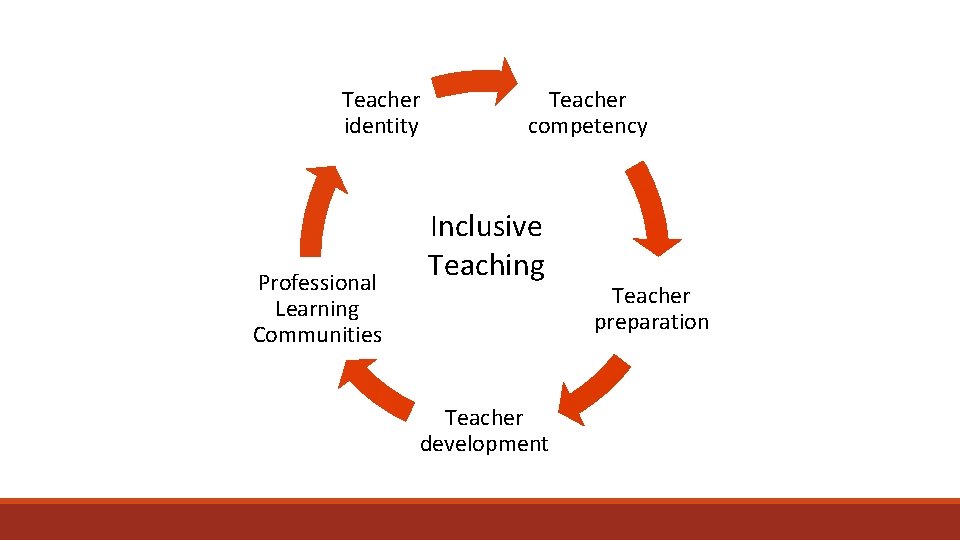
Teacher identity Professional Learning Communities Teacher competency Inclusive Teaching Teacher development Teacher preparation

Assumptions Ø Teachers are learners requiring support and “opportunity to learn” Ø Teacher ability is contingent, rather than fixed Ø Teachers are always agentive; Teacher agency/capability is inseparable from conditions of schooling and practice Ø Teacher practice for inclusion is ambiguous and shifting; it is an invitation to all into a space of discomfort and less-than-certainty that can be generative
Research Matters: What have we learnt through systematic inquiry? Practice Matters: What struggles are being documented? Promising/Challenging Matters: What emerging insights are being stimulated by current dilemmas? New metaphors What new metaphors, if any, are invoked?
Teacher competency for Inclusion: What does teacher competency for inclusion mean? What are teachers supposed to know and be able to do?
Teacher Competency for Inclusion: Research Matters-What do we know? Big Ideas for Knowledge and Disposition* u. Avoid deficit-oriented approaches to student learning; avoid labeling u. Monitor and resist fixed-ability thinking within schooling practices; presume competence and value the notion of “transformability” u. Question notions of “normalcy” and by extension, the concept of “difference” u. Value the perspectives of students with disabilities and their families u. Promote democratic values in schooling communities *(For example, Biklen & Burke, 2006; Danforth & Naraian, 2015; Hart, Drummond, Mc. Intyre, 2007; Slee, 2011; Valle & Connor, 2011)
Teacher Competency for Inclusion: Big Ideas for Skills Research Matters-What do we Know? Ø Child-centered pedagogy Ø Inquiry-based, constructivist approaches Ø Differentiating Instruction for all learners Ø Universally designed classrooms § Multiple forms of representation of content § Multiple forms of engagement of learners § Multiple forms of expression of learning Ø Integrate specialized supports Ø Using Collaborative Teaching Models; Partnerships with Professionals, Para-professionals and Families Ø Making curriculum and pedagogy accessible to all learners
Teacher Competency for Inclusion: Practice Matters ★ How should teachers disrupt normalcy when they are mandated to sort children by ability levels ? ★ How should teachers avoid deficit-oriented approaches when they are asked to identify, measure, and remediate the learning difficulties of students ? ★ How should teachers work towards the empowerment of students and families when they are themselves alienated from decision-making processes that are narrowed to numeric data and which discount their local understandings of students and school communities? ★ How should teachers promote democratic values when they have limited autonomy over curriculum and assessment practices within their schools and classrooms?
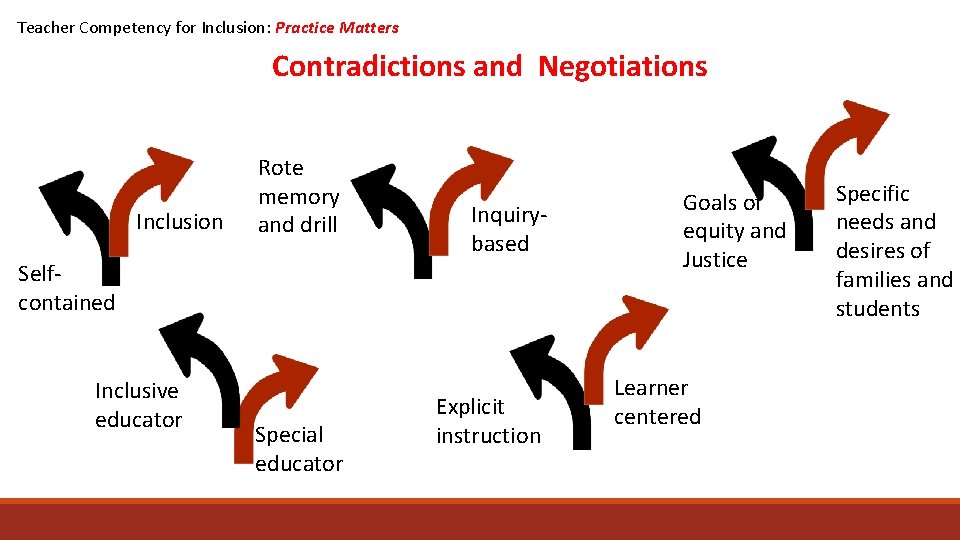
Teacher Competency for Inclusion: Practice Matters Contradictions and Negotiations Inclusion Rote memory and drill Inquirybased Selfcontained Inclusive educator Special educator Explicit instruction Goals of equity and Justice Learner centered Specific needs and desires of families and students
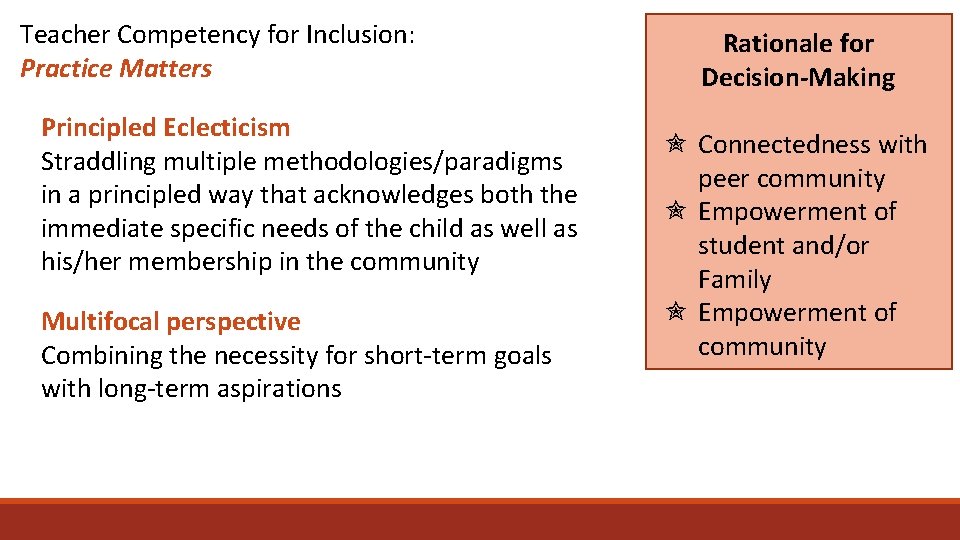
Teacher Competency for Inclusion: Practice Matters Principled Eclecticism Straddling multiple methodologies/paradigms in a principled way that acknowledges both the immediate specific needs of the child as well as his/her membership in the community Multifocal perspective Combining the necessity for short-term goals with long-term aspirations Rationale for Decision-Making ✮ Connectedness with peer community ✮ Empowerment of student and/or Family ✮ Empowerment of community
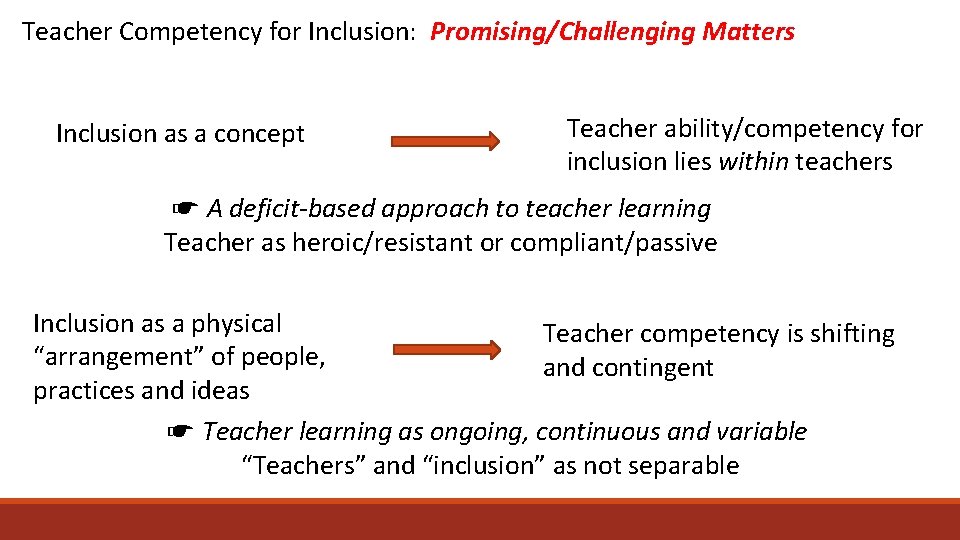
Teacher Competency for Inclusion: Promising/Challenging Matters Inclusion as a concept Teacher ability/competency for inclusion lies within teachers ☛ A deficit-based approach to teacher learning Teacher as heroic/resistant or compliant/passive Inclusion as a physical Teacher competency is shifting “arrangement” of people, and contingent practices and ideas ☛ Teacher learning as ongoing, continuous and variable “Teachers” and “inclusion” as not separable
Teacher Competency for Inclusion: Promising/Challenging Matters v Exemplars of inclusion in practice v Exemplars of decision-making in practice; how do schools, administrators, teachers, make everyday decisions about inclusion? How are people, resources, and ideas mobilized, distributed, and arranged to make inclusion happen?

Teacher preparation for Inclusion What trajectory of experiences can best support pre-service teacher learning?
Teacher Preparation for Inclusion: Research Matters-What do we know? ✭ The central concept of “agent of change” ✭ Teacher candidates experience discomfort in negotiating prior beliefs of ability norms and an inclusive stance ✭ Teacher candidates need to be socialized into inclusion as a stance towards difference, rather than the education of students with disabilities ✭ Teacher education programming for inclusion is still largely compartmentalized into general and special education ✭ Teacher candidates require opportunities for collective reflection and problem-solving
Teacher Preparation for Inclusion: Practice Matters ✭ Teacher candidates experience tensions between the meritocratic structure of schools and an inclusive philosophy; ✭ The absence of predictable models of inclusive practice within their field preparation; contradictory models of practice in schools ✭ The type and nature of intellectual resources that are offered in teacher education programs have to accommodate the complexities of schooling contexts Preparation for Instructional Tension versus Technical Proficiency
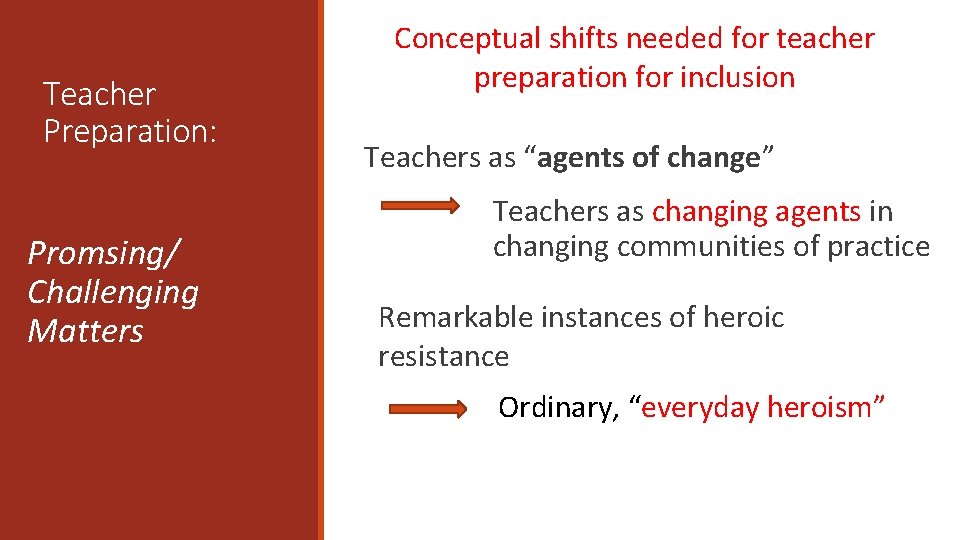
Teacher Preparation: Promsing/ Challenging Matters Conceptual shifts needed for teacher preparation for inclusion Teachers as “agents of change” Teachers as changing agents in changing communities of practice Remarkable instances of heroic resistance Ordinary, “everyday heroism”
Teacher Preparation for Inclusion: Promising Practices Preparation for Instructional Tension ✭Integrating theory with practice § Field-based instruction ✭“Clinically rich” experiences for teacher candidates; § University-school collaborative inquiry partnerships § Partnerships with community-based agencies § Qualified mentor teachers; ➤Professional development for mentor teachers ✭Supervision and support during field experiences § Guided observation; video/debrief; intellectual learning communities; dialogue journals; “rounds” § Navigating the emotional stress of practicing in flawed, deficit-oriented contexts
New metaphors of teacher work for Preparation for Inclusion*… ◦ Inclusion as a borderland space ◦ Boundary practices ◦ World-traveling *(Anzaldua, 1987; Lugones, 1987; Naraian, 2017; Waitoller & Kozleski, 2013)
Teacher Development What conditions can support teachers’ learning and development so that they can perform to the best of their capabilities?
Teacher Development: What do we know? /Practice matters ✭Unlike PD for curricular improvements, PD for inclusion calls for radical shift in perspective on children and schools ✭Inquiry-based opportunities rather than a one-shot workshop are more effective ✭Guided process of inquiry-to-action over a period of time ✭Timely, continuous and relevant supports for particular dimensions of inclusive teaching ✭Teachers as Instructional/Peer coaches ✭Developing cadres of teachers within/across schools to support peer development in inclusive practices
Teacher Development: Promising Practices Role “diffusion”: ★Encourage movement across general and special education boundaries § Collaborative teaching partnerships § Collaborative inquiry groups § Assessment models that emphasize collaboration rather than individualized supports Teachers as Teacher Educators ✭Presuming peer-teacher competence ✭Adopting a posture of empathy ✭Opportunities for collective self-reflection
Professional Learning Communities What are the conditions necessary for teachers’ continual growth?
Professional Learning Communities: What do we know? ➤ Important across teachers’ developmental trajectory ➤ Collective sense-making/reflection for greater focus on student learning ➤ Guided/Facilitated Inquiry
Professional learning Communities: Promising/ Matters ØSystemic opportunities for collaborative learning ØOpportunities for action research ØOpportunities for curricular decisionmaking, planning for student support, professional needs, assessments, etc.
Teacher Identity How can we recognize and support teacher identity formation for more inclusive practice?
Teacher Identity: What do we know? ➤ It matters! ➤ Interconnected with opportunities made available to practice professional obligations ➤ Reflects patterns of distribution of students within and across schools ➤ Teachers’ identities not separable from the capacities of the students they serve
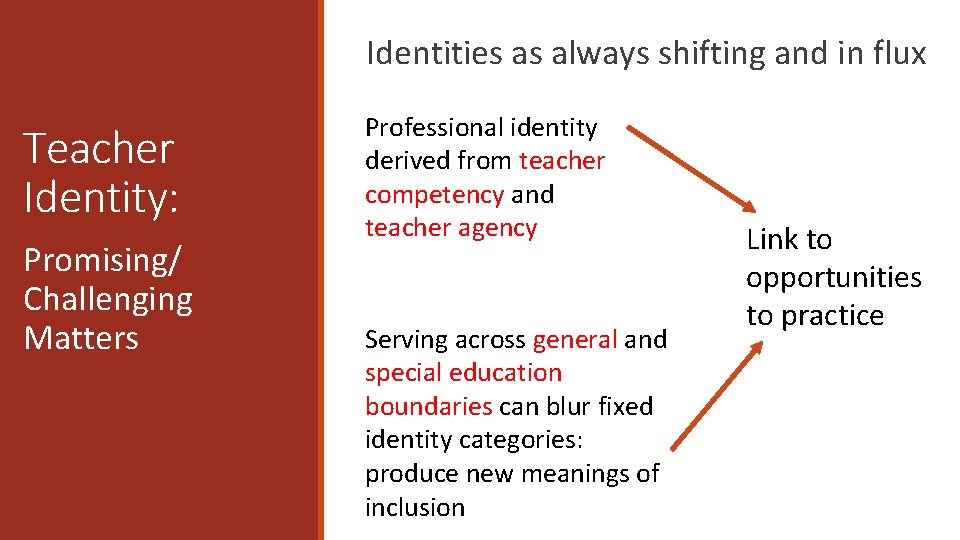
Identities as always shifting and in flux Teacher Identity: Promising/ Challenging Matters Professional identity derived from teacher competency and teacher agency Serving across general and special education boundaries can blur fixed identity categories: produce new meanings of inclusion Link to opportunities to practice
New metaphors for teacher identitymaking… ◦ Teaching as a state of diaspora ◦ Third-Space practitioners
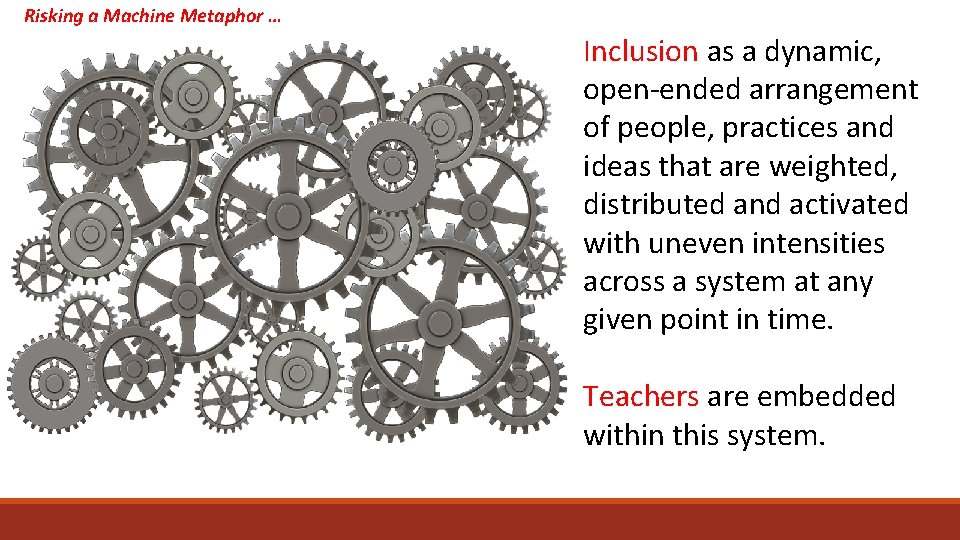
Risking a Machine Metaphor … Inclusion as a dynamic, open-ended arrangement of people, practices and ideas that are weighted, distributed and activated with uneven intensities across a system at any given point in time. Teachers are embedded within this system.
- Slides: 29