
TEACHING FIRSTYEAR STUDENTS Mark Potter Director Center for
- Slides: 25
TEACHING FIRST-YEAR STUDENTS Mark Potter Director, Center for Faculty Development mpotte 10@mscd. edu
Introductions Please introduce yourselves to 2 other people in the room whom you do not already know. Share your interest in teaching in the FYS program. At least 11 of you are here with your “linked” faculty partner. Take this opportunity to meet him/her if you haven’t already done so.
Workshop Objectives Understanding who our first-year students are is a first step to developing meaningful learning experiences for them. Participants in this workshop will Become familiar with the profile of students entering the FYS program. Apply knowledge about undergraduate intellectual development and learning styles to their FYS course designs. Evaluate and determine appropriate course objectives and learning activities. See handout.
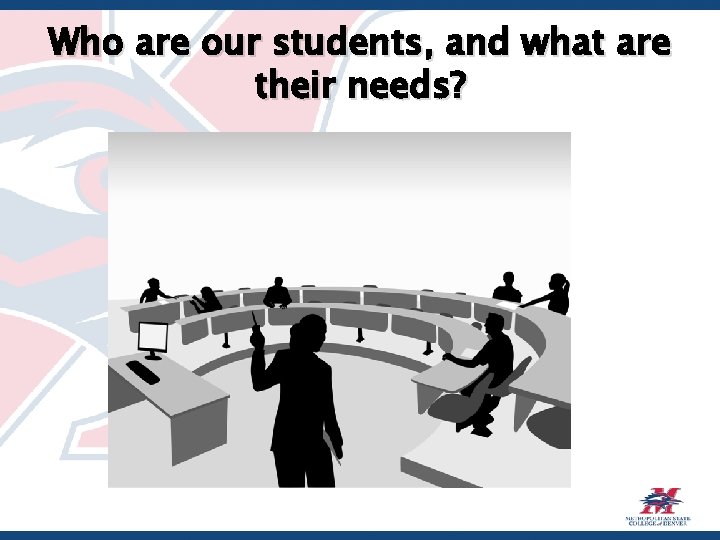
Who are our students, and what are their needs?
Discussion In pairs, discuss the description of college freshmen from the Higher Education Research Institute (“Chronicle” article). What findings from the study stand out to you? How do you think Metro students might compare to national findings?
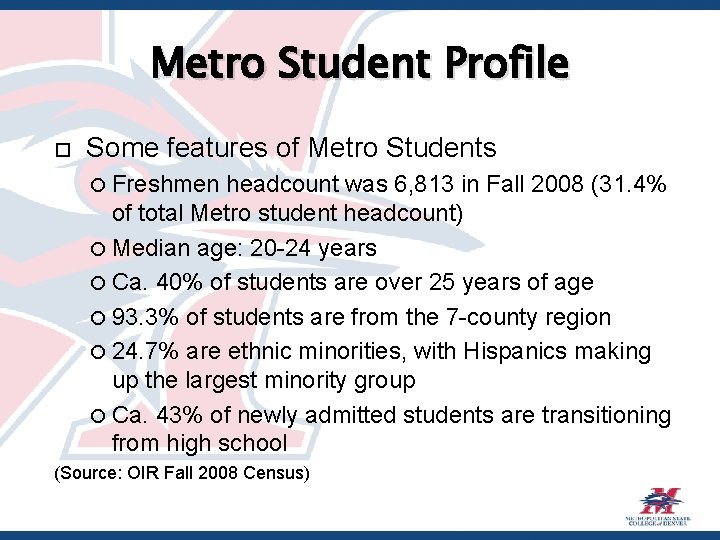
Metro Student Profile Some features of Metro Students Freshmen headcount was 6, 813 in Fall 2008 (31. 4% of total Metro student headcount) Median age: 20 -24 years Ca. 40% of students are over 25 years of age 93. 3% of students are from the 7 -county region 24. 7% are ethnic minorities, with Hispanics making up the largest minority group Ca. 43% of newly admitted students are transitioning from high school (Source: OIR Fall 2008 Census)
Metro FYS Students First-year first-time students Traditional aged Transitioning from high school Ca. 75% are self-selected, motivated by: The chance to connect The promise of guaranteed enrollment Class size ? ? ? 59 Metro Summer Scholars students
Students as Learners Brainstorm: What do we know about learning styles? What initial conclusions can we draw about our course design?
Students as Learners From what we know about the conditions for academic success, students learn best when they Are actively involved. Have an opportunity to function in different learning activities consistent with their learning styles. Believe that their instructors are both invested in their learning and care about them. Receive frequent feedback on their performance. Source: Upcraft and Crissman, 1999, In Hunter & Skipper, Solid Foundations: Building success for first-year seminars.
Students as Learners Perry’s research on student development Read the brief description of dualism in Erickson, et al. , pp. 22 -24. How well does this description align with our perceptions of Metro students? What are some implications for how we teach?
Students as Learners Witkin’s categories of field independent and field sensitive Read the brief description, pp. 36 -37. What sorts of learning activities correspond to the two categories?
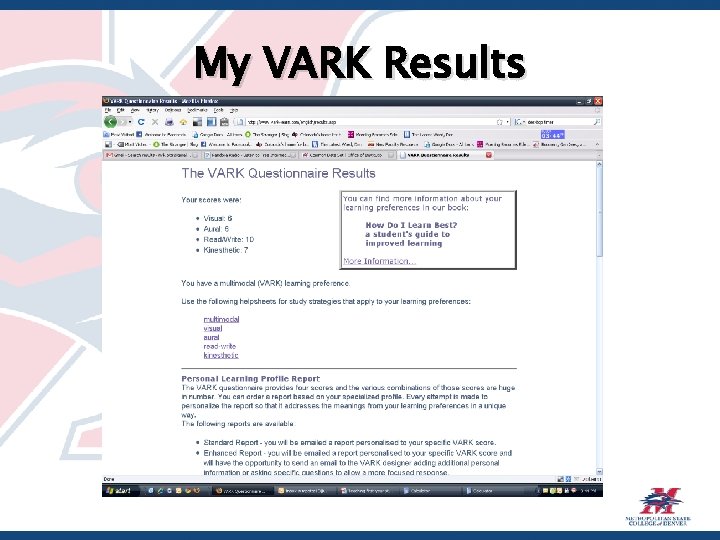
Students as Learners VARK learning skills inventory http: //www. varklearn. com/english/index. asp Some suggestions: Answer the questionnaire yourself while you are designing your course. Incorporate the questionnaire into your course and discuss with students the meaning of their findings.
My VARK Results
Discussion First Year Success Program Objectives Sheila Thompson, Director of Student Learning Assessment
Lunch—Bon appetit
Course Learning Objectives What can we do to align our course learning objectives with the program objectives? Don’t feel constrained by the objectives defined in the regular syllabus; we can supplement them especially with non-content objectives. 2. Take a fresh look at your own values: 1. a) What skills, abilities, knowledge and attributes do you feel it important for students to develop? b) What are the necessary components to create significant learning experiences? Consider FYS program objectives, including importance of co-curricular activities. 4. Consider drafting learning objectives that are integrated across linked sections. 3.
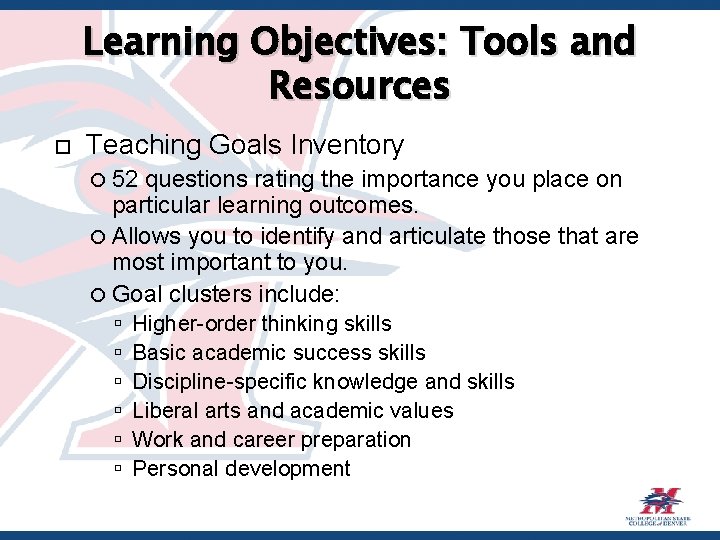
Learning Objectives: Tools and Resources Teaching Goals Inventory 52 questions rating the importance you place on particular learning outcomes. Allows you to identify and articulate those that are most important to you. Goal clusters include: Higher-order thinking skills Basic academic success skills Discipline-specific knowledge and skills Liberal arts and academic values Work and career preparation Personal development
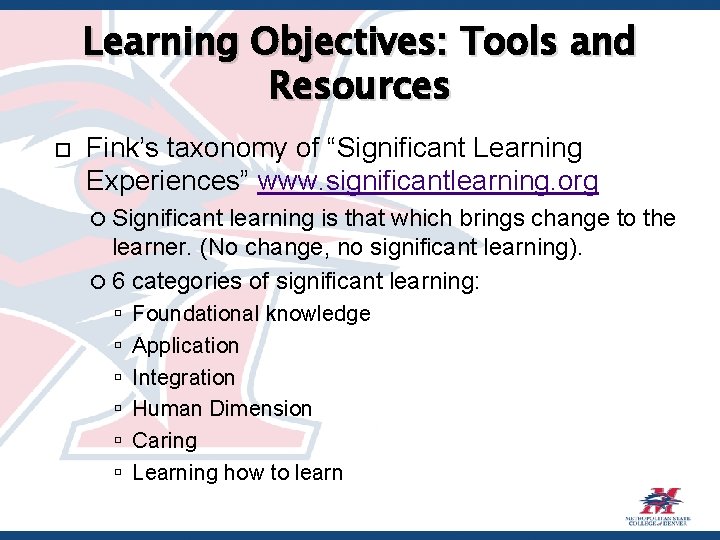
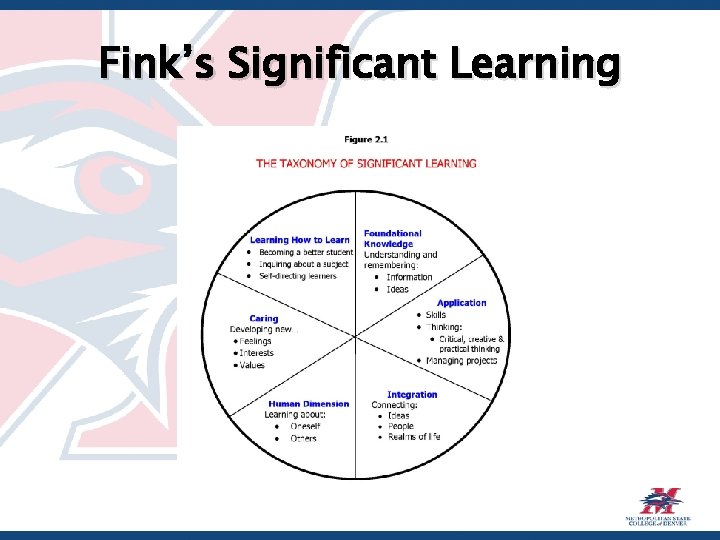
Learning Objectives: Tools and Resources Fink’s taxonomy of “Significant Learning Experiences” www. significantlearning. org Significant learning is that which brings change to the learner. (No change, no significant learning). 6 categories of significant learning: Foundational knowledge Application Integration Human Dimension Caring Learning how to learn
Fink’s Significant Learning
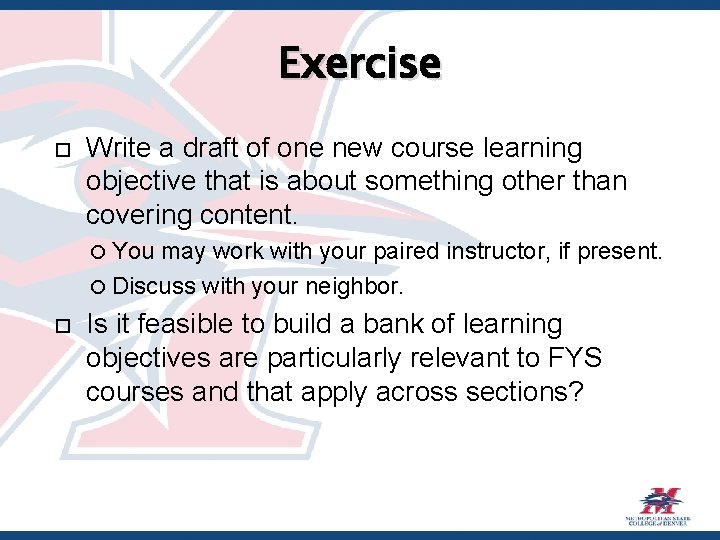
Exercise Write a draft of one new course learning objective that is about something other than covering content. You may work with your paired instructor, if present. Discuss with your neighbor. Is it feasible to build a bank of learning objectives are particularly relevant to FYS courses and that apply across sections?
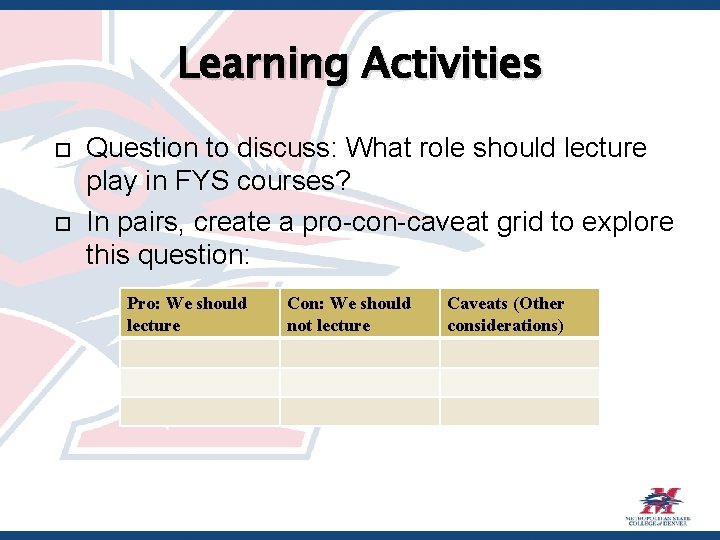
Learning Activities Question to discuss: What role should lecture play in FYS courses? In pairs, create a pro-con-caveat grid to explore this question: Pro: We should lecture Con: We should not lecture Caveats (Other considerations)
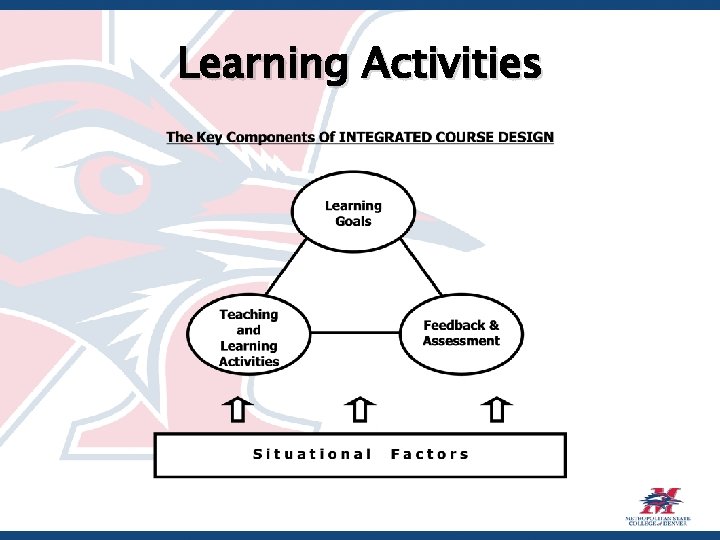
Learning Activities
Activity and Discussion From cards that will be distributed, discuss specific learning activity: Have you used this learning activity in the past? What was your experience? Would you be comfortable using this learning activity in the future? Why, or why not? What do you anticipate might be the challenges to using this learning activity?
Minute Paper Activity What was the most important thing you learned in this session (afternoon)? What question(s) remain uppermost in your mind as we conclude this session? (Write your responses anonymously on a slip of paper that you can hand in).
fin