
Teaching Excellence Teaching Expertise and the Scholarship of



- Slides: 26
Teaching Excellence, Teaching Expertise, and the Scholarship of Teaching Michel A. Wattiaux, Dairy Science Department and Teaching Academy UW-Madison, Teaching Academy Dec 9, 2005; 1
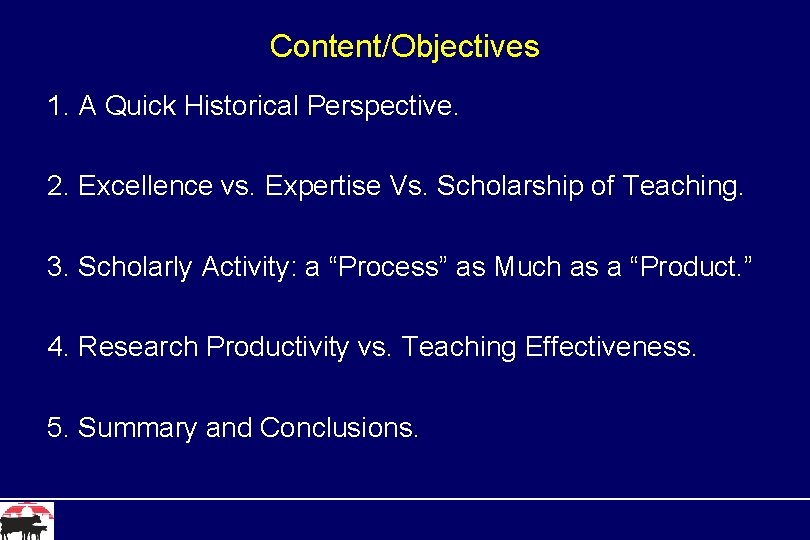
Content/Objectives 1. A Quick Historical Perspective. 2. Excellence vs. Expertise Vs. Scholarship of Teaching. 3. Scholarly Activity: a “Process” as Much as a “Product. ” 4. Research Productivity vs. Teaching Effectiveness. 5. Summary and Conclusions. UW-Madison, Teaching Academy Dec 9, 2005; 2
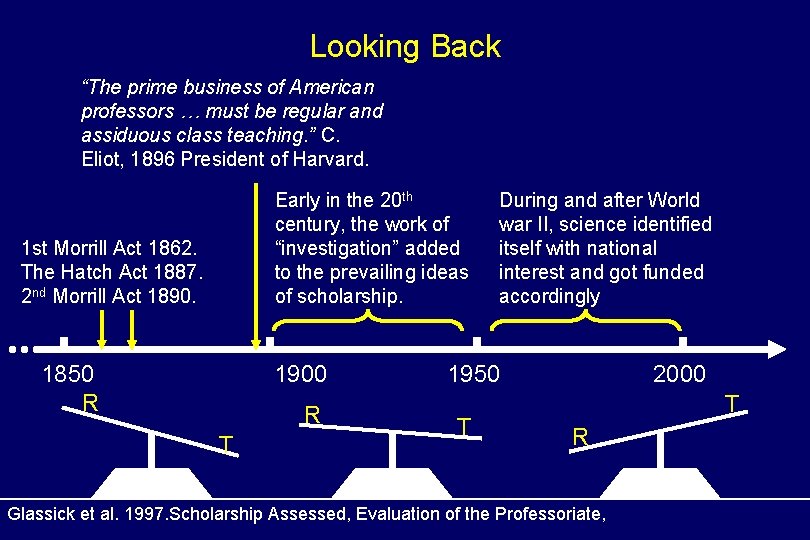
Looking Back “The prime business of American professors … must be regular and assiduous class teaching. ” C. Eliot, 1896 President of Harvard. Early in the 20 th century, the work of “investigation” added to the prevailing ideas of scholarship. 1 st Morrill Act 1862. The Hatch Act 1887. 2 nd Morrill Act 1890. 1850 R 1900 R T During and after World war II, science identified itself with national interest and got funded accordingly 1950 T 2000 T R UW-Madison, Teaching Academy Dec 9, 2005; Glassick et al. 1997. Scholarship Assessed, Evaluation of the Professoriate, 3
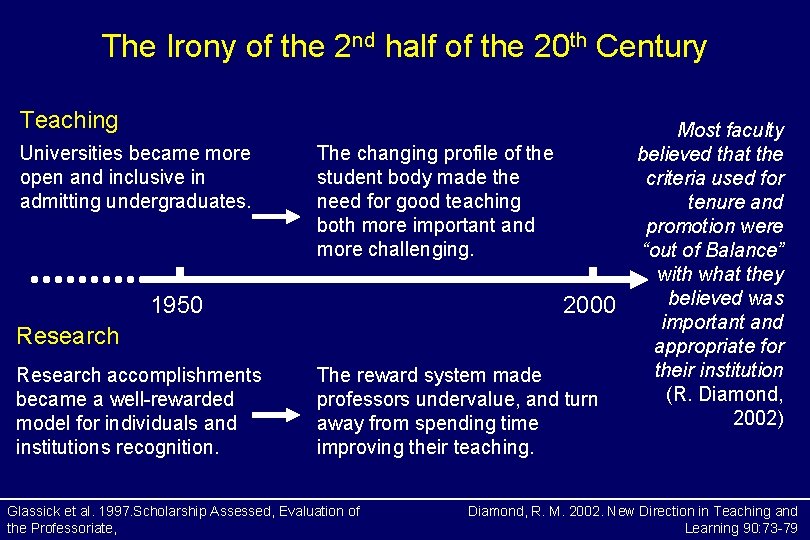
The Irony of the 2 nd half of the 20 th Century Teaching Universities became more open and inclusive in admitting undergraduates. The changing profile of the student body made the need for good teaching both more important and more challenging. 1950 2000 Research accomplishments became a well-rewarded model for individuals and institutions recognition. The reward system made professors undervalue, and turn away from spending time improving their teaching. Glassick et al. 1997. Scholarship Assessed, Evaluation of the Professoriate, Most faculty believed that the criteria used for tenure and promotion were “out of Balance” with what they believed was important and appropriate for their institution (R. Diamond, 2002) Academy Dec 9, 2005; 4 and Diamond, UW-Madison, R. M. 2002. Teaching New Direction in Teaching Learning 90: 73 -79
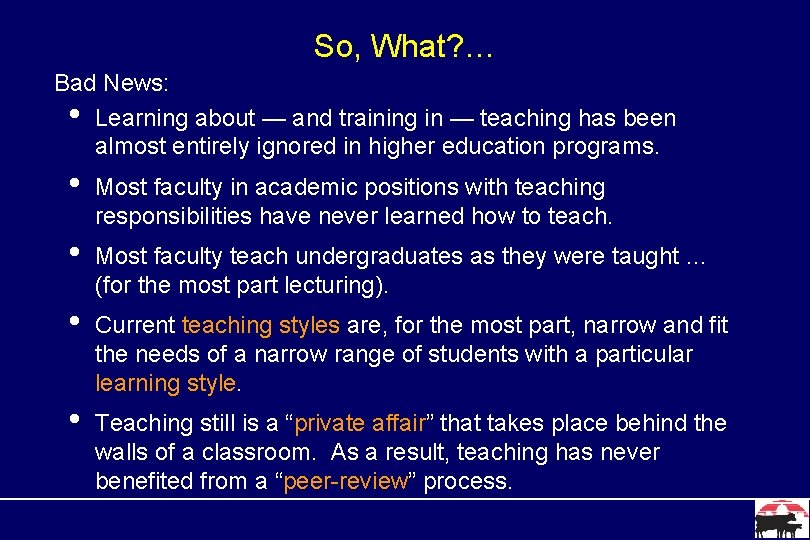
So, What? … Bad News: • Learning about — and training in — teaching has been almost entirely ignored in higher education programs. • Most faculty in academic positions with teaching responsibilities have never learned how to teach. • Most faculty teach undergraduates as they were taught … (for the most part lecturing). • Current teaching styles are, for the most part, narrow and fit the needs of a narrow range of students with a particular learning style. • Teaching still is a “private affair” that takes place behind the walls of a classroom. As a result, teaching has never benefited from a “peer-review” process. UW-Madison, Teaching Academy Dec 9, 2005; 5
Teaching Excellence, Teaching Expertise, and the Scholarship of Teaching Carolin Kreber C. 2002. Higher Education 46: 93 -121 UW-Madison, Teaching Academy Dec 9, 2005; 6
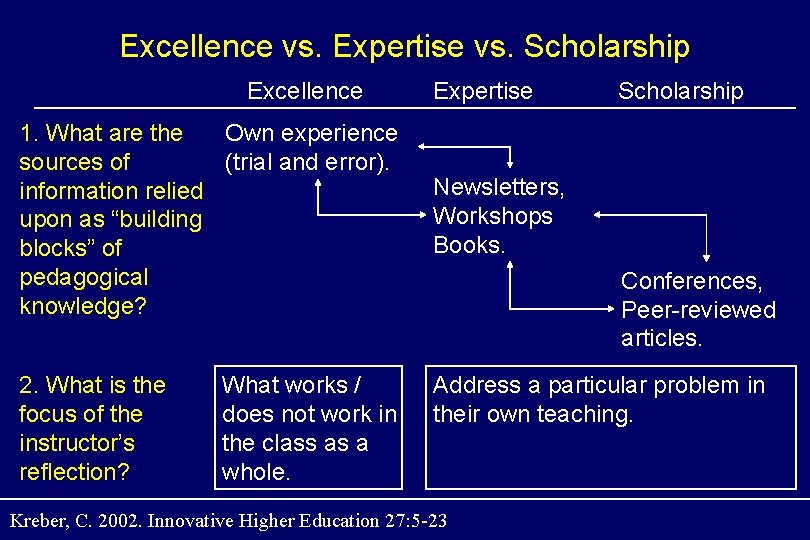
Excellence vs. Expertise vs. Scholarship Excellence Own experience 1. What are the (trial and error). sources of information relied upon as “building blocks” of pedagogical knowledge? 2. What is the focus of the instructor’s reflection? What works / does not work in the class as a whole. Expertise Scholarship Newsletters, Workshops Books. Conferences, Peer-reviewed articles. Address a particular problem in their own teaching. Kreber, C. 2002. Innovative Higher Education 27: 5 -23 UW-Madison, Teaching Academy Dec 9, 2005; 7
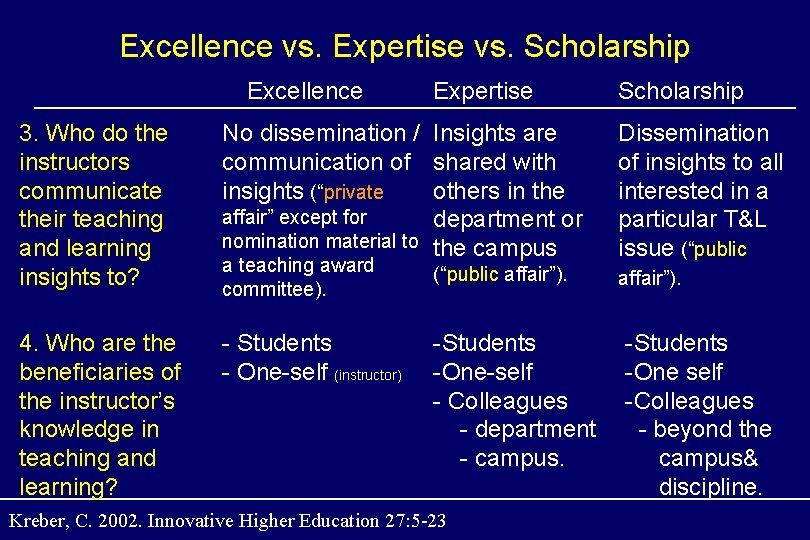
Excellence vs. Expertise vs. Scholarship Excellence Expertise 3. Who do the instructors communicate their teaching and learning insights to? No dissemination / Insights are communication of shared with insights (“private others in the affair” except for department or nomination material to the campus a teaching award committee). (“public affair”). 4. Who are the beneficiaries of the instructor’s knowledge in teaching and learning? - Students - One-self (instructor) -Students -One-self - Colleagues - department - campus. Kreber, C. 2002. Innovative Higher Education 27: 5 -23 Scholarship Dissemination of insights to all interested in a particular T&L issue (“public affair”). -Students -One self -Colleagues - beyond the campus& discipline. UW-Madison, Teaching Academy Dec 9, 2005; 8
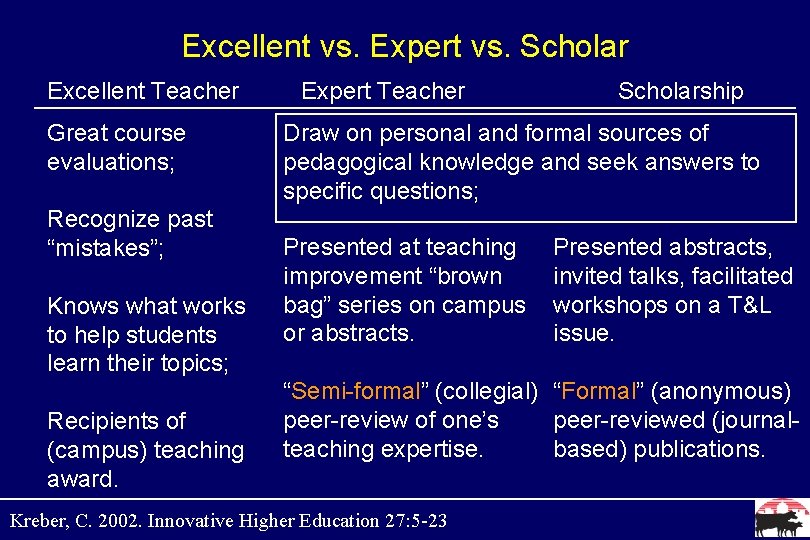
Excellent vs. Expert vs. Scholar Excellent Teacher Great course evaluations; Recognize past “mistakes”; Knows what works to help students learn their topics; Recipients of (campus) teaching award. Expert Teacher Scholarship Draw on personal and formal sources of pedagogical knowledge and seek answers to specific questions; Presented at teaching improvement “brown bag” series on campus or abstracts. Presented abstracts, invited talks, facilitated workshops on a T&L issue. “Semi-formal” (collegial) “Formal” (anonymous) peer-review of one’s peer-reviewed (journalteaching expertise. based) publications. Kreber, C. 2002. Innovative Higher Education 27: 5 -23 UW-Madison, Teaching Academy Dec 9, 2005; 9
UW-Madison, Teaching Academy Dec 9, 2005; 10
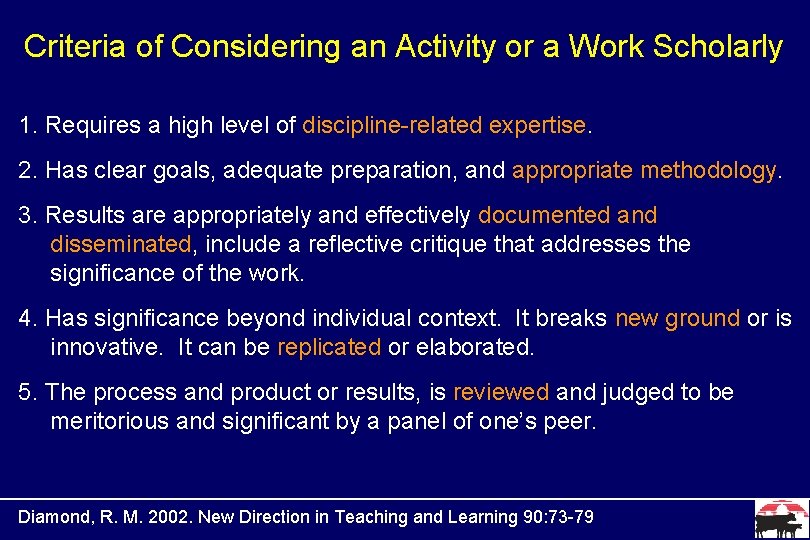
Criteria of Considering an Activity or a Work Scholarly 1. Requires a high level of discipline-related expertise. 2. Has clear goals, adequate preparation, and appropriate methodology. 3. Results are appropriately and effectively documented and disseminated, include a reflective critique that addresses the significance of the work. 4. Has significance beyond individual context. It breaks new ground or is innovative. It can be replicated or elaborated. 5. The process and product or results, is reviewed and judged to be meritorious and significant by a panel of one’s peer. UW-Madison, Teaching Academy Dec 9, 2005; Diamond, R. M. 2002. New Direction in Teaching and Learning 90: 73 -79 11
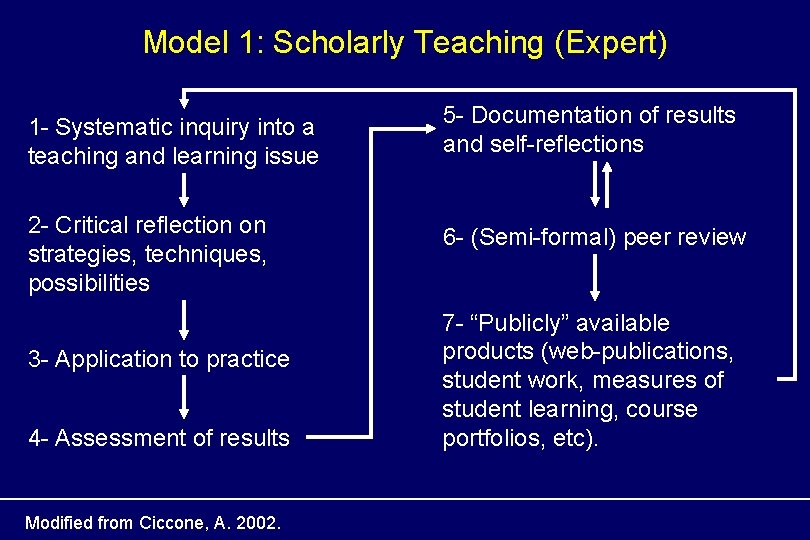
Model 1: Scholarly Teaching (Expert) 1 - Systematic inquiry into a teaching and learning issue 5 - Documentation of results and self-reflections 2 - Critical reflection on strategies, techniques, possibilities 6 - (Semi-formal) peer review 3 - Application to practice 4 - Assessment of results Modified from Ciccone, A. 2002. 7 - “Publicly” available products (web-publications, student work, measures of student learning, course portfolios, etc). UW-Madison, Teaching Academy Dec 9, 2005; 12
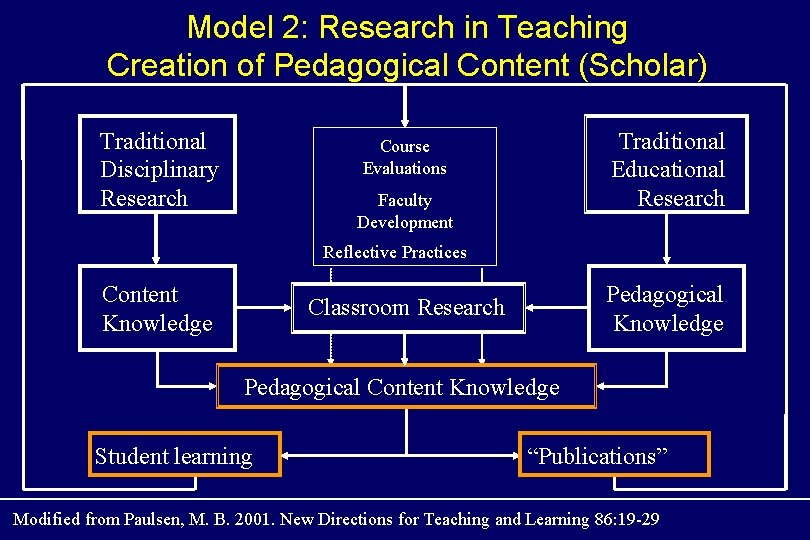
Model 2: Research in Teaching Creation of Pedagogical Content (Scholar) Traditional Disciplinary Research Traditional Educational Research Course Evaluations Faculty Development Reflective Practices Content Knowledge Pedagogical Knowledge Classroom Research Pedagogical Content Knowledge Student learning “Publications” UW-Madison, Teaching Academy Dec 9, 2005; 13 Modified from Paulsen, M. B. 2001. New Directions for Teaching and Learning 86: 19 -29
UW-Madison, Teaching Academy Dec 9, 2005; 14
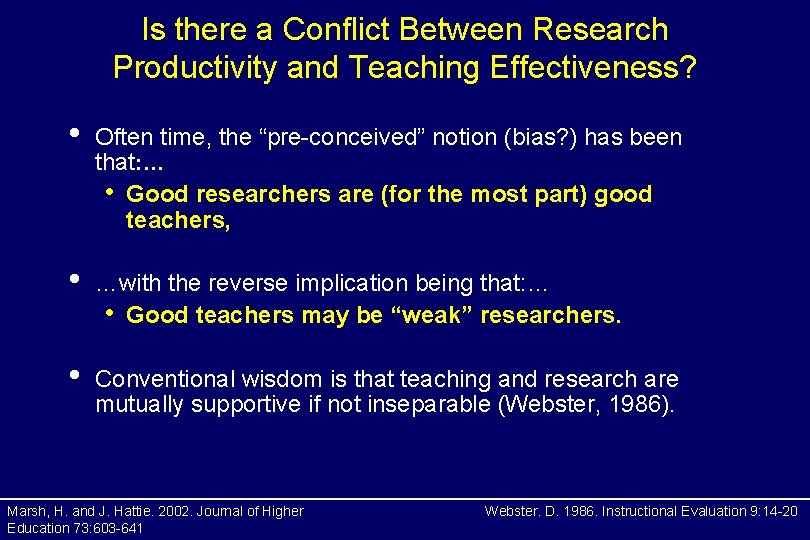
Is there a Conflict Between Research Productivity and Teaching Effectiveness? • Often time, the “pre-conceived” notion (bias? ) has been that: … • Good researchers are (for the most part) good teachers, • …with the reverse implication being that: … • Good teachers may be “weak” researchers. • Conventional wisdom is that teaching and research are mutually supportive if not inseparable (Webster, 1986). Marsh, H. and J. Hattie. 2002. Journal of Higher Education 73: 603 -641 UW-Madison, Academy Dec 9, 2005; 15 Webster. D. 1986. Teaching Instructional Evaluation 9: 14 -20
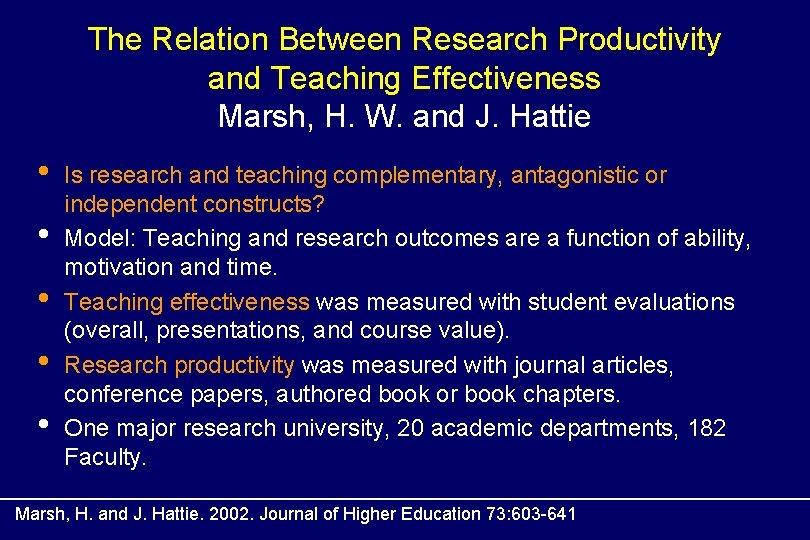
The Relation Between Research Productivity and Teaching Effectiveness Marsh, H. W. and J. Hattie • • • Is research and teaching complementary, antagonistic or independent constructs? Model: Teaching and research outcomes are a function of ability, motivation and time. Teaching effectiveness was measured with student evaluations (overall, presentations, and course value). Research productivity was measured with journal articles, conference papers, authored book or book chapters. One major research university, 20 academic departments, 182 Faculty. UW-Madison, Teaching Academy Dec 9, 2005; Marsh, H. and J. Hattie. 2002. Journal of Higher Education 73: 603 -641 16
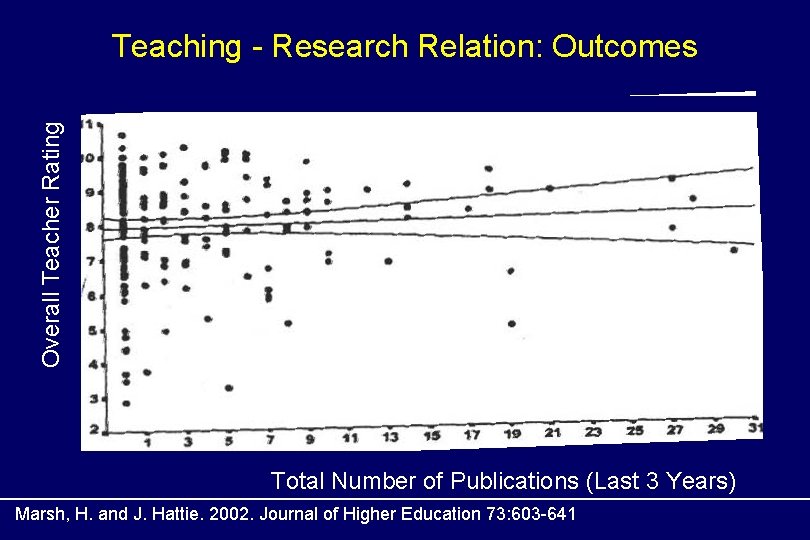
Overall Teacher Rating Teaching - Research Relation: Outcomes r = 0. 03 Total Number of Publications (Last 3 Years) UW-Madison, Teaching Academy Dec 9, 2005; Marsh, H. and J. Hattie. 2002. Journal of Higher Education 73: 603 -641 17
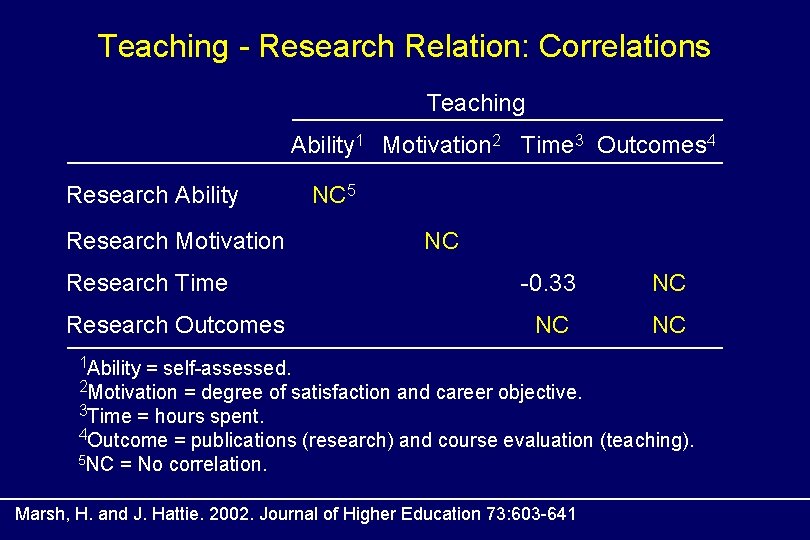
Teaching - Research Relation: Correlations Teaching Ability 1 Motivation 2 Time 3 Outcomes 4 Research Ability Research Motivation Research Time Research Outcomes NC 5 NC -0. 33 NC NC NC 1 Ability = self-assessed. 2 Motivation = degree of satisfaction and career objective. 3 Time = hours spent. 4 Outcome = publications (research) and course evaluation (teaching). 5 NC = No correlation. UW-Madison, Teaching Academy Dec 9, 2005; Marsh, H. and J. Hattie. 2002. Journal of Higher Education 73: 603 -641 18
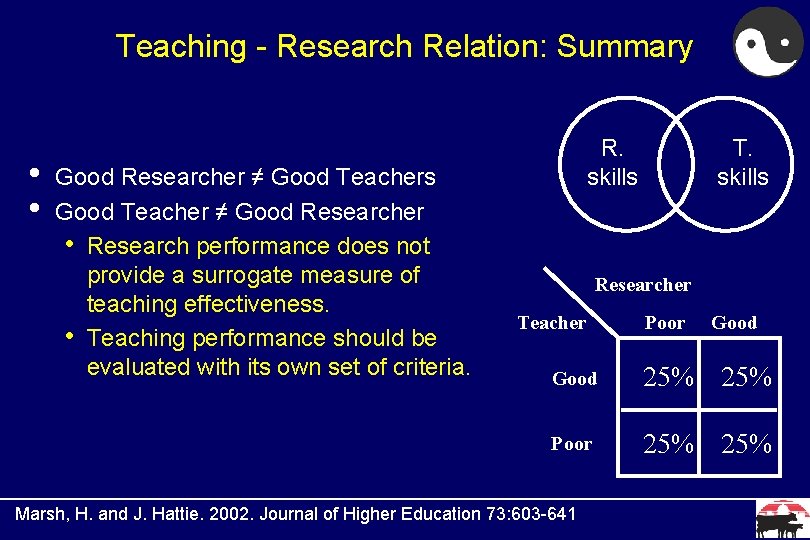
Teaching - Research Relation: Summary • • Good Researcher ≠ Good Teachers Good Teacher ≠ Good Researcher • Research performance does not provide a surrogate measure of teaching effectiveness. • Teaching performance should be evaluated with its own set of criteria. R. skills T. skills Researcher Teacher Poor Good 25% Poor 25% UW-Madison, Teaching Academy Dec 9, 2005; Marsh, H. and J. Hattie. 2002. Journal of Higher Education 73: 603 -641 19
UW-Madison, Teaching Academy Dec 9, 2005; 20
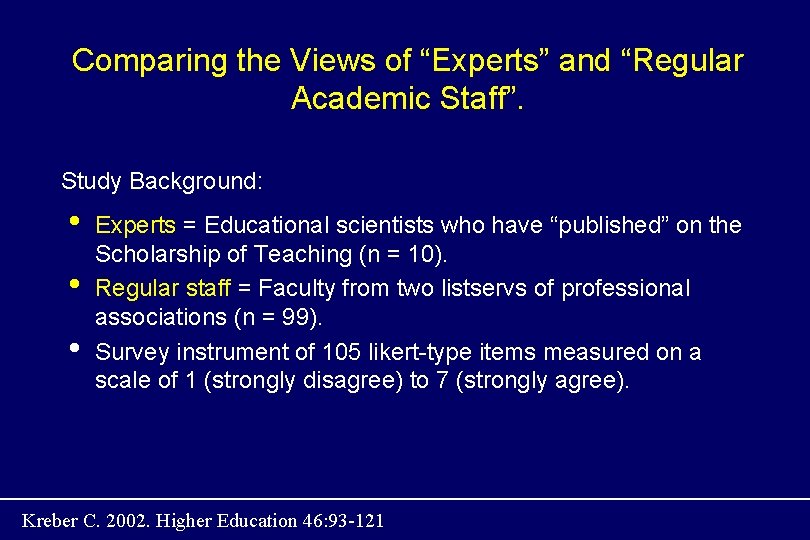
Comparing the Views of “Experts” and “Regular Academic Staff”. Study Background: • • • Experts = Educational scientists who have “published” on the Scholarship of Teaching (n = 10). Regular staff = Faculty from two listservs of professional associations (n = 99). Survey instrument of 105 likert-type items measured on a scale of 1 (strongly disagree) to 7 (strongly agree). Kreber C. 2002. Higher Education 46: 93 -121 UW-Madison, Teaching Academy Dec 9, 2005; 21
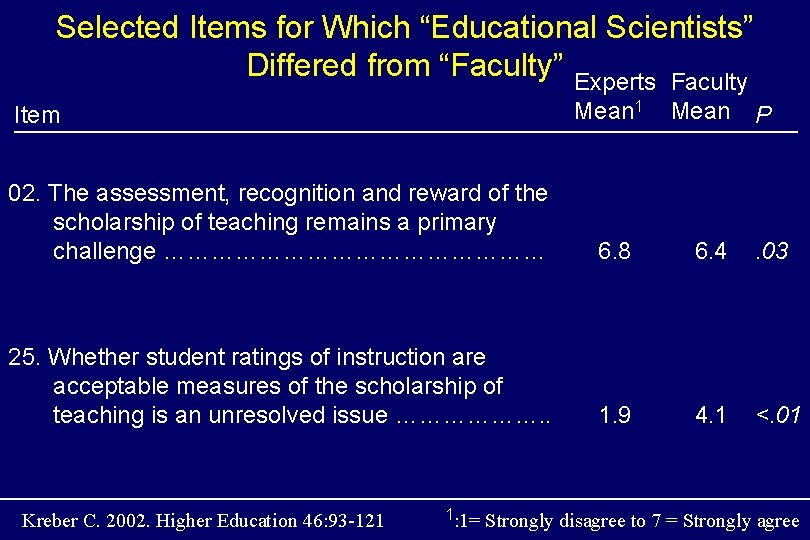
Selected Items for Which “Educational Scientists” Differed from “Faculty” Experts Faculty Mean 1 Item Mean P 02. The assessment, recognition and reward of the scholarship of teaching remains a primary challenge …………………… 6. 8 6. 4 . 03 25. Whether student ratings of instruction are acceptable measures of the scholarship of teaching is an unresolved issue ………………. . 1. 9 4. 1 <. 01 Kreber C. 2002. Higher Education 46: 93 -121 1: 1= UW-Madison, Teaching Academy Dec 9, 2005; 22 Strongly disagree to 7 = Strongly agree
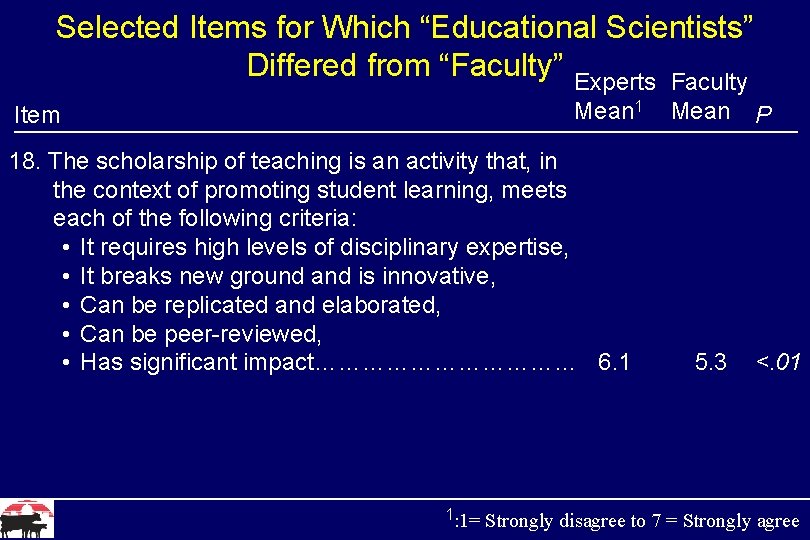
Selected Items for Which “Educational Scientists” Differed from “Faculty” Experts Faculty Mean 1 Item 18. The scholarship of teaching is an activity that, in the context of promoting student learning, meets each of the following criteria: • It requires high levels of disciplinary expertise, • It breaks new ground and is innovative, • Can be replicated and elaborated, • Can be peer-reviewed, • Has significant impact……………… 6. 1 1: 1= Mean 5. 3 P <. 01 UW-Madison, Teaching Academy Dec 9, 2005; 23 Strongly disagree to 7 = Strongly agree
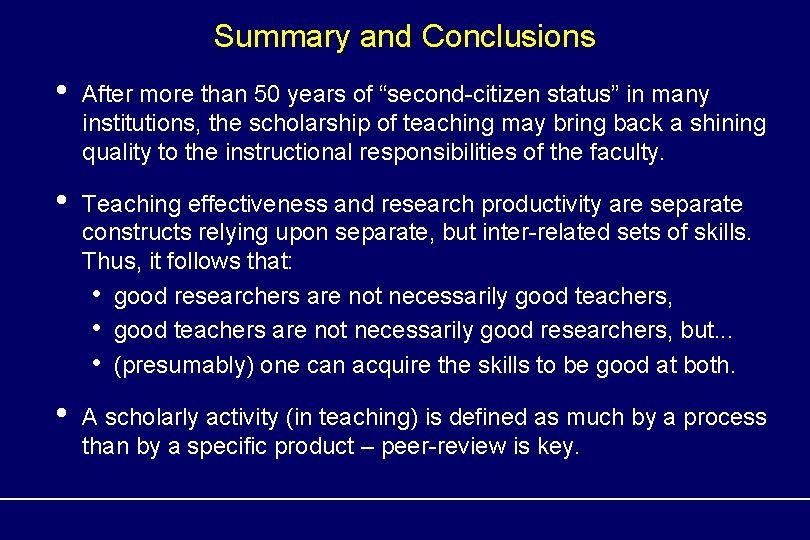
Summary and Conclusions • After more than 50 years of “second-citizen status” in many institutions, the scholarship of teaching may bring back a shining quality to the instructional responsibilities of the faculty. • Teaching effectiveness and research productivity are separate constructs relying upon separate, but inter-related sets of skills. Thus, it follows that: • good researchers are not necessarily good teachers, • good teachers are not necessarily good researchers, but. . . • (presumably) one can acquire the skills to be good at both. • A scholarly activity (in teaching) is defined as much by a process than by a specific product – peer-review is key. UW-Madison, Teaching Academy Dec 9, 2005; 24
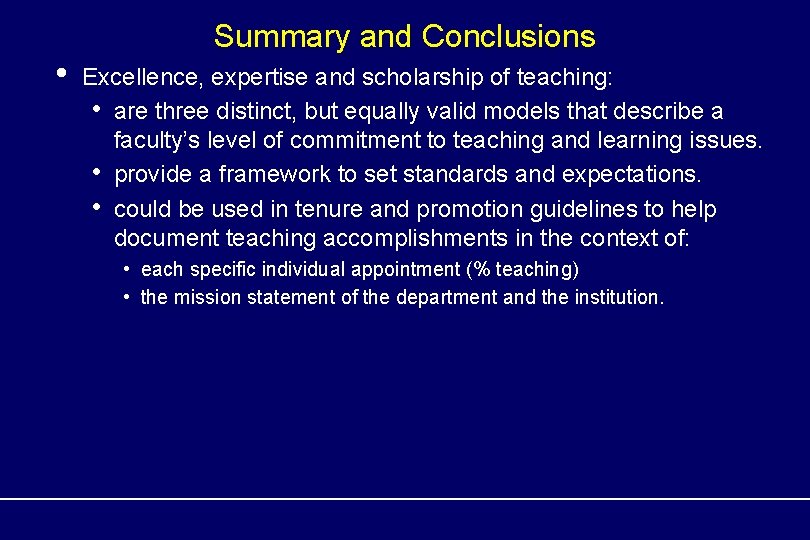
• Summary and Conclusions Excellence, expertise and scholarship of teaching: • are three distinct, but equally valid models that describe a faculty’s level of commitment to teaching and learning issues. • provide a framework to set standards and expectations. • could be used in tenure and promotion guidelines to help document teaching accomplishments in the context of: • each specific individual appointment (% teaching) • the mission statement of the department and the institution. UW-Madison, Teaching Academy Dec 9, 2005; 25
Citations are available at: http: //dairynutrient. wisc. edu/page. php? id=87 UW-Madison, Teaching Academy Dec 9, 2005; 26