
Teaching evidence based policy to fly How to
‘Teaching evidence based policy to fly’: How to deal with the politics of policy learning and transfer Paul Cairney, Professor of Politics and Public Policy p. a. cairney@stir. ac. uk @Cairneypaul https: //paulcairney. wordpress. com/

Wouldn’t it be nice?
But there are three problems 1. ‘Evidence based’ policy transfer is misleading 2. ‘Blueprint’ approach ignores local context 3. ‘How to’ guides exist, but most studies do not identify their use. Why? Policy learning and transfer require political choices, not mechanistic steps.

Political choice and 3 problems with ‘evidence based’ policymaking 1. The ‘good evidence’ problem 2. The ‘information processing’ problem 3. The complexity problem
’Evidence based’ is one of many types of policy learning Epistemic. Experts transmitting knowledge to policymakers. Reflection. Dialogue to incorporate diverse forms of knowledge. Bargaining. Learning how to cooperate/compete effectively. Hierarchy. Actors with authority learn how to impose their aims; others learn the limits to their discretion.

Policy Transfer studies suggest: 1. Some transfer is voluntary • Shortcuts to learning: propinquity, entrepreneurs, limited searches for evidence. 2. Some transfer is driven by pressure • Encouragement by governments, international norms/ agreements, ‘spillovers’, foreign investment.
Some studies warn about failure to: 1. Generate or use enough evidence on what made the initial policy successful 2. Adapt policy to local circumstances 3. Back policy change with sufficient resources But the assumption is that transfer is of a product
Other studies provide caveats: 1. ‘Transfer’ is really ‘translation’ or ‘transformation’ 2. Transfer success not the same as implementation success … 3. … or policy success The assumption is that ‘failed transfer’ makes less sense
Political choices combine: evidence and governance Implementation science Story telling Improvement method How should you Hierarchy of gather evidence? evidence, RCTs Practitioner knowledge Service user feedback Mix of evidence Trained practitioners experimenting and evaluating How should you Uniform model ‘scale up’ from Fidelity to dosage best practice? Tell stories, invite people to learn If you think your practice is working, keep doing it. What aim should Administer the you prioritise? active ingredient Governance principles: localism, respect Training, experimenting, feedback
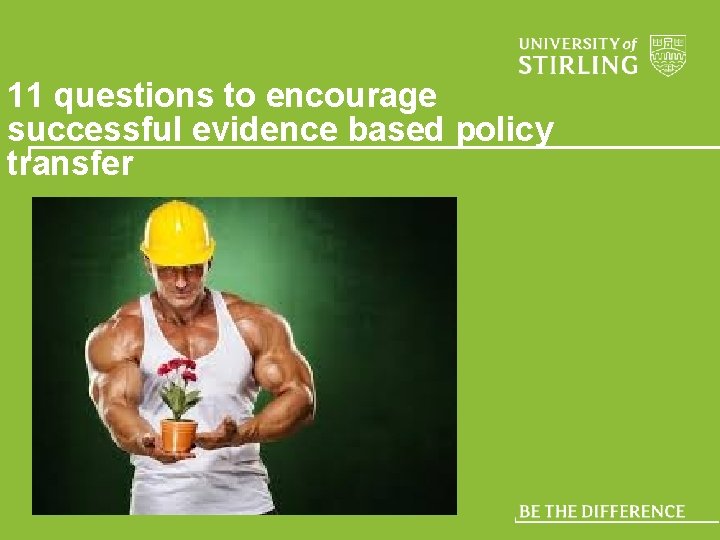
11 questions to encourage successful evidence based policy transfer
11 questions to encourage successful evidence based policy transfer 1. What problem did policymakers say they were trying to solve, and why? 2. What solution did they produce? 3. Why? 1 -3 help establish comparability in agenda setting
11 questions to encourage successful evidence based policy transfer 4. Was the project introduced in a comparable region? 5. Was it introduced nationwide, or in a region which is sufficiently representative of the national experience? 6. How do we account for the role of scale and cultural expectations? 4 -6 help establish meaningful comparison
11 questions to encourage successful evidence based policy transfer 7. Evaluated independently, and well? 8. Enough time for long term evaluation? 9. Evaluated more favourably than other solutions? 10. Are we identifying promise or evidence of success? 7 -10 help establish evidence base
11 questions to encourage successful evidence based policy transfer 11. How shall we transfer policy at scale? • Fidelity and uniformity? • Storytelling and discretion? • Training and pragmatic approaches to evidence? 11 links good transfer to good policymaking
Take home messages 1. Communication technology helps increase access to information from international experience 2. It also increases the chance to import policy unwisely 3. More evidence is not a substitute for analysis and choice Key choices include: • How to define the problem to solve • How to identify good evidence on policy transfer • How to connect good evidence to good
THANK YOU Paul Cairney, Professor of Politics and Public Policy p. a. cairney@stir. ac. uk @Cairneypaul https: //paulcairney. wordpress. com/
- Slides: 16