
Teaching English Language Learners ELLs What We Know
- Slides: 1
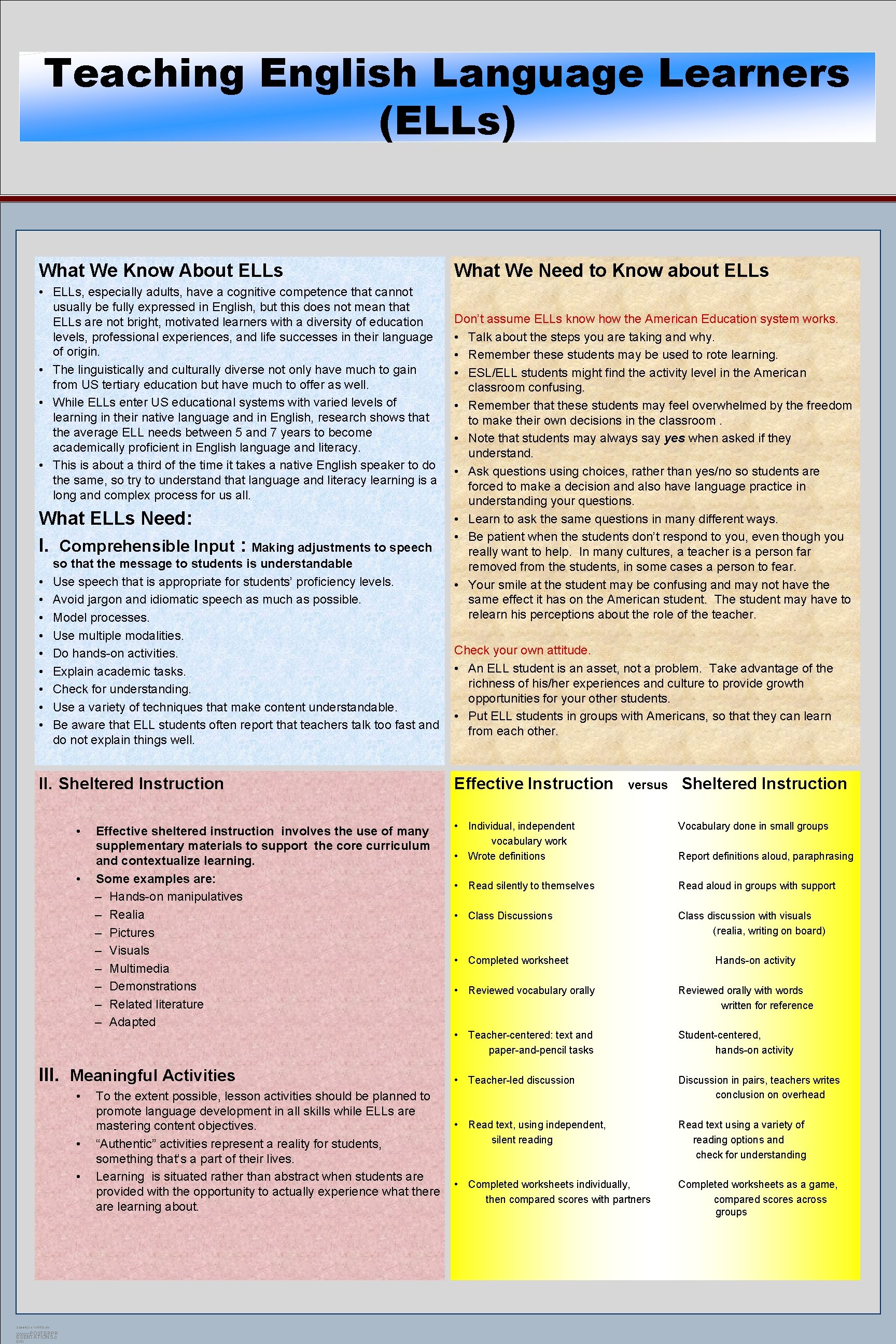
Teaching English Language Learners (ELLs) What We Know About ELLs • ELLs, especially adults, have a cognitive competence that cannot usually be fully expressed in English, but this does not mean that ELLs are not bright, motivated learners with a diversity of education levels, professional experiences, and life successes in their language of origin. • The linguistically and culturally diverse not only have much to gain from US tertiary education but have much to offer as well. • While ELLs enter US educational systems with varied levels of learning in their native language and in English, research shows that the average ELL needs between 5 and 7 years to become academically proficient in English language and literacy. • This is about a third of the time it takes a native English speaker to do the same, so try to understand that language and literacy learning is a long and complex process for us all. What ELLs Need: I. Comprehensible Input : Making adjustments to speech • • • so that the message to students is understandable Use speech that is appropriate for students’ proficiency levels. Avoid jargon and idiomatic speech as much as possible. Model processes. Use multiple modalities. Do hands-on activities. Explain academic tasks. Check for understanding. Use a variety of techniques that make content understandable. Be aware that ELL students often report that teachers talk too fast and do not explain things well. II. Sheltered Instruction • • Effective sheltered instruction involves the use of many supplementary materials to support the core curriculum and contextualize learning. Some examples are: – Hands-on manipulatives – Realia – Pictures – Visuals – Multimedia – Demonstrations – Related literature – Adapted III. Meaningful Activities • • • DESIGNED & PRINTED BY: www. POSTERPR ESENTATIONS. c om To the extent possible, lesson activities should be planned to promote language development in all skills while ELLs are mastering content objectives. “Authentic” activities represent a reality for students, something that’s a part of their lives. Learning is situated rather than abstract when students are provided with the opportunity to actually experience what there are learning about. What We Need to Know about ELLs Don’t assume ELLs know how the American Education system works. • Talk about the steps you are taking and why. • Remember these students may be used to rote learning. • ESL/ELL students might find the activity level in the American classroom confusing. • Remember that these students may feel overwhelmed by the freedom to make their own decisions in the classroom. • Note that students may always say yes when asked if they understand. • Ask questions using choices, rather than yes/no so students are forced to make a decision and also have language practice in understanding your questions. • Learn to ask the same questions in many different ways. • Be patient when the students don’t respond to you, even though you really want to help. In many cultures, a teacher is a person far removed from the students, in some cases a person to fear. • Your smile at the student may be confusing and may not have the same effect it has on the American student. The student may have to relearn his perceptions about the role of the teacher. Check your own attitude. • An ELL student is an asset, not a problem. Take advantage of the richness of his/her experiences and culture to provide growth opportunities for your other students. • Put ELL students in groups with Americans, so that they can learn from each other. Effective Instruction versus Sheltered Instruction • Individual, independent vocabulary work • Wrote definitions Vocabulary done in small groups • Read silently to themselves Read aloud in groups with support • Class Discussions Class discussion with visuals (realia, writing on board) • Completed worksheet Report definitions aloud, paraphrasing Hands-on activity • Reviewed vocabulary orally Reviewed orally with words written for reference • Teacher-centered: text and paper-and-pencil tasks Student-centered, hands-on activity • Teacher-led discussion Discussion in pairs, teachers writes conclusion on overhead • Read text, using independent, silent reading Read text using a variety of reading options and check for understanding • Completed worksheets individually, then compared scores with partners Completed worksheets as a game, compared scores across groups