
Teaching English Grammar Penny Ur 2015 1 This




- Slides: 72
Teaching English Grammar Penny Ur 2015 1
This session A. Some background research and theory • What is ‘correct’ grammar? • The importance of grammatical accuracy • ‘Implicit’ and ‘explicit’ grammar teaching B. Classroom practice and materials • Explanations • Learning by heart • ‘Focus on Form’ • Practice 2
What is ‘correct’ grammar 3
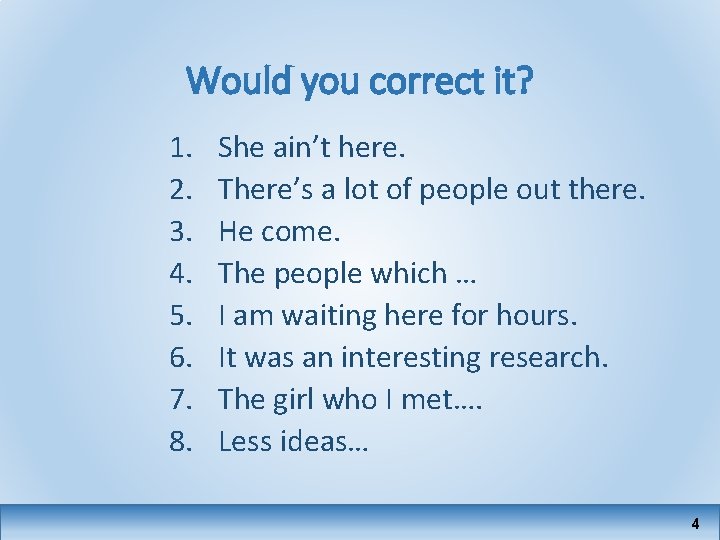
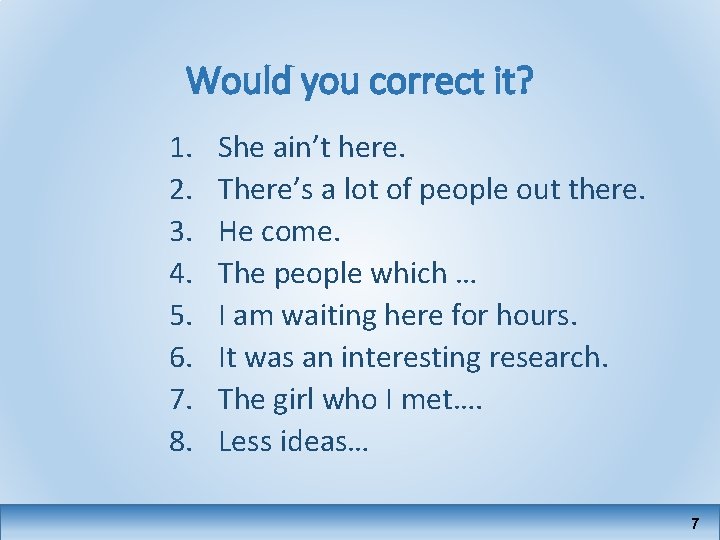
Would you correct it? 1. 2. 3. 4. 5. 6. 7. 8. She ain’t here. There’s a lot of people out there. He come. The people which … I am waiting here for hours. It was an interesting research. The girl who I met…. Less ideas… 4
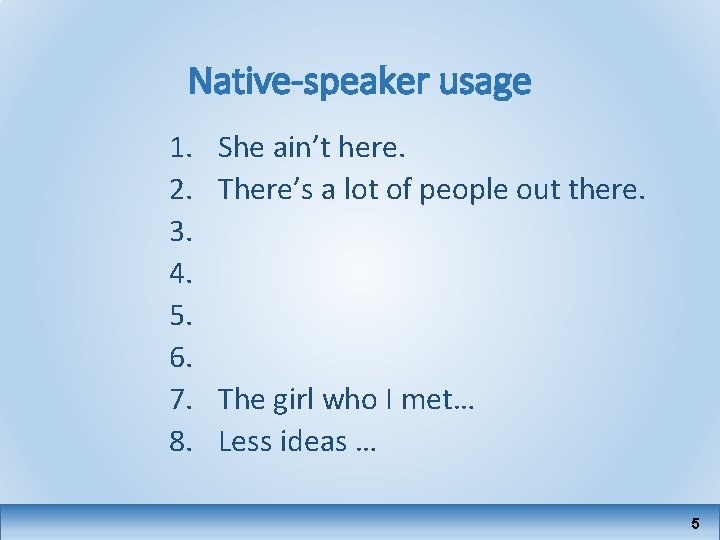
Native-speaker usage 1. 2. 3. 4. 5. 6. 7. 8. She ain’t here. There’s a lot of people out there. The girl who I met… Less ideas … 5
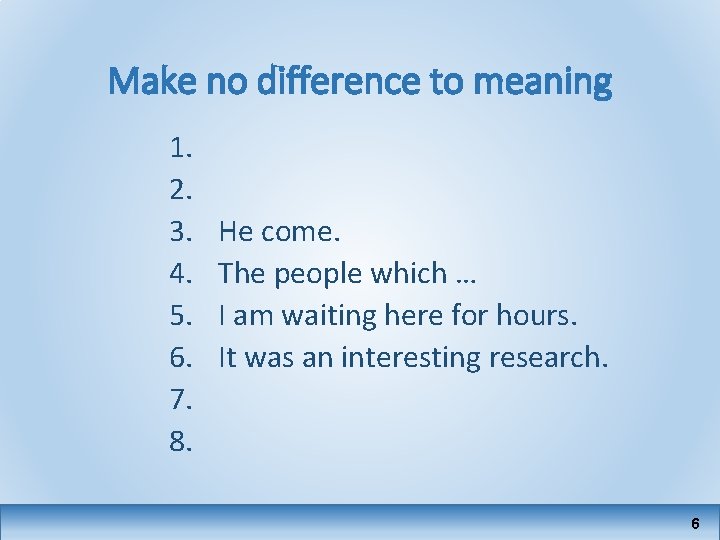
Make no difference to meaning 1. 2. 3. 4. 5. 6. 7. 8. He come. The people which … I am waiting here for hours. It was an interesting research. 6
Would you correct it? 1. 2. 3. 4. 5. 6. 7. 8. She ain’t here. There’s a lot of people out there. He come. The people which … I am waiting here for hours. It was an interesting research. The girl who I met…. Less ideas… 7
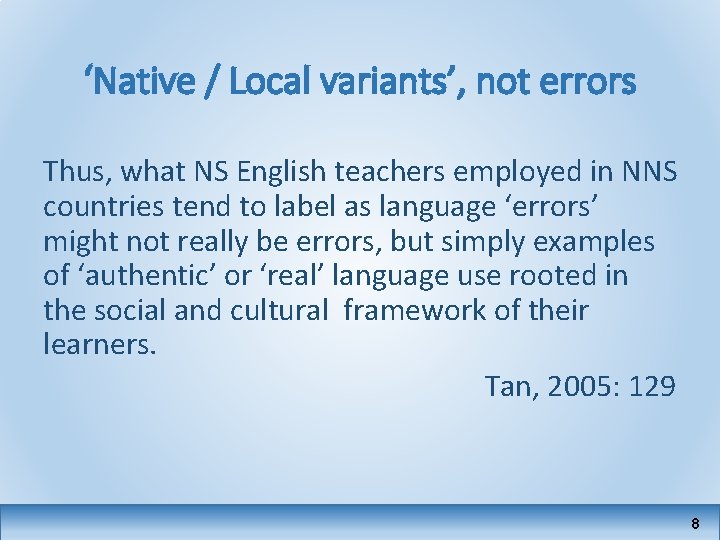
‘Native / Local variants’, not errors Thus, what NS English teachers employed in NNS countries tend to label as language ‘errors’ might not really be errors, but simply examples of ‘authentic’ or ‘real’ language use rooted in the social and cultural framework of their learners. Tan, 2005: 129 8
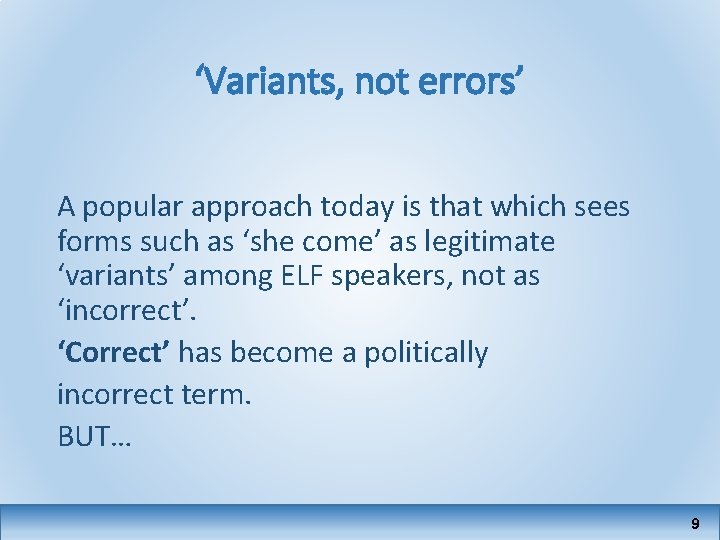
‘Variants, not errors’ A popular approach today is that which sees forms such as ‘she come’ as legitimate ‘variants’ among ELF speakers, not as ‘incorrect’. ‘Correct’ has become a politically incorrect term. BUT… 9
I would correct them all. …because I am a teacher. 10
Why should we relate to these usages as incorrect? 1. Students have a right to be taught the most useful, acceptable and important forms used for ELF worldwide. 2. I don’t have time to teach everything: need to decide on priorities. 3. Students want clearcut guidance. 4. We need a clear basis for classroom teaching, materials design and tests. 11
So … When we encounter different ways of saying things in English, I will encourage awareness of and respect for the different varieties of English, with their diverse usages. But I will not relate to usages such as those listed earlier as ‘acceptable’ or ‘correct’ for the students’ own emergent language production; and I will correct them if they appear. 12
But what are ‘correct’ forms? Most of these are obvious. For some, we guess, based on our own intuitions as fully competent speakers Grammars? Dictionaries? In the future: a ‘wiki’? 13
Conclusion There is such a thing as ‘correct’ and ‘incorrect’, ‘acceptable’ and ‘unacceptable’ usage in the context of English as an international language. Where learners use incorrect or unacceptable forms, we should correct them. 14
A Reservation With older / more advanced learners I would raise awareness of variants they will encounter. These are acceptable in input. But they should aim for standard forms for their own output. 15
Importance of grammatical accuracy 16
Questionnaire (1) 4=strongly agree 3=agree 2=not sure 1=don’t agree 1. It is important to me to know that I’m using correct grammar when speaking my second language __ 2. It is important to me to know that I’m using correct grammar when writing my second language __ 17
Grammatical accuracy is important because… …From the point of view of the hearer/reader, inaccuracy, even if it doesn’t affect meaning, is – distracting – ‘uncomfortable’ – may lower respect for the speaker/writer 18
And because… … from the point of view of the speaker/writer, inaccuracy may – lower self-confidence – lower self-respect as a language user 19
And because… …from the point of view of the teacher, professionalism means teaching the best language we can, aiming for full grammatical accuracy for our students. 20
Reservations 1. The fact that correct grammar is important does not necessarily mean that lessons should be mainly grammar-based. 2. In any case, vocabulary is more important than grammar. 3. In some contexts, we may prioritize meanings and ‘downplay’ grammatical accuracy. 21
Implicit and explicit grammar teaching 22
1. 2 Implicit and explicit knowledge Implicit knowledge is ‘I get it right without thinking or analyzing’ Explicit knowledge is ‘I think and analyze in order to get it right’. Our ultimate aim is for our students to achieve implicit knowledge of grammar. 23
Implicit and explicit teaching Implicit teaching: just providing exposure to and use of the grammar without explaining or applying explicit rules. Explicit teaching: explaining and applying rules. 24
The question: Does implicit teaching lead to our goal of implicit knowing? 25
Implicit teaching § Providing comprehensible input (Krashen, 1983) § Encouraging students to produce output (Swain, 1995) § Task-based learning (Skehan, 2003) § Exposing students to exemplars of grammatical forms and meanings • N. Ellis (2002): frequency • Meunier & Granger (2008): formulaic sequences 26
The teachability hypothesis There is a natural developmental sequence of acquisition of morpho-syntactical structures. Teaching of a grammatical feature will be effective only if the learner is developmentally ready to acquire it. Teaching of a feature when a learner is not ready may have a detrimental effect. (Pienemann, 1984; Spada & Lightbown, 1999) 27
Explicit teaching § Teaching grammatical rules (R. Ellis, 2001) § Providing practice exercises (Dekeyser, 2007) § Explicit corrective feedback on errors (R. Ellis et al. , 2006) 28
Questionnaire (2) 4 = strongly agree 3= agree 2 = not sure 1 = don’t agree When I was taught English, it helped me use correct grammar if the teacher a) provided lots of opportunities to communicate __ b) provided lots of opportunities to read and listen to correct English __ c) provided explanations of grammatical rules __ d)) provided opportunities to practice (grammar exercises) __ e) corrected my mistakes __ 29
Research evidence Explicit grammar teaching appears to contribute to better learning of grammar. Norris and Ortega (2001), Ellis (2012) But importance also of meaningful, communicative language use. 30
Interim summary 31
§ We shall teach standard grammatical forms and meanings. § The teaching and learning of such forms and meanings is important. § Both explicit and implicit strategies should be used when teaching grammar. 32
Some implications for classroom teaching and teaching materials 33
Combining explicit and implicit classroom strategies § § Explanations Learning by heart, language play ‘Focus on form’ Practice 34
Explanations 35
Proactive or reactive May be ‘proactive’: based on a grammatical syllabus. May be ‘reactive’: based on something that has come up in a text or task (‘focus on form’). 36
Deductive or inductive May be deductive: the teacher or textbook explains, the rule is then implemented in examples (or practice) May be inductive: the teacher provides examples, learners then work out the rule 37
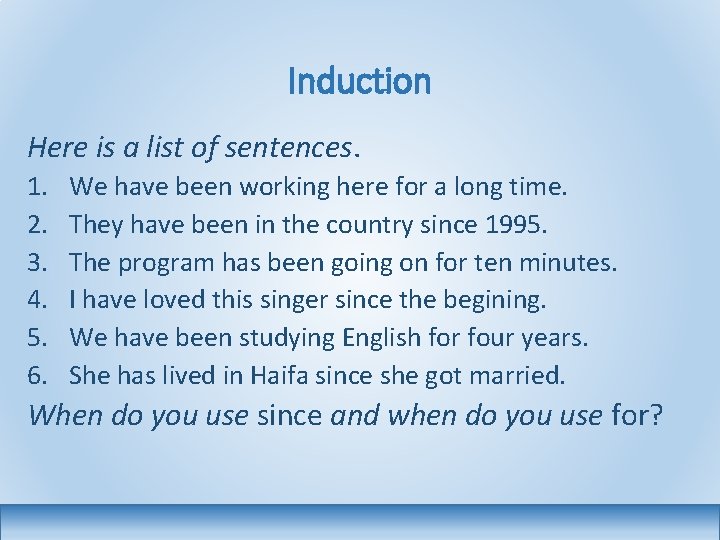
Induction Here is a list of sentences. 1. 2. 3. 4. 5. 6. We have been working here for a long time. They have been in the country since 1995. The program has been going on for ten minutes. I have loved this singer since the begining. We have been studying English for four years. She has lived in Haifa since she got married. When do you use since and when do you use for?
The process of explanation ‘Sandwich’: § Provide meaningful examples § Give a good pedagogical rule § Give more examples 39
A good pedagogical rule Would you use the following rules with your students? What criticisms can you apply to them? 40
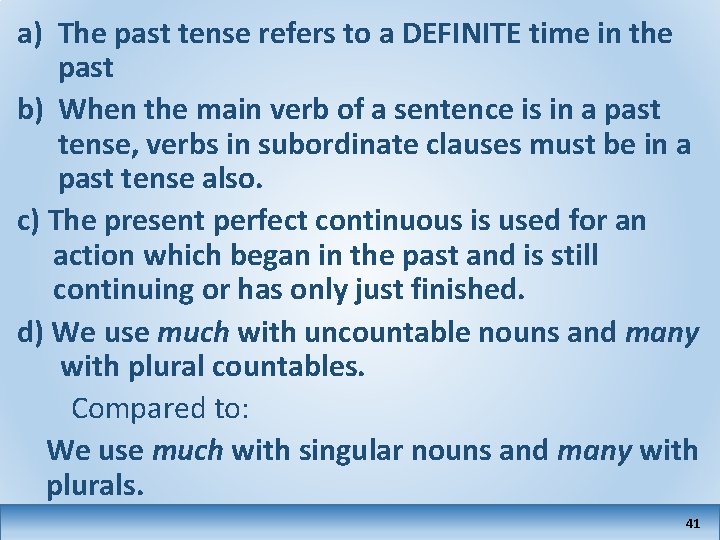
a) The past tense refers to a DEFINITE time in the past b) When the main verb of a sentence is in a past tense, verbs in subordinate clauses must be in a past tense also. c) The present perfect continuous is used for an action which began in the past and is still continuing or has only just finished. d) We use much with uncountable nouns and many with plural countables. Compared to: We use much with singular nouns and many with plurals. 41
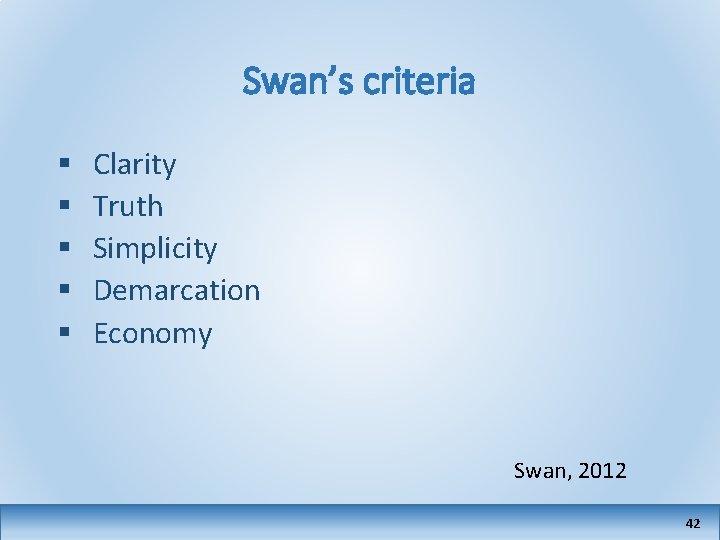
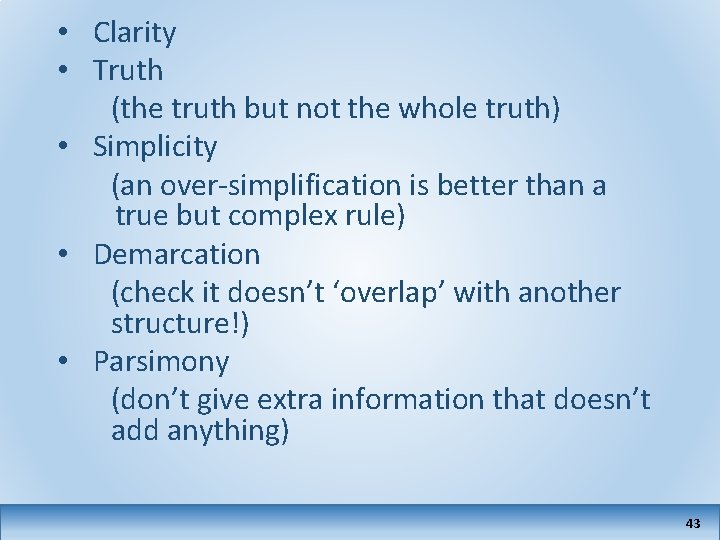
Swan’s criteria § § § Clarity Truth Simplicity Demarcation Economy Swan, 2012 42
• Clarity • Truth (the truth but not the whole truth) • Simplicity (an over-simplification is better than a true but complex rule) • Demarcation (check it doesn’t ‘overlap’ with another structure!) • Parsimony (don’t give extra information that doesn’t add anything) 43
Should we explain the rule in L 1? The use of the L 1 in grammar explanations may be very helpful for two main purposes: 1. To explain underlying rules 2. To contrast L 1 with L 2 44
Should explanations be followed by practice exercises? Yes: according to skill theory (Dekeyser, 2007) No: according to model of consciousness-raising (Ellis, 2001) Probably: minor points of grammar do not need to be practised in focused exercises. Major features which are very often used wrongly – probably benefit from practice. 45
Learning by heart 46
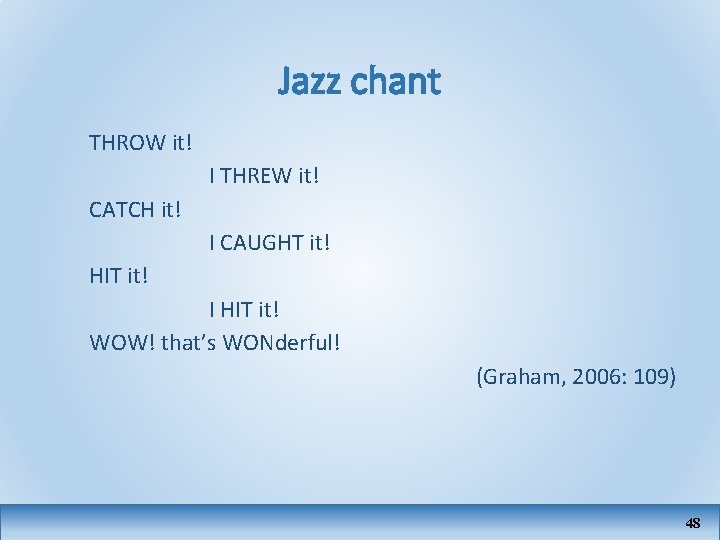
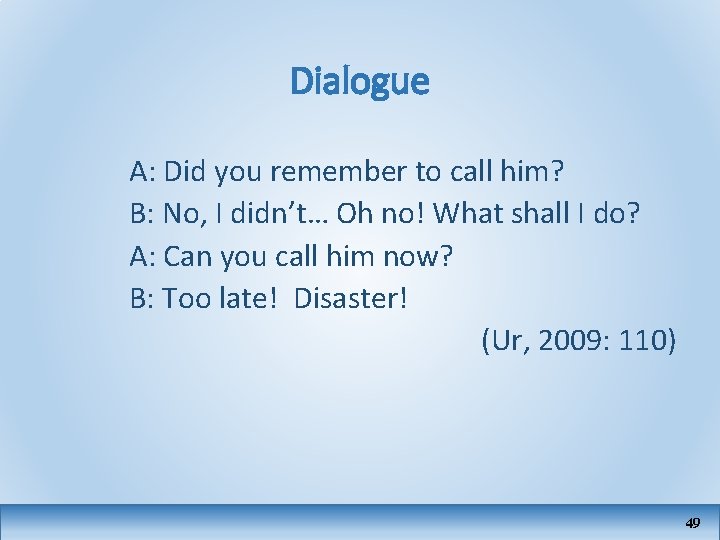
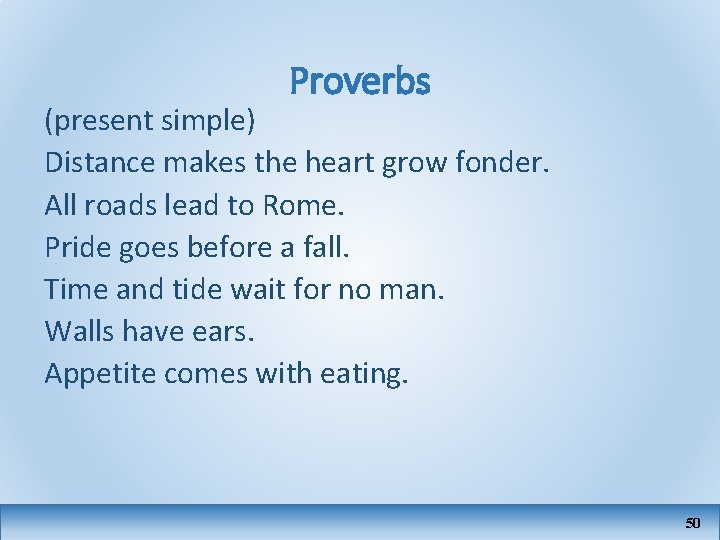
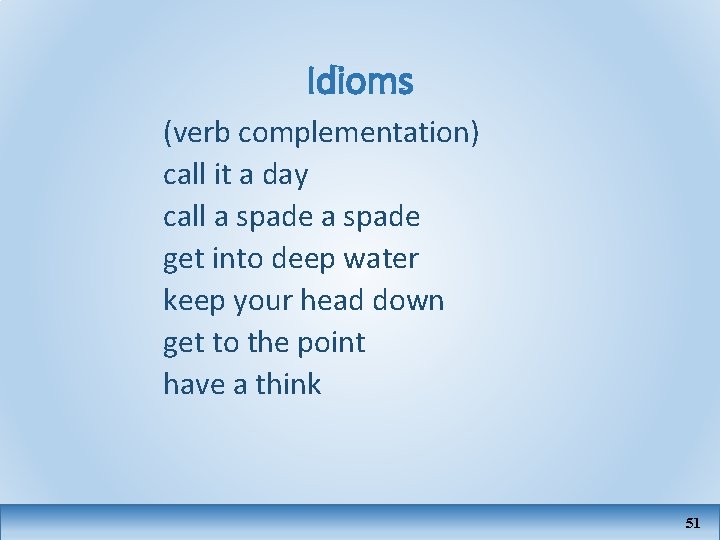
Learning by heart The aim is to equip the learner with a repertoire of automatic grammatical ‘chunks’ § Jazz chants (Graham, 2006) § Dialogues § Rhymes § Songs § Plays, sketches § Proverbs, idioms 47
Jazz chant THROW it! I THREW it! CATCH it! I CAUGHT it! HIT it! I HIT it! WOW! that’s WONderful! (Graham, 2006: 109) 48
Dialogue A: Did you remember to call him? B: No, I didn’t… Oh no! What shall I do? A: Can you call him now? B: Too late! Disaster! (Ur, 2009: 110) 49
Proverbs (present simple) Distance makes the heart grow fonder. All roads lead to Rome. Pride goes before a fall. Time and tide wait for no man. Walls have ears. Appetite comes with eating. 50
Idioms (verb complementation) call it a day call a spade get into deep water keep your head down get to the point have a think 51
Language play Cook (2000): The importance of language play (including learning by heart). Bell (2012): Playful use of language produced better learning of new items than did serious communicative use. 52
Focus on form 53
Focus on form The basis of the lesson is a communicative task. The teacher takes brief ‘time out’ to focus on a grammatical point (Long & Robinson, 1998). Could be based on: § Error-correction § Student question § An interesting feature noticed by the teacher § Difficulty of comprehension or self-expression 54
Focus on form: planned or spontaneous? Originally: spontaneous (Long and Robinson, 1998) Later: planned (Ellis et al. 2002). The grammar may even be built in to the original task or text. 55
Advantages Focuses on the target form when it is actually needed for communication Shows the grammar in context 56
Disadvantages May hold up the communicative activity A bit ‘hit or miss’: does not ensure systematic coverage 57
Probably best … as an occasional reinforcement of features, as needed … as a back-up to regular ‘conventional’ teaching of grammar, based on explanation + practice. 58
Practice Based on skill theory: declarative stage proceduralization automatization Practice is the ‘proceduralization’ stage, where the learner produces the target forms ‘…while temporarily leaning on declarative crutches’ (Dekeyser, 1998: 49) 59
The problem Students often make mistakes even after doing exercises correctly. The problem: they can get it right when they are thinking about it. When they are creating their own sentences, they are thinking about the meaning, not the form. So they naturally make slips. What can we do? 60
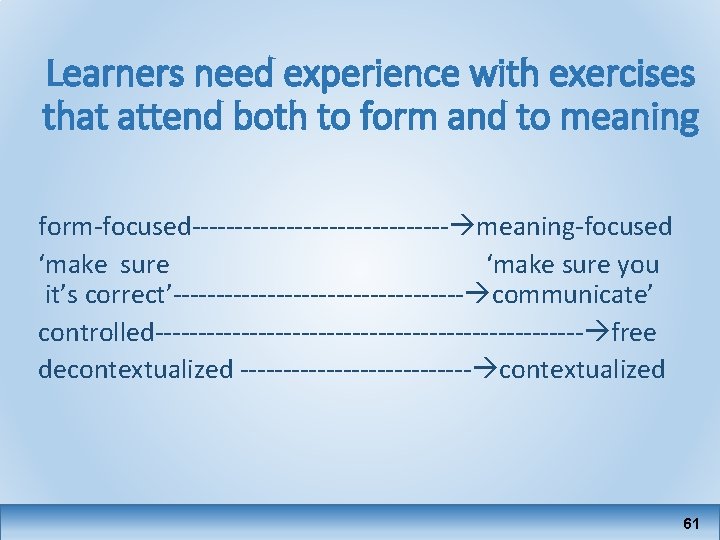
Learners need experience with exercises that attend both to form and to meaning form-focused--------------- meaning-focused ‘make sure you it’s correct’----------------- communicate’ controlled------------------------- free decontextualized -------------- contextualized 61
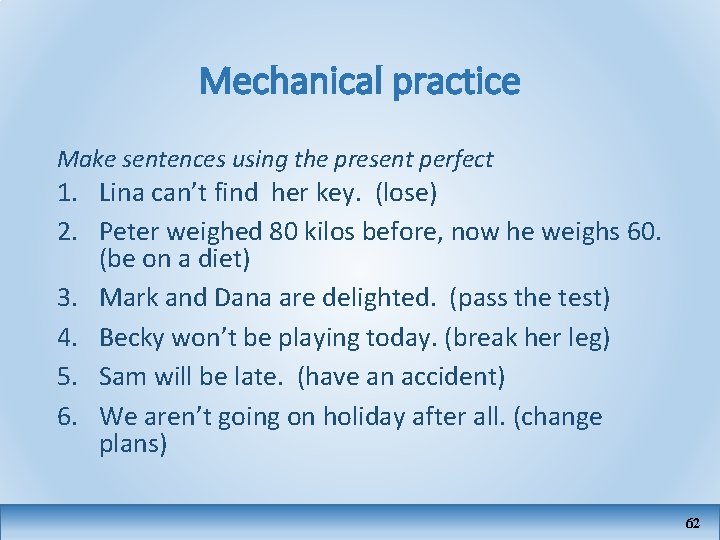
Mechanical practice Make sentences using the present perfect 1. Lina can’t find her key. (lose) 2. Peter weighed 80 kilos before, now he weighs 60. (be on a diet) 3. Mark and Dana are delighted. (pass the test) 4. Becky won’t be playing today. (break her leg) 5. Sam will be late. (have an accident) 6. We aren’t going on holiday after all. (change plans) 62
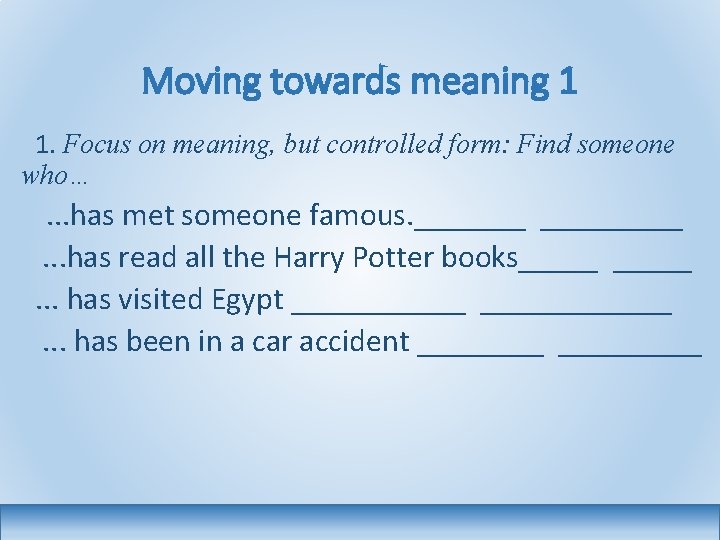
Moving towards meaning 1 1. Focus on meaning, but controlled form: Find someone who… . . . has met someone famous. _________. . . has read all the Harry Potter books_____. . . has visited Egypt ____________. . . has been in a car accident _________
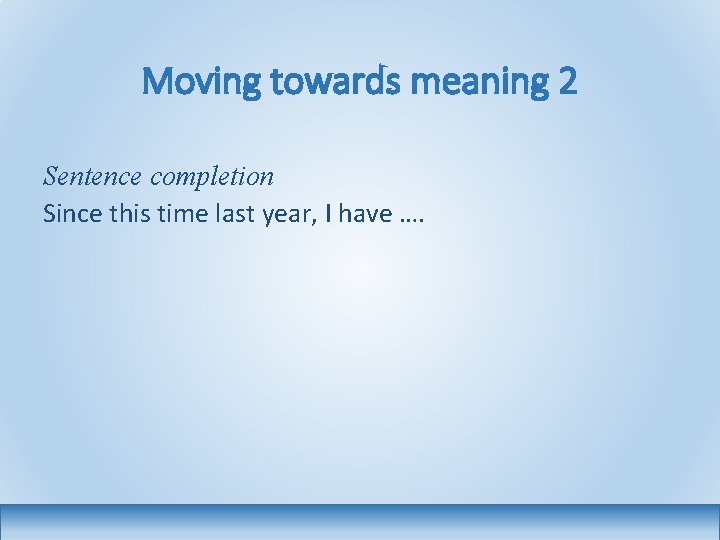
Moving towards meaning 2 Sentence completion Since this time last year, I have ….
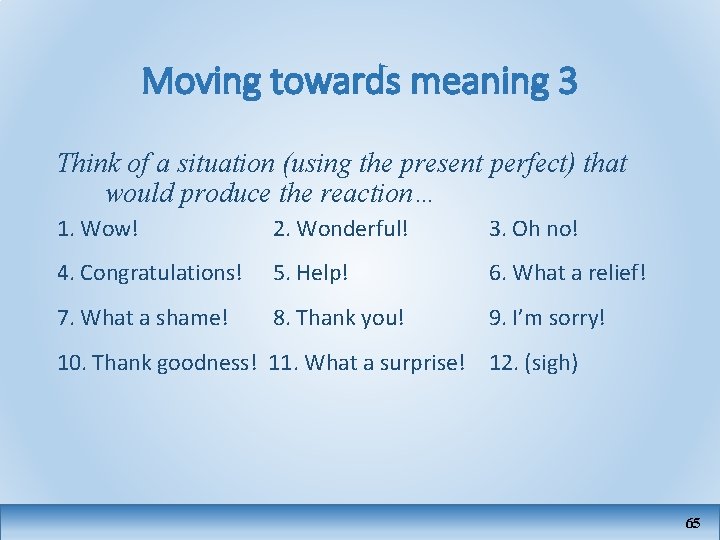
Moving towards meaning 3 Think of a situation (using the present perfect) that would produce the reaction… 1. Wow! 2. Wonderful! 3. Oh no! 4. Congratulations! 5. Help! 6. What a relief! 7. What a shame! 8. Thank you! 9. I’m sorry! 10. Thank goodness! 11. What a surprise! 12. (sigh) 65
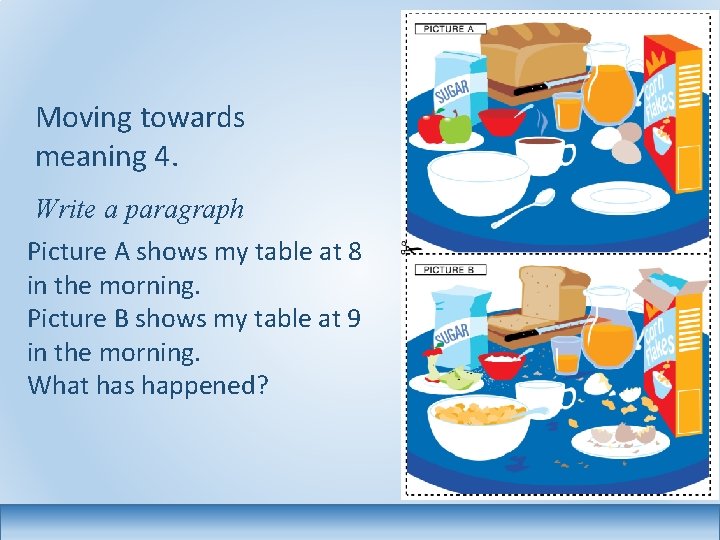
Moving towards meaning 4. Write a paragraph Picture A shows my table at 8 in the morning. Picture B shows my table at 9 in the morning. What has happened?
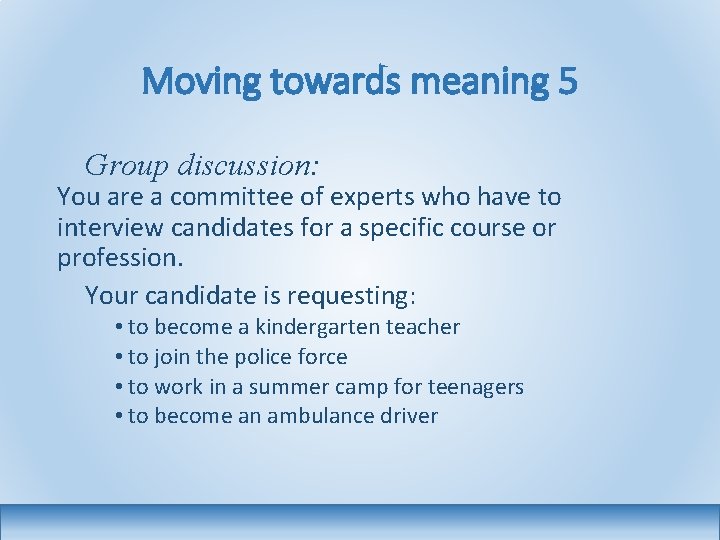
Moving towards meaning 5 Group discussion: You are a committee of experts who have to interview candidates for a specific course or profession. Your candidate is requesting: • to become a kindergarten teacher • to join the police force • to work in a summer camp for teenagers • to become an ambulance driver
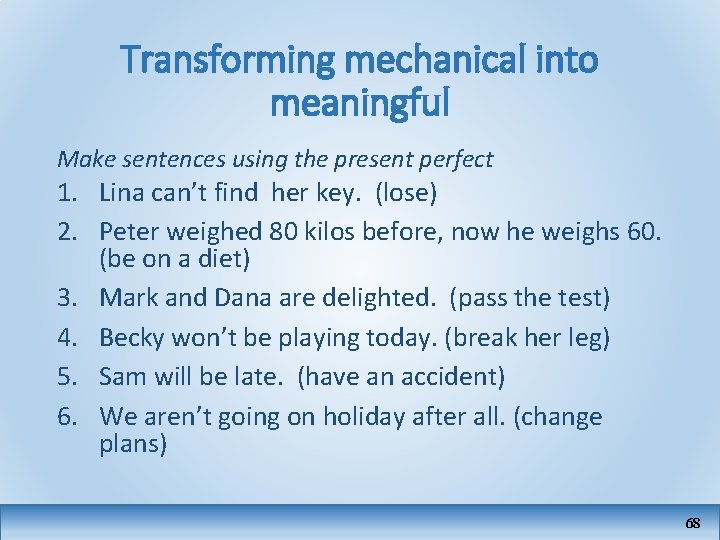
Transforming mechanical into meaningful Make sentences using the present perfect 1. Lina can’t find her key. (lose) 2. Peter weighed 80 kilos before, now he weighs 60. (be on a diet) 3. Mark and Dana are delighted. (pass the test) 4. Becky won’t be playing today. (break her leg) 5. Sam will be late. (have an accident) 6. We aren’t going on holiday after all. (change plans) 68
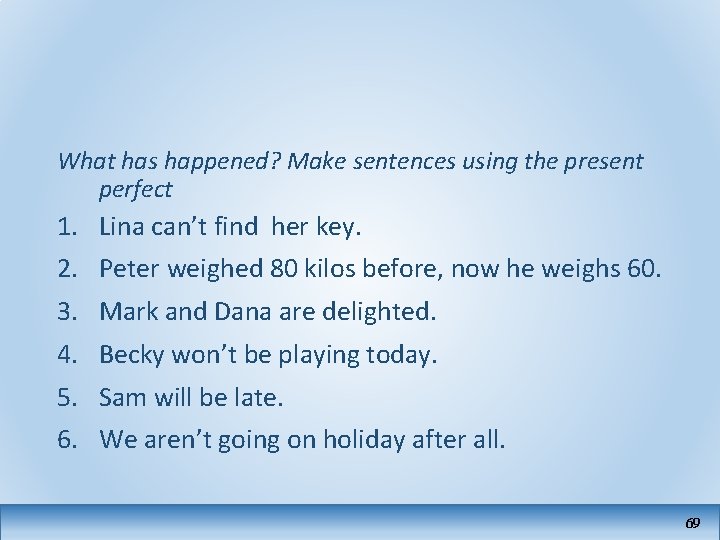
What has happened? Make sentences using the present perfect 1. Lina can’t find her key. 2. Peter weighed 80 kilos before, now he weighs 60. 3. Mark and Dana are delighted. 4. Becky won’t be playing today. 5. Sam will be late. 6. We aren’t going on holiday after all. 69
Summary and conclusions 70
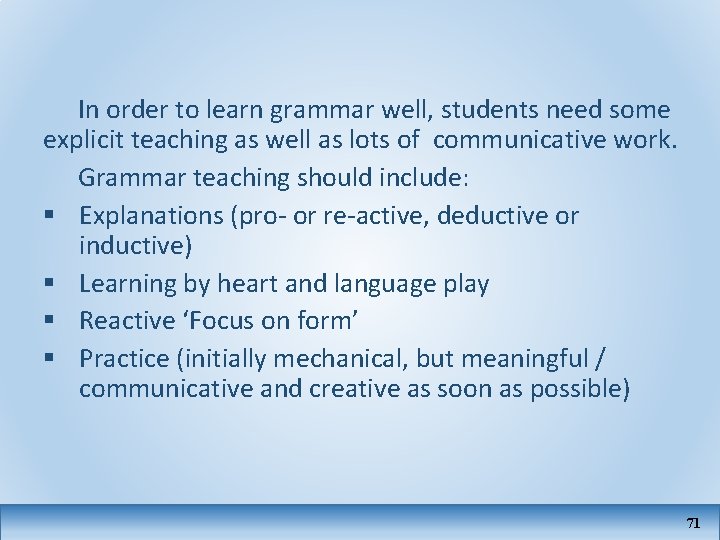
In order to learn grammar well, students need some explicit teaching as well as lots of communicative work. Grammar teaching should include: § Explanations (pro- or re-active, deductive or inductive) § Learning by heart and language play § Reactive ‘Focus on form’ § Practice (initially mechanical, but meaningful / communicative and creative as soon as possible) 71
But if they are still making mistakes… We are going to need to provide corrective feedback. 72