
Teaching English 6 Language competences learning strategies and
![1. 4 Mediation and intercultural competence – politeness skills [I]n Chinese culture, paying a](https://slidetodoc.com/presentation_image/4996d2506eb3e57eadb462a756e53a17/image-39.jpg "1. 4 Mediation and intercultural competence – politeness skills [I]n Chinese culture, paying a")
- Slides: 68
Teaching English 6. Language competences, learning strategies, and the individual learner Nancy Grimm – Michael Meyer – Laurenz Volkmann
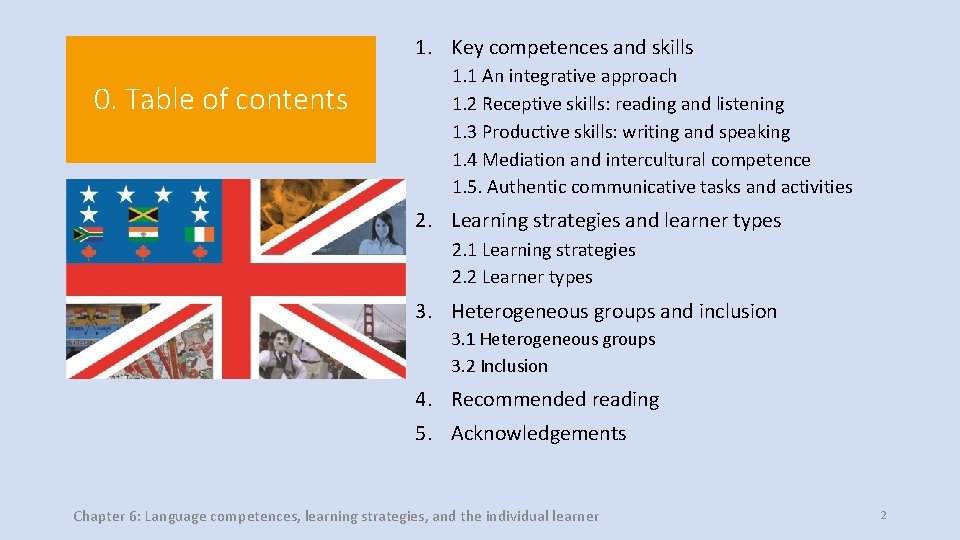
1. Key competences and skills 0. Table of contents 1. 1 An integrative approach 1. 2 Receptive skills: reading and listening 1. 3 Productive skills: writing and speaking 1. 4 Mediation and intercultural competence 1. 5. Authentic communicative tasks and activities 2. Learning strategies and learner types 2. 1 Learning strategies 2. 2 Learner types 3. Heterogeneous groups and inclusion 3. 1 Heterogeneous groups 3. 2 Inclusion 4. Recommended reading 5. Acknowledgements Chapter 6: Language competences, learning strategies, and the individual learner 2
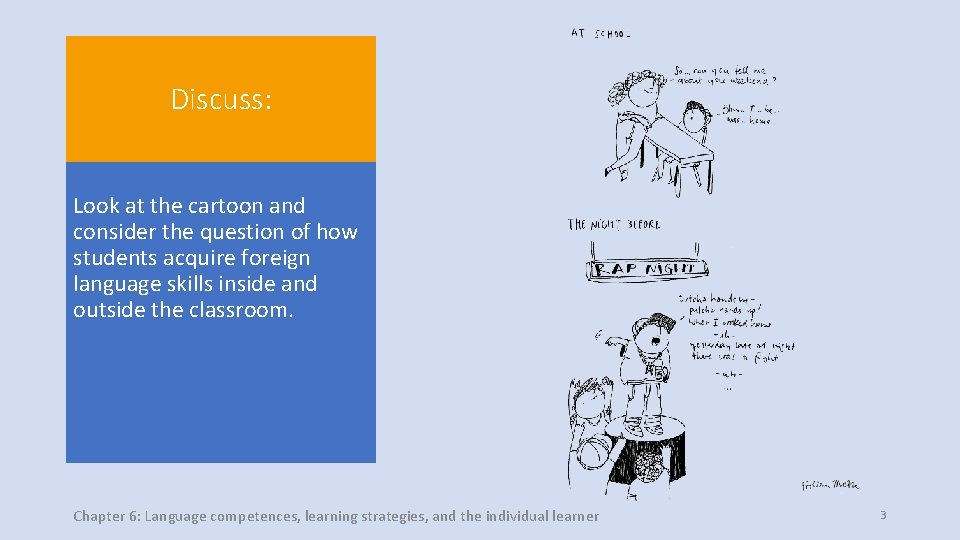
Discuss: Look at the cartoon and consider the question of how students acquire foreign language skills inside and outside the classroom. Chapter 6: Language competences, learning strategies, and the individual learner 3
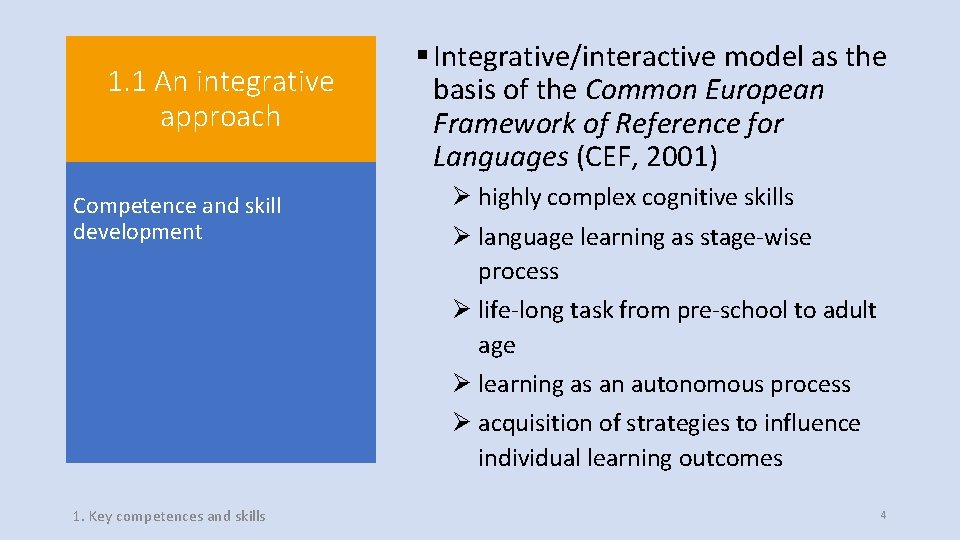
1. 1 An integrative approach Competence and skill development 1. Key competences and skills § Integrative/interactive model as the basis of the Common European Framework of Reference for Languages (CEF, 2001) Ø highly complex cognitive skills Ø language learning as stage-wise process Ø life-long task from pre-school to adult age Ø learning as an autonomous process Ø acquisition of strategies to influence individual learning outcomes 4
1. 1 An integrative approach Consider the following passage from the CEF. They sum up the interrelationship of language competences and learning strategies. Language use, embracing language learning, comprises the actions performed by persons who as individuals and as social agents develop a range of competences, both general and in particular communicative language competences. They draw on the competences at their disposal in various contexts under various conditions and under various constraints to engage in language activities involving language processes to produce and/or receive texts in relation to themes in specific domains, activating those strategies which seem most appropriate for carrying out the tasks to be accomplished. The monitoring of these actions by the participants leads to the reinforcement or modification of their competences. Council of Europe 2001: 9 1. Key competences and skills 5
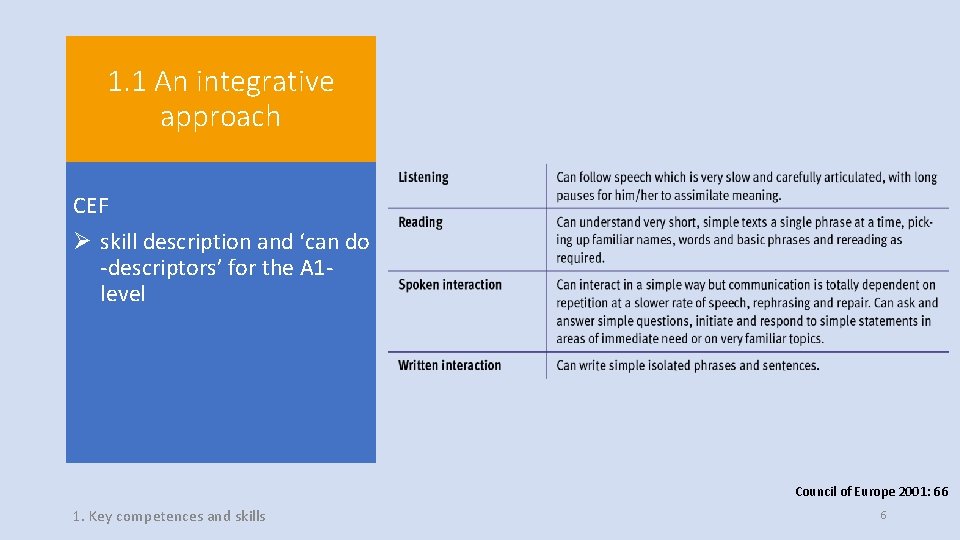
1. 1 An integrative approach CEF Ø skill description and ‘can do -descriptors’ for the A 1 level Council of Europe 2001: 66 1. Key competences and skills 6
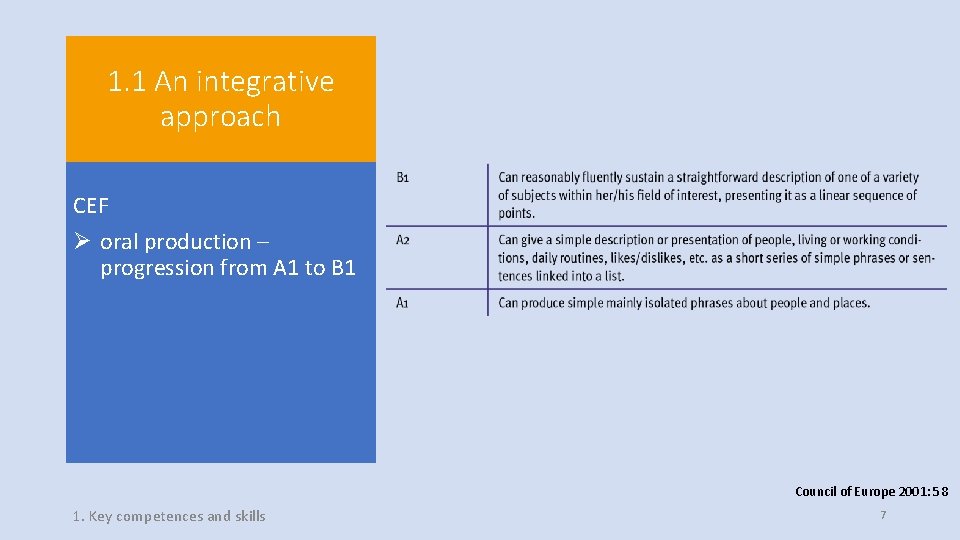
1. 1 An integrative approach CEF Ø oral production – progression from A 1 to B 1 Council of Europe 2001: 58 1. Key competences and skills 7
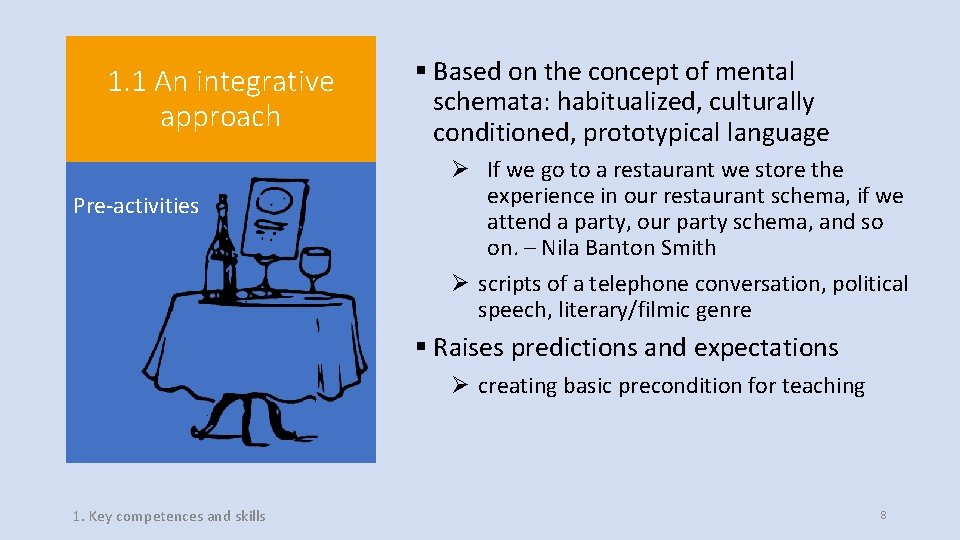
1. 1 An integrative approach Pre-activities § Based on the concept of mental schemata: habitualized, culturally conditioned, prototypical language Ø If we go to a restaurant we store the experience in our restaurant schema, if we attend a party, our party schema, and so on. – Nila Banton Smith Ø scripts of a telephone conversation, political speech, literary/filmic genre § Raises predictions and expectations Ø creating basic precondition for teaching 1. Key competences and skills 8
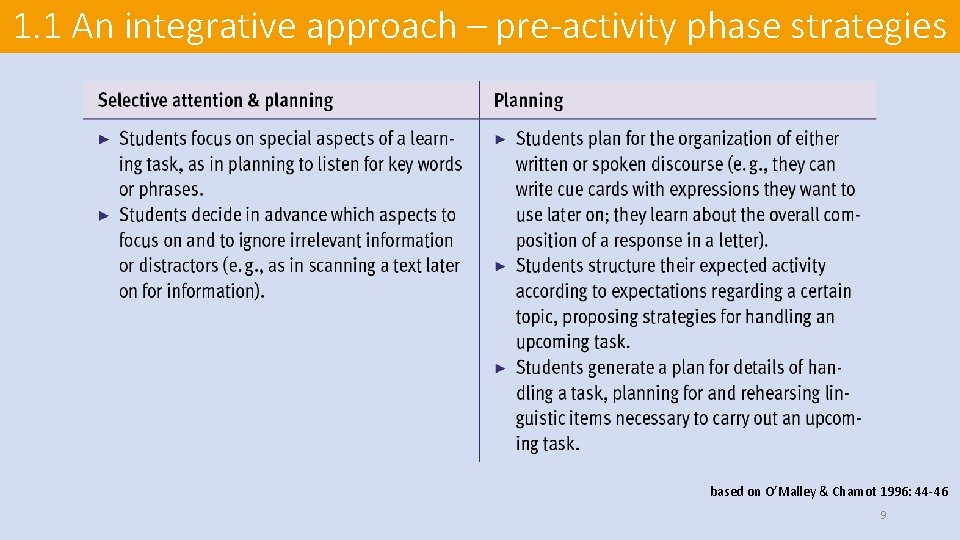
1. 1 An integrative approach – pre-activity phase strategies based on O’Malley & Chamot 1996: 44 -46 9
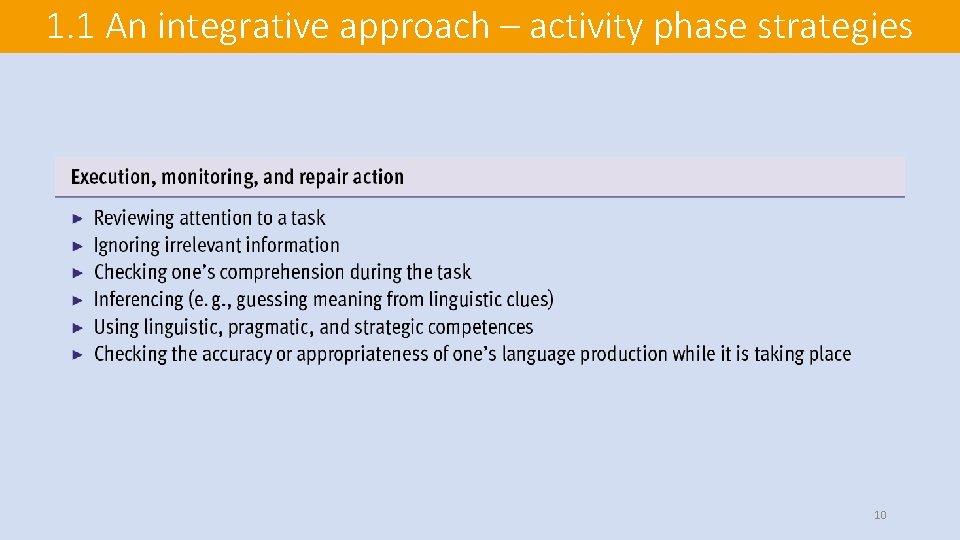
1. 1 An integrative approach – activity phase strategies 10
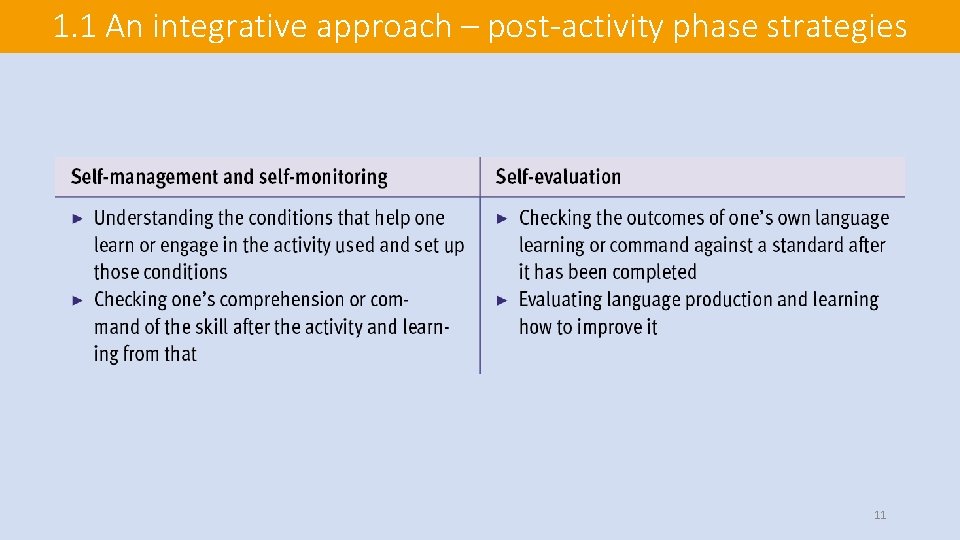
1. 1 An integrative approach – post-activity phase strategies 11
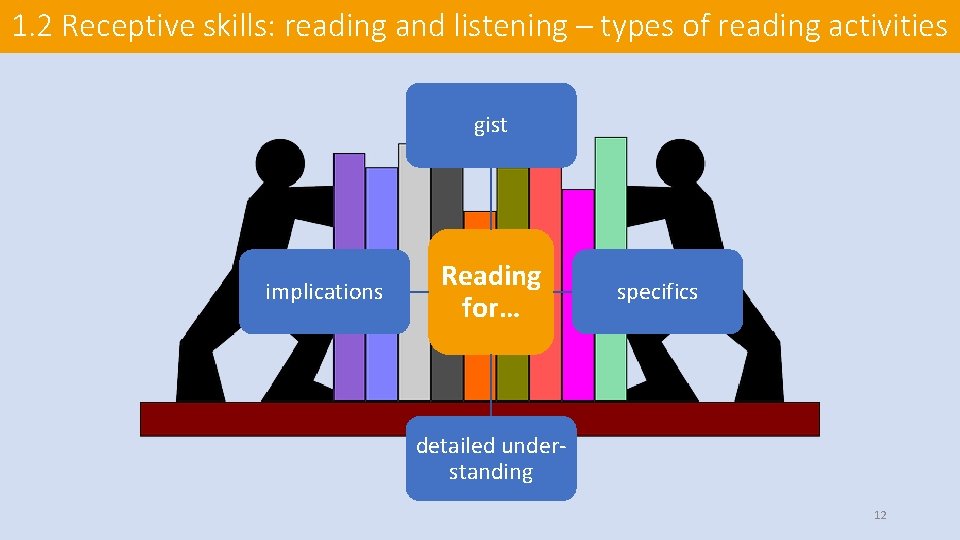
1. 2 Receptive skills: reading and listening – types of reading activities gist implications Reading for… specifics detailed understanding 12
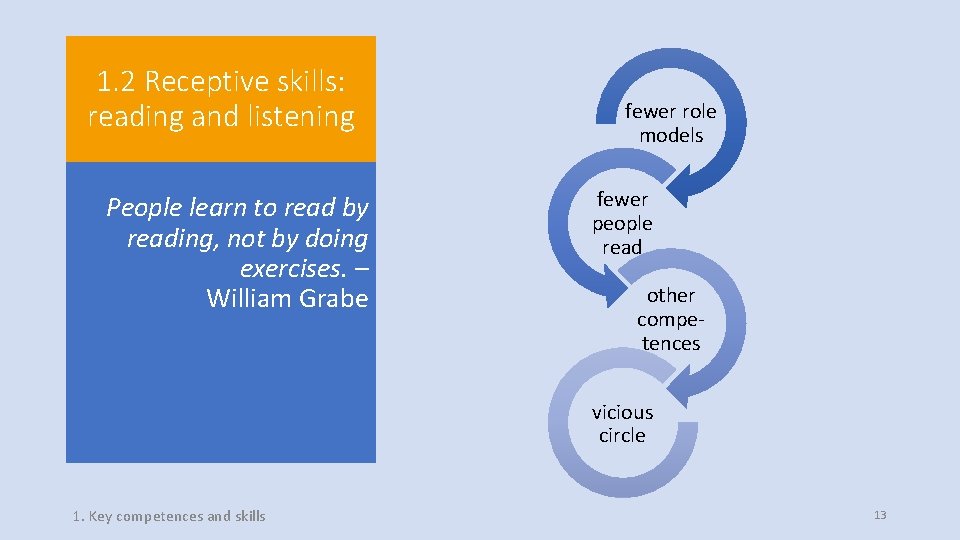
1. 2 Receptive skills: reading and listening People learn to read by reading, not by doing exercises. – William Grabe fewer role models fewer people read other competences vicious circle 1. Key competences and skills 13
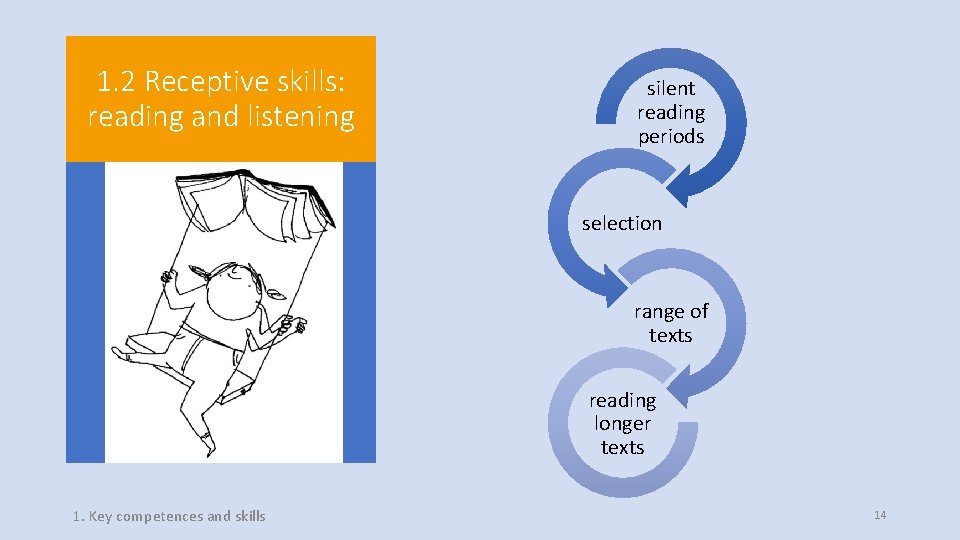
1. 2 Receptive skills: reading and listening silent reading periods selection range of texts reading longer texts 1. Key competences and skills 14
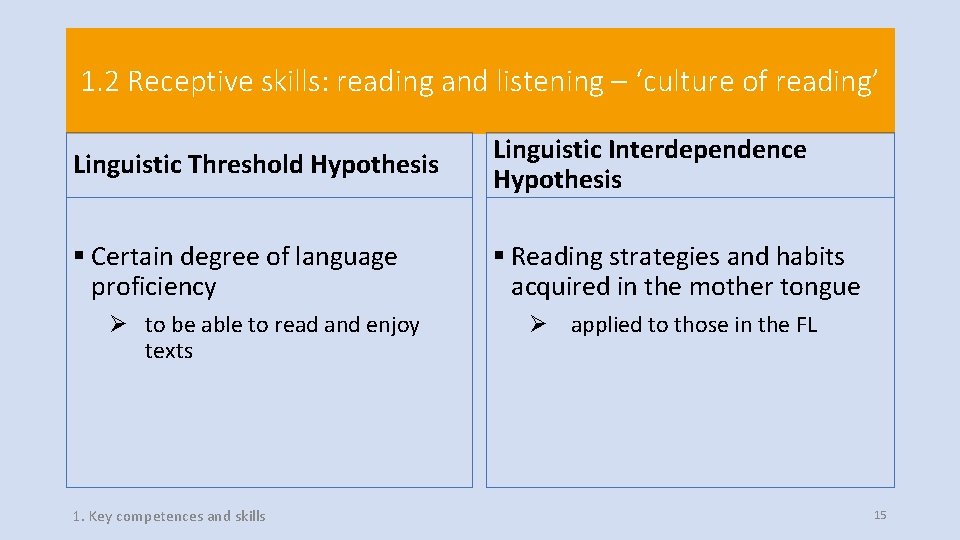
1. 2 Receptive skills: reading and listening – ‘culture of reading’ Linguistic Threshold Hypothesis Linguistic Interdependence Hypothesis § Certain degree of language proficiency § Reading strategies and habits acquired in the mother tongue Ø to be able to read and enjoy texts 1. Key competences and skills Ø applied to those in the FL 15
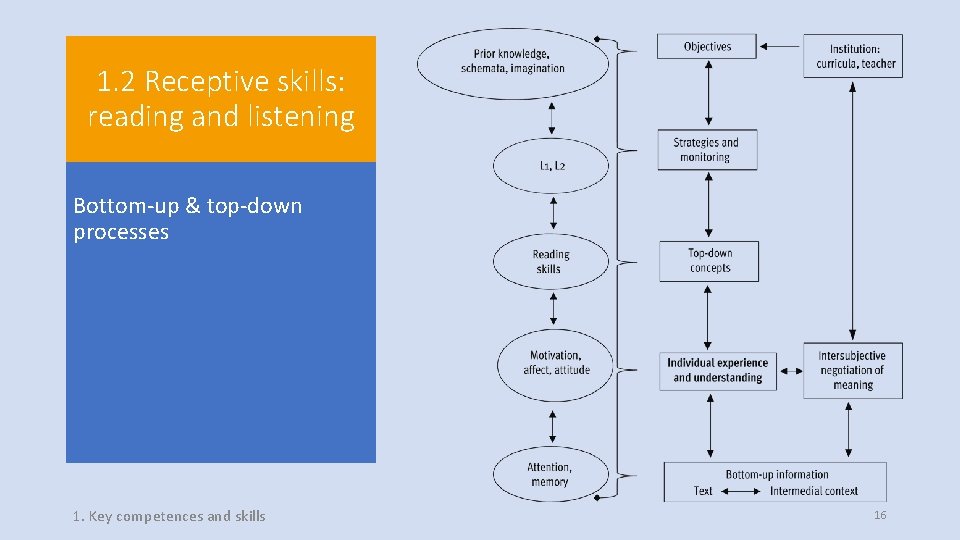
1. 2 Receptive skills: reading and listening Bottom-up & top-down processes 1. Key competences and skills 16
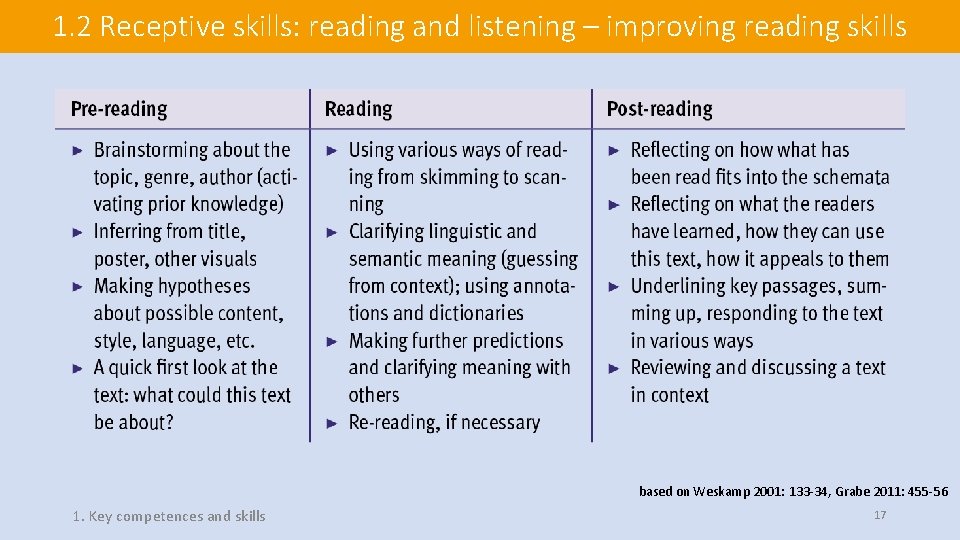
1. 2 Receptive skills: reading and listening – improving reading skills based on Weskamp 2001: 133 -34, Grabe 2011: 455 -56 1. Key competences and skills 17
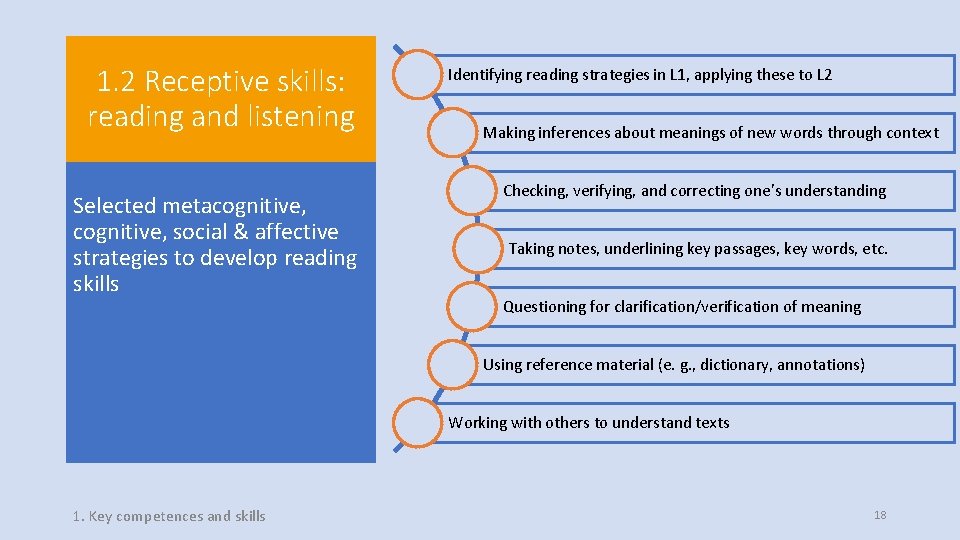
1. 2 Receptive skills: reading and listening Selected metacognitive, social & affective strategies to develop reading skills Identifying reading strategies in L 1, applying these to L 2 Making inferences about meanings of new words through context Checking, verifying, and correcting one’s understanding Taking notes, underlining key passages, key words, etc. Questioning for clarification/verification of meaning Using reference material (e. g. , dictionary, annotations) Working with others to understand texts 1. Key competences and skills 18
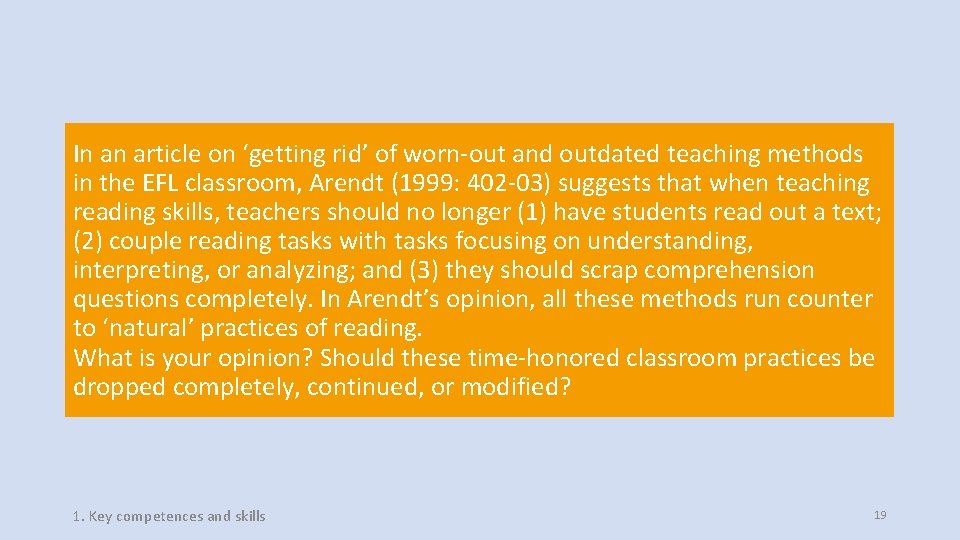
In an article on ‘getting rid’ of worn-out and outdated teaching methods in the EFL classroom, Arendt (1999: 402 -03) suggests that when teaching reading skills, teachers should no longer (1) have students read out a text; (2) couple reading tasks with tasks focusing on understanding, interpreting, or analyzing; and (3) they should scrap comprehension questions completely. In Arendt’s opinion, all these methods run counter to ‘natural’ practices of reading. What is your opinion? Should these time-honored classroom practices be dropped completely, continued, or modified? 1. Key competences and skills 19
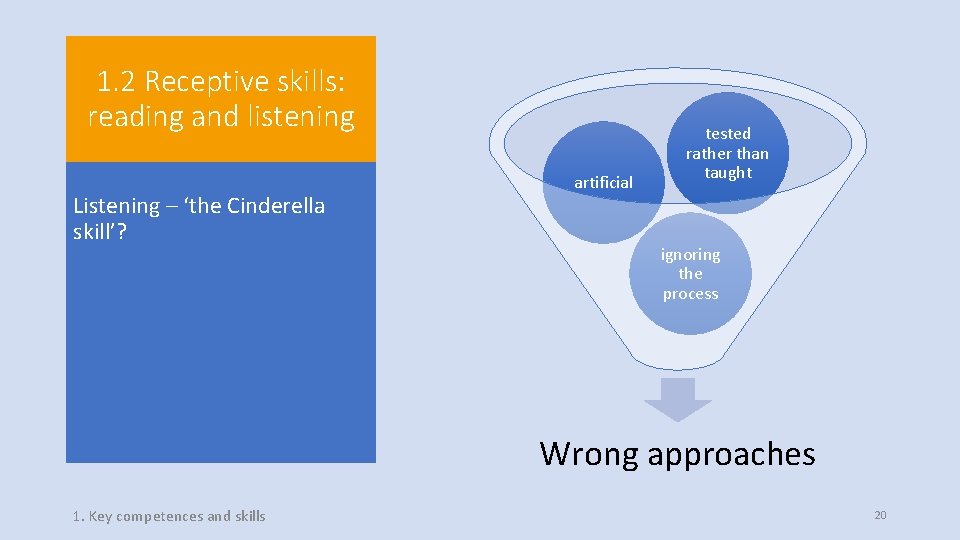
1. 2 Receptive skills: reading and listening Listening – ‘the Cinderella skill’? artificial tested rather than taught ignoring the process Wrong approaches 1. Key competences and skills 20
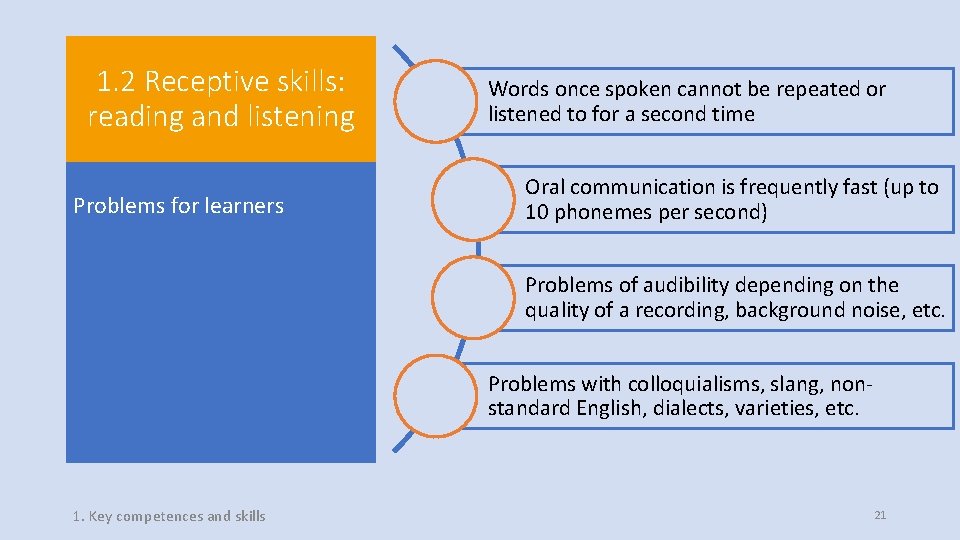
1. 2 Receptive skills: reading and listening Problems for learners Words once spoken cannot be repeated or listened to for a second time Oral communication is frequently fast (up to 10 phonemes per second) Problems of audibility depending on the quality of a recording, background noise, etc. Problems with colloquialisms, slang, nonstandard English, dialects, varieties, etc. 1. Key competences and skills 21
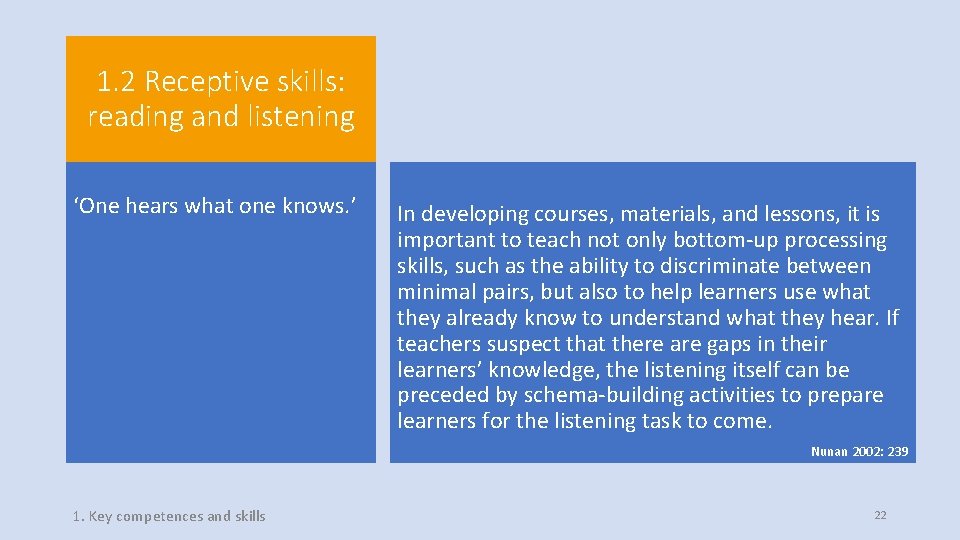
1. 2 Receptive skills: reading and listening ‘One hears what one knows. ’ In developing courses, materials, and lessons, it is important to teach not only bottom-up processing skills, such as the ability to discriminate between minimal pairs, but also to help learners use what they already know to understand what they hear. If teachers suspect that there are gaps in their learners’ knowledge, the listening itself can be preceded by schema-building activities to prepare learners for the listening task to come. Nunan 2002: 239 1. Key competences and skills 22
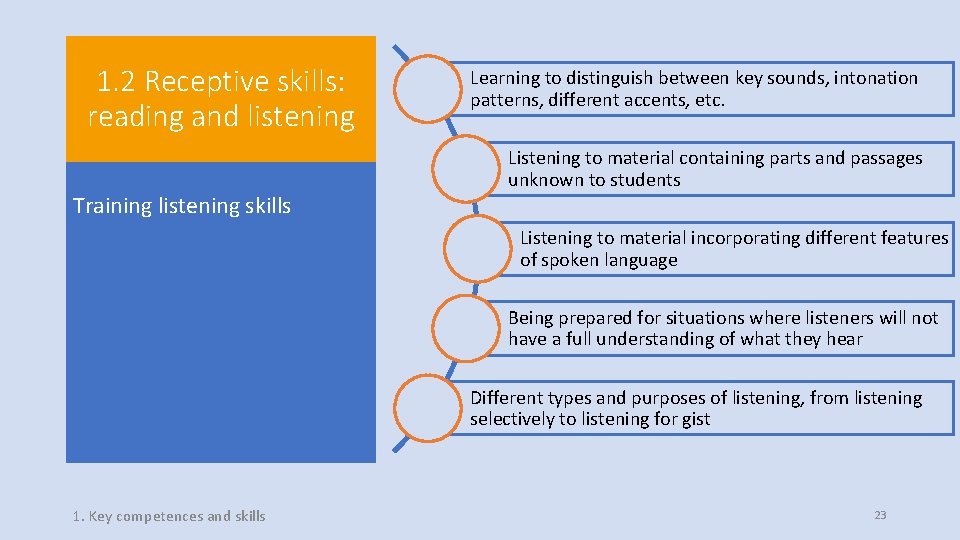
1. 2 Receptive skills: reading and listening Training listening skills Learning to distinguish between key sounds, intonation patterns, different accents, etc. Listening to material containing parts and passages unknown to students Listening to material incorporating different features of spoken language Being prepared for situations where listeners will not have a full understanding of what they hear Different types and purposes of listening, from listening selectively to listening for gist 1. Key competences and skills 23
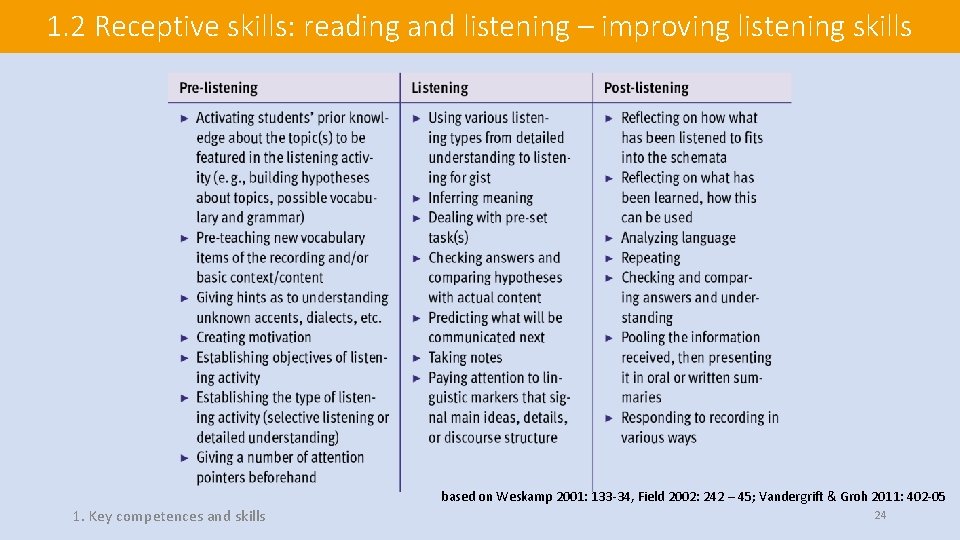
1. 2 Receptive skills: reading and listening – improving listening skills based on Weskamp 2001: 133 -34, Field 2002: 242 – 45; Vandergrift & Groh 2011: 402 -05 1. Key competences and skills 24
Arendt (1999: 404 -05) argues against using listening comprehensions featuring listening for discrete items (discrimination tasks) and uninteresting topics. Most importantly, Arendt surmises, listening tasks should not have several repetitions of the recording. These practices run counter to listening scenarios in real life. What is your opinion, especially regarding the suggestion that recordings should be played only once? 1. Key competences and skills 25
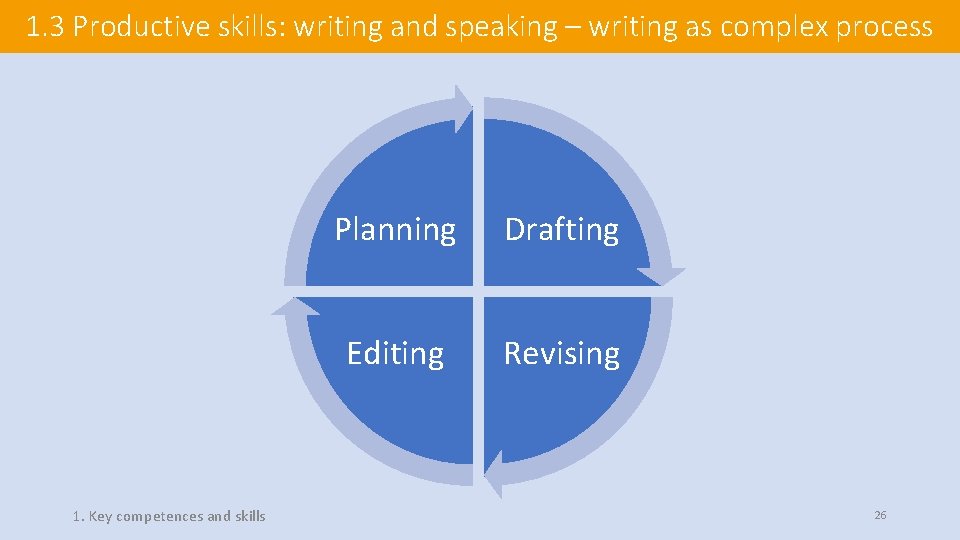
1. 3 Productive skills: writing and speaking – writing as complex process 1. Key competences and skills Planning Drafting Editing Revising 26
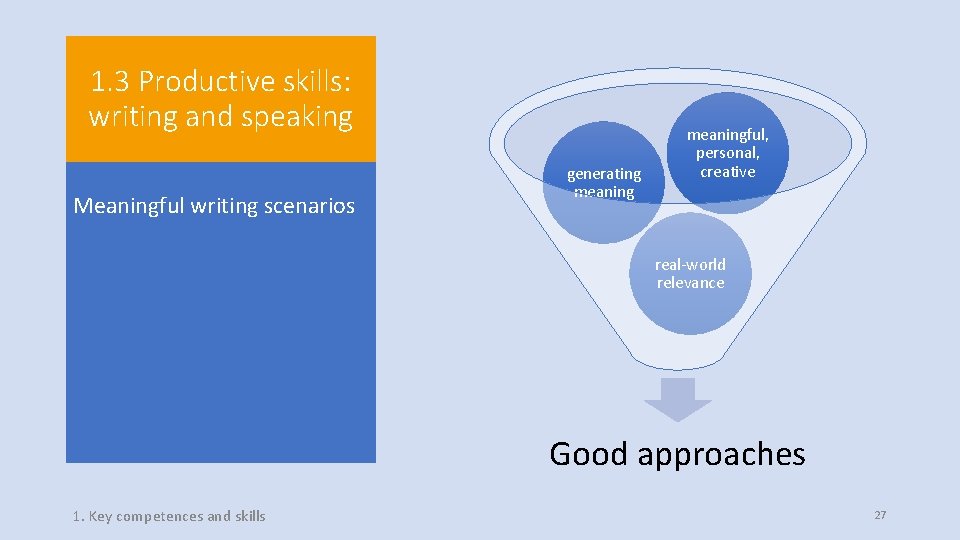
1. 3 Productive skills: writing and speaking Meaningful writing scenarios generating meaningful, personal, creative real-world relevance Good approaches 1. Key competences and skills 27
Arendt (1999: 407) suggests that writing skills should never be practiced with rigid and patterned activities such as writing ‘model dialogs’ but rather by focusing on real-life and creative forms of writing. Think of ways to make writing more creative, with students writing responses resembling real-life situations. 1. Key competences and skills 28
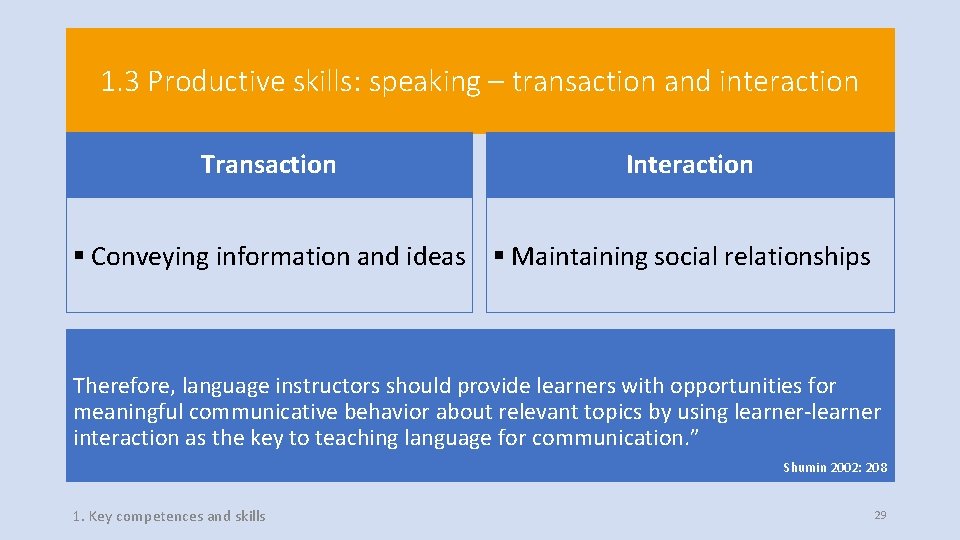
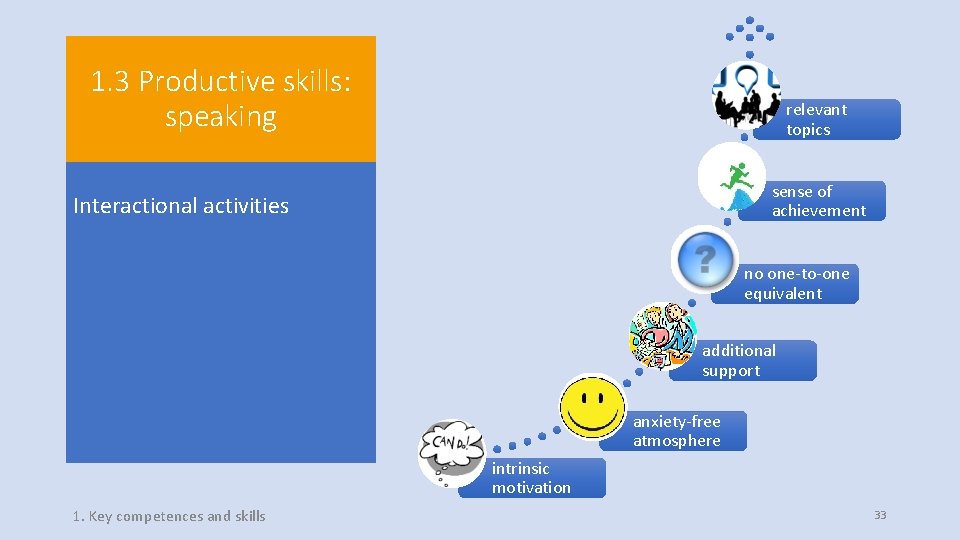
1. 3 Productive skills: speaking – transaction and interaction Transaction Interaction § Conveying information and ideas § Maintaining social relationships Therefore, language instructors should provide learners with opportunities for meaningful communicative behavior about relevant topics by using learner-learner interaction as the key to teaching language for communication. ” Shumin 2002: 208 1. Key competences and skills 29
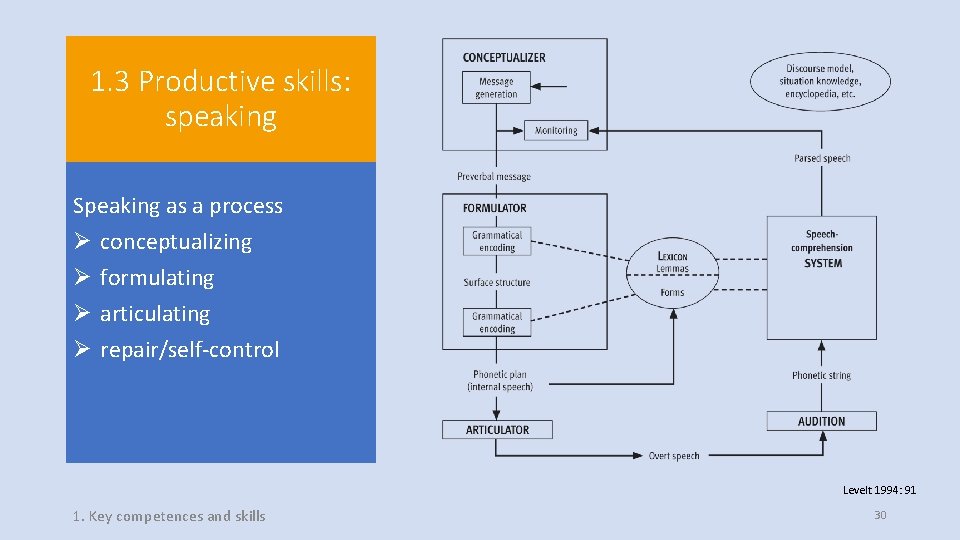
1. 3 Productive skills: speaking Speaking as a process Ø conceptualizing Ø formulating Ø articulating Ø repair/self-control Levelt 1994: 91 1. Key competences and skills 30
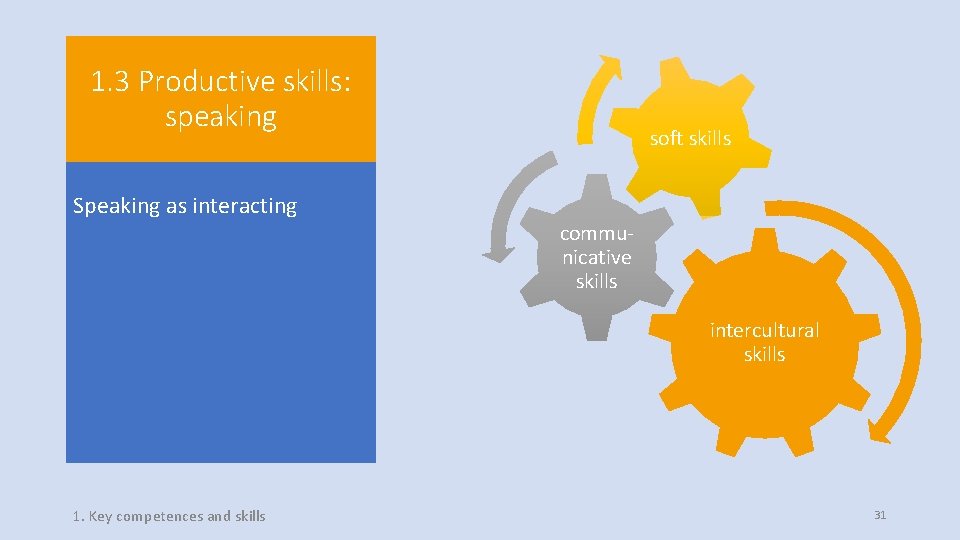
1. 3 Productive skills: speaking Speaking as interacting soft skills communicative skills intercultural skills 1. Key competences and skills 31
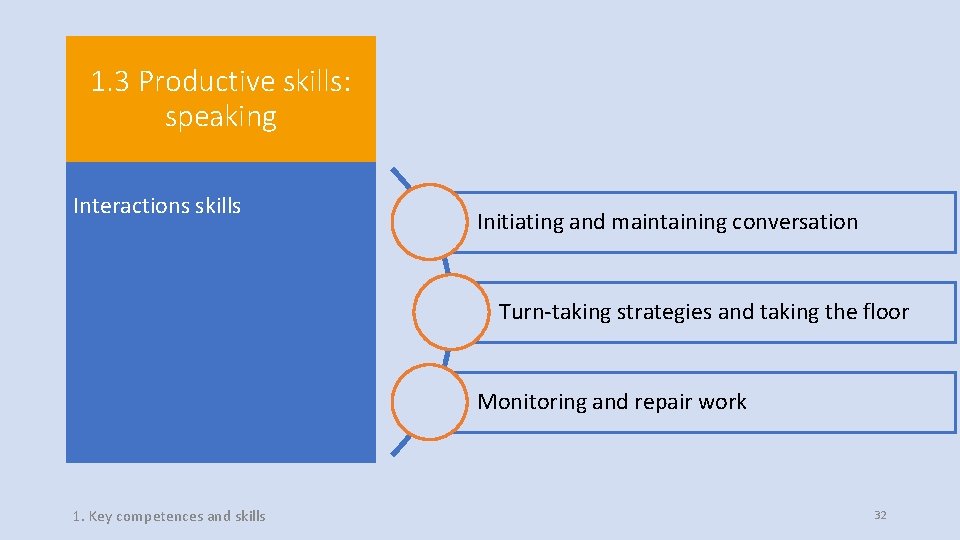
1. 3 Productive skills: speaking Interactions skills Initiating and maintaining conversation Turn-taking strategies and taking the floor Monitoring and repair work 1. Key competences and skills 32
1. 3 Productive skills: speaking relevant topics sense of achievement Interactional activities no one-to-one equivalent additional support anxiety-free atmosphere intrinsic motivation 1. Key competences and skills 33
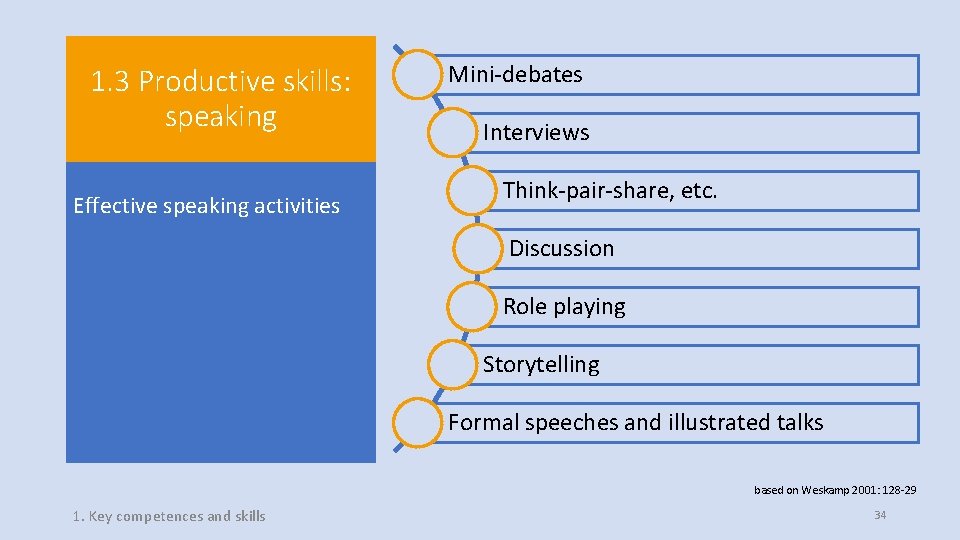
1. 3 Productive skills: speaking Effective speaking activities Mini-debates Interviews Think-pair-share, etc. Discussion Role playing Storytelling Formal speeches and illustrated talks based on Weskamp 2001: 128 -29 1. Key competences and skills 34
Arendt (1999: 405 -06) suggests that frontal teaching is one of the main obstacles to students’ developing speaking or interaction skills. Think of ways to decrease teacher talk time. 1. Key competences and skills 35
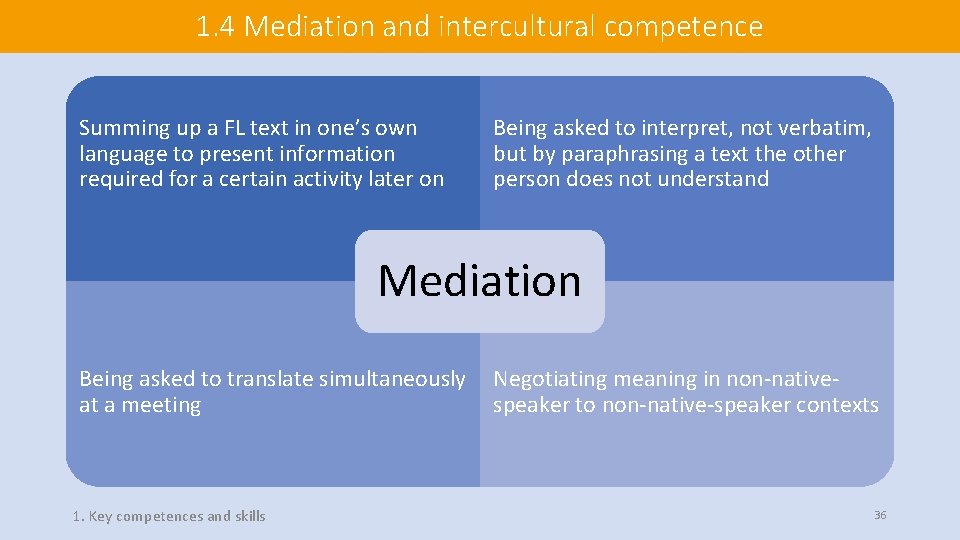
1. 4 Mediation and intercultural competence Summing up a FL text in one’s own language to present information required for a certain activity later on Being asked to interpret, not verbatim, but by paraphrasing a text the other person does not understand Mediation Being asked to translate simultaneously at a meeting 1. Key competences and skills Negotiating meaning in non-nativespeaker to non-native-speaker contexts 36
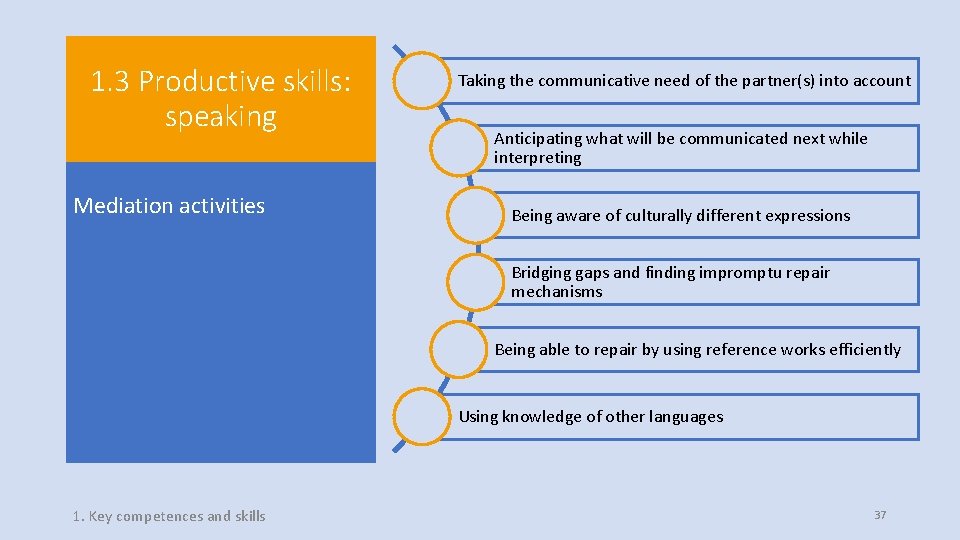
1. 3 Productive skills: speaking Mediation activities Taking the communicative need of the partner(s) into account Anticipating what will be communicated next while interpreting Being aware of culturally different expressions Bridging gaps and finding impromptu repair mechanisms Being able to repair by using reference works efficiently Using knowledge of other languages 1. Key competences and skills 37
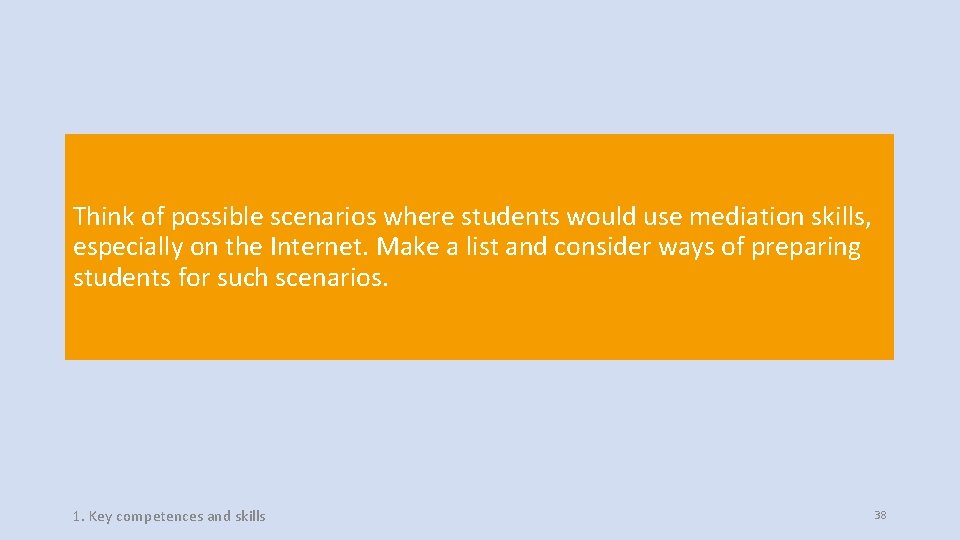
Think of possible scenarios where students would use mediation skills, especially on the Internet. Make a list and consider ways of preparing students for such scenarios. 1. Key competences and skills 38
1. 4 Mediation and intercultural competence – politeness skills [I]n Chinese culture, paying a compliment to someone obliges that person to give a negative answer (such as ‘No. It is not so good. ’) in order to show ‘modesty’, whereas in North American culture such a response might be both inappropriate and embarrassing. Shumin 2002: 206 One day, when a Chinese student heard ‘Let’s get together for lunch sometime. ’ he immediately responded by proposing to fix a specific date without noticing the speaker’s indifferent facial expression. […] [H]e was puzzled when his interlocutor left without giving him an expected answer. ibid. 1. Key competences and skills 39
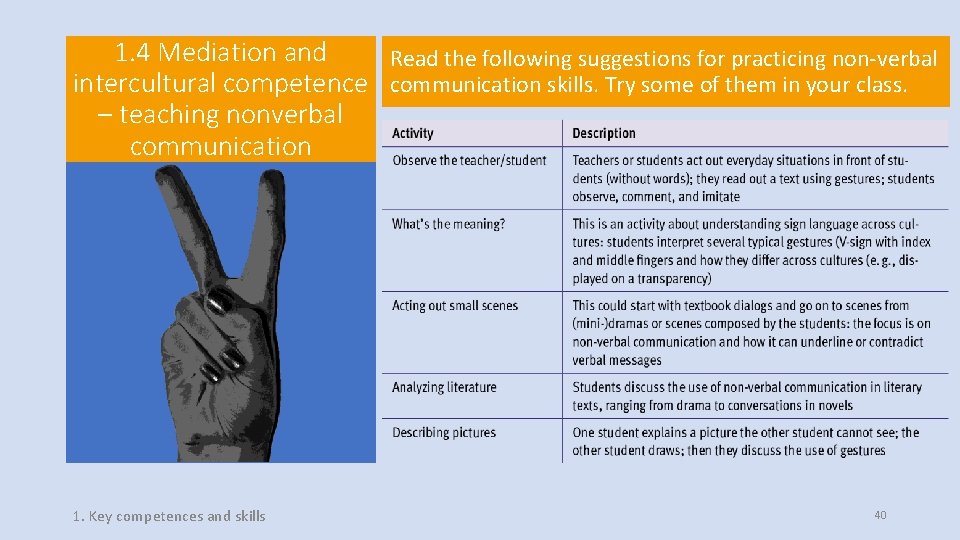
1. 4 Mediation and Read the following suggestions for practicing non-verbal intercultural competence communication skills. Try some of them in your class. – teaching nonverbal communication 1. Key competences and skills 40
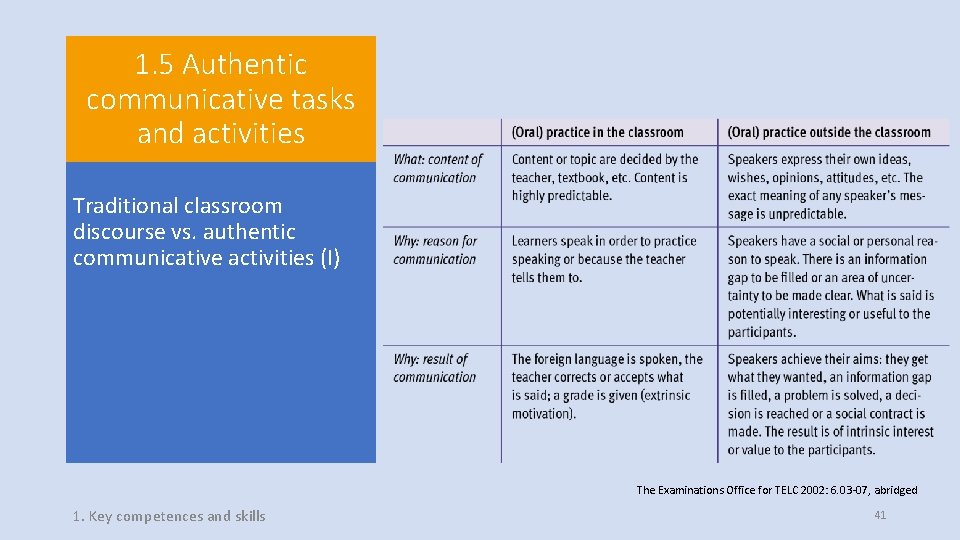
1. 5 Authentic communicative tasks and activities Traditional classroom discourse vs. authentic communicative activities (I) The Examinations Office for TELC 2002: 6. 03 -07, abridged 1. Key competences and skills 41
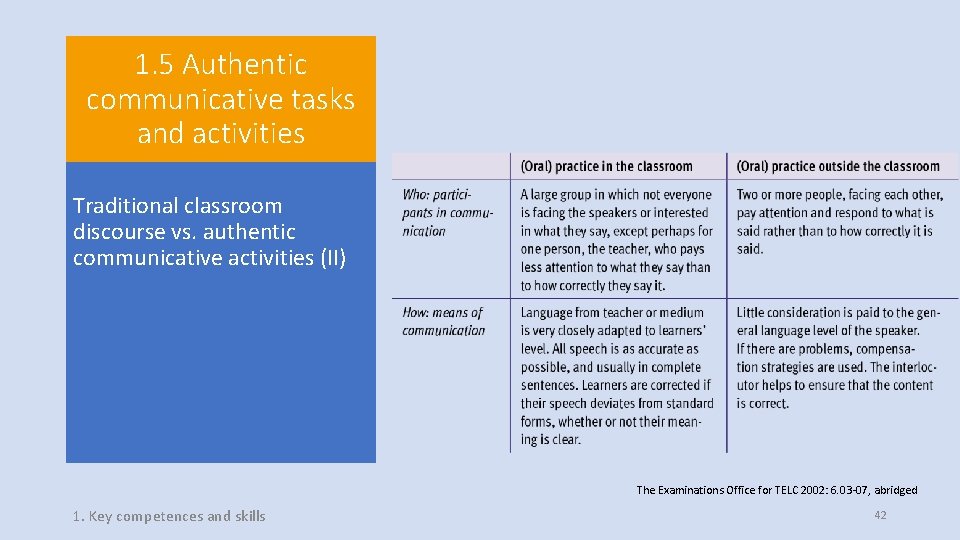
1. 5 Authentic communicative tasks and activities Traditional classroom discourse vs. authentic communicative activities (II) The Examinations Office for TELC 2002: 6. 03 -07, abridged 1. Key competences and skills 42
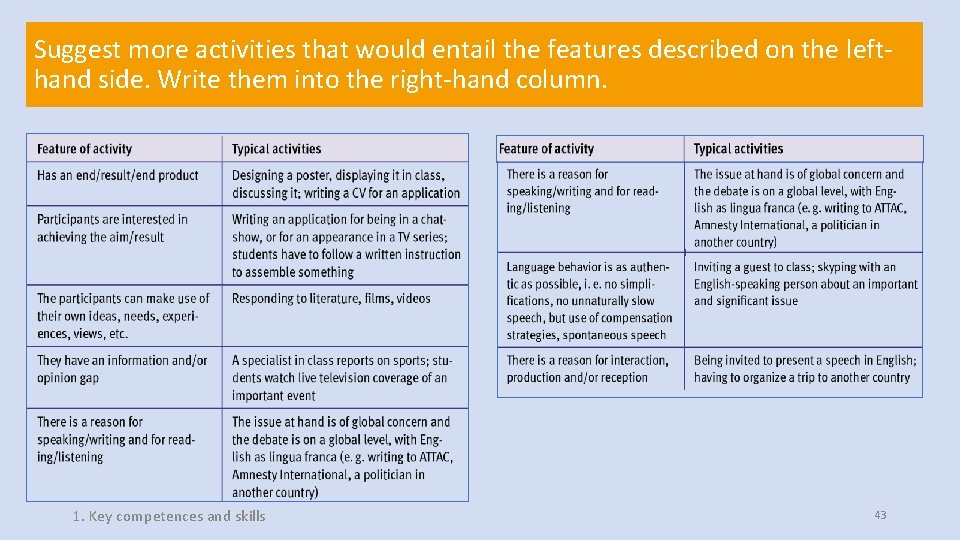
Suggest more activities that would entail the features described on the lefthand side. Write them into the right-hand column. 1. Key competences and skills 43
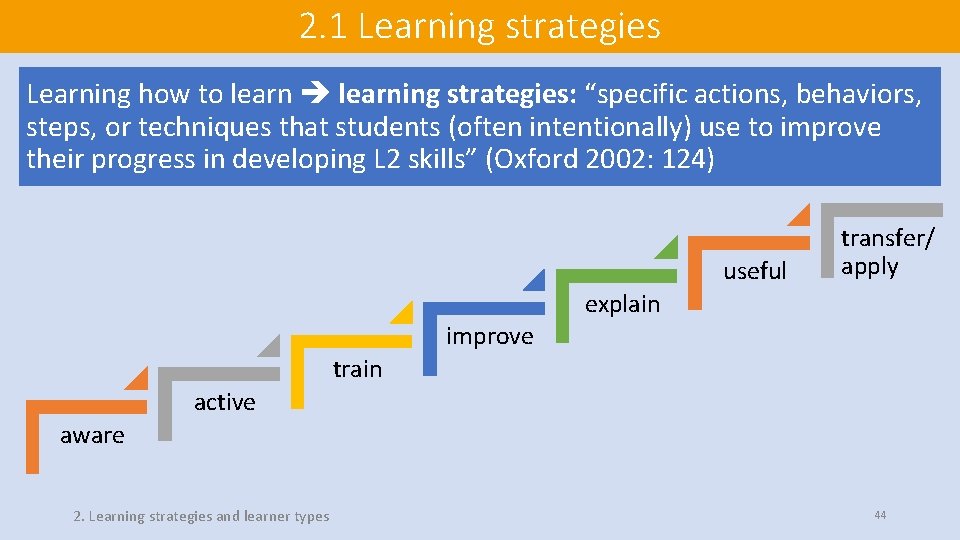
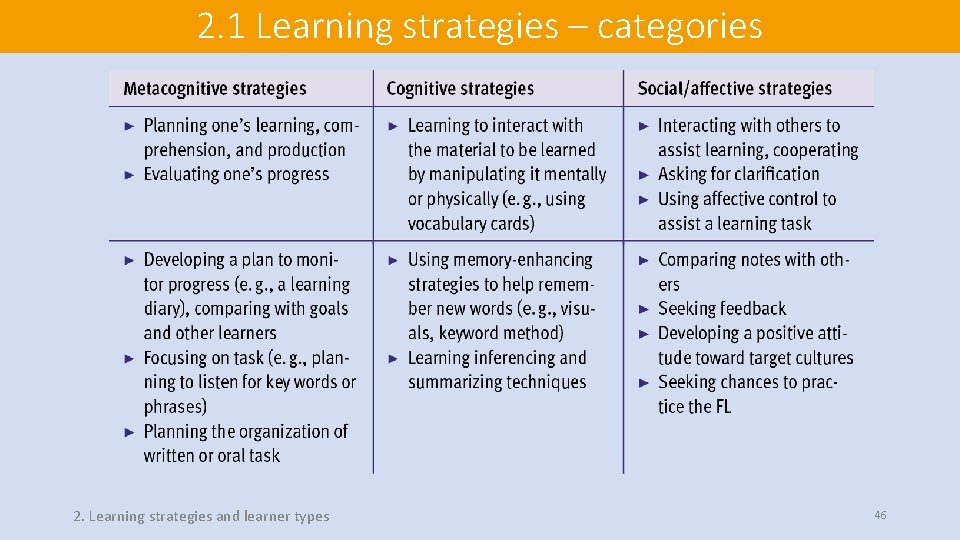
2. 1 Learning strategies Learning how to learning strategies: “specific actions, behaviors, steps, or techniques that students (often intentionally) use to improve their progress in developing L 2 skills” (Oxford 2002: 124) useful transfer/ apply explain improve train active aware 2. Learning strategies and learner types 44
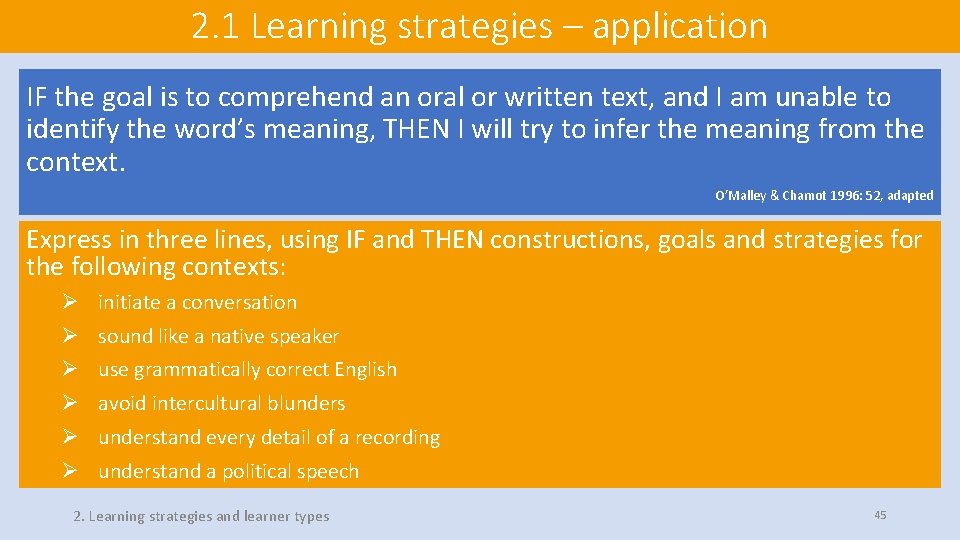
2. 1 Learning strategies – application IF the goal is to comprehend an oral or written text, and I am unable to identify the word’s meaning, THEN I will try to infer the meaning from the context. O’Malley & Chamot 1996: 52, adapted Express in three lines, using IF and THEN constructions, goals and strategies for the following contexts: Ø initiate a conversation Ø sound like a native speaker Ø use grammatically correct English Ø avoid intercultural blunders Ø understand every detail of a recording Ø understand a political speech 2. Learning strategies and learner types 45
2. 1 Learning strategies – categories 2. Learning strategies and learner types 46
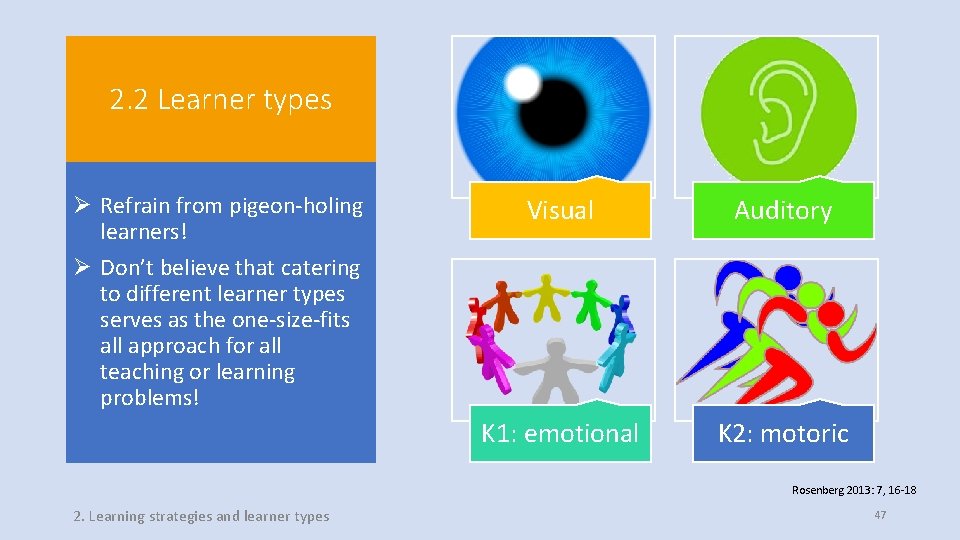
2. 2 Learner types Ø Refrain from pigeon-holing learners! Ø Don’t believe that catering to different learner types serves as the one-size-fits all approach for all teaching or learning problems! Visual Auditory K 1: emotional K 2: motoric Rosenberg 2013: 7, 16 -18 2. Learning strategies and learner types 47
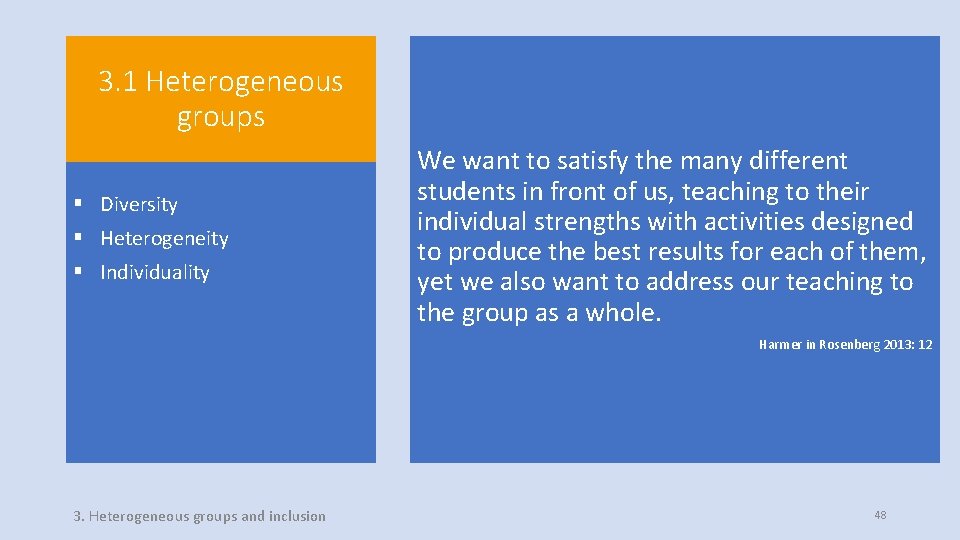
3. 1 Heterogeneous groups § Diversity § Heterogeneity § Individuality We want to satisfy the many different students in front of us, teaching to their individual strengths with activities designed to produce the best results for each of them, yet we also want to address our teaching to the group as a whole. Harmer in Rosenberg 2013: 12 3. Heterogeneous groups and inclusion 48
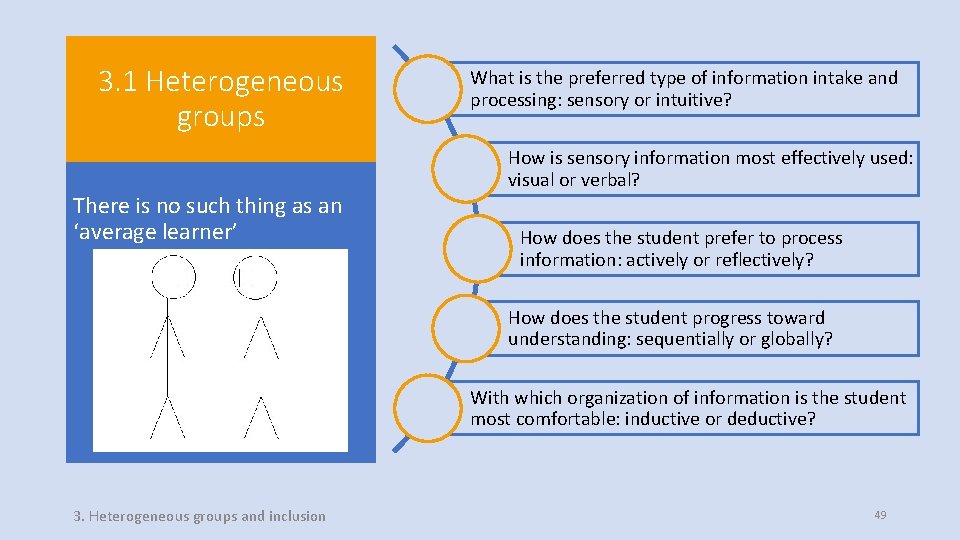
3. 1 Heterogeneous groups There is no such thing as an ‘average learner’ What is the preferred type of information intake and processing: sensory or intuitive? How is sensory information most effectively used: visual or verbal? How does the student prefer to process information: actively or reflectively? How does the student progress toward understanding: sequentially or globally? With which organization of information is the student most comfortable: inductive or deductive? 3. Heterogeneous groups and inclusion 49
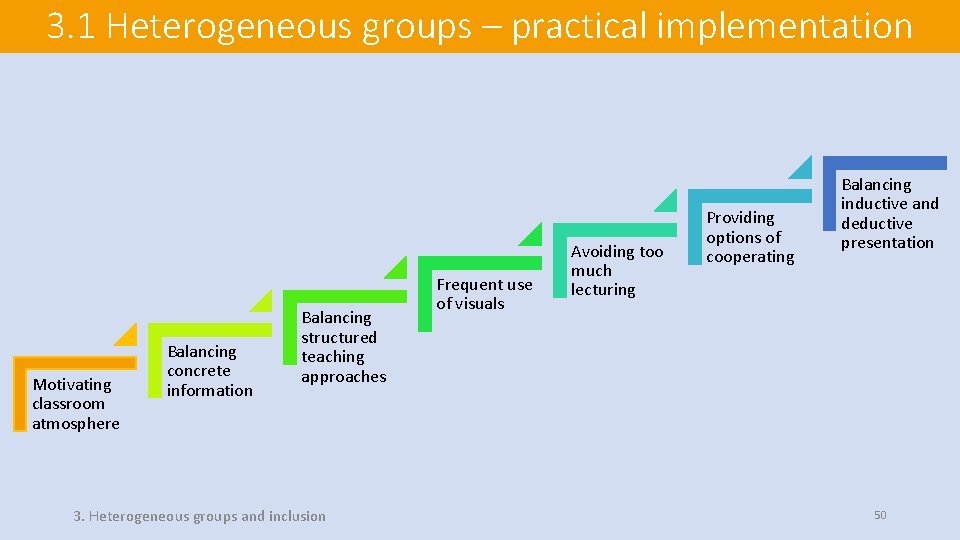
3. 1 Heterogeneous groups – practical implementation Motivating classroom atmosphere Balancing concrete information Balancing structured teaching approaches 3. Heterogeneous groups and inclusion Frequent use of visuals Avoiding too much lecturing Providing options of cooperating Balancing inductive and deductive presentation 50
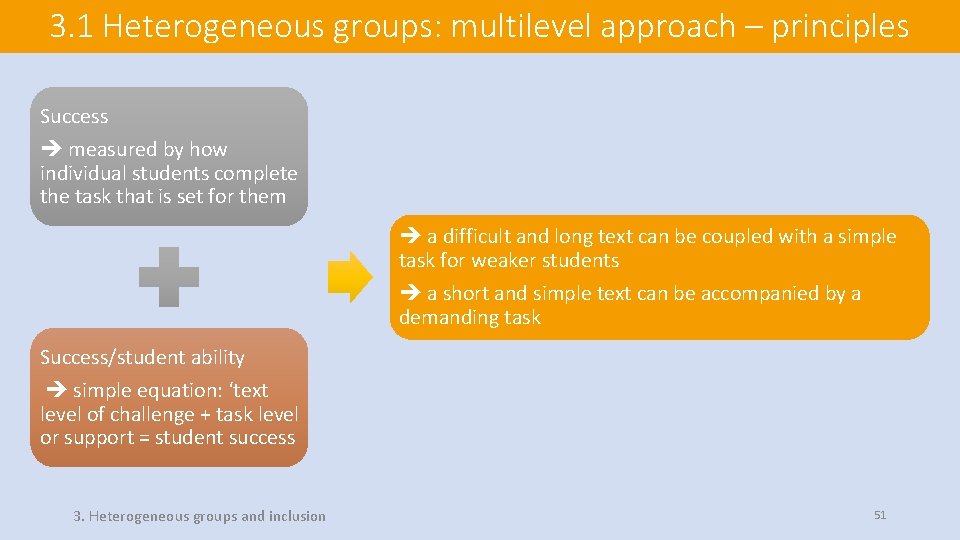
3. 1 Heterogeneous groups: multilevel approach – principles Success measured by how individual students complete the task that is set for them a difficult and long text can be coupled with a simple task for weaker students a short and simple text can be accompanied by a demanding task Success/student ability simple equation: ‘text level of challenge + task level or support = student success 3. Heterogeneous groups and inclusion 51
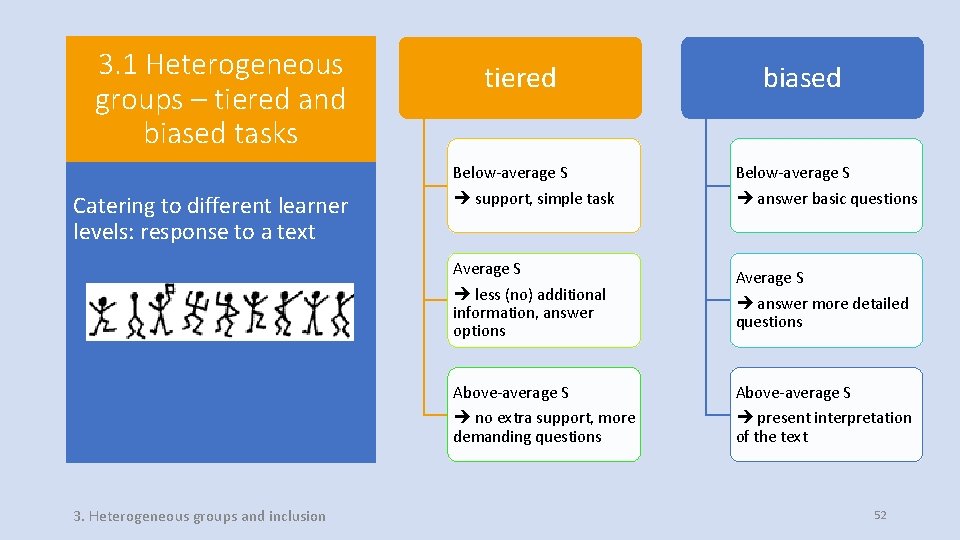
3. 1 Heterogeneous groups – tiered and biased tasks Catering to different learner levels: response to a text 3. Heterogeneous groups and inclusion tiered biased Below-average S support, simple task Below-average S answer basic questions Average S less (no) additional information, answer options Average S answer more detailed questions Above-average S no extra support, more demanding questions Above-average S present interpretation of the text 52
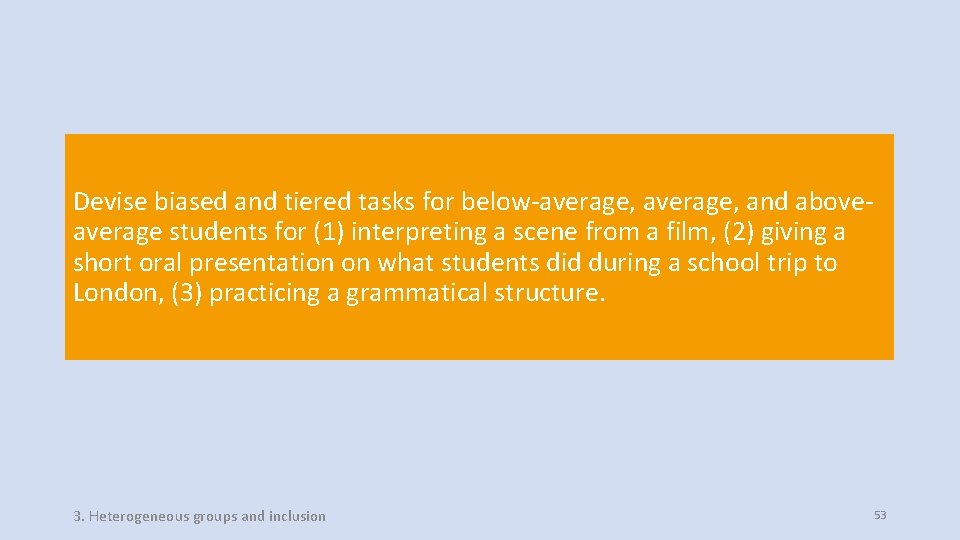
Devise biased and tiered tasks for below-average, and aboveaverage students for (1) interpreting a scene from a film, (2) giving a short oral presentation on what students did during a school trip to London, (3) practicing a grammatical structure. 3. Heterogeneous groups and inclusion 53
3. 2 Inclusion Discuss the following statement with regard to the challenge of ‘inclusion’: “From the first day of school our school system aims at securing the fiction of homogeneous learner groups. ” (Tillmann 2007: 7, our trans. ) 3. Heterogeneous groups and inclusion 54
3. 2 Inclusion as a ‘revolution’? UNESCO Guidelines for Inclusion: Ensuring Access to Education for All (2005) Inclusion is seen as a process of addressing and responding to the diversity of needs of all learners through increasing participation in learning, cultures and communities, and reducing exclusion within and from education. It involves changes and modifications in content, approaches, structures and strategies, with a common vision which covers all children of the appropriate age range and a conviction that it is the responsibility of the regular system to educate all children. UNESCO 2005: 13 3. Heterogeneous groups and inclusion 55
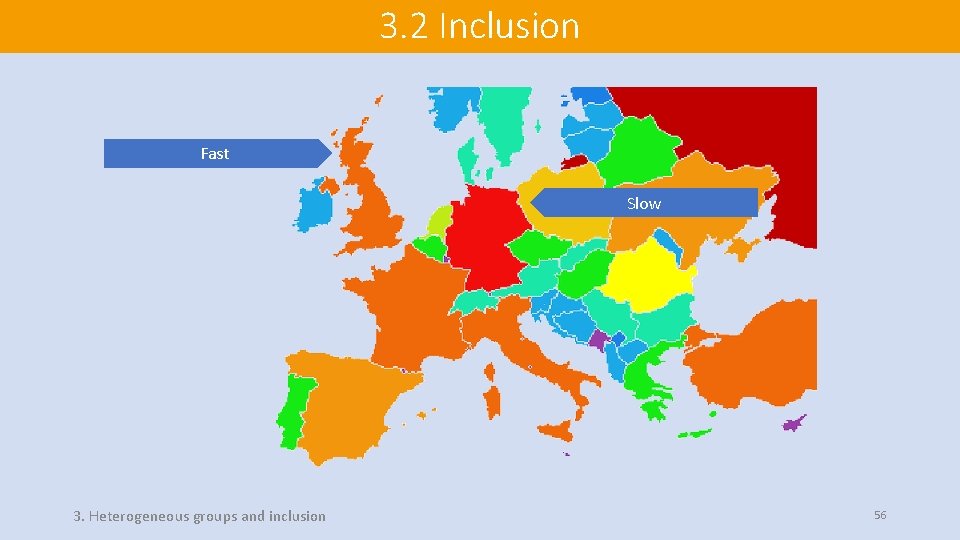
3. 2 Inclusion Fast Slow 3. Heterogeneous groups and inclusion 56
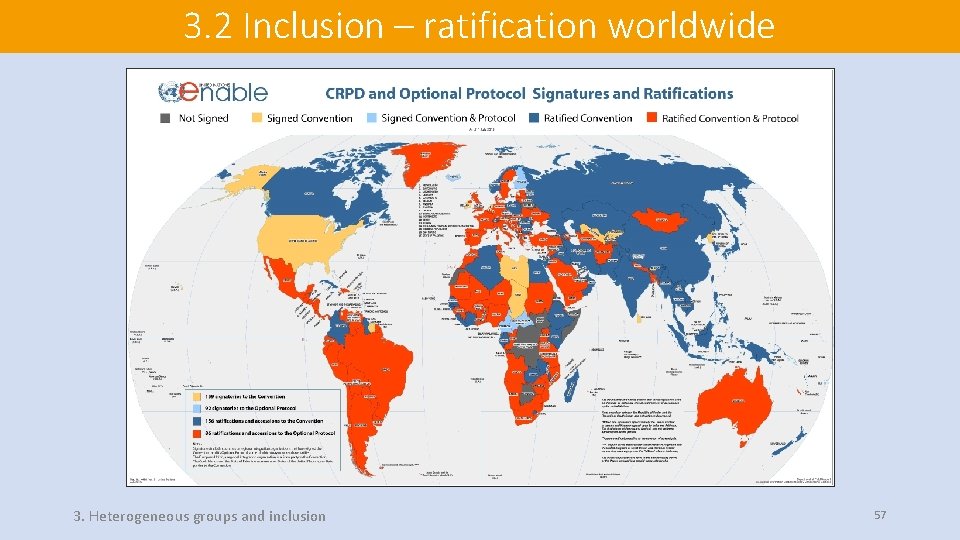
3. 2 Inclusion – ratification worldwide 3. Heterogeneous groups and inclusion 57
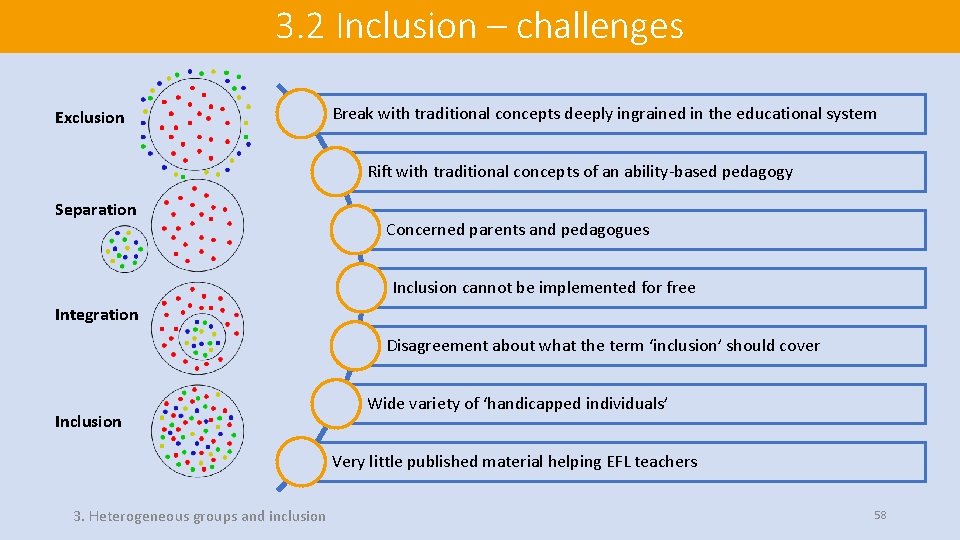
3. 2 Inclusion – challenges Exclusion Break with traditional concepts deeply ingrained in the educational system Rift with traditional concepts of an ability-based pedagogy Separation Concerned parents and pedagogues Inclusion cannot be implemented for free Integration Disagreement about what the term ‘inclusion’ should cover Inclusion Wide variety of ‘handicapped individuals’ Very little published material helping EFL teachers 3. Heterogeneous groups and inclusion 58
Discuss the issue of ‘inclusion’ with friends, parents, children, and your peers. Do you know of instances of ‘inclusion’? What is your personal position? Think of how teaching and learning methods need to be changed in general and for the EFL classroom in particular. 3. Heterogeneous groups and inclusion 59
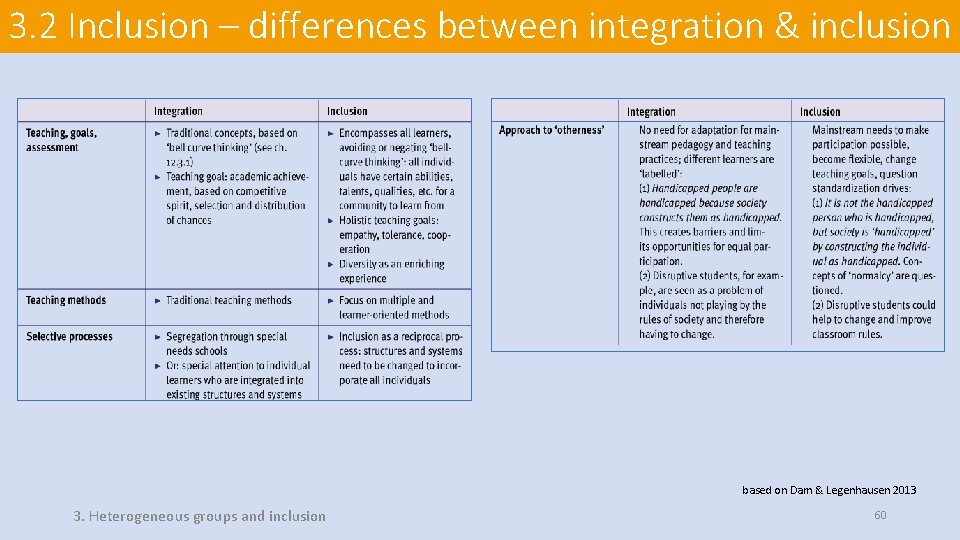
3. 2 Inclusion – differences between integration & inclusion based on Dam & Legenhausen 2013 3. Heterogeneous groups and inclusion 60
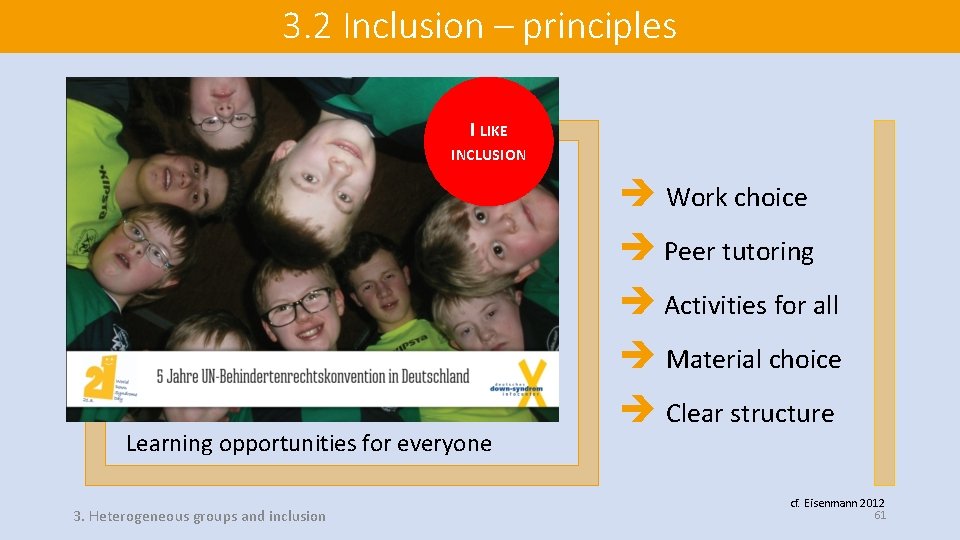
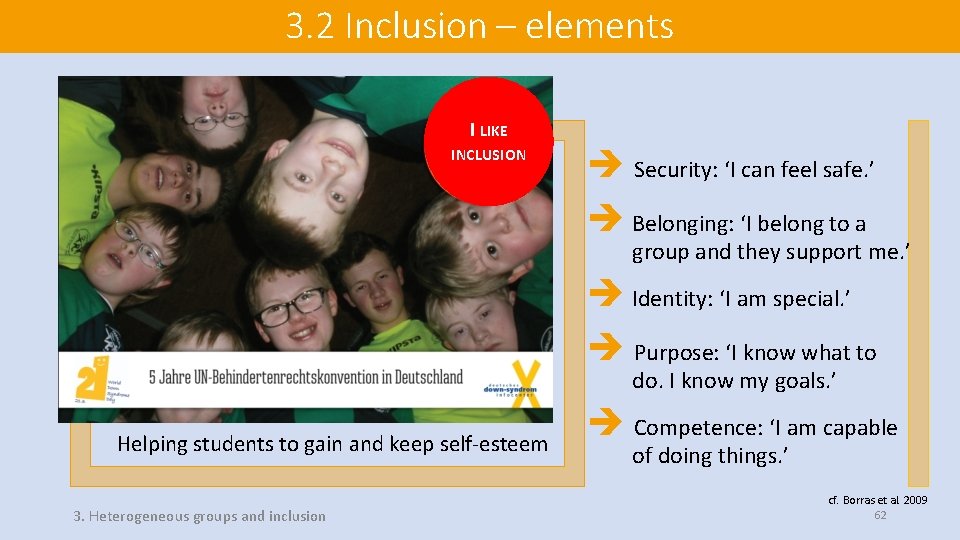
3. 2 Inclusion – principles I LIKE INCLUSION Work choice Learning opportunities for everyone 3. Heterogeneous groups and inclusion Peer tutoring Activities for all Material choice Clear structure cf. Eisenmann 2012 61
3. 2 Inclusion – elements I LIKE INCLUSION Security: ‘I can feel safe. ’ Belonging: ‘I belong to a group and they support me. ’ Identity: ‘I am special. ’ Purpose: ‘I know what to do. I know my goals. ’ Helping students to gain and keep self-esteem 3. Heterogeneous groups and inclusion Competence: ‘I am capable of doing things. ’ cf. Borras et al. 2009 62
Consider how principles used for different learner styles can be employed in the inclusive EFL classroom. Consider the crucial concepts of fostering autonomous learning and supporting the individual learner’s self-esteem. 3. Heterogeneous groups and inclusion 63
Recommended reading Arendt, Manfred (1999). Entru mpelung des Methodenrepertoires. In: Fremdsprachenunterricht 43. 52, 401– 08. Bo rner, Otfried; Christoph Edelhoff & Christa Lohmann, eds. (2010). Individualisierung und Differenzierung im kommunikativen Englischunterricht. Braunschweig: Diesterweg. Dam, Leni & Lienhard Legenhausen (2013). Learner Autonomy – A Possible Answer to Inclusion. In: Maria Eisenmann; Margit Hempel & Christian Ludwig, eds. Medien und Interkulturalita t im Fremdsprachenunterricht: Zwischen Autonomie, Kollaboration und Konstruktion. Duisburg: Universita tsverlag Rhein-Ruhr, 115– 32. Eisenmann, Maria (2012). Introduction: Heterogeneity and Differentiation. In: Maria Eisenmann & Theresa Summer, eds. Basic Issues in EFL Teaching and Learning. Heidelberg: Winter, 297– 311. Klippert, Heinz (2010). Heterogenita t im Klassenzimmer: Wie Lehrkra fte effektiv und zeitsparend damit umgehen ko nnen. Weinheim et al. : Beltz. O’Malley, J. Michael & Anna Uhl Chamot (1996). Learning Strategies in Second Language Acquisition. Cambridge: Cambridge University Press. Oxford, Rebecca L. (1990). Language Learning Strategies: What Every Teacher Should Know. Boston, MA: Heinle & Heinle. Chapter 6: Language competences, learning strategies, and the individual learner 64
Acknowledgments Arendt, Manfred (1999). Entrümpelung des Methodenrepertoires. In: Fremdsprachenunterricht 43. 52, 401 -08. Borras, Laurence; Maria Boucherie; Sylvia Mohr; Tania Lecomte; Nader Perroud & Philippe Huguelet (2009). Increasing Self-esteem: Efficacy of a Group Intervention for Individuals with Severe Mental Disorders. In: European Psychiatry 24. 5, 307 -16. Council of Europe (2001). Common European Framework of Reference for Languages: Learning, Teaching, Assessment. Cambridge: Cambridge University Press. Dam, Leni & Lienhard Legenhausen (2013). Learner Autonomy – A Possible Answer to Inclusion. In: Maria Eisenmann & Margit Hempel, eds. Medien und Interkulturalität im Fremdsprachenunterricht: Zwischen Autonomie, Kollaboration und Konstruktion. Duisburg: Universitätsverlag Rhein-Ruhr, 115 -32. Eisenmann, Maria (2012). Introduction: Heterogeneity and Differentiation. In: Maria Eisenmann & Theresa Summer, eds. Basic Issues in EFL Teaching and Learning. Heidelberg: Winter, 297 -311. Grabe, William (2011). Teaching and Testing Reading. In: Michael H. Long & Catherine J. Doughty, eds. The Handbook of Language Teaching. Malden, MA: Wiley-Blackwell, 441 -62. Levelt, Willem J. M. (1994). The Skill of Speaking. In: Paul Bertelson, Paul Eelen & Géry D’Ydewalle, eds. International Perspectives on Psychological Science. Vol. 1. Hove: Lawrence Erlbaum, 89 -104. Nunan, David (2002). Listening in Language Learning. In: Jack C. Richards & Willy A. Renandya, eds. Methodology in Language Teaching: An Anthology of Current Practice. Cambridge et al. : Cambridge University Press, 238 -41. Chapter 6: Language competences, learning strategies, and the individual learner 65
Acknowledgments O’Malley, J. Michael & Anna Uhl Chamot (1996). Learning Strategies in Second Language Acquisition. Cambridge et al. : Cambridge University Press. Oxford, Rebecca L. (2002). Language Learning Strategies in a Nutshell: Update and ESL Suggestions. In: Jack C. Richards & Willy A. Renandya, eds. Methodology in Language Teaching: An Anthology of Current Practice. Cambridge et al. : Cambridge University Press, 124 -32. Rosenberg, Marjorie (2013). Spotlight on Learning Styles: Teacher Strategies for Learner Success. Peaslake: Delta Publishing. Shumin, Kang (2002). Factors to Consider: Developing EFL Students’ Speaking Abilities. In: Jack C. Richards & Willy A. Renandya, eds. Methodology in Language Teaching: An Anthology of Current Practice. Cambridge et al. : Cambridge University Press, 204 -11. The Examination Office for TELC – The European Language Certificates (2002). The ABC of the Common European Reference for Languages (CEFR): A Brief Introduction for Teachers and Learners. DVD. Tillmann, Klaus-Jürgen (2007). Kann man in heterogenen Lerngruppen alle Schülerinnen und Schüler fördern? Der Blick der Bildungsforschung in das Regelschulsystem. http: //bildungsserver. berlinbrandenburg. de/fileadmin/bbb/schulqualitaet/lehren_und_lernen/schulanfang/tillmann 07 heterog enitaet_selektion_auch_GSOR 071230__1_. pdf. UNESCO (2005). Guidelines for Inclusion: Ensuring Access to Education for All. Paris: UNESCO. Weskamp, Ralf (2001). Fachdidaktik: Grundlagen & Konzepte. Berlin: Cornelsen. Chapter 6: Language competences, learning strategies, and the individual learner 66
Acknowledgments The cartoons at the beginning of each ppt were designed by Frollein Motte, 2014. If not otherwise indicated, the copyright of the figures lies with the authors. The complete titles of the sources can be found in the references to the units unless given below. All of the websites were checked on 10 September 2014. Slide 8: https: //pixabay. com/en/table-wine-dinner-restaurant-147314 Slide 9: Pre-activity phase strategies, based on O’Malley & Chamot 1996: 44 -46 Slide 12: https: //pixabay. com/en/bookends-books-shelf-men-pushing-155762 Slide 17: Improving reading skills, based on Weskamp 2001: 133 -34; Grabe 2011: 455 -56 Slide 24: Improving listening skills, based on Weskamp 2001: 124; Field 2002: 242 -45; Vandergrift & Groh 2011: 402 -05 Slide 33: https: //pixabay. com/en/achievement-across-advantage-703442, http: //ilstuafrica. wikispaces. com/Zambia+Classroom+Activities, https: //commons. wikimedia. org/wiki/File: Blue_question_mark. jpg, https: //commons. wikimedia. org/wiki/File: A_Smiley. jpg, http: //edpsychtemple. wikispaces. com/Motivation+in+Learning? response. Token=9 cb 1209 f 7018267 d 10 d 45 a 97 9 a 421358, https: //pixabay. com/en/exchange-of-ideas-debate-discussion-222788 Slide 39: https: //commons. wikimedia. org/wiki/%E 4%B 8%AD%E 5%9 B%BD#/media/File: Ding_Jun-hui. jpg Chapter 6: Language competences, learning strategies, and the individual learner 67
Acknowledgments Slide 47: https: //pixabay. com/en/eye-iris-vision-human-blue-part-29246, https: //it. wikipedia. org/wiki/Sistema_uditivo#/media/File: 00 -Oreille-ear. jpg, https: //pixabay. com/en/community-people-human-together-419045, https: //pixabay. com/en/runner-iconsport-racing-blue-305292 Slide 49: https: //commons. wikimedia. org/wiki/File: Average_Joe_and_Average_Stu. jpg? uselang=de#/media/File: Averag e_Joe_and_Average_Stu. jpg Slide 52: https: //commons. wikimedia. org/wiki/Category: Stick_figures? uselang=de#/media/File: Dancing_men. png Slide 56: https: //commons. wikimedia. org/wiki/Europe__Europa#/media/File: Europe_population_map_countries. PNG Slide 57: http: //www. un. org/disabilities/documents/maps/enablemap. jpg Slide 58: Exclusion, segregation, integration, inclusion; Robert Aehnelt, Historische Schritte auf dem Weg zur Inklusion auf gesellschaftlicher Ebene; http: //de. wikipedia. org/wiki/Inklusive_P%C 3%A 4 dagogik, adapted; CC BY-SA 3. 0 Slide 60: Differences between integration and inclusion, based on Damm & Legenhausen 2013 Slides 61 & 62: https: //commons. wikimedia. org/wiki/File: TABALi. NGOs_Sportler_2014. jpg? uselang=de#/media/File: TABALi. NG Os_Sportler_2014. jpg, adapted Chapter 6: Language competences, learning strategies, and the individual learner 68