
Teaching Emergent Bilinguals How Do I Plan for
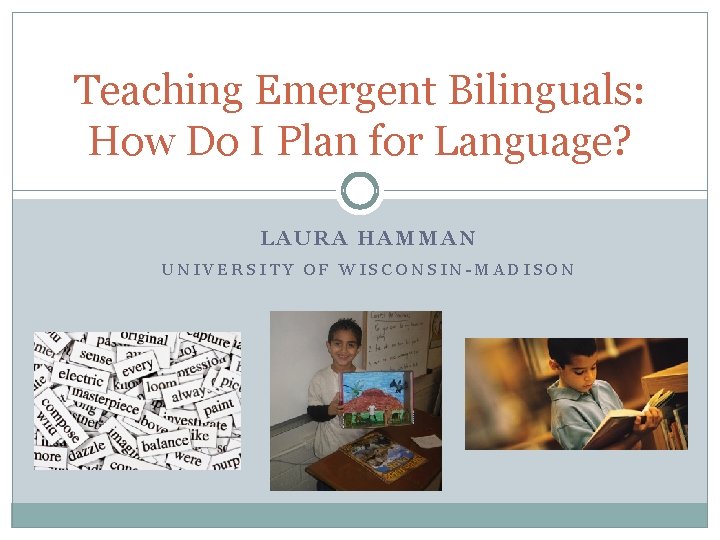
Teaching Emergent Bilinguals: How Do I Plan for Language? LAURA HAMMAN UNIVERSITY OF WISCONSIN-MADISON
Today’s Objectives SWBAT… �Identify language demands in instructional design �Create language objectives that align with content objectives & standards
Key Considerations: Language & Learning �Emergent bilinguals not only learn language; they also learn through language �Learning is most effective when in students’ Zone of Proximal Development (ZPD) �Learning language is NOT just about mastering vocabulary words.
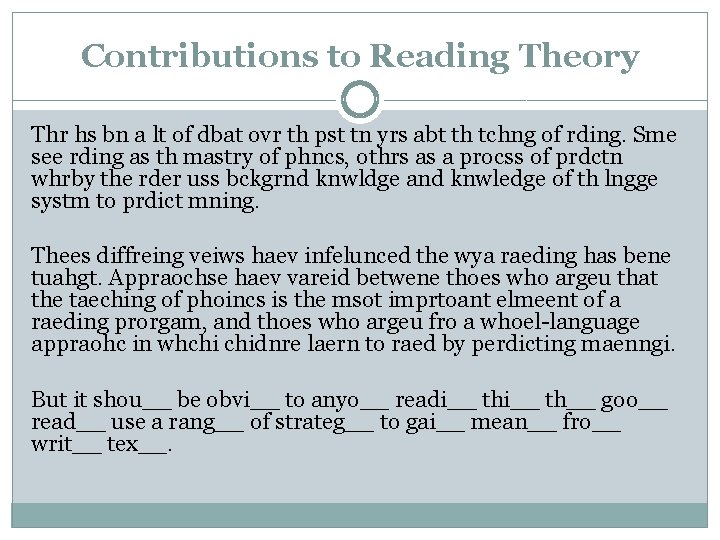
Contributions to Reading Theory Thr hs bn a lt of dbat ovr th pst tn yrs abt th tchng of rding. Sme see rding as th mastry of phncs, othrs as a procss of prdctn whrby the rder uss bckgrnd knwldge and knwledge of th lngge systm to prdict mning. Thees diffreing veiws haev infelunced the wya raeding has bene tuahgt. Appraochse haev vareid betwene thoes who argeu that the taeching of phoincs is the msot imprtoant elmeent of a raeding prorgam, and thoes who argeu fro a whoel-language appraohc in whchi chidnre laern to raed by perdicting maenngi. But it shou__ be obvi__ to anyo__ readi__ th__ goo__ read__ use a rang__ of strateg__ to gai__ mean__ fro__ writ__ tex__.
Central Questions for Considering Language 1. What are the language DEMANDS of this lesson or activity?
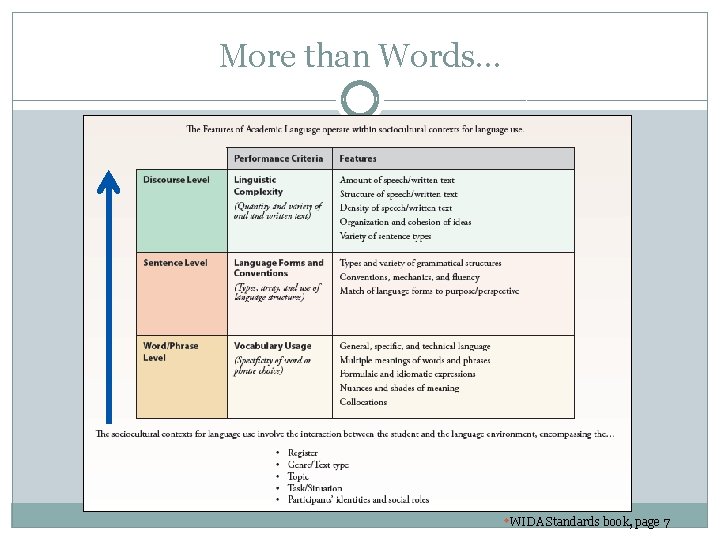
More than Words… WIDA Standards book, page 7
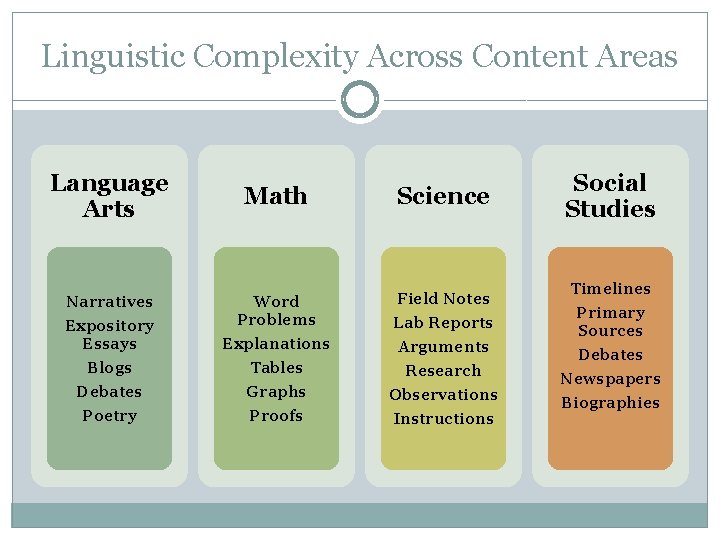
Linguistic Complexity Across Content Areas Language Arts Math Science Social Studies Narratives Expository Essays Word Problems Explanations Field Notes Lab Reports Timelines Primary Sources Blogs Tables Debates Poetry Graphs Proofs Arguments Research Observations Instructions Debates Newspapers Biographies
Central Questions for Considering Language 1. What are the language DEMANDS of this lesson or activity? 2. How will I SUPPORT students to access content (comprehensible input) and to participate fully in the lesson or activity?

Language Supports
Writing Language Objectives
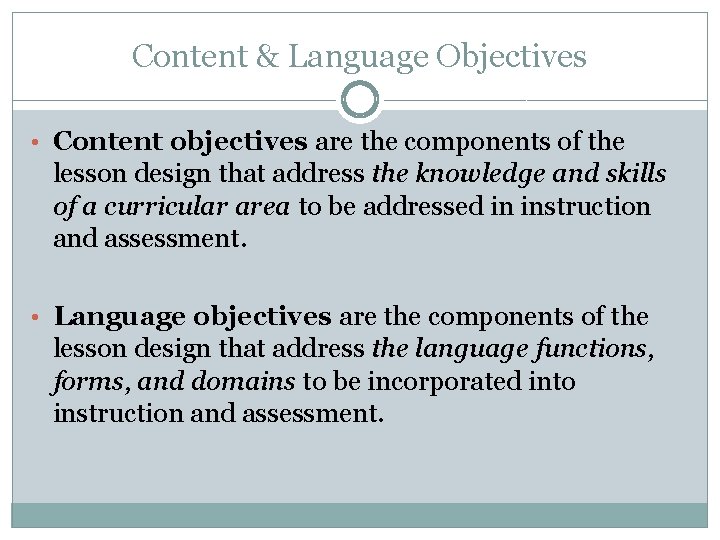
Content & Language Objectives • Content objectives are the components of the lesson design that address the knowledge and skills of a curricular area to be addressed in instruction and assessment. • Language objectives are the components of the lesson design that address the language functions, forms, and domains to be incorporated into instruction and assessment.
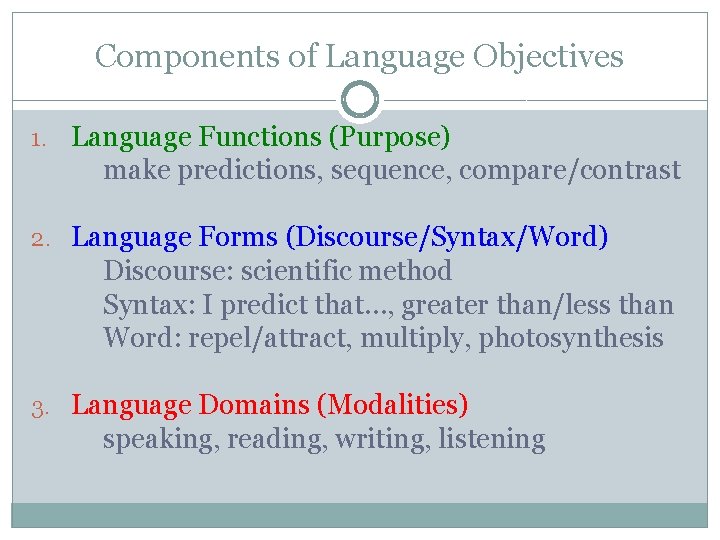
Components of Language Objectives 1. Language Functions (Purpose) make predictions, sequence, compare/contrast 2. Language Forms (Discourse/Syntax/Word) Discourse: scientific method Syntax: I predict that…, greater than/less than Word: repel/attract, multiply, photosynthesis 3. Language Domains (Modalities) speaking, reading, writing, listening
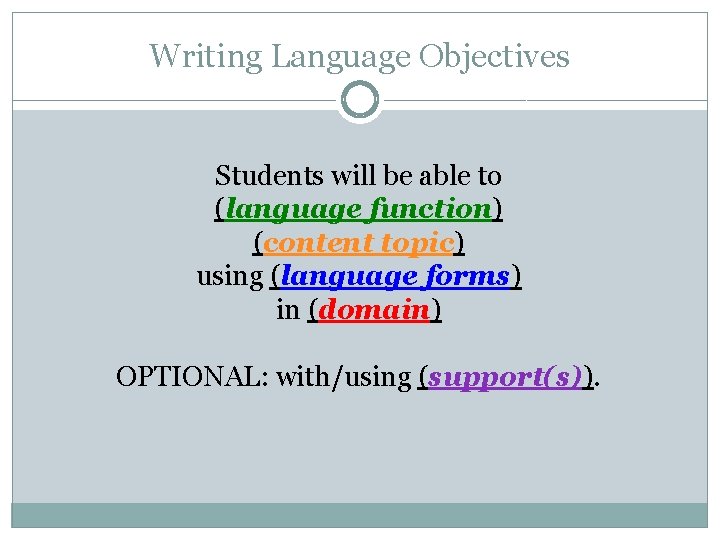
Writing Language Objectives Students will be able to (language function) (content topic) using (language forms) in (domain) OPTIONAL: with/using (support(s)).
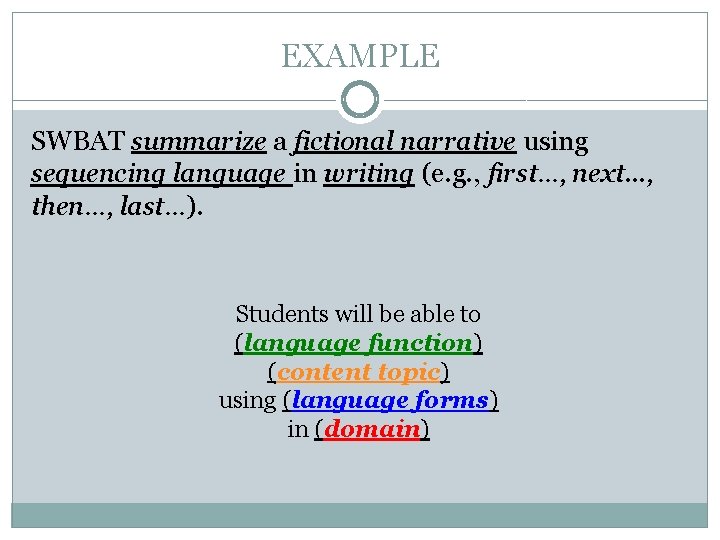
EXAMPLE SWBAT summarize a fictional narrative using sequencing language in writing (e. g. , first…, next. . . , then…, last…). Students will be able to (language function) (content topic) using (language forms) in (domain)
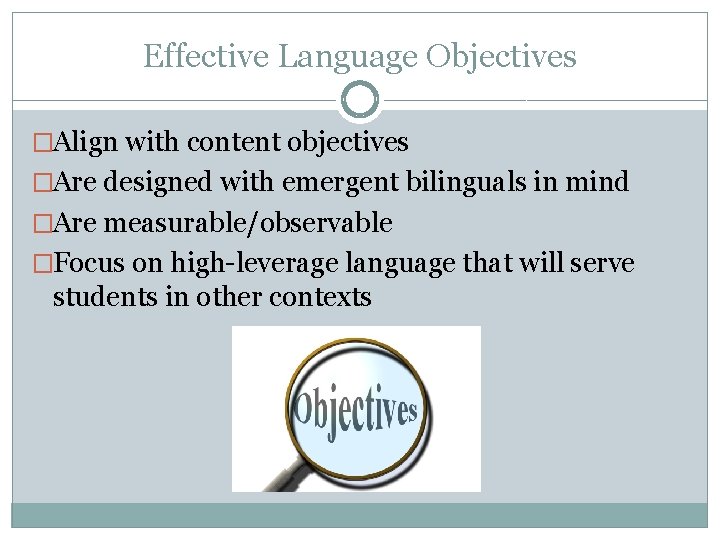
Effective Language Objectives �Align with content objectives �Are designed with emergent bilinguals in mind �Are measurable/observable �Focus on high-leverage language that will serve students in other contexts
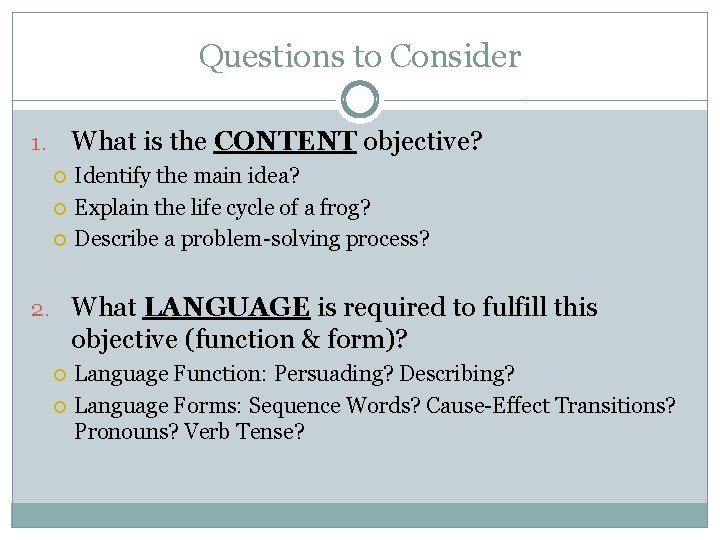
Questions to Consider What is the CONTENT objective? 1. Identify the main idea? Explain the life cycle of a frog? Describe a problem-solving process? 2. What LANGUAGE is required to fulfill this objective (function & form)? Language Function: Persuading? Describing? Language Forms: Sequence Words? Cause-Effect Transitions? Pronouns? Verb Tense?
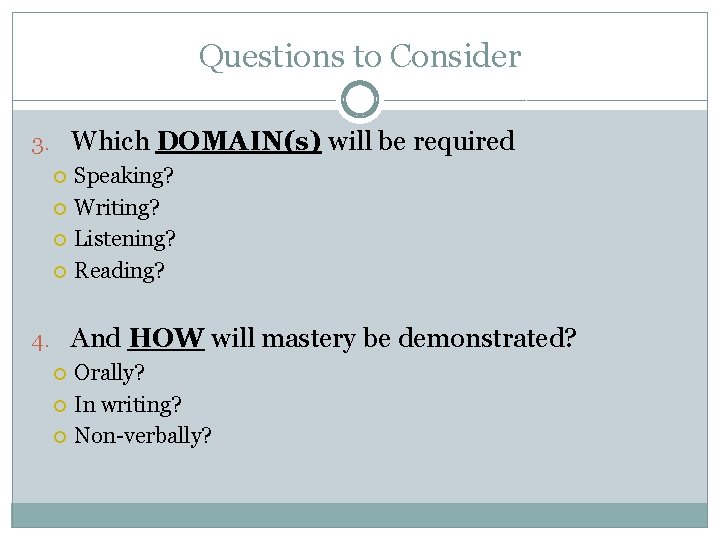
Questions to Consider 3. Which DOMAIN(s) will be required Speaking? Writing? Listening? Reading? 4. And HOW will mastery be demonstrated? Orally? In writing? Non-verbally?

Your Turn!
Thank You! Questions/Comments? Laura Hamman lhamman@wisc. edu
- Slides: 19