
TEACHING EFFECTIVE READING STRATEGIES HELPING STUDENTS EXPLORE COMPLEX
- Slides: 15
TEACHING EFFECTIVE READING STRATEGIES: HELPING STUDENTS EXPLORE COMPLEX TEXTS
How do you define the reading process? • Ten-minute free-write. Quickly jot down your thoughts on what you think about the reading process. Attempt to define what reading is in relation to your teaching experiences in the classroom.
So! What do we talk about when we talk about reading? • While seemingly a simplistic question, we almost never actually question the reading process. We often take it for granted that our students can “read” in the same way that we faculty members do. Also, what will become of reading? As Maryanne Wolf has argued in her book Proust and the Squid: “The unique aspect of reading has begun to trouble me considerably as I consider the Google universe… Will the constructive component at the heart of reading begin to change and potentially atrophy as we shift to computer-presented text… In other words, when seemingly complete visual information is given almost simultaneously, as it is in many digital presentations, is there sufficient time or sufficient motivation to process the information more inferentially, analytically, and critically? Is the act of reading dramatically different in such contexts? ”
What is, therefore the future of reading? What is its present? • Different contexts creates different readers. • Today, more than ever, we need to teach our students how to read in different ways. As Wolf suggests, things are changing rapidly and we need to keep up with these new literacies. • Reading has never been a historically static concept.
Other things to consider; or, more Wolf quotes • “We were never born to read. ” Writing, and therefore reading, are rather new technologies. • “Reading can be learned only because of the brain’s plastic design, and when reading takes place, that individual brain is forever changed, both physiologically and intellectually. ” Reading can change how we think, and, therefore, who we are.
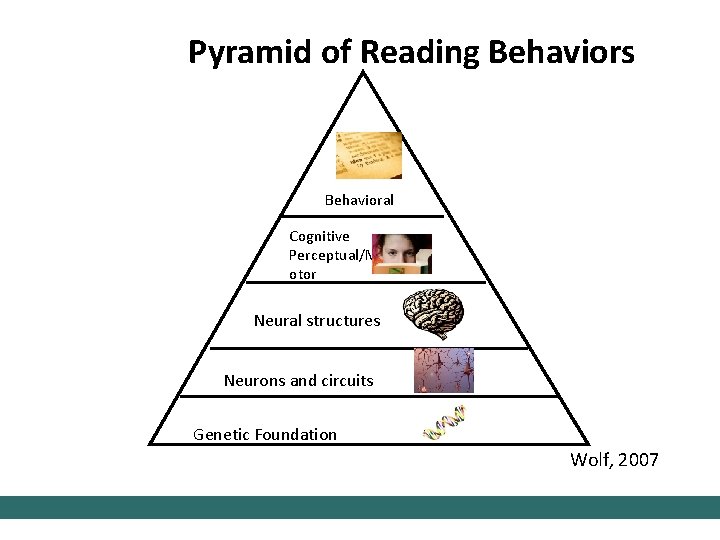
Pyramid of Reading Behaviors Behavioral Cognitive Perceptual/M otor Neural structures Neurons and circuits Genetic Foundation Wolf, 2007
The reading pyramid • Maryanne Wolf : “This pyramid functions like a three-dimensional map for understanding how any genetically programmed behavior, such as vision, happens. It does not explain, however, how it can be applied to a reading circuit, because there are no genes specific only to reading in the bottom layer. Unlike its component parts such as vision and speech, which are genetically organized, reading has no direct genetic program passing it on to future generations. Thus the next four layers involved must learn how to form the necessary pathways anew every time reading is acquired by an individual brain. This is part of what makes reading—and any cultural invention—different from other processes, and why it does not come naturally to our children as vision or spoken language, which are preprogrammed. ”
Reading thoughts • Students must be taught how to read in an “academic” manner. • Students must be taught how to read in context specific and (inter)disciplinary ways. • Reading is never a passive act. • As faculty, we must do our best to facilitate the reading process. • Reading is not a solitary process. Nothing is, really. How can we turn the reading process into a collaborative effort?
The best reading practices arise form the best assignments • The first and best way to prepare students in becoming critical and analytical readers is to develop clear and concise assignments. Students will bring more to the reading process when they are reading with goals in mind. • Develop reading and grading rubrics: tell the students to look for specific things. Be as concrete and as concise as possible. • Develop learning goals! Tell the students why they are reading and what goals you hope they should achieve in each reading assignment.
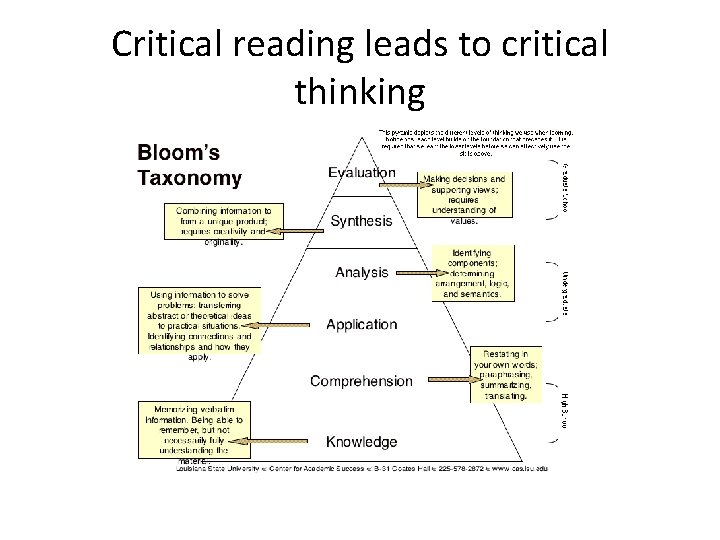
Critical reading leads to critical thinking
Where reading can lead to • Consider Bloom’s taxonomy. While not the only way to consider the process of learning, Bloom’s taxonomy can be a helpful rubric to better understanding how we want our students to progress as learners and readers. Reading should be a process that leads to specific goals.
Reading method # 1: Double-Entry Begin by taking a piece of paper and folding it directly down the middle to create two columns. Title the left-side column “Says, ” and the right side column “Means. ” The purpose is to differentiate between two modes of reading: Says is meant to suggest surface-level understanding, the ability to comprehend what the text is attempting to communicate, whereas the Means column will be used for more analytical and critical engagement with the ideas being considered.
Reading method # 2: Annotation • You are to read the selection with a pen in hand annotate while reading. Students should be given different annotation directions. For example, underline concepts, lines, phrases that are understood or useful. Circle words that are confusing or not understood. Write thoughts on the margins of a text in order to create a dialogue between reader and text.
Reading method # 3: Free-Write • Do not write or annotate the text while you are reading it. Read it in full first and then begin writing down your thoughts about what you just read. Try not to think too much about what it is you are writing, and just let go. The purpose here is to allow the process of writing to do the “thinking” for you, and to let the reading sink in.
Reading method # 4: Scanning • After reading the text, students will be expected to sit down and carefully and thoughtfully go over what it is they just read. They will be told to look for the following: thesis statements, topic sentences, and important ideas that relate to the assignment.