
Teaching Cognitive Learning Strategies to College Students Shirley

- Slides: 37
Teaching Cognitive Learning Strategies to College Students Shirley L. Yu Department of Educational Psychology University of Houston slyu@uh. edu 713 -743 -9822 1
Outline u Activity u Some principles of information processing theory u Defining cognitive learning strategies u Issues in teaching college students to be self-regulated learners u Integrated cognitive strategy instruction 2
Activity u Rate the sentences I will read according to the scale on your handout. 3
Some Principles of Information Processing Theory 4
Levels of Processing u Deeper processing focused on meaning of information results in better recall than does u Shallow processing focused on superficial aspects of information (Craik & Lockhart, 1972) 5
Effortfulness in Processing u The more difficult decisions and thinking required during learning, the better the learning u (related sidebar) Bloom’s taxonomy of educational objectives 6
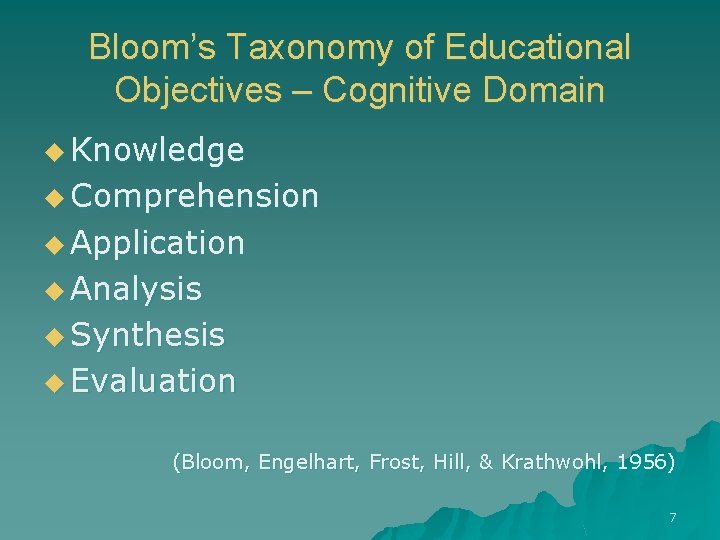
Bloom’s Taxonomy of Educational Objectives – Cognitive Domain u Knowledge u Comprehension u Application u Analysis u Synthesis u Evaluation (Bloom, Engelhart, Frost, Hill, & Krathwohl, 1956) 7
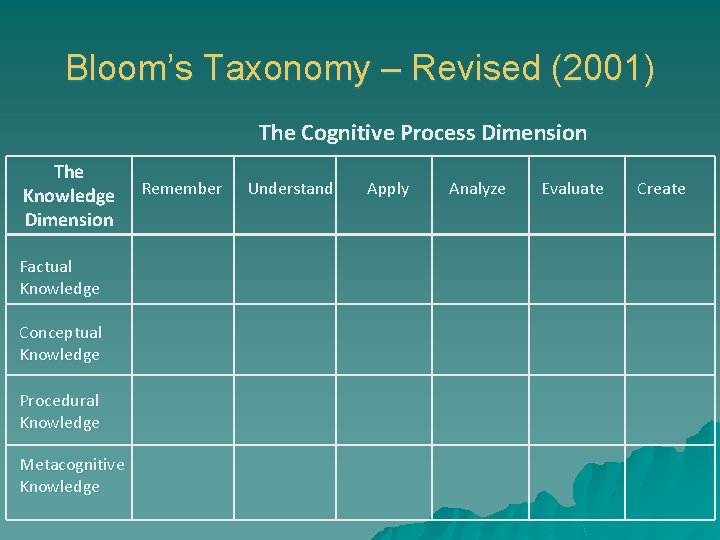
Bloom’s Taxonomy – Revised (2001) The Cognitive Process Dimension The Knowledge Dimension Factual Knowledge Conceptual Knowledge Procedural Knowledge Metacognitive Knowledge Remember Understand Apply Analyze Evaluate Create
Elaboration in Processing u Generating more information and adding it to the target information helps in learning u Links target information to prior knowledge 9
Encoding Specificity u When trying to recall information, cues start the retrieval (search) process u When same cues are present at time of presentation (encoding) AND at time of testing/use (retrieval), recall is better (Tulving, 1983; Tulving & Thomson, 1974) 10
Defining Cognitive Learning Strategies 11
Teaching Strategies vs. Cognitive Learning Strategies u Teaching strategies – Utilized by the instructor/teacher to teach u Cognitive learning strategies – Utilized by the student to learn 12
Cognitive Learning Strategies u Conscious behaviors and mental activities used by students in order to learn (Alexander, Graham, & Harris, 1998; Weinstein & Mayer, 1986) 13
Rehearsal u Repeating information over and over u E. g. , Re-read textbook; Review lecture notes 14
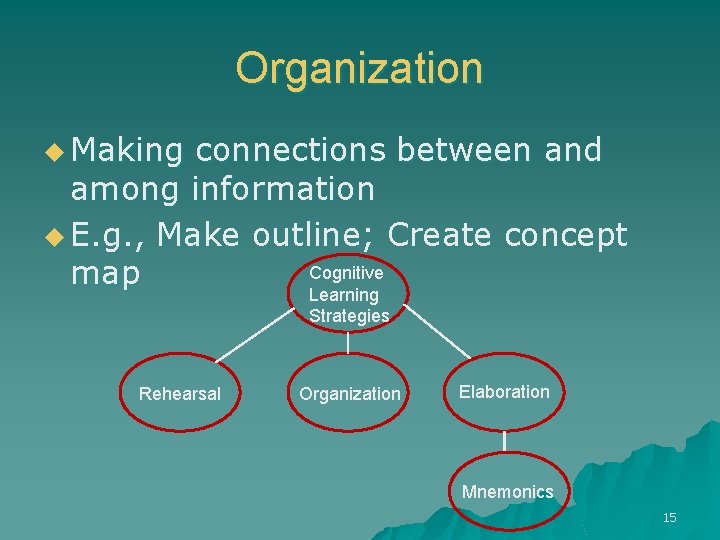
Organization u Making connections between and among information u E. g. , Make outline; Create concept Cognitive map Learning Strategies Rehearsal Organization Elaboration Mnemonics 15
Elaboration u Generating more information and adding it to the target information u E. g. , Create an example; Restate into own words; Relate information to own experience or something learned previously; Use a mnemonic strategy 16
Mnemonic Strategies u Memory tricks u E. g. , Rhymes and songs; 1 st letter technique; Keyword method 17
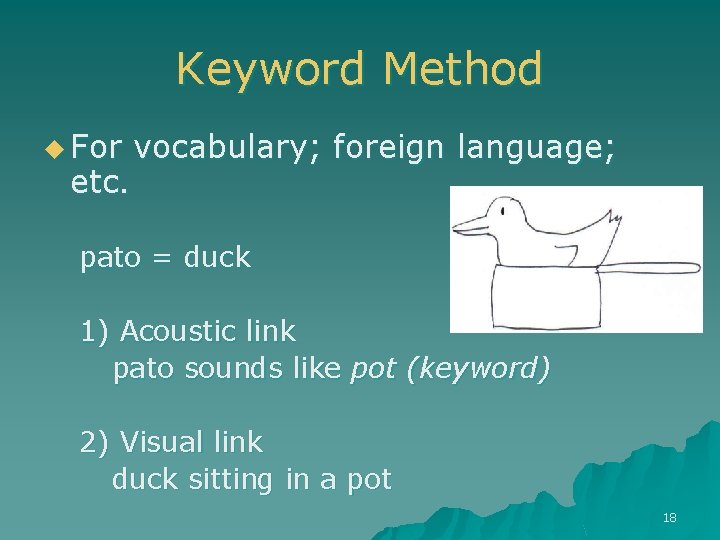
Keyword Method u For etc. vocabulary; foreign language; pato = duck 1) Acoustic link pato sounds like pot (keyword) 2) Visual link duck sitting in a pot 18
Issues in Teaching College Students to be SRL (Hofer, Yu, & Pintrich, 1998) 19
General Assumptions of a Self. Regulated Learning Perspective u Active construction u Potential for control u Use of goals/criterion/standards u Mediates between personal and contextual characteristics and actual achievement (Pintrich, 2004) 20
Integrated vs. Adjunct Course Design u Adjunct course – Stand-alone course – Example at University of Houston HDFS 1311: Development of Selfregulated Learning (Cr. 3) u Theory and research on cognitive, motivational, and behavioral factors related to academic success; emphasis on application to students' development. 21
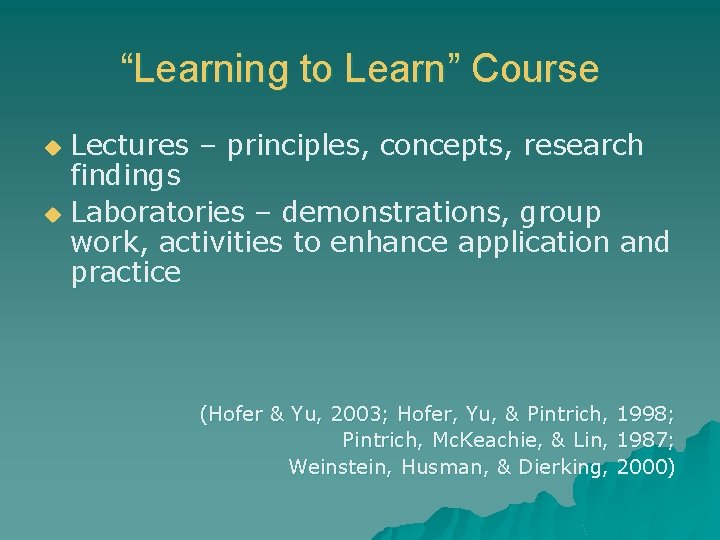
“Learning to Learn” Course Lectures – principles, concepts, research findings u Laboratories – demonstrations, group work, activities to enhance application and practice u (Hofer & Yu, 2003; Hofer, Yu, & Pintrich, Mc. Keachie, & Lin, Weinstein, Husman, & Dierking, 1998; 1987; 2000)
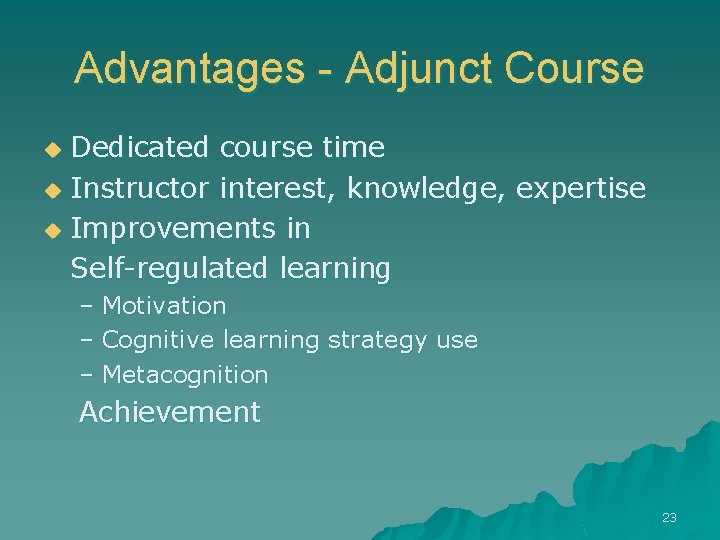
Advantages - Adjunct Course Dedicated course time u Instructor interest, knowledge, expertise u Improvements in Self-regulated learning u – Motivation – Cognitive learning strategy use – Metacognition Achievement 23
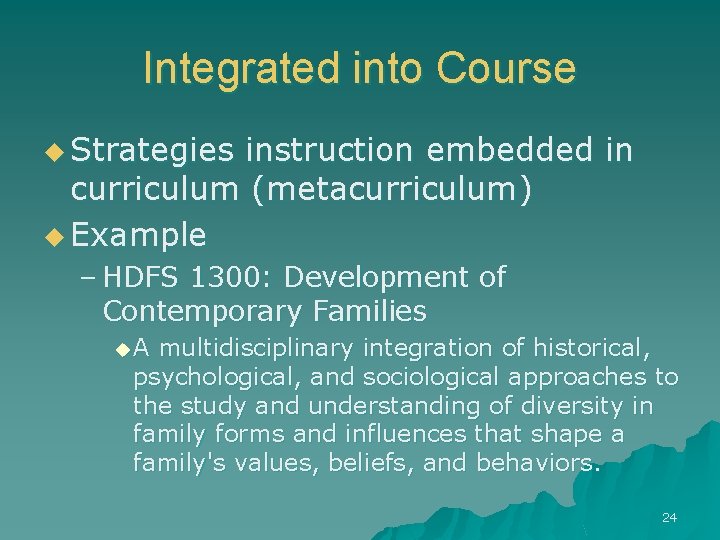
Integrated into Course u Strategies instruction embedded in curriculum (metacurriculum) u Example – HDFS 1300: Development of Contemporary Families u. A multidisciplinary integration of historical, psychological, and sociological approaches to the study and understanding of diversity in family forms and influences that shape a family's values, beliefs, and behaviors. 24
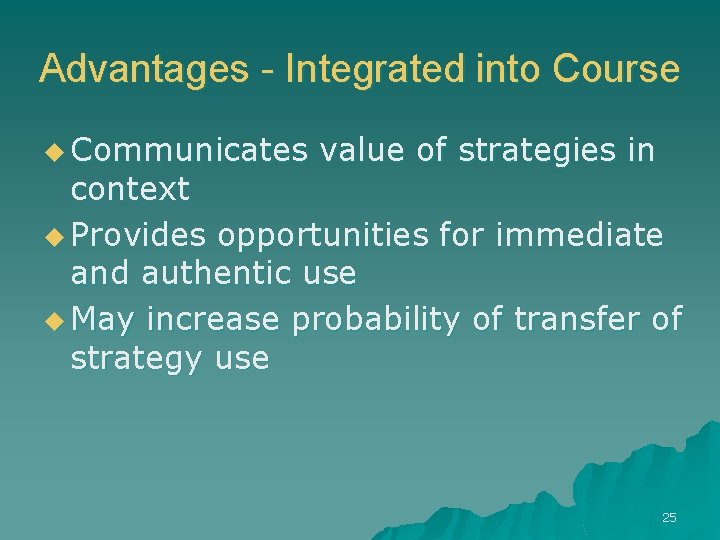
Advantages - Integrated into Course u Communicates value of strategies in context u Provides opportunities for immediate and authentic use u May increase probability of transfer of strategy use 25
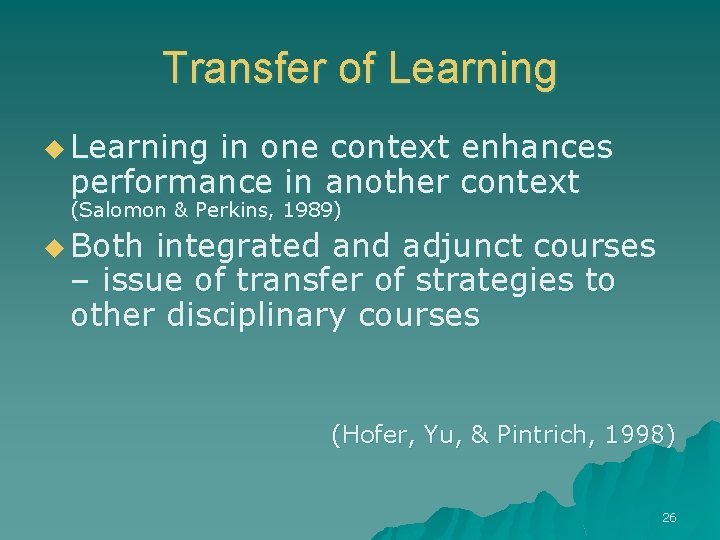
Transfer of Learning u Learning in one context enhances performance in another context (Salomon & Perkins, 1989) u Both integrated and adjunct courses – issue of transfer of strategies to other disciplinary courses (Hofer, Yu, & Pintrich, 1998) 26
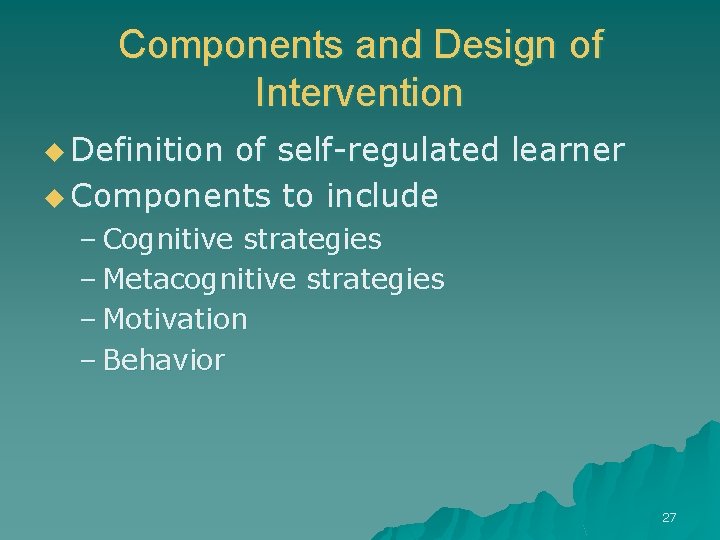
Components and Design of Intervention u Definition of self-regulated learner u Components to include – Cognitive strategies – Metacognitive strategies – Motivation – Behavior 27
Integrated Cognitive Strategy Instruction 28
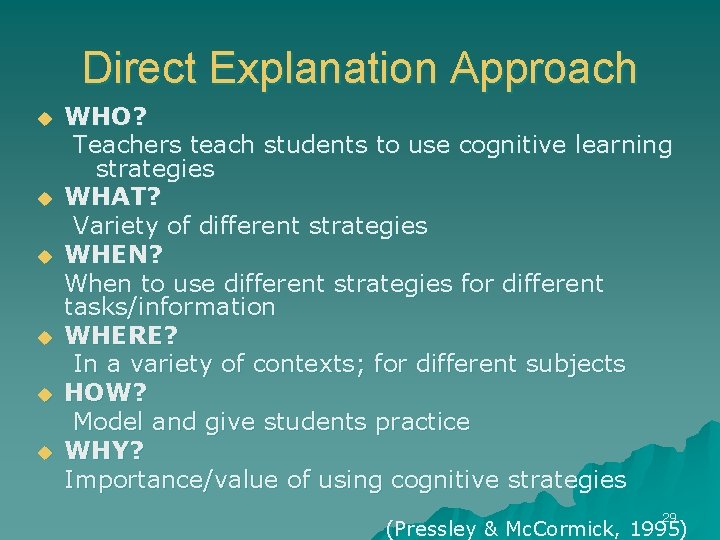
Direct Explanation Approach u u u WHO? Teachers teach students to use cognitive learning strategies WHAT? Variety of different strategies WHEN? When to use different strategies for different tasks/information WHERE? In a variety of contexts; for different subjects HOW? Model and give students practice WHY? Importance/value of using cognitive strategies 29 (Pressley & Mc. Cormick, 1995)
State Those Objectives Specifically u On syllabus, in class, by TAs u E. g. , Active learning; Students will become more effective in their learning processes 30
Label and Discuss Strategies Explicitly u Make metacognition and strategies part of classroom discourse u Learning is not “something that happens mysteriously” (Pintrich, 2002) 31
Model and Explain Strategy Use Demonstrate your own use of strategies and explain why it is useful u E. g. , While solving a problem, provide mental modeling by talking aloud about your thought process; Provide a mnemonic for hard-toremember information u (Duffy & Roehler, 1989; Pintrich, 2002) 32
Provide Opportunities for Student Practice u Embed cognitive learning strategies as assignments – Conveys the importance – Encourages participation
Organization u Assignment example: Write an outline for one of the textbook chapters – Jigsaw method u Students get in groups of 4 -5 u Each student writes outline for 1 chapter u Students distribute and review copies of their outline to group members 34
Elaboration u Assignment example: Generate examples of concept X; Relate course concepts to your own experience 35
Writing Strategies u Teach procedural knowledge related to writing papers u Break down task into smaller subgoals (and collect for feedback) prior to due date – Peer review – Revise, edit 36
Final Thoughts u Cognitive strategies (as part of selfregulated learning) improve performance u College students can be taught to use strategies u Faculty can begin this process on a small scale and build up