
Teaching and the changing context of the learning
- Slides: 3
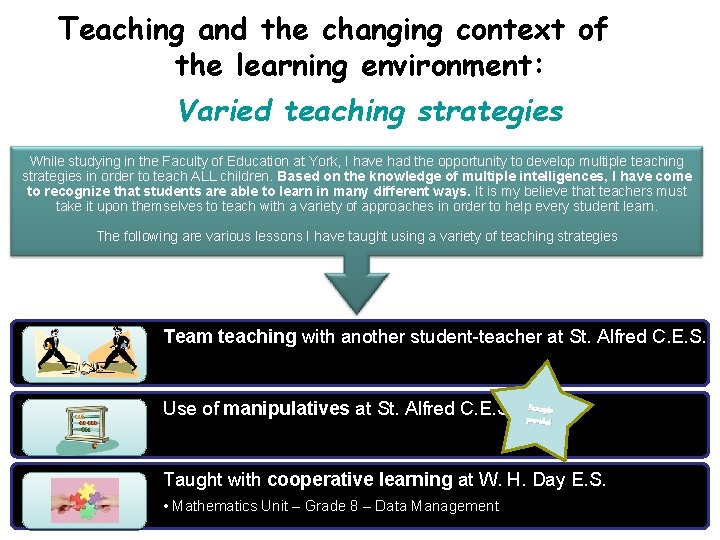
Teaching and the changing context of the learning environment: Varied teaching strategies While studying in the Faculty of Education at York, I have had the opportunity to develop multiple teaching strategies in order to teach ALL children. Based on the knowledge of multiple intelligences, I have come to recognize that students are able to learn in many different ways. It is my believe that teachers must take it upon themselves to teach with a variety of approaches in order to help every student learn. The following are various lessons I have taught using a variety of teaching strategies Team teaching with another student-teacher at St. Alfred C. E. S. • Geometry Unit – Grade 5 – 3 D Geometry Use of manipulatives at St. Alfred C. E. S. • Mathematics Unit – Grade 4/5 – Probability Example provided Taught with cooperative learning at W. H. Day E. S. • Mathematics Unit – Grade 8 – Data Management
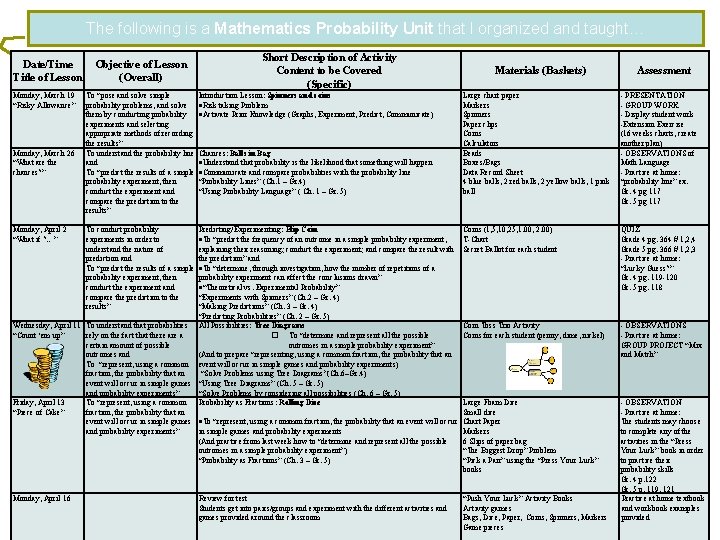
The following is a Mathematics Probability Unit that I organized and taught… Date/Time Title of Lesson Monday, March 19 “Risky Allowance” Objective of Lesson (Overall) Assessment - PRESENTATION - GROUP WORK - Display student work -Extension Exercise (16 weeks charts, create another plan) - OBSERVATIONS of Math Language - Practice at home: “probability line” ex. Gr. 4 pg 117 Gr. 5 pg 117 Predicting/Experimenting: Flip Coin To “predict the frequency of an outcome in a simple probability experiment, explaining their reasoning; conduct the experiment; and compare the result with the prediction” and To “determine, through investigation, how the number of repetitions of a probability experiment can affect the conclusions drawn” “Theoretical vs. Experimental Probability” “Experiments with Spinners” (Ch. 2 – Gr. 4) “Making Predictions” (Ch. 3 – Gr. 4) “Predicting Probabilities” (Ch. 2 – Gr. 5) Wednesday, April 11 To understand that probabilities All Possibilities: Tree Diagrams “Count ‘em up” rely on the fact that there a � To “determine and represent all the possible certain amount of possible outcomes in a simple probability experiment” outcomes and (And to prepare “representing, using a common fraction, the probability that an To “represent, using a common event will occur in simple games and probability experiments) fraction, the probability that an “Solve Problems using Tree Diagrams”(Ch. 6–Gr. 4) event will occur in simple games “Using Tree Diagrams” (Ch. 5 – Gr. 5) and probability experiments” “Solve Problems by considering all possibilities (Ch. 6 – Gr. 5) Friday, April 13 To “represent, using a common Probability as Fractions: Rolling Dice “Piece of Cake” fraction, the probability that an event will occur in simple games To “represent, using a common fraction, the probability that an event will occur and probability experiments” in simple games and probability experiments (And practice from last week how to “determine and represent all the possible outcomes in a simple probability experiment”) “Probability as Fractions” (Ch. 3 – Gr. 5) Coins (1, 5, 10, 25, 1. 00, 2. 00) T-Chart Secret Ballot for each student QUIZ Grade 4 pg. 364 # 1, 2, 4 Grade 5 pg. 366 # 1, 2, 3 - Practice at home: “Lucky Guess? ” Gr. 4 pg. 119 -120 Gr. 5 pg. 118 Coin Toss Trio Activity Coins for each student (penny, dime, nickel) - OBSERVATIONS - Practice at home: GROUP PROJECT “Mix and Match” Large Foam Dice Small dice Chart Paper Markers 6 Slips of paper bag “The Biggest Drop” Problem “Pick a Pair” using the “Press Your Luck” books Monday, April 16 “Push Your Luck” Activity Books Activity games Bags, Dice, Paper, Coins, Spinners, Markers Game pieces - OBSERVATION - Practice at home: The students may choose to complete any of the activities in the “Press Your Luck” book in order to practice their probability skills Gr. 4 p. 122 Gr. 5 p. 119, 121 Practice at home textbook and workbook examples provided Monday, April 2 “What if ? …” Introduction Lesson: Spinners and coins Risk taking Problem Activate Prior Knowledge (Graphs, Experiment, Predict, Communicate) Materials (Baskets) Large chart paper Markers Spinners Paper clips Coins Calculators Beads Boxes/Bags Data Record Sheet 4 blue balls, 2 red balls, 2 yellow balls, 1 pink ball Monday, March 26 “What are the chances? ” To “pose and solve simple probability problems, and solve them by conducting probability experiments and selecting appropriate methods of recording the results” To understand the probability line and To “predict the results of a simple probability experiment, then conduct the experiment and compare the prediction to the results” Short Description of Activity Content to be Covered (Specific) Chances: Balls in Bag Understand that probability is the likelihood that something will happen Communicate and compare probabilities with the probability line “Probability Lines” (Ch. 1 – Gr. 4) “Using Probability Language” ( Ch. 1 – Gr. 5) To conduct probability experiments in order to understand the nature of prediction and To “predict the results of a simple probability experiment, then conduct the experiment and compare the prediction to the results” Review for test Students get into pairs/groups and experiment with the different activities and games provided around the classroom
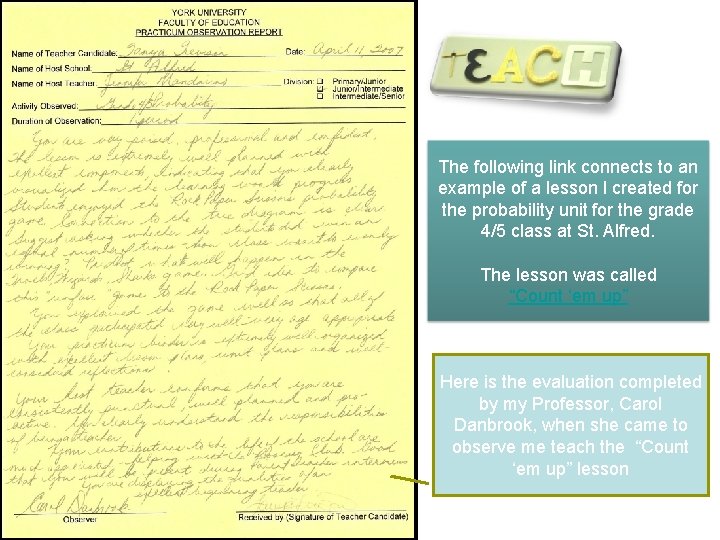
The following link connects to an example of a lesson I created for the probability unit for the grade 4/5 class at St. Alfred. The lesson was called “Count ‘em up” Here is the evaluation completed by my Professor, Carol Danbrook, when she came to observe me teach the “Count ‘em up” lesson