
Teaching and Learning Phonics and Reading at Bradley
Teaching and Learning Phonics and Reading at Bradley Green Primary Academy
How is Phonics taught at Bradley Green? • We use the ‘Read Write Inc. ’ phonics scheme to teach phonics. • It is a systematic approach to the teaching of phonics. • It relies on repetition and a specified format in the teaching of sounds. • Sounds (phonemes) and associated graphemes (what the sound looks like) are taught in a specified order. This order is listed on the next page.

Speed Sounds Set 1, 2 and 3
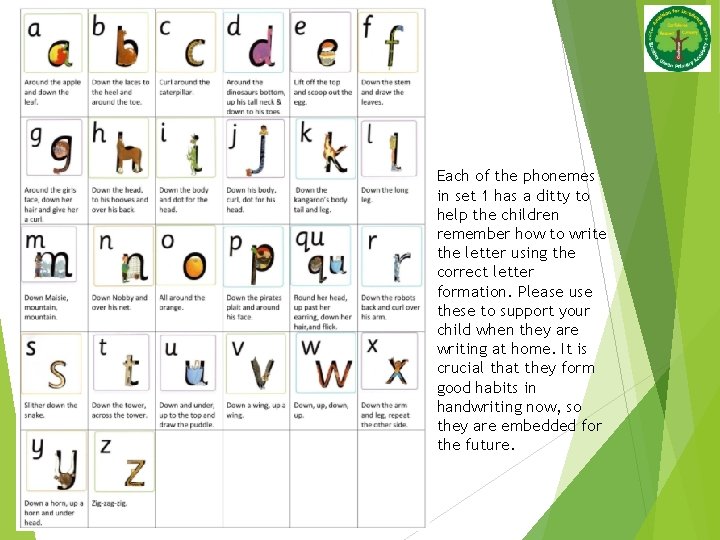
Each of the phonemes in set 1 has a ditty to help the children remember how to write the letter using the correct letter formation. Please use these to support your child when they are writing at home. It is crucial that they form good habits in handwriting now, so they are embedded for the future.
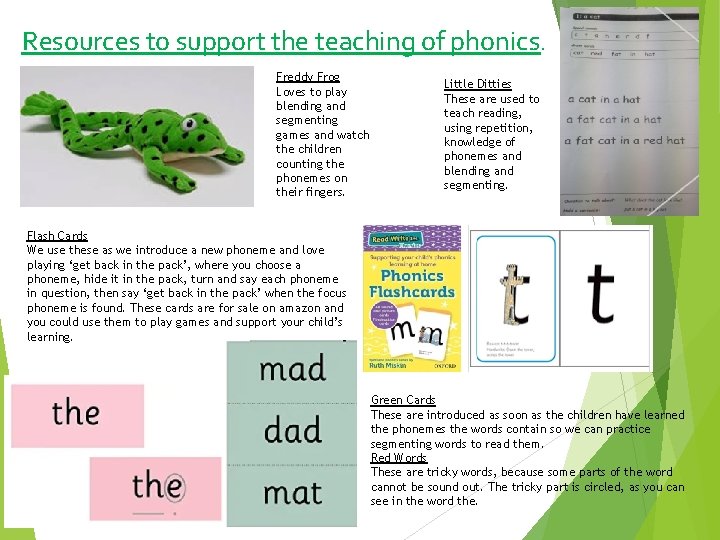
Resources to support the teaching of phonics. Freddy Frog Loves to play blending and segmenting games and watch the children counting the phonemes on their fingers. Little Ditties These are used to teach reading, using repetition, knowledge of phonemes and blending and segmenting. Flash Cards We use these as we introduce a new phoneme and love playing ‘get back in the pack’, where you choose a phoneme, hide it in the pack, turn and say each phoneme in question, then say ‘get back in the pack’ when the focus phoneme is found. These cards are for sale on amazon and you could use them to play games and support your child’s learning. Green Cards These are introduced as soon as the children have learned the phonemes the words contain so we can practice segmenting words to read them. Red Words These are tricky words, because some parts of the word cannot be sound out. The tricky part is circled, as you can see in the word the.
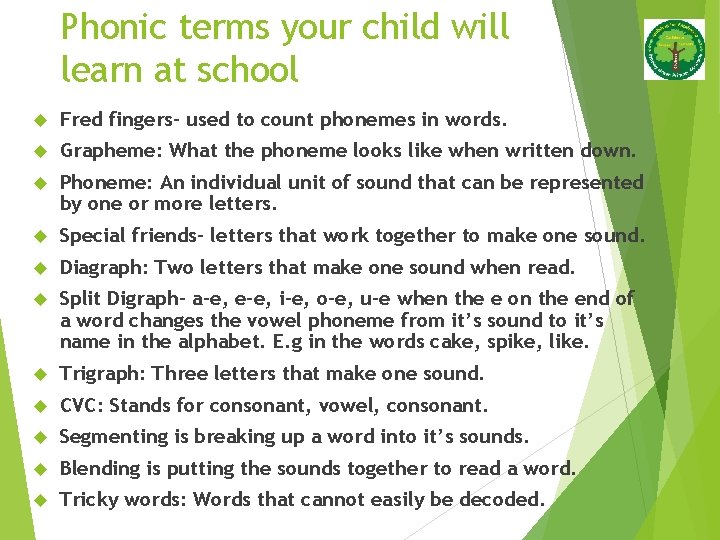
Phonic terms your child will learn at school Fred fingers- used to count phonemes in words. Grapheme: What the phoneme looks like when written down. Phoneme: An individual unit of sound that can be represented by one or more letters. Special friends- letters that work together to make one sound. Diagraph: Two letters that make one sound when read. Split Digraph- a-e, e-e, i-e, o-e, u-e when the e on the end of a word changes the vowel phoneme from it’s sound to it’s name in the alphabet. E. g in the words cake, spike, like. Trigraph: Three letters that make one sound. CVC: Stands for consonant, vowel, consonant. Segmenting is breaking up a word into it’s sounds. Blending is putting the sounds together to read a word. Tricky words: Words that cannot easily be decoded.
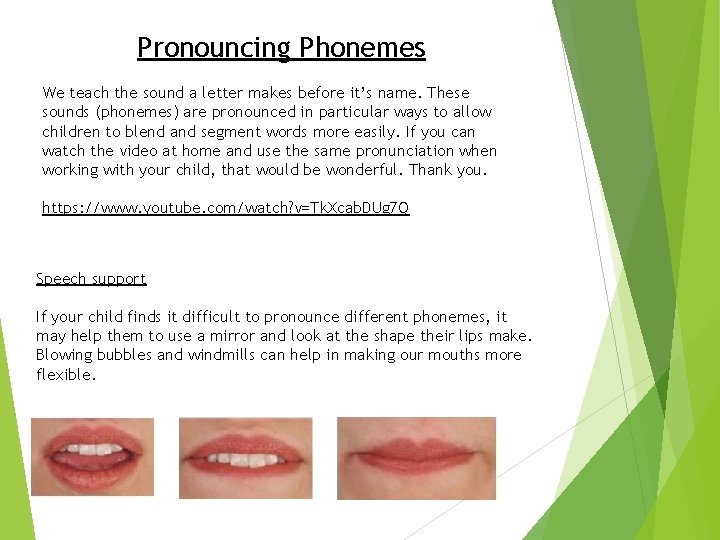
Pronouncing Phonemes We teach the sound a letter makes before it’s name. These sounds (phonemes) are pronounced in particular ways to allow children to blend and segment words more easily. If you can watch the video at home and use the same pronunciation when working with your child, that would be wonderful. Thank you. https: //www. youtube. com/watch? v=Tk. Xcab. DUg 7 Q Speech support If your child finds it difficult to pronounce different phonemes, it may help them to use a mirror and look at the shape their lips make. Blowing bubbles and windmills can help in making our mouths more flexible.
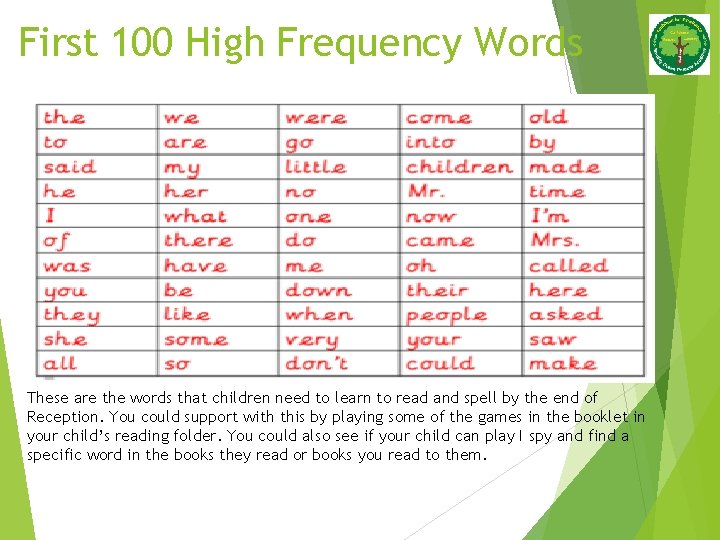
First 100 High Frequency Words These are the words that children need to learn to read and spell by the end of Reception. You could support with this by playing some of the games in the booklet in your child’s reading folder. You could also see if your child can play I spy and find a specific word in the books they read or books you read to them.
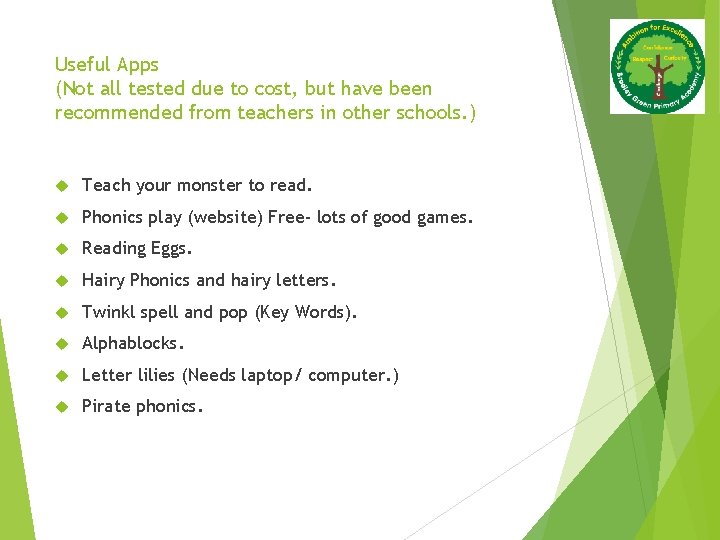
Useful Apps (Not all tested due to cost, but have been recommended from teachers in other schools. ) Teach your monster to read. Phonics play (website) Free- lots of good games. Reading Eggs. Hairy Phonics and hairy letters. Twinkl spell and pop (Key Words). Alphablocks. Letter lilies (Needs laptop/ computer. ) Pirate phonics.
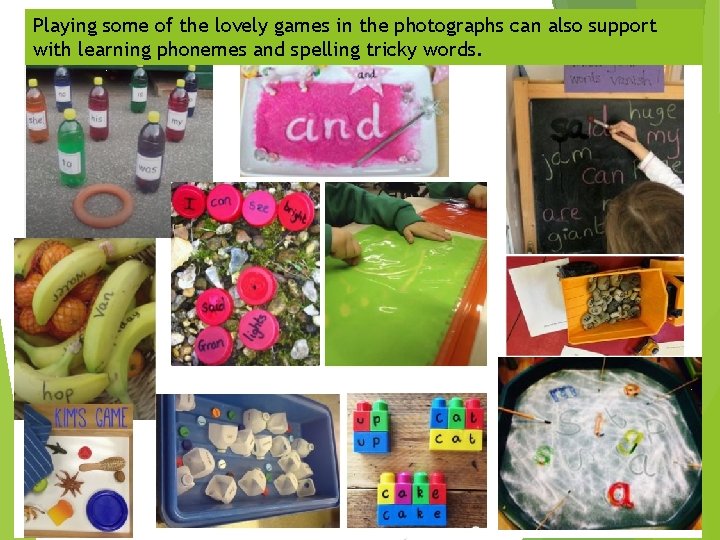
Playing some of the lovely games in the photographs can also support with learning phonemes and spelling tricky words.
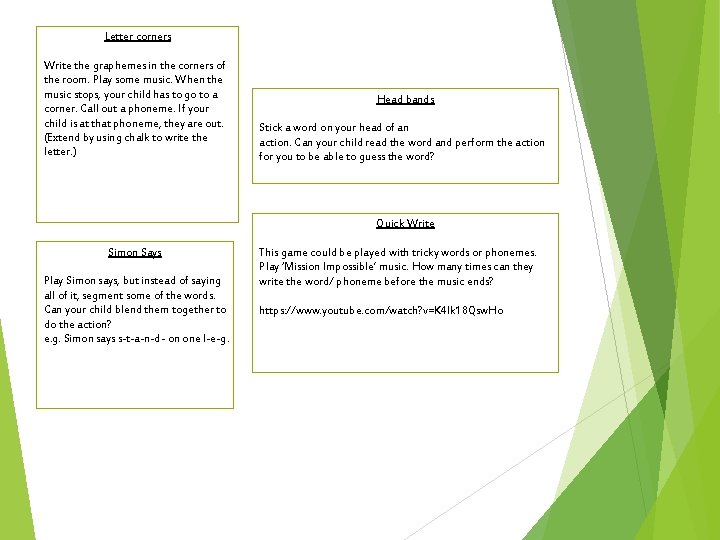
Letter corners Write the graphemes in the corners of the room. Play some music. When the music stops, your child has to go to a corner. Call out a phoneme. If your child is at that phoneme, they are out. (Extend by using chalk to write the letter. ) Head bands Stick a word on your head of an action. Can your child read the word and perform the action for you to be able to guess the word? Quick Write Simon Says Play Simon says, but instead of saying all of it, segment some of the words. Can your child blend them together to do the action? e. g. Simon says s-t-a-n-d- on one l-e-g. This game could be played with tricky words or phonemes. Play ‘Mission Impossible’ music. How many times can they write the word/ phoneme before the music ends? https: //www. youtube. com/watch? v=K 4 Ik 18 Qsw. Ho
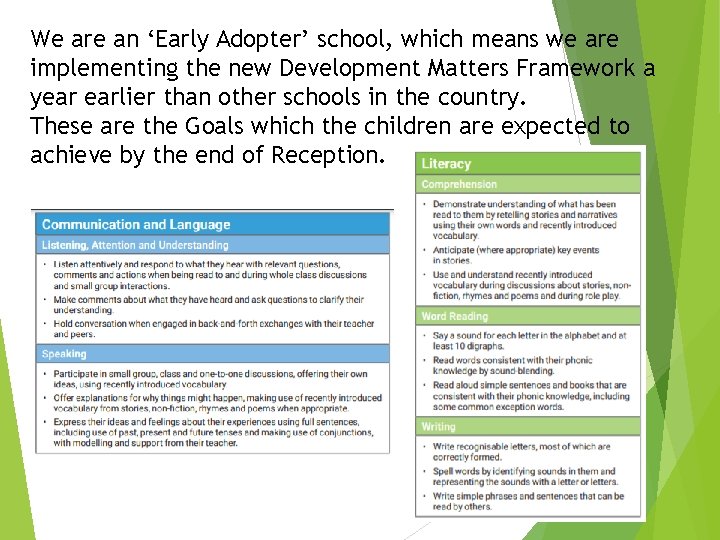
We are an ‘Early Adopter’ school, which means we are implementing the new Development Matters Framework a year earlier than other schools in the country. These are the Goals which the children are expected to achieve by the end of Reception.
Ways to help with reading at home. Develop your child’s love of reading and books by sharing them regularly. In books that rhyme stop and let them complete the sentence. Sing nursery rhymes and songs and identify the rhyming words. Quartermaster stores- add own names and invent rhymes to go with them. Ask questions (what, when, who, how, where) to develop children’s understanding of texts. Re-call the main events of stories. Maybe they could react them with home made puppets or soft toys or you could make a story box with your child to explore and develop the story further. Model to children how simple words can be segmented into sounds and blended together to make words. Encourage children to tell their own stories using language they have heard in books, e. g. Once upon a time, One day, They all lived happily ever after etc.
Children Reading To You. Identify commonly occurring words within the text prior to reading. Go on a word hunt within the book. Can we find that word? How many times do we see it? Play tricky word hunt. Get the book ready to read, ensuring it is the correct way up. Point to words/ trap words. Encourage children to look at the graphemes and sound out the letters then blend them to read. Before turning over predict what might happen next and talk about why. Use pictures as clues to support reading. If children are unsure of a word, read on then return to it to see if they can work out the word by contextualisation.
- Slides: 14