
Teaching and Learning Cycle Writing a recount Theme

- Slides: 19
Teaching and Learning Cycle: Writing a recount Theme: Our city, Melbourne Level: S 1 Resource Guide Jessie Sambell and Leah Kontos Blackburn English Language School
Learning context Blackburn English Language School delivers full-time, intensive English language programs to newly arrived students across the North-Eastern Victoria Region (NEVR). The school provides primary and secondary English language acquisition programs to students from a range of culturally and linguistically diverse backgrounds. The schooling cycle operates around a term-based program. As new students enrol each term, classes are formed centred on either age and English language competency or a combination of these two factors. This teaching resource was implemented with a beginner level class at the school. The students were aged between 12 -14 years old with an English level of S 1. 1 – S 1. 2. The recount unit based on the Melbourne city was completed within a 2 week period post excursion with approximately 20 hours of teaching time dedicated to the unit.
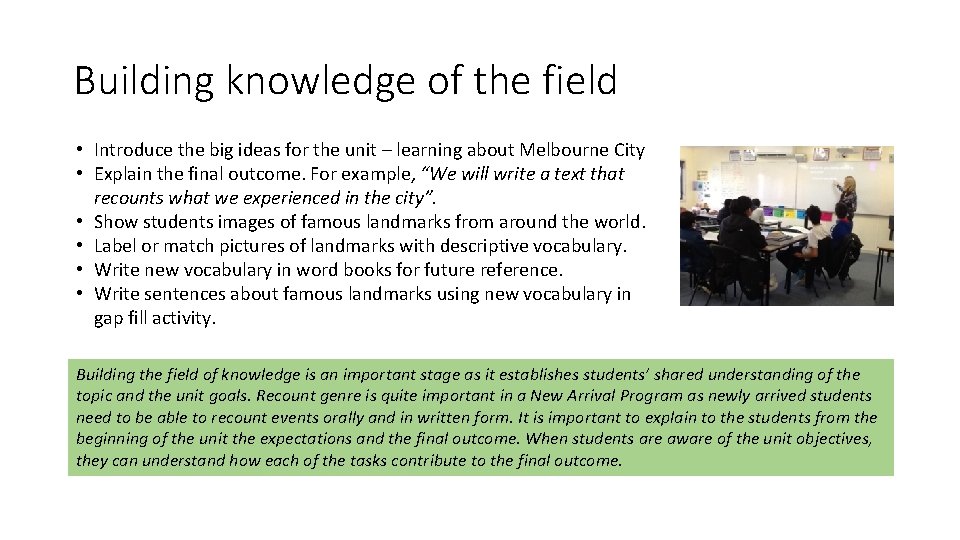
Building knowledge of the field • Introduce the big ideas for the unit – learning about Melbourne City • Explain the final outcome. For example, “We will write a text that recounts what we experienced in the city”. • Show students images of famous landmarks from around the world. • Label or match pictures of landmarks with descriptive vocabulary. • Write new vocabulary in word books for future reference. • Write sentences about famous landmarks using new vocabulary in gap fill activity. Building the field of knowledge is an important stage as it establishes students’ shared understanding of the topic and the unit goals. Recount genre is quite important in a New Arrival Program as newly arrived students need to be able to recount events orally and in written form. It is important to explain to the students from the beginning of the unit the expectations and the final outcome. When students are aware of the unit objectives, they can understand how each of the tasks contribute to the final outcome.
Building knowledge of the field • Participate in the Melbourne city excursion. During the City excursion, teachers and students visit six landmarks in the city and complete a range of short activities in their student booklet. These activities relate to understanding why the landmark is important in Melbourne. Students take photos at each landmark to refer to in class, and the teacher takes video footage at each of the landmarks to stimulate discussions and elicit vocabulary in future classes.
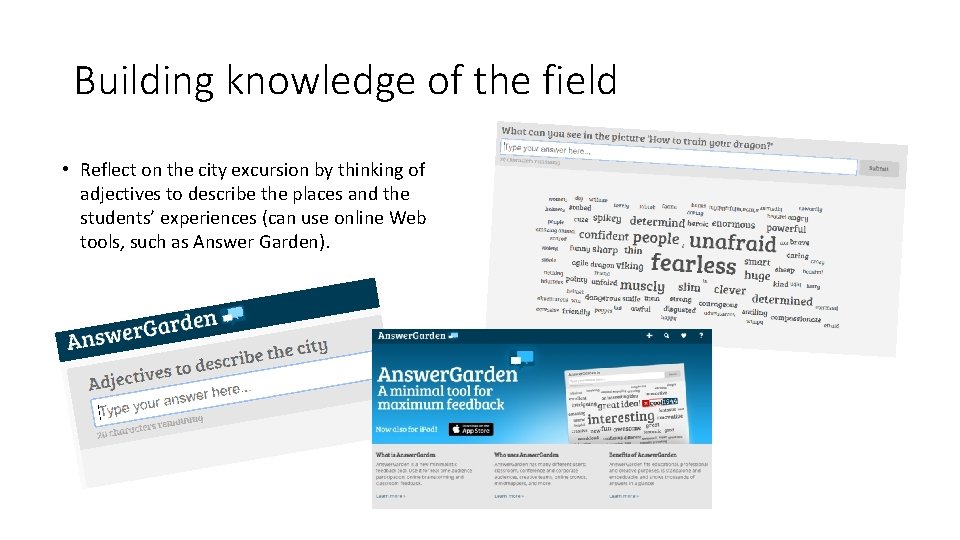
Building knowledge of the field • Reflect on the city excursion by thinking of adjectives to describe the places and the students’ experiences (can use online Web tools, such as Answer Garden).
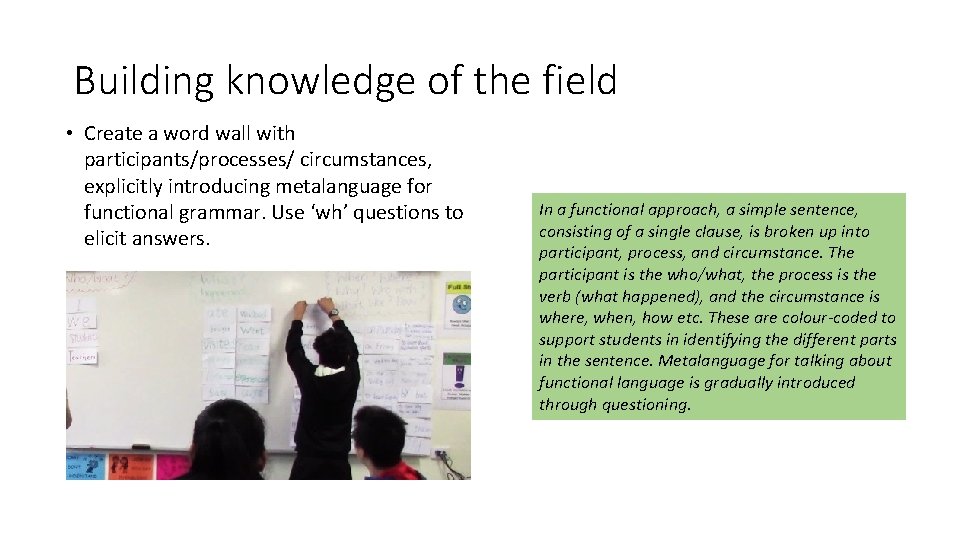
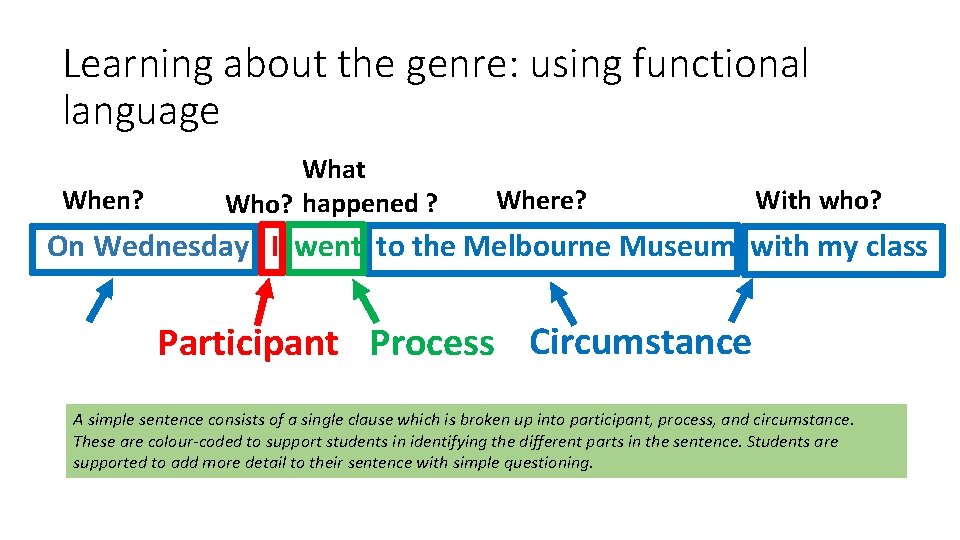
Building knowledge of the field • Create a word wall with participants/processes/ circumstances, explicitly introducing metalanguage for functional grammar. Use ‘wh’ questions to elicit answers. In a functional approach, a simple sentence, consisting of a single clause, is broken up into participant, process, and circumstance. The participant is the who/what, the process is the verb (what happened), and the circumstance is where, when, how etc. These are colour-coded to support students in identifying the different parts in the sentence. Metalanguage for talking about functional language is gradually introduced through questioning.
Building knowledge of the field • Complete oral video recount in pairs. Refer to the word wall to support sentence construction. Students practise using the new vocabulary orally before writing, gradually moving across the register continuum from more spoken like to more written like. Watch the video at: https: //victesol. vic. edu. au/index. php/teaching-and-learningcycle-project/teaching-and-learning-cycle-units-of-work/units-ofwork-secondary/#tab-id-3
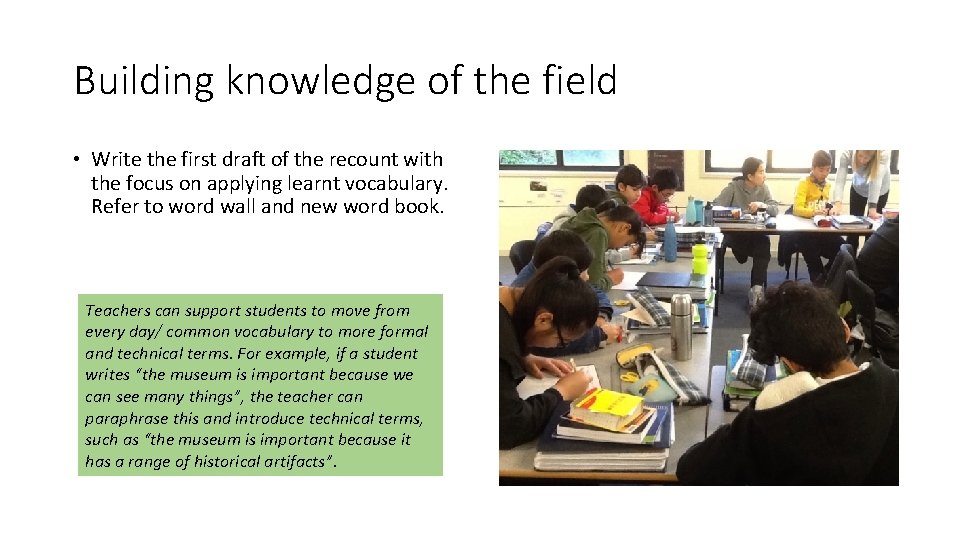
Building knowledge of the field • Write the first draft of the recount with the focus on applying learnt vocabulary. Refer to word wall and new word book. Teachers can support students to move from every day/ common vocabulary to more formal and technical terms. For example, if a student writes “the museum is important because we can see many things”, the teacher can paraphrase this and introduce technical terms, such as “the museum is important because it has a range of historical artifacts”.
Supported reading • Participate in modelled and shared reading sessions using fiction and non-fiction texts related to the city (e. g. narrative about travelling to a city, information report about history of Melbourne, descriptive text about Melbourne City. ). • Complete pre, during and post reading tasks (oral summary of text prior to reading, cloze, sentence making, building word banks of nouns/adjectives, etc. ) Providing an oral summary prior to reading allows students to focus on other areas of language such as using the new vocabulary or sentence structures.
Supported reading • Complete shared reading of a narrative text about an excursion to the city. Identify and discuss how the language in a recount is different to the narrative. • Introduce metalanguage to talk about language features found in a recount and narrative (or draw on students’ prior knowledge). Complete Venn diagram to show differences between genres. The aim here is to improve students’ ability to process a text and become more confident with their reading. In these sessions, the students are provided comprehension activities such as literal questions and answers to locate the information from the text, vocabulary activities such as vocabulary cells and charts with word meanings, parts of speech and simple sentence making. The teacher models reading strategies, rhythm, and expectations for reading a text. The teacher provides an opportunity for students to see and hear reading strategies. Different genres can highlight how texts are organised differently to express particular purposes.
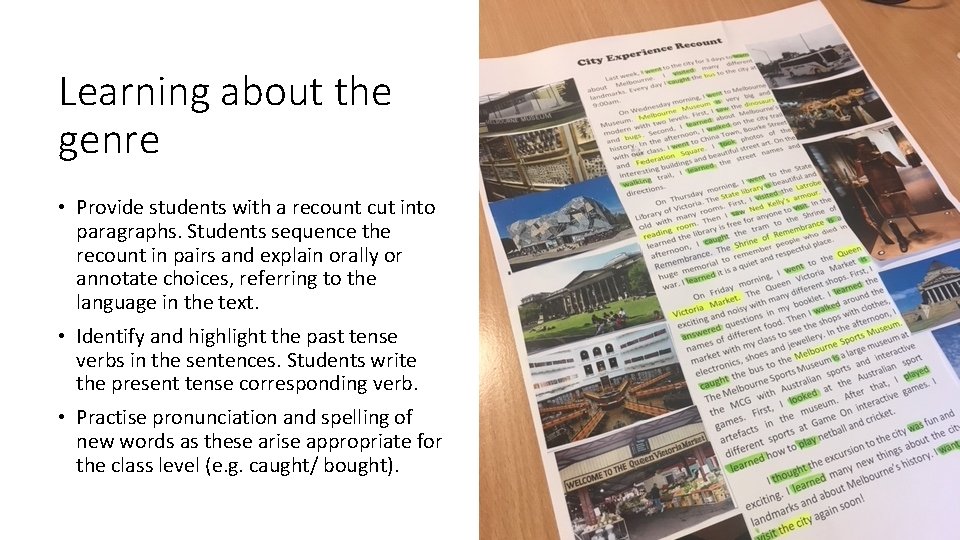
Learning about the genre • Provide students with a recount cut into paragraphs. Students sequence the recount in pairs and explain orally or annotate choices, referring to the language in the text. • Identify and highlight the past tense verbs in the sentences. Students write the present tense corresponding verb. • Practise pronunciation and spelling of new words as these arise appropriate for the class level (e. g. caught/ bought).
Learning about the genre • Provide students with cut up sentences including participant, process, and multiple circumstances following the functional language colour-coding. • Students create sentences with the cut up parts of language in pairs or small groups. Watch the video at: https: //victesol. vic. edu. au/index. php/teaching-and-learningcycle-project/teaching-and-learning-cycle-units-of-work/units-ofwork-secondary/#tab-id-2
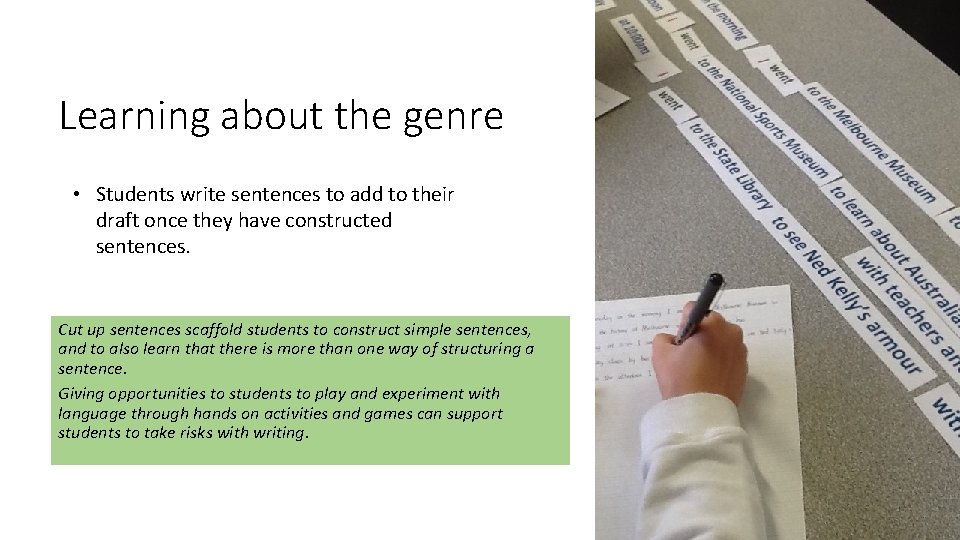
Learning about the genre • Students write sentences to add to their draft once they have constructed sentences. Cut up sentences scaffold students to construct simple sentences, and to also learn that there is more than one way of structuring a sentence. Giving opportunities to students to play and experiment with language through hands on activities and games can support students to take risks with writing.
Learning about the genre: using functional language When? What Who? happened ? Where? With who? On Wednesday I went to the Melbourne Museum with my class Participant Process Circumstance A simple sentence consists of a single clause which is broken up into participant, process, and circumstance. These are colour-coded to support students in identifying the different parts in the sentence. Students are supported to add more detail to their sentence with simple questioning.
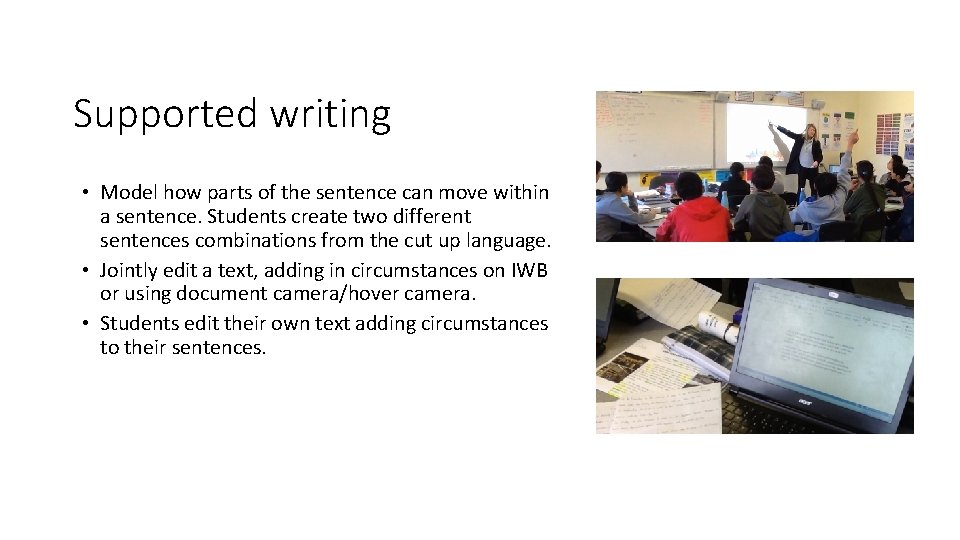
Supported writing • Model how parts of the sentence can move within a sentence. Students create two different sentences combinations from the cut up language. • Jointly edit a text, adding in circumstances on IWB or using document camera/hover camera. • Students edit their own text adding circumstances to their sentences.
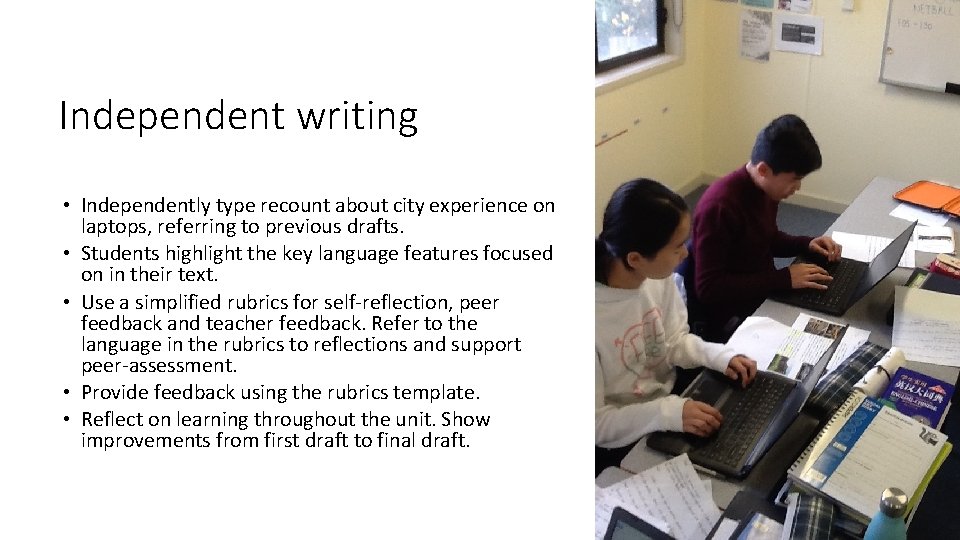
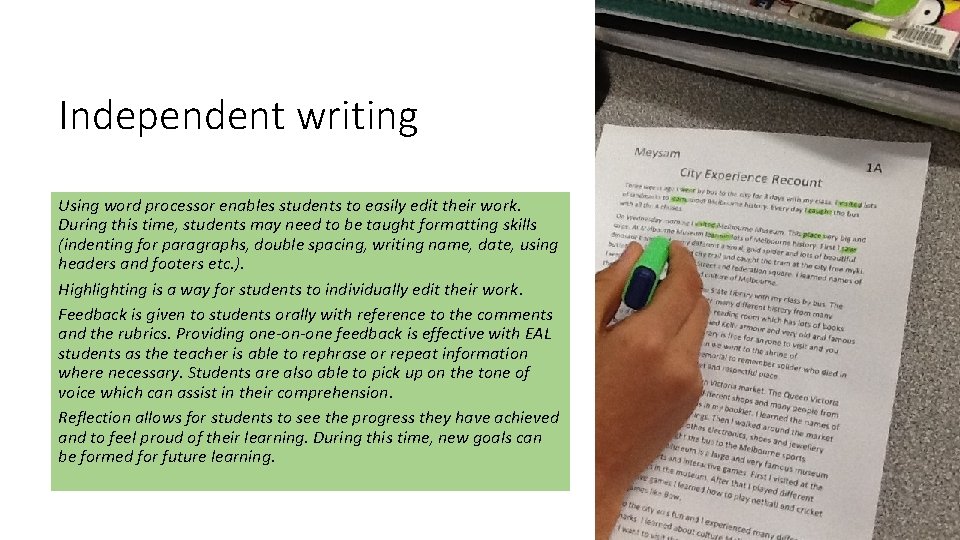
Independent writing • Independently type recount about city experience on laptops, referring to previous drafts. • Students highlight the key language features focused on in their text. • Use a simplified rubrics for self-reflection, peer feedback and teacher feedback. Refer to the language in the rubrics to reflections and support peer-assessment. • Provide feedback using the rubrics template. • Reflect on learning throughout the unit. Show improvements from first draft to final draft.
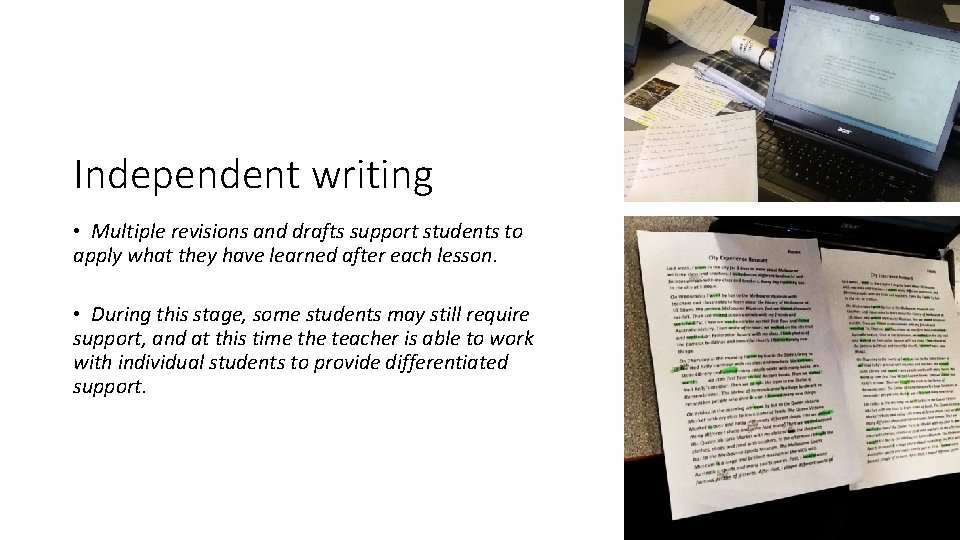
Independent writing • Multiple revisions and drafts support students to apply what they have learned after each lesson. • During this stage, some students may still require support, and at this time the teacher is able to work with individual students to provide differentiated support.
Independent writing Using word processor enables students to easily edit their work. During this time, students may need to be taught formatting skills (indenting for paragraphs, double spacing, writing name, date, using headers and footers etc. ). Highlighting is a way for students to individually edit their work. Feedback is given to students orally with reference to the comments and the rubrics. Providing one-on-one feedback is effective with EAL students as the teacher is able to rephrase or repeat information where necessary. Students are also able to pick up on the tone of voice which can assist in their comprehension. Reflection allows for students to see the progress they have achieved and to feel proud of their learning. During this time, new goals can be formed for future learning.
Teacher reflections Initially the role of the teacher was to lead the instructions by providing explicit teaching and models of the genres about their use and patterns of language. As the teacher moved into the different stages of the teaching and learning cycle and the students used the more written-like language, the students started taking more responsibility for using the language independently, taking risks with their sentences and identifying the groupings in the sentences. It was visible that the students were able to move the circumstances of place in the beginning of the sentences or at the end and positioned the reader to see things described in a certain way. Students experienced success with their independent construction and it maximised their confidence and participation in the classroom activities. As a result, students were able to write their own recount and express their own ideas and clauses. It was an unforgettable experience as all the students in the classroom were proud of their work and ready for the next set of challenges with their writing and reading tasks.