
Teaching and Learning About Scripture Biblical Genres Contents

Teaching and Learning About Scripture Biblical Genres
Contents • Introduction • • • Narrative Parable Myth Recount Summary story Slide 3 Slide 7 Slide 13 Slide 17 Slide 22 Slide 28

Introduction

The Bible: a book of books • It is strange to think of the Bible and genres, but it is very important to do so! • The Bible is a library of books…it contains more than 75 individual books written by more than 75 authors. • Just as it is important to know what you are reading everyday (in a newspaper for example) so it is important to know what you are reading in the Bible.

The Bible: a book of books • The most common genre in the Bible is narrative but there are other genres too: recount, parable, poetry and song to name a few. • What makes the writing in the Bible special is that Christians consider the Bible ‘sacred’ – the Bible is called ‘the word of God. ’ • However, although the Bible is called ‘the word of God’, the Church insists that words we see on the page are the words of human authors.

The Bible: a book of books • That means that when we read the Bible, one of the first things we need to do is determine what genre we are reading…then we will know how to interpret it. • Each time you read a passage, you need to find out what genre it is. Most often it will be a narrative (although watch out, the Bible has many different types of narratives) or a recount.

Narrative
Narrative • Most of the Bible is written in narrative style. • The purpose of a narrative is to entertain or inform. • Because the Bible is set in a specific historical time, the narratives are sometimes called ‘historical narratives. ’ • Historical narratives contain details (characters, events and settings) which may well be factually accurate, but their purpose is not to relay details. Instead it is to tell something which the author thinks is important; a value, behaviour; an attitude; a belief.
Narrative • Narratives follow a distinctive pattern and structure. – Orientation (Introduction of characters and setting) – Development of a problem or conflict – Resolution of the problem – Coda (where we often see the result of what has happened)
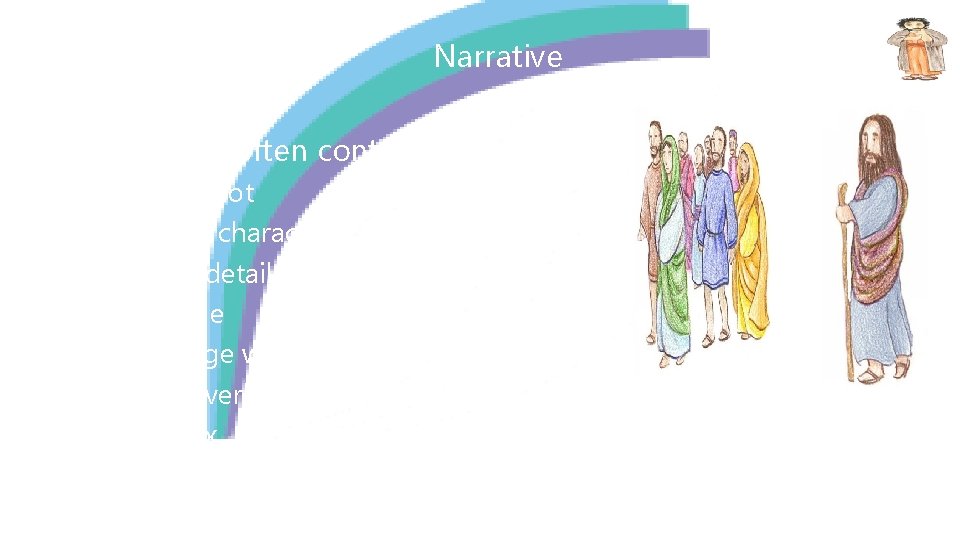
Narrative • Narratives often contain… – A clear plot – Defined characters – Lots of detail – Dialogue – Language which keeps you engaged – Lots of verbs – A climax

How does a narrative convey meaning? • A narrative is a story. It conveys meaning not necessarily in the literal detail (although it may contain factual information), but rather through the connections it makes between the characters and the reader or listener. • Usually, one of the characters undergoes a change in their thinking or behaviour and this prompts the listener to think about their own behaviour, to learn a lesson or to find a message.

How does a narrative convey meaning? • When you read and interpret a biblical narrative spend more time thinking about what the story teaches, rather than the detail it contains. • The important question is ‘What does it mean? ’, not ‘Did it happen that exact way? ’ • An important point to remember though is that the story was written for people who knew the world of the story. We don’t – so you might need to do some research on the history of the passage before you are sure about what it means.
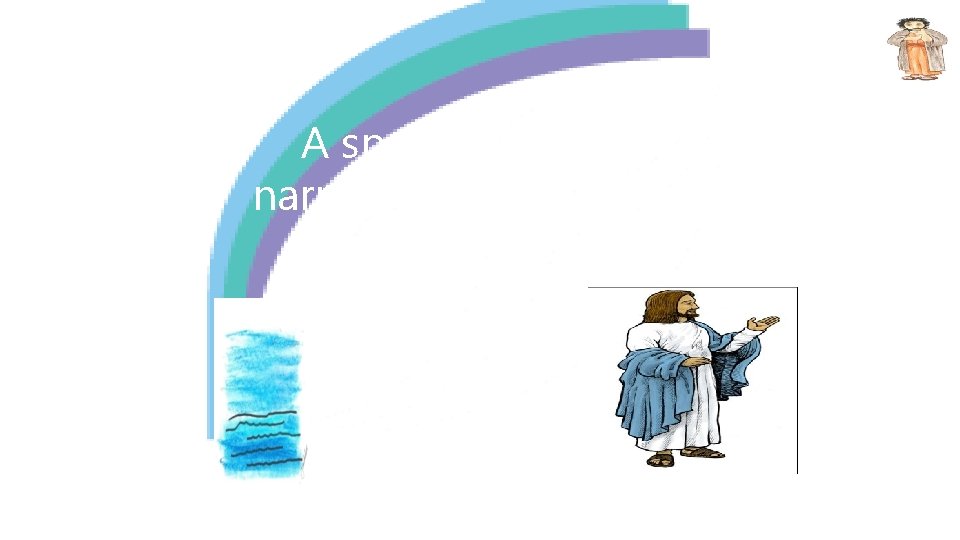
A special type of narrative: The Parable

Parable • A parable is a type of narrative: it is made up. However, it could have happened. • In a parable, two ‘things’ are compared. • Sometimes the ‘things’ being compared are actions (e. g. , the parables of the kingdom of God compare the kingdom of God and a human activity). • Sometimes the things being compared are the actions of people (e. g. , the Good Samaritan compares how the characters behave).

Parable • In order to understand the parable, you need to find out what is being compared and actually do the comparison! • Be careful though: if you think it’s easy it’s not! – Parables are intended to make you think. Usually there is a twist in them somewhere. – And remember! When you think about the things being compared, try to think as a person from the time of Jesus. Think like them…not us!

How does a parable convey meaning? • Parables make us think. In fact, the comparison is designed to make us think. Parables are different from ordinary narratives in that possible meanings (and there will most likely be plenty of them) are found as we explore! • Meaning is found as we sift and sort out what might be a lesson or message for us. • Example parables (such as The Good Samaritan) make us think about who is a good example for us: they give us an example of how to behave and how not to behave.

A special type of narrative: The Myth

Myth • A myth is a type of narrative. • It is a non-literal form of writing, that means that although myths might seem to explain how something came to be, they are not meant to be read as scientific explanations or descriptions. Myths are narratives, stories.

Myth • In the Bible, the two accounts of the creation of the earth in Genesis are myths. These myths do not try to offer a scientific account of what happened at the beginning of time; instead they try to teach important lessons. Rather than try to explain what happened, they try to explain the authors’ understanding of why they happened, important things we can learn about God and creation

How does a myth convey meaning? • Although myths are not to be taken literally, they do tell wonderful truths. • Like other narratives, they are interested in teaching an important moral, value or message. • When we interpret the creation myths we need to ask about meaning; about what we learn about God, ourselves and creation, not about science.
How does a myth convey meaning? • The creation myths in Genesis contain some of the most important truths of our faith, sacred truths about God and about us. These are some of the truths the creation myths convey. – That God is a creative God – That God loves creation: creation and all in it are God’s – That we are made like God – to be creative, generous and life giving! – That creation is good – very good.

Recount

Recount • The purpose of a recount is to list or describe a past experience by retelling what happened and when. • Recounts have a very similar structure to narratives – except that there may not be a problem. • The structure of a recount is… – Orientation (which introduces the characters and setting) – Description of events, in chronological order – A personal comment or opinion about what has happened

Recount • Recounts are generally… – Written in the past tense – Written in the first person (although in the Bible they are written in the third person) • Recounts often contain… – ‘Time’ words which connect events…(e. g. next, later, when, then, after, before, first, as soon as, eventually) – Lots of description: verbs, adverbs and nouns – Reported or direct speech (He said ……. ) – Short sentences to increase tension…or – Longer sentences to provide contrast and detail
How does a recount convey meaning? • When you read and interpret a biblical recount remember it is the authors interpretation of what happened. • In this sense a recount is like a diary entry, a journal or a letter: the author has a view about the person, the events or the situation and they wish to share it. A recount is not a report.

How does a recount convey meaning? • Remember also, that a great deal of time (years and years!) has elapsed between the event which is being described and the recount you are reading. • The author has had a lot of time to think about what happened and what it might have meant. Their recounting of the event is, therefore, closely linked to what they believe.
How does a recount convey meaning? • When we look for meaning in a recount, we look for what we can learn…about the characters, the actions or about life in general! • In that way, finding meaning in a recount is like finding meaning in a narrative: meaning is not necessarily in the literal detail (although the recount will contain factual information). Meaning is more likely to be in what we can learn about or from the people and the events.

Summary Story

Summary Story • Every passage has a genre. However, some passages seem to have two genres. First, a passage might be read and understood in its ordinary, face value sort of way. However, at a second look, the same passage might look like an allegory which summarises the life of Jesus; where each person or event has a parallel with something in Jesus’ life. • There are three summaries in the Gospels which help explain this genre. – The visit of Boy Jesus to the Temple – The parable of the Sower and the Seed – The parable of the Wicked Tenants.

Summary Story – Luke’s recording of Jesus’ visit to the Temple when he was 12 (Lk 2: 41 -52) looks, at first, like a simple recount which tells of the boy Jesus visiting the Temple. But a careful reader will notice that the story has a lot in common with the death and resurrection of Jesus. At the end of his life, Jesus will again come to Jerusalem at Passover, he will again be ‘lost’ and three days later, he will again be ‘found’ by those who love him. When asked what he has been doing, he will again say he has been doing what God asked of him.

Summary Story – So the story of the Boy Jesus at the Temple acts as both a recount AND a summary of the death and resurrection of Jesus.

– The parable of the sower and the seed (Lk 8: 4 -8) reads at first like a regular parable…but a closer look reveals it is also a summary of how people will respond to God’s word (which is the seed). – The parable of the Wicked Tenants (Lk 20: 9 -19) explains that God (the vineyard owner) trusted creation to people who did not care for it. It summarises the work of the prophets and Jesus, (the vineyard owners son) who are either attacked or killed.

How does a summary convey meaning? • You would think that because two genres are recognised in a summary that they would convey meaning in two ways: wrong! • Summaries only convey meaning in their ‘face value’ genre, that is as a recount or narrative. • The fact that a passage acts as a summary does not add to the meaning it conveys – its purpose as a summary is simply to act as a marker or pointer for what is about to happen.
- Slides: 33