
TEACHING ADULTS IN DE FORMAT A faculty development
- Slides: 26
TEACHING ADULTS IN DE FORMAT A faculty development workshop on designing online courses using a LMS and learning theory.
Workshop Agenda Welcome and Introductions Discussion: Teaching Adults Using Technology Form: Theory & Principles: Pedagogy vs. Andragogy Consistency-PIE Model Measurable Outcomes - More Than Test Scores: Skill Transfer, Engagement, and Motivation Count Objectives 1. Differentiate between Pedagogy from Andragogy 2. Identify Adult Learning Principles 3. Demonstrate a working knowledge of the PIE Model 4. Understand that form and consistency in DE course design impacts measurable outcomes (a standardized course design lowers frustration, diminishes distractions, and empowers students)
Welcome! Let’s take a few moments to get to know each other. Please tell us: • Your name • What courses you teach • How long you’ve been teaching • Whether you’ve taught a DE section • Your greatest concern surrounding online education
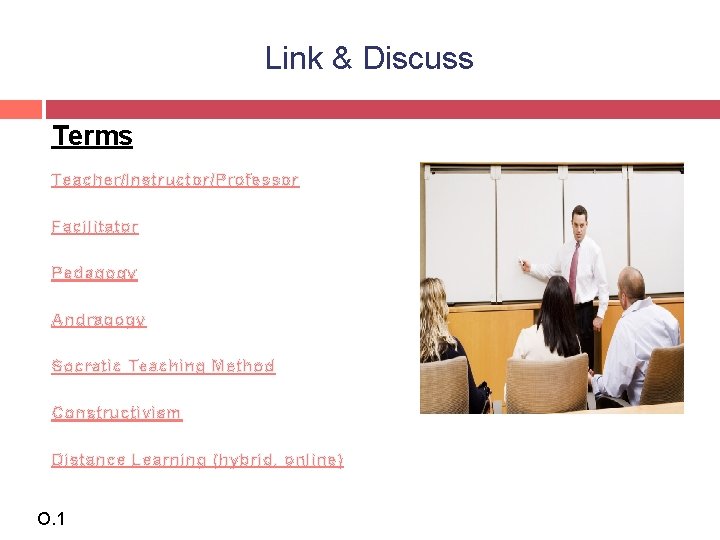
Link & Discuss Terms Teacher/Instructor/Professor Facilitator Pedagogy Andragogy Socratic Teaching Method Constructivism Distance Learning (hybrid, online) O. 1
Compare and Contrast Pedagogy vs. Andragogy. . . What's the difference? “Adult education is a process through which learners become aware of significant experience. Recognition of significance leads to evaluation. Meanings accompany experience when we know what is happening and what importance the event includes for our personalities” (Knowles, Holton, and Swanson, 2005). Reference Knowles, M. S. Holton, E. F. and Swanson, R. A. (2005). The adult learner: The definitive classic in adult education and human resource development (6 th ed. ). Burlington, MA: Elsevier Inc. O. 1
EXAMPLES CURRICULUM DEVELOPMENT FOR LAW ENFORCEMENT PEDAGOGY “In pedagogy, the instructor is in charge of the learning experience. The instructor will control the content, delivery methods, and evaluation processes. In a true pedagogical approach, the passing of an instructor designed or approved examination determines how effectively the students have learned” (Flosi, 2011 para 5). ANDRAGOGY “Adults need to understand the applicability of the lesson before they will engage in the learning. In law enforcement training, the subject matter must be relevant, realistic and immediately applicable …. In a survey of officers, they indicated that for learning to transfer, they had to be able to apply the skills and knowledge immediately into their practice” (Flosi, 2011 para 9). REFERENCE Flosi, E. (2011). Curriculum development for law enforcement: Pedagogy versus andragogy. Retrieved from: http: //www. Policeone. Com/officer-safety/articles/3773478 curriculum-development-for-law-enforcement-pedagogy-versus-andragogy/ O. 1
From theory to principle… Adult Learning Principles 1. Adults are motivated to learn as they experience needs and interests that learning will satisfy (immediate and relevant). 2. Adults’ orientation to learning is life-centered. 3. Experience is the richest source for adult learning. 4. Adult’s have a deep need to be self-directing. 5. Individual differences among people increase with age. Reference Knowles, M. S. Holton, E. F. and Swanson, R. A. (2005). The adult learner: The definitive classic in adult education and human resource development (6 th ed. ). Burlington, MA: Elsevier Inc. O. 2
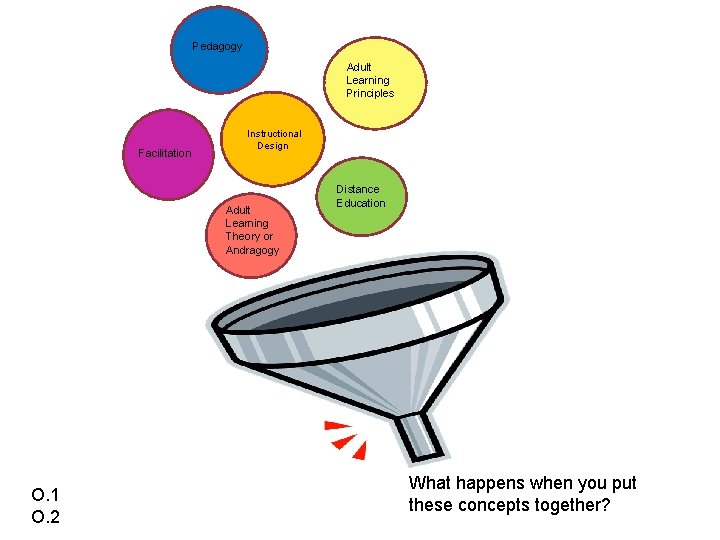
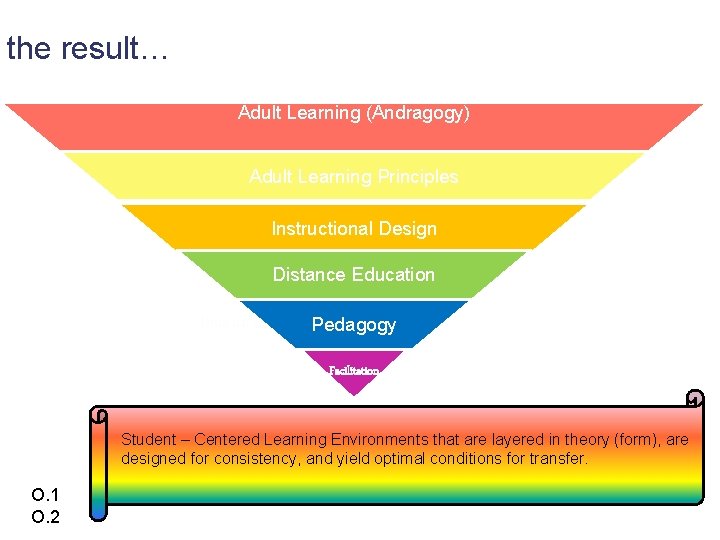
Pedagogy Adult Learning Principles Facilitation Instructional Design Adult Learning Theory or Andragogy O. 1 O. 2 Distance Education What happens when you put these concepts together?
the result… Adult Learning (Andragogy) Adult Instructional Design Learning Principles Adult Learning Instructional Principles Design Distance Education Pedagogy Facilitation Student – Centered Learning Environments that are layered in theory (form), are designed for consistency, and yield optimal conditions for transfer. O. 1 O. 2
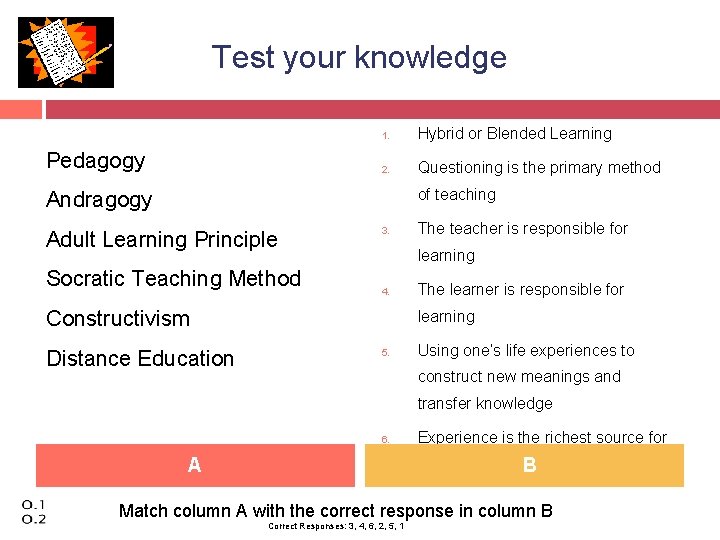
Test your knowledge Pedagogy 1. Hybrid or Blended Learning 2. Questioning is the primary method of teaching Andragogy Adult Learning Principle Socratic Teaching Method 3. learning 4. Constructivism Distance Education The teacher is responsible for The learner is responsible for learning 5. Using one’s life experiences to construct new meanings and transfer knowledge 6. A Experience is the richest source for adult learning B Match column A with the correct response in column B Correct Responses: 3, 4, 6, 2, 5, 1
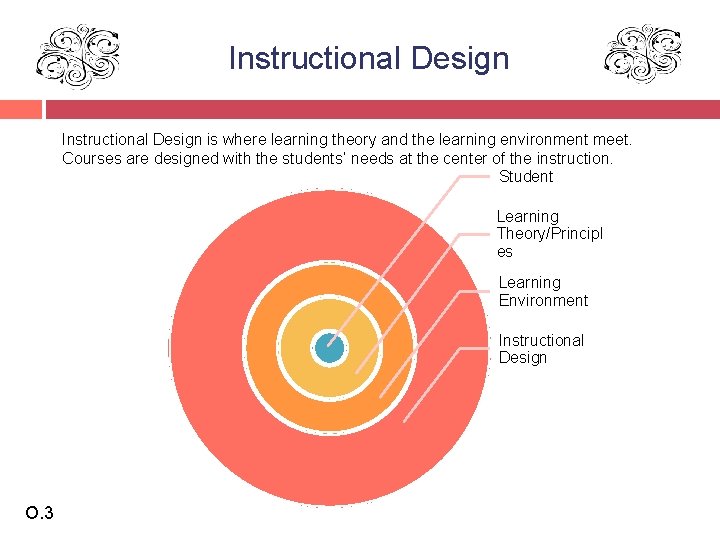
Instructional Design is where learning theory and the learning environment meet. Courses are designed with the students’ needs at the center of the instruction. Student Learning Theory/Principl es Learning Environment Instructional Design O. 3
Designing DE Courses for Adults What do we know? • Adults need to direct their learning experiences • Adults need relevant learning experiences • Adults have rich life experiences to draw from • Adults are responsible for their learning • Facilitators and designers, design courses with the adult learners’ needs in mind • When designing courses we need to consider more than the content, but the experience the learner will encounter • Understanding how adults learn allows us to design courses that are engaging, relevant, and assess for synthesis and transfer
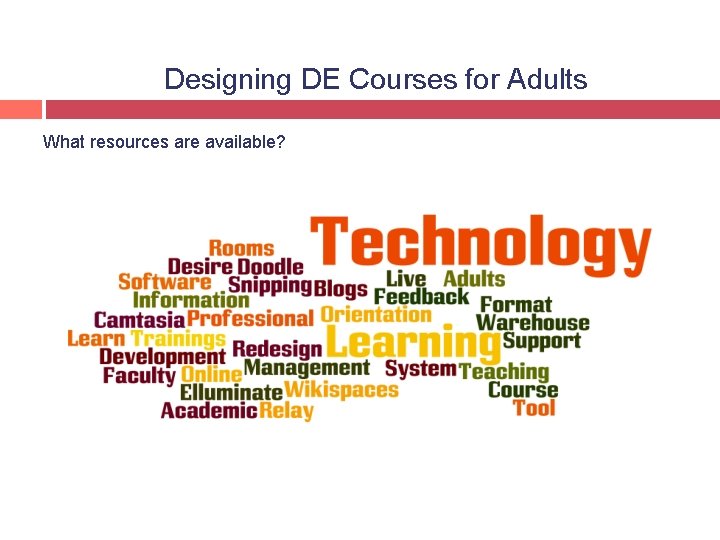
Designing DE Courses for Adults What resources are available?
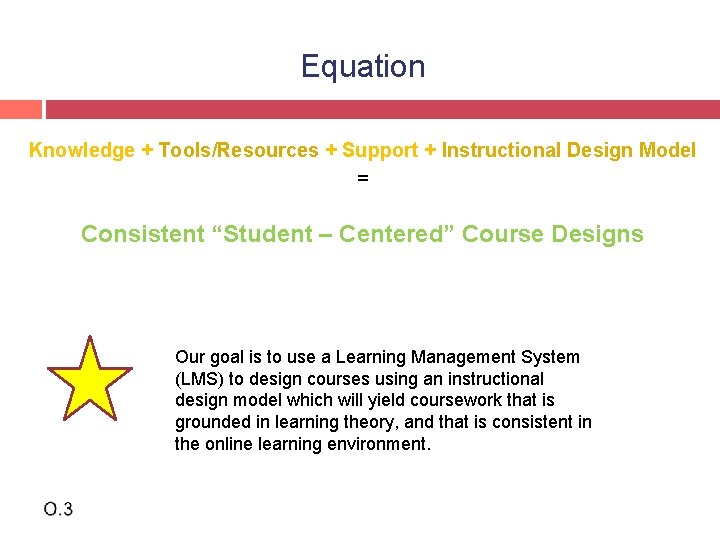
Equation Knowledge + Tools/Resources + Support + Instructional Design Model = Consistent “Student – Centered” Course Designs Our goal is to use a Learning Management System (LMS) to design courses using an instructional design model which will yield coursework that is grounded in learning theory, and that is consistent in the online learning environment.
Consistency is form Why is it important to maintain consistency in DE courses? When we design courses according to an easy to use model, both the instructor and student encounter less distractions. Distractions reduce motivation and engagement. When all faculty members use the same model of design, all students come to know the model and will know how to navigate each DE course with ease. When students experience success, they believe they will be successful in the future. Self efficacy is a key ingredient in an online learning environment (self directing). A consistent model also allows students to integrate their current skill-set across the curriculum (relevance).
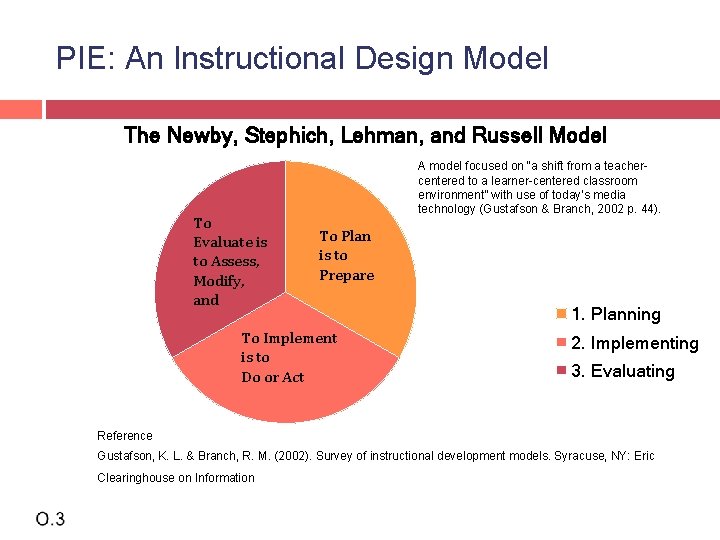
PIE: An Instructional Design Model The Newby, Stephich, Lehman, and Russell Model To Evaluate is to Assess, Modify, and A model focused on “a shift from a teachercentered to a learner-centered classroom environment” with use of today’s media technology (Gustafson & Branch, 2002 p. 44). To Plan is to Prepare To Implement is to Do or Act 1. Planning 2. Implementing 3. Evaluating Reference Gustafson, K. L. & Branch, R. M. (2002). Survey of instructional development models. Syracuse, NY: Eric Clearinghouse on Information
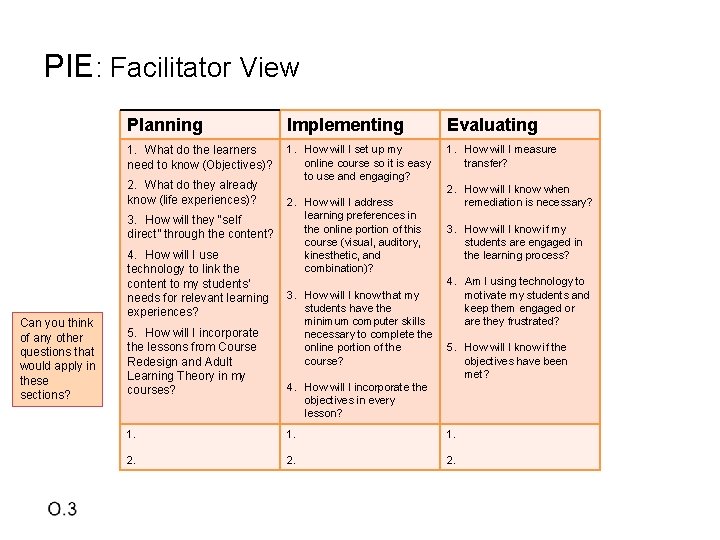
PIE: Facilitator View Planning Implementing Evaluating 1. What do the learners need to know (Objectives)? 1. How will I set up my online course so it is easy to use and engaging? 1. How will I measure transfer? 2. What do they already know (life experiences)? 3. How will they “self direct” through the content? Can you think of any other questions that would apply in these sections? 4. How will I use technology to link the content to my students’ needs for relevant learning experiences? 5. How will I incorporate the lessons from Course Redesign and Adult Learning Theory in my courses? 2. How will I address learning preferences in the online portion of this course (visual, auditory, kinesthetic, and combination)? 3. How will I know that my students have the minimum computer skills necessary to complete the online portion of the course? 2. How will I know when remediation is necessary? 3. How will I know if my students are engaged in the learning process? 4. Am I using technology to motivate my students and keep them engaged or are they frustrated? 5. How will I know if the objectives have been met? 4. How will I incorporate the objectives in every lesson? 1. 1. 2. 2.
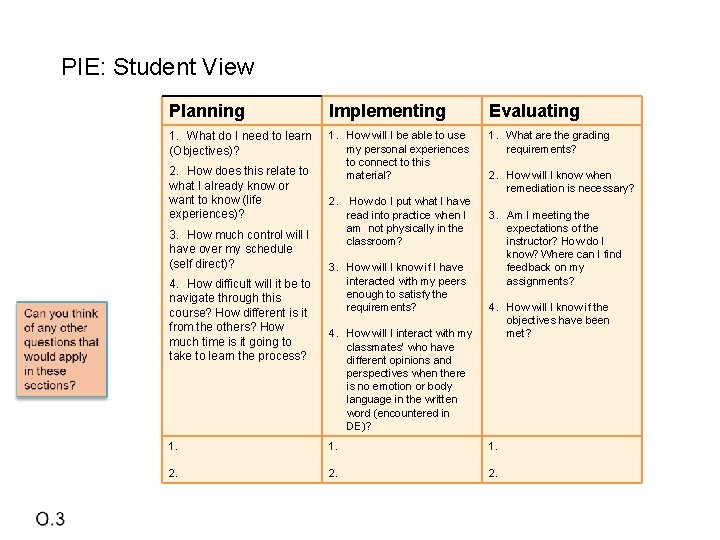
PIE: Student View Planning Implementing Evaluating 1. What do I need to learn (Objectives)? 1. How will I be able to use my personal experiences to connect to this material? 1. What are the grading requirements? 2. How does this relate to what I already know or want to know (life experiences)? 3. How much control will I have over my schedule (self direct)? 4. How difficult will it be to navigate through this course? How different is it from the others? How much time is it going to take to learn the process? 2. How do I put what I have read into practice when I am not physically in the classroom? 3. How will I know if I have interacted with my peers enough to satisfy the requirements? 4. How will I interact with my classmates’ who have different opinions and perspectives when there is no emotion or body language in the written word (encountered in DE)? 2. How will I know when remediation is necessary? 3. Am I meeting the expectations of the instructor? How do I know? Where can I find feedback on my assignments? 4. How will I know if the objectives have been met? 1. 1. 2. 2.
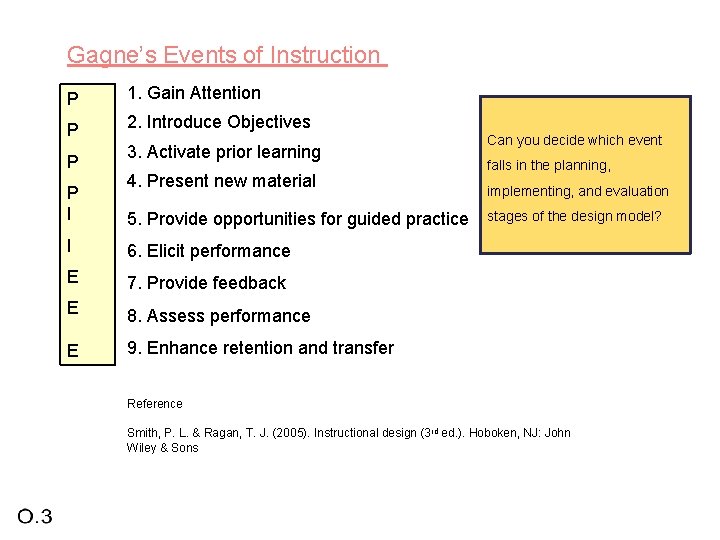
Gagne’s Events of Instruction P 1. Gain Attention P 2. Introduce Objectives P P I 3. Activate prior learning 4. Present new material 5. Provide opportunities for guided practice I 6. Elicit performance E 7. Provide feedback E 8. Assess performance E 9. Enhance retention and transfer Can you decide which event falls in the planning, implementing, and evaluation stages of the design model? Reference Smith, P. L. & Ragan, T. J. (2005). Instructional design (3 rd ed. ). Hoboken, NJ: John Wiley & Sons
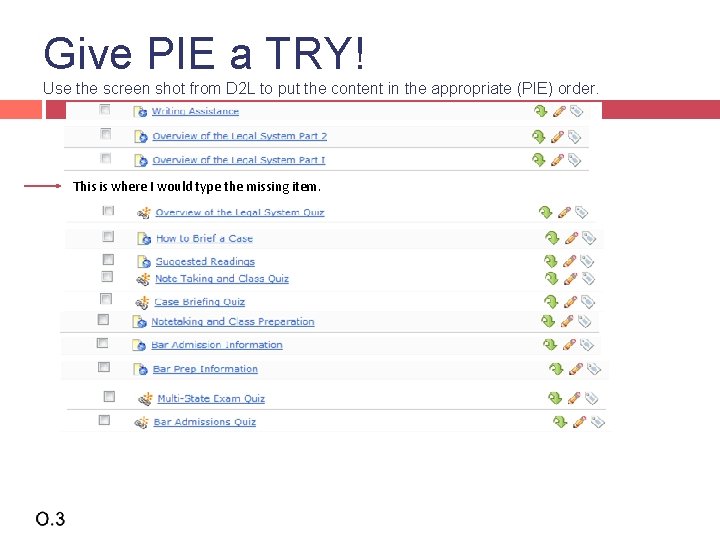
Give PIE a TRY! Use the screen shot from D 2 L to put the content in the appropriate (PIE) order. This is where I would type the missing item.
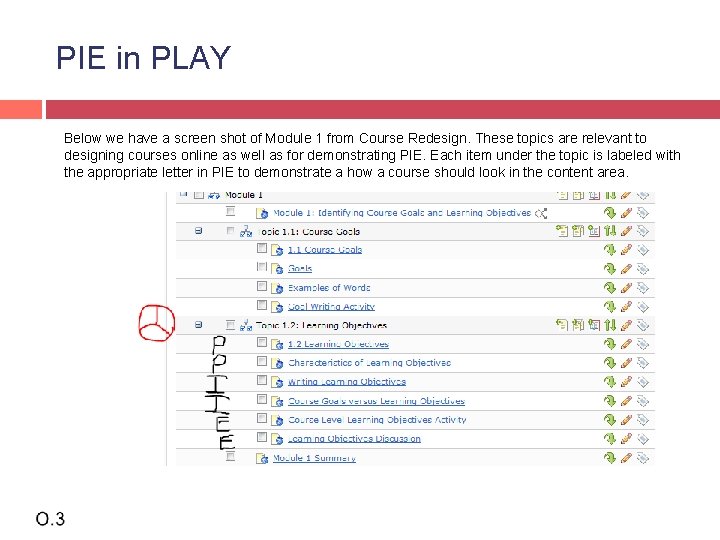
PIE in PLAY Below we have a screen shot of Module 1 from Course Redesign. These topics are relevant to designing courses online as well as for demonstrating PIE. Each item under the topic is labeled with the appropriate letter in PIE to demonstrate a how a course should look in the content area.
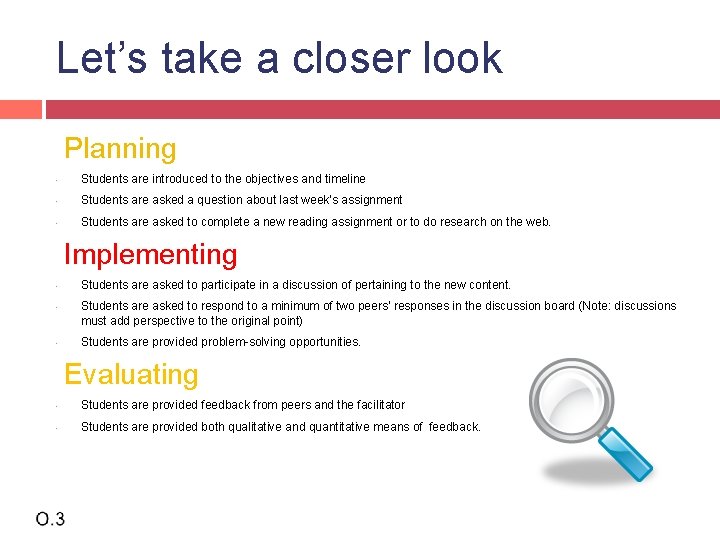
Let’s take a closer look Planning • Students are introduced to the objectives and timeline • Students are asked a question about last week’s assignment • Students are asked to complete a new reading assignment or to do research on the web. Implementing • • • Students are asked to participate in a discussion of pertaining to the new content. Students are asked to respond to a minimum of two peers’ responses in the discussion board (Note: discussions must add perspective to the original point) Students are provided problem-solving opportunities. Evaluating • Students are provided feedback from peers and the facilitator • Students are provided both qualitative and quantitative means of feedback.
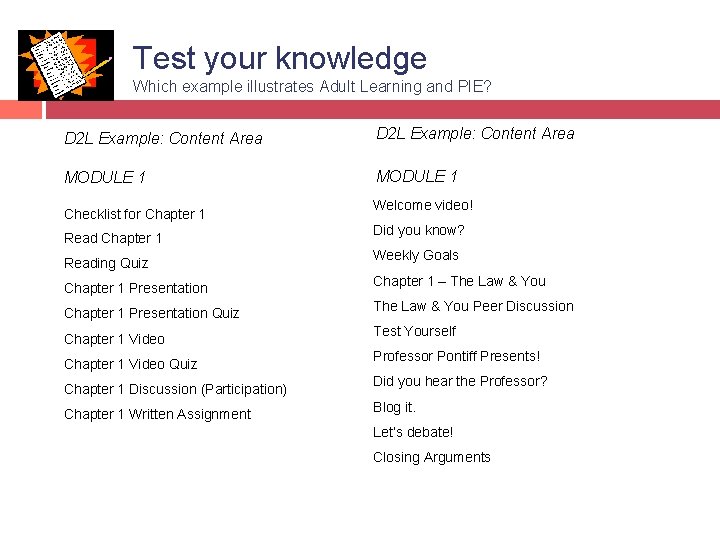
Test your knowledge Which example illustrates Adult Learning and PIE? D 2 L Example: Content Area MODULE 1 Checklist for Chapter 1 Reading Quiz Chapter 1 Presentation Quiz Chapter 1 Video Quiz Chapter 1 Discussion (Participation) Chapter 1 Written Assignment Welcome video! Did you know? Weekly Goals Chapter 1 – The Law & You Peer Discussion Test Yourself Professor Pontiff Presents! Did you hear the Professor? Blog it. Let’s debate! Closing Arguments
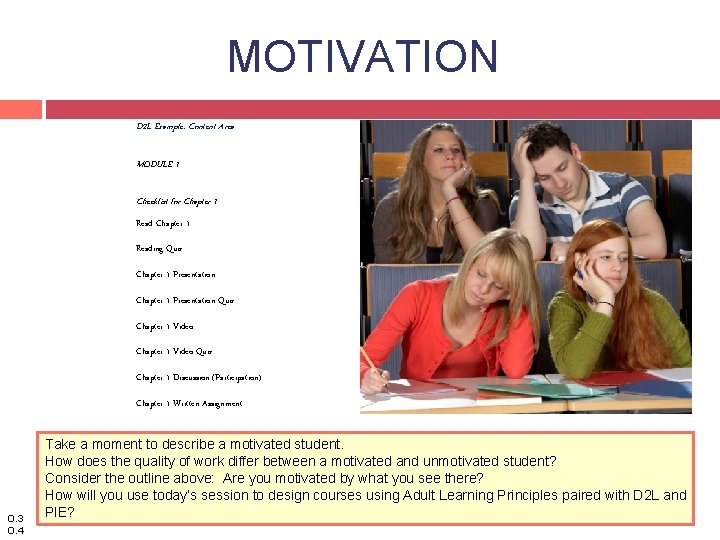
MOTIVATION D 2 L Example: Content Area MODULE 1 Checklist for Chapter 1 Reading Quiz Chapter 1 Presentation Quiz Chapter 1 Video Quiz Chapter 1 Discussion (Participation) Chapter 1 Written Assignment O. 3 O. 4 Take a moment to describe a motivated student. How does the quality of work differ between a motivated and unmotivated student? Consider the outline above: Are you motivated by what you see there? How will you use today’s session to design courses using Adult Learning Principles paired with D 2 L and PIE?
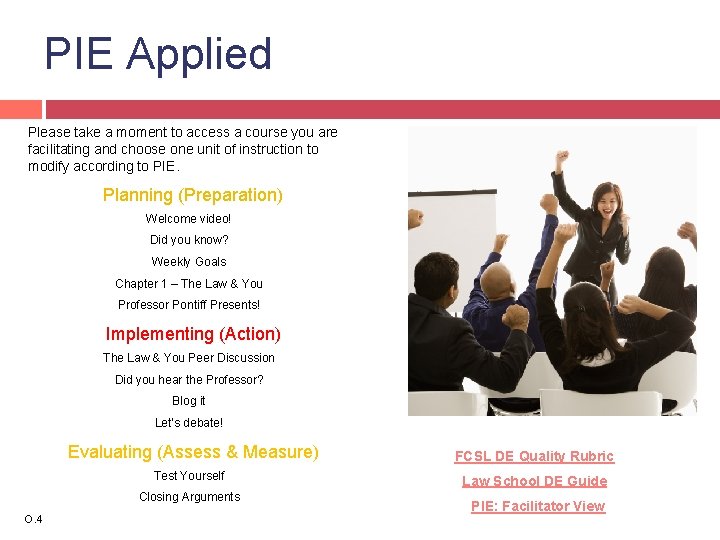
PIE Applied Please take a moment to access a course you are facilitating and choose one unit of instruction to modify according to PIE. Planning (Preparation) Welcome video! Did you know? Weekly Goals Chapter 1 – The Law & You Professor Pontiff Presents! Implementing (Action) The Law & You Peer Discussion Did you hear the Professor? Blog it Let’s debate! Evaluating (Assess & Measure) Test Yourself Closing Arguments O. 4 FCSL DE Quality Rubric Law School DE Guide PIE: Facilitator View
PIE Check 1. What was your greatest challenge when modifying your unit of instruction? 2. Do you need additional feedback on applying the PIE model? Please elaborate. 3. O. 4 Will you use the PIE model when designing DE courses?