
Teaching a DataDriven Approach to Inference Patti Frazer
![Yes, we are related! (And there are more of us…) Kari [Harvard] Penn State](https://slidetodoc.com/presentation_image_h2/03406330ccc23ab2e87b2b7960c93253/image-2.jpg "Yes, we are related! (And there are more of us…) Kari [Harvard] Penn State")
- Slides: 59
Teaching a Data-Driven Approach to Inference Patti Frazer Lock, St. Lawrence University Robin Lock, St. Lawrence University Kari Lock Morgan, Penn State University USCOTS 2017
Yes, we are related! (And there are more of us…) Kari [Harvard] Penn State Eric [North Carolina] Minnesota Dennis [Iowa State] Miami Dolphins Patti & Robin St. Lawrence
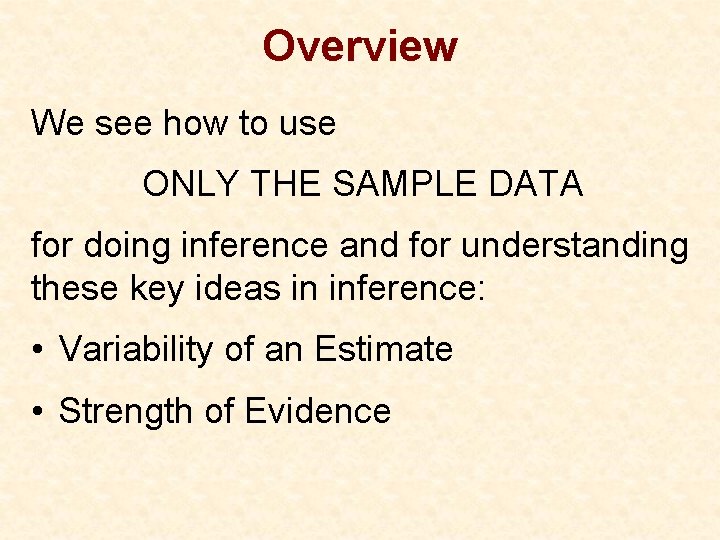
Overview We see how to use ONLY THE SAMPLE DATA for doing inference and for understanding these key ideas in inference: • Variability of an Estimate • Strength of Evidence
Overview We see how to use ONLY THE SAMPLE DATA. No theoretical distributions! No formulas!
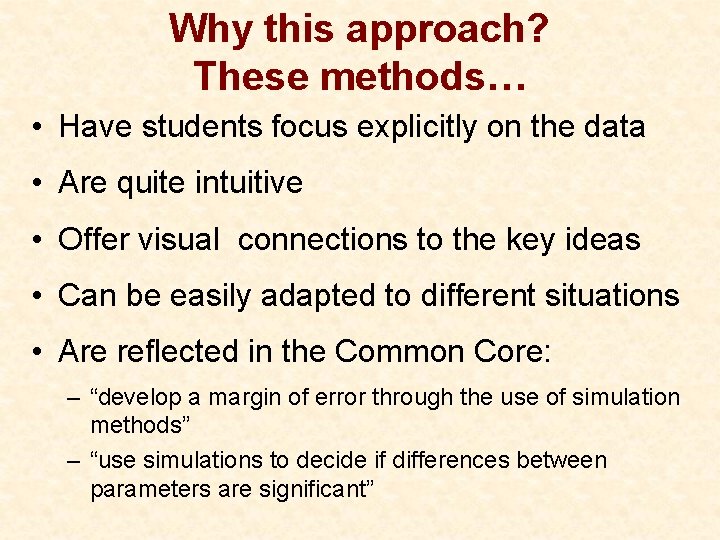
Why this approach? These methods… • Have students focus explicitly on the data • Are quite intuitive • Offer visual connections to the key ideas • Can be easily adapted to different situations • Are reflected in the Common Core: – “develop a margin of error through the use of simulation methods” – “use simulations to decide if differences between parameters are significant”
Outline Part 1: A data-driven approach to help students understand variability of estimates. Part 2: A data-driven approach to help students understand strength of evidence.
A Data-Driven Approach to Understanding Variability of Estimates
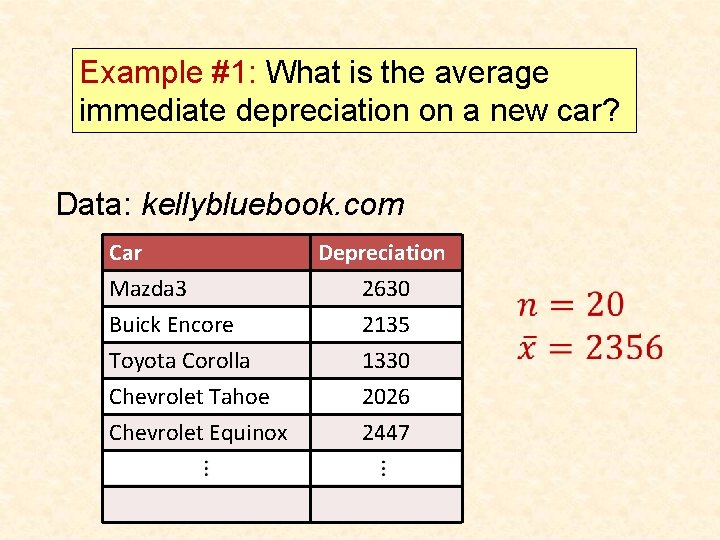
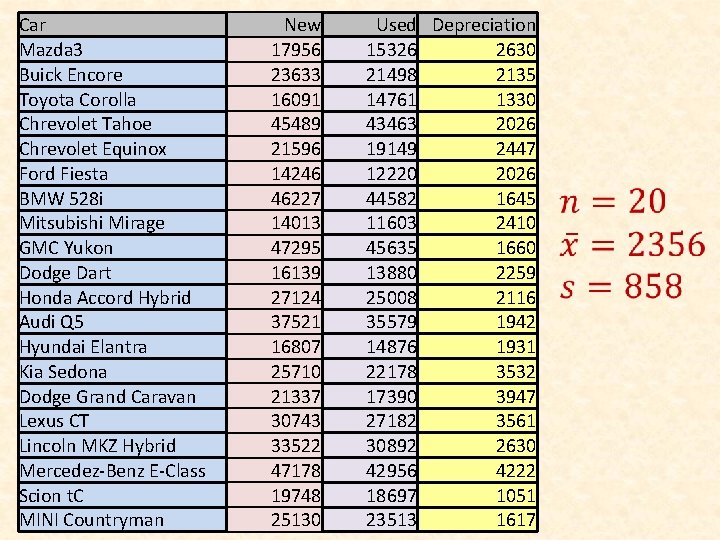
Example #1: What is the average immediate depreciation on a new car? Data: kellybluebook. com Car Mazda 3 Buick Encore Toyota Corolla Chevrolet Tahoe Chevrolet Equinox Depreciation 2630 2135 1330 2026 2447
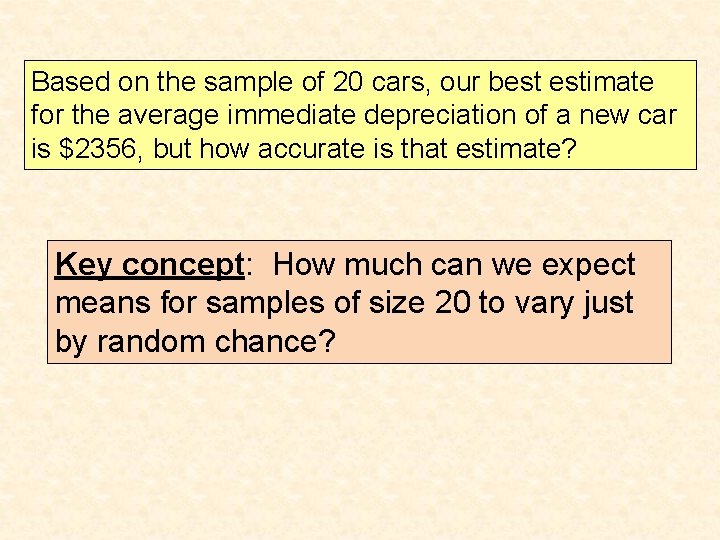
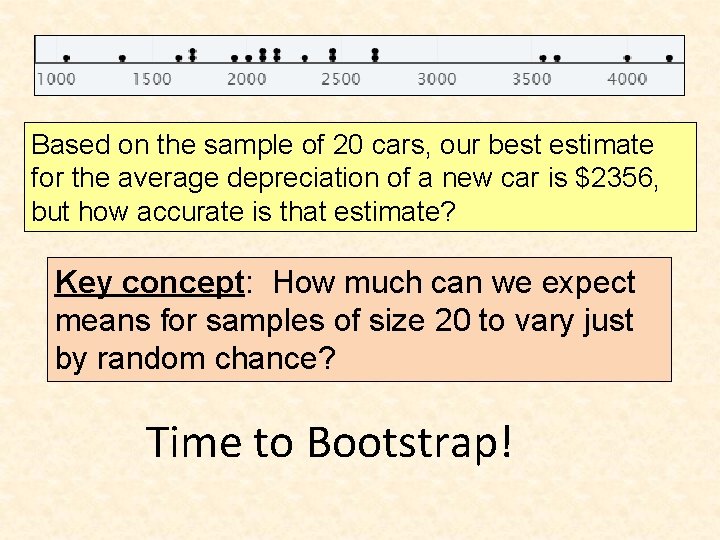
Based on the sample of 20 cars, our best estimate for the average immediate depreciation of a new car is $2356, but how accurate is that estimate? Key concept: How much can we expect means for samples of size 20 to vary just by random chance?
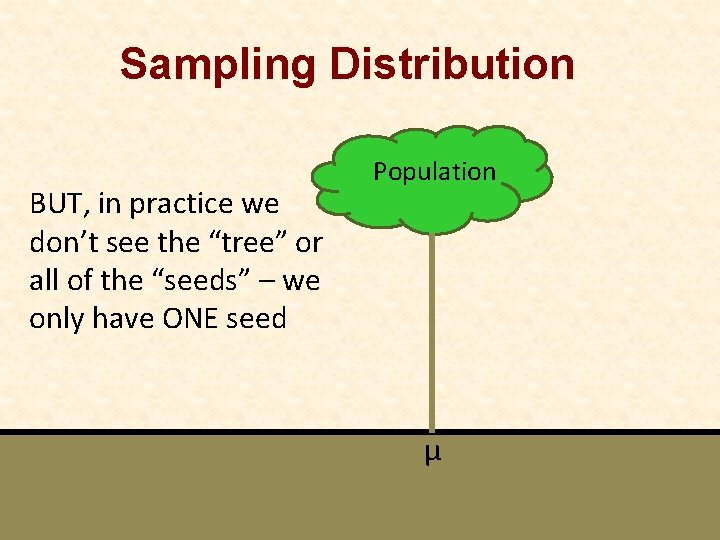
Sampling Distribution BUT, in practice we don’t see the “tree” or all of the “seeds” – we only have ONE seed Population µ
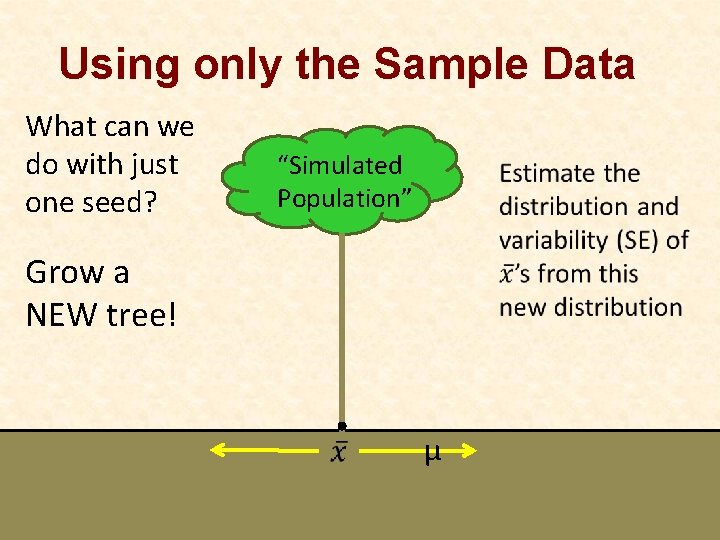
Using only the Sample Data What can we do with just one seed? “Simulated Population” Grow a NEW tree! µ
Brad Efron Stanford University Bootstrapping “Let your data be your guide. ” How can we measure the variability of a sample statistic using only the data in that one sample?
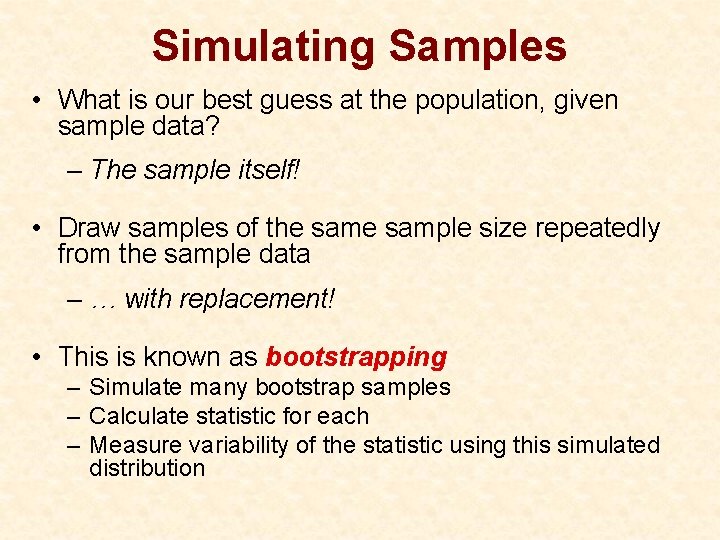
Simulating Samples • What is our best guess at the population, given sample data? – The sample itself! • Draw samples of the sample size repeatedly from the sample data – … with replacement! • This is known as bootstrapping – Simulate many bootstrap samples – Calculate statistic for each – Measure variability of the statistic using this simulated distribution
Assessing Uncertainty • Key idea: how much do statistics vary from sample to sample? • Problem? • We can’t take lots of samples from the population! • Solution? • (re)sample from our best guess at the population – the sample itself!
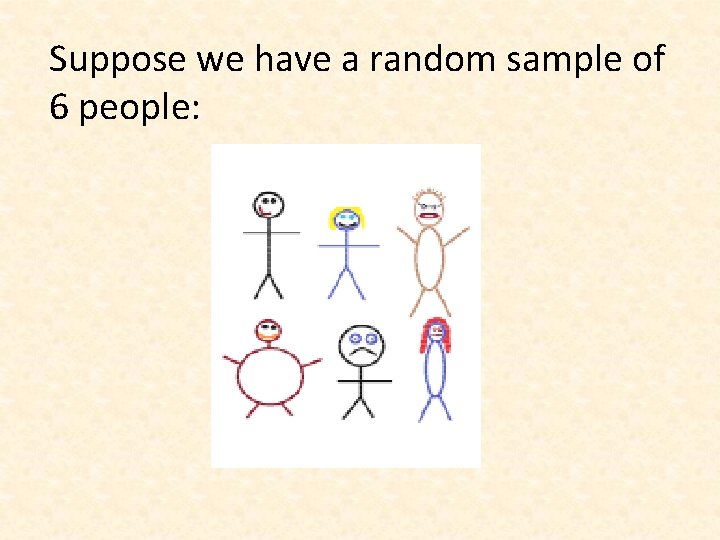
Suppose we have a random sample of 6 people:
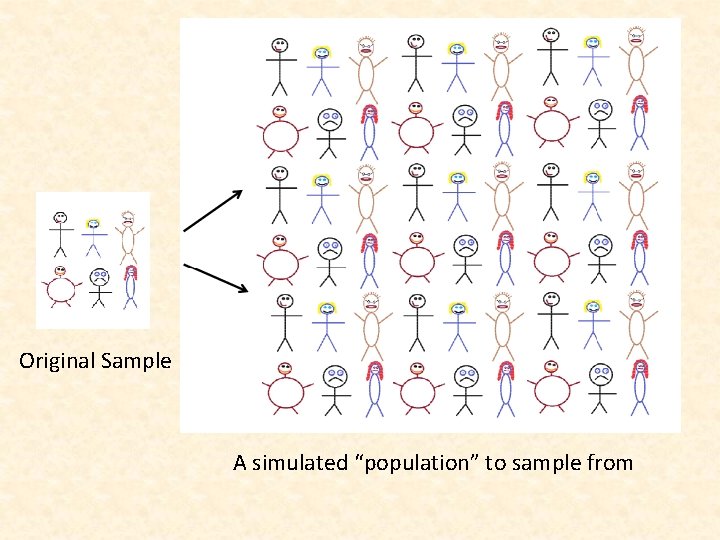
Original Sample A simulated “population” to sample from
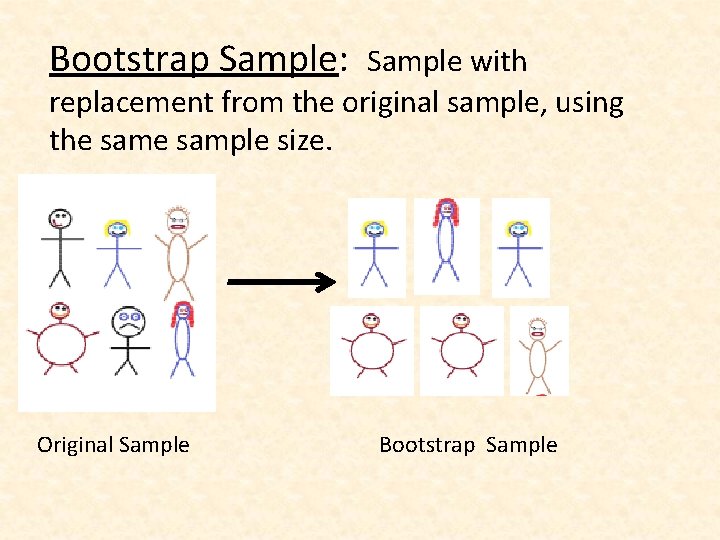
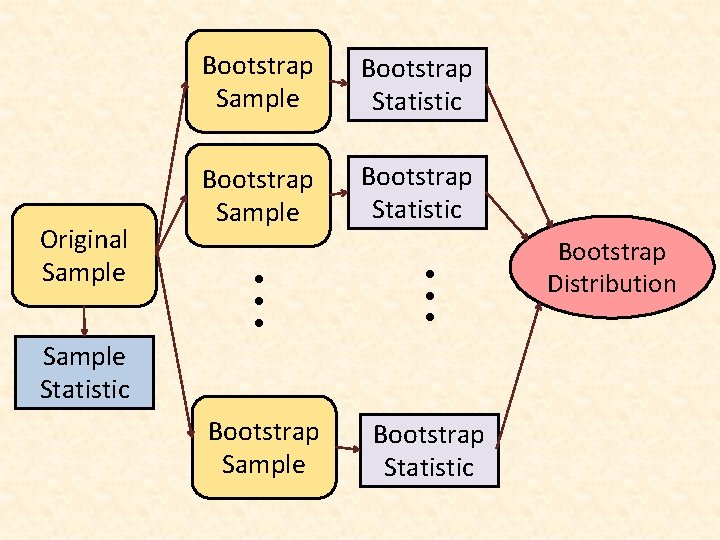
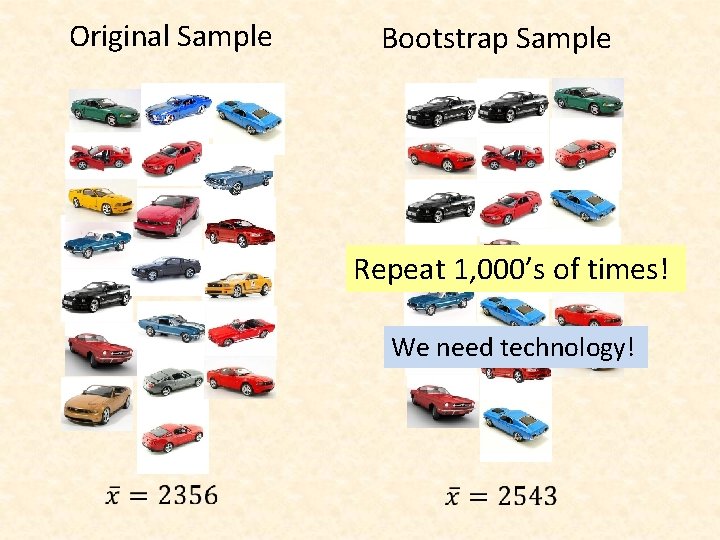
Bootstrap Sample: Sample with replacement from the original sample, using the sample size. Original Sample Bootstrap Sample
Original Sample Bootstrap Statistic Bootstrap Sample Bootstrap Statistic ● ● ● Sample Statistic Bootstrap Sample Bootstrap Statistic Bootstrap Distribution
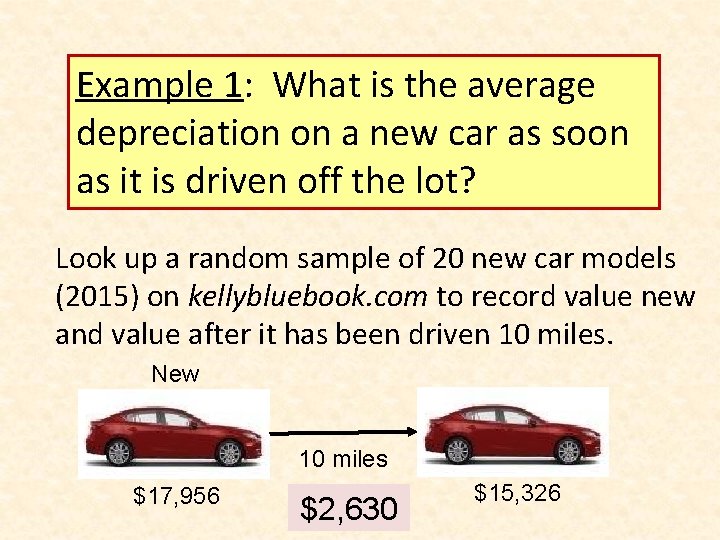
Example 1: What is the average depreciation on a new car as soon as it is driven off the lot? Look up a random sample of 20 new car models (2015) on kellybluebook. com to record value new and value after it has been driven 10 miles. New 10 miles $17, 956 $2, 630 $15, 326
Car Mazda 3 Buick Encore Toyota Corolla Chrevolet Tahoe Chrevolet Equinox Ford Fiesta BMW 528 i Mitsubishi Mirage GMC Yukon Dodge Dart Honda Accord Hybrid Audi Q 5 Hyundai Elantra Kia Sedona Dodge Grand Caravan Lexus CT Lincoln MKZ Hybrid Mercedez-Benz E-Class Scion t. C MINI Countryman New 17956 23633 16091 45489 21596 14246 46227 14013 47295 16139 27124 37521 16807 25710 21337 30743 33522 47178 19748 25130 Used Depreciation 15326 2630 21498 2135 14761 1330 43463 2026 19149 2447 12220 2026 44582 1645 11603 2410 45635 1660 13880 2259 25008 2116 35579 1942 14876 1931 22178 3532 17390 3947 27182 3561 30892 2630 42956 4222 18697 1051 23513 1617
Based on the sample of 20 cars, our best estimate for the average depreciation of a new car is $2356, but how accurate is that estimate? Key concept: How much can we expect means for samples of size 20 to vary just by random chance? Time to Bootstrap!
Original Sample Bootstrap Sample Repeat 1, 000’s of times! We need technology!
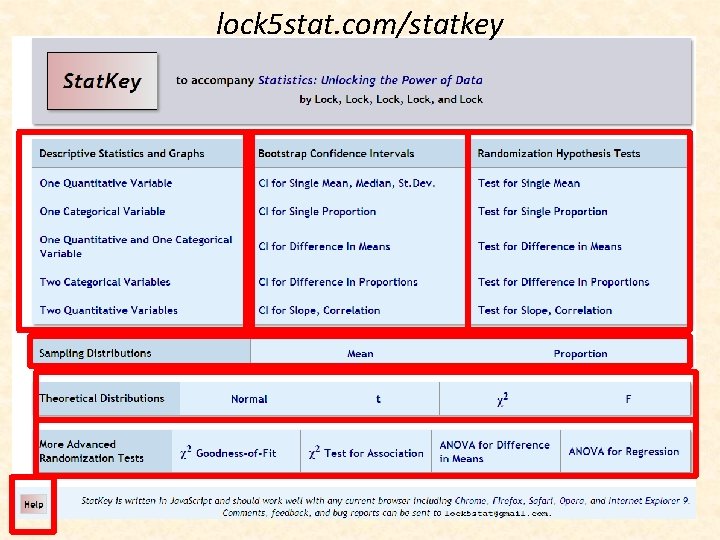
Stat. Key lock 5 stat. com/statkey �Freely available web apps with no login required �Runs in (almost) any browser (incl. smartphones/tablets) �Google Chrome App available (no internet needed) �Use standalone or supplement to existing technology
lock 5 stat. com/statkey
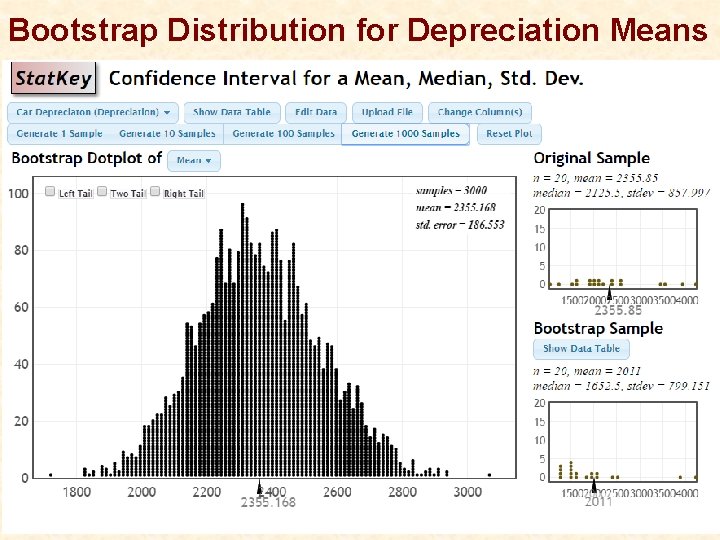
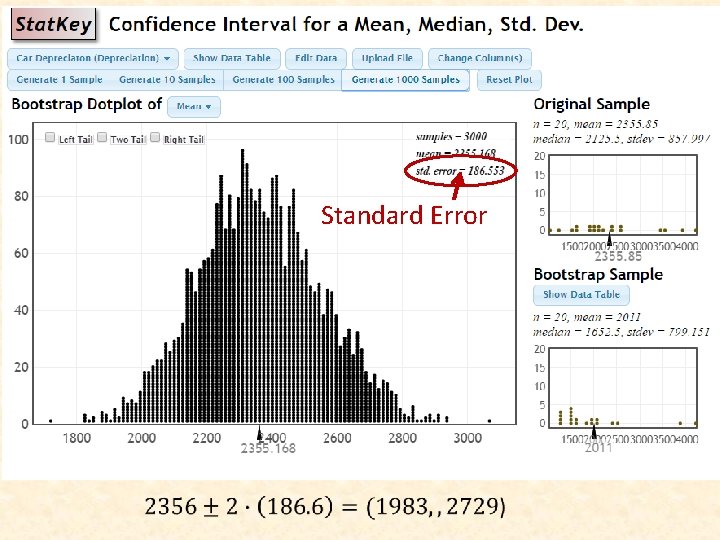
Bootstrap Distribution for Depreciation Means
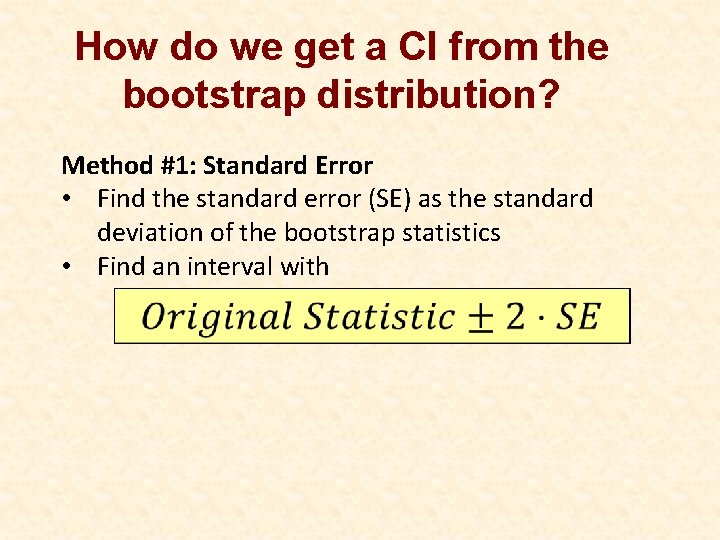
How do we get a CI from the bootstrap distribution? Method #1: Standard Error • Find the standard error (SE) as the standard deviation of the bootstrap statistics • Find an interval with
Standard Error
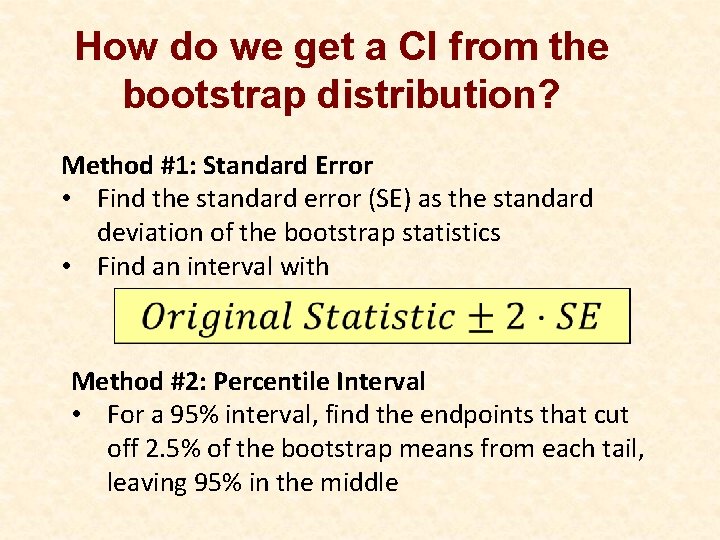
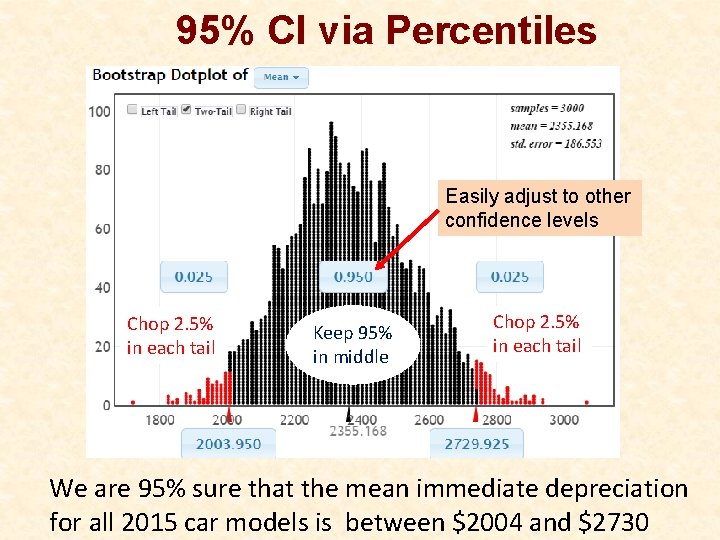
How do we get a CI from the bootstrap distribution? Method #1: Standard Error • Find the standard error (SE) as the standard deviation of the bootstrap statistics • Find an interval with Method #2: Percentile Interval • For a 95% interval, find the endpoints that cut off 2. 5% of the bootstrap means from each tail, leaving 95% in the middle
95% CI via Percentiles Easily adjust to other confidence levels Chop 2. 5% in each tail Keep 95% in middle Chop 2. 5% in each tail We are 95% sure that the mean immediate depreciation for all 2015 car models is between $2004 and $2730
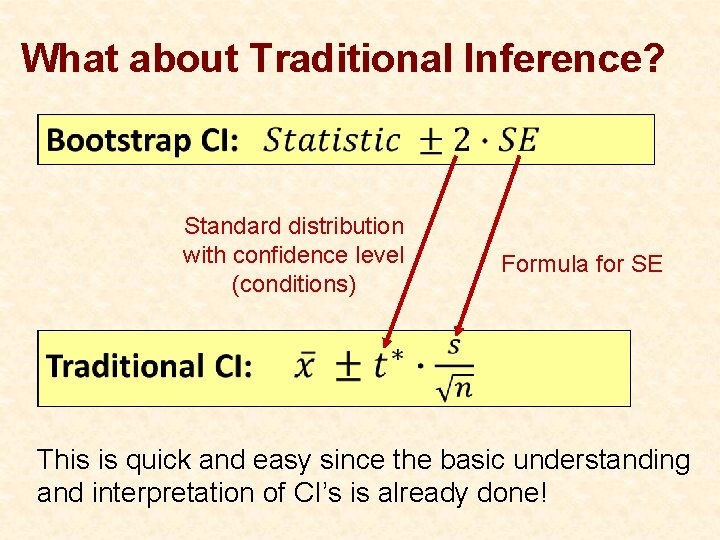
Bootstrap Confidence Intervals Version 1 (Statistic 2 SE): Great preparation for moving to traditional methods Version 2 (Percentiles): Great at building understanding of confidence level Same process works for different parameters
Bootstrap Approach • Create a bootstrap distribution by simulating many samples from the original data, with replacement, and calculating the sample statistic for each new sample. • Estimate confidence interval using either statistic ± 2 SE or the middle 95% of the bootstrap distribution.
Have you used a dating app? Example 2: Estimate the proportion of collegeeducated American adults to have ever used a dating site or dating app. A survey conducted by the Pew Research Center in July 2015 asked a random sample of American adults if they had ever used an online dating site or a dating app. In the sample, 157 of the 823 college-educated respondents said yes.
Donating Blood to Grandma? Example 3: What is the effect of getting an infusion of young blood? Old mice were randomly assigned to receive blood from a young mouse or another old mouse. The mice receiving the young blood showed multiple signs of a reversal of brain aging. We look here at exercise endurance as measured by maximum runtime on a treadmill.
Synchronized Movement • How close do you feel to others in the room? Use a 7 point Likert scale where 7=extremely close and 1=not at all close. Record your answer (you don’t have to share it!) • Now dance!! Cha Slide Dance! • NOW how close do you feel to others in the room? Use the same 7 -point Likert scale. Record your answer. Calculate the difference: After – Before. Example 4: How much does synchronized movement increase feelings of closeness? Data from a study done with High School students in Brazil. Tarr, Launay, Cohen, Dunbar, “Synchrony and exertion during dance independently raise pain threshold and encourage social bonding, ” Biology Letters, 11(10), Oct 2015.
Summary: Bootstrap Confidence Intervals • Same process for all parameters! Enables big picture understanding • Reinforces the importance of considering whether sample is representative of population • Reinforces the concept of sampling variability • Very visual! • Low emphasis on algebra and formulas • Ties directly (and visually) to understanding confidence level
A Data-Driven Approach to Understanding Strength of Evidence
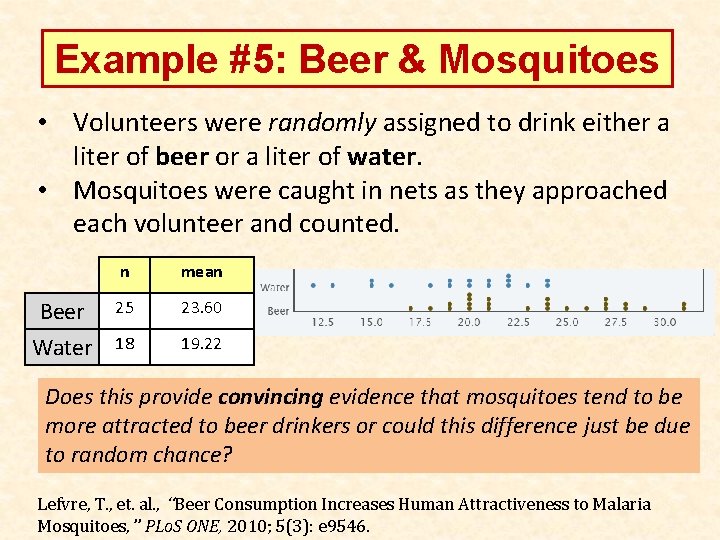
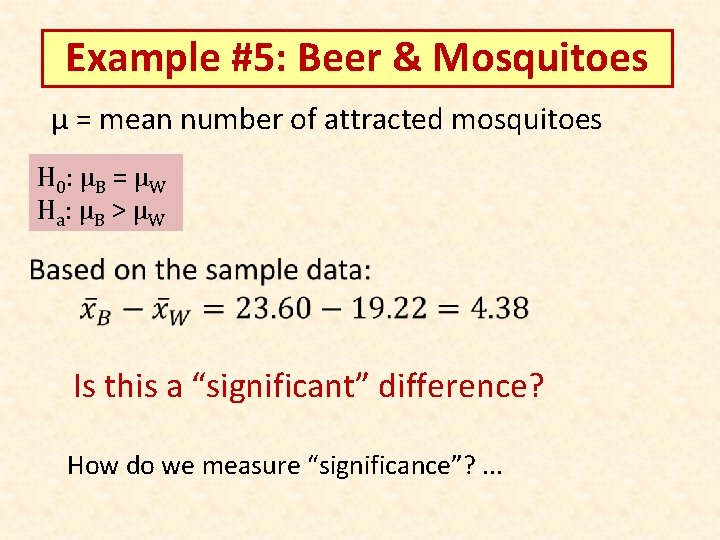
Example #5: Beer & Mosquitoes • Volunteers were randomly assigned to drink either a liter of beer or a liter of water. • Mosquitoes were caught in nets as they approached each volunteer and counted. Beer Water n mean 25 23. 60 18 19. 22 Does this provide convincing evidence that mosquitoes tend to be more attracted to beer drinkers or could this difference just be due to random chance? Lefvre, T. , et. al. , “Beer Consumption Increases Human Attractiveness to Malaria Mosquitoes, ” PLo. S ONE, 2010; 5(3): e 9546.
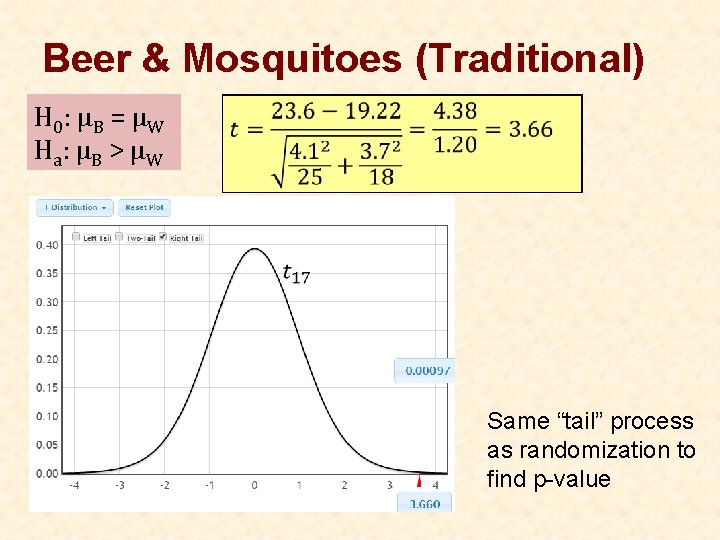
Example #5: Beer & Mosquitoes µ = mean number of attracted mosquitoes H 0: μ B = μ W H a: μ B > μ W Is this a “significant” difference? How do we measure “significance”? . . .
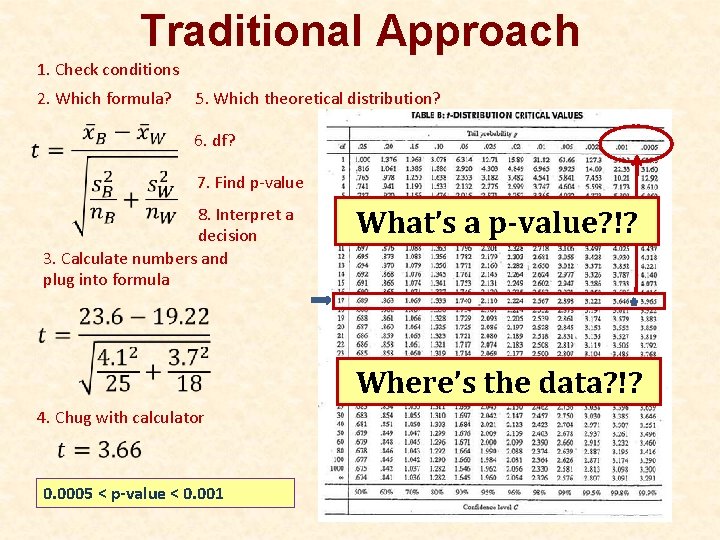
Traditional Approach 1. Check conditions 2. Which formula? 5. Which theoretical distribution? 6. df? 7. Find p-value 8. Interpret a decision 3. Calculate numbers and plug into formula What’s a p-value? !? Where’s the data? !? 4. Chug with calculator 0. 0005 < p-value < 0. 001
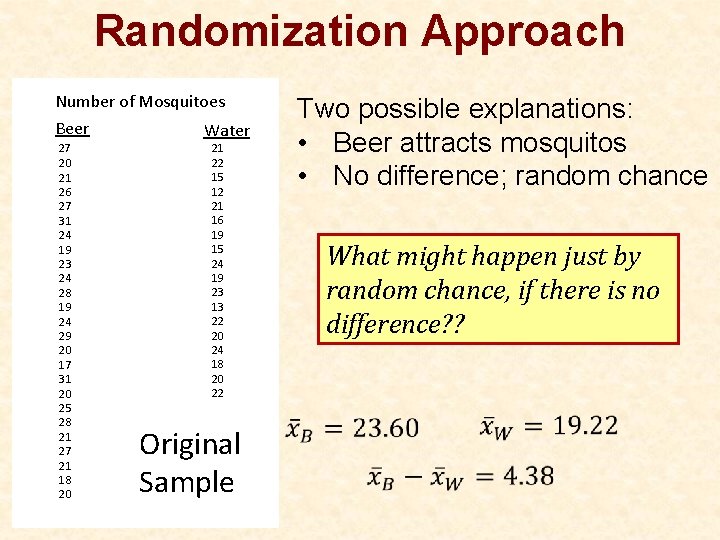
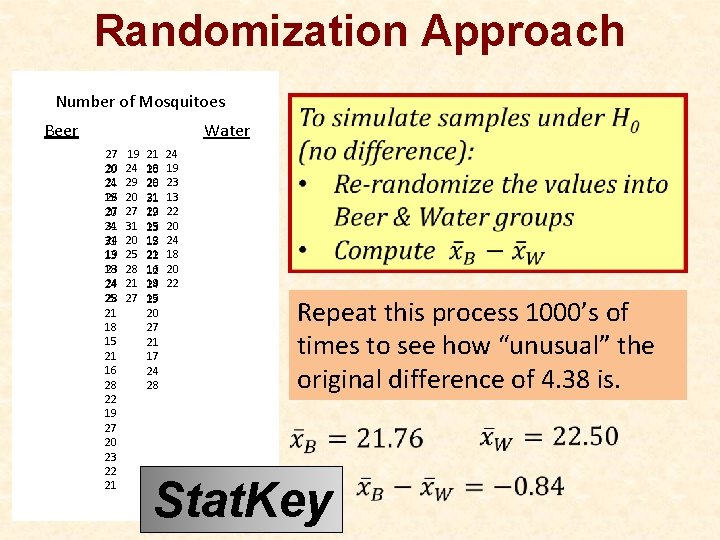
Randomization Approach Number of Mosquitoes Beer 27 20 21 26 27 31 24 19 23 24 28 19 24 29 20 17 31 20 25 28 21 27 21 18 20 Water 21 22 15 12 21 16 19 15 24 19 23 13 22 20 24 18 20 22 Original Sample Two possible explanations: • Beer attracts mosquitos • No difference; random chance What might happen just by random chance, if there is no difference? ?
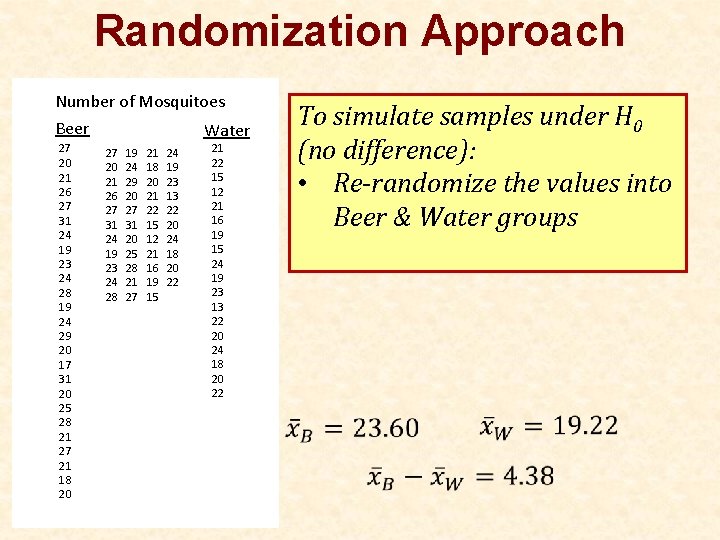
Randomization Approach Number of Mosquitoes Beer 27 20 21 26 27 31 24 19 23 24 28 19 24 29 20 17 31 20 25 28 21 27 21 18 20 Water 27 20 21 26 27 31 24 19 23 24 28 19 24 29 20 27 31 20 25 28 21 27 21 18 20 21 22 15 12 21 16 19 15 24 19 23 13 22 20 24 18 20 22 To simulate samples under H 0 (no difference): • Re-randomize the values into Beer & Water groups
Randomization Approach Number of Mosquitoes Beer Water 27 20 20 21 24 26 19 27 20 31 24 24 31 19 13 23 18 24 24 28 25 21 18 15 21 16 28 22 19 27 20 23 22 21 19 24 29 20 27 31 20 25 28 21 27 21 18 20 20 26 21 31 22 19 15 23 12 15 21 22 16 12 19 24 15 29 20 27 21 17 24 28 24 19 23 13 22 20 24 18 20 22 Repeat this process 1000’s of times to see how “unusual” the original difference of 4. 38 is. Stat. Key
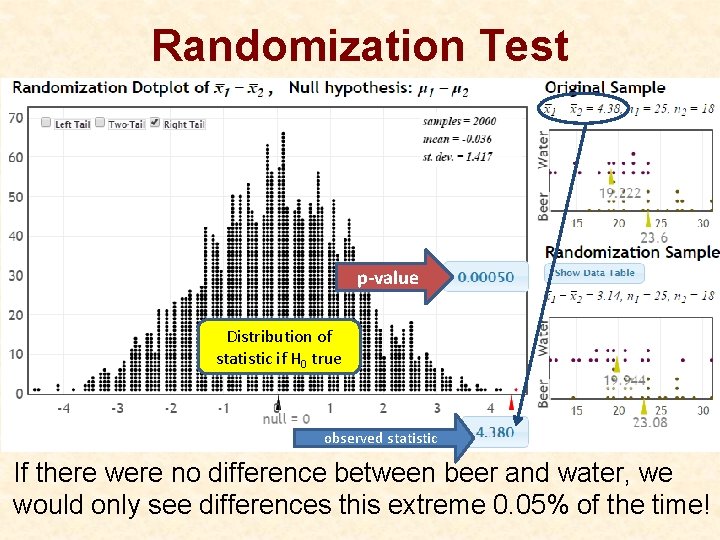
Randomization Test p-value Distribution of statistic if H 0 true observed statistic If there were no difference between beer and water, we would only see differences this extreme 0. 05% of the time!
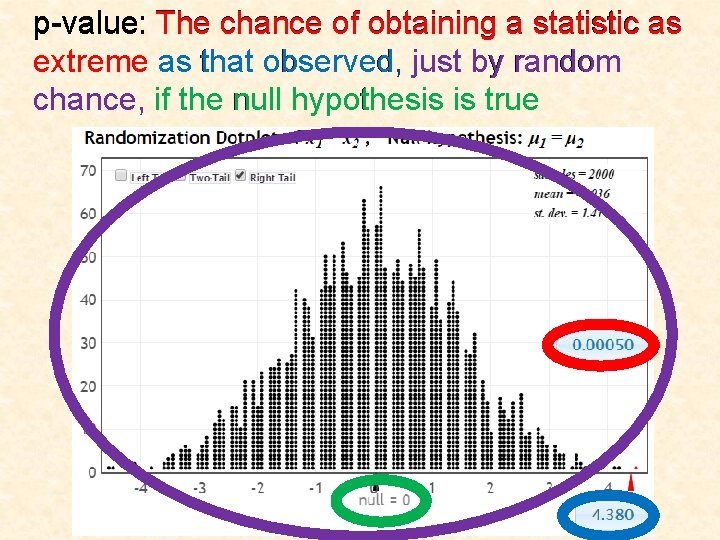
p-value: The chance of obtaining a statistic as extreme as that observed, just by random chance, if the null hypothesis is true
Randomization Approach • Create a randomization distribution by simulating many samples from the original data, assuming H 0 is true, and calculating the sample statistic for each new sample. • Estimate p-value directly as the proportion of these randomization statistics that exceed the original sample statistic. Small p-value Evidence against Ho
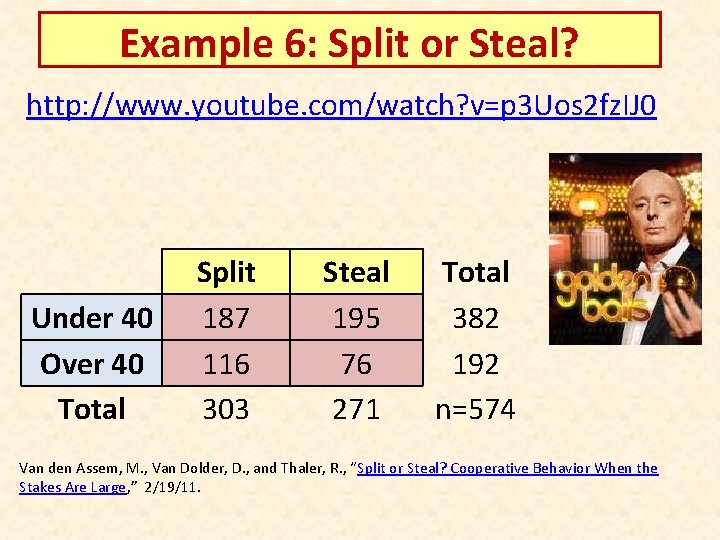
Example 6: Split or Steal? http: //www. youtube. com/watch? v=p 3 Uos 2 fz. IJ 0 Under 40 Over 40 Total Split 187 116 303 Steal 195 76 271 Total 382 192 n=574 Van den Assem, M. , Van Dolder, D. , and Thaler, R. , “Split or Steal? Cooperative Behavior When the Stakes Are Large, ” 2/19/11.
Example #7: Malevolent Uniforms Do sports teams with more “malevolent” uniforms get penalized more often?
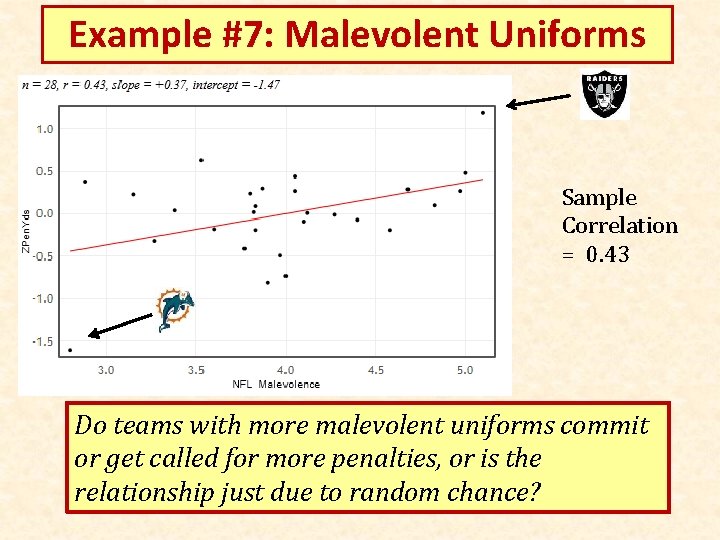
Example #7: Malevolent Uniforms Sample Correlation = 0. 43 Do teams with more malevolent uniforms commit or get called for more penalties, or is the relationship just due to random chance?
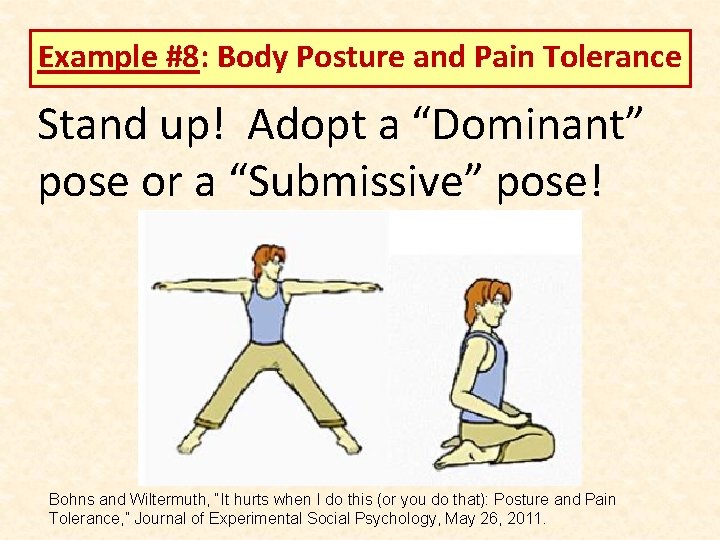
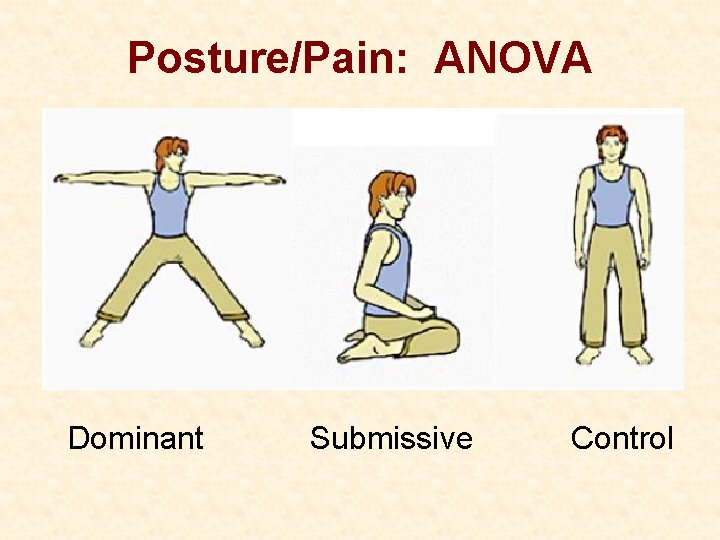
Example #8: Body Posture and Pain Tolerance Stand up! Adopt a “Dominant” pose or a “Submissive” pose! Bohns and Wiltermuth, “It hurts when I do this (or you do that): Posture and Pain Tolerance, ” Journal of Experimental Social Psychology, May 26, 2011.
Posture/Pain: ANOVA Dominant Submissive Control
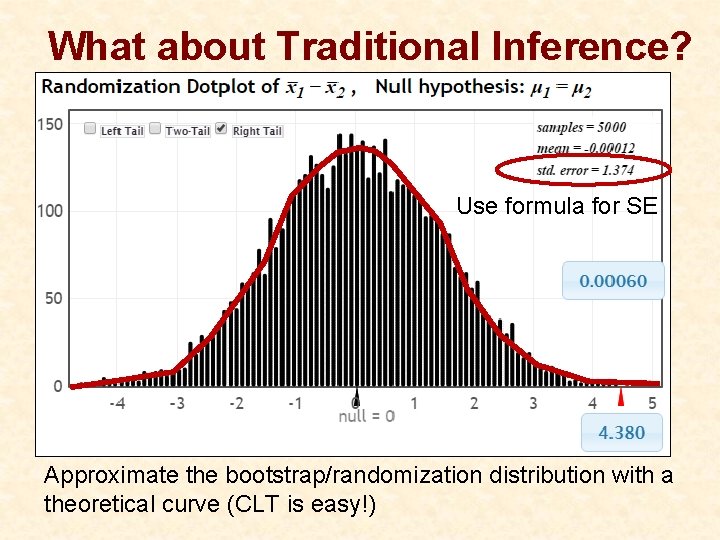
What about Traditional Inference? Use formula for SE Approximate the bootstrap/randomization distribution with a theoretical curve (CLT is easy!)
What about Traditional Inference? Standard distribution with confidence level (conditions) Formula for SE This is quick and easy since the basic understanding and interpretation of CI’s is already done!
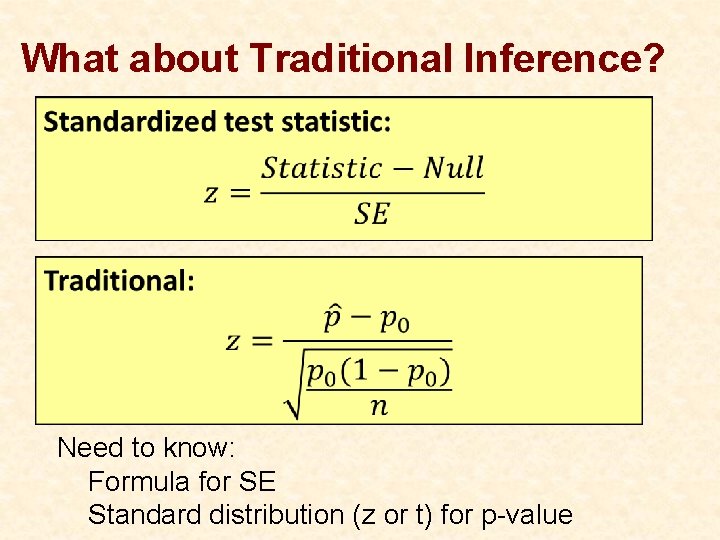
What about Traditional Inference? Need to know: Formula for SE Standard distribution (z or t) for p-value
Beer & Mosquitoes (Traditional) H 0: μ B = μ W H a: μ B > μ W Same “tail” process as randomization to find p-value
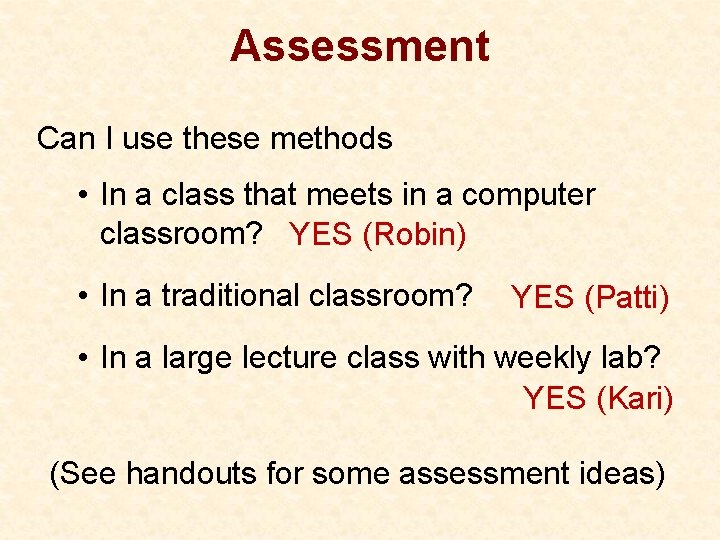
Assessment Can I use these methods • In a class that meets in a computer classroom? YES (Robin) • In a traditional classroom? YES (Patti) • In a large lecture class with weekly lab? YES (Kari) (See handouts for some assessment ideas)
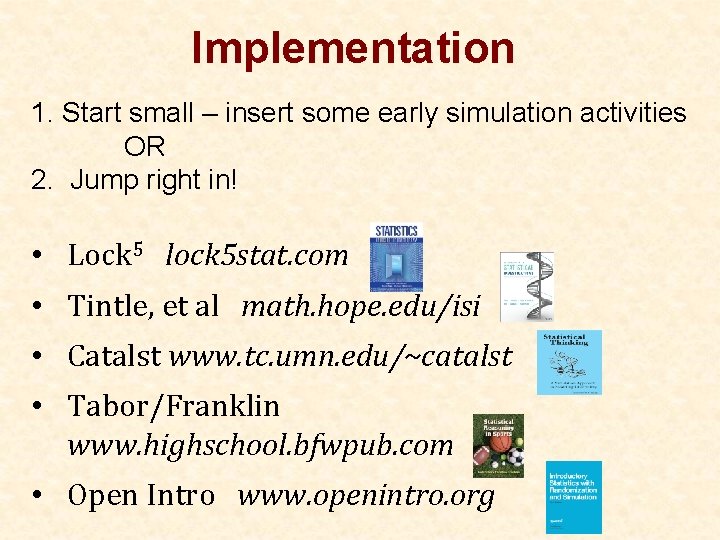
Implementation 1. Start small – insert some early simulation activities OR 2. Jump right in! • Lock 5 lock 5 stat. com • Tintle, et al math. hope. edu/isi • Catalst www. tc. umn. edu/~catalst • Tabor/Franklin www. highschool. bfwpub. com • Open Intro www. openintro. org
Technology Options • Stat. Key (alone) • Stat. Key + other (Minitab, JMP, Fathom, . . . ) • R • JMP • Minitab Express • Stat. Crunch
https: //www. causeweb. org/sbi/
QUESTIONS? • Questions about assessment? • Questions about the methods? • Questions about implementation? • Questions on other topics?