
Teachers Notes It is important to use blocks
Teachers’ Notes • It is important to use blocks for this activity. This builds the visual basis for so many future skills: not only 2 - digit multiplication, but also fraction multiplication, decimal multiplication and binomial multiplication in algebra. • When the slide says, “…try it…’, WAIT! Let students build the model before confirming their outcome on the next step of the slide. Encourage students NOT to give up when their first attempt doesn’t work. “Hmmm… Let’s just move the blocks around a little… something will have to work!” • It is important to practice the layout of the quadrants (the 100 -flat in the upper left, the unit blocks in the lower right. If nothing else, it develops uniformity in representation, that allows us to compare our models easily. • When finished with the 3 slides, let students work on the problems on the recording sheet. Not everyone will finish all of them, but completing a few is a good start towards developing this vital concept.
MULTIPLYING without a pencil ! Yay! Painless! You will need • 2 flats • 10 rods • 16 unit cubes
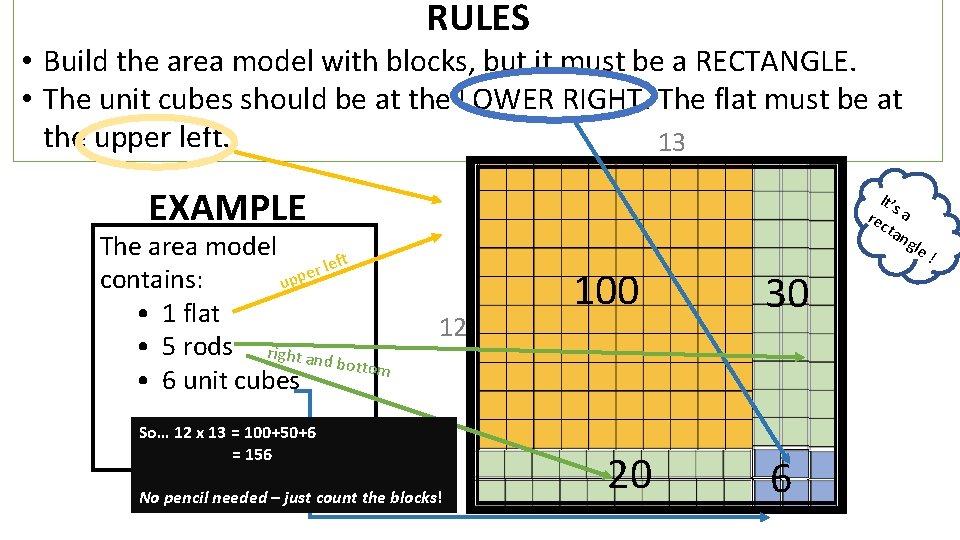
RULES • Build the area model with blocks, but it must be a RECTANGLE. • The unit cubes should be at the LOWER RIGHT. The flat must be at the upper left. 13 EXAMPLE The area model left r e contains: upp • 1 flat • 5 rods right and b ottom • 6 unit cubes It’s rec a tan gle 12 So… 12 x 13 = 100+50+6 = 156 No pencil needed – just count the blocks! 100 20 30 6 !
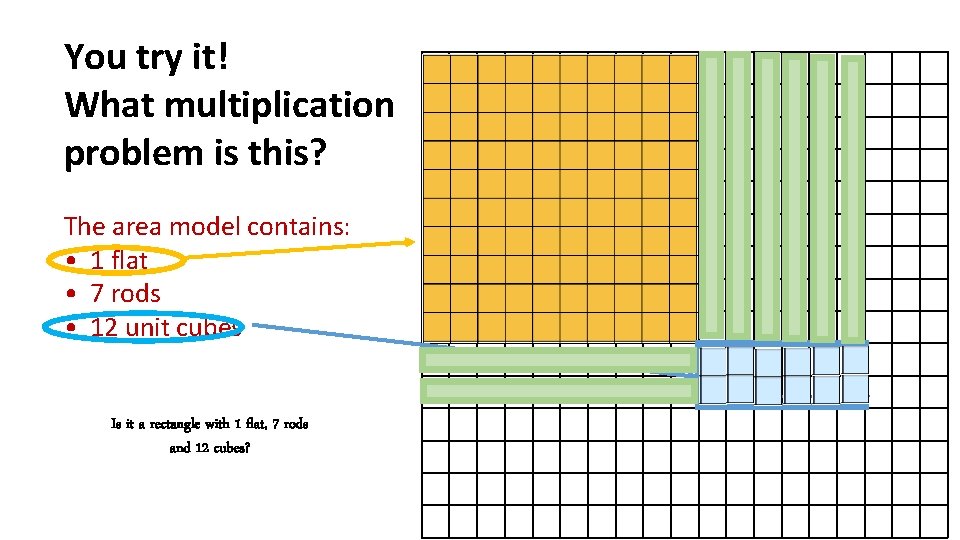
You try it! What multiplication problem is this? The area model contains: • 1 flat • 7 rods • 12 unit cubes ? 6 x 2 = 12…. try it… Is it a rectangle with 1 flat, 7 rods and 12 cubes?
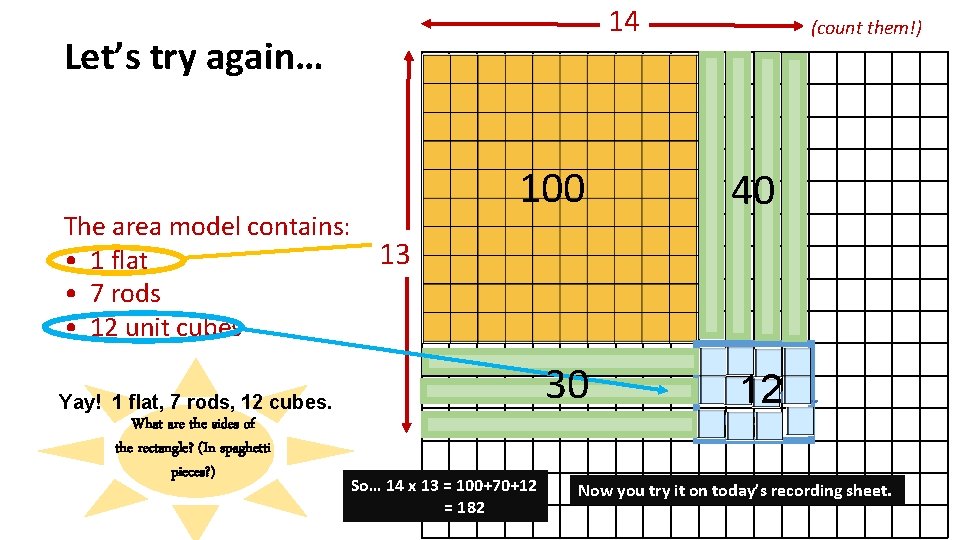
14 Let’s try again… The area model contains: • 1 flat • 7 rods • 12 unit cubes Yay! 1 flat, 7 rods, 12 cubes. What are the sides of the rectangle? (In spaghetti pieces? ) 100 (count them!) 40 13 30 So… 14 x 13 = 100+70+12 = 182 ? 12 3 x 4 = 12…. try it… Now you try it on today’s recording sheet.
- Slides: 5