
Teachers in the Schoolhouse Panopticon Complicity and Resistance






- Slides: 25
Teachers in the Schoolhouse Panopticon: Complicity and Resistance (Mary Bushnell, 2003) BY La. Trenda Terrell
Author’s Discussion � The article discusses educational reforms subordinating elementary school teachers and reducing their opportunities for professionalism � It also reflects a Foucault’s image and discussion of the panopticon, educational administration and the public participation in monitoring teachers practices, leaving teachers in an untenable position for professional autonomy and therefore opportunities to become professionals � Author used qualitative data of new and veteran New York City schoolteachers
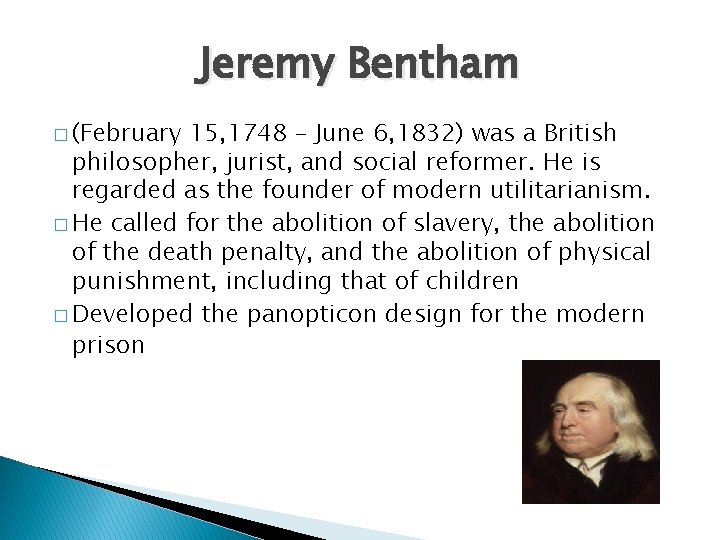
Jeremy Bentham � (February 15, 1748 – June 6, 1832) was a British philosopher, jurist, and social reformer. He is regarded as the founder of modern utilitarianism. � He called for the abolition of slavery, the abolition of the death penalty, and the abolition of physical punishment, including that of children � Developed the panopticon design for the modern prison
Panopticon Design � Allowed the prison guards to be able to look into the individual cells of every prisoner at will � Prisoner never knew when she was going to be watched and so had to monitor her own behavior and obey the rules � Because at any moment she might be observed
Panopticon Idea � Bentham's idea of the panopticon has been taken from the prison and applied in every domain of modern life as the principal technology by which power operates � It was copied in every other institution of modern life that developed in the same era Factory Immigration System Military barracks Hospitals Modern school Government Department
French Philosopher Michel Foucault � Michel Foucault born Paul-Michel Foucault (October 15, 1926 – June 25, 1984) was a French Philosopher, historian of ideas, social theorist, philologist and literary critic. His theories addressed the relationship between power and knowledge, and how they are used as a form of social control through societal institutions
Foucault � Foucault says the panopticon is a physical and social structure designed for the observation and regulation of its resident’s activities.
Teachers as the Objects of Power Relations � Teachers are in their cells observed and monitored by administrators, parents, politicians, and boards of education. � Teachers themselves are complicit in their own subordination and are left with limited opportunities for resistance
No Child Left Behind Act � NCLB exemplifies the current climate of externally constructed teacher accountability measure � Losing sight of those teachers who are doing a great job- and who could do an even better job in the absence of inappropriately constricting regulatory structures � Accountability Discourse- Presumes that without the state educational administrator’s establishing such controlling measures, teachers practice would be inadequate. We presume that external regulation of teachers is necessary because we cannot trust teachers to regulate themselves.
Panopticon of Surveillance � The daily activities of teachers, principals, and other school workers remain under close monitoring by school and nonschool-based persons and institutions. State education agencies, unions, parents, and citizens are only some of the groups who oversee the work of teachers.
Panopticon of Surveillance � Is there a need for teacher surveillance in elementary schools? (Yes/No role play). Can teachers be trusted to educate children without being closely monitored? Who would know or care?
Surveillance as Restricting � Surveillance restricts the power of school workers and constructs teaching as a semi-profession � Teachers who are externally monitored do not enjoy the decision making autonomy, collegial community, and trust characteristic of professionals � National study indicated that Catholic school teachers were more likely to be satisfied with their jobs because of the degree of autonomy despite getting paid less and larger class sizes
How are teachers being monitored?
Teacher Monitoring � � � Monitoring includes but is not limited to: Curricular Standards- which detail what shall be studied and when in public schools Pedagogy- Method of teaching. The use of curricular packages. “Teacher proof” materials script every interaction between teachers and students. One lesson will be precisely duplicated in multiple classrooms with no variation for the unique students or teacher in each classroom Standardized Tests- Justified by the discourse of accountability. Test scores put in newspapers (API scores online) School loud speakers- One way communication allows administrative personnel to interrupt classroom activities and secure the attention of everyone in the classroom.
Meek, 1998 �A work force of experienced, committed, well qualified teachers who find their work very satisfying and who enjoy the support of their principals and are reasonably comfortable with the resources provided for their work and the harmony they enjoy with their colleagues (Meek, 1998 p. 16) � Is this true of all teachers…
Refuting Meek, 1998 � Teachers are burnout and prematurely leave classrooms � One third of beginning New York teachers leave teaching within their first 5 years � Think � How about your own organizations has teaching changed since NCLB or in the last few years? (share)
Teaching as a Profession � Teachers are imagined and represented as decision makers and professionals, but their autonomy is limited. Teaching maybe a profession, but it can be considered “the profession that eats its young” (Halford, 1998 p. 33)
Knowledge-Power Relations � � Is there a hierarchy present among teachers? Certain teachers particularly those who are male involved in the sciences, teaching wealthy students from elite schools operate within a discourse of greater power and authority. A physics teacher from an elite high school is regarded as a greater educational and intellectual authority than a female public school teacher in the Bronx Why is this so? What makes one better than the other? Can this discourse be changed? Does money talk? (Discussion)
Social Reproduction � Teachers are passive participants in systems of power, which occurs with both the willing compliance and the active refusal of its own victim. � Panopticon participants engage in behaviors that maintain their subservient status.
Resistance � Teachers � Unions resist individually and collectively are their primary form of collective resistance � Union efforts have been hampered by accusations of communist activity and underdeveloped labor movement in the United States � Water cooler discourse-Teachers complaining about their lack of autonomy, decision making, and authority that did not evolve into action � Resistance enables transformation in society (*&%$# no we won’t go! Civil Rights Movement)
Complicity and Constraint � Teachers choosing to ignore the implications of surveillance and conduct their work within the prescribe limitations and not disrupting the system. � Gender assumptions-Female teachers are answering to the authority of mostly male administrators. � The system institutionalized (Discussion).
Professionalization in Education � Is framed in gendered terms as embodying male authority, privilege, and control over women’s work in teaching (Weiler, 1998 p. 80) � The authority structure remains consistent and is often embedded in teachers themselves. � Ex. Ralph Ellison on the complicity of African American in their own discrimination during the Jim Crow era; Three general ways they confronted their destiny 1. accept it through hope and religion 2. Repress their dislike 3. Reject the situation,
Continuing to Rethink Professionalism � Teachers should actively construct resistance through developing the practice of questioning to become “awake” to the social construction of their work- and therefore the possibility of altering that construction (Greene, 1978)
Conclusion
Reference � Bushnell, M. “Teachers in the Schoolhouse Panopticon: Complicity and Resistance” (2003). Education and Urban society, http: //eus. sagepub. com/content/35/3/251