
Teacher Leadership What do we know so far




- Slides: 17
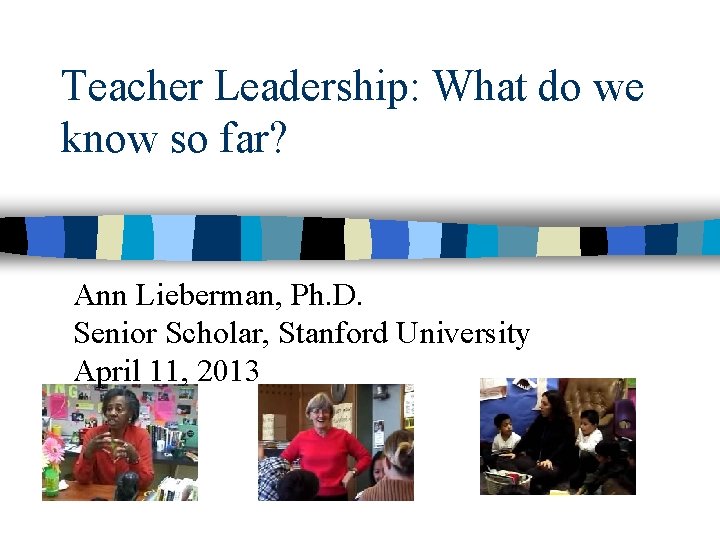
Teacher Leadership: What do we know so far? Ann Lieberman, Ph. D. Senior Scholar, Stanford University April 11, 2013
WHY TEACHER LEADERSHIP? AND WHY NOW? * CHANGES IN THE WORLD * CHALLENGES FOR SCHOOLS * TEACHER LEADERS CAN MAKE THE DIFFERENCE
GLOBALIZATION: CHALLENGES FOR SCHOOLS Teaching to learning n Passive to active involvement n Rote to teaching for understanding n Solo artisans to members of a professional community n Anecdotes to evidence n Aligning policies with practices n
Learning in Practice n n n n Schon’s reflective practice Making the private public Making implicit-explicit Wenger’s “communities of practice” Learning as social participation Learning as discovering meaning Learning as identity
Learning to Lead in a Network The Social Practices of the NWP • Approaching each colleague as a potentially valuable contributor • Honoring teacher knowledge. • Creating public forums for teacher sharing, dialog, and critique. • Turning ownership over to learners
Social Practices (Cont’d) Situating human learning in practice and relationships. • Providing multiple entry points in the learning community. • Guiding reflection on teaching through reflection on learning. • Sharing leadership. •
Social Practices (Cont’d) • Promoting a stance of inquiry. • Reconceptualizing professional identity and linking it to professional community.
Learning to Lead through Teacher Scholarship Yvonne’s website Joan’s website Sarah's website
Learning from Teacher Consultants: Vignettes on Leadership Learning Leadership: Acquiring an identity n Learning to handle conflict: Making it productive n Learning to develop collaboration and community n Learning from practice: Reflecting on old and new knowledge. n
Learning from Mentors as Teacher Leaders n Building a new identity n Developing trusting relationships n Accelerating teacher development n Mentoring in challenging contexts n Learning leadership skills
Learning from the Teacher Learning and Leadership Program (TLLP) n Promoting trust and cooperation between government and unions n Teachers teaching teachers n Growing teacher leaders n Building community rather than compliance n Joining practice, research and enabling policy
TLLP STUDY RESULTS n Teacher led, self directed unique & vital. n Knowledge exchange clearly advanced as 85% worked with another person or team. n Huge benefits in teacher learning, leadership, spreading practices, small budgets. n Teachers felt professionally valued.
Teachers who lead: n Become inquirers into their own practice n Provide leadership through their example of becoming lifelong learners n Take risks by expanding their own comfort zones. n Inspire their peers through a continual struggle to improve their practice.
Teachers who lead (Cont’d) n Work hard expanding their own knowledge base. n Organize novice and veteran teachers into communities of support n Care about the content and character of colleagueship as well as the content of the curriculum n Understand that learning the culture is a critical part of leadership
Teachers who lead (Cont’d) n Go public with their understandings of students; strategies for student learning and the organization of curriculum. n Pursue working with their peers despite sometimes negative responses. n Lead in different ways - both formally and informally
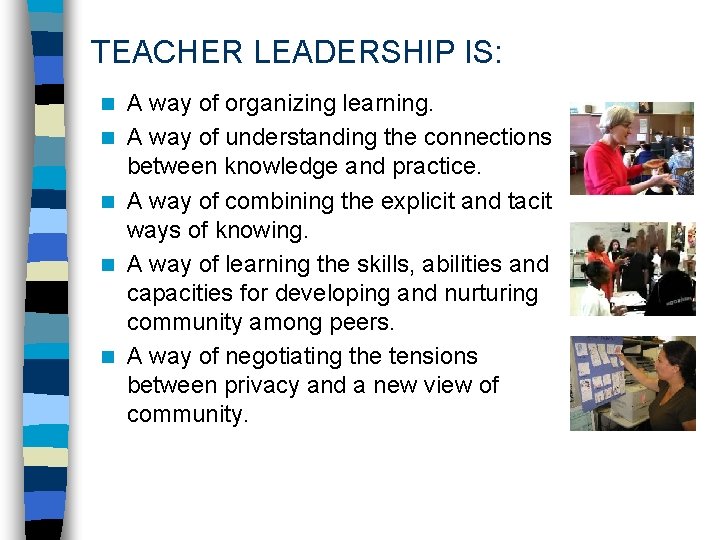
TEACHER LEADERSHIP IS: n n n A way of organizing learning. A way of understanding the connections between knowledge and practice. A way of combining the explicit and tacit ways of knowing. A way of learning the skills, abilities and capacities for developing and nurturing community among peers. A way of negotiating the tensions between privacy and a new view of community.