
Teacher Aurora Comis 1 Content Culture The 4


- Slides: 31
Teacher: Aurora Comis 1
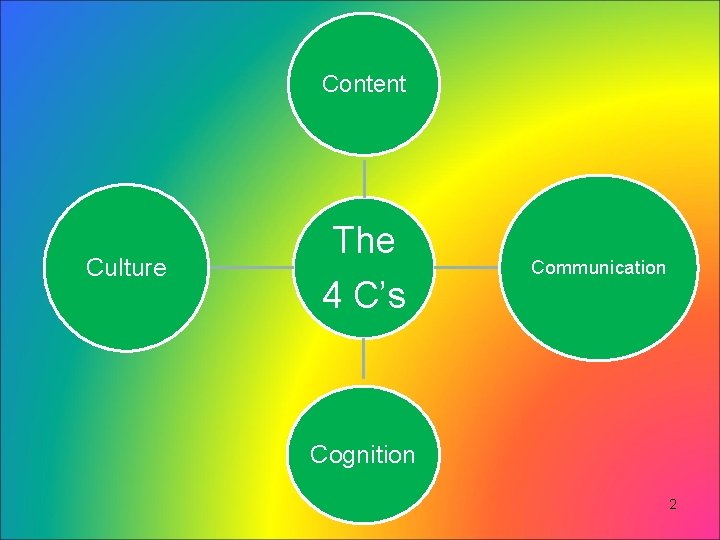
Content Culture The 4 C’s Communication Cognition 2
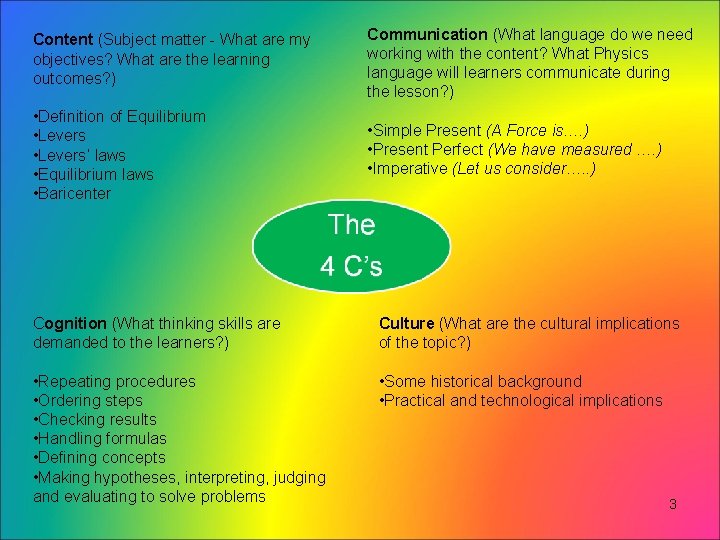
Content (Subject matter - What are my objectives? What are the learning outcomes? ) Communication (What language do we need working with the content? What Physics language will learners communicate during the lesson? ) • Definition of Equilibrium • Levers’ laws • Equilibrium laws • Baricenter • Simple Present (A Force is…. ) • Present Perfect (We have measured …. ) • Imperative (Let us consider…. . ) Cognition (What thinking skills are demanded to the learners? ) Culture (What are the cultural implications of the topic? ) • Repeating procedures • Ordering steps • Checking results • Handling formulas • Defining concepts • Making hypotheses, interpreting, judging and evaluating to solve problems • Some historical background • Practical and technological implications 3
Static equilibrium is a term used in physics to describe a situation in which the total forces acting on an object at rest add up to zero. In other words, the forces pulling the object in different directions balance out, causing the object to remain motionless. For an object to be in static equilibrium, it must also be in translational equilibrium and in rotational equilibrium, meaning that the external forces and external torques acting on the object must sum up to exactly zero. In a case of static equilibrium, forces are acting on an object, but the vector sum of all forces acting on that object is zero. This means that opposing vectors cancel each other out exactly, resulting in zero net force on the object. Although forces are present, the object remains motionless. 4
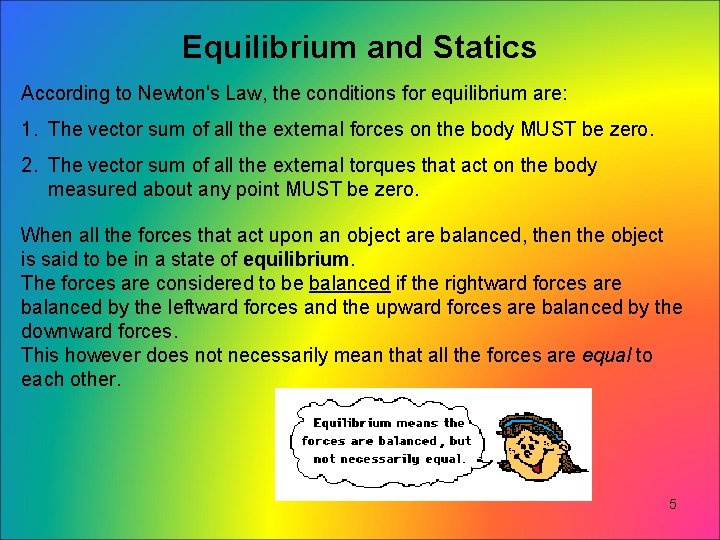
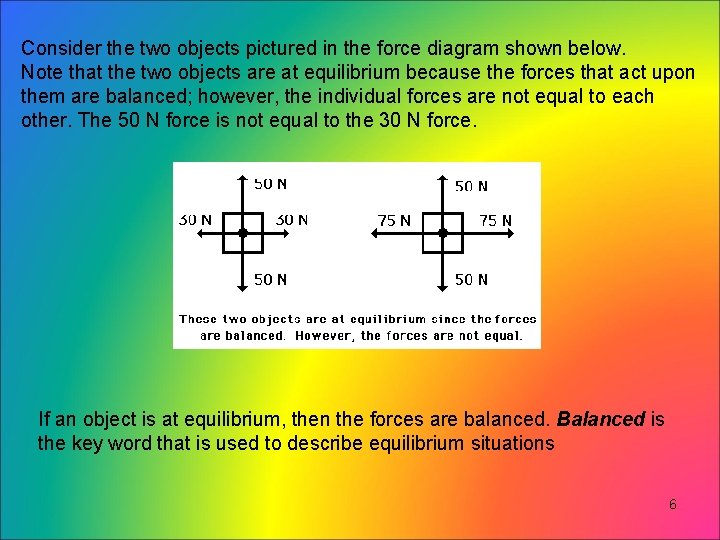
Equilibrium and Statics According to Newton's Law, the conditions for equilibrium are: 1. The vector sum of all the external forces on the body MUST be zero. 2. The vector sum of all the external torques that act on the body measured about any point MUST be zero. When all the forces that act upon an object are balanced, then the object is said to be in a state of equilibrium. The forces are considered to be balanced if the rightward forces are balanced by the leftward forces and the upward forces are balanced by the downward forces. This however does not necessarily mean that all the forces are equal to each other. 5
Consider the two objects pictured in the force diagram shown below. Note that the two objects are at equilibrium because the forces that act upon them are balanced; however, the individual forces are not equal to each other. The 50 N force is not equal to the 30 N force. If an object is at equilibrium, then the forces are balanced. Balanced is the key word that is used to describe equilibrium situations 6
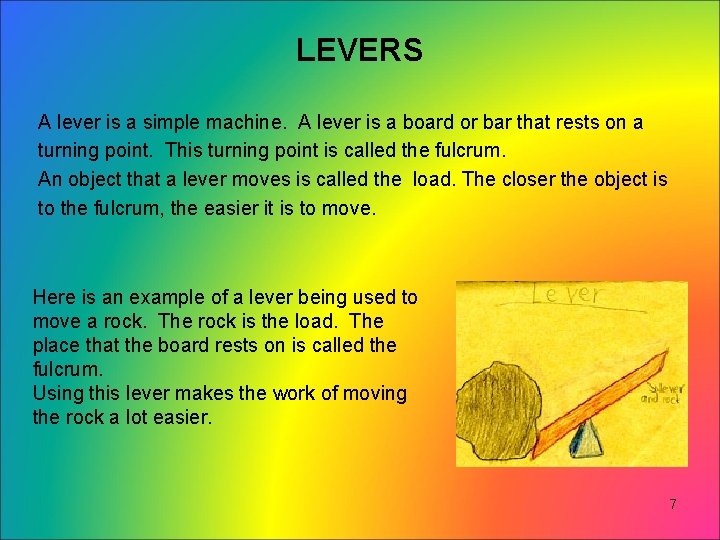
LEVERS A lever is a simple machine. A lever is a board or bar that rests on a turning point. This turning point is called the fulcrum. An object that a lever moves is called the load. The closer the object is to the fulcrum, the easier it is to move. Here is an example of a lever being used to move a rock. The rock is the load. The place that the board rests on is called the fulcrum. Using this lever makes the work of moving the rock a lot easier. 7
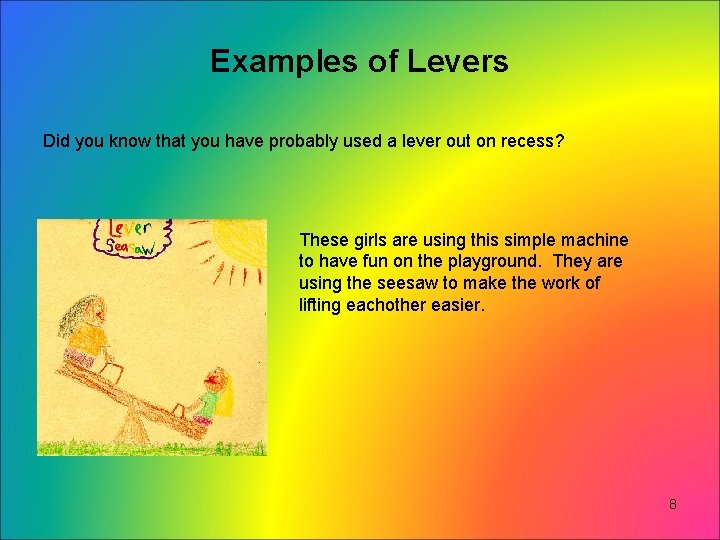
Examples of Levers Did you know that you have probably used a lever out on recess? These girls are using this simple machine to have fun on the playground. They are using the seesaw to make the work of lifting eachother easier. 8
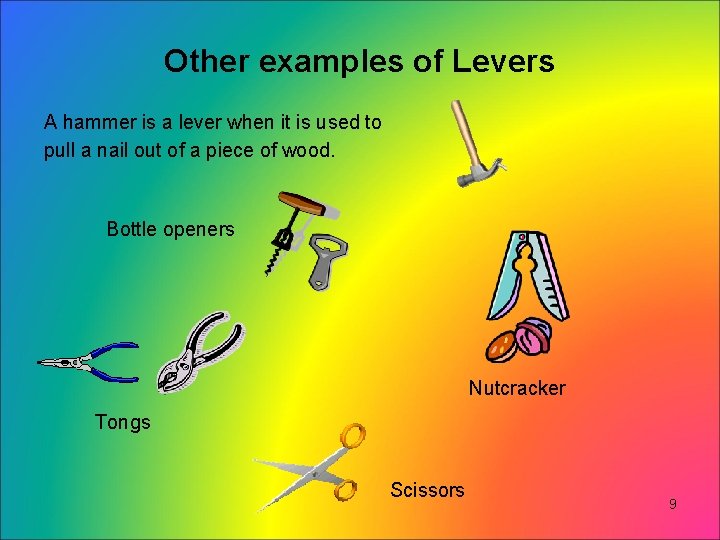
Other examples of Levers A hammer is a lever when it is used to pull a nail out of a piece of wood. Bottle openers Nutcracker Tongs Scissors 9
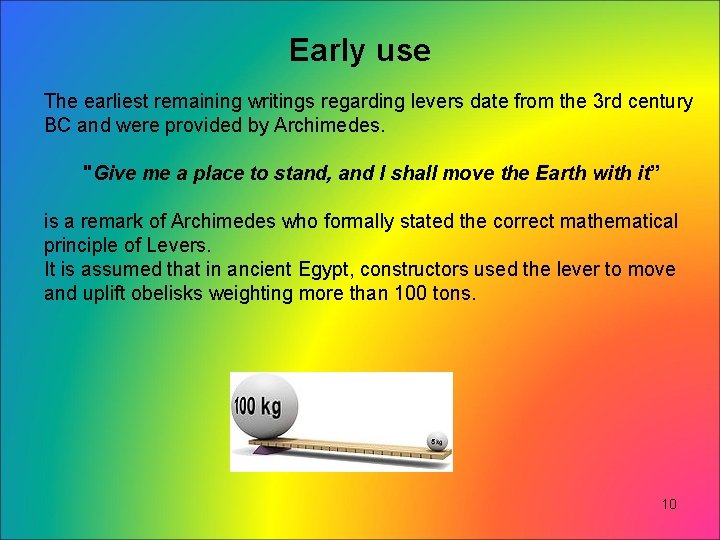
Early use The earliest remaining writings regarding levers date from the 3 rd century BC and were provided by Archimedes. "Give me a place to stand, and I shall move the Earth with it” is a remark of Archimedes who formally stated the correct mathematical principle of Levers. It is assumed that in ancient Egypt, constructors used the lever to move and uplift obelisks weighting more than 100 tons. 10
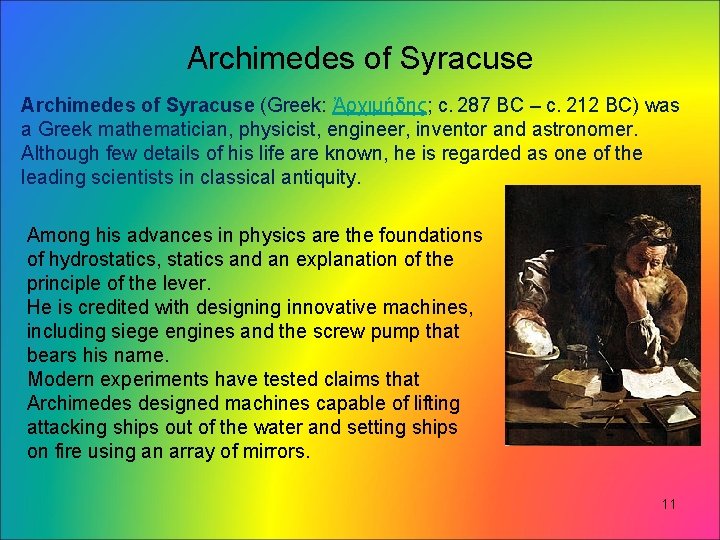
Archimedes of Syracuse (Greek: Ἀρχιμήδης; c. 287 BC – c. 212 BC) was a Greek mathematician, physicist, engineer, inventor and astronomer. Although few details of his life are known, he is regarded as one of the leading scientists in classical antiquity. Among his advances in physics are the foundations of hydrostatics, statics and an explanation of the principle of the lever. He is credited with designing innovative machines, including siege engines and the screw pump that bears his name. Modern experiments have tested claims that Archimedes designed machines capable of lifting attacking ships out of the water and setting ships on fire using an array of mirrors. 11
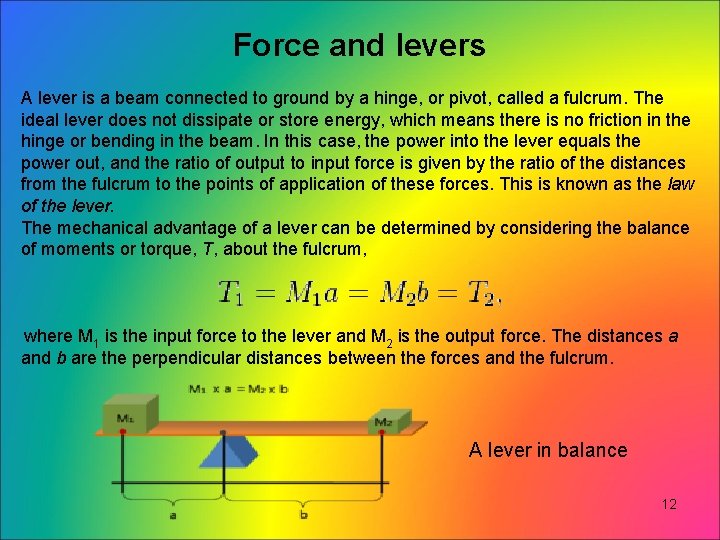
Force and levers A lever is a beam connected to ground by a hinge, or pivot, called a fulcrum. The ideal lever does not dissipate or store energy, which means there is no friction in the hinge or bending in the beam. In this case, the power into the lever equals the power out, and the ratio of output to input force is given by the ratio of the distances from the fulcrum to the points of application of these forces. This is known as the law of the lever. The mechanical advantage of a lever can be determined by considering the balance of moments or torque, T, about the fulcrum, where M 1 is the input force to the lever and M 2 is the output force. The distances a and b are the perpendicular distances between the forces and the fulcrum. A lever in balance 12
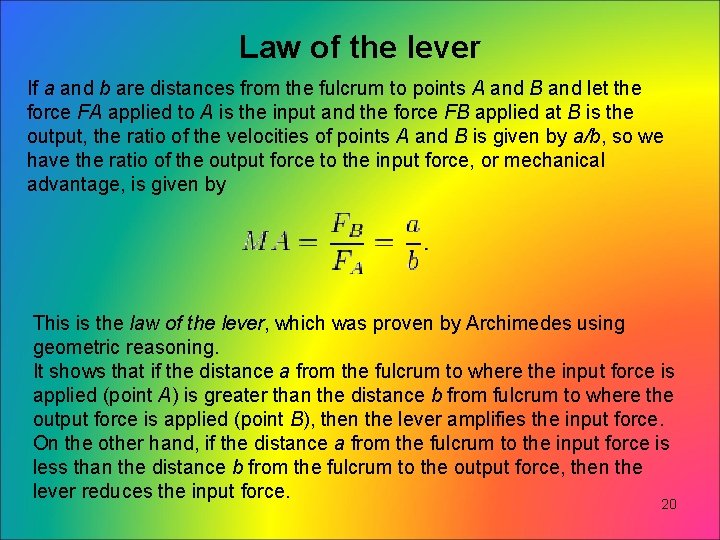
The law of the lever The mechanical advantage of the lever is the ratio of output force to input force, This relationship shows that the mechanical advantage can be computed from ratio of the distances from the fulcrum towhere the input and output forces are applied to the lever. 13
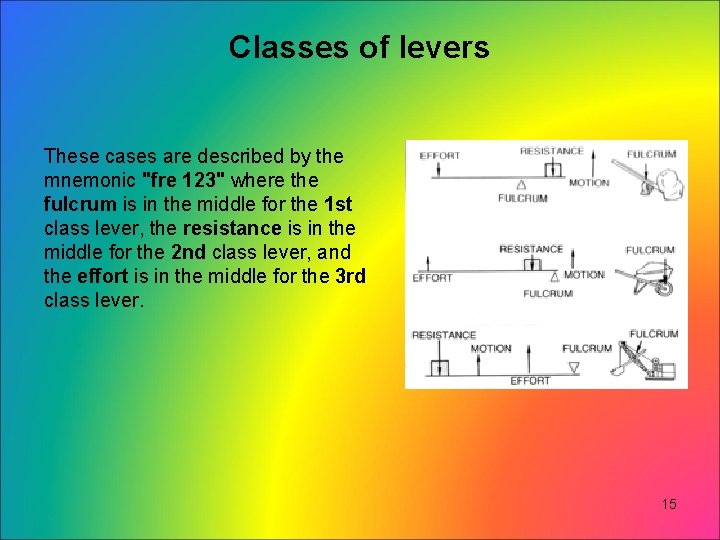
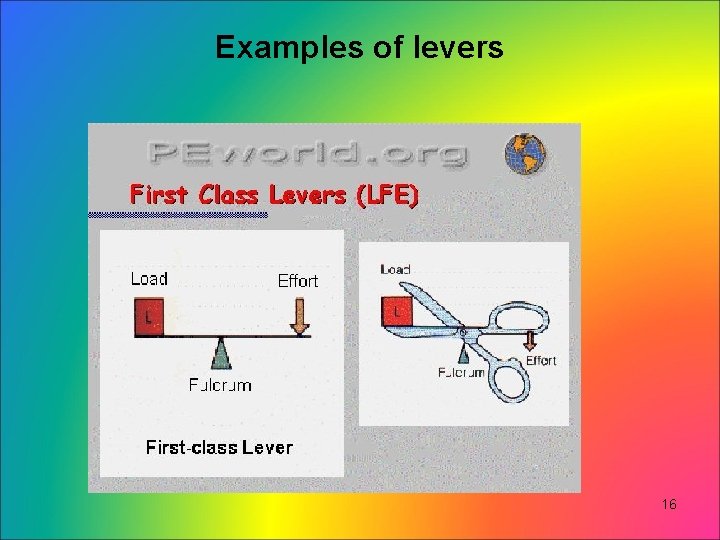
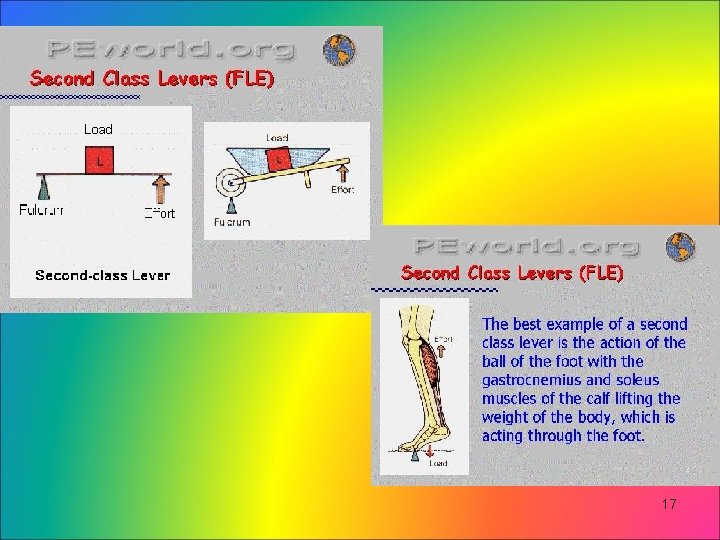
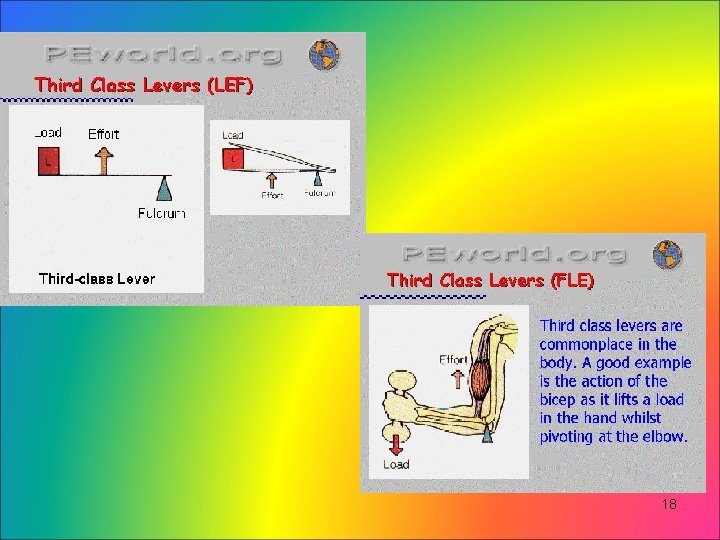
Classes of levers Levers are classified by the relative positions of the fulcrum and the input and output forces. It is common to call the input force the effort and the output force the load or the resistance. This allows the identification of three classes of levers by the relative locations of the fulcrum, the resistance and the effort. Class 1: Fulcrum in the middle: the effort is applied on one side of the fulcrum and the resistance on the other side for example, a crowbar or a pair of scissors. Class 2: Resistance in the middle: the effort is applied on one side of the resistance and the fulcrum is located on the other side for example, a wheelbarrow, a nutcracker, a bottle opener or the brake pedal of a car. Class 3: Effort in the middle: the resistance is on one side of the effort and the fulcrum is located on the other side for example, a pair of tweezers or the human mandible. 14
Classes of levers These cases are described by the mnemonic "fre 123" where the fulcrum is in the middle for the 1 st class lever, the resistance is in the middle for the 2 nd class lever, and the effort is in the middle for the 3 rd class lever. 15
Examples of levers 16
17
18
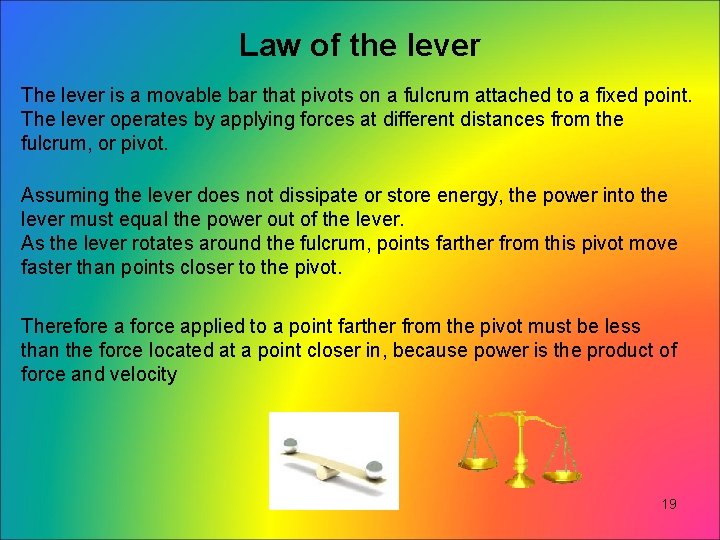
Law of the lever The lever is a movable bar that pivots on a fulcrum attached to a fixed point. The lever operates by applying forces at different distances from the fulcrum, or pivot. Assuming the lever does not dissipate or store energy, the power into the lever must equal the power out of the lever. As the lever rotates around the fulcrum, points farther from this pivot move faster than points closer to the pivot. Therefore a force applied to a point farther from the pivot must be less than the force located at a point closer in, because power is the product of force and velocity 19
Law of the lever If a and b are distances from the fulcrum to points A and B and let the force FA applied to A is the input and the force FB applied at B is the output, the ratio of the velocities of points A and B is given by a/b, so we have the ratio of the output force to the input force, or mechanical advantage, is given by This is the law of the lever, which was proven by Archimedes using geometric reasoning. It shows that if the distance a from the fulcrum to where the input force is applied (point A) is greater than the distance b from fulcrum to where the output force is applied (point B), then the lever amplifies the input force. On the other hand, if the distance a from the fulcrum to the input force is less than the distance b from the fulcrum to the output force, then the lever reduces the input force. 20
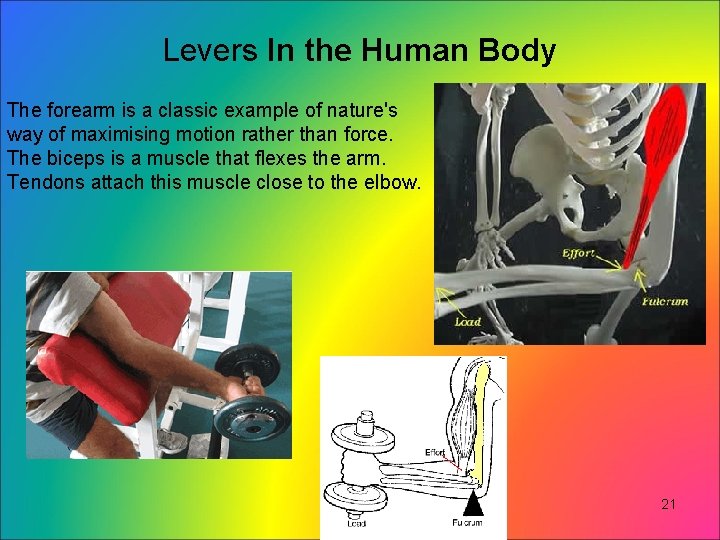
Levers In the Human Body The forearm is a classic example of nature's way of maximising motion rather than force. The biceps is a muscle that flexes the arm. Tendons attach this muscle close to the elbow. 21
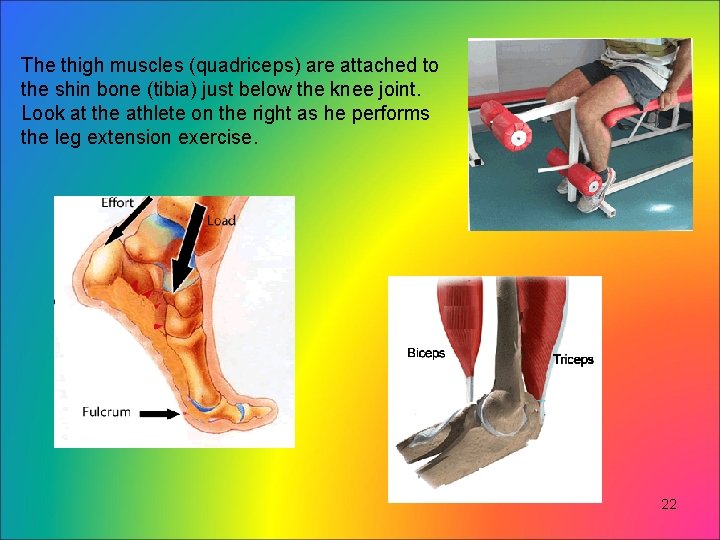
The thigh muscles (quadriceps) are attached to the shin bone (tibia) just below the knee joint. Look at the athlete on the right as he performs the leg extension exercise. 22
Center of gravity In Physics, the centre of gravity, or the center of mass, or barycenter, is an imaginary point in a body of matter where, for convenience in certain calculations, the total weight of the body may be thought to be concentrated. We can say that the center of gravity of a body is the point of application of the weight force In the case of a single rigid body, the center of mass is fixed in relation to the body, and if the body has uniform density, it will be located at the centroid. The center of mass may be located outside the physical body, as is sometimes the case for hollow or open-shaped objects, such as a horseshoe. In the case of a distribution of separate bodies, such as the planets of the Solar Sistem, the center of mass may not correspond to the position of any individual member of the system. 23
Locating the center of mass The location of a body’s centre of gravity may coincide with the geometric centre of the body, especially in a symmetrically shaped object composed of homogeneous material. An asymmetrical object composed of a variety of materials with different masses, however, is likely to have a centre of gravity located at some distance from its geometric centre. In some cases, such as hollow bodies or irregularly shaped objects, the centre of gravity (or centre of mass) may occur in space at a point external to the physical material—e. g. , in the centre of a tennis ball or between the legs of a chair. 24
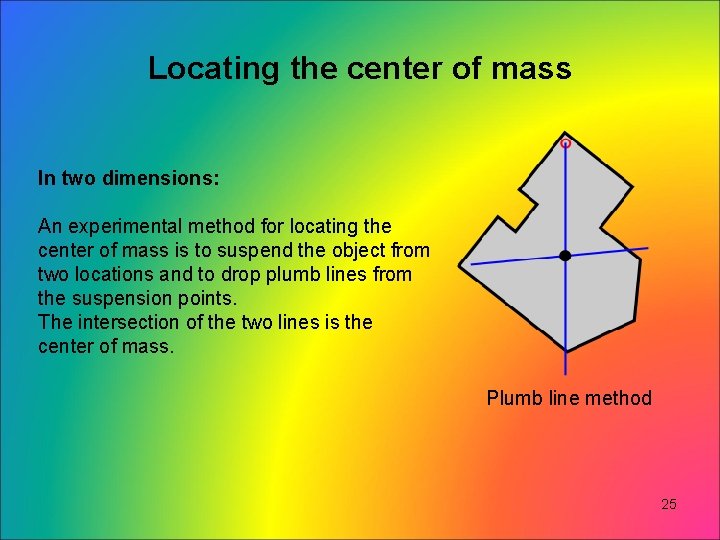
Locating the center of mass In two dimensions: An experimental method for locating the center of mass is to suspend the object from two locations and to drop plumb lines from the suspension points. The intersection of the two lines is the center of mass. Plumb line method 25
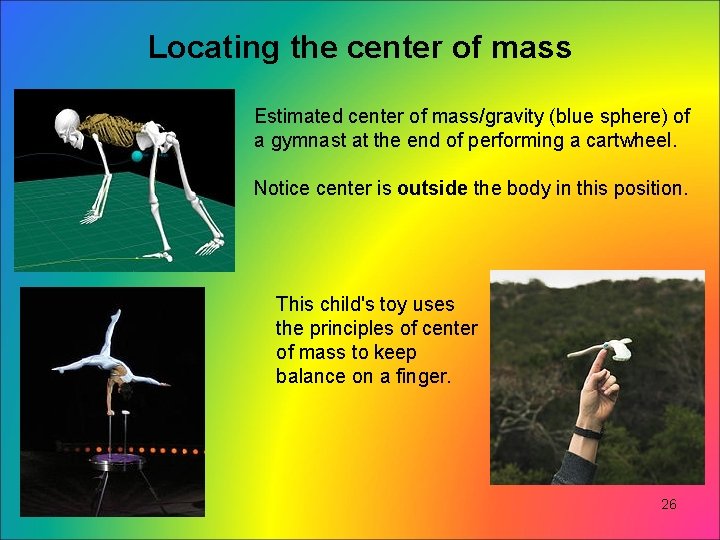
Locating the center of mass Estimated center of mass/gravity (blue sphere) of a gymnast at the end of performing a cartwheel. Notice center is outside the body in this position. This child's toy uses the principles of center of mass to keep balance on a finger. 26
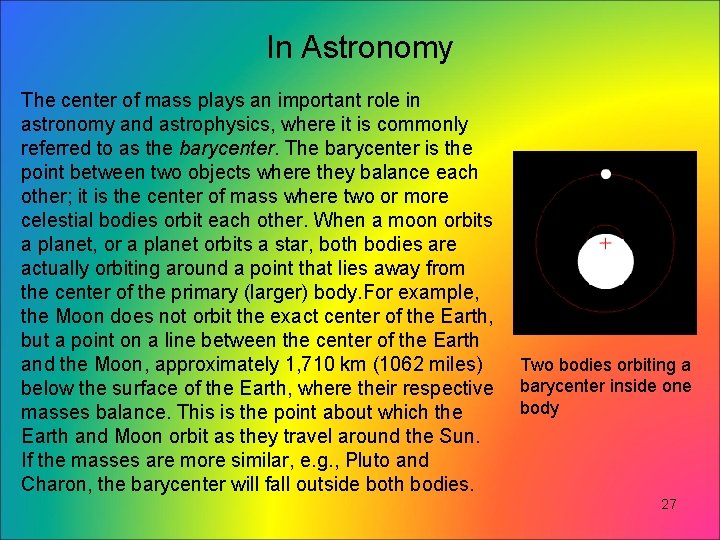
In Astronomy The center of mass plays an important role in astronomy and astrophysics, where it is commonly referred to as the barycenter. The barycenter is the point between two objects where they balance each other; it is the center of mass where two or more celestial bodies orbit each other. When a moon orbits a planet, or a planet orbits a star, both bodies are actually orbiting around a point that lies away from the center of the primary (larger) body. For example, the Moon does not orbit the exact center of the Earth, but a point on a line between the center of the Earth and the Moon, approximately 1, 710 km (1062 miles) below the surface of the Earth, where their respective masses balance. This is the point about which the Earth and Moon orbit as they travel around the Sun. If the masses are more similar, e. g. , Pluto and Charon, the barycenter will fall outside both bodies. Two bodies orbiting a barycenter inside one body 27
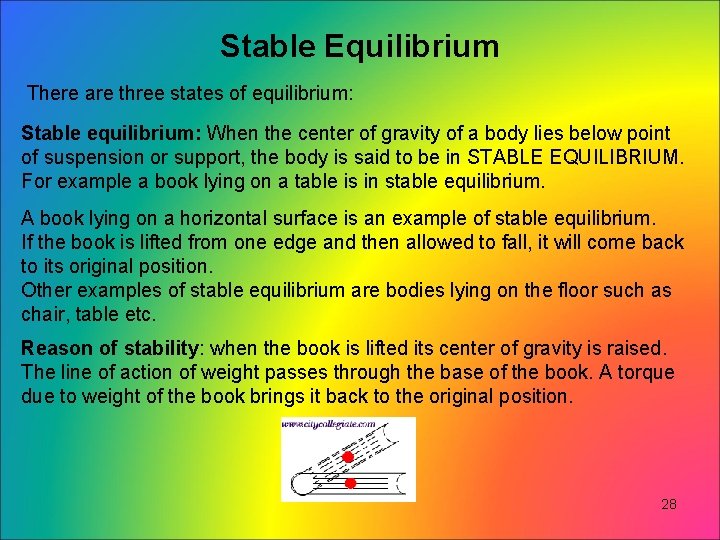
Stable Equilibrium There are three states of equilibrium: Stable equilibrium: When the center of gravity of a body lies below point of suspension or support, the body is said to be in STABLE EQUILIBRIUM. For example a book lying on a table is in stable equilibrium. A book lying on a horizontal surface is an example of stable equilibrium. If the book is lifted from one edge and then allowed to fall, it will come back to its original position. Other examples of stable equilibrium are bodies lying on the floor such as chair, table etc. Reason of stability: when the book is lifted its center of gravity is raised. The line of action of weight passes through the base of the book. A torque due to weight of the book brings it back to the original position. 28
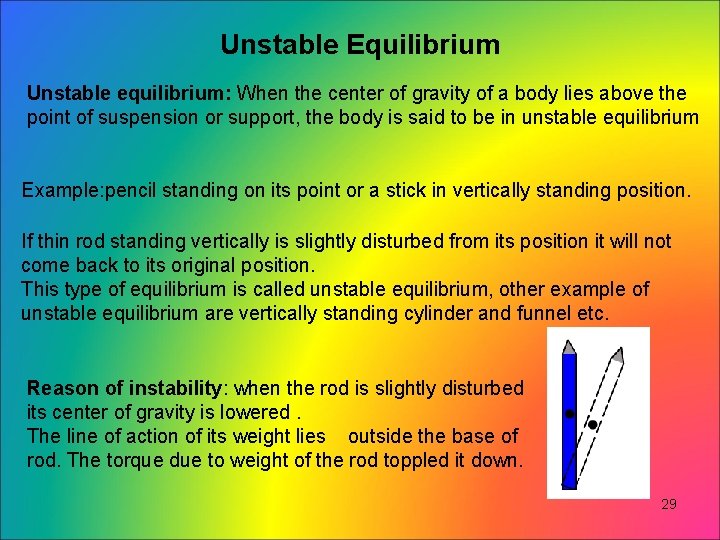
Unstable Equilibrium Unstable equilibrium: When the center of gravity of a body lies above the point of suspension or support, the body is said to be in unstable equilibrium Example: pencil standing on its point or a stick in vertically standing position. If thin rod standing vertically is slightly disturbed from its position it will not come back to its original position. This type of equilibrium is called unstable equilibrium, other example of unstable equilibrium are vertically standing cylinder and funnel etc. Reason of instability: when the rod is slightly disturbed its center of gravity is lowered. The line of action of its weight lies outside the base of rod. The torque due to weight of the rod toppled it down. 29
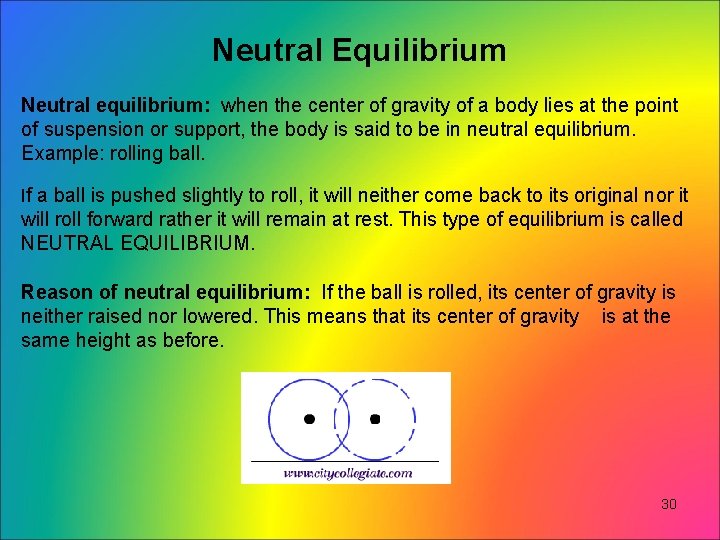
Neutral Equilibrium Neutral equilibrium: when the center of gravity of a body lies at the point of suspension or support, the body is said to be in neutral equilibrium. Example: rolling ball. If a ball is pushed slightly to roll, it will neither come back to its original nor it will roll forward rather it will remain at rest. This type of equilibrium is called NEUTRAL EQUILIBRIUM. Reason of neutral equilibrium: If the ball is rolled, its center of gravity is neither raised nor lowered. This means that its center of gravity is at the same height as before. 30
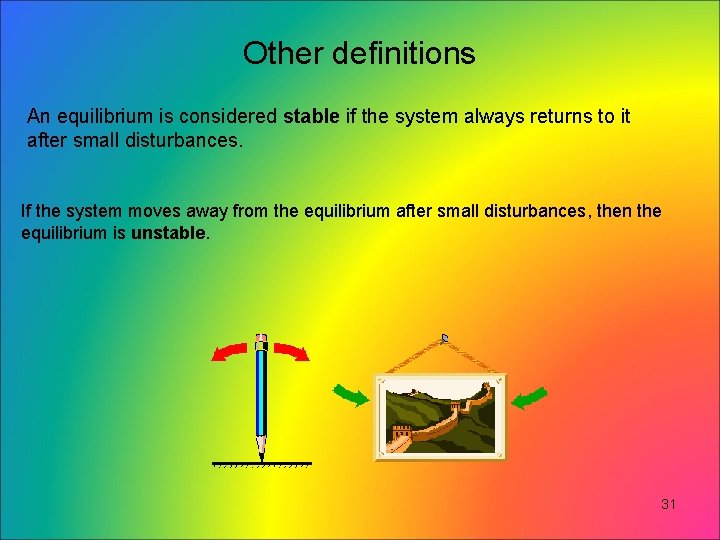
Other definitions An equilibrium is considered stable if the system always returns to it after small disturbances. If the system moves away from the equilibrium after small disturbances, then the equilibrium is unstable. 31