
Teach Like a Champion Establishing positive behavior and
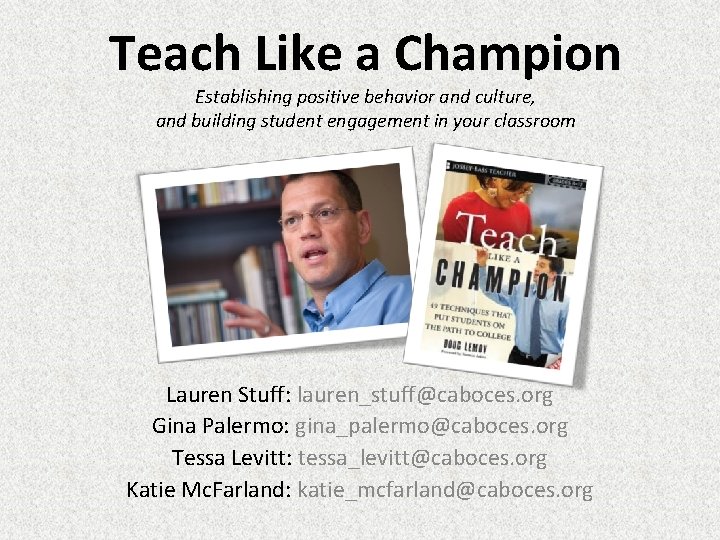
Teach Like a Champion Establishing positive behavior and culture, and building student engagement in your classroom Lauren Stuff: lauren_stuff@caboces. org Gina Palermo: gina_palermo@caboces. org Tessa Levitt: tessa_levitt@caboces. org Katie Mc. Farland: katie_mcfarland@caboces. org
-Agenda for the Day. Morning Afternoon TLa. C Background Info Strong Voice Systems and Routines Format Matters Check for Understanding Everybody Writes Action Planning Joy Factor Action Planning
What Will I Walk Away With? Objectives: • Learn and practice techniques associated with improving classroom behavior and culture, and engaging students in their academics • Take action to plan ways to begin implementing these techniques in the classroom NYS Teaching Standards Addressed in this workshop: Standard I: Knowledge of Students & Student Learning Standard IV: Learning Environment Standard VII: Professional Growth
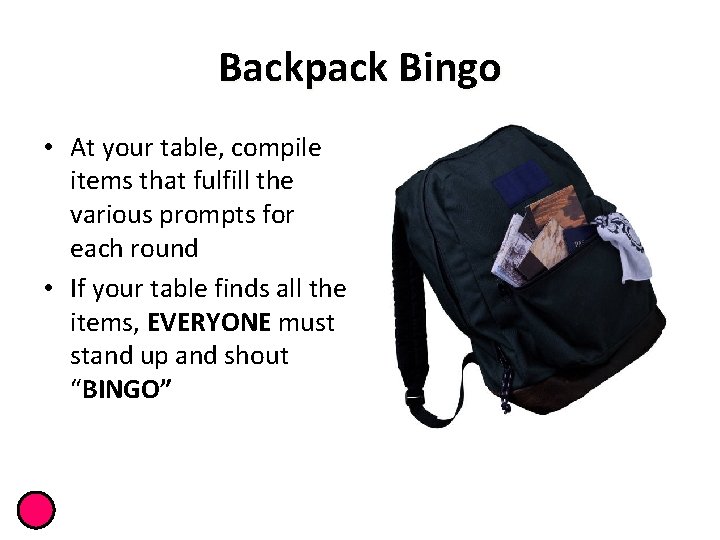
Backpack Bingo • At your table, compile items that fulfill the various prompts for each round • If your table finds all the items, EVERYONE must stand up and shout “BINGO”
Round 1: • A book you are reading (for pleasure or for purpose) • Something you would NEVER give away • Something you would GLADLY give away • Something that has been in your bag for OVER a year
Round 2: • Something that you are currently using in your classroom • Something that you took from a student, and have yet to give back… • Something you use EVERYDAY and can’t live without • Something that was a gift to you
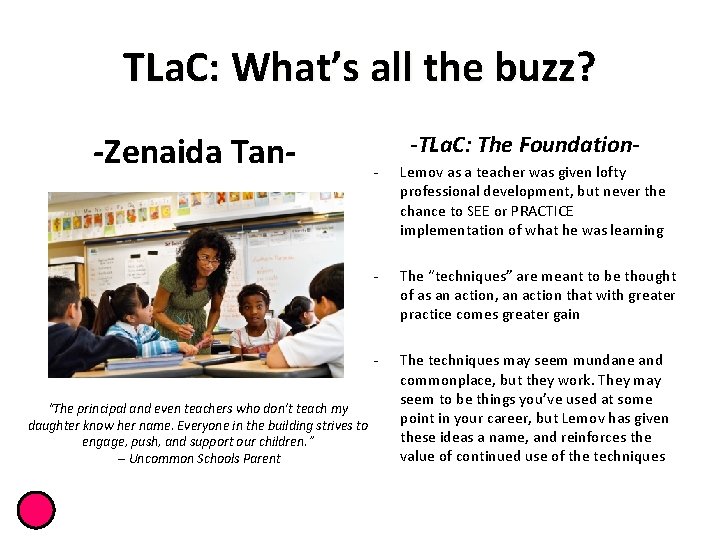
TLa. C: What’s all the buzz? -Zenaida Tan- “The principal and even teachers who don’t teach my daughter know her name. Everyone in the building strives to engage, push, and support our children. ” – Uncommon Schools Parent -TLa. C: The Foundation- Lemov as a teacher was given lofty professional development, but never the chance to SEE or PRACTICE implementation of what he was learning - The “techniques” are meant to be thought of as an action, an action that with greater practice comes greater gain - The techniques may seem mundane and commonplace, but they work. They may seem to be things you’ve used at some point in your career, but Lemov has given these ideas a name, and reinforces the value of continued use of the techniques

-Tight Transitions No time to waste! Creating a Strong Classroom Culture -p. 154 in TLa. C text-
What makes up “Systems and Routines”? Effective procedures minimize disruptions and maximize instructional time. Strive for consistency and efficiency so students can focus on classroom activities. • • • Quick is King Low Narration Plan What You Want No Interruptions Systemize Culture Shared Ownership
Watch and Learn While watching, take note of the components of tight transitions that the teacher addresses. • How long does it take to pass out papers in a typical classroom? • On average, how many times a day do teachers have to pass out papers or materials? Clip Marisa Segal “Fastest We’ve Done” 6 th grade What rules of systems and routines does Ms. Segal follow as she practices with her class?
Time to Practice!
Check for Understanding 1. 0 Just as good drivers check their mirrors every five seconds so they constantly know what is going on around them, teachers should constantly check for understanding! Structuring and Delivering Your Lessons -p. 97 in TLa. C text-
What makes up “Check for Understanding 1. 0”? Checking for Understanding 1. 0 means intentionally gathering data and acting on it. The second part is harder to do and at least as important! CFU = Gather Data + Act On It Now There are two methods for gathering your data: 1. Via Questions 2. Via Observation
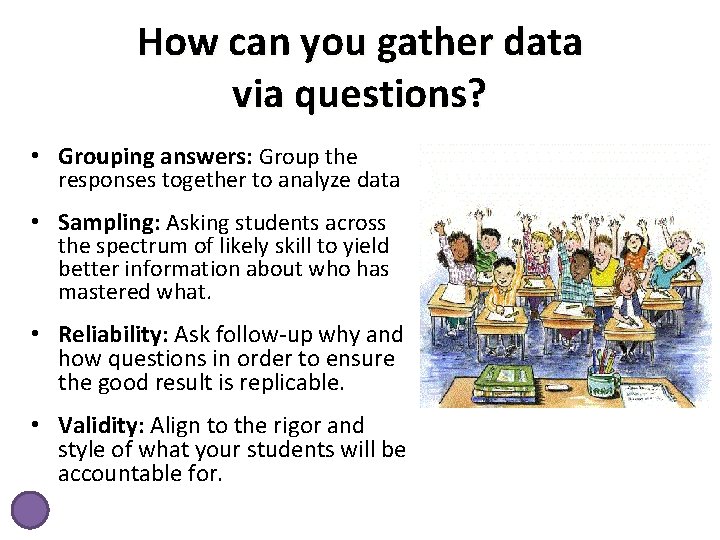
How can you gather data via questions? • Grouping answers: Group the responses together to analyze data • Sampling: Asking students across the spectrum of likely skill to yield better information about who has mastered what. • Reliability: Ask follow-up why and how questions in order to ensure the good result is replicable. • Validity: Align to the rigor and style of what your students will be accountable for.
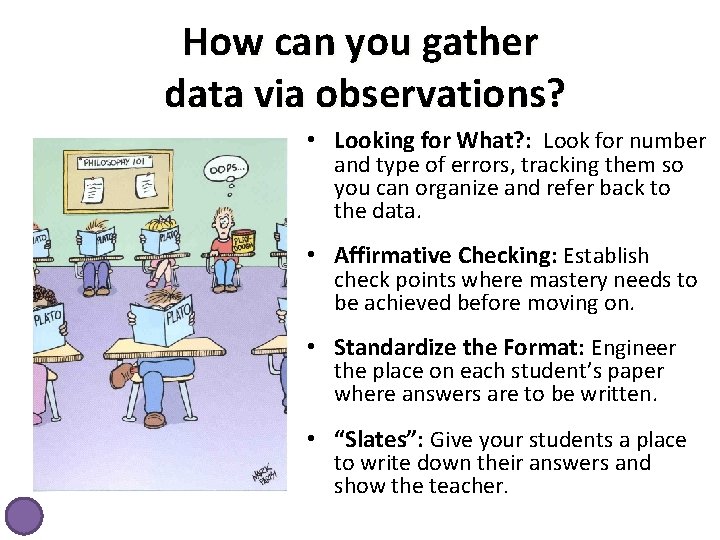
How can you gather data via observations? • Looking for What? : Look for number and type of errors, tracking them so you can organize and refer back to the data. • Affirmative Checking: Establish check points where mastery needs to be achieved before moving on. • Standardize the Format: Engineer the place on each student’s paper where answers are to be written. • “Slates”: Give your students a place to write down their answers and show the teacher.
Watch and Learn While watching, take note of the components of Check for Understanding that the teacher addresses. Clip Bob Zimmereli, “Here’s the deal” 7 th grade Think-Pair-Share: 2 minutes • How does Bob structure his lesson materials to Check for Understanding and what is effective about the way he implements his check for understanding? • How does he approach re-teaching? • 3: 30 – 3 minutes setting up expectations, 30 second interactions with students during independent work, 30 seconds surveying the room before going to work with another student for 30 seconds.
Check for Understanding 2. 0 Its OK not to know, but it’s not OK not to try! Structuring and Delivering Your Lessons -p. 97 in TLa. C text-
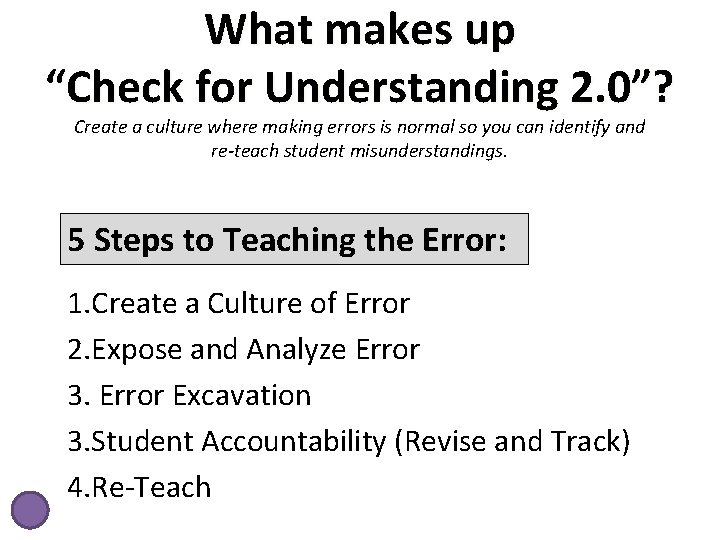
What makes up “Check for Understanding 2. 0”? Create a culture where making errors is normal so you can identify and re-teach student misunderstandings. 5 Steps to Teaching the Error: 1. Create a Culture of Error 2. Expose and Analyze Error 3. Error Excavation 3. Student Accountability (Revise and Track) 4. Re-Teach
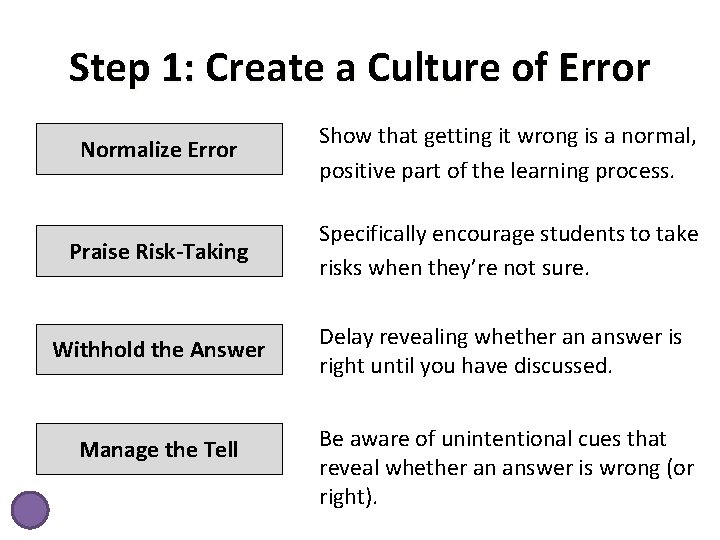
Step 1: Create a Culture of Error Normalize Error Show that getting it wrong is a normal, positive part of the learning process. Praise Risk-Taking Specifically encourage students to take risks when they’re not sure. Withhold the Answer Manage the Tell Delay revealing whether an answer is right until you have discussed. Be aware of unintentional cues that reveal whether an answer is wrong (or right).
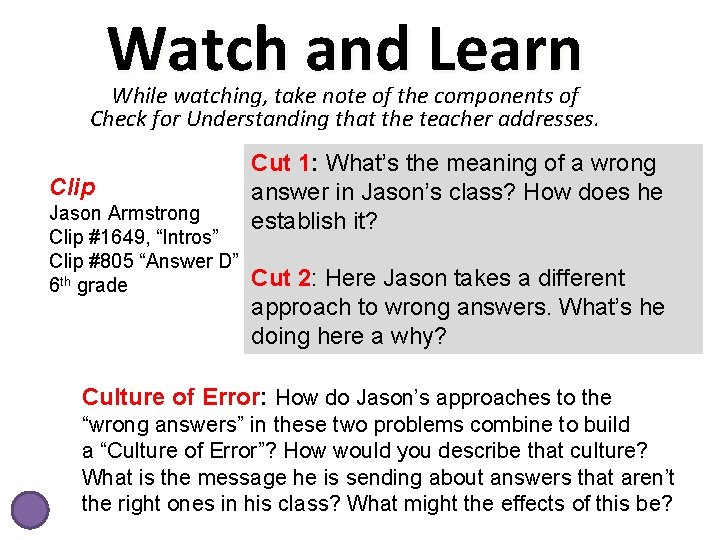
Watch and Learn While watching, take note of the components of Check for Understanding that the teacher addresses. Clip Jason Armstrong Clip #1649, “Intros” Clip #805 “Answer D” 6 th grade Cut 1: What’s the meaning of a wrong answer in Jason’s class? How does he establish it? Cut 2: Here Jason takes a different approach to wrong answers. What’s he doing here a why? Culture of Error: How do Jason’s approaches to the “wrong answers” in these two problems combine to build a “Culture of Error”? How would you describe that culture? What is the message he is sending about answers that aren’t the right ones in his class? What might the effects of this be?
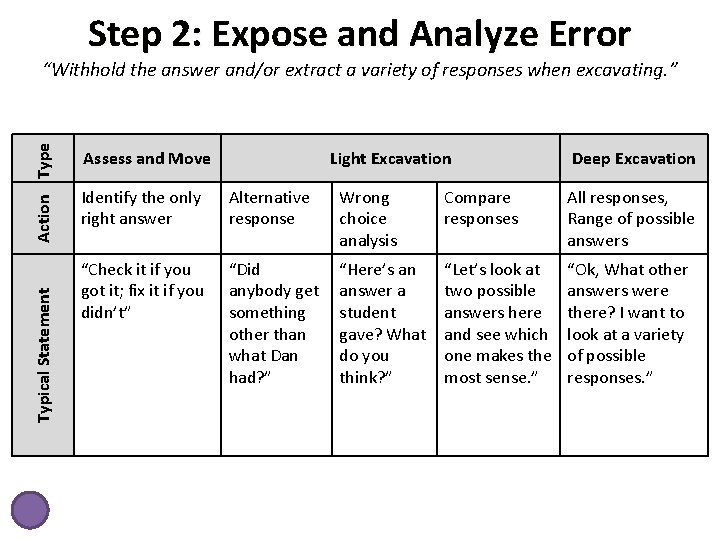
Step 2: Expose and Analyze Error Typical Statement Action Type “Withhold the answer and/or extract a variety of responses when excavating. ” Assess and Move Light Excavation Deep Excavation Identify the only right answer Alternative response Wrong choice analysis Compare responses All responses, Range of possible answers “Check it if you got it; fix it if you didn’t” “Did anybody get something other than what Dan had? ” “Here’s an answer a student gave? What do you think? ” “Let’s look at two possible answers here and see which one makes the most sense. ” “Ok, What other answers were there? I want to look at a variety of possible responses. ”
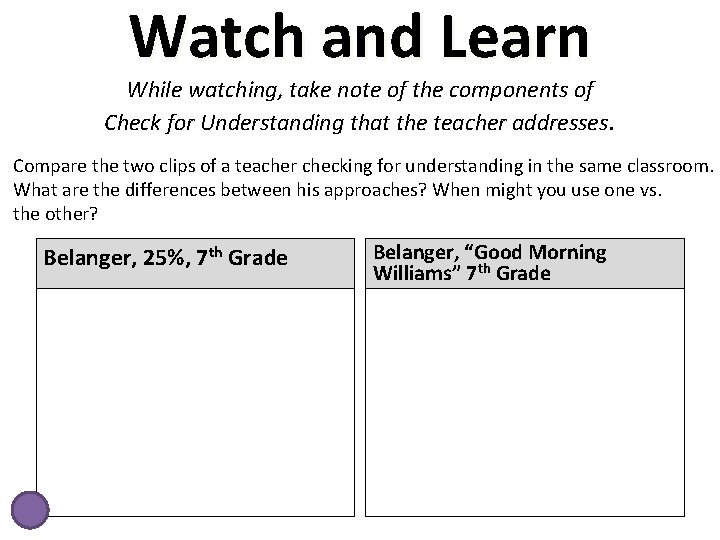
Watch and Learn While watching, take note of the components of Check for Understanding that the teacher addresses. Compare the two clips of a teacher checking for understanding in the same classroom. What are the differences between his approaches? When might you use one vs. the other? Belanger, 25%, 7 th Grade Belanger, “Good Morning Williams” 7 th Grade
Watch and Learn While watching, take note of the components of Check for Understanding that the teacher addresses. When to go Deep Take a closer look at one of the problems Jason is teaching. If students are asked to round 246. 74 to the nearest hundreds place, what errors are they apt to make? List as many misunderstandings as you can. Clip Armstrong, “ 247”, 6 th Grade Watch Jason teach the whole problem on rounding 246. 74 to the nearest hundreds place. What are the benefits and limitations to his approach?
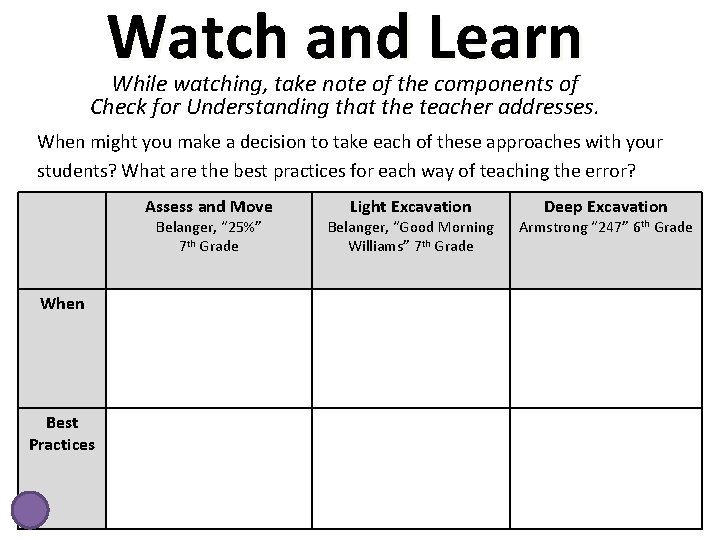
Watch and Learn While watching, take note of the components of Check for Understanding that the teacher addresses. When might you make a decision to take each of these approaches with your students? What are the best practices for each way of teaching the error? Assess and Move Belanger, “ 25%” 7 th Grade When Best Practices Light Excavation Belanger, “Good Morning Williams” 7 th Grade Deep Excavation Armstrong “ 247” 6 th Grade
Step 3: Accountability Students correct and or revise their work Teacher says: • “Give yourself a check for every one of these steps that you got correct. If you’re missing one, make a note to yourself. ” • “Circle answer B and write a margin note that explains that it uses the wrong operation. ” • “Draw a line through the (insert grammar mistake) and re-write it correctly in the space above/in the margin. ” • “Make your paper look like mine. ” • “Re-read your response. Add at least one piece of evidence from our discussion to better support your answer. ” • “I’m coming around to check that you’ve defined ‘fortuitous’ in the margin and your definition includes the word ‘lucky. ’”
Step 4: Re-Teach Students apply their learning to a similar challenge Teacher says: • “OK, let’s try one more to make sure we’ve got it. ” • “Now that we’ve looked at an example together, you’re going to return to your own paper to show what you know. ” • “Great, now apply the same steps to a new problem. ” • “Try one more response. The parts of the response will be the same as the one we just reviewed but the answer and evidence will be different. ”
Your turn! Brainstorm two additional accountability phrases or actions and two additional re-teach phrases or actions. Accountability Phrases/Actions Re-Teach Phrases / Actions
Teach the Error Speed Dating Ready for some fun? 1. How might Teach the Error look different in elementary vs. middle school vs. high school? 2. What needs to be systematized or routinized in your class to make Teach the Error successful? 3. How would you adapt this to a subject where answers are subjective like reading and art? 4. How would you apply this in content heavy subjects like Science or History?
Teach the Error Speed Dating 1 2 3 4
-Break-
-Everybody Writes. Step away from the teacher doing all the cognitive work… Engaging Students in Your Lessons -Page 137 in TLa. C text-
Everybody Writes • Set your students up for rigorous engagement by giving students an opportunity to reflect first in writing BEFORE discussing. “I write to know what I think” –Joan Didion
What is “everybody writes? ” Get ALL students to participate by requiring a written response before group share Why write? • We will discussing the benefits of students writing before participating Four Components: 1. Keep it tight 2. The Question Matters 3. Set Expectations and Provide Space 4. Build Habits
Video Analysis: While watching, take note of the components of strong voice that each teacher addresses. What do you see? Elementary School High School Jamie Davidson “Resilient” 5 th Grade Art Worrell “Population Decline” 12 th Grade How different would it be if Ms. Davidson went straight into a discussion on resilience? How is using everybody writes more rigorous? What elements of Everybody Writes do you see and how do these moments make Mr. Worrell’s classroom more rigorous?
Lets Discuss Everybody Writes within our own practice: RIGOR • Writing is a rigorous activity within itself. • We talk all the time about making student work and our assessments more rigorous. EQ: What have you done lately in your planning, instruction or practice to make your lessons, assignments, assessments or activities more RIGOROUS?
Everybody Writes Reflection • Using the template: Why and How Do We Write? , please reflect for a few minutes on an approach that you would most likely use and discuss why in the reflection column.

-Action Planning: Round 1 Take some time to collaborate with your teams to determine how you will infuse these techniques in your classroom or school(s) as early as next week…
-Lunch-
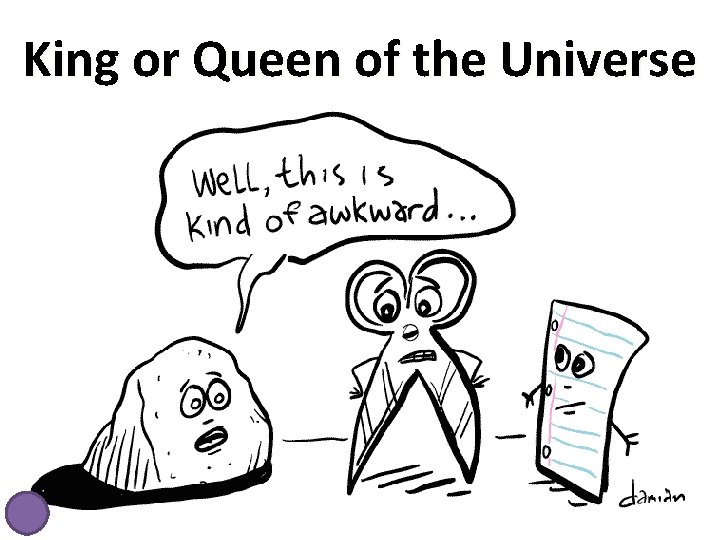
King or Queen of the Universe
-Strong Voice- No more “because I said so, ” give clear direction as to how you would like a task completed. Setting and Maintaining High Behavioral Expectations -Page 182 in TLa. C text-
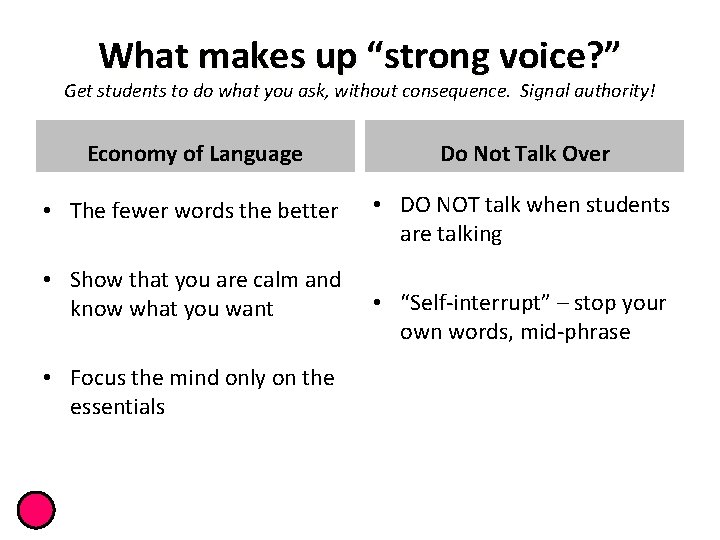
What makes up “strong voice? ” Get students to do what you ask, without consequence. Signal authority! Economy of Language Do Not Talk Over • The fewer words the better • DO NOT talk when students are talking • Show that you are calm and know what you want • Focus the mind only on the essentials • “Self-interrupt” – stop your own words, mid-phrase
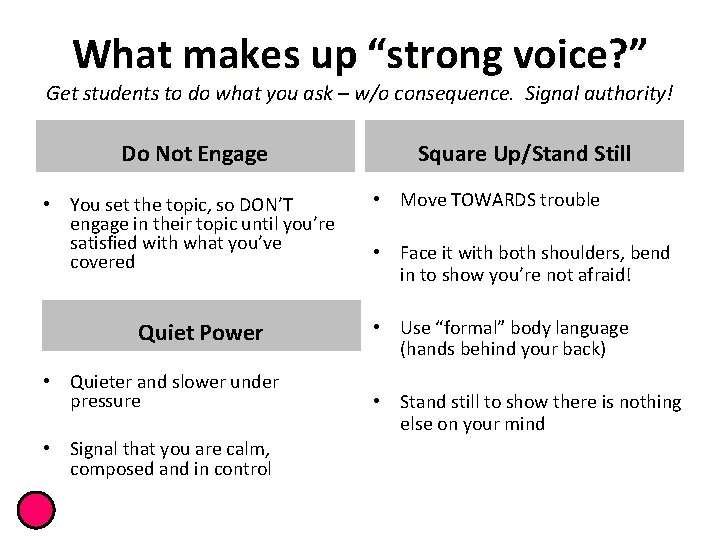
What makes up “strong voice? ” Get students to do what you ask – w/o consequence. Signal authority! Do Not Engage • You set the topic, so DON’T engage in their topic until you’re satisfied with what you’ve covered Quiet Power • Quieter and slower under pressure • Signal that you are calm, composed and in control Square Up/Stand Still • Move TOWARDS trouble • Face it with both shoulders, bend in to show you’re not afraid! • Use “formal” body language (hands behind your back) • Stand still to show there is nothing else on your mind
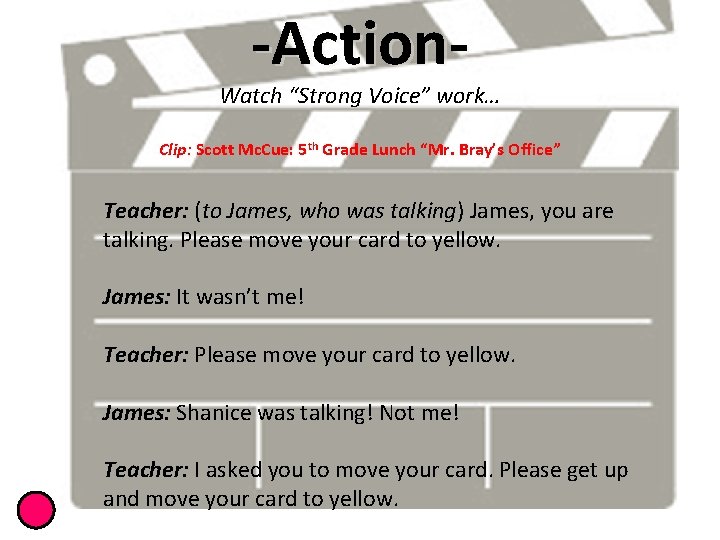
-Action- Watch “Strong Voice” work… Clip: Scott Mc. Cue: 5 th Grade Lunch “Mr. Bray’s Office” Teacher: (to James, who was talking) James, you are talking. Please move your card to yellow. James: It wasn’t me! Teacher: Please move your card to yellow. James: Shanice was talking! Not me! Teacher: I asked you to move your card. Please get up and move your card to yellow.
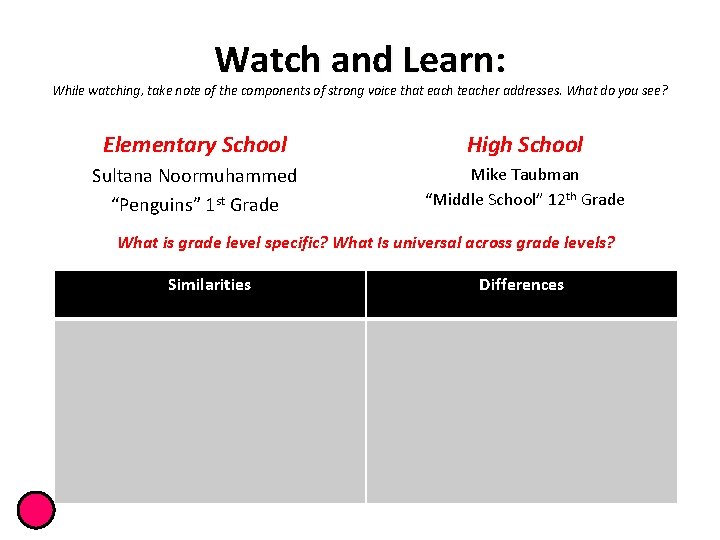
Watch and Learn: While watching, take note of the components of strong voice that each teacher addresses. What do you see? Elementary School High School Sultana Noormuhammed “Penguins” 1 st Grade Mike Taubman “Middle School” 12 th Grade What is grade level specific? What Is universal across grade levels? Similarities Differences
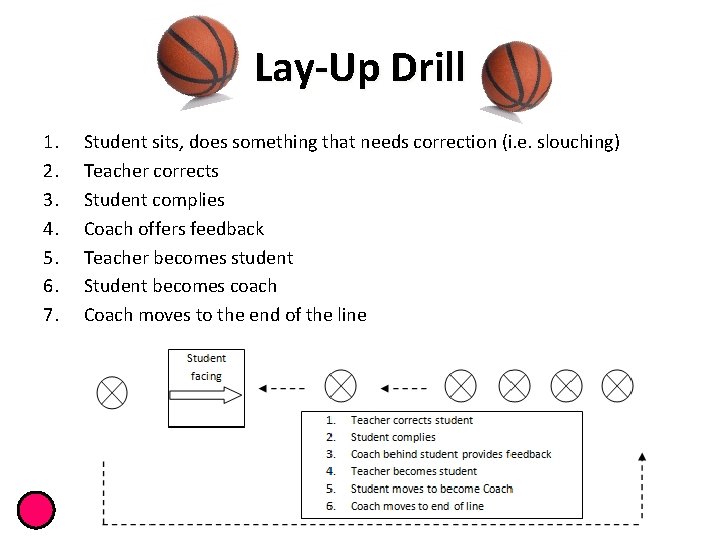
Lay-Up Drill 1. 2. 3. 4. 5. 6. 7. Student sits, does something that needs correction (i. e. slouching) Teacher corrects Student complies Coach offers feedback Teacher becomes student Student becomes coach Coach moves to the end of the line
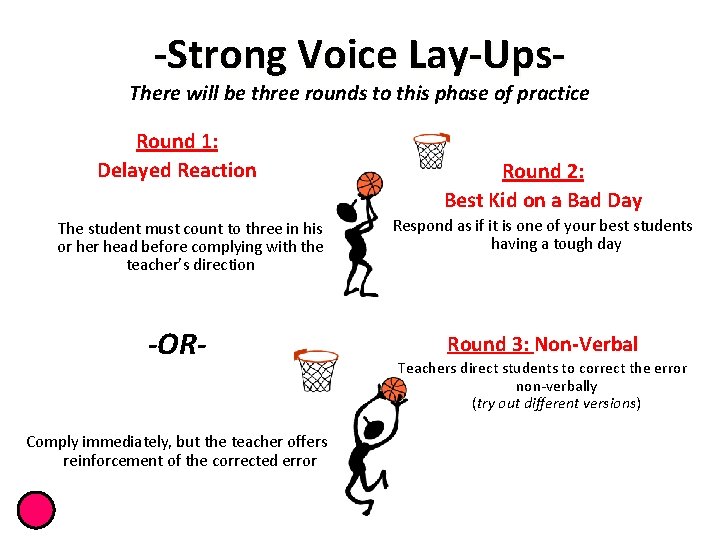
-Strong Voice Lay-Ups- There will be three rounds to this phase of practice Round 1: Delayed Reaction The student must count to three in his or head before complying with the teacher’s direction -ORComply immediately, but the teacher offers reinforcement of the corrected error Round 2: Best Kid on a Bad Day Respond as if it is one of your best students having a tough day Round 3: Non-Verbal Teachers direct students to correct the error non-verbally (try out different versions)
-Format Matters- “The complete sentence is the battering ram that knocks down the door to college. ” Setting High Academic Expectations -Page 47 in TLa. C text-
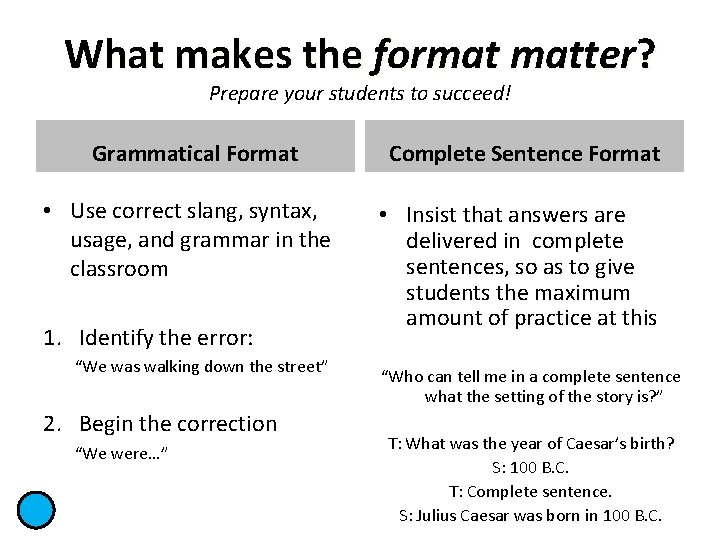
What makes the format matter? Prepare your students to succeed! Grammatical Format Complete Sentence Format • Use correct slang, syntax, usage, and grammar in the classroom • Insist that answers are delivered in complete sentences, so as to give students the maximum amount of practice at this 1. Identify the error: “We was walking down the street” 2. Begin the correction “We were…” “Who can tell me in a complete sentence what the setting of the story is? ” T: What was the year of Caesar’s birth? S: 100 B. C. T: Complete sentence. S: Julius Caesar was born in 100 B. C.
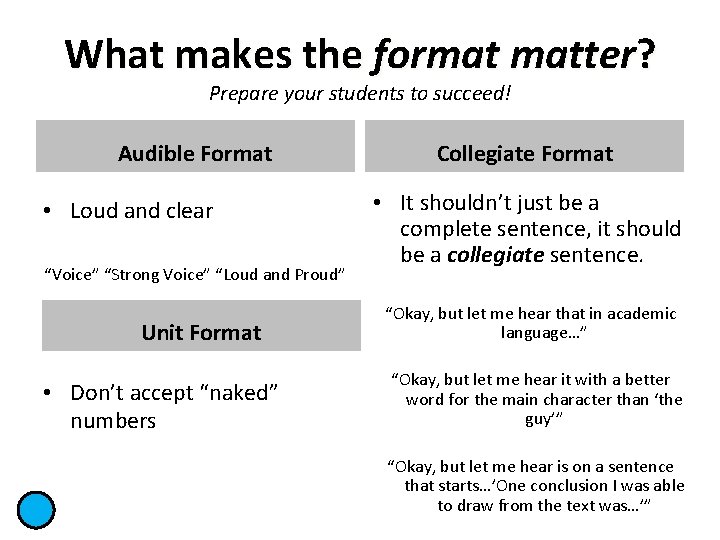
What makes the format matter? Prepare your students to succeed! Audible Format • Loud and clear “Voice” “Strong Voice” “Loud and Proud” Unit Format • Don’t accept “naked” numbers Collegiate Format • It shouldn’t just be a complete sentence, it should be a collegiate sentence. “Okay, but let me hear that in academic language…” “Okay, but let me hear it with a better word for the main character than ‘the guy’” “Okay, but let me hear is on a sentence that starts…’One conclusion I was able to draw from the text was…’”
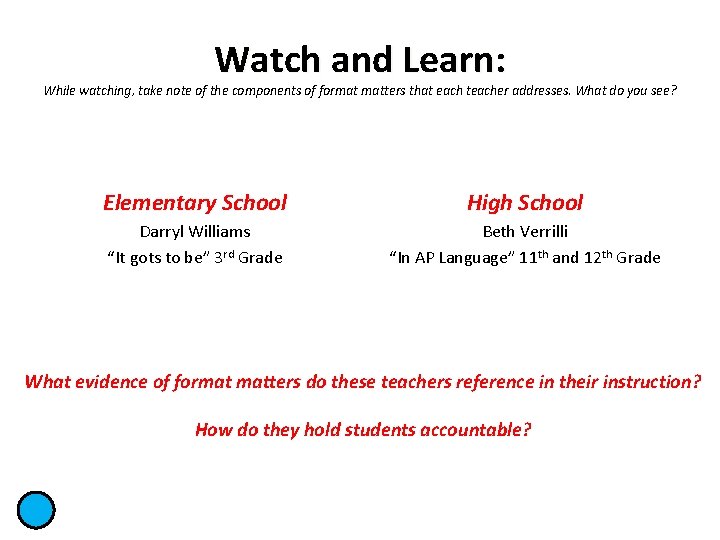
Watch and Learn: While watching, take note of the components of format matters that each teacher addresses. What do you see? Elementary School High School Darryl Williams “It gots to be” 3 rd Grade Beth Verrilli “In AP Language” 11 th and 12 th Grade What evidence of format matters do these teachers reference in their instruction? How do they hold students accountable?
-Speed Play • Independently: 3 minutes – Script as many sample student responses, in an incorrect format, to one of the question on your speed play document – Draft a Format Matters prompt you could use to correct student formatting • Turn and talk: 7 minutes – – – With a partner, act out your scenario, alternating between teacher and student roles Ask the question from the table that you selected Your partner would respond with one of the incorrect responses You would correct the response using Format Matters Student responds again Reverse roles when finished
-Joy Factor- The finest teachers offer up their work with generous servings of energy, passion, enthusiasm, fun and humor - - not as the antidote to hard work, but because those are some of the primary ways hard work gets done. Building Character and Trust -Page 214 in TLa. C text-
What brings the j-factor in the classroom? Know when and where to incorporate an element of “fun” into instruction. What is Joy Factor? • Finding joy in the work of learning is a key driver not just of a happy classroom but of a high achieving classroom. • Joy can be loud or quiet, individual, small-group or large-group oriented. • Examples of Joy Factor” – – – Fun and Games Us and Them (i. e. nicknames) Drama, Song and Dance Humor Suspense and Surprise Elements to Consider: • The Faucet: “You need to know when to turn it on and turn it off. ” • It’s Whistling: Take a page from Snow White. Joy Factor isn’t the cure for work; you whistle while you work. • The Servant: The best Joy Factor serves the objective. • Systems and Structures for Joy: Joy factor responds to systems. Systems allow you to incorporate joy efficiently and effectively.
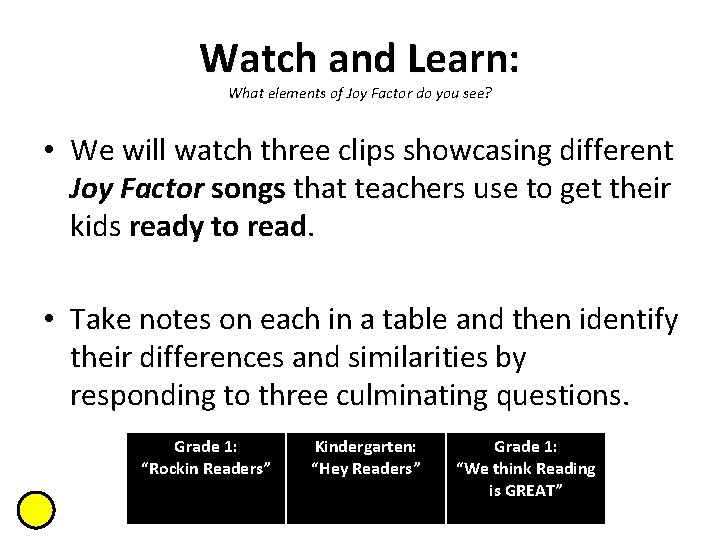
Watch and Learn: What elements of Joy Factor do you see? • We will watch three clips showcasing different Joy Factor songs that teachers use to get their kids ready to read. • Take notes on each in a table and then identify their differences and similarities by responding to three culminating questions. Grade 1: “Rockin Readers” Kindergarten: “Hey Readers” Grade 1: “We think Reading is GREAT”
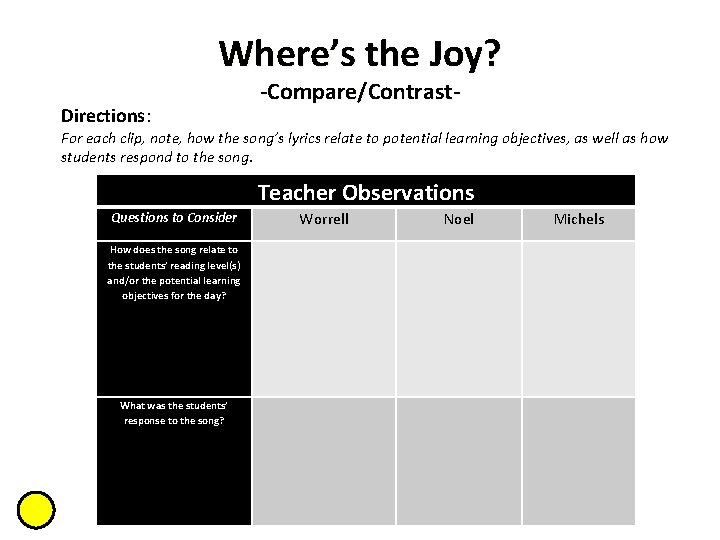
Where’s the Joy? Directions: -Compare/Contrast- For each clip, note, how the song’s lyrics relate to potential learning objectives, as well as how students respond to the song. Teacher Observations Questions to Consider Worrell Noel Michels How does the song relate to the students’ reading level(s) and/or the potential learning objectives for the day? What was the students’ response to the song?
“Joy Factor” Reflection Directions: Record the similarities and differences between each teacher’s approach in the table below as well as your key takeaways. What was different? What was similar? Takeaways:
-Give One, Get One • Write down 5 ways that you share “joy” in your classrooms (celebrations, song, games, fun, dance, surprise, suspense) • After 3 minutes, we will all get up and GIVE ONE/GET ONE • We will do 5 rounds of sharing ideas • Try to meet with others you haven’t talked to today!
Game Time: Taxonalities • Think of all the techniques and terminology you learned today; the “buzz words” of today’s training… – – – – – Check for Understanding Everybody Writes Pass the Papers Format Matters Strong Voice Teach the Error Quiet Power Square Up/Stand Still Zenaida Tan …other buzz words of the day…
Game Time: Taxonalities • There will be three rounds to this game: – Round 1: One person at your table picks a word from the bag and describes the chosen word for the group. Play continues until all words have been guessed, or until time is called. – Round 2: One person (same person or different) picks a word from the bag and must describe it in 3 words or less – Round 3: One person (same person or different) must act out the words using NO VOCABULARY *Passing is allowed, but if a card is passed, you WILL NOT get to re-try that particular card *You will have 1 minutes for each round of play.

-Action Planning: Round 2 Take some time to collaborate with your teams to determine how you will infuse these techniques in your classroom or school(s) as early as next week…
Now it’s your turn to… Teach Like a Champion -Please fill out a feedback form (both sides) before heading out the door- If you’d like to be featured in a regional TLa. C video, please let us know before leaving today.
- Slides: 61