
Teach A Level Statistics Maths 1 Conditional Probability
“Teach A Level Statistics Maths” 1 Conditional Probability © Christine Crisp
Conditional Probability Statistics 1 AQA EDEXCEL MEI/OCR "Certain images and/or photos on this presentation are the copyrighted property of Jupiter. Images and are being used with permission under license. These images and/or photos may not be copied or downloaded without permission from Jupiter. Images"
Conditional Probability We talk about conditional probability when the probability of one event depends on whether or not another event has occurred. e. g. There are 2 red and 3 blue counters in a bag and, without looking, we take out one counter and do not replace it. The probability of a 2 nd counter taken from the bag being red depends on whether the 1 st was red or blue. Conditional probability problems can be solved by considering the individual possibilities or by using a table, a Venn diagram, a tree diagram or a formula. Harder problems are most easily solved by using a formula together with a tree diagram.
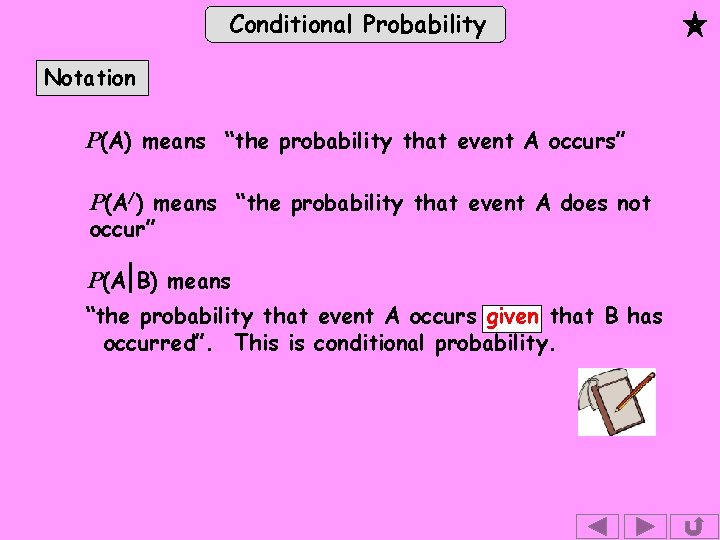
Conditional Probability Notation P(A) means “the probability that event A occurs” P(A/) means “the probability that event A does not occur” P(A B) means “the probability that event A occurs given that B has occurred”. This is conditional probability.
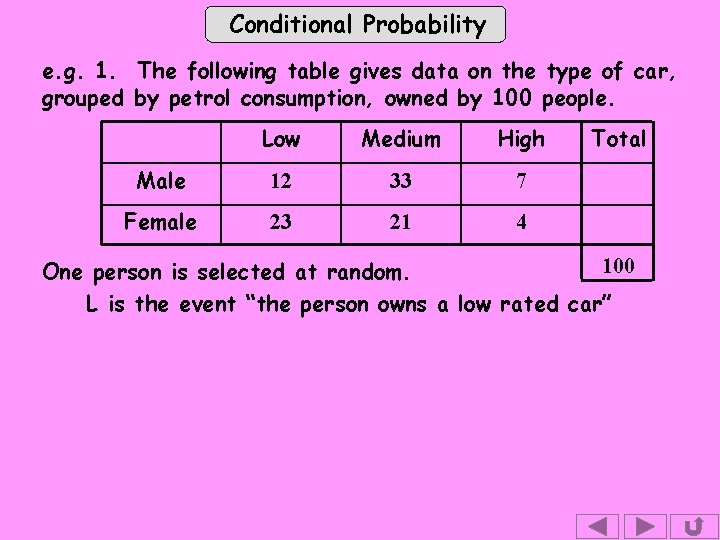
Conditional Probability e. g. 1. The following table gives data on the type of car, grouped by petrol consumption, owned by 100 people. Low Medium High Male 12 33 7 Female 23 21 4 Total 100 One person is selected at random. L is the event “the person owns a low rated car”
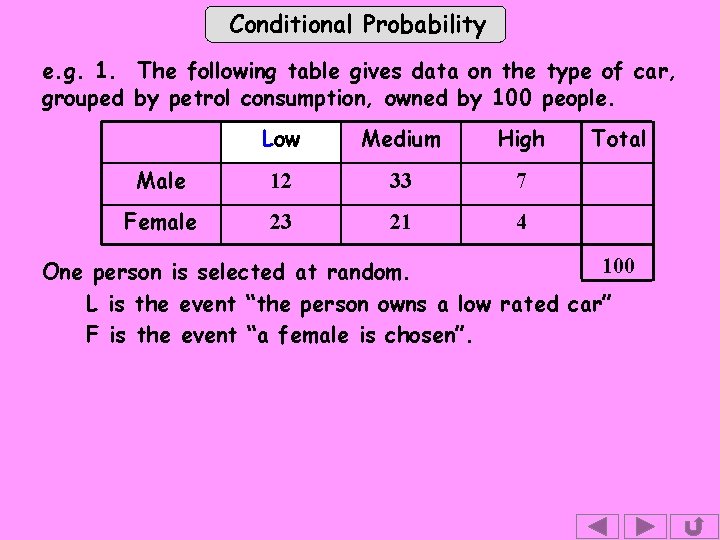
Conditional Probability e. g. 1. The following table gives data on the type of car, grouped by petrol consumption, owned by 100 people. Low Medium High Male 12 33 7 Female 23 21 4 Total 100 One person is selected at random. L is the event “the person owns a low rated car” F is the event “a female is chosen”.
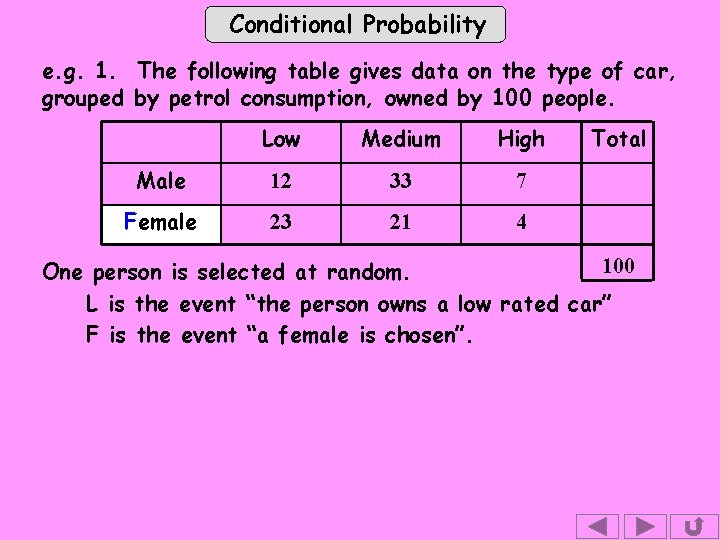
Conditional Probability e. g. 1. The following table gives data on the type of car, grouped by petrol consumption, owned by 100 people. Low Medium High Male 12 33 7 Female 23 21 4 Total 100 One person is selected at random. L is the event “the person owns a low rated car” F is the event “a female is chosen”.
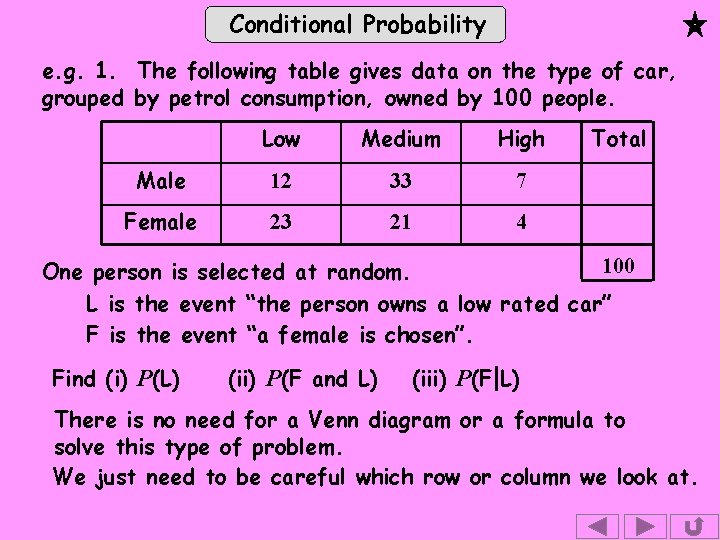
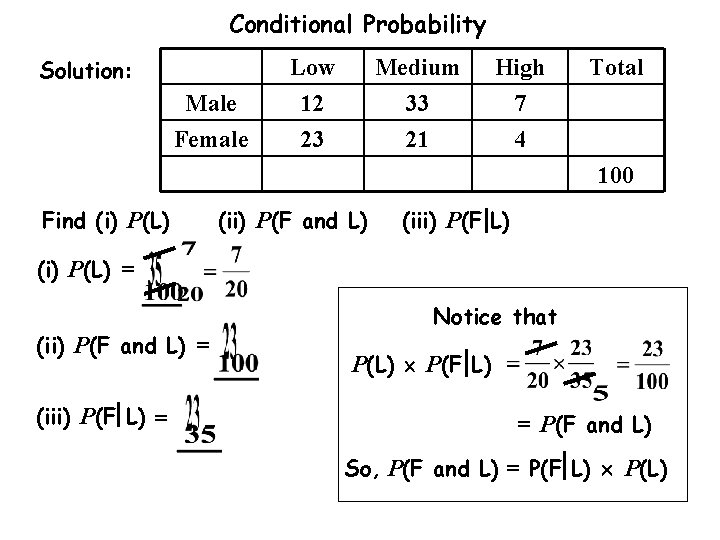
Conditional Probability e. g. 1. The following table gives data on the type of car, grouped by petrol consumption, owned by 100 people. Low Medium High Male 12 33 7 Female 23 21 4 Total 100 One person is selected at random. L is the event “the person owns a low rated car” F is the event “a female is chosen”. Find (i) P(L) (ii) P(F and L) (iii) P(F L) There is no need for a Venn diagram or a formula to solve this type of problem. We just need to be careful which row or column we look at.
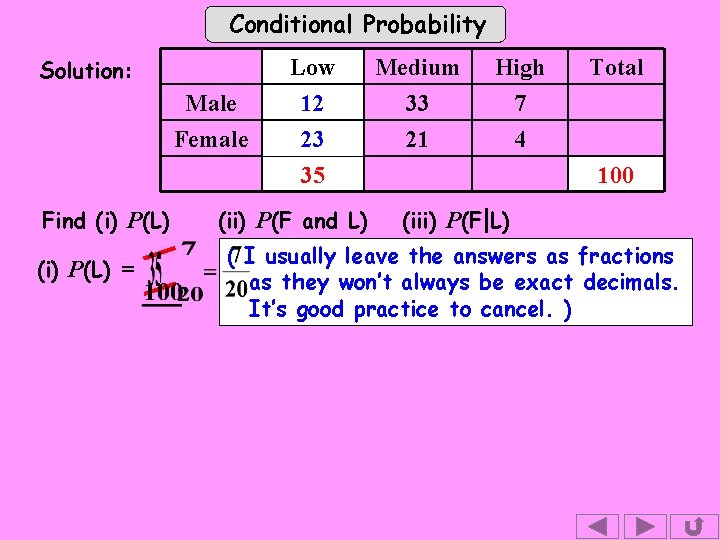
Conditional Probability Solution: Male Female Find (i) P(L) = Low 12 23 35 (ii) P(F and L) Medium 33 21 High 7 4 Total 100 (iii) P(F L) ( I usually leave the answers as fractions as they won’t always be exact decimals. It’s good practice to cancel. )
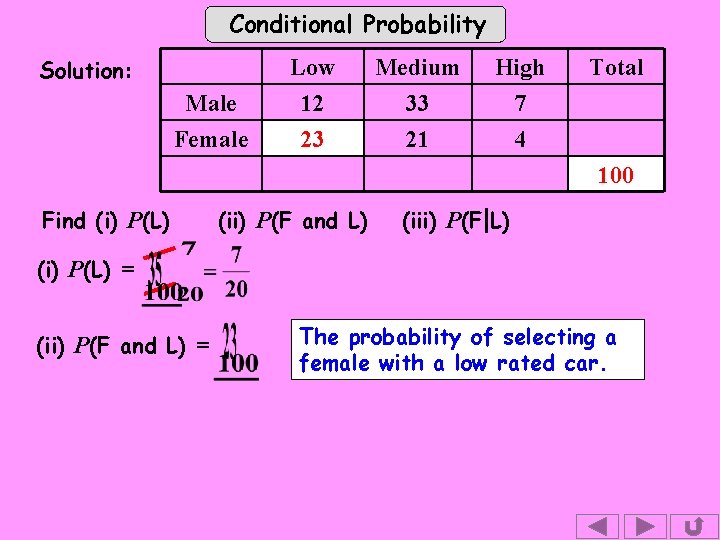
Conditional Probability Solution: Male Female Low 12 23 Medium 33 21 High 7 4 Total 100 Find (i) P(L) (ii) P(F and L) (iii) P(F L) (i) P(L) = (ii) P(F and L) = The probability of selecting a female with a low rated car.
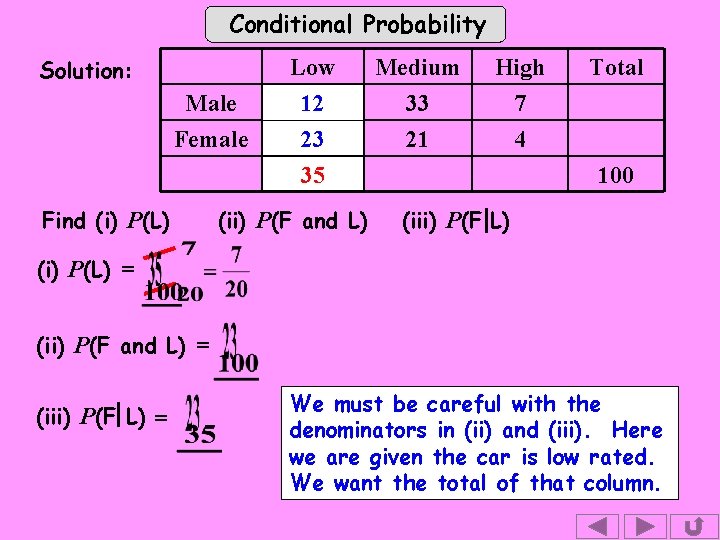
Conditional Probability Solution: Male Female Find (i) P(L) Low 12 23 35 (ii) P(F and L) Medium 33 21 High 7 4 Total 100 (iii) P(F L) (i) P(L) = (ii) P(F and L) = (iii) P(F L) = We be careful with thea The must probability of selecting denominators in (ii) Here female given the carand is (iii). low rated. we are given the car is low rated. We want the total of that column.
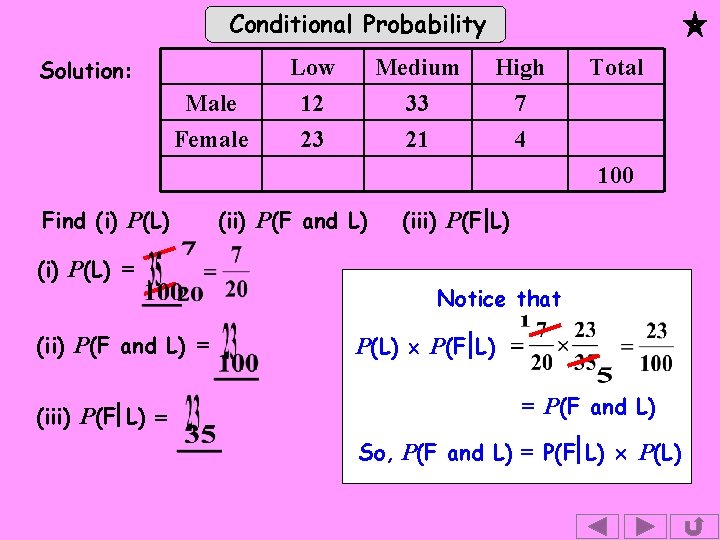
Conditional Probability Solution: Male Female Low 12 23 Medium 33 21 High 7 4 Total 100 Find (i) P(L) = (ii) P(F and L) = (iii) P(F L) = (ii) P(F and L) (iii) P(F L) Notice that P(L) P(F L) = P(F and L) So, P(F and L) = P(F L) P(L)
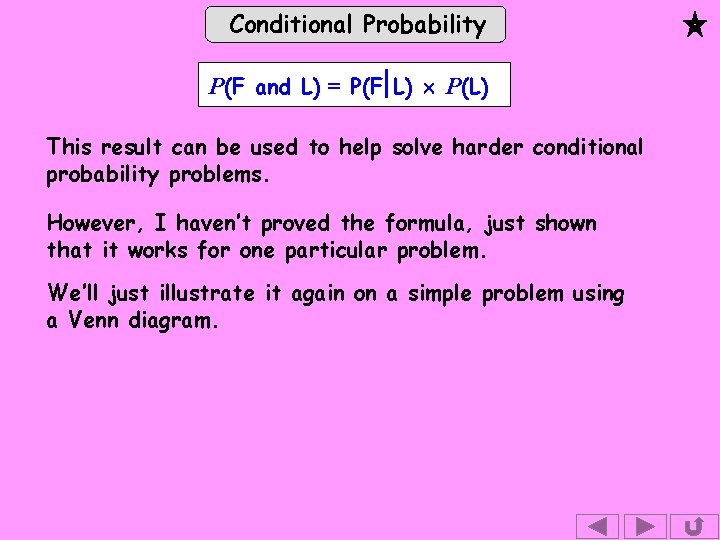
Conditional Probability P(F and L) = P(F L) P(L) This result can be used to help solve harder conditional probability problems. However, I haven’t proved the formula, just shown that it works for one particular problem. We’ll just illustrate it again on a simple problem using a Venn diagram.
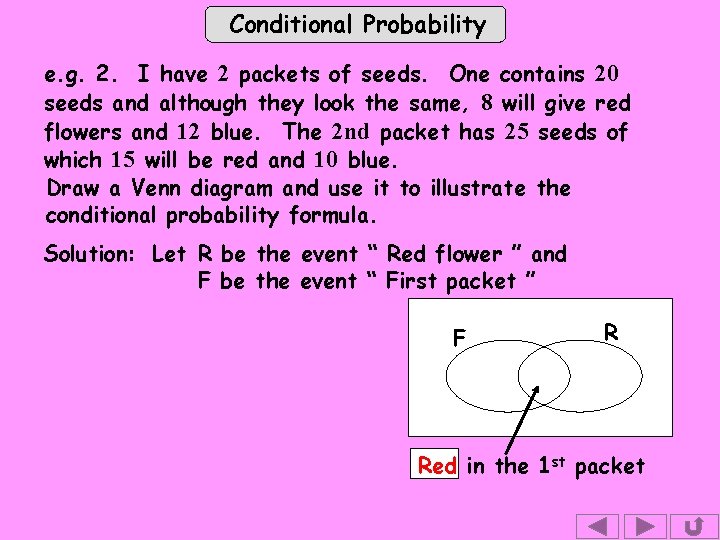
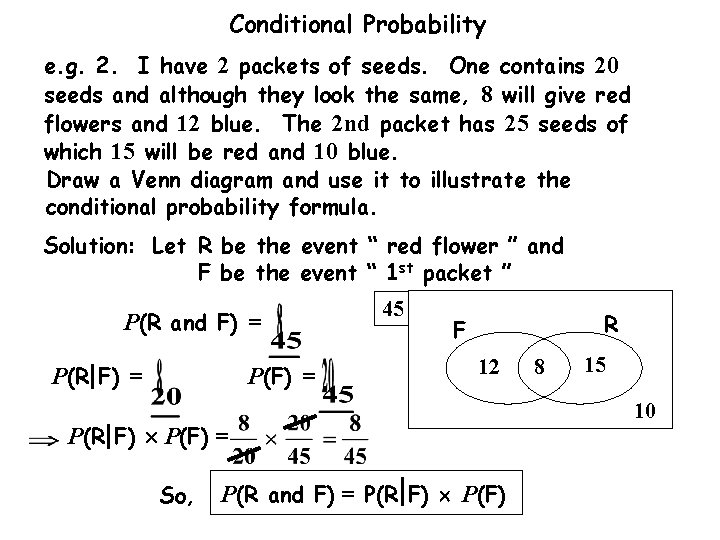
Conditional Probability e. g. 2. I have 2 packets of seeds. One contains 20 seeds and although they look the same, 8 will give red flowers and 12 blue. The 2 nd packet has 25 seeds of which 15 will be red and 10 blue. Draw a Venn diagram and use it to illustrate the conditional probability formula. Solution: Let R be the event “ Red flower ” and F be the event “ First packet ” F R Red in the 1 st packet
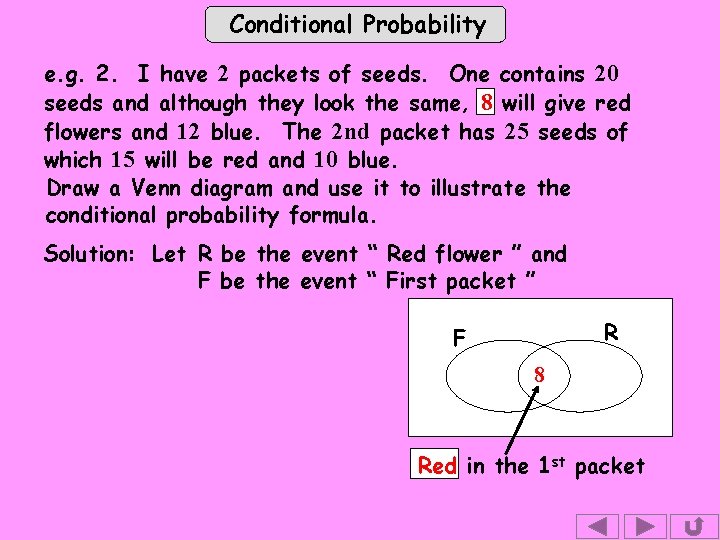
Conditional Probability e. g. 2. I have 2 packets of seeds. One contains 20 seeds and although they look the same, 8 will give red flowers and 12 blue. The 2 nd packet has 25 seeds of which 15 will be red and 10 blue. Draw a Venn diagram and use it to illustrate the conditional probability formula. Solution: Let R be the event “ Red flower ” and F be the event “ First packet ” R F 8 Red in the 1 st packet
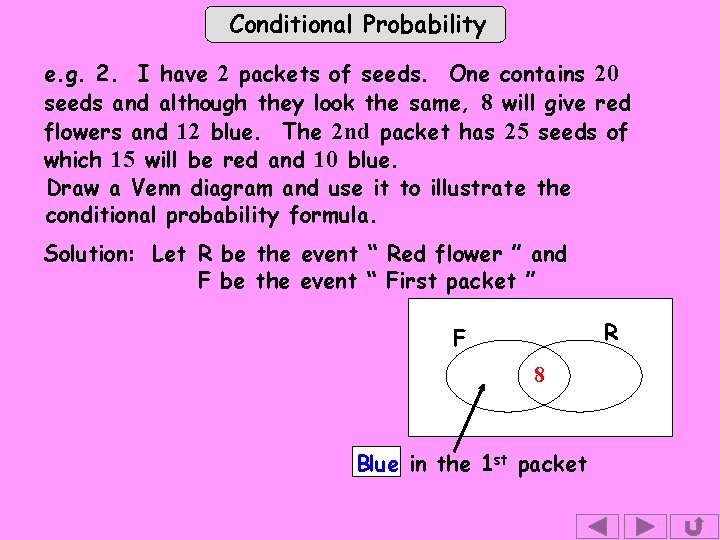
Conditional Probability e. g. 2. I have 2 packets of seeds. One contains 20 seeds and although they look the same, 8 will give red flowers and 12 blue. The 2 nd packet has 25 seeds of which 15 will be red and 10 blue. Draw a Venn diagram and use it to illustrate the conditional probability formula. Solution: Let R be the event “ Red flower ” and F be the event “ First packet ” R F 8 Blue in the 1 st packet
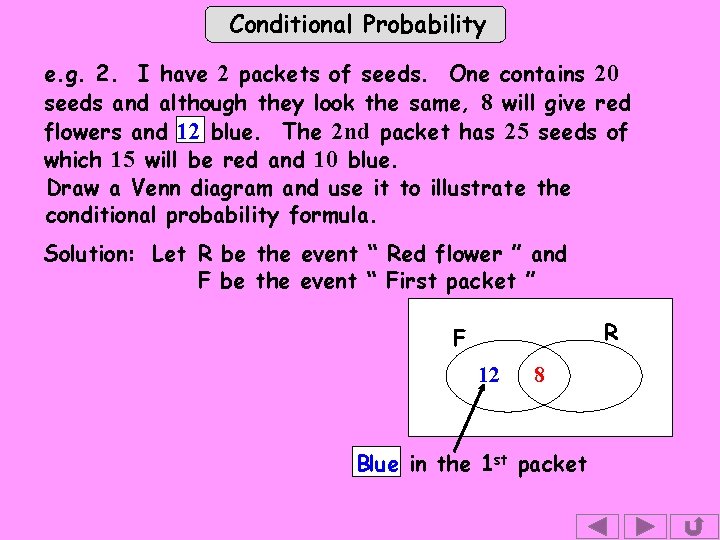
Conditional Probability e. g. 2. I have 2 packets of seeds. One contains 20 seeds and although they look the same, 8 will give red flowers and 12 blue. The 2 nd packet has 25 seeds of which 15 will be red and 10 blue. Draw a Venn diagram and use it to illustrate the conditional probability formula. Solution: Let R be the event “ Red flower ” and F be the event “ First packet ” R F 12 8 Blue in the 1 st packet
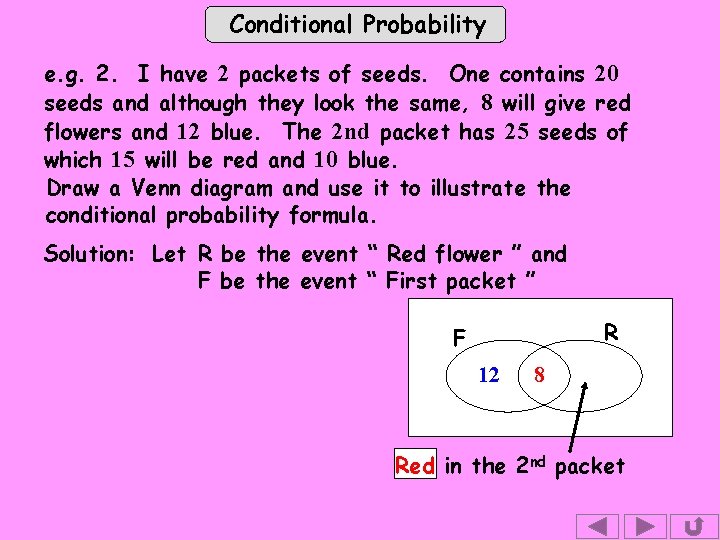
Conditional Probability e. g. 2. I have 2 packets of seeds. One contains 20 seeds and although they look the same, 8 will give red flowers and 12 blue. The 2 nd packet has 25 seeds of which 15 will be red and 10 blue. Draw a Venn diagram and use it to illustrate the conditional probability formula. Solution: Let R be the event “ Red flower ” and F be the event “ First packet ” R F 12 8 Red in the 2 nd packet
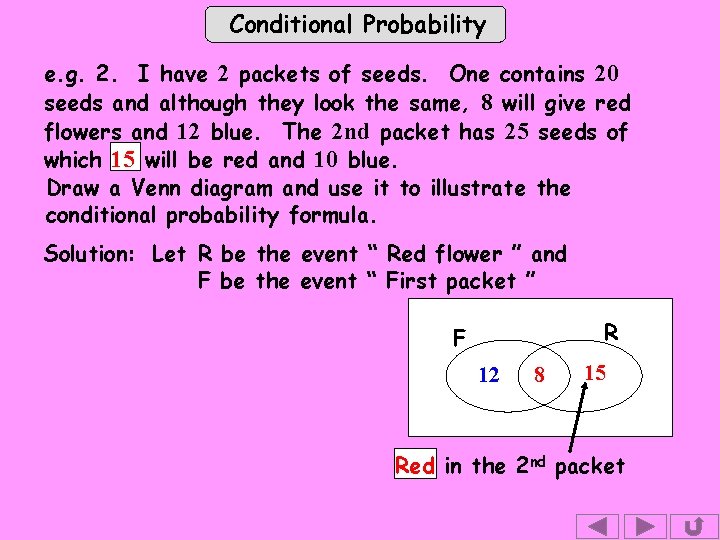
Conditional Probability e. g. 2. I have 2 packets of seeds. One contains 20 seeds and although they look the same, 8 will give red flowers and 12 blue. The 2 nd packet has 25 seeds of which 15 will be red and 10 blue. Draw a Venn diagram and use it to illustrate the conditional probability formula. Solution: Let R be the event “ Red flower ” and F be the event “ First packet ” R F 12 8 15 Red in the 2 nd packet
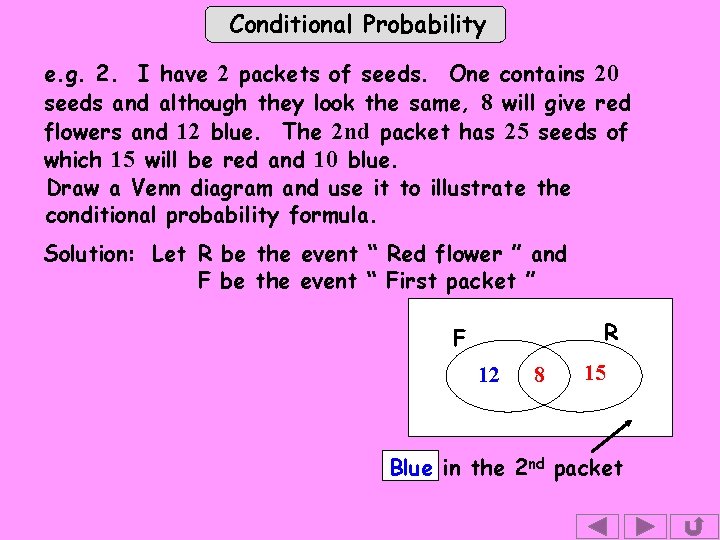
Conditional Probability e. g. 2. I have 2 packets of seeds. One contains 20 seeds and although they look the same, 8 will give red flowers and 12 blue. The 2 nd packet has 25 seeds of which 15 will be red and 10 blue. Draw a Venn diagram and use it to illustrate the conditional probability formula. Solution: Let R be the event “ Red flower ” and F be the event “ First packet ” R F 12 8 15 Blue in the 2 nd packet
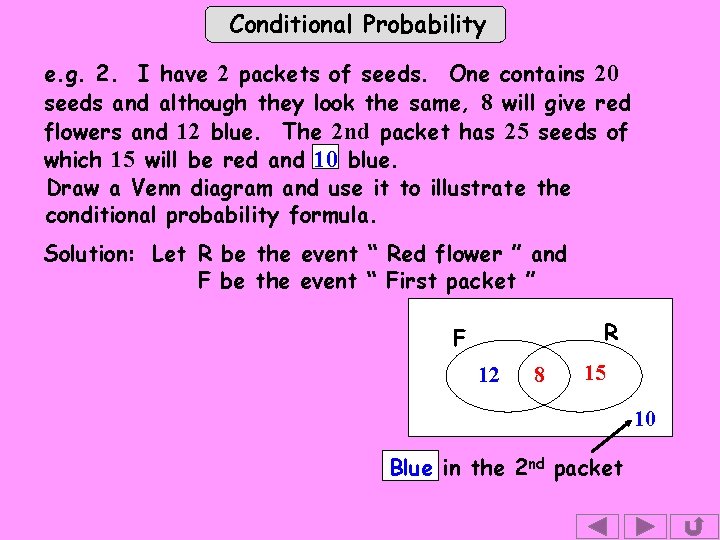
Conditional Probability e. g. 2. I have 2 packets of seeds. One contains 20 seeds and although they look the same, 8 will give red flowers and 12 blue. The 2 nd packet has 25 seeds of which 15 will be red and 10 blue. Draw a Venn diagram and use it to illustrate the conditional probability formula. Solution: Let R be the event “ Red flower ” and F be the event “ First packet ” R F 12 8 15 10 Blue in the 2 nd packet
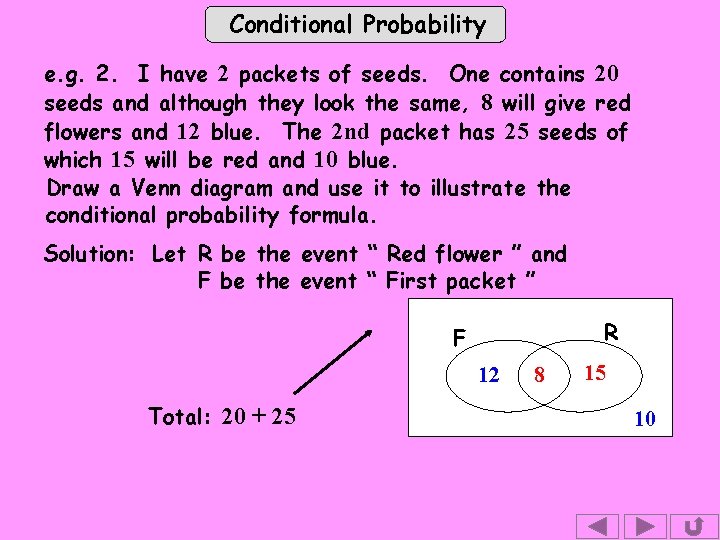
Conditional Probability e. g. 2. I have 2 packets of seeds. One contains 20 seeds and although they look the same, 8 will give red flowers and 12 blue. The 2 nd packet has 25 seeds of which 15 will be red and 10 blue. Draw a Venn diagram and use it to illustrate the conditional probability formula. Solution: Let R be the event “ Red flower ” and F be the event “ First packet ” R F 12 Total: 20 + 25 8 15 10
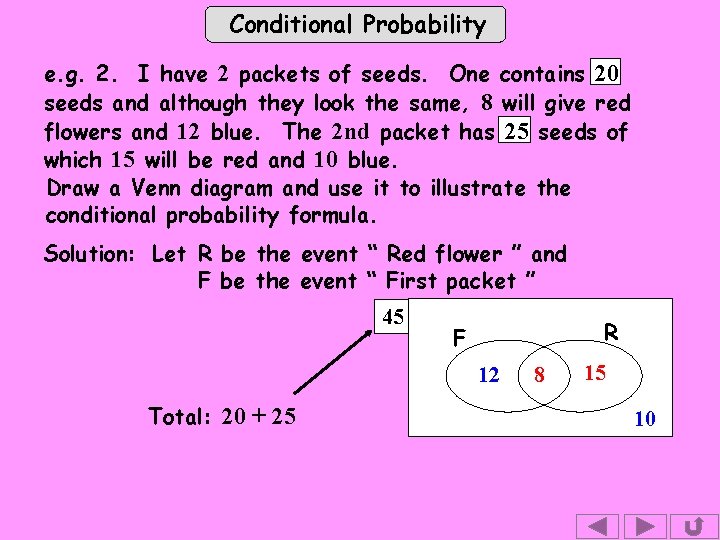
Conditional Probability e. g. 2. I have 2 packets of seeds. One contains 20 seeds and although they look the same, 8 will give red flowers and 12 blue. The 2 nd packet has 25 seeds of which 15 will be red and 10 blue. Draw a Venn diagram and use it to illustrate the conditional probability formula. Solution: Let R be the event “ Red flower ” and F be the event “ First packet ” 45 R F 12 Total: 20 + 25 8 15 10
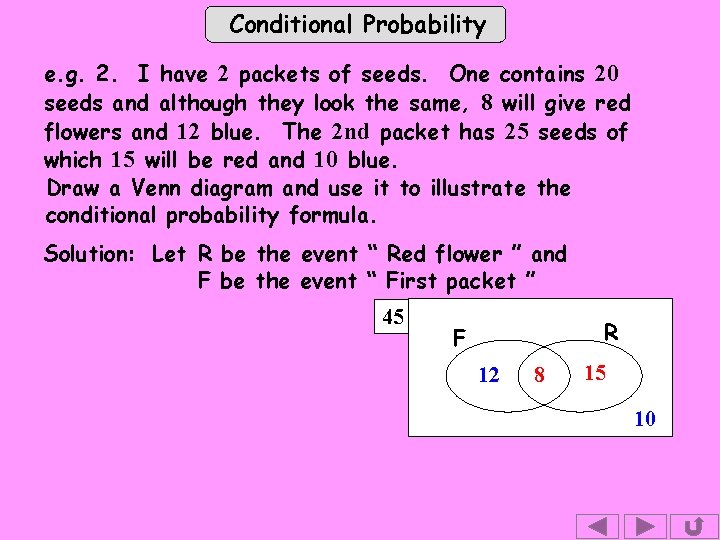
Conditional Probability e. g. 2. I have 2 packets of seeds. One contains 20 seeds and although they look the same, 8 will give red flowers and 12 blue. The 2 nd packet has 25 seeds of which 15 will be red and 10 blue. Draw a Venn diagram and use it to illustrate the conditional probability formula. Solution: Let R be the event “ Red flower ” and F be the event “ First packet ” 45 R F 12 8 15 10
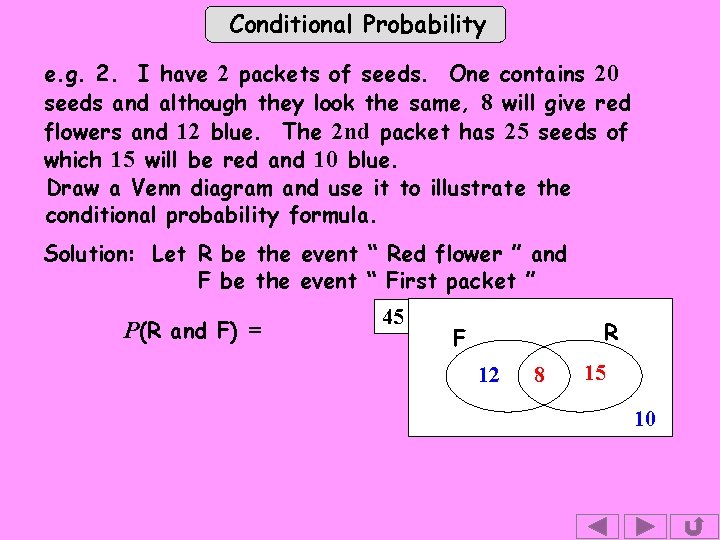
Conditional Probability e. g. 2. I have 2 packets of seeds. One contains 20 seeds and although they look the same, 8 will give red flowers and 12 blue. The 2 nd packet has 25 seeds of which 15 will be red and 10 blue. Draw a Venn diagram and use it to illustrate the conditional probability formula. Solution: Let R be the event “ Red flower ” and F be the event “ First packet ” P(R and F) = 45 R F 12 8 15 10
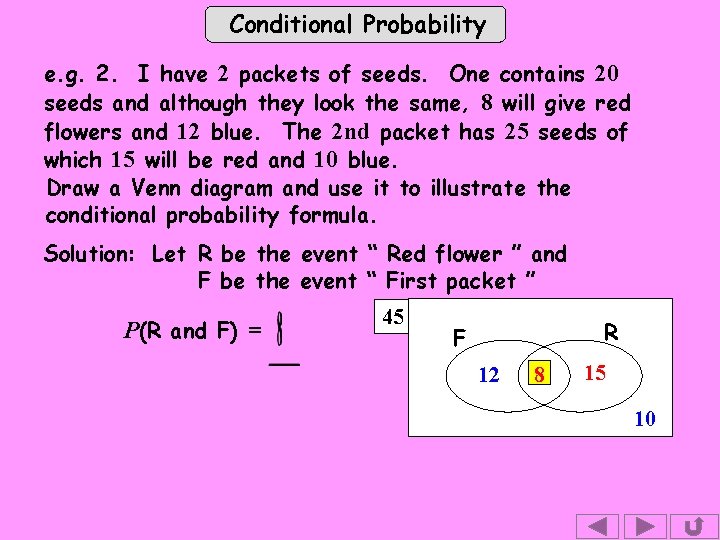
Conditional Probability e. g. 2. I have 2 packets of seeds. One contains 20 seeds and although they look the same, 8 will give red flowers and 12 blue. The 2 nd packet has 25 seeds of which 15 will be red and 10 blue. Draw a Venn diagram and use it to illustrate the conditional probability formula. Solution: Let R be the event “ Red flower ” and F be the event “ First packet ” P(R and F) = 45 R F 12 8 15 10
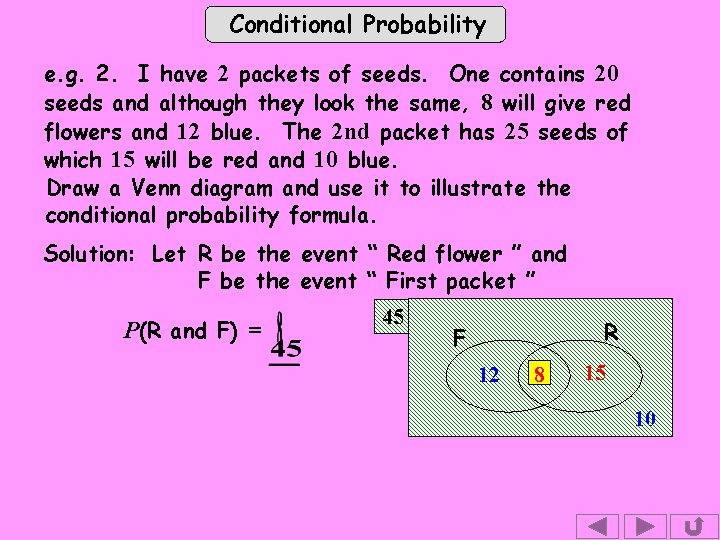
Conditional Probability e. g. 2. I have 2 packets of seeds. One contains 20 seeds and although they look the same, 8 will give red flowers and 12 blue. The 2 nd packet has 25 seeds of which 15 will be red and 10 blue. Draw a Venn diagram and use it to illustrate the conditional probability formula. Solution: Let R be the event “ Red flower ” and F be the event “ First packet ” P(R and F) = 45 R F 12 8 15 10
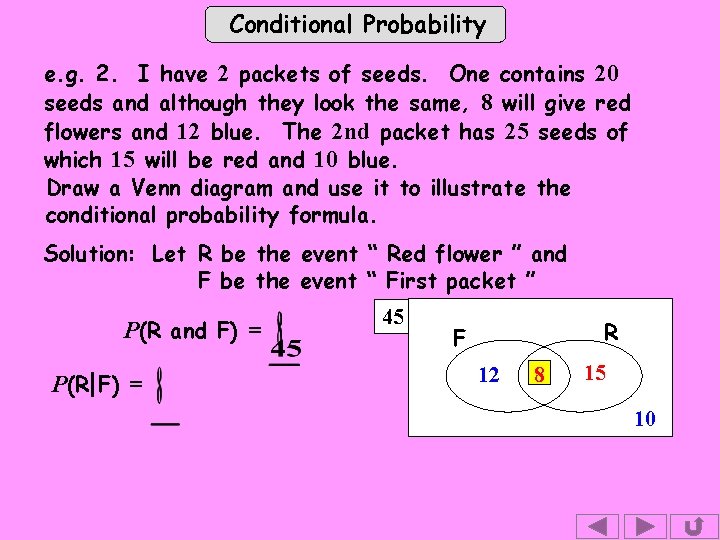
Conditional Probability e. g. 2. I have 2 packets of seeds. One contains 20 seeds and although they look the same, 8 will give red flowers and 12 blue. The 2 nd packet has 25 seeds of which 15 will be red and 10 blue. Draw a Venn diagram and use it to illustrate the conditional probability formula. Solution: Let R be the event “ Red flower ” and F be the event “ First packet ” P(R and F) = P(R F) = 45 R F 12 8 15 10
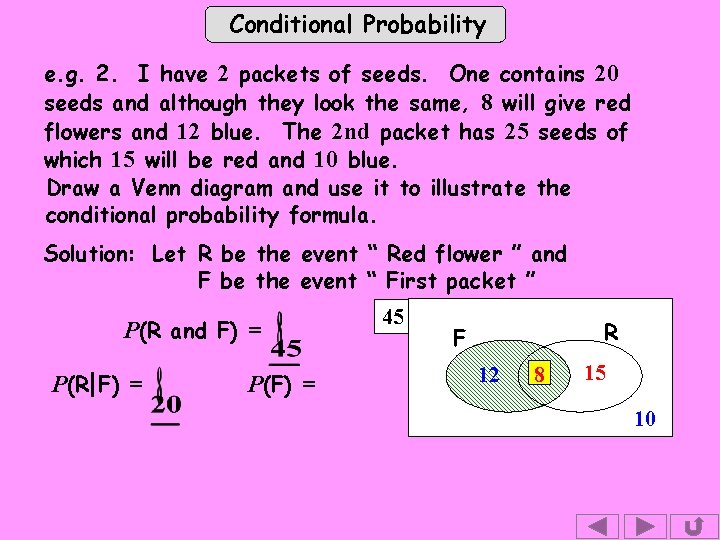
Conditional Probability e. g. 2. I have 2 packets of seeds. One contains 20 seeds and although they look the same, 8 will give red flowers and 12 blue. The 2 nd packet has 25 seeds of which 15 will be red and 10 blue. Draw a Venn diagram and use it to illustrate the conditional probability formula. Solution: Let R be the event “ Red flower ” and F be the event “ First packet ” P(R and F) = P(R F) = P(F) = 45 R F 12 8 15 10
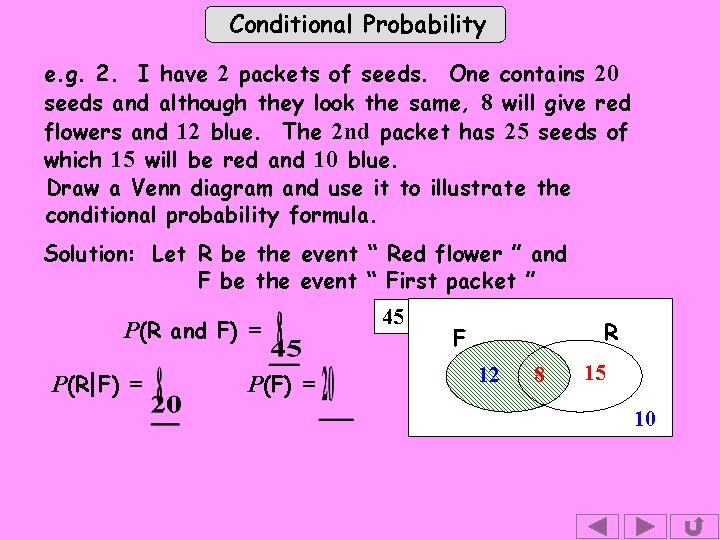
Conditional Probability e. g. 2. I have 2 packets of seeds. One contains 20 seeds and although they look the same, 8 will give red flowers and 12 blue. The 2 nd packet has 25 seeds of which 15 will be red and 10 blue. Draw a Venn diagram and use it to illustrate the conditional probability formula. Solution: Let R be the event “ Red flower ” and F be the event “ First packet ” P(R and F) = P(R F) = P(F) = 45 R F 12 8 15 10
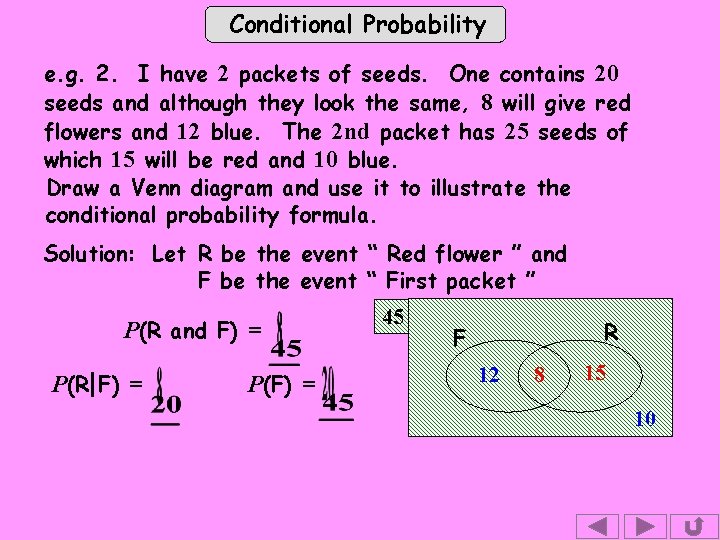
Conditional Probability e. g. 2. I have 2 packets of seeds. One contains 20 seeds and although they look the same, 8 will give red flowers and 12 blue. The 2 nd packet has 25 seeds of which 15 will be red and 10 blue. Draw a Venn diagram and use it to illustrate the conditional probability formula. Solution: Let R be the event “ Red flower ” and F be the event “ First packet ” P(R and F) = P(R F) = P(F) = 45 R F 12 8 15 10
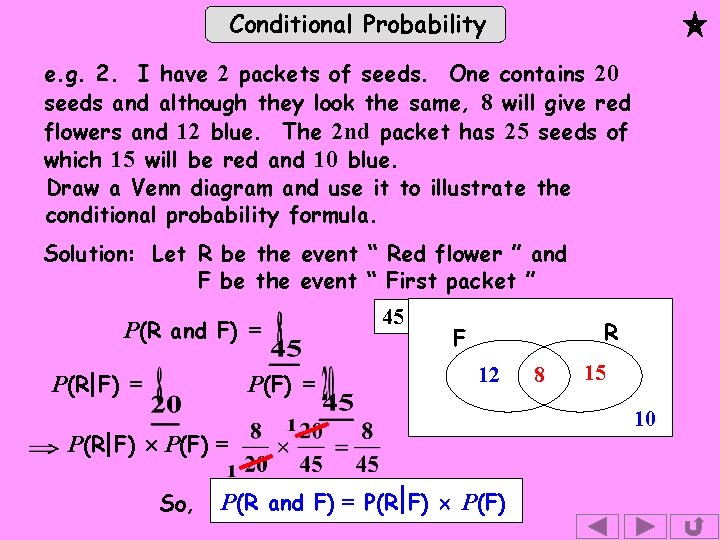
Conditional Probability e. g. 2. I have 2 packets of seeds. One contains 20 seeds and although they look the same, 8 will give red flowers and 12 blue. The 2 nd packet has 25 seeds of which 15 will be red and 10 blue. Draw a Venn diagram and use it to illustrate the conditional probability formula. Solution: Let R be the event “ Red flower ” and F be the event “ First packet ” P(R and F) = P(R F) = P(F) = 45 R F 12 P(R F) P(F) = So, P(R and F) = P(R F) P(F) 8 15 10
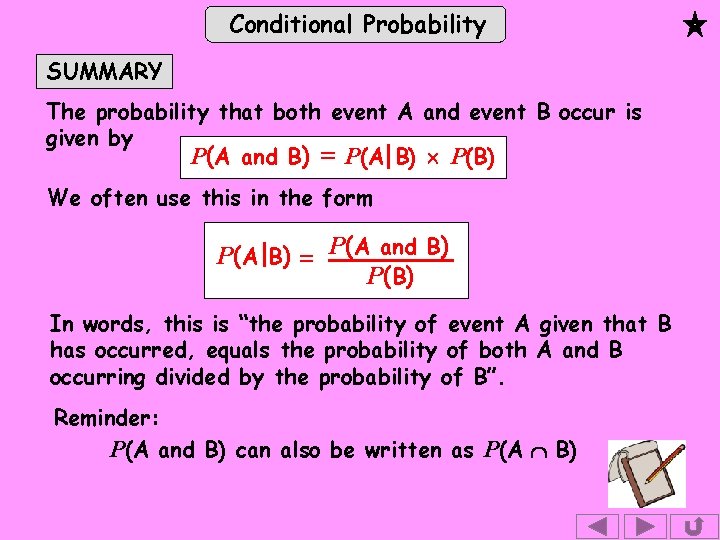
Conditional Probability SUMMARY The probability that both event A and event B occur is given by P(A and B) = P(A B) P(B) We often use this in the form P(A B) = P(A and B) P (B ) In words, this is “the probability of event A given that B has occurred, equals the probability of both A and B occurring divided by the probability of B”. Reminder: P(A and B) can also be written as P(A B)
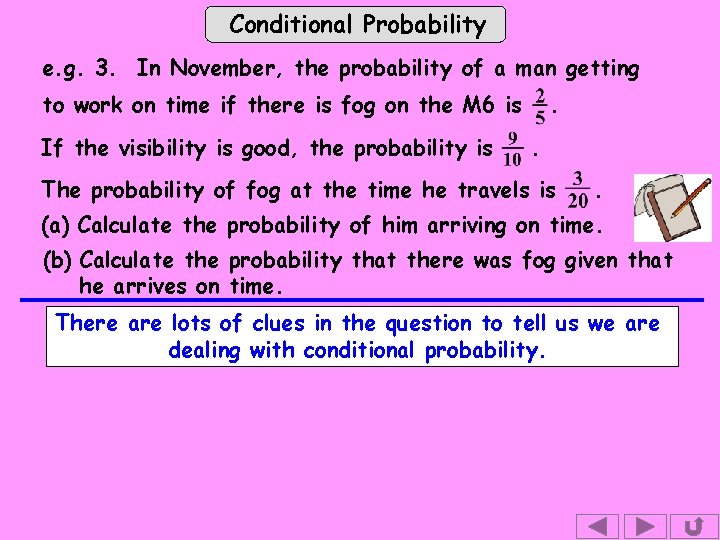
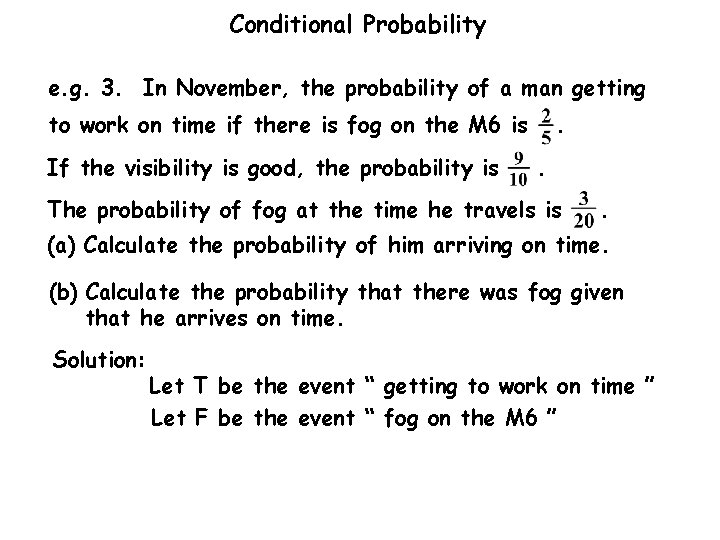
Conditional Probability e. g. 3. In November, the probability of a man getting to work on time if there is fog on the M 6 is If the visibility is good, the probability is . . The probability of fog at the time he travels is . (a) Calculate the probability of him arriving on time. (b) Calculate the probability that there was fog given that he arrives on time. There are lots of clues in the question to tell us we are dealing with conditional probability.
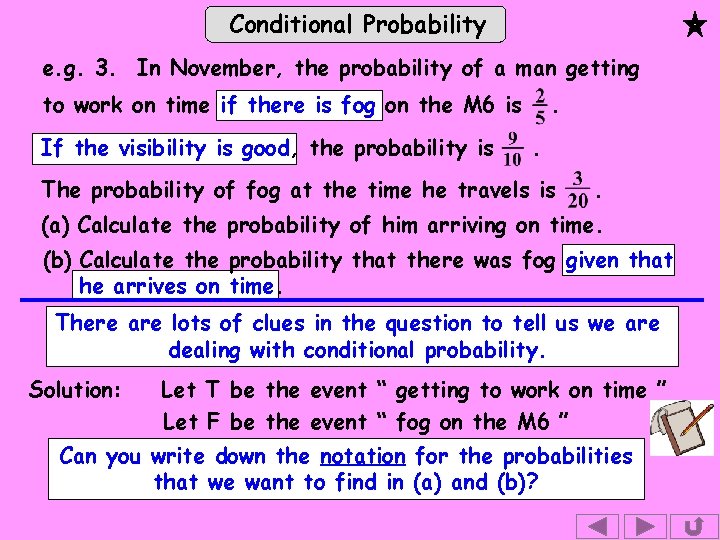
Conditional Probability e. g. 3. In November, the probability of a man getting to work on time if there is fog on the M 6 is If the visibility is good, the probability is . . The probability of fog at the time he travels is . (a) Calculate the probability of him arriving on time. (b) Calculate the probability that there was fog given that he arrives on time. There are lots of clues in the question to tell us we are dealing with conditional probability. Solution: Let T be the event “ getting to work on time ” Let F be the event “ fog on the M 6 ” Can you write down the notation for the probabilities that we want to find in (a) and (b)?
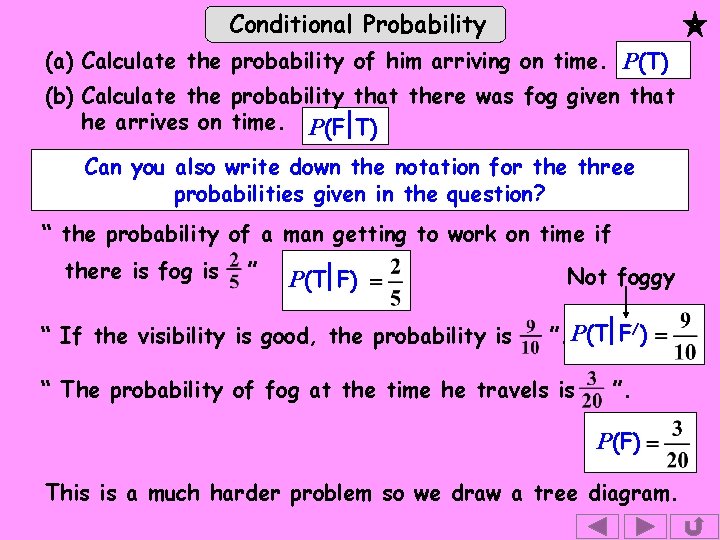
Conditional Probability (a) Calculate the probability of him arriving on time. P(T) (b) Calculate the probability that there was fog given that he arrives on time. P(F T) Can you also write down the notation for the three probabilities given in the question? “ the probability of a man getting to work on time if there is fog is ” P(T F) “ If the visibility is good, the probability is Not foggy ”. P(T F/) “ The probability of fog at the time he travels is ”. P(F) This is a much harder problem so we draw a tree diagram.
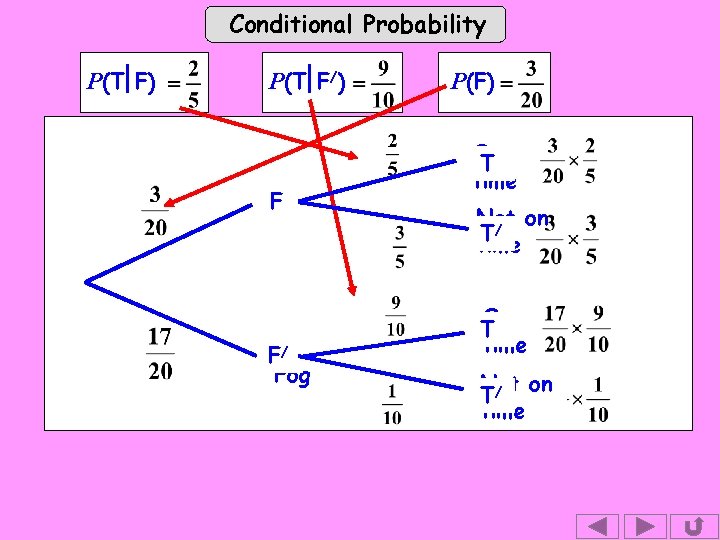
Conditional Probability P(T F) P(T F/) F Fog / FNo Fog P(F) On T time Not on / T time On T time Not on T/ time
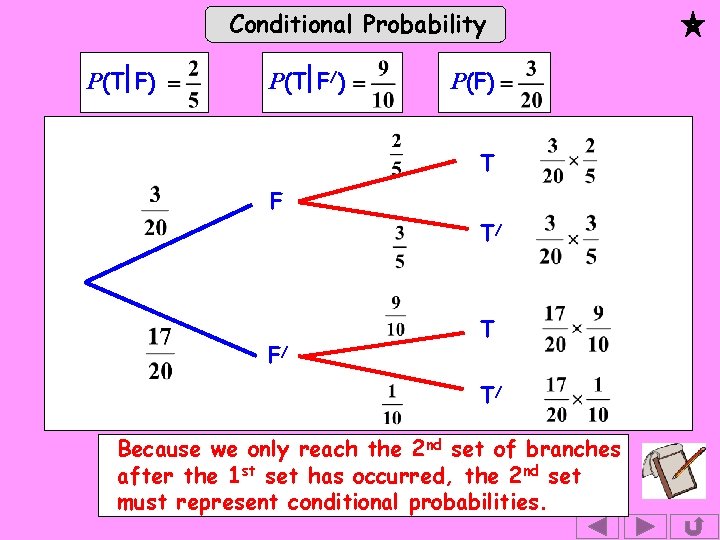
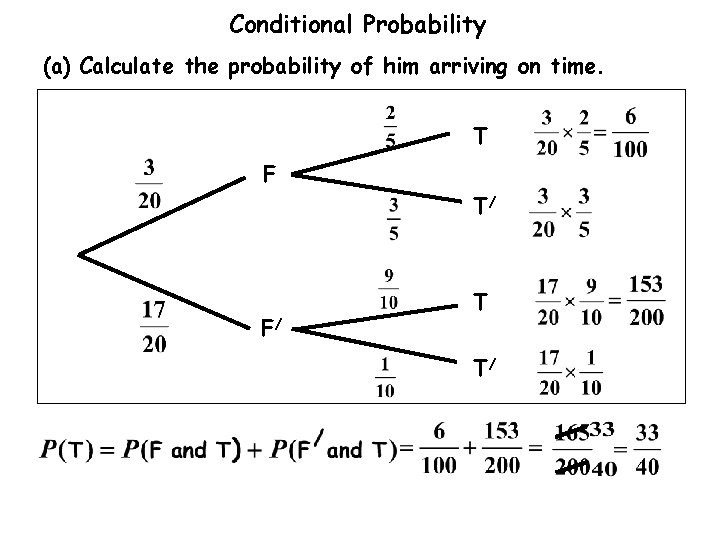
Conditional Probability P(T F) P(T F/) P(F) T F T/ F/ T T/ Because we only reach the 2 nd set of branches after the 1 st set has occurred, the 2 nd set must represent conditional probabilities.
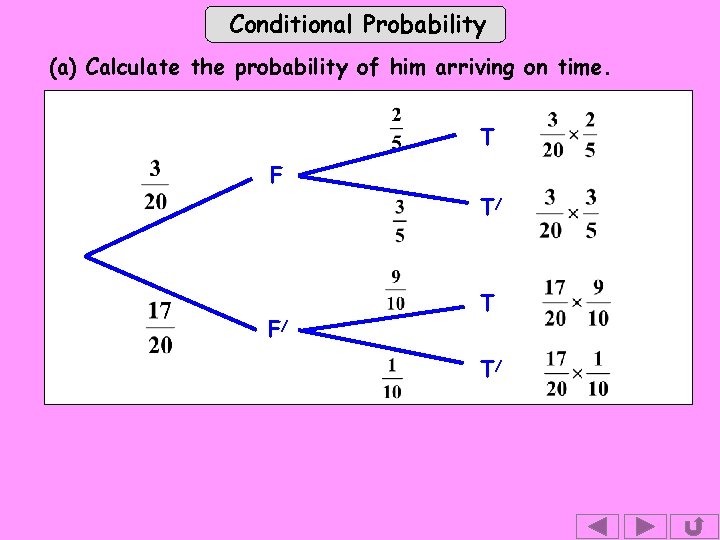
Conditional Probability (a) Calculate the probability of him arriving on time. T F T/ F/ T T/
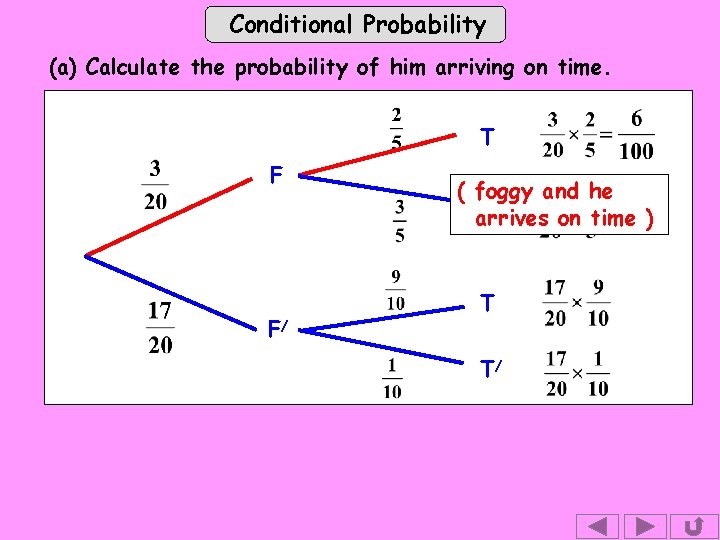
Conditional Probability (a) Calculate the probability of him arriving on time. T F F/ ( foggy and he / T arrives on time ) T T/
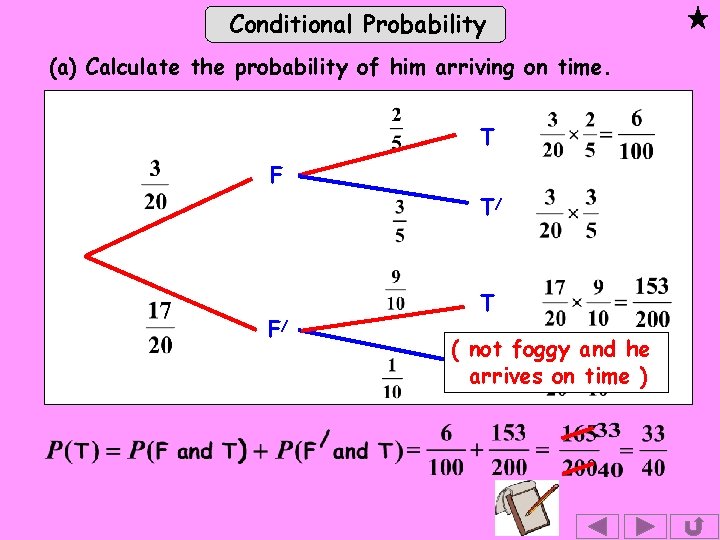
Conditional Probability (a) Calculate the probability of him arriving on time. T F T/ F/ T ( not foggy and he T/ arrives on time )
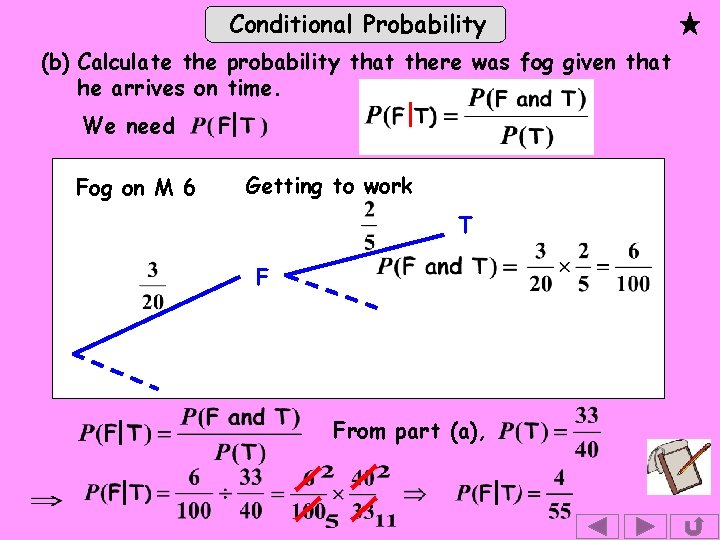
Conditional Probability (b) Calculate the probability that there was fog given that he arrives on time. We need Fog on M 6 Getting to work T F From part (a),
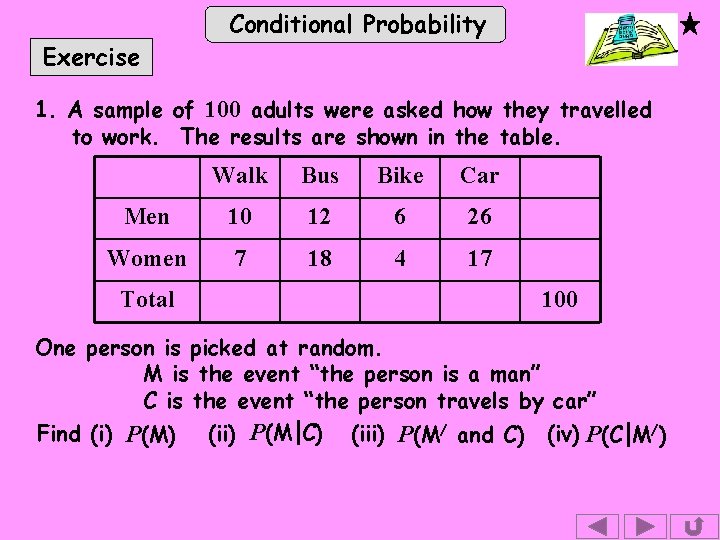
Exercise Conditional Probability 1. A sample of 100 adults were asked how they travelled to work. The results are shown in the table. Walk Bus Bike Car Men 10 12 6 26 Women 7 18 4 17 Total 100 One person is picked at random. M is the event “the person is a man” C is the event “the person travels by car” Find (i) P(M) (ii) P(M C) (iii) P(M/ and C) (iv) P(C M/)
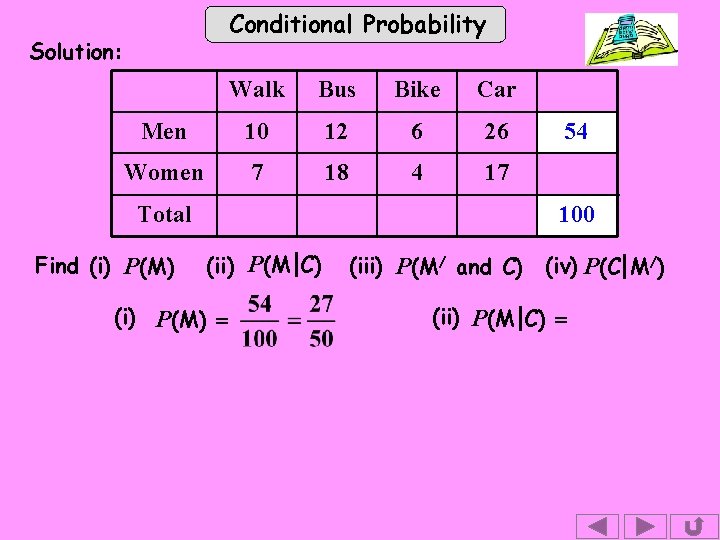
Conditional Probability Solution: Walk Bus Bike Car Men 10 12 6 26 Women 7 18 4 17 Total Find (i) P(M) 54 100 (ii) P(M C) (i) P(M) = (iii) P(M/ and C) (iv) P(C M/) (ii) P(M C) =
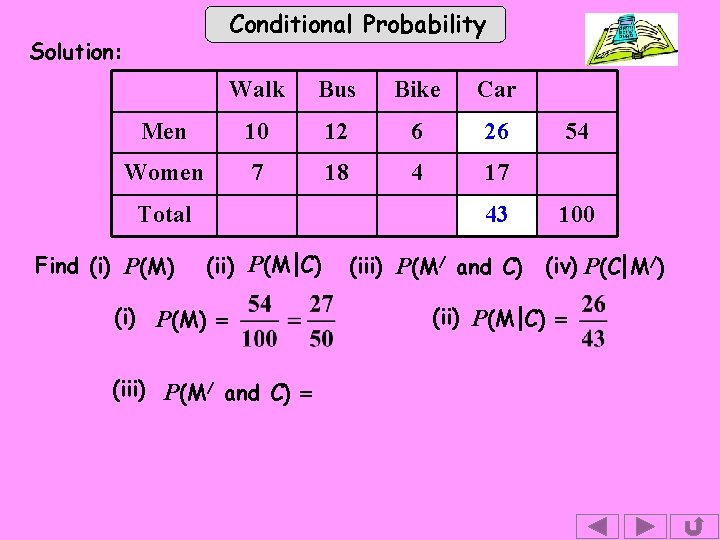
Conditional Probability Solution: Walk Bus Bike Car Men 10 12 6 26 Women 7 18 4 17 Total Find (i) P(M) 43 (ii) P(M C) (i) P(M) = (iii) P(M/ and C) 54 100 (iv) P(C M/) (ii) P(M C) =
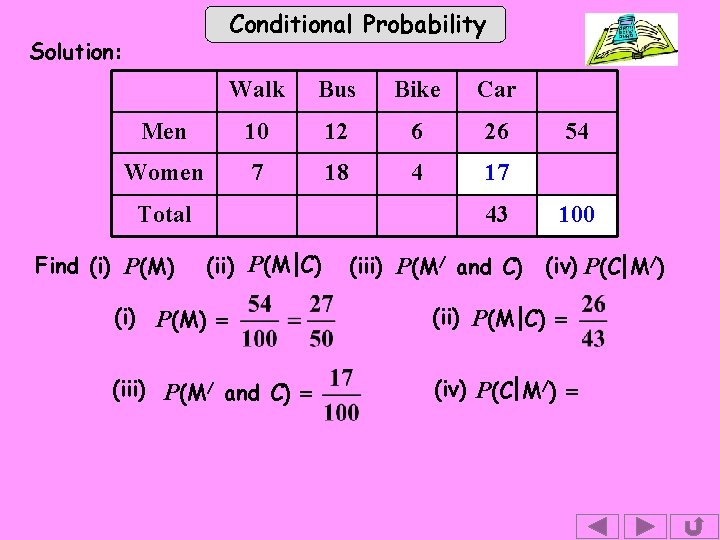
Conditional Probability Solution: Walk Bus Bike Car Men 10 12 6 26 Women 7 18 4 17 Total Find (i) P(M) 43 (ii) P(M C) (iii) P(M/ and C) 54 100 (iv) P(C M/) (i) P(M) = (ii) P(M C) = (iii) P(M/ and C) = (iv) P(C M/) =
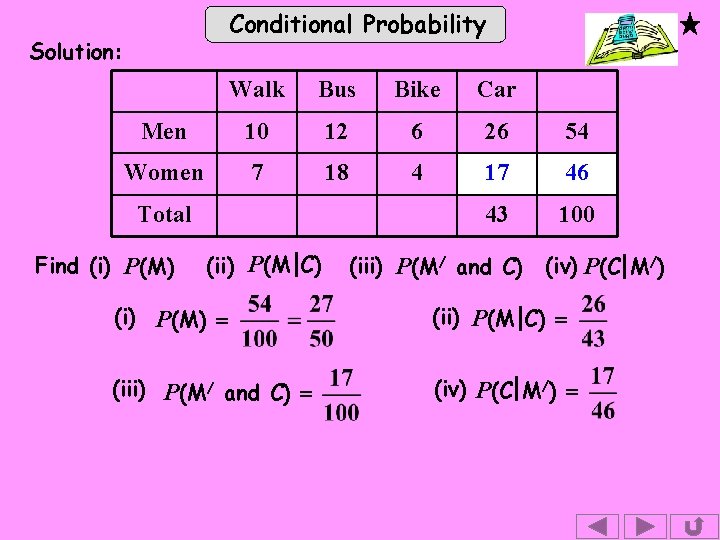
Conditional Probability Solution: Walk Bus Bike Car Men 10 12 6 26 54 Women 7 18 4 17 46 43 100 Total Find (i) P(M) (ii) P(M C) (iii) P(M/ and C) (iv) P(C M/) (i) P(M) = (ii) P(M C) = (iii) P(M/ and C) = (iv) P(C M/) =
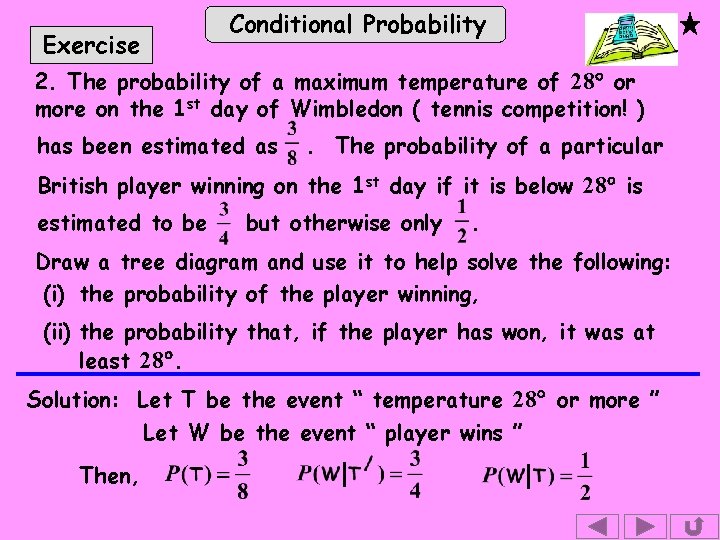
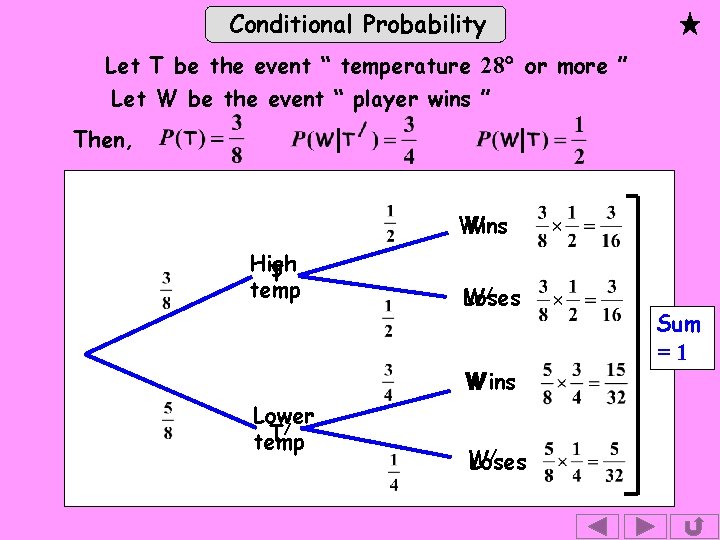
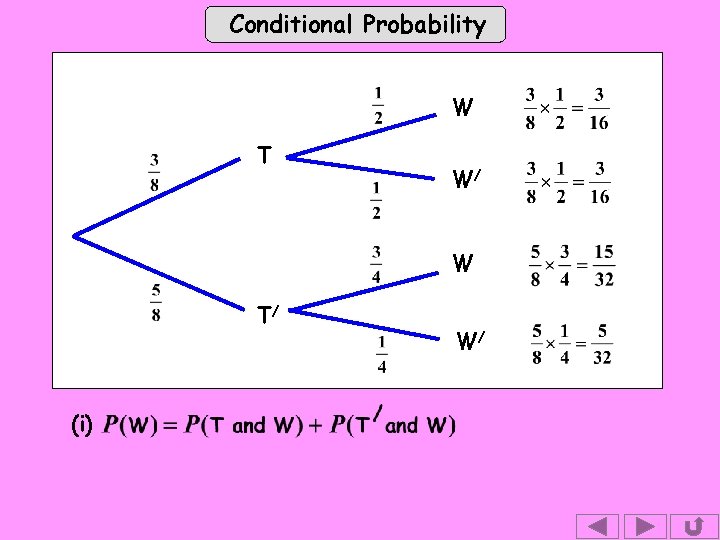
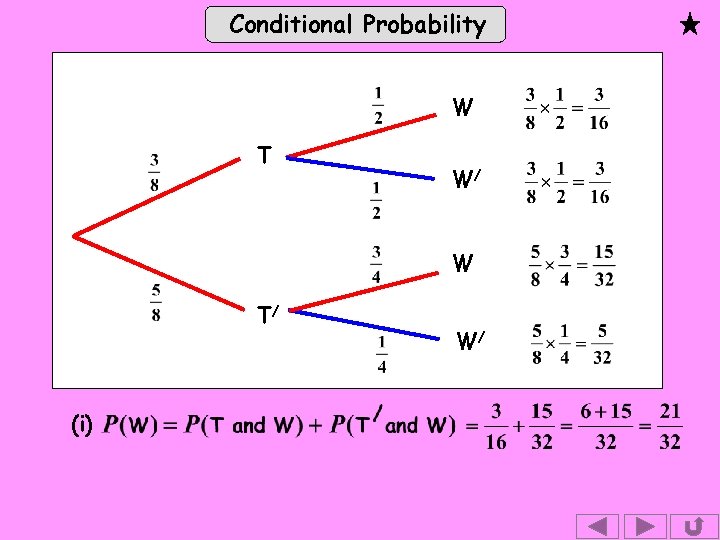
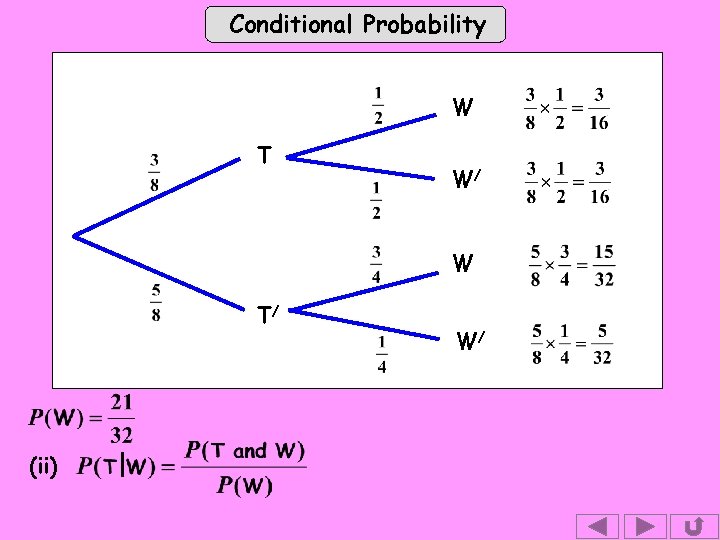
Conditional Probability Exercise 2. The probability of a maximum temperature of 28 or more on the 1 st day of Wimbledon ( tennis competition! ) has been estimated as . The probability of a particular British player winning on the 1 st day if it is below 28 is estimated to be but otherwise only . Draw a tree diagram and use it to help solve the following: (i) the probability of the player winning, (ii) the probability that, if the player has won, it was at least 28. Solution: Let T be the event “ temperature 28 or more ” Let W be the event “ player wins ” Then,
Conditional Probability Let T be the event “ temperature 28 or more ” Let W be the event “ player wins ” Then, Wins W High T temp W/ Loses W Wins Lower / T temp / W Loses Sum =1
Conditional Probability W T W/ W T/ (i) W/
Conditional Probability W T W/ W T/ (i) W/
Conditional Probability W T W/ W T/ (ii) W/
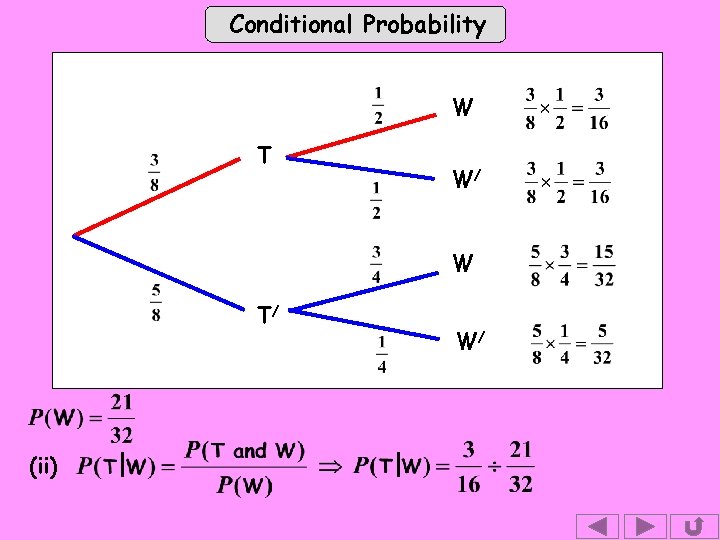
Conditional Probability W T W/ W T/ (ii) W/
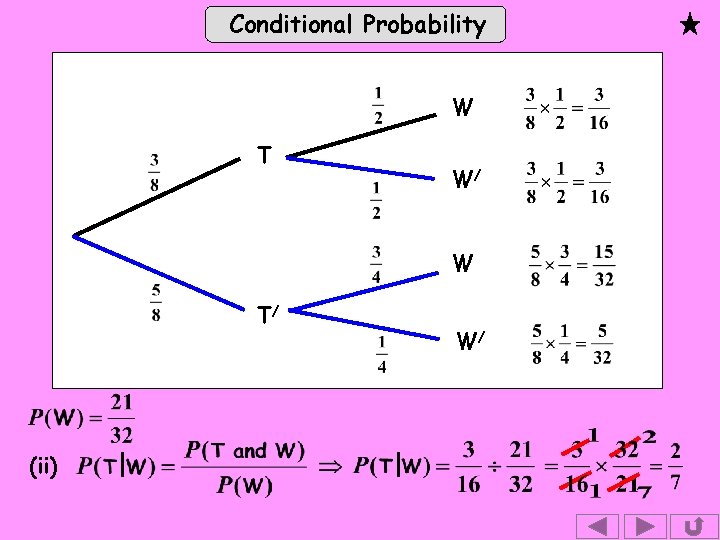
Conditional Probability W T W/ W T/ (ii) W/
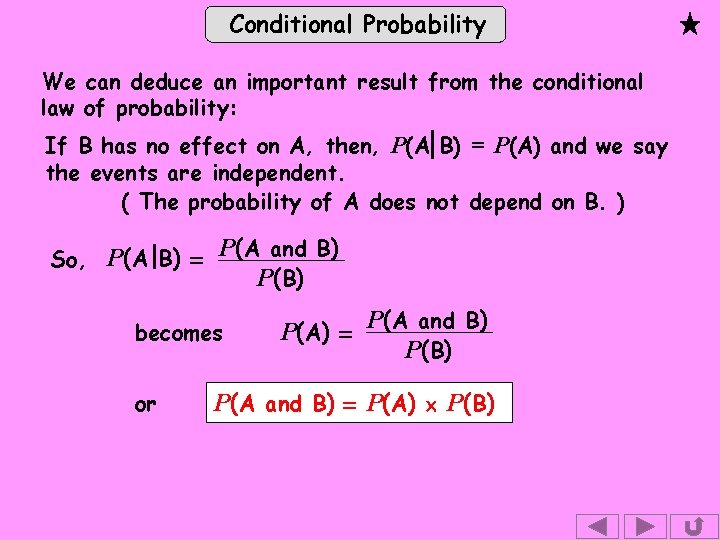
Conditional Probability We can deduce an important result from the conditional law of probability: If B has no effect on A, then, P(A B) = P(A) and we say the events are independent. ( The probability of A does not depend on B. ) So, P(A B) = P(A and B) P (B ) becomes or P(A) = P(A and B) P (B ) P(A and B) = P(A) P(B)
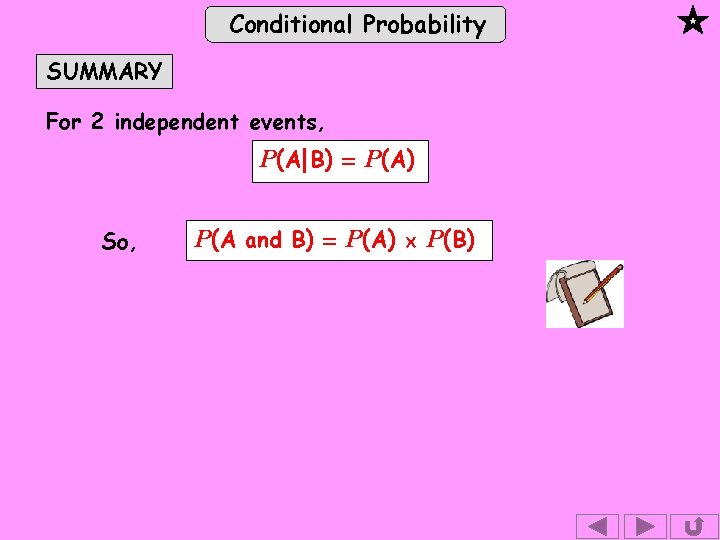
Conditional Probability SUMMARY For 2 independent events, P (A B ) = P (A ) So, P(A and B) = P(A) P(B)
The following slides contain repeats of information on earlier slides, shown without colour, so that they can be printed and photocopied. For most purposes the slides can be printed as “Handouts” with up to 6 slides per sheet.
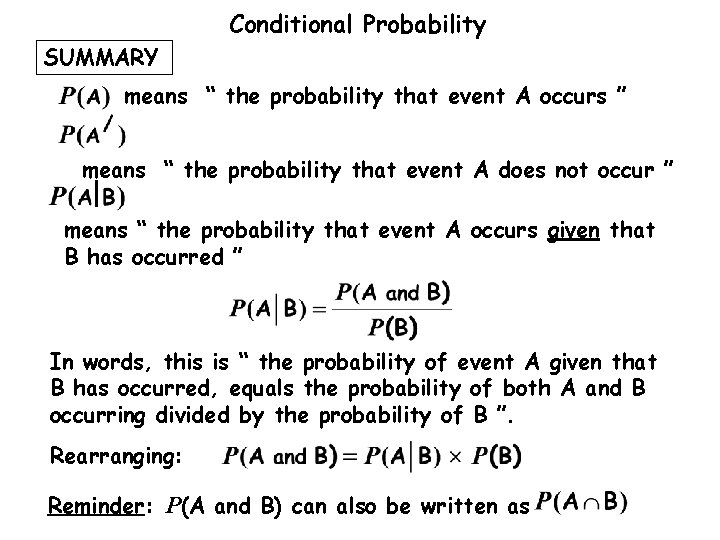
Conditional Probability SUMMARY means “ the probability that event A occurs ” means “ the probability that event A does not occur ” means “ the probability that event A occurs given that B has occurred ” In words, this is “ the probability of event A given that B has occurred, equals the probability of both A and B occurring divided by the probability of B ”. Rearranging: Reminder: P(A and B) can also be written as
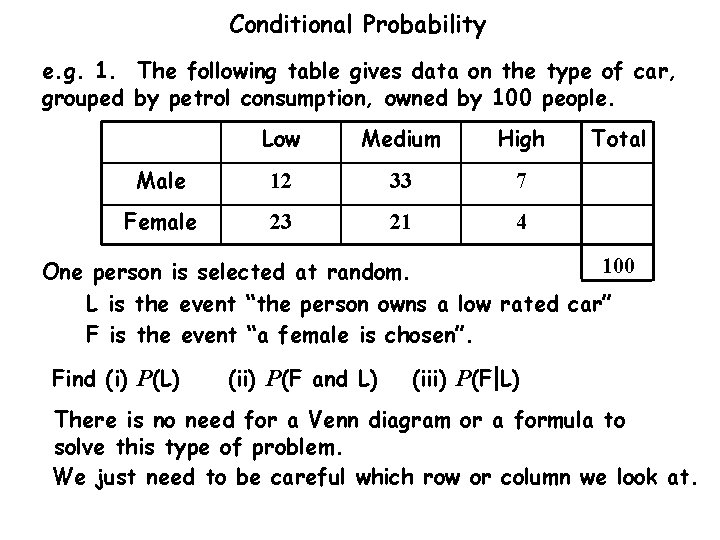
Conditional Probability e. g. 1. The following table gives data on the type of car, grouped by petrol consumption, owned by 100 people. Low Medium High Male 12 33 7 Female 23 21 4 Total 100 One person is selected at random. L is the event “the person owns a low rated car” F is the event “a female is chosen”. Find (i) P(L) (ii) P(F and L) (iii) P(F L) There is no need for a Venn diagram or a formula to solve this type of problem. We just need to be careful which row or column we look at.
Conditional Probability Solution: Male Female Low 12 23 Medium 33 21 High 7 4 Total 100 Find (i) P(L) (ii) P(F and L) (iii) P(F L) (i) P(L) = (ii) P(F and L) = (iii) P(F L) = Notice that P(L) P(F L) = P(F and L) So, P(F and L) = P(F L) P(L)
Conditional Probability e. g. 2. I have 2 packets of seeds. One contains 20 seeds and although they look the same, 8 will give red flowers and 12 blue. The 2 nd packet has 25 seeds of which 15 will be red and 10 blue. Draw a Venn diagram and use it to illustrate the conditional probability formula. Solution: Let R be the event “ red flower ” and F be the event “ 1 st packet ” P(R and F) = P(R F) = P(F) = 45 R F 12 P(R F) P(F) = So, P(R and F) = P(R F) P(F) 8 15 10
Conditional Probability e. g. 3. In November, the probability of a man getting to work on time if there is fog on the M 6 is If the visibility is good, the probability is . . The probability of fog at the time he travels is . (a) Calculate the probability of him arriving on time. (b) Calculate the probability that there was fog given that he arrives on time. Solution: Let T be the event “ getting to work on time ” Let F be the event “ fog on the M 6 ”
Conditional Probability (a) Calculate the probability of him arriving on time. T F T/ F/ T T/
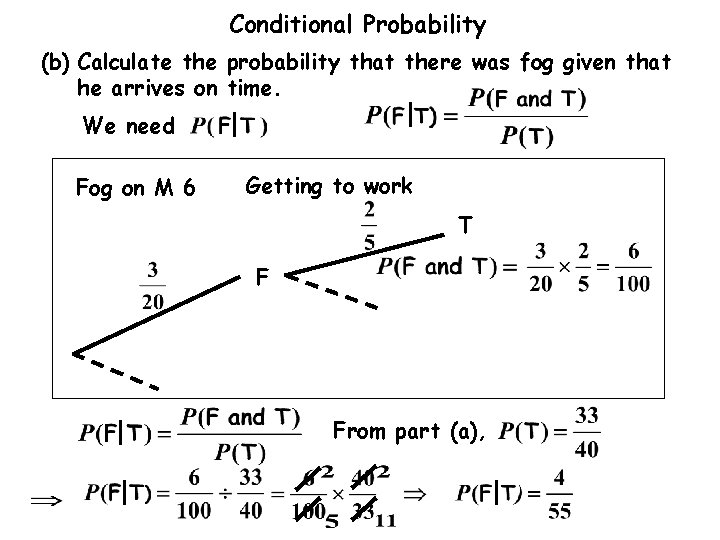
Conditional Probability (b) Calculate the probability that there was fog given that he arrives on time. We need Fog on M 6 Getting to work T F From part (a),
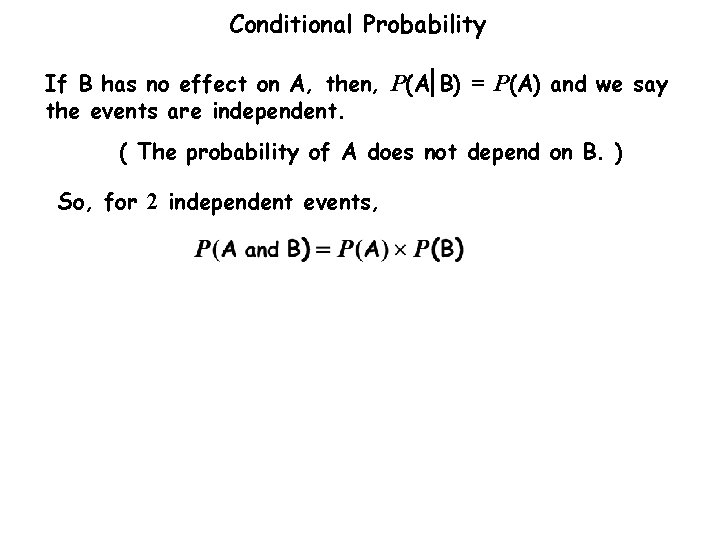
Conditional Probability If B has no effect on A, then, P(A B) = P(A) and we say the events are independent. ( The probability of A does not depend on B. ) So, for 2 independent events,
- Slides: 66