
Teach A Level Maths Vol 1 AS Core

- Slides: 26
“Teach A Level Maths” Vol. 1: AS Core Modules 51: The Trapezium Rule © Christine Crisp
The Trapezium Rule Module C 2 "Certain images and/or photos on this presentation are the copyrighted property of Jupiter. Images and are being used with permission under license. These images and/or photos may not be copied or downloaded without permission from Jupiter. Images"
The Trapezium Rule To find an area bounded by a curve, we need to evaluate a definite integral. If the integral cannot be evaluated, we can use an approximate method. This presentation uses the approximate method called the Trapezium Rule.
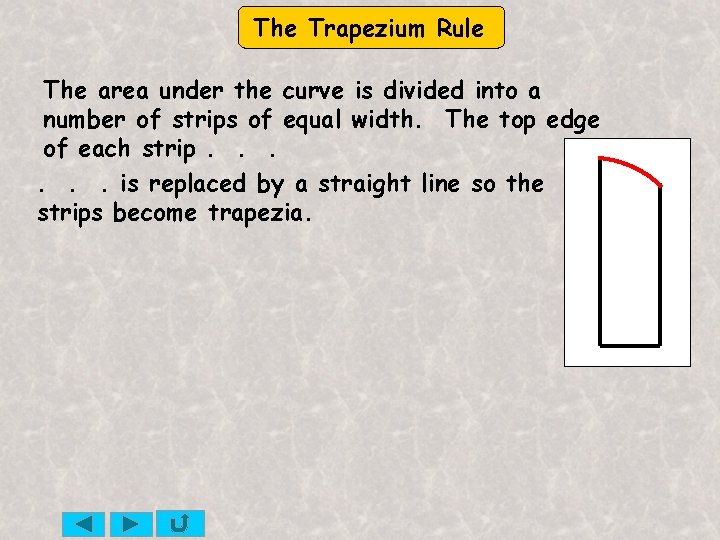
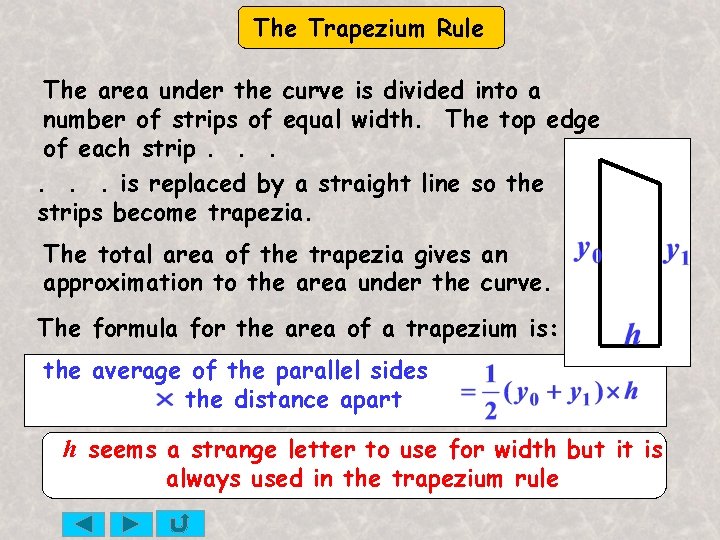
The Trapezium Rule The area under the curve is divided into a number of strips of equal width. The top edge of each strip. . . is replaced by a straight line so the strips become trapezia.
The Trapezium Rule The area under the curve is divided into a number of strips of equal width. The top edge of each strip. . . is replaced by a straight line so the strips become trapezia. The total area of the trapezia gives an approximation to the area under the curve. The formula for the area of a trapezium is: the average of the parallel sides the distance apart h seems a strange letter to use for width but it is always used in the trapezium rule
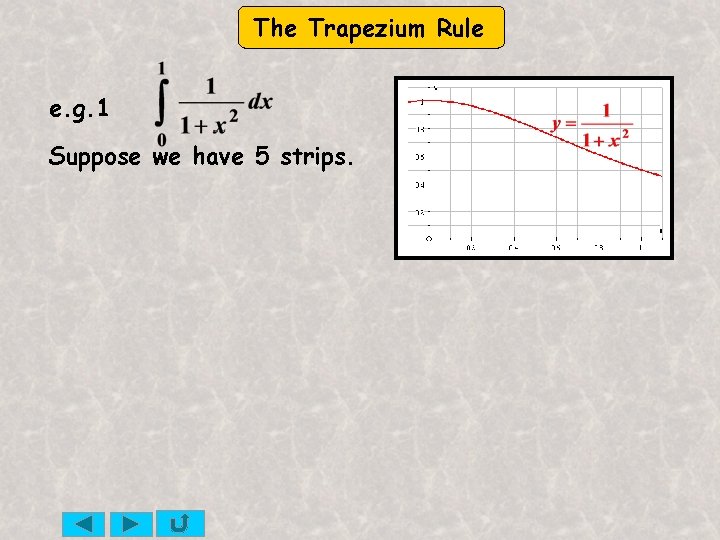
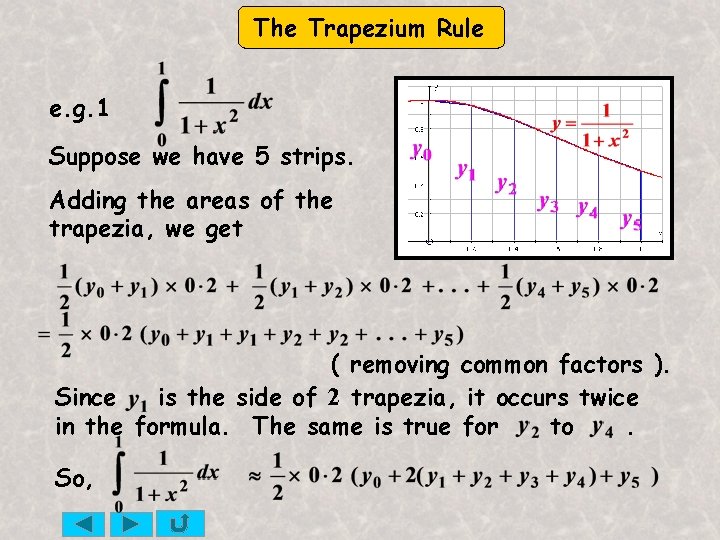
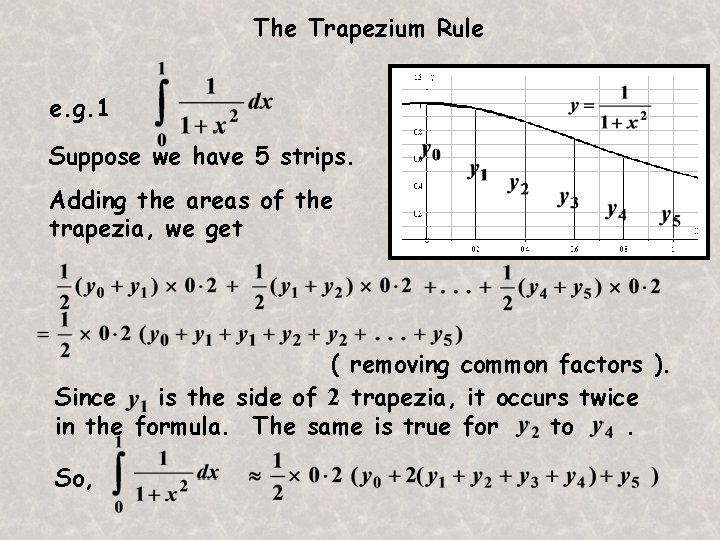
The Trapezium Rule e. g. 1 Suppose we have 5 strips.
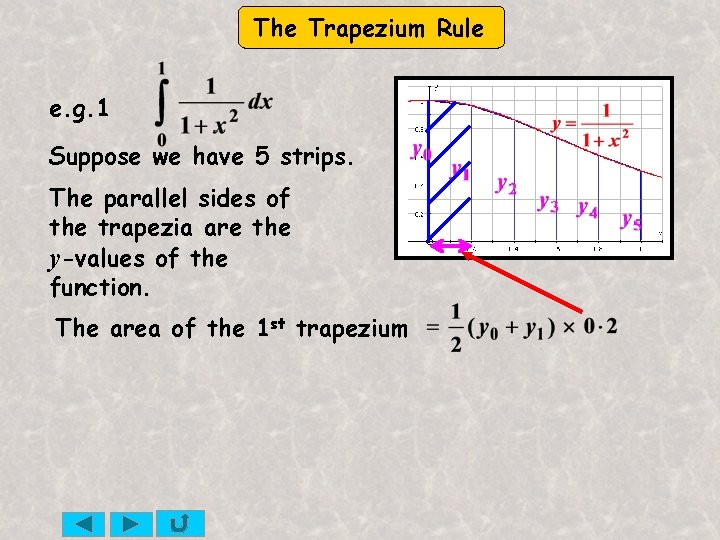
The Trapezium Rule e. g. 1 Suppose we have 5 strips. The parallel sides of the trapezia are the y-values of the function. The area of the 1 st trapezium
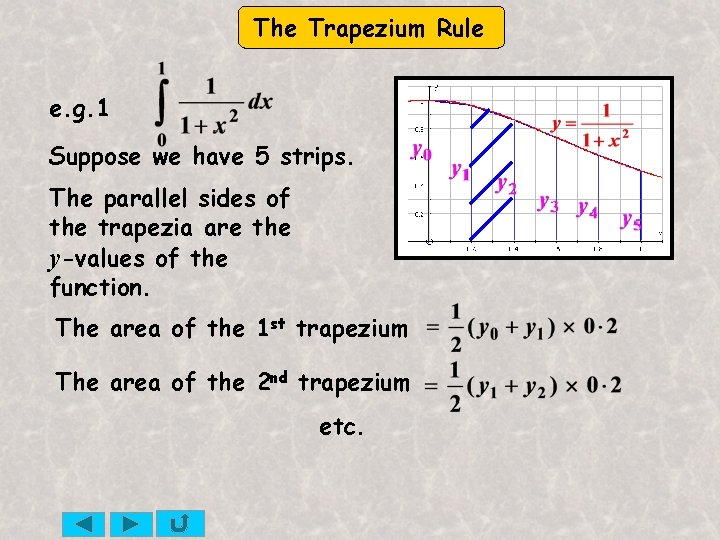
The Trapezium Rule e. g. 1 Suppose we have 5 strips. The parallel sides of the trapezia are the y-values of the function. The area of the 1 st trapezium The area of the 2 nd trapezium etc.
The Trapezium Rule e. g. 1 Suppose we have 5 strips. Adding the areas of the trapezia, we get ( removing common factors ). Since is the side of 2 trapezia, it occurs twice in the formula. The same is true for to. So,
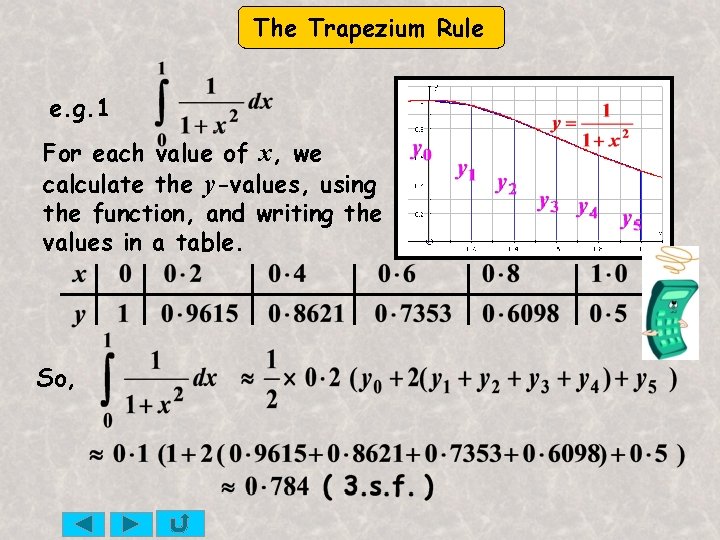
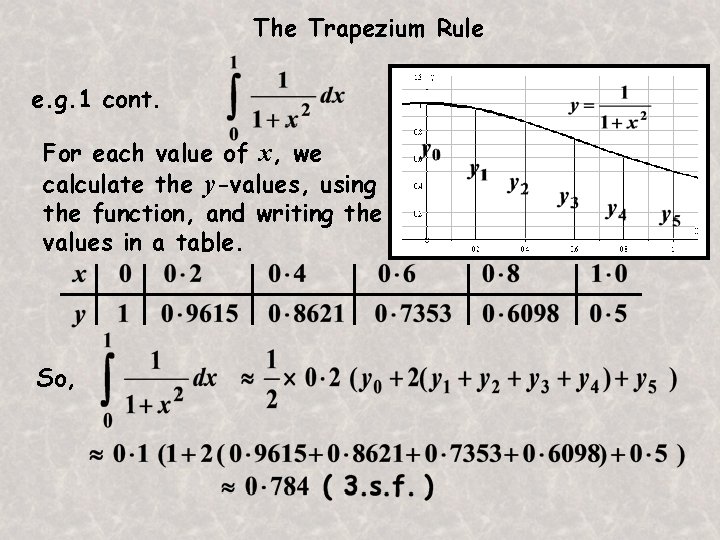
The Trapezium Rule e. g. 1 For each value of x, we calculate the y-values, using the function, and writing the values in a table. So,
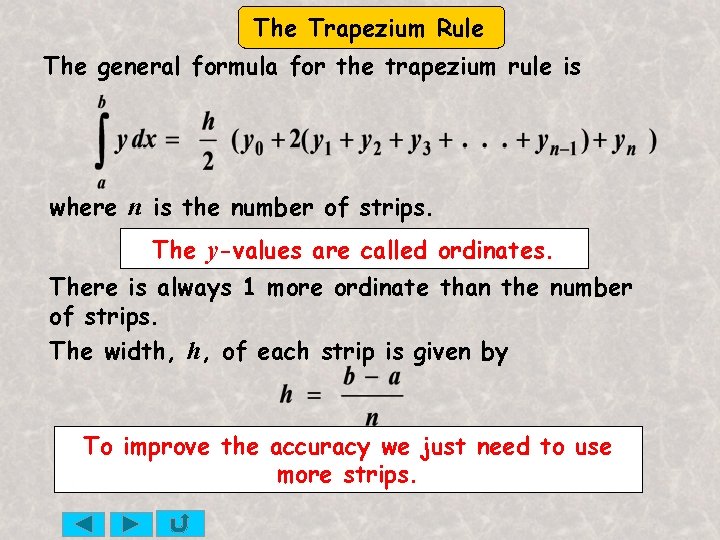
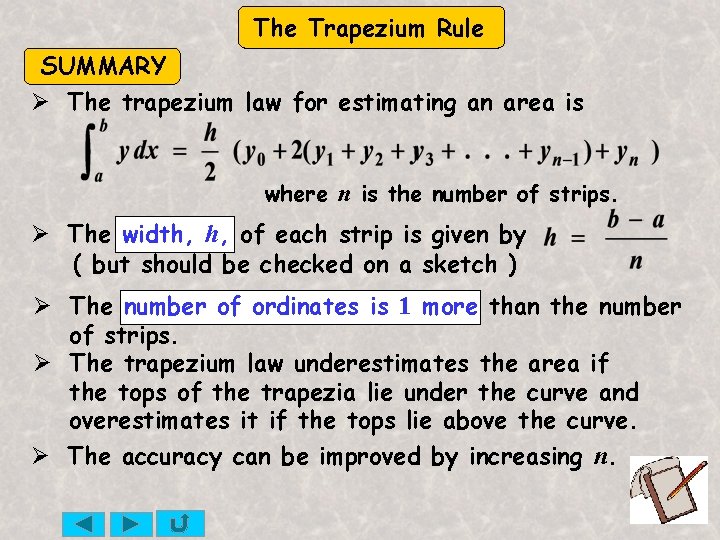
The Trapezium Rule The general formula for the trapezium rule is where n is the number of strips. The y-values are called ordinates. There is always 1 more ordinate than the number of strips. The width, h, of each strip is given by To improve the accuracy we just need to use more strips.
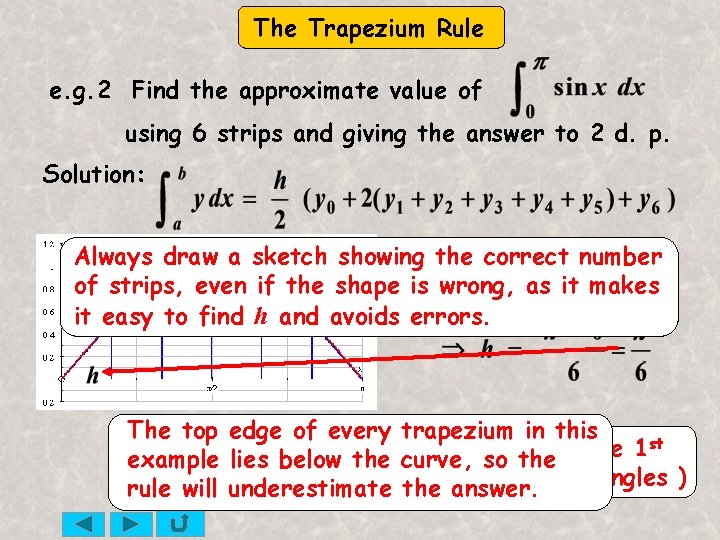
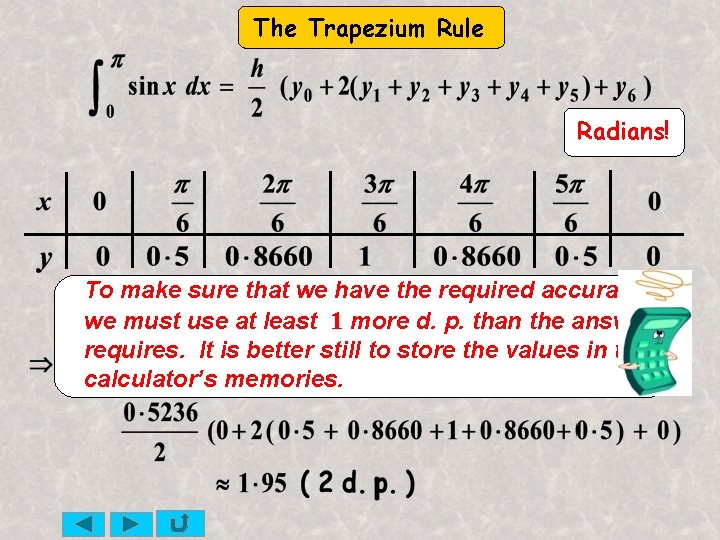
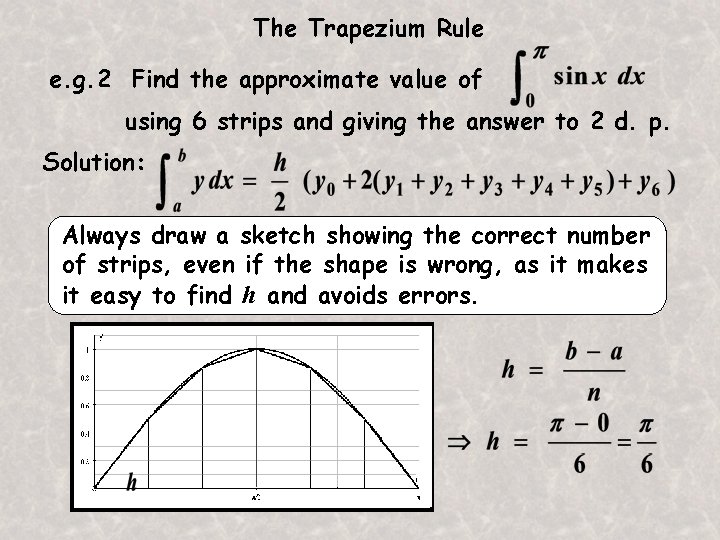
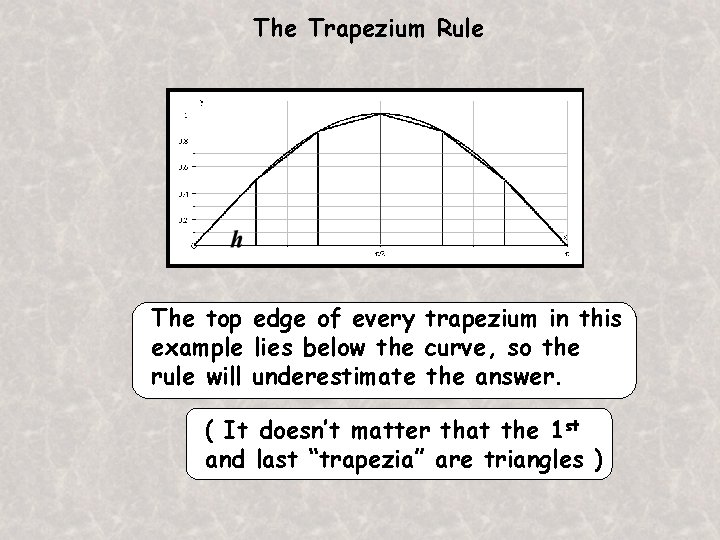
The Trapezium Rule e. g. 2 Find the approximate value of using 6 strips and giving the answer to 2 d. p. Solution: Always draw a sketch showing the correct number of strips, even if the shape is wrong, as it makes it easy to find h and avoids errors. The top edge of every trapezium in this st ( It doesn’t matter that the 1 example lies below the curve, so the and last “trapezia” are triangles ) rule will underestimate the answer.
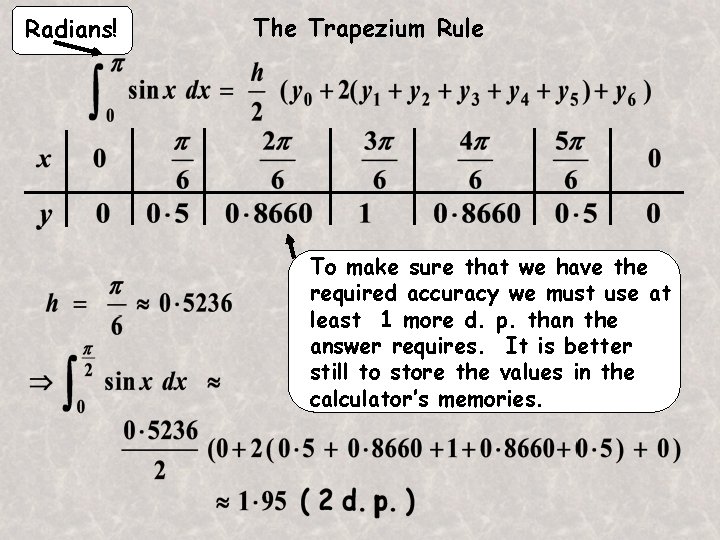
The Trapezium Rule Radians! To make sure that we have the required accuracy we must use at least 1 more d. p. than the answer requires. It is better still to store the values in the calculator’s memories.
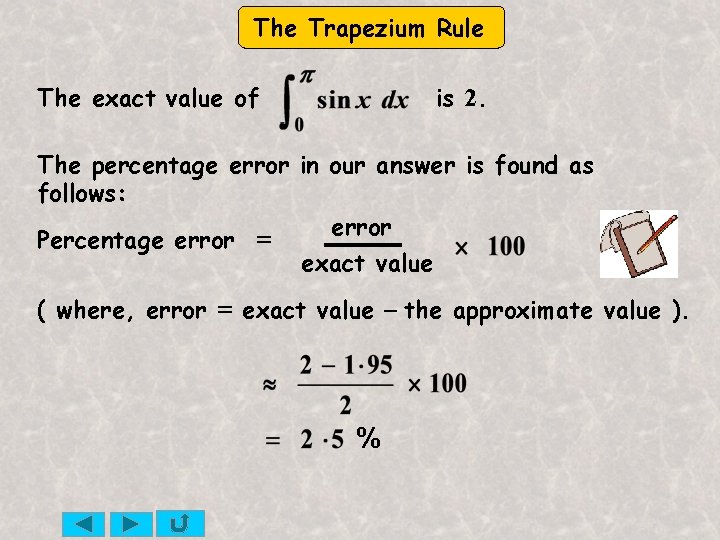
The Trapezium Rule The exact value of is 2. The percentage error in our answer is found as follows: error Percentage error = exact value ( where, error = exact value - the approximate value ). %
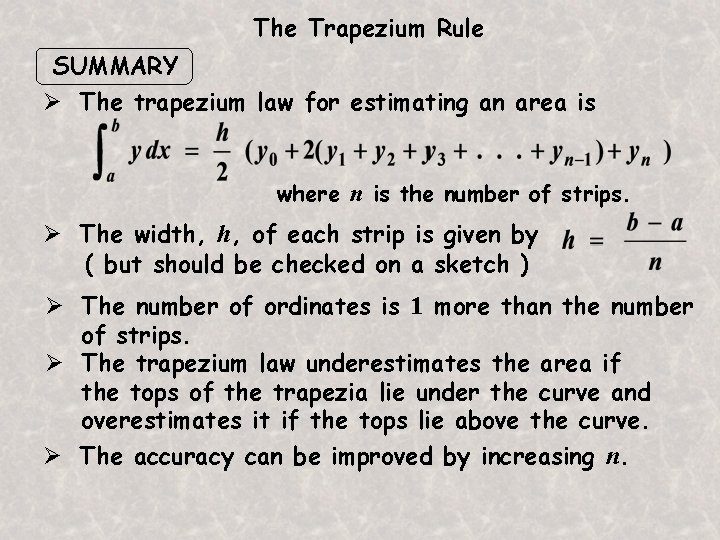
The Trapezium Rule SUMMARY Ø The trapezium law for estimating an area is where n is the number of strips. Ø The width, h, of each strip is given by ( but should be checked on a sketch ) Ø The number of ordinates is 1 more than the number of strips. Ø The trapezium law underestimates the area if the tops of the trapezia lie under the curve and overestimates it if the tops lie above the curve. Ø The accuracy can be improved by increasing n.
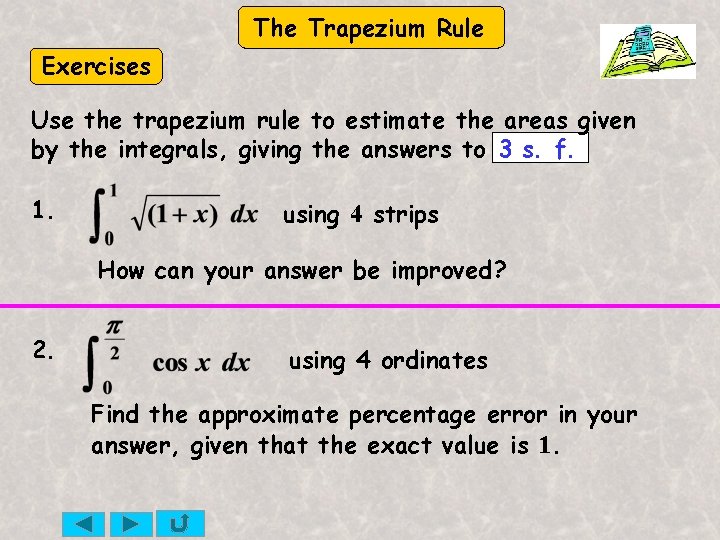
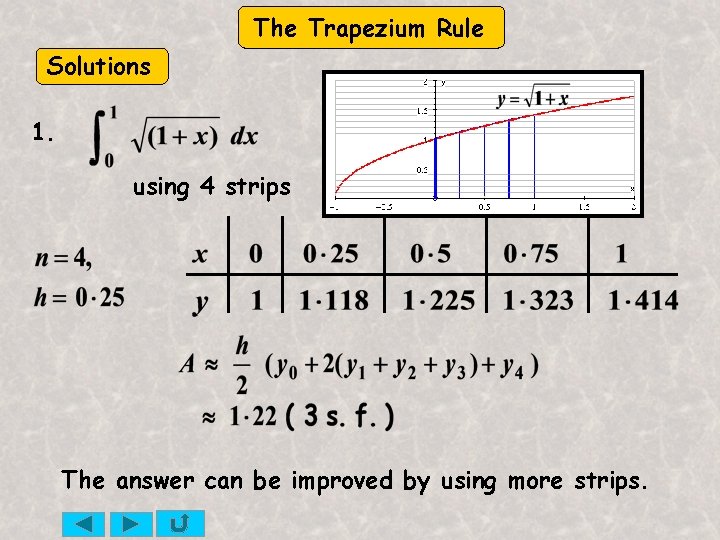
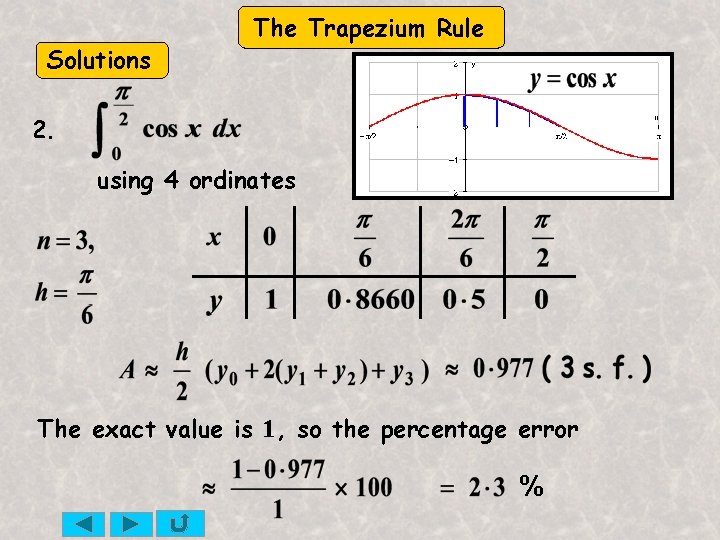
The Trapezium Rule Exercises Use the trapezium rule to estimate the areas given by the integrals, giving the answers to 3 s. f. 1. using 4 strips How can your answer be improved? 2. using 4 ordinates Find the approximate percentage error in your answer, given that the exact value is 1.
The Trapezium Rule Solutions 1. using 4 strips The answer can be improved by using more strips.
Solutions The Trapezium Rule 2. using 4 ordinates The exact value is 1, so the percentage error %
The Trapezium Rule
The Trapezium Rule The following slides contain repeats of information on earlier slides, shown without colour, so that they can be printed and photocopied. For most purposes the slides can be printed as “Handouts” with up to 6 slides per sheet.
The Trapezium Rule e. g. 1 Suppose we have 5 strips. Adding the areas of the trapezia, we get ( removing common factors ). Since is the side of 2 trapezia, it occurs twice in the formula. The same is true for to. So,
The Trapezium Rule e. g. 1 cont. For each value of x, we calculate the y-values, using the function, and writing the values in a table. So,
The Trapezium Rule e. g. 2 Find the approximate value of using 6 strips and giving the answer to 2 d. p. Solution: Always draw a sketch showing the correct number of strips, even if the shape is wrong, as it makes it easy to find h and avoids errors.
The Trapezium Rule The top edge of every trapezium in this example lies below the curve, so the rule will underestimate the answer. ( It doesn’t matter that the 1 st and last “trapezia” are triangles )
Radians! The Trapezium Rule To make sure that we have the required accuracy we must use at least 1 more d. p. than the answer requires. It is better still to store the values in the calculator’s memories.
The Trapezium Rule SUMMARY Ø The trapezium law for estimating an area is where n is the number of strips. Ø The width, h, of each strip is given by ( but should be checked on a sketch ) Ø The number of ordinates is 1 more than the number of strips. Ø The trapezium law underestimates the area if the tops of the trapezia lie under the curve and overestimates it if the tops lie above the curve. Ø The accuracy can be improved by increasing n.