
TE Topology and Tunnel Modeling for Transport Networks
- Slides: 12
TE Topology and Tunnel Modeling for Transport Networks draft-bryskin-teas-te-topo-and-tunnel-modeling Igor Bryskin (Huawei Technologies) Xufeng Liu (Jabil) Vishnu Pavan Beeram (Juniper Networks) Tarek Saad (Cisco) 1
Includes: § TE topology modeling constructs and attributes § TE Tunnel modeling constructs and attributes § Use cases explaining use of TE topology and tunnel models 2
Changes from IETF 100 presentation • Introduced new concepts/features: - shared protection - protection commands/actions • On– and off-line discussions • Editorial changes 3
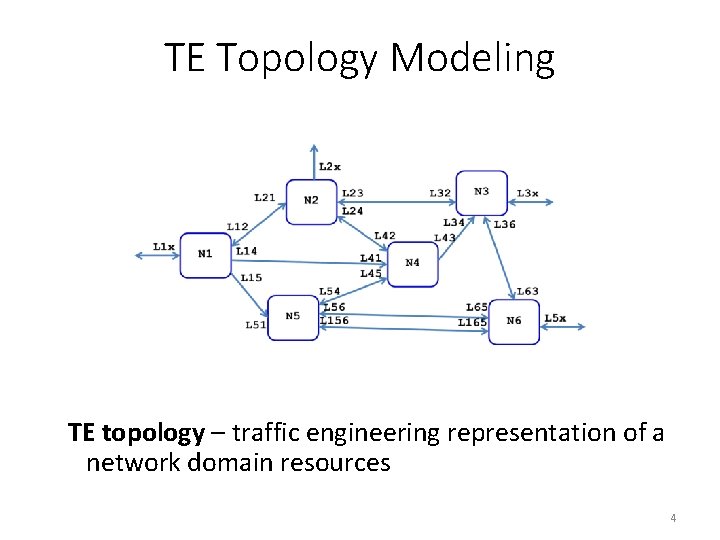
TE Topology Modeling TE topology – traffic engineering representation of a network domain resources 4
TE Topology Elements § TE node (vertex on TE topology graph) – represents network's flexibility (switching capabilities and limitations) § TE link (edge on TE topology graph) - represents network’s forwarding capability (bandwidth) § TE link termination point - represents a point of connection of a TE node to one of TE links it terminates § TE tunnel termination point - represents network’s client-server layer adaptation capability 5
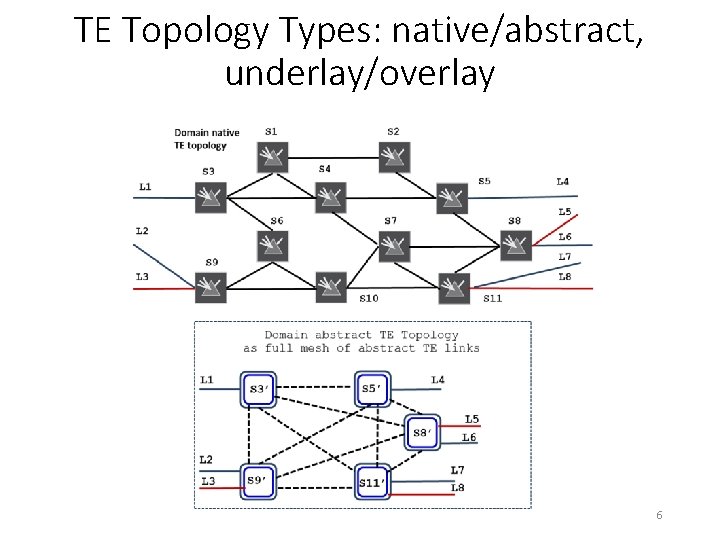
TE Topology Types: native/abstract, underlay/overlay 6
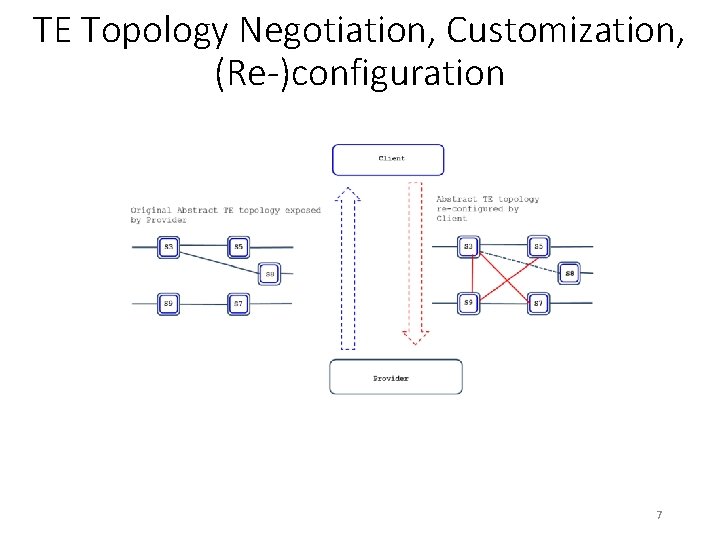
TE Topology Negotiation, Customization, (Re-)configuration 7
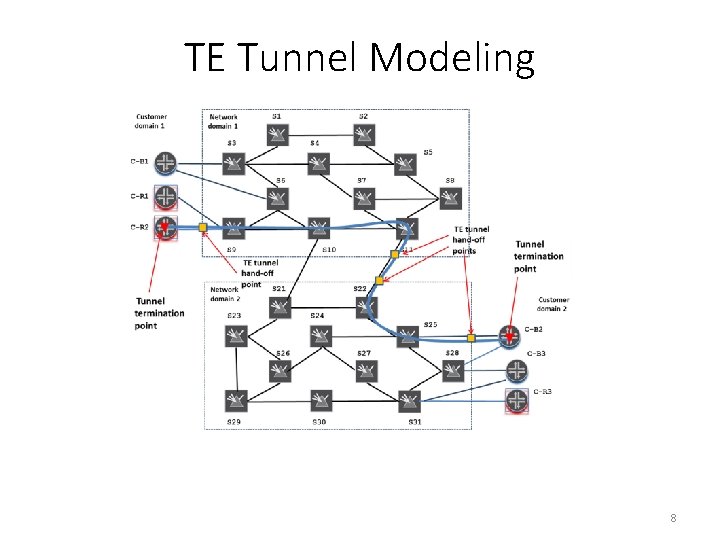
TE Tunnel Modeling 8
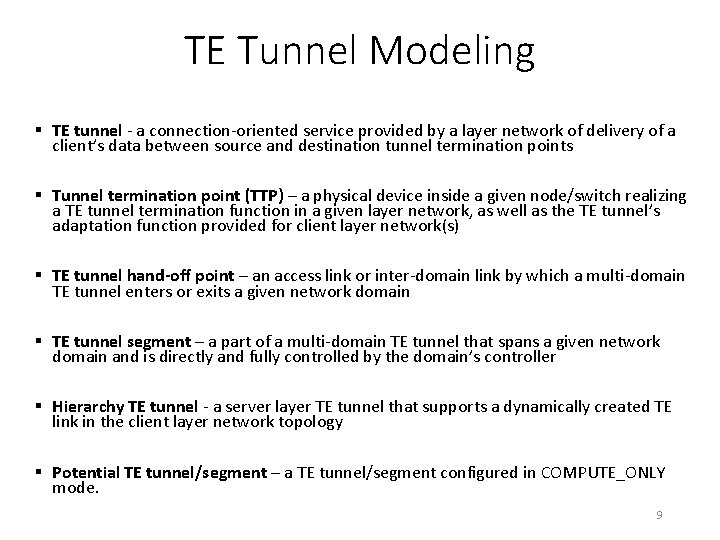
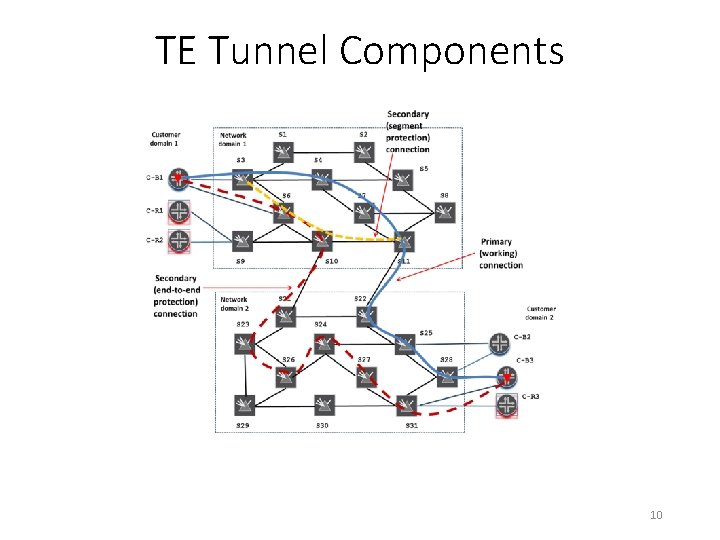
TE Tunnel Modeling § TE tunnel - a connection-oriented service provided by a layer network of delivery of a client’s data between source and destination tunnel termination points § Tunnel termination point (TTP) – a physical device inside a given node/switch realizing a TE tunnel termination function in a given layer network, as well as the TE tunnel’s adaptation function provided for client layer network(s) § TE tunnel hand-off point – an access link or inter-domain link by which a multi-domain TE tunnel enters or exits a given network domain § TE tunnel segment – a part of a multi-domain TE tunnel that spans a given network domain and is directly and fully controlled by the domain’s controller § Hierarchy TE tunnel - a server layer TE tunnel that supports a dynamically created TE link in the client layer network topology § Potential TE tunnel/segment – a TE tunnel/segment configured in COMPUTE_ONLY mode. 9
TE Tunnel Components 10
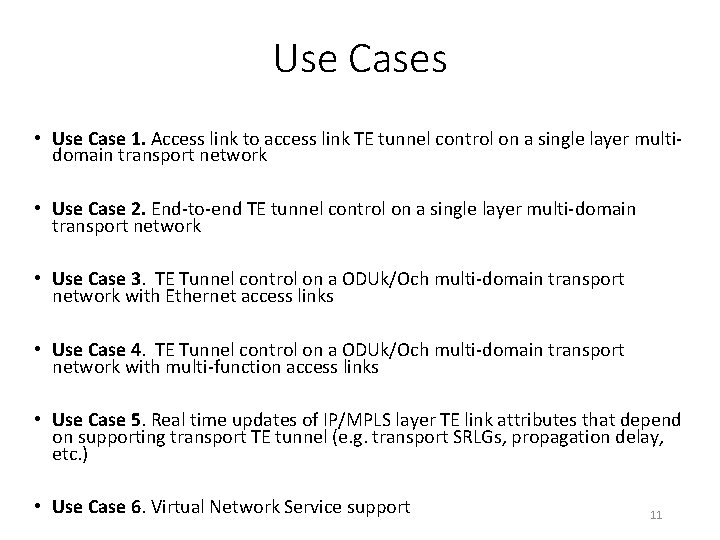
Use Cases • Use Case 1. Access link to access link TE tunnel control on a single layer multidomain transport network • Use Case 2. End-to-end TE tunnel control on a single layer multi-domain transport network • Use Case 3. TE Tunnel control on a ODUk/Och multi-domain transport network with Ethernet access links • Use Case 4. TE Tunnel control on a ODUk/Och multi-domain transport network with multi-function access links • Use Case 5. Real time updates of IP/MPLS layer TE link attributes that depend on supporting transport TE tunnel (e. g. transport SRLGs, propagation delay, etc. ) • Use Case 6. Virtual Network Service support 11
Next steps § Aligning with the latest TE topology and tunnel models § Providing missing definitions and guidances § Adding more use cases § Soliciting more feedback from WG 12