
TE Halls Cultural Framework Edward T Hall a
- Slides: 13
TE Halls’ Cultural Framework
• Edward T. Hall, a respected anthropologist and cross-cultural researcher, identified two classic dimensions of culture in his books The Silent Language and The Hidden Dimension. Understanding and applying these concepts can help today’s leaders improve their communication skills across cultures.
High-Context Versus Low-Context Cultures • Hall presented a popular cultural framework in which he stated that all cultures are situated in relation to one another through the styles in which they communicate (Wurtz, 2005). He identified high-context and low-context cultures, where the high and low context concept is primarily concerned with the way information is transmitted (communicated) and where context has to do with how much you need to know before you can communicate effectively (Dahl, 2006 and www. via-web. de).
• Low-context communication occurs predominantly through explicit statements in text and speech – the mass of the information is vested in the explicit code. As such, most of the information must be in the transmitted message in order to make up for what is missing in the context. Cultures, such as Scandinavians, Germans, and the Swiss, are predominantly low-context communicators
• High-context transactions are the reverse. This context involves implying a message through that which is not spoken; messages include other communication cues such as body language, eye movement, para-verbal cues, and the use of silence (Wurtz, 2005). These transactions feature pre-programmed information that is in the receiver and in the setting, with only minimal information in the transmitted message (Hall, 1976 as presented in Dahl, 2006). Cultures considered high-context are Japan and Arab countries.
• Although this concept is one of the easiest concepts to witness in intercultural encounters, these differences in communication styles pose significant challenges. Consider, for example, American and Japanese executives engaged in negotiations. The communication style of Americans is typically identified as low-context; direct communication is expected. Japanese have the concept of Wa, harmony being the most valued principle in their society. As such, this concept is reflected in their high-context communication style where subtle eye movements, body language, silence, and their indirect expression of “no” are common (Hall and Hall, 1990). If an executive from America attempts to engage in a business transaction in Japan without understanding this difference, it is unlikely true communication will happen and a successful transaction achieved.
Monochronic and Polychronic Cultures • Hall’s second concept deals with the ways in which cultures structure time, how cultures perceive and manage time. His concept of polychronic verses monochronic time orientation is also easy to understand, but lacks empirical data (Dahl, 2006). However, it has merit in analyzing cultural implications about time and communication.
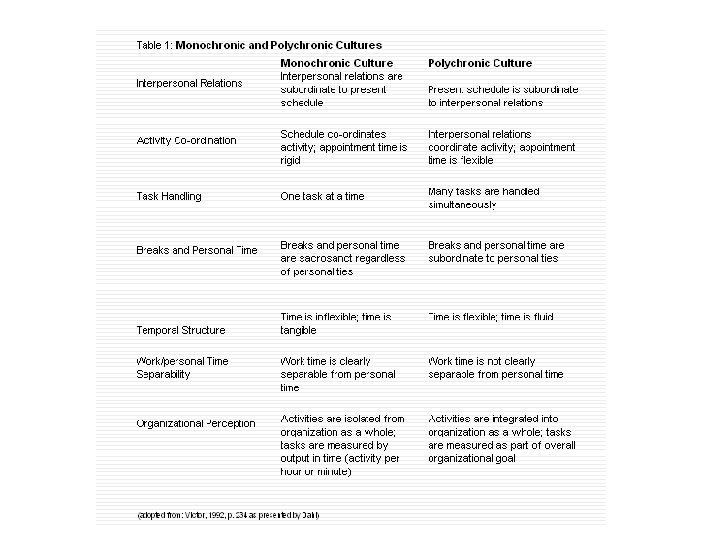
• Cultures (and individuals) identified as monochronic typically emphasize doing one thing at a time during a specified time-period, working on a single task until it is finished. Monochrons see time as being divided into fixed elements (seconds, minutes, hours, etc. ), sequential blocks that can be organized, quantified, and scheduled. They love to plan in detail, make lists, keep track of activities, and organize time into a daily routine. Only after one task is completed are they comfortable moving to another, and switching back and forth from one task to another is not only wasteful and distracting, it is also uncomfortable
• In contrast, polychronic cultures are involved with many things at once, usually with varying levels of attention paid to each. For polychrons, time is continuous, moving from an infinite past through the present and into an infinite future; it has no particular structure. Polychrons prefer not to have detailed plans imposed on them but want to make their own plans and meet deadlines in their own way. Switching from one activity to another is both stimulating and productive and the most desirable way to work
• The Japanese time culture provides an excellent example of this concept. Time use for the Japanese is complex and, depending on the cultural common practice and level of personal interaction likely to occur, exhibits both monochronistic and polychromatic traits. Although polychronic time use is more dominant, the language of time is not strictly polychronic. For example, appointments and scheduling are adhered to with great precision (monochronic) but polychronic time behaviors are followed once the meeting begins. In fact, when decisions in a business setting are to be made, it seems to take forever
• To further explain this difference, Americans tend to have a monochronic view of time (as do the British and Germans). Repetitive tasks (accountants, factory workers, train engineers, etc) that are easy to define within specified boundaries are preferred. In contrast, cultures that have greater value on human contact, patience, and honesty above speed (particularly amongst their own) have a polychronic view of time (most Asian cultures).
Conclusion • Hall’s concepts of high-context verses lowcontest cultures and monochronic and polychronic time orientation are easily observed and very useful. Although the lack of empirical data makes the monochronic/polychronic concept more difficult to apply in research, especially when comparing cultures that are seen as relatively close (Dahl, 2006), these concepts can help leaders and organizations preparing to cross cultural boundaries, better understand those with whom they desire to communicate and conduct business.