
TDSCDMA History Current Standard and Future Directions History

- Slides: 29
TD-SCDMA History, Current Standard, and Future Directions
History of TD-SCDMA
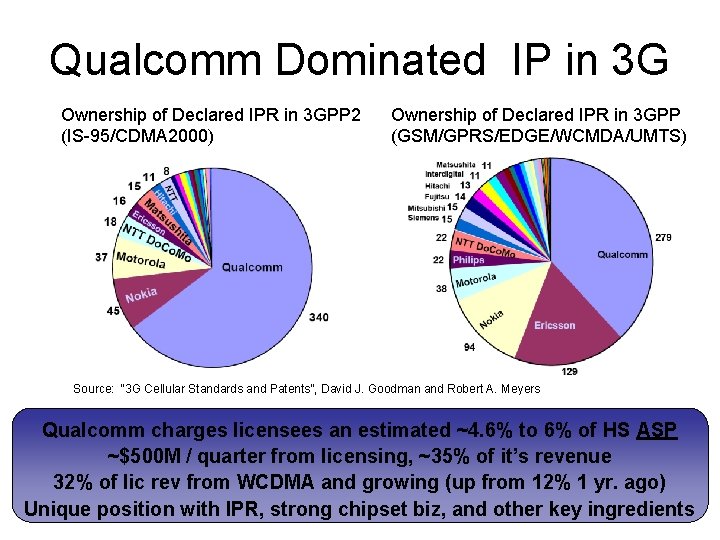
Qualcomm Dominated IP in 3 G Ownership of Declared IPR in 3 GPP 2 (IS-95/CDMA 2000) Ownership of Declared IPR in 3 GPP (GSM/GPRS/EDGE/WCMDA/UMTS) Source: “ 3 G Cellular Standards and Patents”, David J. Goodman and Robert A. Meyers Qualcomm charges licensees an estimated ~4. 6% to 6% of HS ASP ~$500 M / quarter from licensing, ~35% of it’s revenue 32% of lic rev from WCDMA and growing (up from 12% 1 yr. ago) Unique position with IPR, strong chipset biz, and other key ingredients
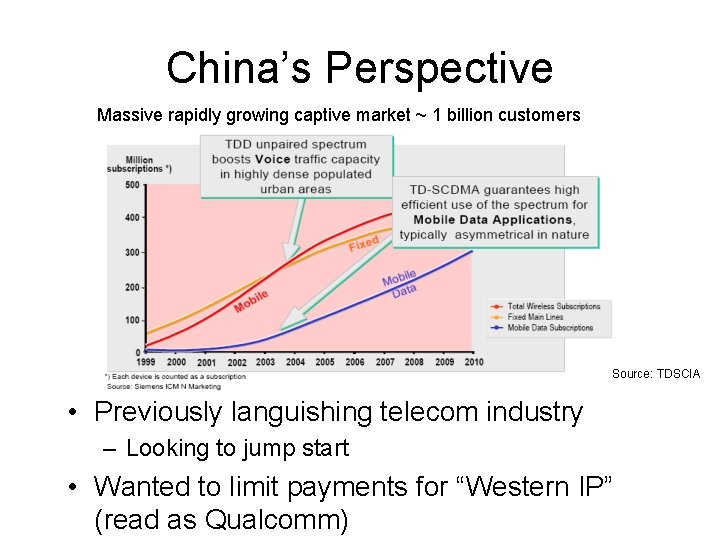
China’s Perspective Massive rapidly growing captive market ~ 1 billion customers Source: TDSCIA • Previously languishing telecom industry – Looking to jump start • Wanted to limit payments for “Western IP” (read as Qualcomm)
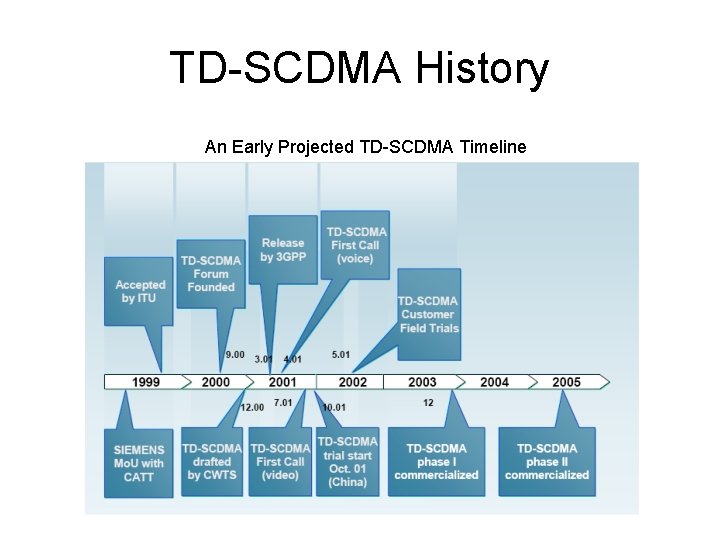
TD-SCDMA History An Early Projected TD-SCDMA Timeline
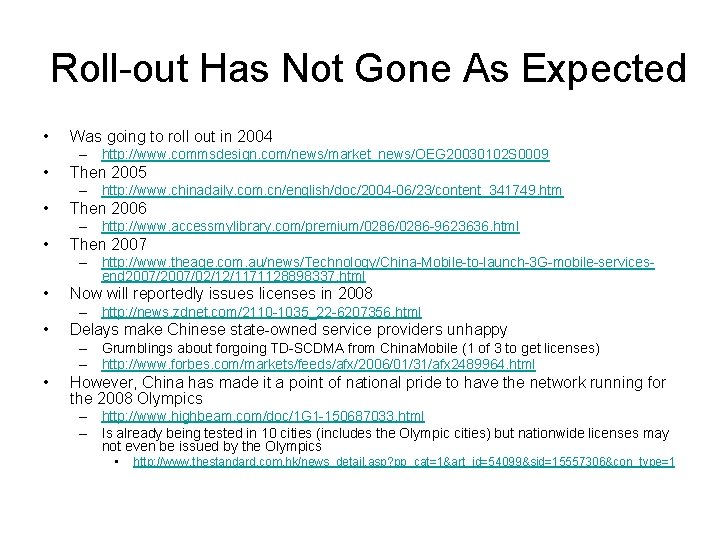
Roll-out Has Not Gone As Expected • Was going to roll out in 2004 – http: //www. commsdesign. com/news/market_news/OEG 20030102 S 0009 • Then 2005 – http: //www. chinadaily. com. cn/english/doc/2004 -06/23/content_341749. htm • Then 2006 – http: //www. accessmylibrary. com/premium/0286 -9623636. html • Then 2007 – http: //www. theage. com. au/news/Technology/China-Mobile-to-launch-3 G-mobile-servicesend 2007/02/12/1171128898337. html • Now will reportedly issues licenses in 2008 – http: //news. zdnet. com/2110 -1035_22 -6207356. html • Delays make Chinese state-owned service providers unhappy – Grumblings about forgoing TD-SCDMA from China. Mobile (1 of 3 to get licenses) – http: //www. forbes. com/markets/feeds/afx/2006/01/31/afx 2489964. html • However, China has made it a point of national pride to have the network running for the 2008 Olympics – http: //www. highbeam. com/doc/1 G 1 -150687033. html – Is already being tested in 10 cities (includes the Olympic cities) but nationwide licenses may not even be issued by the Olympics • http: //www. thestandard. com. hk/news_detail. asp? pp_cat=1&art_id=54099&sid=15557306&con_type=1
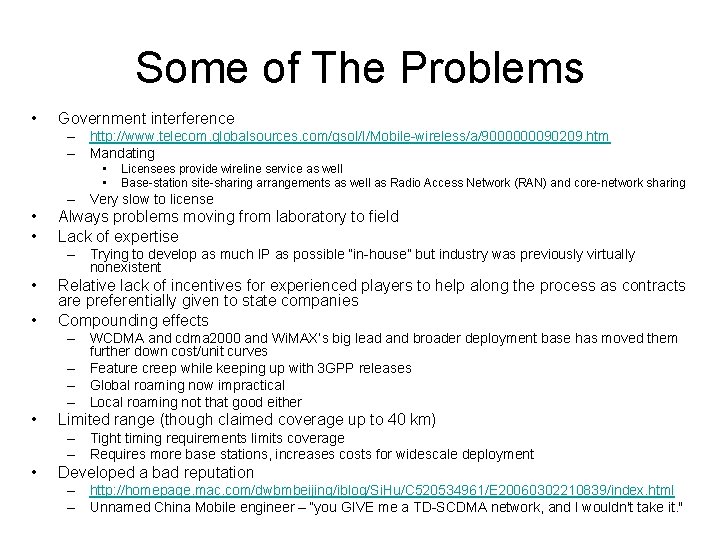
Some of The Problems • Government interference – http: //www. telecom. globalsources. com/gsol/I/Mobile-wireless/a/9000000090209. htm – Mandating • • Licensees provide wireline service as well Base-station site-sharing arrangements as well as Radio Access Network (RAN) and core-network sharing – Very slow to license • • Always problems moving from laboratory to field Lack of expertise – Trying to develop as much IP as possible “in-house” but industry was previously virtually nonexistent • • Relative lack of incentives for experienced players to help along the process as contracts are preferentially given to state companies Compounding effects – WCDMA and cdma 2000 and Wi. MAX’s big lead and broader deployment base has moved them further down cost/unit curves – Feature creep while keeping up with 3 GPP releases – Global roaming now impractical – Local roaming not that good either • Limited range (though claimed coverage up to 40 km) – Tight timing requirements limits coverage – Requires more base stations, increases costs for widescale deployment • Developed a bad reputation – http: //homepage. mac. com/dwbmbeijing/iblog/Si. Hu/C 520534961/E 20060302210839/index. html – Unnamed China Mobile engineer – “you GIVE me a TD-SCDMA network, and I wouldn't take it. "
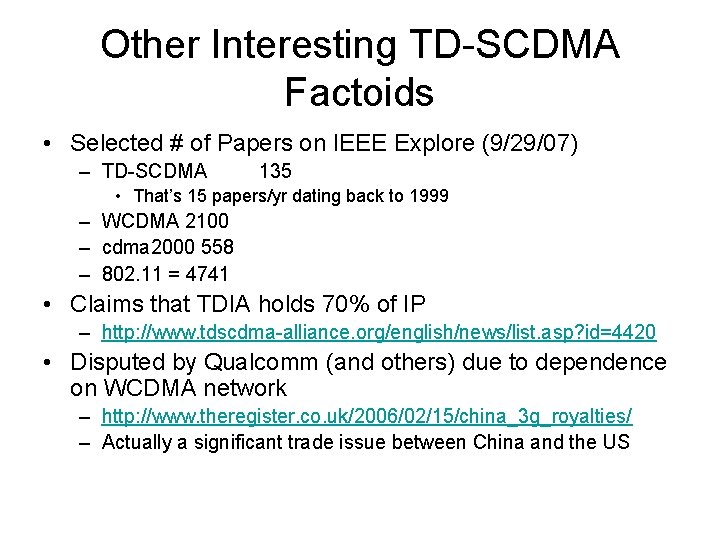
Other Interesting TD-SCDMA Factoids • Selected # of Papers on IEEE Explore (9/29/07) – TD-SCDMA 135 • That’s 15 papers/yr dating back to 1999 – WCDMA 2100 – cdma 2000 558 – 802. 11 = 4741 • Claims that TDIA holds 70% of IP – http: //www. tdscdma-alliance. org/english/news/list. asp? id=4420 • Disputed by Qualcomm (and others) due to dependence on WCDMA network – http: //www. theregister. co. uk/2006/02/15/china_3 g_royalties/ – Actually a significant trade issue between China and the US
Overview of TD-SCDMA Standard and Key Algorithms
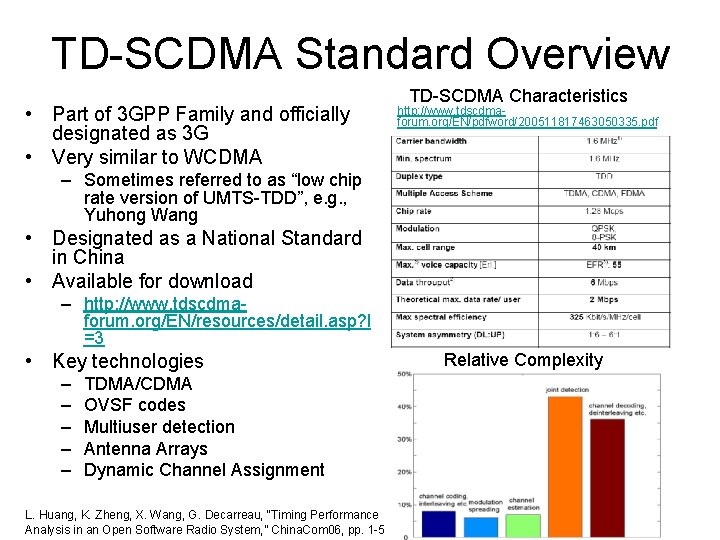
TD-SCDMA Standard Overview • Part of 3 GPP Family and officially designated as 3 G • Very similar to WCDMA TD-SCDMA Characteristics http: //www. tdscdmaforum. org/EN/pdfword/200511817463050335. pdf – Sometimes referred to as “low chip rate version of UMTS-TDD”, e. g. , Yuhong Wang • Designated as a National Standard in China • Available for download – http: //www. tdscdmaforum. org/EN/resources/detail. asp? l =3 • Key technologies – – – TDMA/CDMA OVSF codes Multiuser detection Antenna Arrays Dynamic Channel Assignment L. Huang, K. Zheng, X. Wang, G. Decarreau, “Timing Performance Analysis in an Open Software Radio System, ” China. Com 06, pp. 1 -5 Relative Complexity
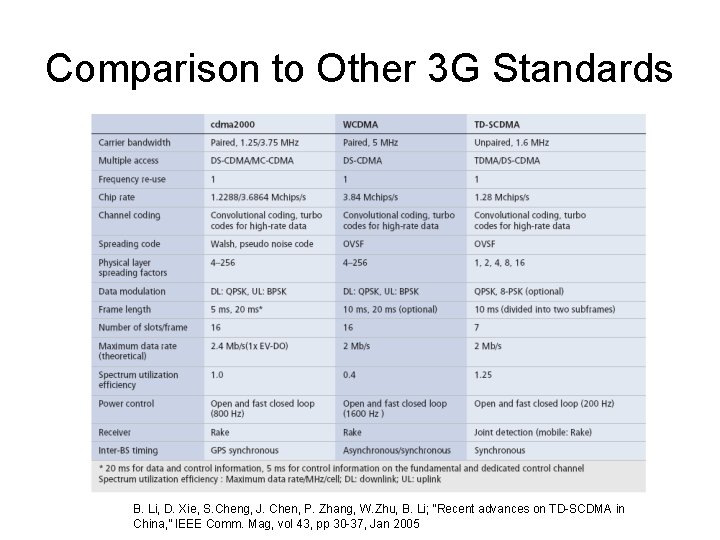
Comparison to Other 3 G Standards B. Li, D. Xie, S. Cheng, J. Chen, P. Zhang, W. Zhu, B. Li; “Recent advances on TD-SCDMA in China, ” IEEE Comm. Mag, vol 43, pp 30 -37, Jan 2005
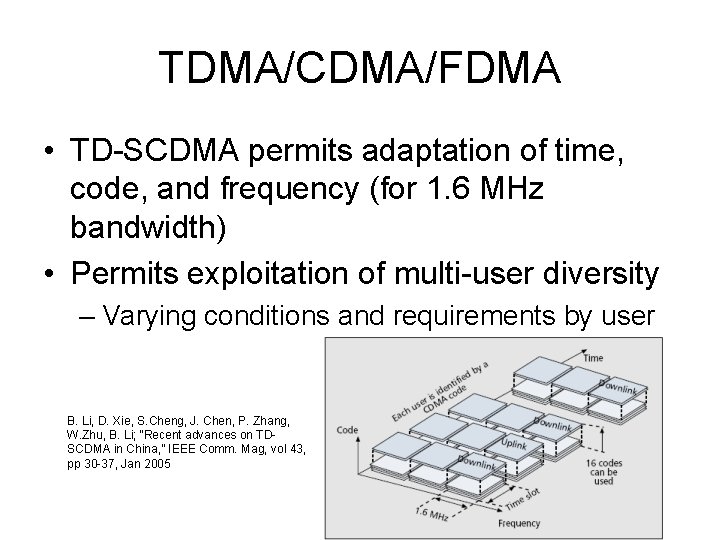
TDMA/CDMA/FDMA • TD-SCDMA permits adaptation of time, code, and frequency (for 1. 6 MHz bandwidth) • Permits exploitation of multi-user diversity – Varying conditions and requirements by user B. Li, D. Xie, S. Cheng, J. Chen, P. Zhang, W. Zhu, B. Li; “Recent advances on TDSCDMA in China, ” IEEE Comm. Mag, vol 43, pp 30 -37, Jan 2005
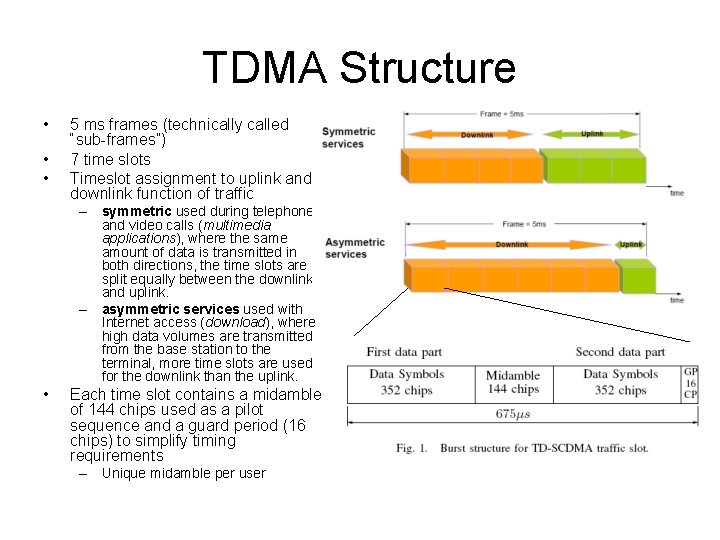
TDMA Structure • • • 5 ms frames (technically called “sub-frames”) 7 time slots Timeslot assignment to uplink and downlink function of traffic – symmetric used during telephone and video calls (multimedia applications), where the same amount of data is transmitted in both directions, the time slots are split equally between the downlink and uplink. – asymmetric services used with Internet access (download), where high data volumes are transmitted from the base station to the terminal, more time slots are used for the downlink than the uplink. • Each time slot contains a midamble of 144 chips used as a pilot sequence and a guard period (16 chips) to simplify timing requirements – Unique midamble per user
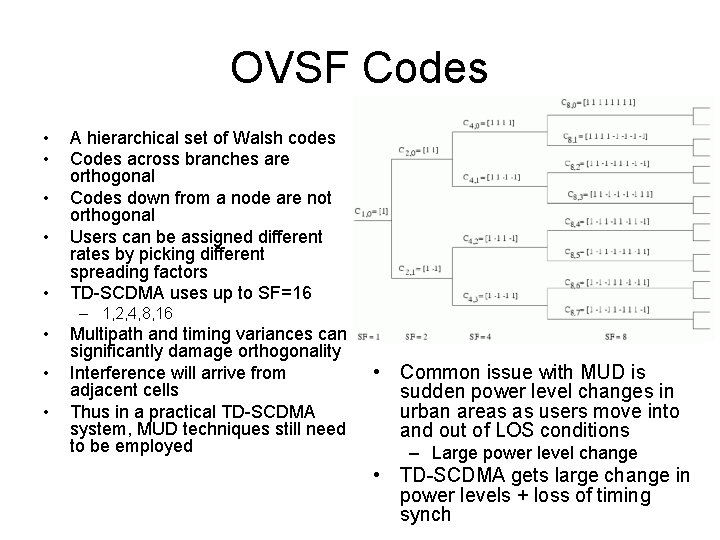
OVSF Codes • • • A hierarchical set of Walsh codes Codes across branches are orthogonal Codes down from a node are not orthogonal Users can be assigned different rates by picking different spreading factors TD-SCDMA uses up to SF=16 – 1, 2, 4, 8, 16 • • • Multipath and timing variances can significantly damage orthogonality Interference will arrive from adjacent cells Thus in a practical TD-SCDMA system, MUD techniques still need to be employed • Common issue with MUD is sudden power level changes in urban areas as users move into and out of LOS conditions – Large power level change • TD-SCDMA gets large change in power levels + loss of timing synch
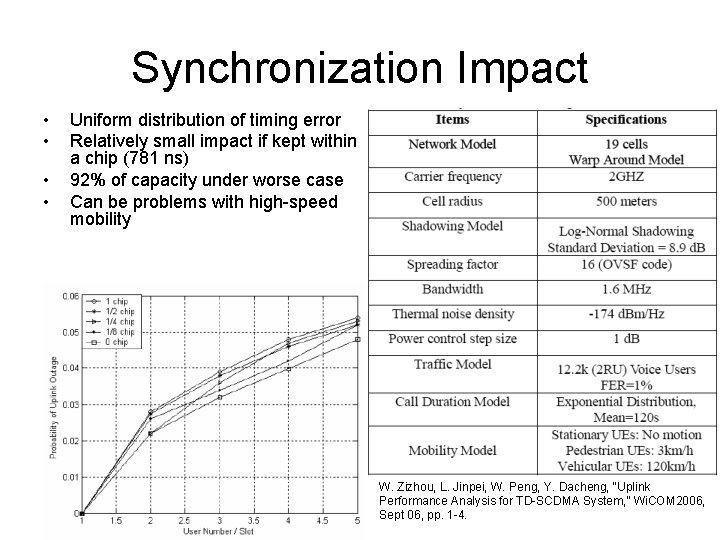
Synchronization Impact • • Uniform distribution of timing error Relatively small impact if kept within a chip (781 ns) 92% of capacity under worse case Can be problems with high-speed mobility W. Zizhou, L. Jinpei, W. Peng, Y. Dacheng, “Uplink Performance Analysis for TD-SCDMA System, ” Wi. COM 2006, Sept 06, pp. 1 -4.
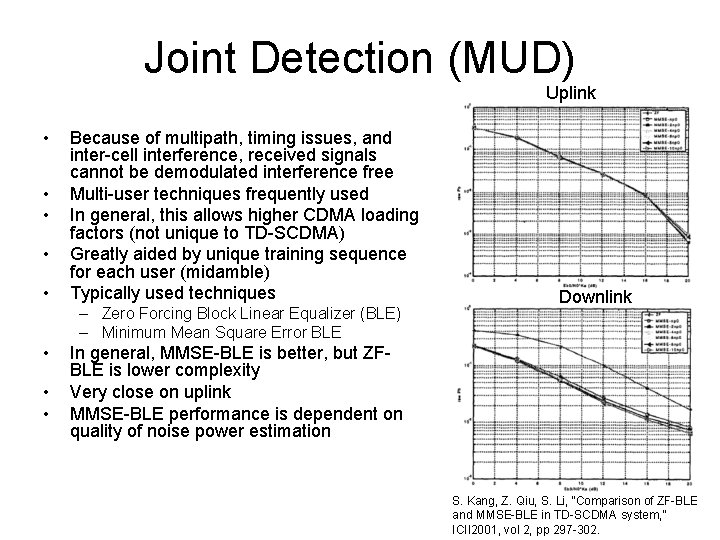
Joint Detection (MUD) Uplink • • • Because of multipath, timing issues, and inter-cell interference, received signals cannot be demodulated interference free Multi-user techniques frequently used In general, this allows higher CDMA loading factors (not unique to TD-SCDMA) Greatly aided by unique training sequence for each user (midamble) Typically used techniques – Zero Forcing Block Linear Equalizer (BLE) – Minimum Mean Square Error BLE • • • Downlink In general, MMSE-BLE is better, but ZFBLE is lower complexity Very close on uplink MMSE-BLE performance is dependent on quality of noise power estimation S. Kang, Z. Qiu, S. Li, “Comparison of ZF-BLE and MMSE-BLE in TD-SCDMA system, ” ICII 2001, vol 2, pp 297 -302.
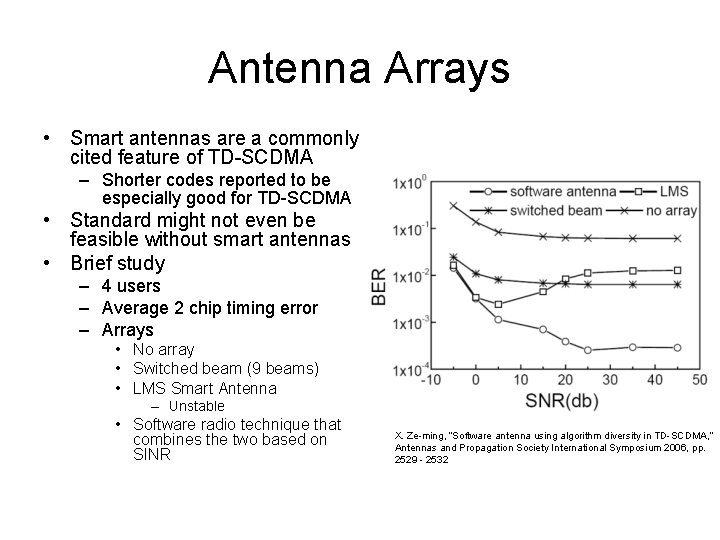
Antenna Arrays • Smart antennas are a commonly cited feature of TD-SCDMA – Shorter codes reported to be especially good for TD-SCDMA • Standard might not even be feasible without smart antennas • Brief study – 4 users – Average 2 chip timing error – Arrays • No array • Switched beam (9 beams) • LMS Smart Antenna – Unstable • Software radio technique that combines the two based on SINR X. Ze-ming, “Software antenna using algorithm diversity in TD-SCDMA, ” Antennas and Propagation Society International Symposium 2006, pp. 2529 - 2532
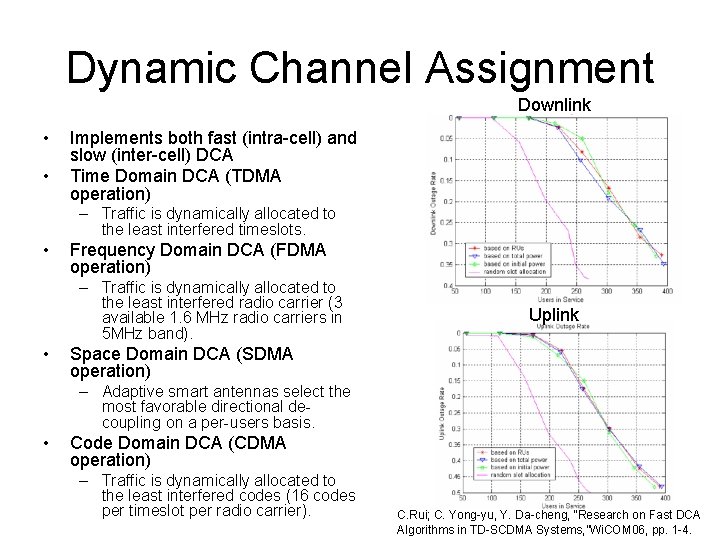
Dynamic Channel Assignment Downlink • • Implements both fast (intra-cell) and slow (inter-cell) DCA Time Domain DCA (TDMA operation) – Traffic is dynamically allocated to the least interfered timeslots. • Frequency Domain DCA (FDMA operation) – Traffic is dynamically allocated to the least interfered radio carrier (3 available 1. 6 MHz radio carriers in 5 MHz band). • Uplink Space Domain DCA (SDMA operation) – Adaptive smart antennas select the most favorable directional decoupling on a per-users basis. • Code Domain DCA (CDMA operation) – Traffic is dynamically allocated to the least interfered codes (16 codes per timeslot per radio carrier). C. Rui; C. Yong-yu, Y. Da-cheng, “Research on Fast DCA Algorithms in TD-SCDMA Systems, ”Wi. COM 06, pp. 1 -4.
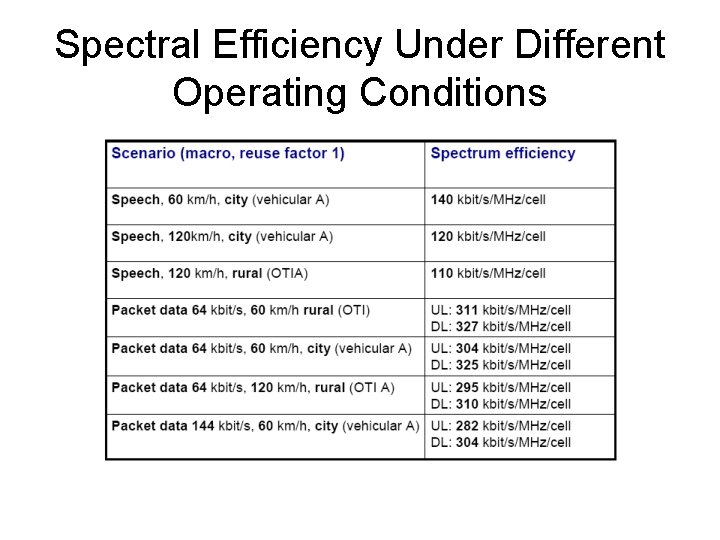
Spectral Efficiency Under Different Operating Conditions
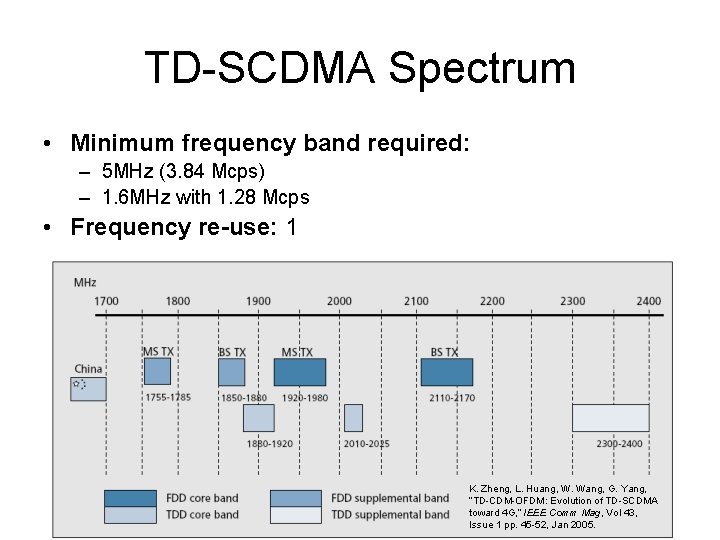
TD-SCDMA Spectrum • Minimum frequency band required: – 5 MHz (3. 84 Mcps) – 1. 6 MHz with 1. 28 Mcps • Frequency re-use: 1 K. Zheng, L. Huang, W. Wang, G. Yang, “TD-CDM-OFDM: Evolution of TD-SCDMA toward 4 G, ” IEEE Comm Mag, Vol 43, Issue 1 pp. 45 -52, Jan 2005.
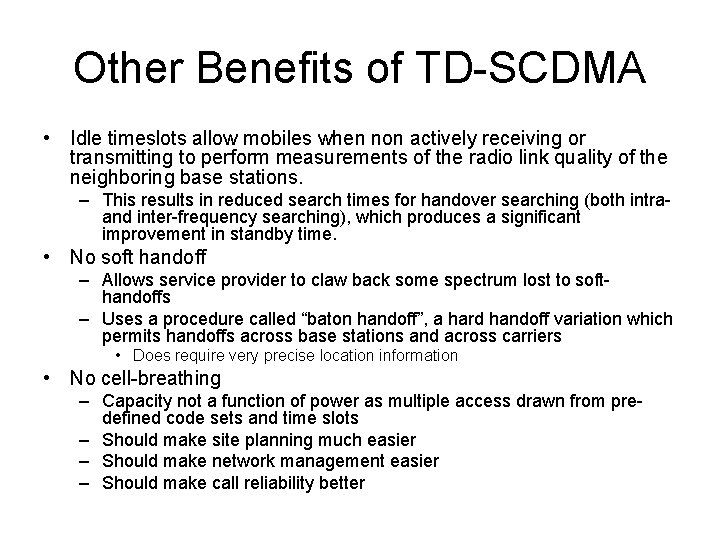
Other Benefits of TD-SCDMA • Idle timeslots allow mobiles when non actively receiving or transmitting to perform measurements of the radio link quality of the neighboring base stations. – This results in reduced search times for handover searching (both intraand inter-frequency searching), which produces a significant improvement in standby time. • No soft handoff – Allows service provider to claw back some spectrum lost to softhandoffs – Uses a procedure called “baton handoff”, a hard handoff variation which permits handoffs across base stations and across carriers • Does require very precise location information • No cell-breathing – Capacity not a function of power as multiple access drawn from predefined code sets and time slots – Should make site planning much easier – Should make network management easier – Should make call reliability better
TD-SCDMA Evolution
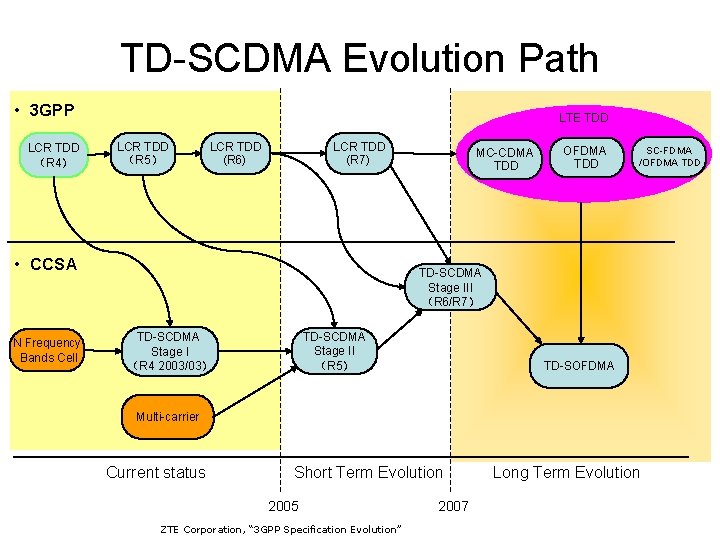
TD-SCDMA Evolution Path • 3 GPP LCR TDD (R 4) LTE TDD LCR TDD (R 5) LCR TDD (R 6) LCR TDD (R 7) • CCSA N Frequency Bands Cell MC-CDMA TDD OFDMA TDD SC-FDMA /OFDMA TDD TD-SCDMA Stage III (R 6/R 7) TD-SCDMA Stage II (R 5) TD-SCDMA Stage I (R 4 2003/03) TD-SOFDMA Multi-carrier Current status Short Term Evolution 2005 ZTE Corporation, “ 3 GPP Specification Evolution” 2007 Long Term Evolution
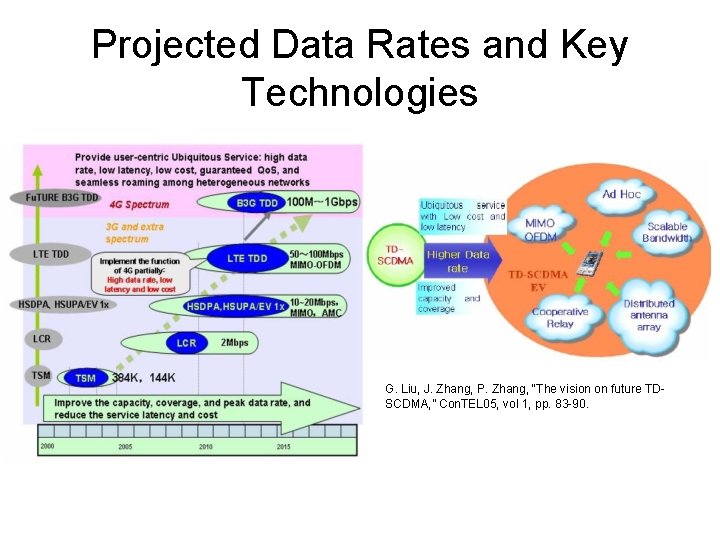
Projected Data Rates and Key Technologies G. Liu, J. Zhang, P. Zhang, “The vision on future TDSCDMA, ” Con. TEL 05, vol 1, pp. 83 -90.
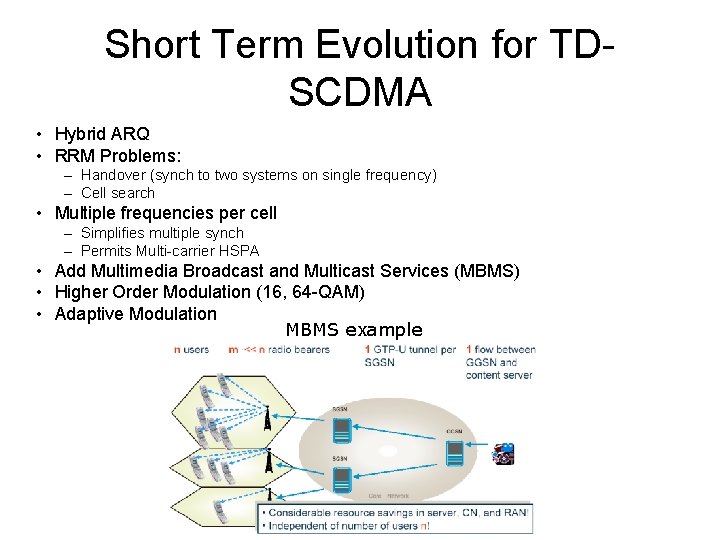
Short Term Evolution for TDSCDMA • Hybrid ARQ • RRM Problems: – Handover (synch to two systems on single frequency) – Cell search • Multiple frequencies per cell – Simplifies multiple synch – Permits Multi-carrier HSPA • Add Multimedia Broadcast and Multicast Services (MBMS) • Higher Order Modulation (16, 64 -QAM) • Adaptive Modulation MBMS example
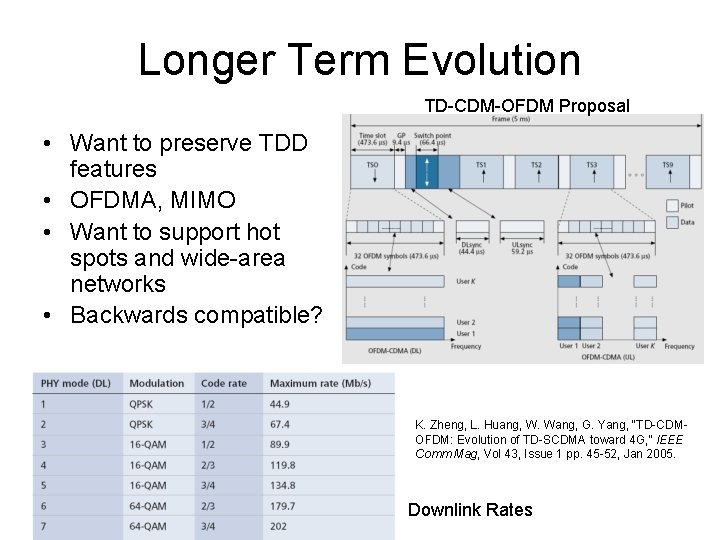
Longer Term Evolution TD-CDM-OFDM Proposal • Want to preserve TDD features • OFDMA, MIMO • Want to support hot spots and wide-area networks • Backwards compatible? K. Zheng, L. Huang, W. Wang, G. Yang, “TD-CDMOFDM: Evolution of TD-SCDMA toward 4 G, ” IEEE Comm Mag, Vol 43, Issue 1 pp. 45 -52, Jan 2005. Downlink Rates
TD-SCDMA Summary
TD-SCDMA Summary • Similar to WCDMA • Synchronous Time-slotted CDMA – Asymmetric UL/DL TDD • Significant opportunities to exploit multi-user diversity • Short term evolution will adopt 3 GPP advances • Evolving to exploit OFDM and MIMO long term • Significantly delayed roll-out – Nationwide may miss the Olympics, though fall back to just test systems is viable
TD-SCDMA Links • Standard – http: //www. tdscdmaforum. org/EN/resources/detail. asp? l=3 • TD-SCDMA Forum – http: //www. tdscdma-forum. org/ • TD-SCDMA Industry Alliance – http: //www. tdscdmaalliance. org/english/index. asp