
TDES for New Teachers Megan Scully TDES Coordinator


- Slides: 54
TDES for New Teachers Megan Scully, TDES Coordinator 2017 -2018
Thought Question • Think about a lesson you felt was highly effective. . • What were the elements that led you to this decision? *Write down the elements on a post-it and be ready to share
Introductions • Megan Scully, TDES Coordinator • Deborah Paden, Resident Educator Coordinator • Jacquinette Brown, Director of Professional Development • Cheryl Shelton, Office of Professional Development
Agenda • • • Introductions What is TDES? The 5 Touch Process Dive Deep into the Rubric Authentic Evidence Questions
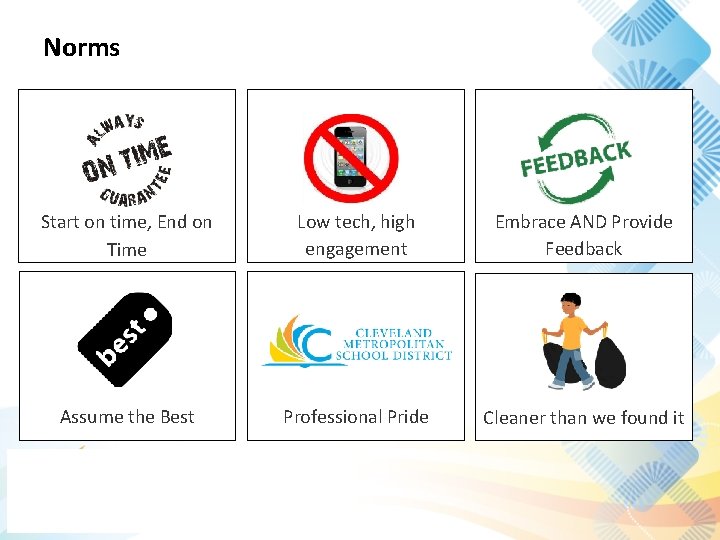
Norms D Start on time, End on Time Low tech, high engagement Embrace AND Provide Feedback Assume the Best Professional Pride Cleaner than we found it
Question Protocol
Objectives • Know the process: Participants will understand the TDES process and their responsibilities as an educator. • Know the rubric: Participants will begin to build their understanding of the TDES rubric, including key elements that define teaching quality at different levels of performance. • Collect Evidence: Participants will strengthen their ability to create and collect authentic evidence to showcase their teaching.
What is TDES? Teacher Development and Evaluation System 5/19/2021 8
What is the research? Enhancing Professional Practice: A Framework for Teaching, 2 nd edition, by Charlotte Danielson. 5/19/2021 9
What is the law? HB 153 Establishes a new teacher evaluation system in Ohio HB 525 Legislates the Cleveland Plan for reform HB 555 Details Student Growth Measures and policy 5/19/2021 10
How is TDES different? • More opportunities for observation. • Evidence-based evaluation. • Opportunities for conversation and reflection. 5/19/2021 11
Who evaluates me? • Teachers: building administrators (Principal, Assistant Principal, or CIS) • Paras: building administrators • Other staff: supervisors or principals • Evaluator will be the same for all steps (unless a leave occurs) 5/19/2021 12
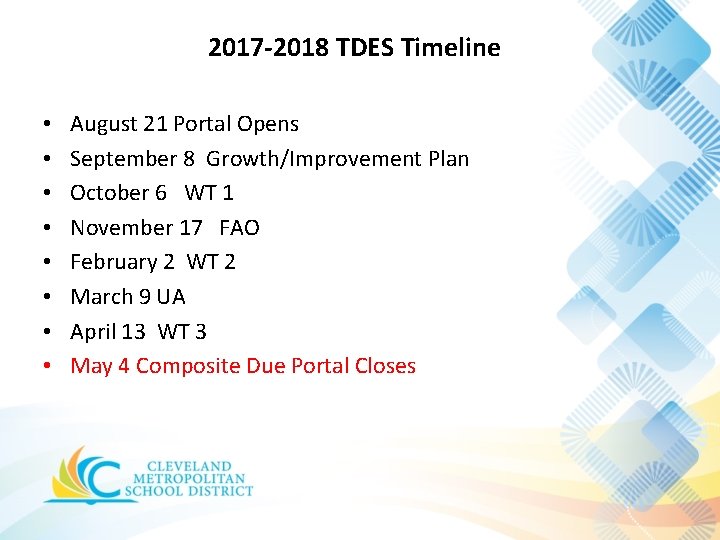
When will I be evaluated? • • • There are “ 5 Touches” Walkthrough 1 (October 6 ) Formal Announced Observation (November 17) Walkthrough 2 (February 2) Unannounced Observation (March 9) Walkthrough 3 (April 13) Final Composite (Portal Closes May 4) 5/19/2021 13
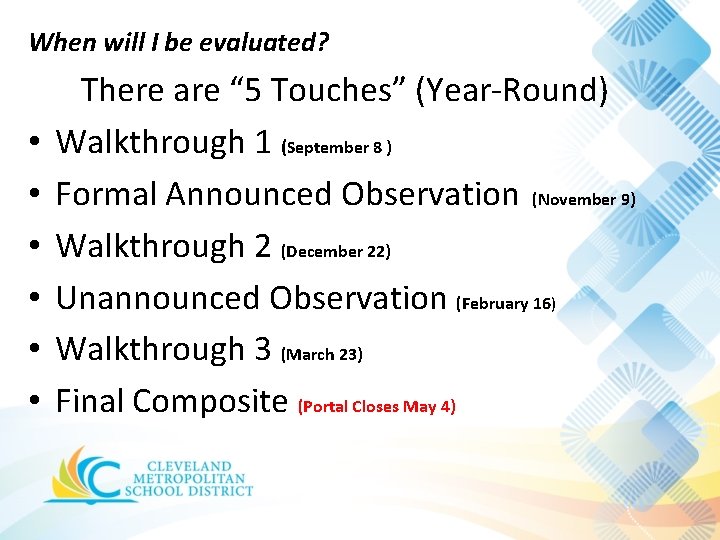
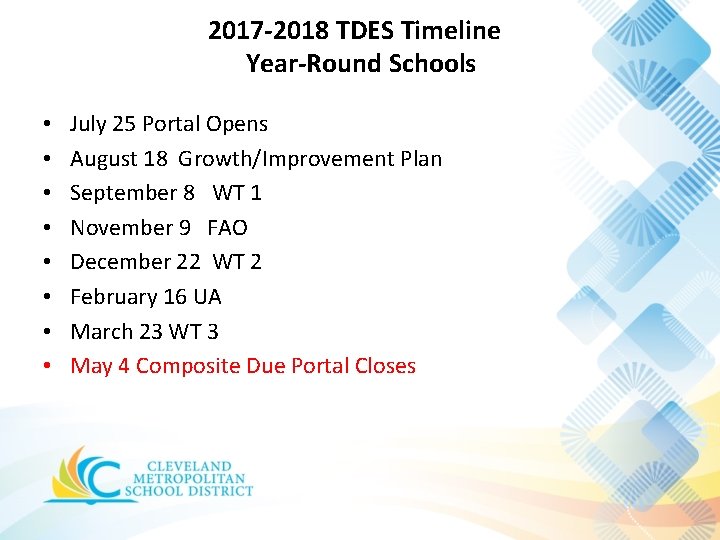
When will I be evaluated? • • • There are “ 5 Touches” (Year-Round) Walkthrough 1 (September 8 ) Formal Announced Observation (November 9) Walkthrough 2 (December 22) Unannounced Observation (February 16) Walkthrough 3 (March 23) Final Composite (Portal Closes May 4)
What is the Portal? • The TDES is managed online. • The Great Teachers & Great Leaders website is called the portal. • User name/password are the district log in. 5/19/2021 15
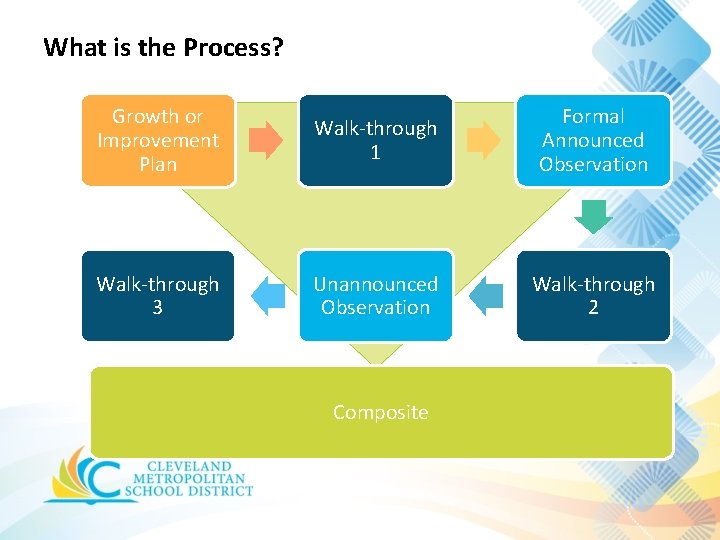
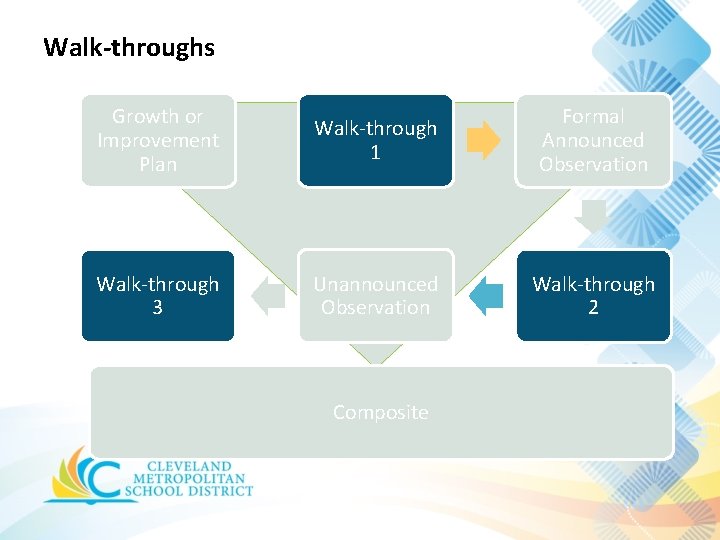
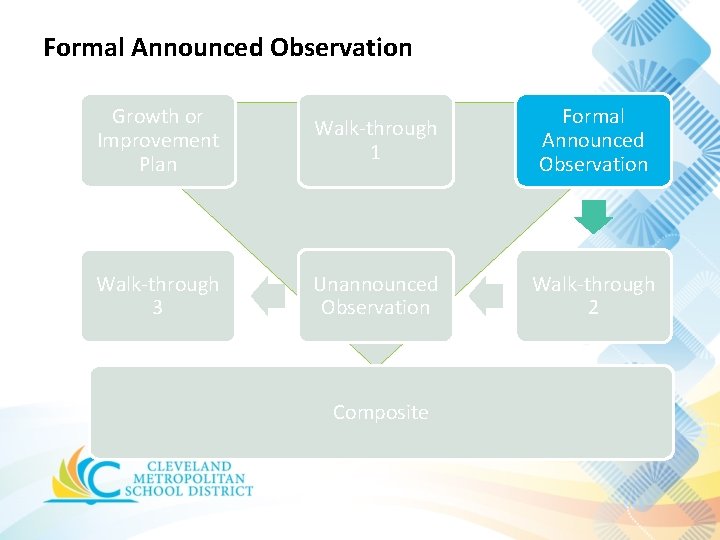
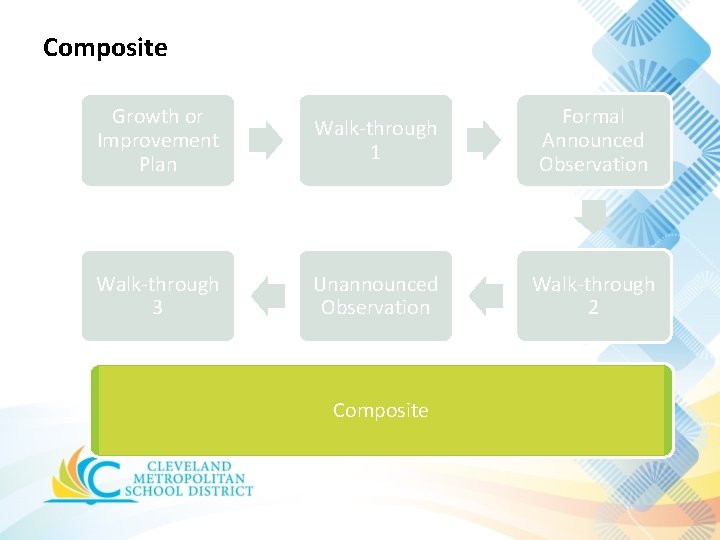
What is the Process? Growth or Improvement Plan Walk-through 1 Formal Announced Observation Walk-through 3 Unannounced Observation Walk-through 2 Composite
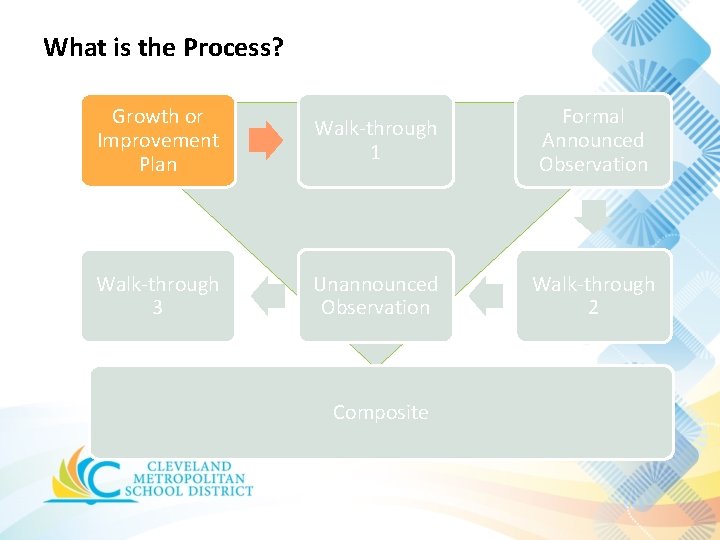
What is the Process? Growth or Improvement Plan Walk-through 1 Formal Announced Observation Walk-through 3 Unannounced Observation Walk-through 2 Composite
Growth Plan or Improvement Plan • Growth Plan: Teacher sets goals and evaluator reviews goals and comments. Both teacher and evaluator sign. • Improvement Plan: Evaluator sets goals and meets with teacher to review goals and create a plan. Both teacher and evaluator sign.
Growth Plan • Select areas of strengths and areas for growth in each of the 9 Power Components. • Identify two priorities for the upcoming year • Use these two priority areas for writing your Professional Growth Plan.
Walk-throughs Growth or Improvement Plan Walk-through 1 Formal Announced Observation Walk-through 3 Unannounced Observation Walk-through 2 Composite
Walk-throughs • Informal 5 -15 minute observation of practice • Evaluator records evidence of the teacher’s practice • Teacher receives notice that evidence is submitted in the portal • Teacher has the option to add evidence to the portal • Post-conference is optional
Formal Announced Observation Growth or Improvement Plan Walk-through 1 Formal Announced Observation Walk-through 3 Unannounced Observation Walk-through 2 Composite
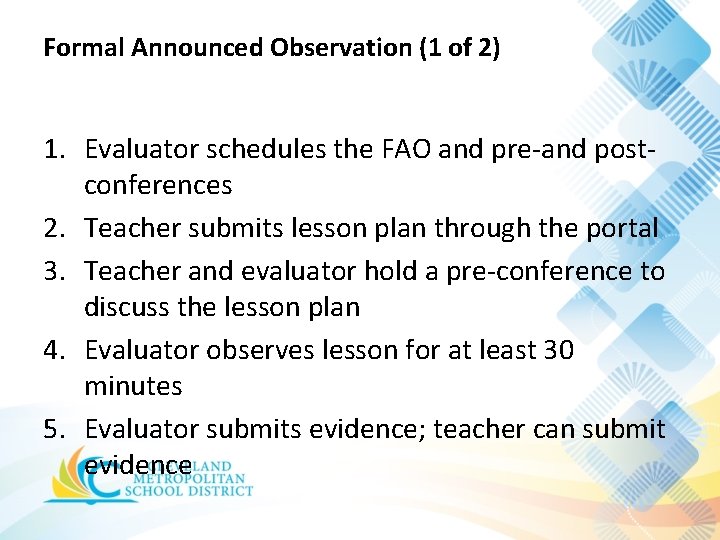
Formal Announced Observation (1 of 2) 1. Evaluator schedules the FAO and pre-and postconferences 2. Teacher submits lesson plan through the portal 3. Teacher and evaluator hold a pre-conference to discuss the lesson plan 4. Evaluator observes lesson for at least 30 minutes 5. Evaluator submits evidence; teacher can submit evidence
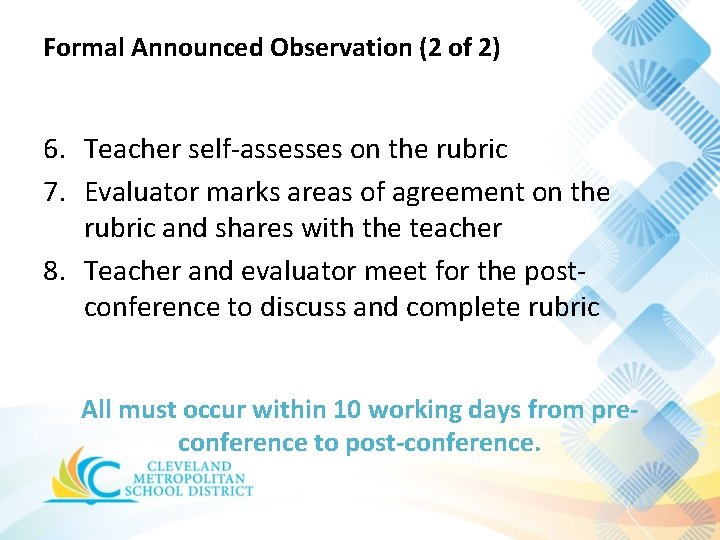
Formal Announced Observation (2 of 2) 6. Teacher self-assesses on the rubric 7. Evaluator marks areas of agreement on the rubric and shares with the teacher 8. Teacher and evaluator meet for the postconference to discuss and complete rubric All must occur within 10 working days from preconference to post-conference.
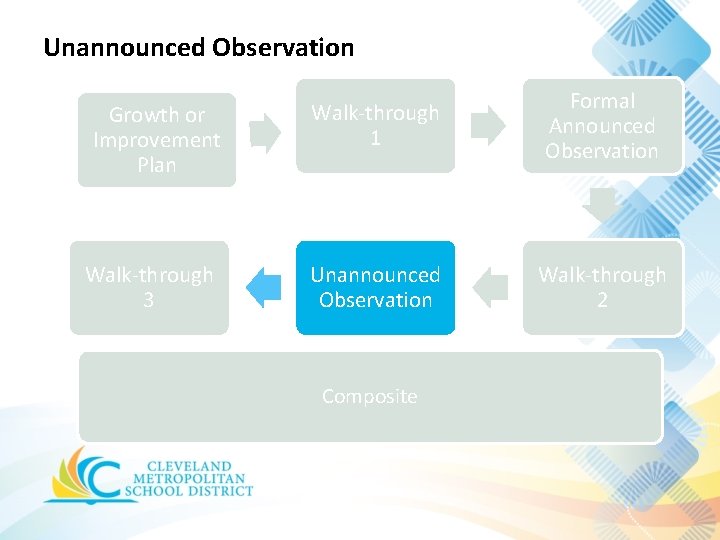
Unannounced Observation Growth or Improvement Plan Walk-through 3 Walk-through 1 Formal Announced Observation Unannounced Observation Walk-through 2 Composite
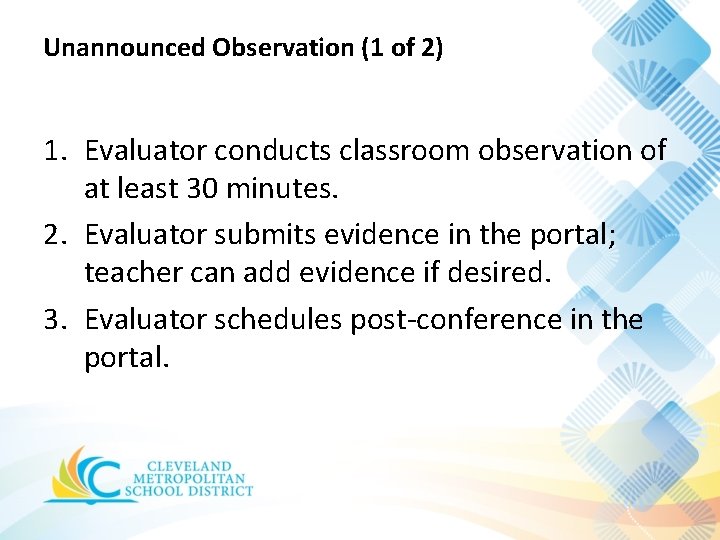
Unannounced Observation (1 of 2) 1. Evaluator conducts classroom observation of at least 30 minutes. 2. Evaluator submits evidence in the portal; teacher can add evidence if desired. 3. Evaluator schedules post-conference in the portal.
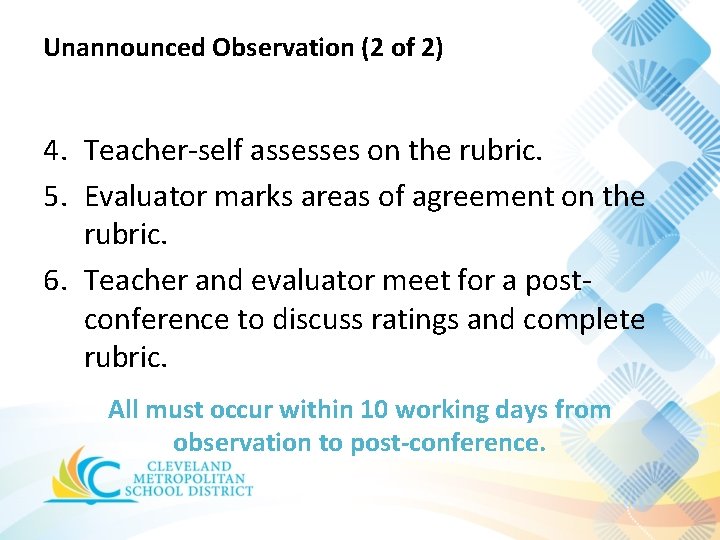
Unannounced Observation (2 of 2) 4. Teacher-self assesses on the rubric. 5. Evaluator marks areas of agreement on the rubric. 6. Teacher and evaluator meet for a postconference to discuss ratings and complete rubric. All must occur within 10 working days from observation to post-conference.
Composite Growth or Improvement Plan Walk-through 1 Formal Announced Observation Walk-through 3 Unannounced Observation Walk-through 2 Composite
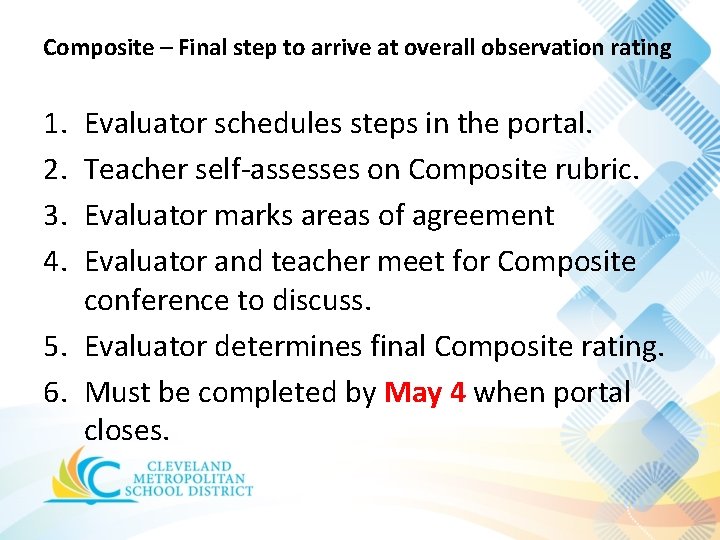
Composite – Final step to arrive at overall observation rating 1. 2. 3. 4. Evaluator schedules steps in the portal. Teacher self-assesses on Composite rubric. Evaluator marks areas of agreement Evaluator and teacher meet for Composite conference to discuss. 5. Evaluator determines final Composite rating. 6. Must be completed by May 4 when portal closes.
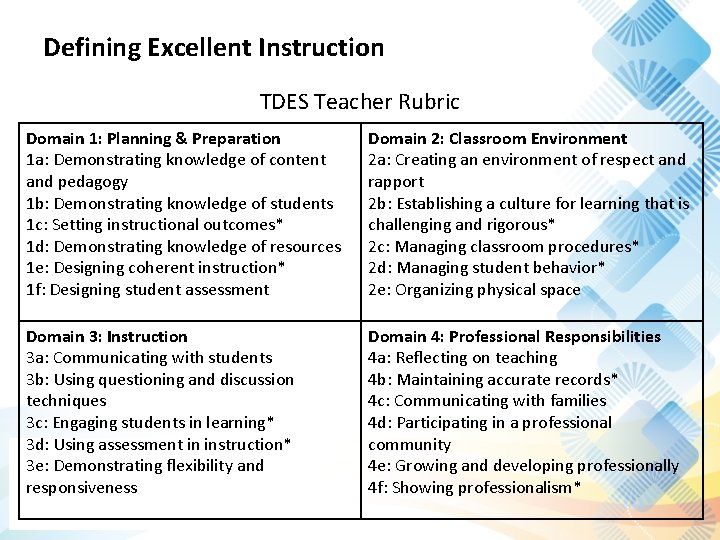
Defining Excellent Instruction TDES Teacher Rubric Domain 1: Planning & Preparation 1 a: Demonstrating knowledge of content and pedagogy 1 b: Demonstrating knowledge of students 1 c: Setting instructional outcomes* 1 d: Demonstrating knowledge of resources 1 e: Designing coherent instruction* 1 f: Designing student assessment Domain 2: Classroom Environment 2 a: Creating an environment of respect and rapport 2 b: Establishing a culture for learning that is challenging and rigorous* 2 c: Managing classroom procedures* 2 d: Managing student behavior* 2 e: Organizing physical space Domain 3: Instruction 3 a: Communicating with students 3 b: Using questioning and discussion techniques 3 c: Engaging students in learning* 3 d: Using assessment in instruction* 3 e: Demonstrating flexibility and responsiveness Domain 4: Professional Responsibilities 4 a: Reflecting on teaching 4 b: Maintaining accurate records* 4 c: Communicating with families 4 d: Participating in a professional community 4 e: Growing and developing professionally 4 f: Showing professionalism*
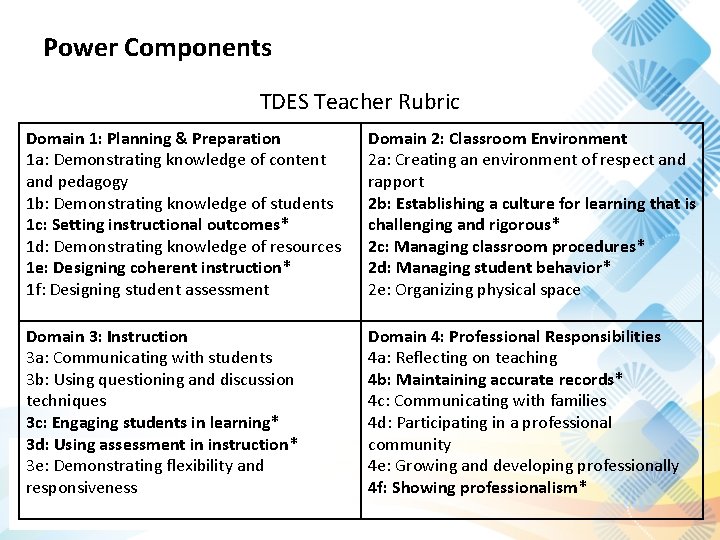
Power Components TDES Teacher Rubric Domain 1: Planning & Preparation 1 a: Demonstrating knowledge of content and pedagogy 1 b: Demonstrating knowledge of students 1 c: Setting instructional outcomes* 1 d: Demonstrating knowledge of resources 1 e: Designing coherent instruction* 1 f: Designing student assessment Domain 2: Classroom Environment 2 a: Creating an environment of respect and rapport 2 b: Establishing a culture for learning that is challenging and rigorous* 2 c: Managing classroom procedures* 2 d: Managing student behavior* 2 e: Organizing physical space Domain 3: Instruction 3 a: Communicating with students 3 b: Using questioning and discussion techniques 3 c: Engaging students in learning* 3 d: Using assessment in instruction* 3 e: Demonstrating flexibility and responsiveness Domain 4: Professional Responsibilities 4 a: Reflecting on teaching 4 b: Maintaining accurate records* 4 c: Communicating with families 4 d: Participating in a professional community 4 e: Growing and developing professionally 4 f: Showing professionalism*
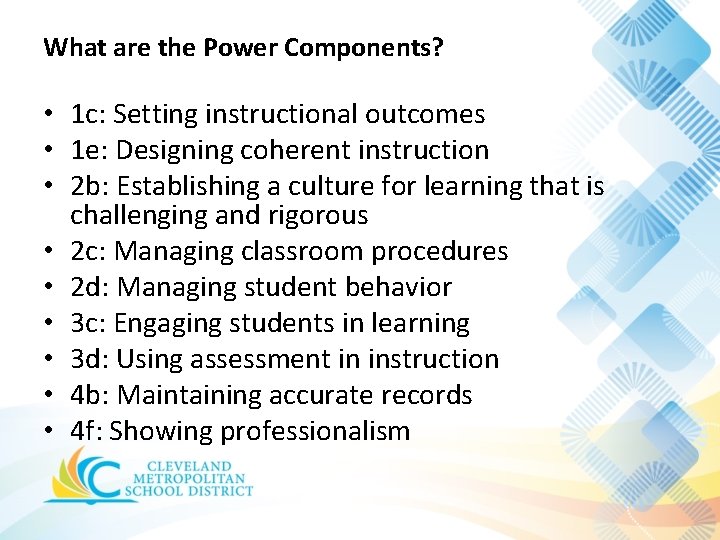
What are the Power Components? • 1 c: Setting instructional outcomes • 1 e: Designing coherent instruction • 2 b: Establishing a culture for learning that is challenging and rigorous • 2 c: Managing classroom procedures • 2 d: Managing student behavior • 3 c: Engaging students in learning • 3 d: Using assessment in instruction • 4 b: Maintaining accurate records • 4 f: Showing professionalism
Lunch! Please return by 1: 00
Thought Question • As you are thinking about instructional planning and assessment, what might be some priorities? • What are some ideas and discoveries you may incorporate into your teaching?
Domain 1 Activity • Each table has a sign with 1 component. • As a table, identify 3 things that would use in planning your lessons to incorporate this component. • Post results on the corresponding poster. • Gallery Walk
Components of Domain #1 IDENTIFY THREE EXAMPLES FOR EACH… 1 a. Demonstrate knowledge of content and pedagogy 1 b. Demonstrating Knowledge of Students 1 c. Setting Instructional Outcomes* 1 d. Demonstrating Knowledge of Resources 1 e. Designing Coherent Instruction* 1 f. Designing Student Assessments Post Table's Results on Easel Paper
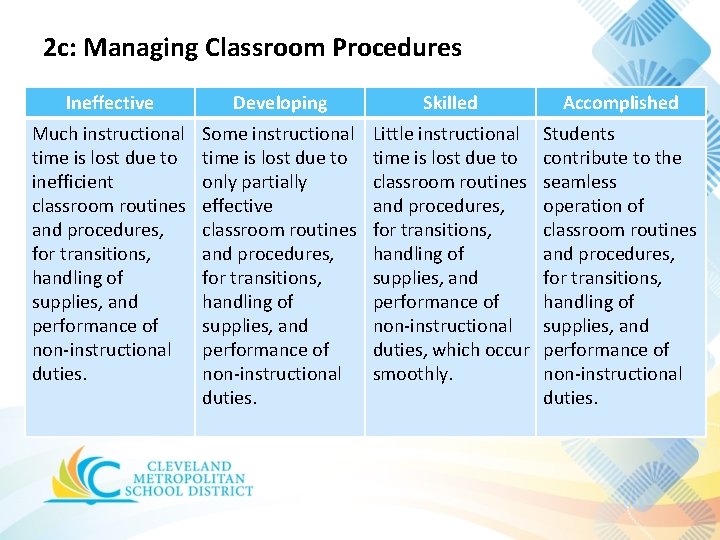
2 c: Managing Classroom Procedures What does it look and sound like in a classroom with strong routines and procedures?
2 c: Managing Classroom Procedures Ineffective Developing Skilled Accomplished Much instructional time is lost due to inefficient classroom routines and procedures, for transitions, handling of supplies, and performance of non-instructional duties. Some instructional time is lost due to only partially effective classroom routines and procedures, for transitions, handling of supplies, and performance of non-instructional duties. Little instructional time is lost due to classroom routines and procedures, for transitions, handling of supplies, and performance of non-instructional duties, which occur smoothly. Students contribute to the seamless operation of classroom routines and procedures, for transitions, handling of supplies, and performance of non-instructional duties.
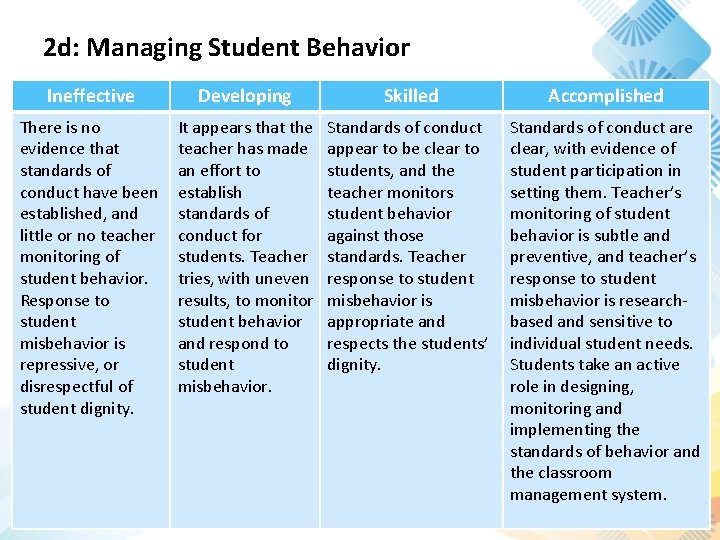
2 d: Managing Student Behavior What does it look and sound like in a classroom with excellent management of student behavior?
2 d: Managing Student Behavior Ineffective Developing Skilled Accomplished There is no evidence that standards of conduct have been established, and little or no teacher monitoring of student behavior. Response to student misbehavior is repressive, or disrespectful of student dignity. It appears that the teacher has made an effort to establish standards of conduct for students. Teacher tries, with uneven results, to monitor student behavior and respond to student misbehavior. Standards of conduct appear to be clear to students, and the teacher monitors student behavior against those standards. Teacher response to student misbehavior is appropriate and respects the students’ dignity. Standards of conduct are clear, with evidence of student participation in setting them. Teacher’s monitoring of student behavior is subtle and preventive, and teacher’s response to student misbehavior is researchbased and sensitive to individual student needs. Students take an active role in designing, monitoring and implementing the standards of behavior and the classroom management system.
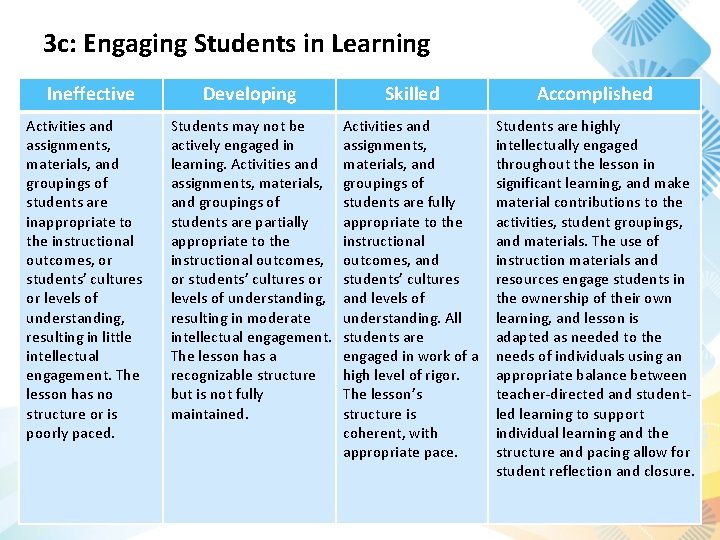
3 c: Engaging Students in Learning What does a classroom with all students engaged in learning look and sound like?
3 c: Engaging Students in Learning Ineffective Activities and assignments, materials, and groupings of students are inappropriate to the instructional outcomes, or students’ cultures or levels of understanding, resulting in little intellectual engagement. The lesson has no structure or is poorly paced. Developing Skilled Accomplished Students may not be actively engaged in learning. Activities and assignments, materials, and groupings of students are partially appropriate to the instructional outcomes, or students’ cultures or levels of understanding, resulting in moderate intellectual engagement. The lesson has a recognizable structure but is not fully maintained. Activities and assignments, materials, and groupings of students are fully appropriate to the instructional outcomes, and students’ cultures and levels of understanding. All students are engaged in work of a high level of rigor. The lesson’s structure is coherent, with appropriate pace. Students are highly intellectually engaged throughout the lesson in significant learning, and make material contributions to the activities, student groupings, and materials. The use of instruction materials and resources engage students in the ownership of their own learning, and lesson is adapted as needed to the needs of individuals using an appropriate balance between teacher-directed and studentled learning to support individual learning and the structure and pacing allow for student reflection and closure.
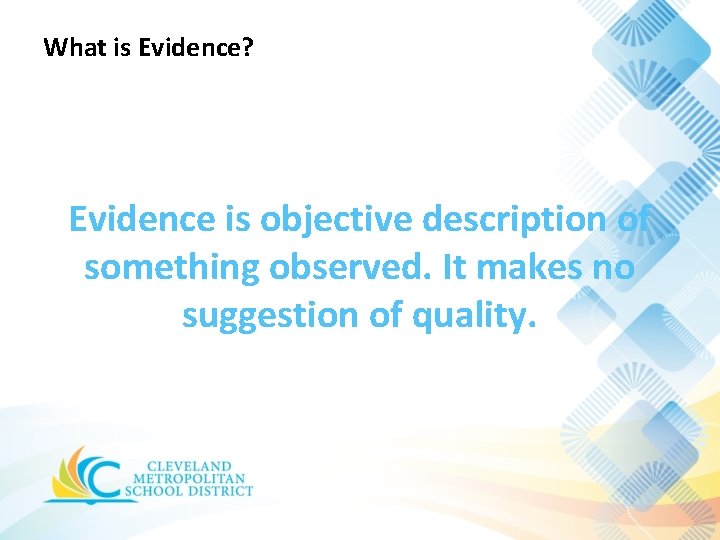
What is Evidence? Evidence is objective description of something observed. It makes no suggestion of quality.
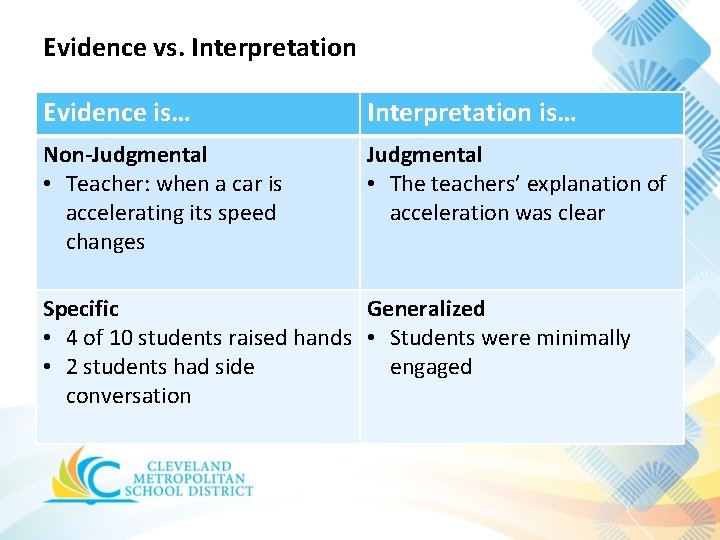
Evidence vs. Interpretation Evidence is… Interpretation is… Non-Judgmental • Teacher: when a car is accelerating its speed changes Judgmental • The teachers’ explanation of acceleration was clear Specific Generalized • 4 of 10 students raised hands • Students were minimally • 2 students had side engaged conversation
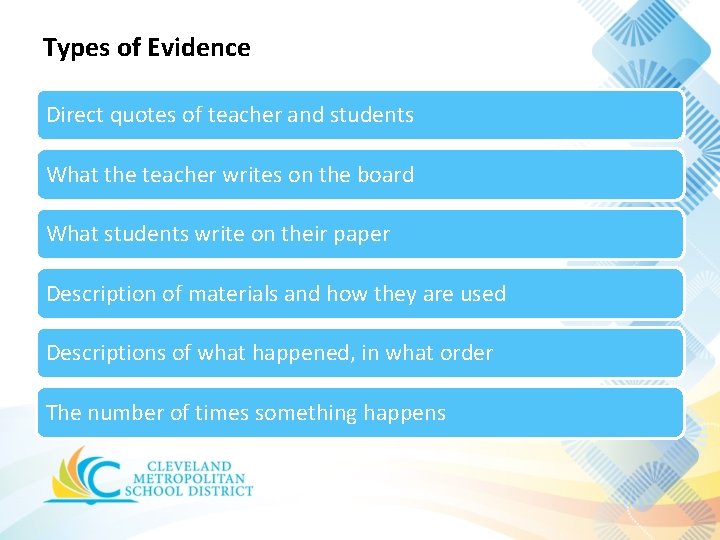
Types of Evidence Direct quotes of teacher and students What the teacher writes on the board What students write on their paper Description of materials and how they are used Descriptions of what happened, in what order The number of times something happens
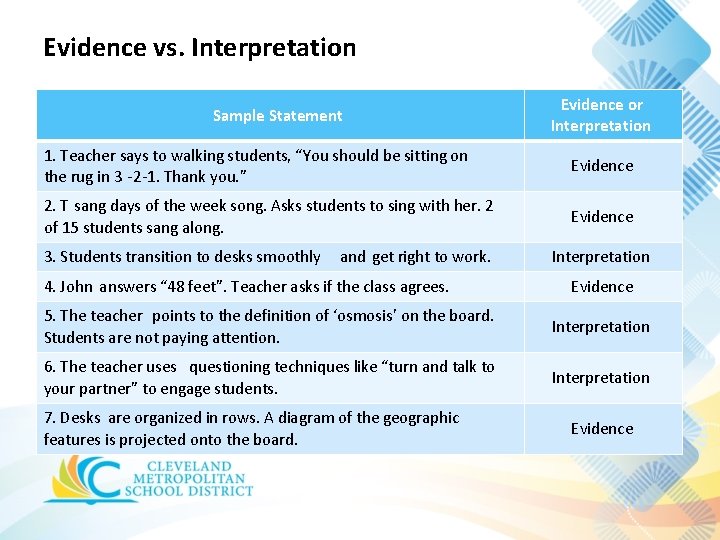
Evidence vs. Interpretation Sample Statement Evidence or Interpretation 1. Teacher says to walking students, “You should be sitting on the rug in 3 -2 -1. Thank you. ” Evidence 2. T sang days of the week song. Asks students to sing with her. 2 of 15 students sang along. Evidence 3. Students transition to desks smoothly and get right to work. 4. John answers “ 48 feet”. Teacher asks if the class agrees. Interpretation Evidence 5. The teacher points to the definition of ‘osmosis’ on the board. Students are not paying attention. Interpretation 6. The teacher uses questioning techniques like “turn and talk to your partner” to engage students. Interpretation 7. Desks are organized in rows. A diagram of the geographic features is projected onto the board. Evidence
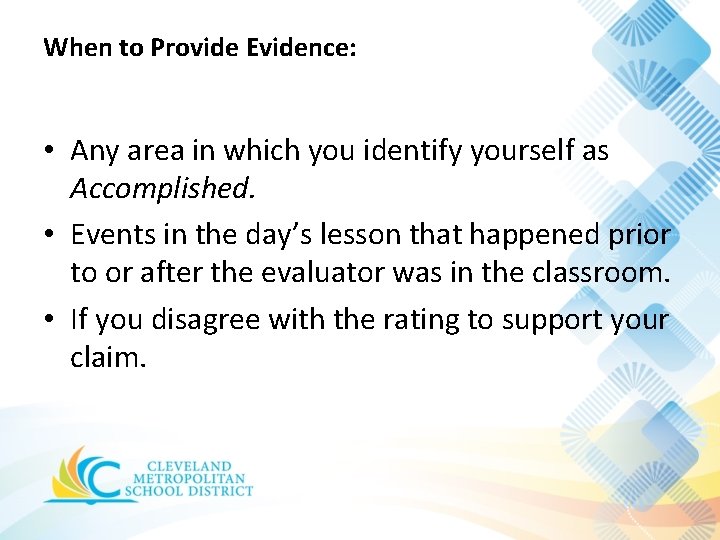
When to Provide Evidence: • Any area in which you identify yourself as Accomplished. • Events in the day’s lesson that happened prior to or after the evaluator was in the classroom. • If you disagree with the rating to support your claim.
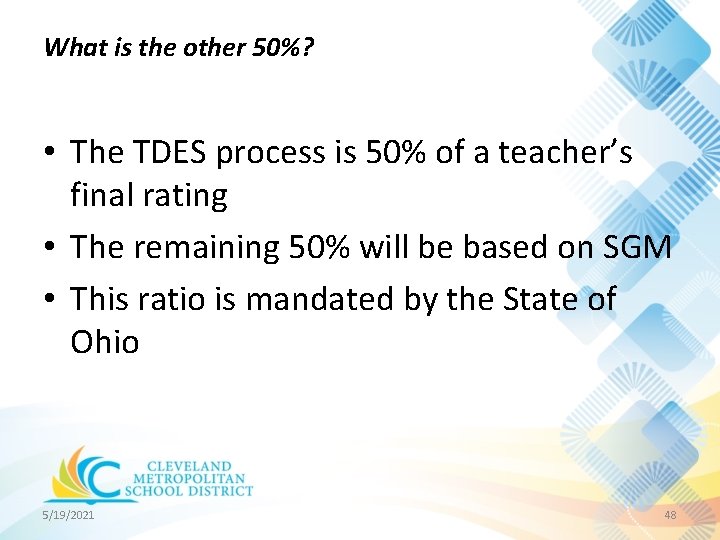
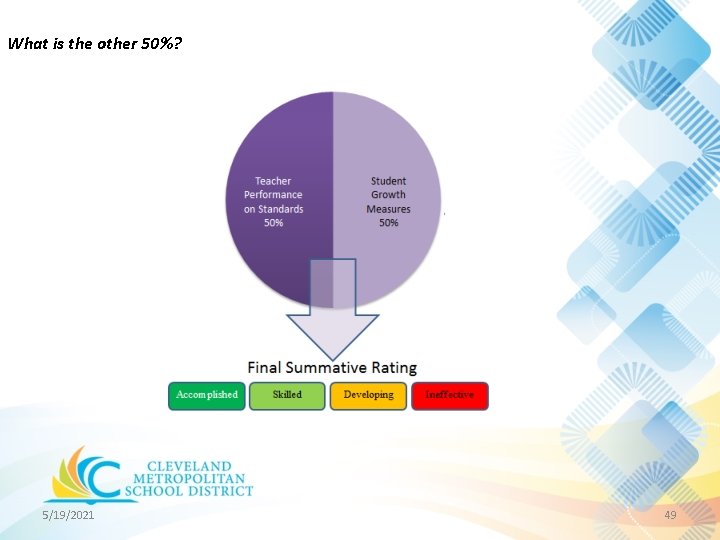
What is the other 50%? • The TDES process is 50% of a teacher’s final rating • The remaining 50% will be based on SGM • This ratio is mandated by the State of Ohio 5/19/2021 48
What is the other 50%? 5/19/2021 49
2017 -2018 TDES Timeline • • August 21 Portal Opens September 8 Growth/Improvement Plan October 6 WT 1 November 17 FAO February 2 WT 2 March 9 UA April 13 WT 3 May 4 Composite Due Portal Closes
2017 -2018 TDES Timeline Year-Round Schools • • July 25 Portal Opens August 18 Growth/Improvement Plan September 8 WT 1 November 9 FAO December 22 WT 2 February 16 UA March 23 WT 3 May 4 Composite Due Portal Closes
Questions
Contact Information: Megan Scully, TDES Coordinator Email: Megan. Scully@clevelandmetroschools. org TDES Mailbox Email: TDES@clevelandmetroschools. org SGM Mailbox Email: SLO@clevelandmtroschools. org