
TDD Frame Structures for Legacy Support in 16
- Slides: 9
TDD Frame Structures for Legacy Support in 16 m IEEE 802. 16 Presentation Submission Template (Rev. 9) Document Number: IEEE S 802. 16 m-07/242, TDD Frame Structures for Legacy Support in 16 m Date Submitted: 2007 -11 -7 Source: Dong Li, Liyu Cai, Hongwei Yang, Jimin Liu Voice: +86 21 58541240 Ext 9292 E-mail: {dong. li, liyu. cai, hongwei. yang, jimin. liu}@alcatel-sbell. com. cn Joerg Schaepperle Voice: +49 711 821 32266 E-mail: Joerg. Schaepperle@alcatel-lucent. de Krishna Balachandran Voice: +1 908 582 2691 E-mail: krishnab@alcatel-lucent. com *<http: //standards. ieee. org/faqs/affiliation. FAQ. html> Venue: [Cite the specific document number of the appropriate Call for Contributions, the ballot number, etc. ] Base Contribution: None. Purpose: For 802. 16 m discussion and eventual adoption for standardization Notice: This document does not represent the agreed views of the IEEE 802. 16 Working Group or any of its subgroups. It represents only the views of the participants listed in the “Source(s)” field above. It is offered as a basis for discussion. It is not binding on the contributor(s), who reserve(s) the right to add, amend or withdraw material contained herein. Release: The contributor grants a free, irrevocable license to the IEEE to incorporate material contained in this contribution, and any modifications thereof, in the creation of an IEEE Standards publication; to copyright in the IEEE’s name any IEEE Standards publication even though it may include portions of this contribution; and at the IEEE’s sole discretion to permit others to reproduce in whole or in part the resulting IEEE Standards publication. The contributor also acknowledges and accepts that this contribution may be made public by IEEE 802. 16. Patent Policy: The contributor is familiar with the IEEE-SA Patent Policy and Procedures: <http: //standards. ieee. org/guides/bylaws/sect 6 -7. html#6> and <http: //standards. ieee. org/guides/opman/sect 6. html#6. 3>. Further information is located at <http: //standards. ieee. org/board/pat-material. html> and <http: //standards. ieee. org/board/pat >.
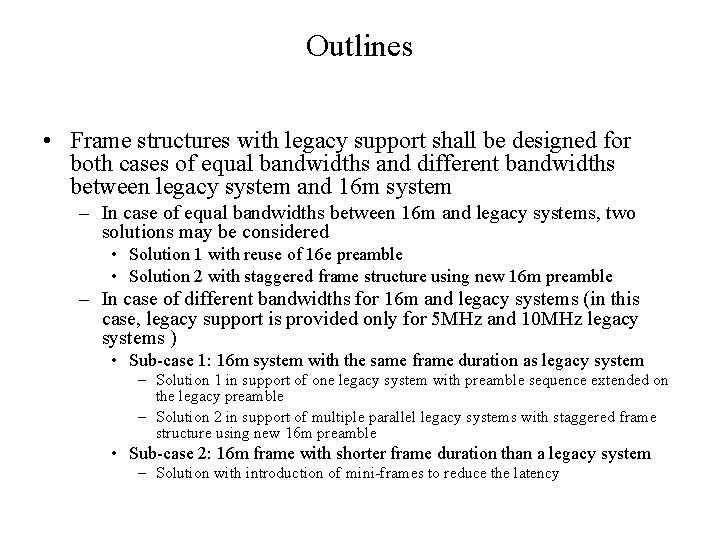
Outlines • Frame structures with legacy support shall be designed for both cases of equal bandwidths and different bandwidths between legacy system and 16 m system – In case of equal bandwidths between 16 m and legacy systems, two solutions may be considered • Solution 1 with reuse of 16 e preamble • Solution 2 with staggered frame structure using new 16 m preamble – In case of different bandwidths for 16 m and legacy systems (in this case, legacy support is provided only for 5 MHz and 10 MHz legacy systems ) • Sub-case 1: 16 m system with the same frame duration as legacy system – Solution 1 in support of one legacy system with preamble sequence extended on the legacy preamble – Solution 2 in support of multiple parallel legacy systems with staggered frame structure using new 16 m preamble • Sub-case 2: 16 m frame with shorter frame duration than a legacy system – Solution with introduction of mini-frames to reduce the latency
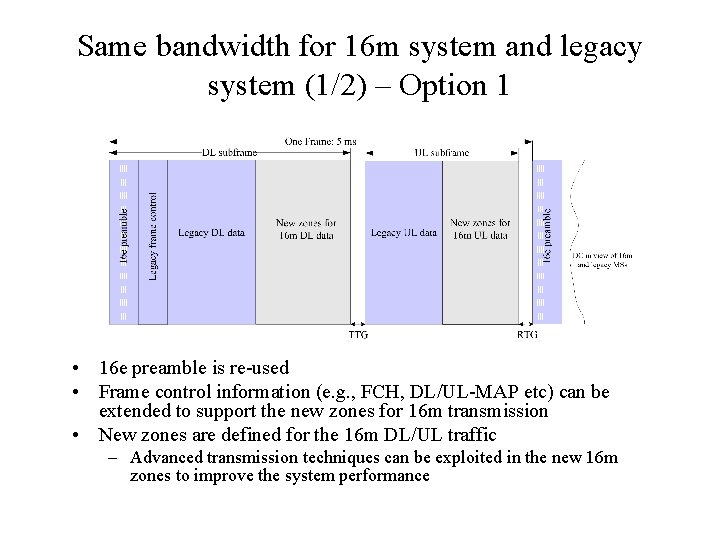
Same bandwidth for 16 m system and legacy system (1/2) – Option 1 • 16 e preamble is re-used • Frame control information (e. g. , FCH, DL/UL-MAP etc) can be extended to support the new zones for 16 m transmission • New zones are defined for the 16 m DL/UL traffic – Advanced transmission techniques can be exploited in the new 16 m zones to improve the system performance
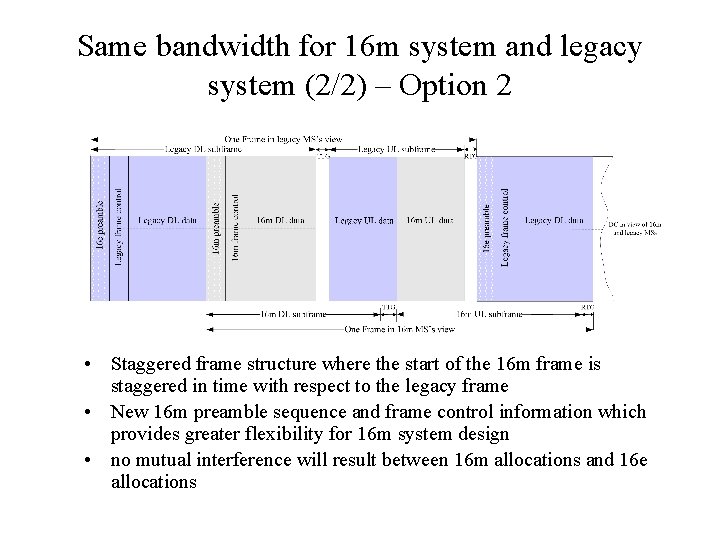
Same bandwidth for 16 m system and legacy system (2/2) – Option 2 • Staggered frame structure where the start of the 16 m frame is staggered in time with respect to the legacy frame • New 16 m preamble sequence and frame control information which provides greater flexibility for 16 m system design • no mutual interference will result between 16 m allocations and 16 e allocations
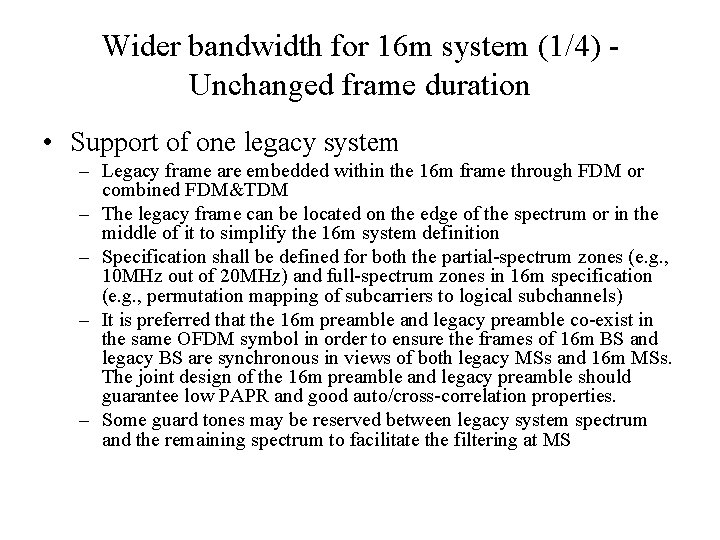
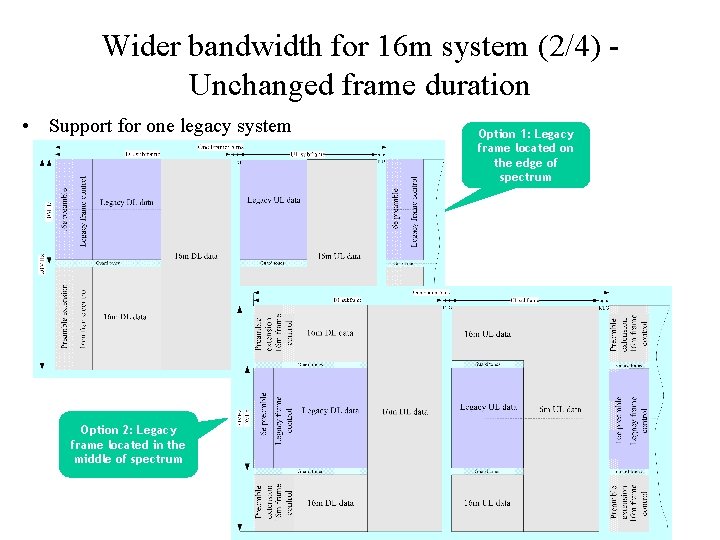
Wider bandwidth for 16 m system (1/4) Unchanged frame duration • Support of one legacy system – Legacy frame are embedded within the 16 m frame through FDM or combined FDM&TDM – The legacy frame can be located on the edge of the spectrum or in the middle of it to simplify the 16 m system definition – Specification shall be defined for both the partial-spectrum zones (e. g. , 10 MHz out of 20 MHz) and full-spectrum zones in 16 m specification (e. g. , permutation mapping of subcarriers to logical subchannels) – It is preferred that the 16 m preamble and legacy preamble co-exist in the same OFDM symbol in order to ensure the frames of 16 m BS and legacy BS are synchronous in views of both legacy MSs and 16 m MSs. The joint design of the 16 m preamble and legacy preamble should guarantee low PAPR and good auto/cross-correlation properties. – Some guard tones may be reserved between legacy system spectrum and the remaining spectrum to facilitate the filtering at MS
Wider bandwidth for 16 m system (2/4) Unchanged frame duration • Support for one legacy system Option 2: Legacy frame located in the middle of spectrum Option 1: Legacy frame located on the edge of spectrum
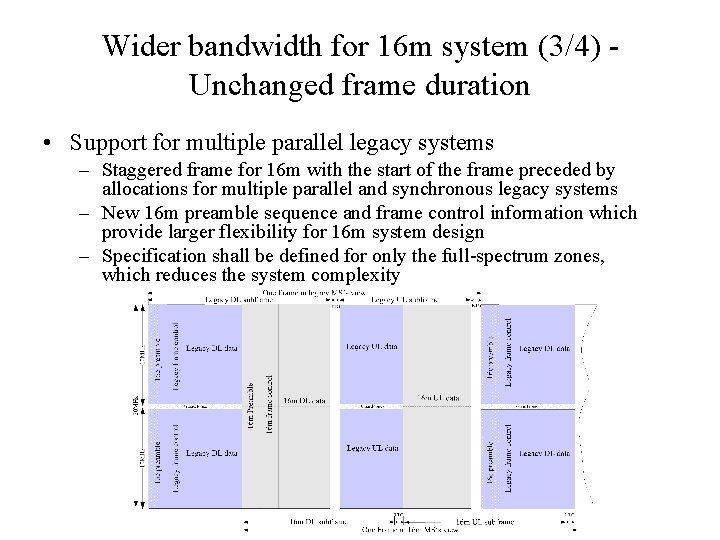
Wider bandwidth for 16 m system (3/4) Unchanged frame duration • Support for multiple parallel legacy systems – Staggered frame for 16 m with the start of the frame preceded by allocations for multiple parallel and synchronous legacy systems – New 16 m preamble sequence and frame control information which provide larger flexibility for 16 m system design – Specification shall be defined for only the full-spectrum zones, which reduces the system complexity
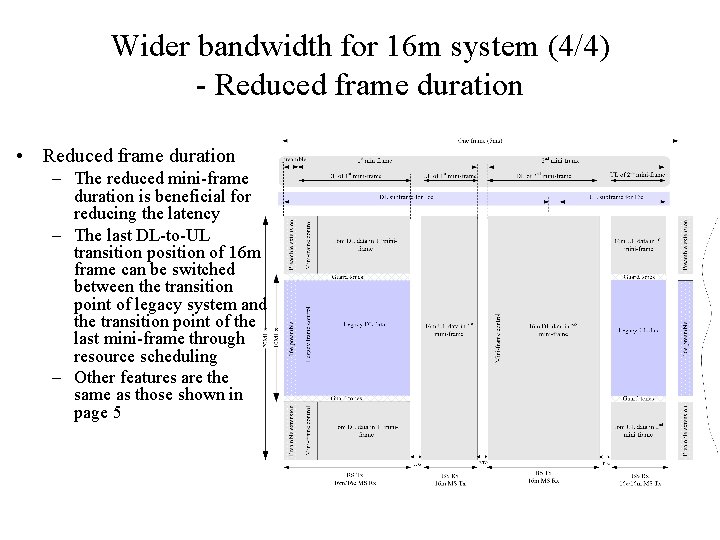
Wider bandwidth for 16 m system (4/4) - Reduced frame duration • Reduced frame duration – The reduced mini-frame duration is beneficial for reducing the latency – The last DL-to-UL transition position of 16 m frame can be switched between the transition point of legacy system and the transition point of the last mini-frame through resource scheduling – Other features are the same as those shown in page 5
Summary • It is suggested to discuss and include the proposed TDD frame structures with legacy support into 16 m SDD