
TCVM Food Therapy for Gastrointestinal Disorders Introduction TCVM

- Slides: 56
TCVM Food Therapy for Gastrointestinal Disorders
Introduction • TCVM Cooking Pot analogy of gastrointestinal function • Used to emphasize Warm Transformation • Cold Damage • Moisture and Dampness
Cooking Pot and Science • Western Biomedicine and Digestion • Mechanical and Biochemical • Biochemical Digestion • Based upon Enzyme (Protein) Function • Enzymes have Temperature Specificity • Cold Temperatures interfere with Function • Cold Foods thus need to be Warmed by the Body
Cooking Pot and Science • Biochemical Digestion • Enzymes have Temperature Specificity • Cold Temperatures interfere with Function • Cold Food is Poorly Enzymatically Transformed • Lower rate of digestion and absorption • Cold Food Challenges the Body to Warm it • Challenge to all, especially Geriatrics • Eventually depletes the body’s Yang Qi
Cooking Pot • Species specificity • Damp-engendering foods for one may be adequate for another • Age and vigor • Middle burner has more Yang Qi in younger animals than older so both environmental temperature and Xing of foods should be warmer in geriatric animals
Introduction to Food Therapy • Food therapy in Traditional Chinese Veterinary Medicine (TCVM) is based upon two fundamental principles • The first principle is of Food Energetics • This refers to the effect of a food on digestive, metabolic, and physiological processes of the body • Xing or Thermal Nature is essentially the post-ingestive effect on the body
Food and Herb Properties • Xing or Thermal Nature or Temperature • • • Cold such as Seaweed Cool such as Rabbit Neutral such as Rice Warm such as Chicken Hot such as Lamb
Food and Herb Properties • Flavor • Sweet benefits SP/ST and strengthens, moistens and tonifies deficiency • Pungent benefits LU/LI and disperses stagnation and promotes flow • Salty benefits KI/BL and moistens, softens and detoxifies • Sour benefits LIV/GB and stimulates absorption and contraction • Bitter benefits HT/SI and drains and counteracts Dampness • Bland is the 6 th Flavor that drains dampness
TCVM Food Therapy: A Note on the Sweet Flavor • “Sweet” enters the Spleen and Stomach and engenders Qi and Blood • TCVM “Sweet” is a property of many foods • This should be obvious since we eat to make Qi and Blood • But modern “Sweet” is an historical anomaly of refinement and excess availability of simple carbohydrates
TCVM Food Therapy: A Note on the Sweet Flavor • Modern “Sweet” is an historical anomaly of refinement and excess availability of simple carbohydrates • In fruits this is called “empty sweet” • Natural sweet or “full sweet” is found in almost all whole grains, all nuts and seeds, most vegetables, and almost all fish and meats
Basic Food Properties: Introduction • Deficiency conditions are treated heteropathically with tonifying foods • Tonifying foods strengthen a bodily substance or function and are especially useful for chronic disharmonies • • Qi tonics Blood tonics Yin Tonics Yang tonics
Basic Food Properties: Qi Tonics • Qi tonics maintain and improve the quantity and quality of available energy in the body • Palatable Qi Tonifying foods for carnivores include • Beef, Chicken, Date, Fig, Lentil, Mackerel, Microalgae, Molasses, Oats, Sweet Potato, Pumpkin and Squash
Advanced Food Properties: Introduction to Regulation • Whereas Tonifying foods strengthen a bodily function or substance Regulating Foods help remove Excess conditions or Stagnation • • Qi Circulating Blood Circulating Cooling foods Warming foods Foods which counteract Dampness Water-draining foods Phlegm-resolving foods
Advanced Food Properties: Qi Circulation • Qi Circulation is stimulated by the sweet and pungent flavors • Palatable Qi Circulating foods for carnivores include: • Basil, Cardamom, Carrot, Cayenne, Clove, Coriander, Garlic, Hawthorn Berry and Turmeric
Advanced Food Properties: Damp • Dampness is a result of poor transformation and/or transportation of fluids • Dampness is treated by avoiding dampening foods (e. g. dairy products, pork and rich meat, concentrated juices, sugar and saturated fats), by strengthening the Spleen and Stomach and by using bitter foods • Foods which counteract Dampness which are palatable to carnivores include: • Alfalfa, Barley, Garlic, Green Tea, Job’s tears, Kidney Bean, Mackerel, Mushroom, Parsley, Pumpkin, Rutabaga, Rye and Turnip
Bian Zheng or Pattern Differentiation • Second Principle • TCVM is based upon Pattern Differentiation • Diagnostic systems include • • Yin/Yang Eight Principles Zang-Fu Organs Four Levels Six Stages San Jiao Pathogenic Factors
Bian Zheng or Pattern Differentiation: Basic • Treatment is based upon the inverse of Pattern of Disharmony (Heteropathy) • Not sure of Herbal Formula? • Use cardinal signs to choose Food Therapy • For example, a dog with loose stools, weakness, shortness of breath, pale moist tongue and a weak pulse might be diagnosed as Spleen Qi Deficient • The treatment principle is then to Tonify (Deficient) Spleen Qi
Bian Zheng or Pattern Differentiation: Basic • For the Spleen Qi deficient dog the weakness, pale tongue and the weak pulse suggest Deficiency • Use Tonifying foods such as Chicken, Oats, Quinoa, Yam and many of the culinary herbs to either add to the current diet or create a Food Therapy Formula for this dog
Bian Zheng or Pattern Differentiation: Advanced • Treatment is based upon the inverse of Pattern of Disharmony (Heteropathy) • A diagnosis of Spleen Qi Deficiency? • Treated by Tonifying (Deficient) Spleen Qi • Classical Herbal Formulae • Already designed to treat Patterns • “Elegant” Food Therapy • May formulate based upon detailed analysis of classical Herbal Formula
Spleen Qi Deficiency: Introduction • General signs of Qi Deficiency include lethargy and fatigue • Qi Deficiency signs are exacerbated by activity and improved with rest • Primary signs of Spleen Qi Deficiency include • • • Loose stools Fatigue Shortness of breath Reduced appetite Pale moist tongue Weak pulse
Bian Zheng and Herbal Formula • Spleen Qi Deficiency • Tonify Spleen Qi with the herbal formula Si Jun Zi Tang or Four Gentlemen Decoction • the chief herb Panax ginseng ren shen is sweet, warm and tonifies Spleen Qi • the deputy herb Atractylodis macrocephalae bai zhu is bitter, warm and strengthens Spleen Qi and dries Dampness • the assistant herb Poria cocos fu ling is sweet, bland leeches out Dampness and mildly Tonifies Spleen Qi • the envoy Glycyrrhizae uralensis gan cao is warm, sweet and warms and regulates the middle burner
Si Jun Zi Tang and Food Therapy • A Food Combination that would have similar actions to Si Jun Zi Tang could include • Warm, sweet Chicken which enters the Spleen and Stomach to Tonify Qi • Warm, sweet Oats to strengthen the Spleen and dry Dampness • Or neutral, bitter Rye to drain Dampness and Water from the Spleen
Si Jun Zi Tang and Food Therapy • A Food Combination that would have similar actions to Si Jun Zi Tang • Cool, sweet Mushroom to leech Dampness and mildly tonify Spleen Qi • Neutral, sweet and sour Coriander to direct the actions to the middle burner and mildly warm the Spleen and Stomach • Use acrid, warm, aromatic Cardamom (Sha Ren) if there is also Phlegm or vomiting
Spleen Qi Deficiency with Damp • Shen Ling Bai Zhu San Ginseng, Poria, and Atractylodes Powder • • • Ren shen ginseng Bai zhu white atractylodes Fu ling poria Zhi gan cao honey-fried licorice Shan yao dioscorea Bai bian dou dolichoris lablab Lian zi nelumbinis Yi yi ren coix Sha ren amomum Jie geng platycodon • Augments the Qi, strengthens the Spleen, leaches out Dampness and stops diarrhea
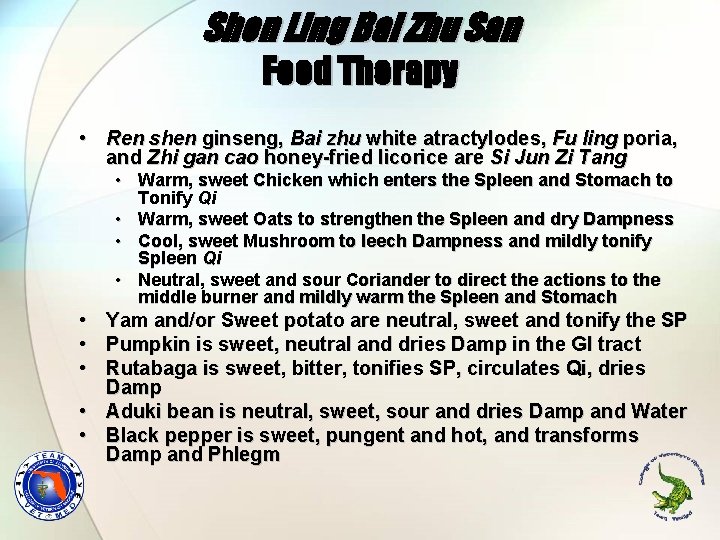
Shen Ling Bai Zhu San Ginseng, Poria, and Atractylodes Powder • Ren shen ginseng, Bai zhu white atractylodes, Fu ling poria, and Zhi gan cao honey-fried licorice are Si Jun Zi Tang • Shan yao dioscorea tonifies the Spleen and supports the chief herbs • Bai bian dou dolichoris lablab and Lian zi nelumbinis strengthen the Spleen and stop diarrhea • Yi yi ren coix strengthens the Spleen and leaches out Dampness • Sha ren amomum transforms Dampness and promotes Qi movement • Jie geng platycodon unblocks the flow of Lung Qi
Shen Ling Bai Zhu San Food Therapy • Ren shen ginseng, Bai zhu white atractylodes, Fu ling poria, and Zhi gan cao honey-fried licorice are Si Jun Zi Tang • Warm, sweet Chicken which enters the Spleen and Stomach to Tonify Qi • Warm, sweet Oats to strengthen the Spleen and dry Dampness • Cool, sweet Mushroom to leech Dampness and mildly tonify Spleen Qi • Neutral, sweet and sour Coriander to direct the actions to the middle burner and mildly warm the Spleen and Stomach • Yam and/or Sweet potato are neutral, sweet and tonify the SP • Pumpkin is sweet, neutral and dries Damp in the GI tract • Rutabaga is sweet, bitter, tonifies SP, circulates Qi, dries Damp • Aduki bean is neutral, sweet, sour and dries Damp and Water • Black pepper is sweet, pungent and hot, and transforms Damp and Phlegm
Spleen Yang Deficiency: Introduction • Cold from Deficiency in the Middle Burner • Disrupts Qi Mechanism • Principle signs • Epigastric and abdominal distention and pain • Fatigue • Cold extremities • White, slippery tongue coating • Slow, deep pulse
Spleen Yang Deficiency: Herbal Formula • Li zhong wan or Regulate the Middle Pill • Actions: Warms the middle burner and strengthens the Spleen and Stomach
Spleen Yang Deficiency: Li zhong wan • Indications: diarrhea with watery stool, nausea and vomiting, little thirst, loss of appetite, abdominal pain • Tongue: pale with white coat • Pulse: thin, deep
Spleen Yang Deficiency: Li zhong wan • Zingiberis officinalis gan jiang warms the Spleen and Stomach Yang and dispels interior Cold • Radix ginseng ren shen strongly tonifies the Yuan Qi and reinforces the Yang • Atractylodis macrocephalae bai zhu tonifies SP/ST and dries damp • One warming, one tonifying, one drying • Glycyrrhizae uralensis zhi gan cao augments the middle burner Qi
Spleen Yang Deficiency Food Therapy • Lamb is sweet, hot, enters the Spleen and Kidney and tonifies Yang • Sweet potato is sweet, warm, enters the Kidney and Spleen and tonifies Yin and Qi and dispels Cold • Corn is sweet, neutral, enters the KI, LI and ST, tonifies Qi and dries damp • Fenugreek seed is warm, bitter, circulates Qi and tonifies Yang • Or Ginger as in Li zhong wan
Stomach Heat • Bai Hu Tang White Tiger Decoction • • Shi gao gypsum Zhi mu anemarrhena Zhi gan cao honey fried licorice Geng mi nonglutinous rice • Clears Qi-level Heat, drains Stomach Fire, generate fluids, and alleviates thirst
Bai Hu Tang White Tiger Decoction • Shi gao gypsum is sweet, acrid and extremely cold to Clear Heat and Drain Fire • Zhi mu anemarrhena is bitter, cold and moistening, Clears Heat and enriches Yin • Zhi gan cao honey fried licorice and Geng mi nonglutinous rice benefit the Stomach and protect the fluids, and protect the middle Jiao from the first two cold ingredients
Bai Hu Tang Food Therapy • Crab is cold, salty, enters the Liver and Stomach, nourishes Yin and Clears Heat • Millet is cool, sweet, salty, enters the Kidney, Spleen and Stomach and Clears Heat • Squash is warm, sweet, enters the Spleen and Stomach, tonifies Qi and protects from Cold • Coriander is neutral, sweet, bitter, enters the Stomach and protects from the Cold
Food and Qi Stagnation • Yue Ju Wan Escape Restraint Pill • • • Cang zhu red/grey atractylodes Chuan xiong ligusticum Xiang fu cyperus Shan zhi zi gardenia Shen qu massa fermentata • Promotes the movement of Qi and releases constraint; “Five Stagnation” (Qi, blood, food, phlegm and heat)
Yue Ju Wan Escape Restraint Pill • Cang zhu red/grey atractylodes dries Dampness and resolves Phlegm • Chuan xiong ligusticum releases constrained Blood to resolve fixed pain • Xiang fu cyperus releases constraint and disperses Qi Stagnation • Shan zhi zi gardenia clears Heat from Sanjiao, resolves Fire from constraint and acid reflux • Shen qu massa fermentata relieves constraint caused by food stagnation
Yue Ju Wan Food Therapy • Crab is cold, salty, enters the Kidney and Stomach and circulates Blood • If crab is unavailable, Chicken is warm, sweet, enters the SP/ST and circulates Blood • Carrot is neutral, sweet, enters the Liver, Lung, and Spleen and circulates Qi • Wheat germ is cold, sweet, enters the Heart and Stomach and circulates Blood • Garlic is hot, sweet, pungent, enters the Heart, Liver, Lung and Stomach, resolves Damp, Phlegm and circulates Qi
Megacolon: Dryness due to Heat • Ma Zi Ren Wan Hemp Seed Pill • • • Huo ma ren cannabis seed Xing ren apricot seed Shao yao peony Zhi shi immature bitter orange Hou po magnolia cortex Da huang rhubarb • Moisten the Intestines, drains Heat, promotes Qi movement, unblocks the bowels
Ma Zi Ren Wan Hemp Seed Pill • Huo ma ren cannabis seed moistens the intestines and unblocks the bowels • Xing ren apricot seed directs Qi downward and moistens the intestines • Bai Shao yao peony nourishes the Yin and harmonizes the interior • Zhi shi immature bitter orange breaks up accumulation, especially in the intestines • Hou po magnolia cortex removes fullness and distension • Da huang rhubarb is a purgative
Ma Zi Ren Wan Food Therapy • Rabbit is cool, sweet, nourishes Qi and Yin and enters the Large Intestine and Liver channels • If Rabbit is unavailable, Beef is neutral, sweet, nourishes Yin, Qi and Blood and enters the SP, ST and LI • Alfalfa sprouts are neutral, salty and bitter, nourish Yin and Blood and enter the LI • Cabbage is neutral sweet and pungent, enters the ST and LI and dispels Heat • Tofu is cool, sweet, nourishes Yin and enters the Spleen, Stomach and Large Intestine • Honey is neutral, sweet, enters the Lung, ST and LI and moistens the bowel • Saffron is neutral, sweet and circulates Qi
Historical TCM Example of “Food as Medicine” • Dang gui sheng jiang yang rou tang or Mutton stew with Angelica and Fresh Ginger Decoction • Angelica sinensis dang gui • Zingiberis officinalis recens sheng jiang • Mutton yang rou • Actions: Warms the interior, nourishes Blood and alleviates pain
Geriatrics and Food Therapy • The astute veterinarian can already see that Raw Foods, although commonly healthful for young, active, warm animals, may be too cooling and stagnating for geriatric, inactive, cool animals • This is compounded when there is a concurrent Spleen Qi or Yang deficiency
Geriatrics, Processing and Xing • Important! • Cooking generally adds “warmth” to foods • Because Warm Transformation is decreased with age • Warming and moving foods more important
Conclusion • TCVM Food Therapy is as important as Acupuncture and Herbal Medicine to facilitate complete healing • Classical Herbal Formula strategies may be used to construct TCVM Food Therapy formulas • Knowledge of Food Energetics is necessary to understand develop food therapy formulas
Another Way for TCVM Feeding • Use a balanced base food • Supplement for constitution, disorders or deficiencies • Add additional therapy as needed
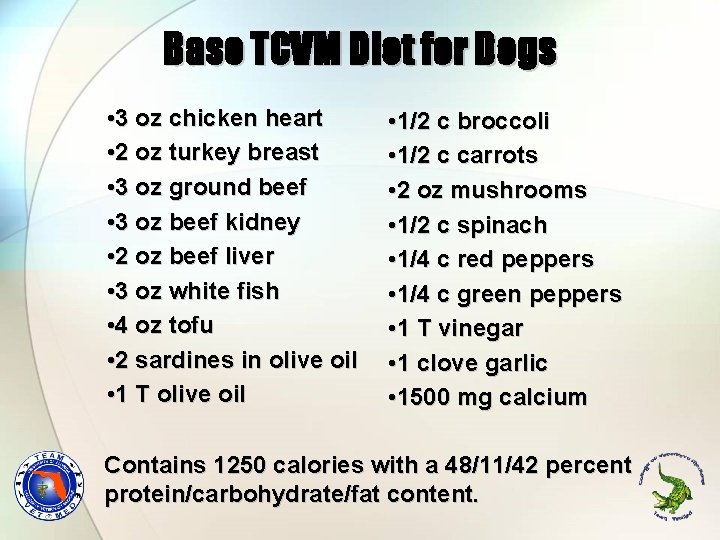
Base TCVM Diet for Dogs • 3 oz chicken heart • 2 oz turkey breast • 3 oz ground beef • 3 oz beef kidney • 2 oz beef liver • 3 oz white fish • 4 oz tofu • 2 sardines in olive oil • 1 T olive oil • 1/2 c broccoli • 1/2 c carrots • 2 oz mushrooms • 1/2 c spinach • 1/4 c red peppers • 1/4 c green peppers • 1 T vinegar • 1 clove garlic • 1500 mg calcium Contains 1250 calories with a 48/11/42 percent protein/carbohydrate/fat content.
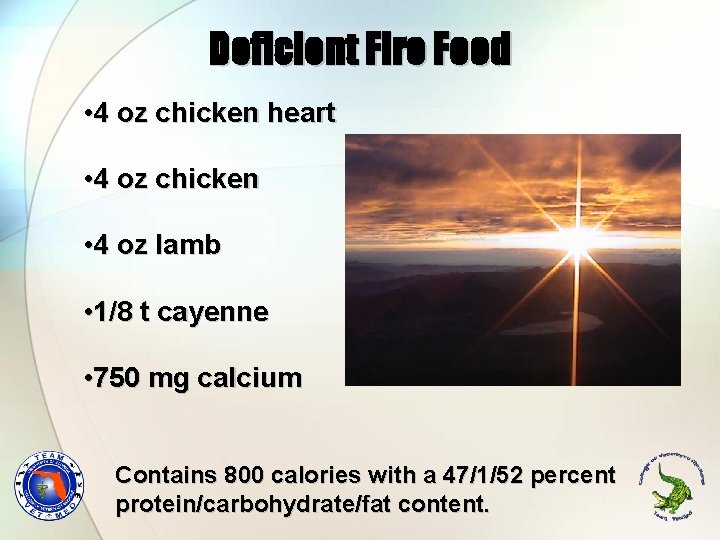
Deficient Fire Food • 4 oz chicken heart • 4 oz chicken • 4 oz lamb • 1/8 t cayenne • 750 mg calcium Contains 800 calories with a 47/1/52 percent protein/carbohydrate/fat content.
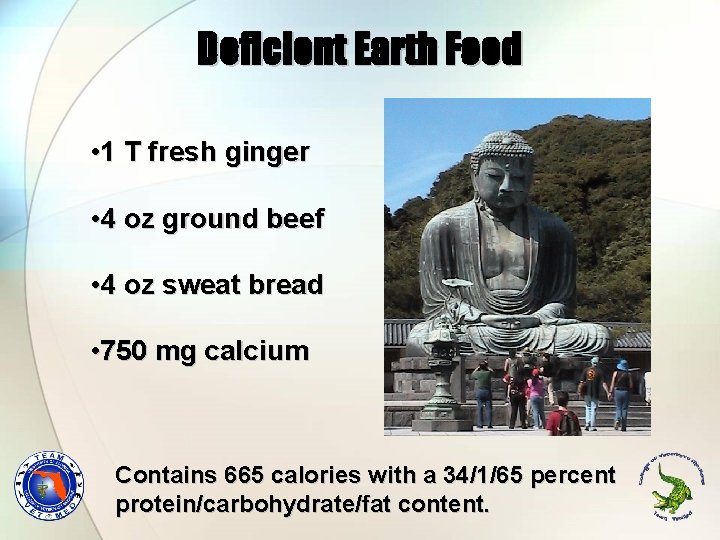
Deficient Earth Food • 1 T fresh ginger • 4 oz ground beef • 4 oz sweat bread • 750 mg calcium Contains 665 calories with a 34/1/65 percent protein/carbohydrate/fat content.
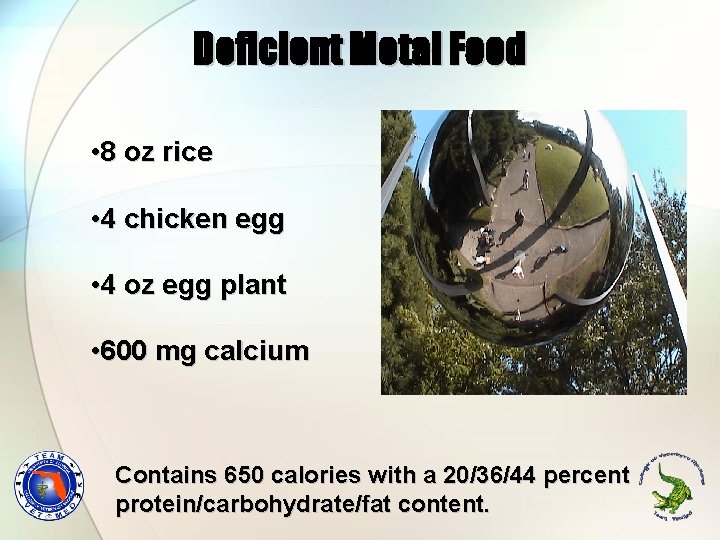
Deficient Metal Food • 8 oz rice • 4 chicken egg • 4 oz egg plant • 600 mg calcium Contains 650 calories with a 20/36/44 percent protein/carbohydrate/fat content.
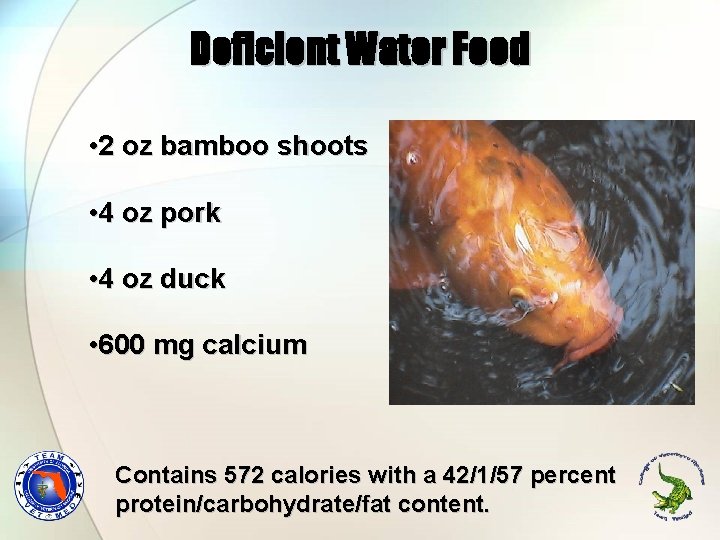
Deficient Water Food • 2 oz bamboo shoots • 4 oz pork • 4 oz duck • 600 mg calcium Contains 572 calories with a 42/1/57 percent protein/carbohydrate/fat content.
Deficient Wood Food • 3 oz chicken liver • 1/2 c asparagus • 4 oz chicken • 600 mg calcium Contains 356 calories with a 61/6/33 percent protein/carbohydrate/fat content.
Qi Tonic Food • 4 oz ground beef • 1/4 cup spinach • 4 oz beef liver • 3 oz string beans • 1 T olive oil • 1000 mg calcium Contains 704 calories with a 37/10/53 percent protein/carbohydrate/fat content.
Yang Tonic Food • 4 oz lamb kidney • 1/2 t fennel • 1 T olive oil • 1/4 cup red pepper • 1/4 t cinnamon • 400 mg calcium Contains 290 calories with a 38/6/56 percent protein/carbohydrate/fat content.
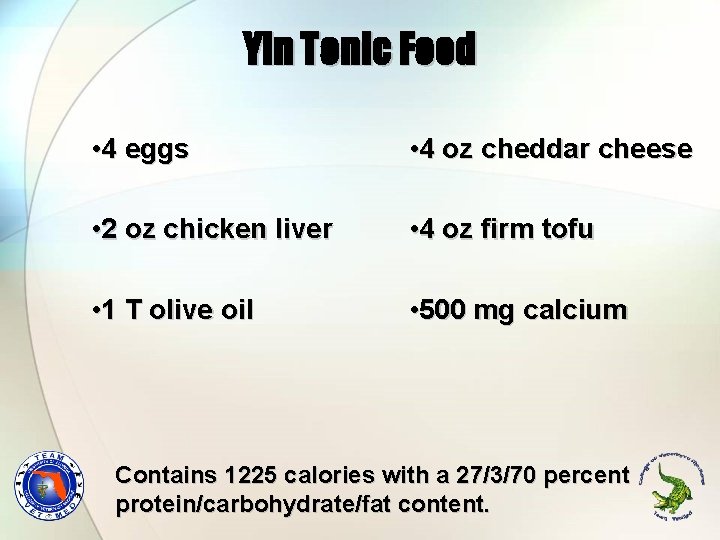
Yin Tonic Food • 4 eggs • 4 oz cheddar cheese • 2 oz chicken liver • 4 oz firm tofu • 1 T olive oil • 500 mg calcium Contains 1225 calories with a 27/3/70 percent protein/carbohydrate/fat content.
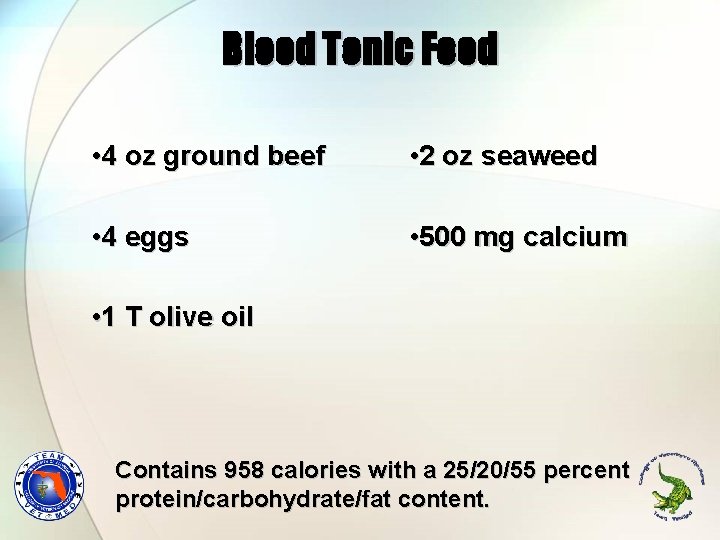
Blood Tonic Food • 4 oz ground beef • 2 oz seaweed • 4 eggs • 500 mg calcium • 1 T olive oil Contains 958 calories with a 25/20/55 percent protein/carbohydrate/fat content.
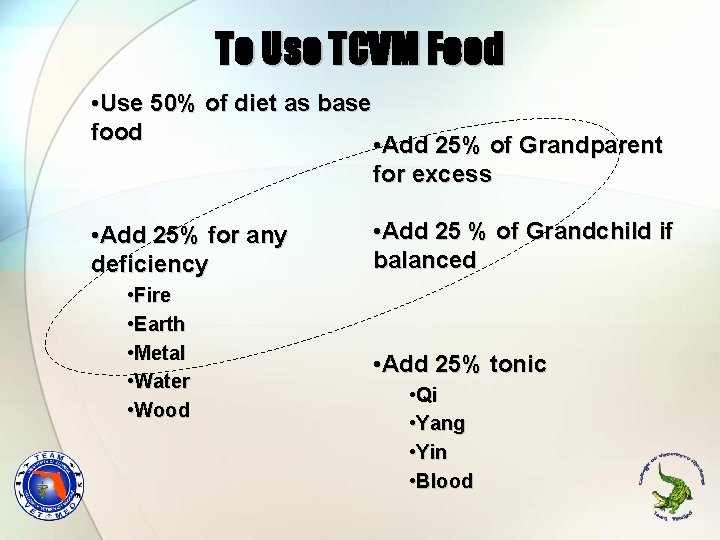
To Use TCVM Food • Use 50% of diet as base food • Add 25% of Grandparent for excess • Add 25% for any deficiency • Fire • Earth • Metal • Water • Wood • Add 25 % of Grandchild if balanced • Add 25% tonic • Qi • Yang • Yin • Blood