
TCR RECEPTORS Main receptors Alpha beta Gamma delta
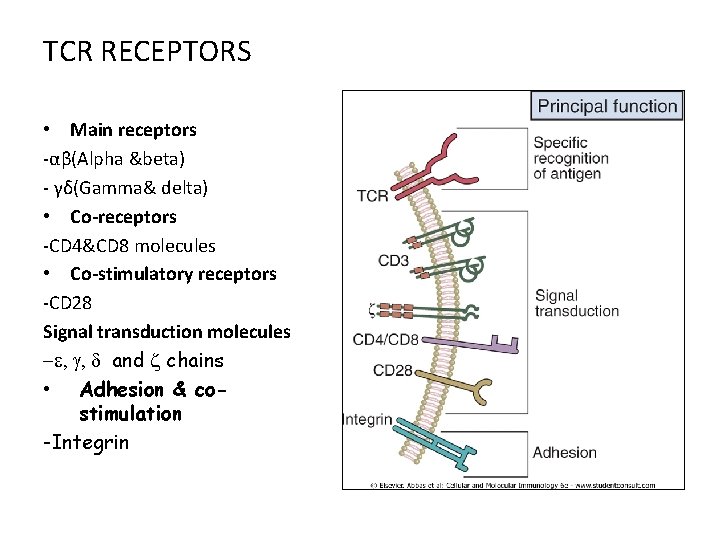
TCR RECEPTORS • Main receptors -αβ(Alpha &beta) - γδ(Gamma& delta) • Co-receptors -CD 4&CD 8 molecules • Co-stimulatory receptors -CD 28 Signal transduction molecules -e, g, d and z chains • Adhesion & costimulation -Integrin

αβ(Alpha &beta) and γδ(Gamma& delta) • Majority(>95%) of T cell receptors are αβ • 1 -5% are γδ, role not clearly known • Recognize antigens on MHC’S • Structure consist of -1 variable (V) domain -1 Ig-like constant (C) domain -A hydrophobic transmembrane region(T m) -A short cytoplasmic region
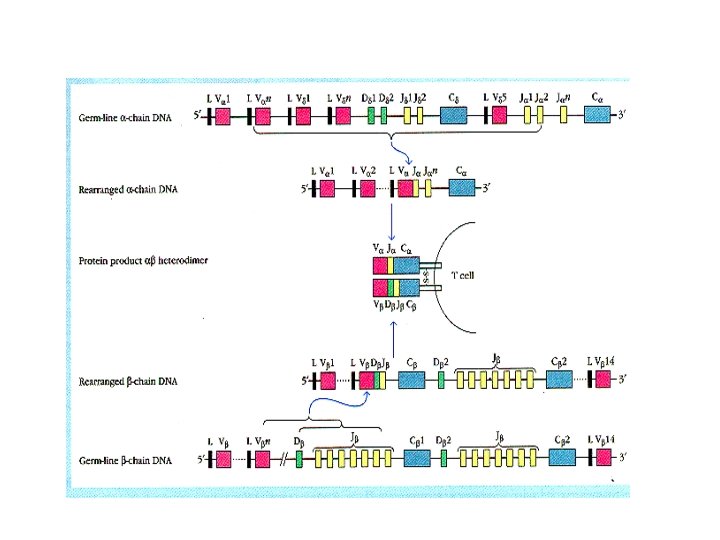
Genetics • Βγ chains-coded for by gene clusters found on chromosome 7 • αδ chains- coded for by gene clusters found on chromosome 14 • Multiple different V region gene segments are present in each gene cluster • One V region gene segment is assembled and is joined to the constant region gene segment. • The m. RNA) transcript is spliced and a mature m. RNA) transcript is produced which is translated into αδ or Βγ protein chains • Note • The expression of a complete V–C gene product excludes further rearrangement events • This phenomenon is referred to as allelic exclusion (allelic exclusion) • The T cell becomes committed to the expression of a single V –C α chain, and a single V–C β chain.
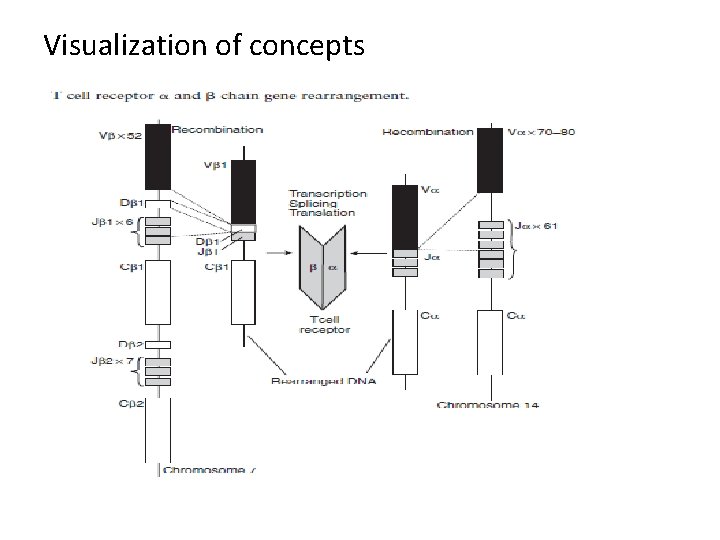
Visualization of concepts
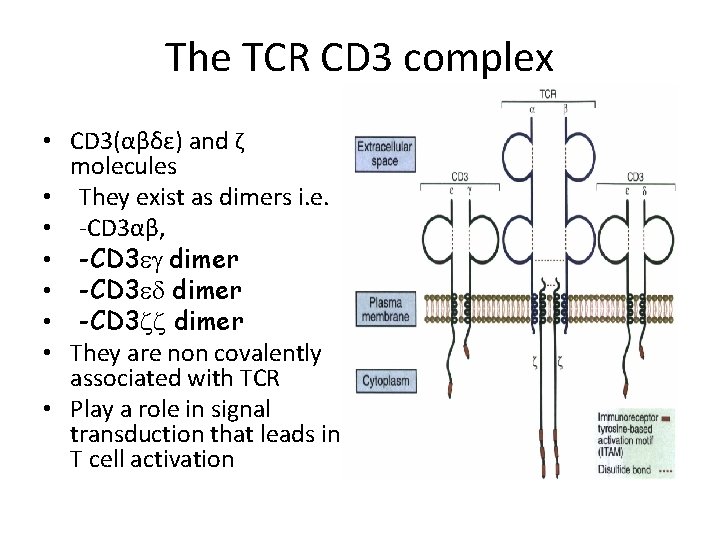
The TCR CD 3 complex • CD 3(αβδε) and ζ molecules • They exist as dimers i. e. • -CD 3αβ, • -CD 3 eg dimer • -CD 3 ed dimer • -CD 3 zz dimer • They are non covalently associated with TCR • Play a role in signal transduction that leads in T cell activation
CD 4&CD 8 co-receptors • Are expressed on the surface of mature T cells • Participate with TCR receptors in recognition of antigens on MHC hence the name co-receptors • CD 4 -MHCII • CD 1 -MHCI • CD 4 is found in helper T cells and CD 8 is found in cytotoxic T cells • About 65% of mature a positive T cells in the blood and lymphoid tissues express CD 4. and 35% express CD 8 • Both consist of 1 extracellular Ig domain, 1 hydrophobic transmembrane region, and a 1, highly basic cytoplasmic tail about 25 amino acids long. • CD 4 has four extracellular Ig-like domains, a hydrophobic transmembrane region, and a highly basic cytoplasmic tail 38 amino acids long
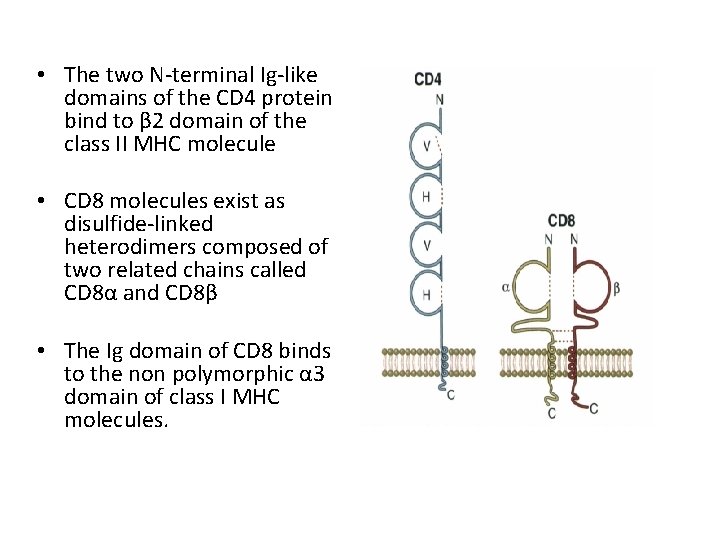
• The two N-terminal Ig-like domains of the CD 4 protein bind to β 2 domain of the class II MHC molecule • CD 8 molecules exist as disulfide-linked heterodimers composed of two related chains called CD 8α and CD 8β • The Ig domain of CD 8 binds to the non polymorphic α 3 domain of class I MHC molecules.
• Co-stimulatory molecules • CD 28 recognize co stimulatory molecule B 7 found APCs, costimulatory molecules are important in B cell activation
- Slides: 9