
TCP Reno New Reno SACK Kulan Kao 2006325




- Slides: 39
TCP Reno New. Reno SACK Kulan Kao 2006/3/25
TCP congestion control l There are five stages in the congestion control mechanisms of TCP l l l Slow-start Congestion avoidance Fast retransmission Fast recovery Timeout retransmission
TCP l l Tahoe: Slow start, congestion avoidance and fast retransmit Reno: Tahoe + fast recovery New-Reno: Reno with modified fast recovery SACK: Reno + selective ACKs
TCP Reno, RFC 2001 l l TCP Reno has Slow Start, Congestion Avoidance, Fast Retransmit, and Fast Recovery Algorithms When a new connection is established with a host on another network, the congestion window is initialized to 1 segment l the segment size announced by the other end, or the default, typically 536 or 512 bytes.
TCP Reno, RFC 2001 Slow-start l l Each time an ACK is received, the congestion window is increased by 1 segment. The sender can transmit up to the minimum of the congestion window and the advertised window. The congestion window is flow control imposed by the sender, based on the sender's assessment of perceived network congestion while the advertised window is flow control imposed by the receiver, related to the amount of available buffer space at the receiver for this connection.
TCP Reno, RFC 2001 Slow-start l l The sender starts by transmitting 1 segment and waiting for its ACK. When that ACK is received, the congestion window is incremented from 1 to 2, and 2 segments can be sent. cwnd=1 in first RTT (round-trip-time), cwnd=2 in second RTT, cwnd=4 in third RTT, cwnd is increasing exponentially
TCP Reno, RFC 2001 Slow-start 1. Initialization for a given connection sets cwnd to 1 segment and sets ssthresh to 65535 bytes. 2. The TCP output routine never sends more than the minimum of cwnd and the receiver's advertised window. 3. When congestion occurs (indicated by a timeout or the reception of duplicate ACKs), 1/2 of the current window size (the minimum of cwnd and the receiver's advertised window, but at least 2 segments) is saved in ssthresh. l if the congestion is indicated by a timeout, cwnd is set to 1 segment (i. e. , slow start).
TCP Reno, RFC 2001 Slow-start 4. When new data is acknowledged by the other end, increase cwnd, but the way it increases depends on whether TCP is performing slow start or congestion avoidance. l l l If cwnd is less than or equal to ssthresh, TCP is in slow start otherwise TCP is performing congestion avoidance. Slow start continues until TCP is halfway to where it was when congestion occurred (since it recorded 1/2 of the window size that caused the problem in step 2), and then congestion avoidance takes over.
TCP Reno, RFC 2001 Congestion avoidance l Congestion avoidance dictates that cwnd be incremented by segsize*segsize/cwnd each time an ACK is received, where segsize is the segment size and cwnd is maintained in bytes. l cwnd=128 in nth RTT, cwnd=129 in n+1 th RTT, cwnd=130 in n+2 th RTT, cwnd is increasing linearly l During Congestion avoidance, the increase in cwnd should be at most 1 segment each round-trip time (regardless how many ACKs are received in that RTT), whereas slow start increments cwnd by the number of ACKs received in a round-trip time.
TCP Reno, RFC 2001 Fast Retransmit l l l TCP Reno may generate an immediate acknowledgment (a duplicate ACK) when an out-oforder segment is received. This duplicate ACK should not be delayed. The purpose of this duplicate ACK is to let the other end know that a segment was received out of order, and to tell it what sequence number is expected. Since TCP does not know whether a duplicate ACK is caused by a lost segment or just a reordering of segments, it waits for a small number of duplicate ACKs to be received
TCP Reno, RFC 2001 Fast Retransmit l l It is assumed that if there is just a reordering of the segments, there will be only 1 or 2 duplicate ACKs before the reordered segment is processed, which will then generate a new ACK. If 3 or more duplicate ACKs are received in a row, it is a strong indication that a segment has been lost. TCP then performs a retransmission of what appears to be the missing segment, without waiting for a retransmission timer to expire.
Example of Duplicate ACKs
TCP Reno, RFC 2001 Fast Recovery l l After fast retransmit sends what appears to be the missing segment, congestion avoidance, but not slow start is performed. This is called the fast recovery algorithm. Since the receiver can only generate the duplicate ACK when another segment is received, that segment has left the network and is in the receiver's buffer. That is, there is still data flowing between the two ends, and TCP does not want to reduce the flow abruptly by going into slow start.
TCP Reno, RFC 2001 Fast Recovery 1. When the 3 rd duplicate ACK is received, set ssthresh to 1/2 the current congestion window, cwnd, but no less than 2 segments. 2. Retransmit the missing segment. Set cwnd to ssthresh plus 3 times the segment size. This inflates the congestion window by the number of segments that have left the network and which the other end has cached. 3. Each time another duplicate ACK arrives, increment cwnd by 1 segment. This inflates the congestion window for the additional segment that has left the network.
TCP Reno, RFC 2001 Fast Recovery 4. When the next ACK arrives that acknowledges new data, set cwnd to ssthresh (the value in step 1 set ssthresh to 1/2 the current congestion window).
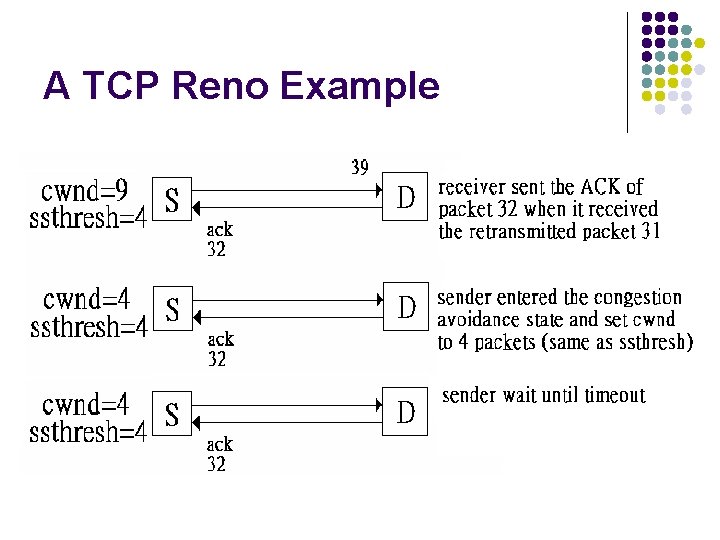
A TCP Reno Example
A TCP Reno Example
Drawbacks of TCP Reno l l TCP Reno have to wait until timeout before retransmit lost packet, because Reno will finish Fast recovery and enter congestion avoidance stage when sender receive Partial ACK. But during this waiting time, some packet still missed.
Drawbacks of TCP Reno l l When TCP Reno sender back to congestion avoidance stage, there are usually no enough duplicate ACK to trigger retransmission mechanism, so sender can only wait until timeout. Timeout affect TCP efficiency heavily, because TCP cannot send out new packet when waiting timeout and cwnd will be set to 1 after timeout.
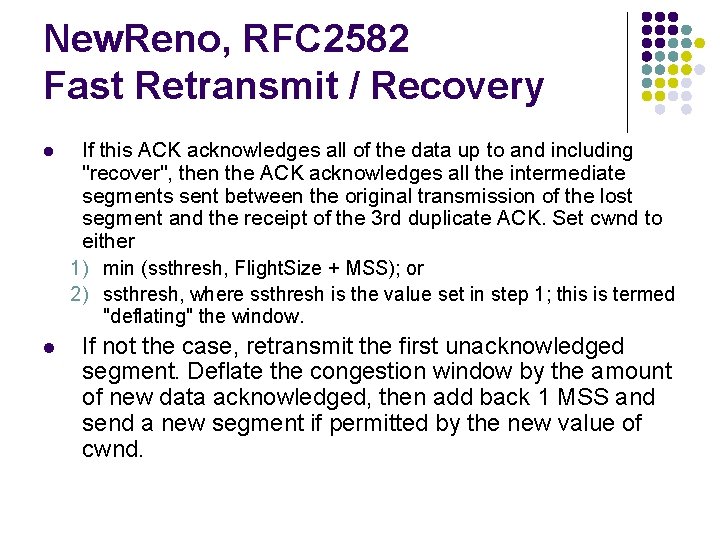
New. Reno, RFC 2582 Fast Retransmit / Recovery l l l TCP New. Reno will not finish Fast recovery when sender receives Partial ACK On the contrary, sender will continuously retransmit those packet after Partial ACK, until all lost packet being retransmit, then finish Fast recovery. TCP New. Reno can retransmit 1 lost packet every RTT time during Fast recovery stage, which improve the usage of link.
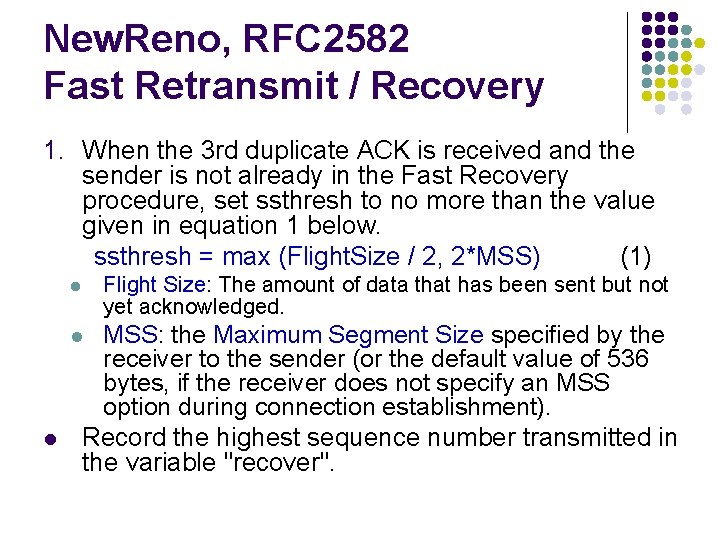
New. Reno, RFC 2582 Fast Retransmit / Recovery 1. When the 3 rd duplicate ACK is received and the sender is not already in the Fast Recovery procedure, set ssthresh to no more than the value given in equation 1 below. ssthresh = max (Flight. Size / 2, 2*MSS) (1) Flight Size: The amount of data that has been sent but not yet acknowledged. l MSS: the Maximum Segment Size specified by the receiver to the sender (or the default value of 536 bytes, if the receiver does not specify an MSS option during connection establishment). Record the highest sequence number transmitted in the variable "recover". l l
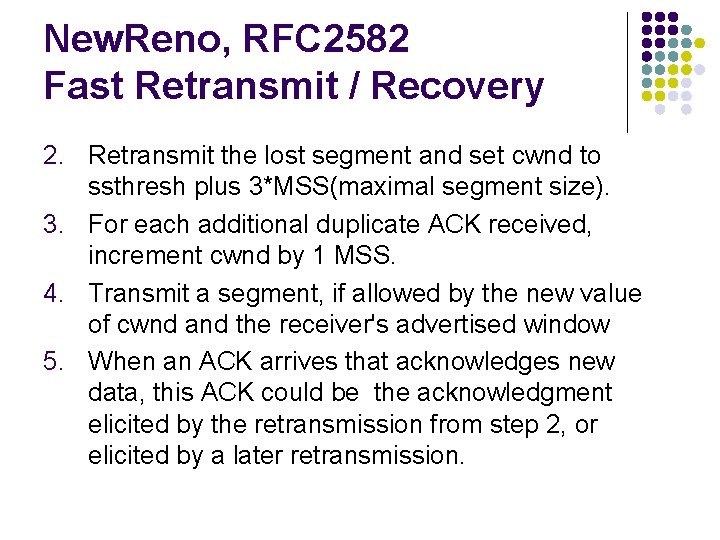
New. Reno, RFC 2582 Fast Retransmit / Recovery 2. Retransmit the lost segment and set cwnd to ssthresh plus 3*MSS(maximal segment size). 3. For each additional duplicate ACK received, increment cwnd by 1 MSS. 4. Transmit a segment, if allowed by the new value of cwnd and the receiver's advertised window 5. When an ACK arrives that acknowledges new data, this ACK could be the acknowledgment elicited by the retransmission from step 2, or elicited by a later retransmission.
New. Reno, RFC 2582 Fast Retransmit / Recovery l If this ACK acknowledges all of the data up to and including "recover", then the ACK acknowledges all the intermediate segments sent between the original transmission of the lost segment and the receipt of the 3 rd duplicate ACK. Set cwnd to either 1) min (ssthresh, Flight. Size + MSS); or 2) ssthresh, where ssthresh is the value set in step 1; this is termed "deflating" the window. l If not the case, retransmit the first unacknowledged segment. Deflate the congestion window by the amount of new data acknowledged, then add back 1 MSS and send a new segment if permitted by the new value of cwnd.
A TCP New. Reno example
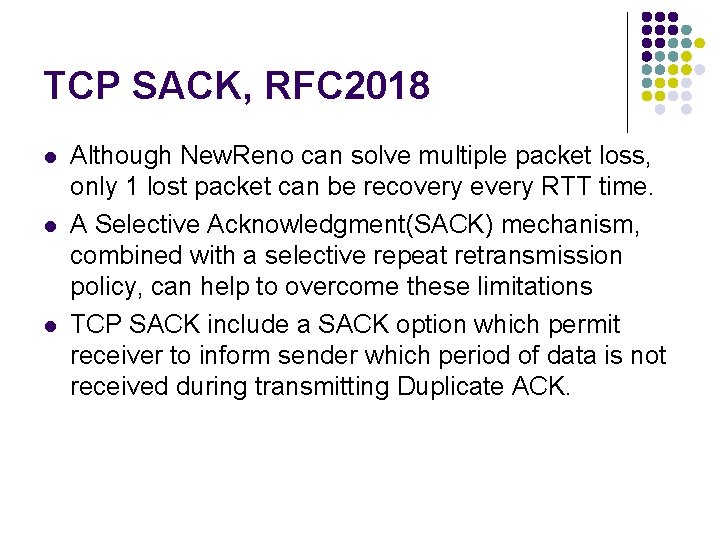
TCP SACK, RFC 2018 l l l Although New. Reno can solve multiple packet loss, only 1 lost packet can be recovery every RTT time. A Selective Acknowledgment(SACK) mechanism, combined with a selective repeat retransmission policy, can help to overcome these limitations TCP SACK include a SACK option which permit receiver to inform sender which period of data is not received during transmitting Duplicate ACK.
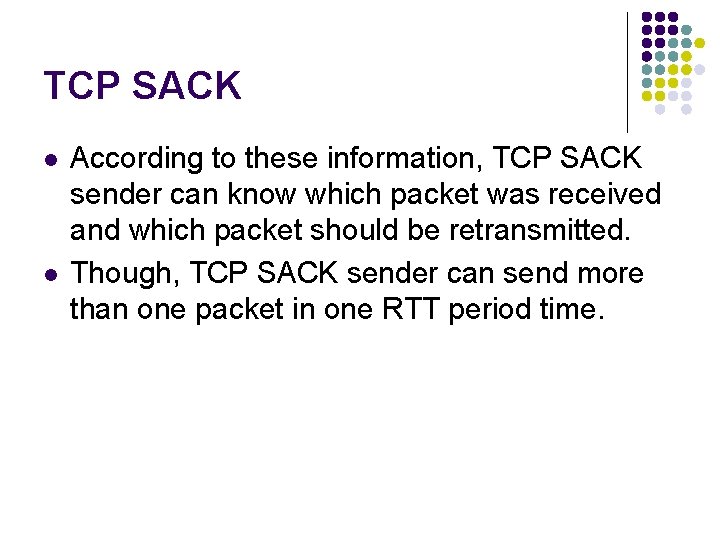
TCP SACK l l According to these information, TCP SACK sender can know which packet was received and which packet should be retransmitted. Though, TCP SACK sender can send more than one packet in one RTT period time.
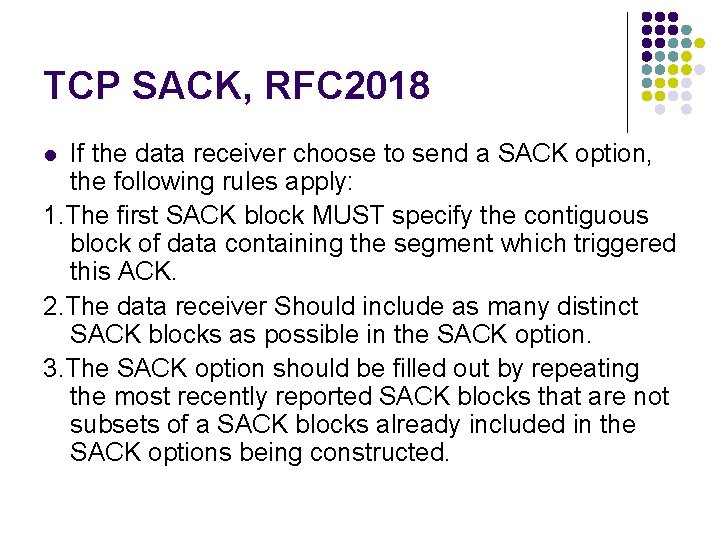
TCP SACK, RFC 2018 If the data receiver choose to send a SACK option, the following rules apply: 1. The first SACK block MUST specify the contiguous block of data containing the segment which triggered this ACK. 2. The data receiver Should include as many distinct SACK blocks as possible in the SACK option. 3. The SACK option should be filled out by repeating the most recently reported SACK blocks that are not subsets of a SACK blocks already included in the SACK options being constructed. l
SACK, RFC 2018 l l l The SACK option is to be sent by a data receiver to inform the data sender of non-contiguous blocks of data that have been received and queued. The data receiver awaits the receipt of data (perhaps by means of retransmissions) to fill the gaps in sequence space between received blocks. When missing segments are received, the data receiver acknowledges the data normally by advancing the left window edge in the Acknowledgement Number Field of the TCP header.
SACK, RFC 2018 l l This SACK option contains a list of some of the blocks of contiguous sequence space occupied by data that has been received and queued within the window. Each contiguous block of data queued at the data receiver is defined in the SACK option by two 32 -bit unsigned integers in network byte order: l l Left Edge of Block l This is the first sequence number of this block. Right Edge of Block l This is the sequence number immediately following the last sequence number of this block.
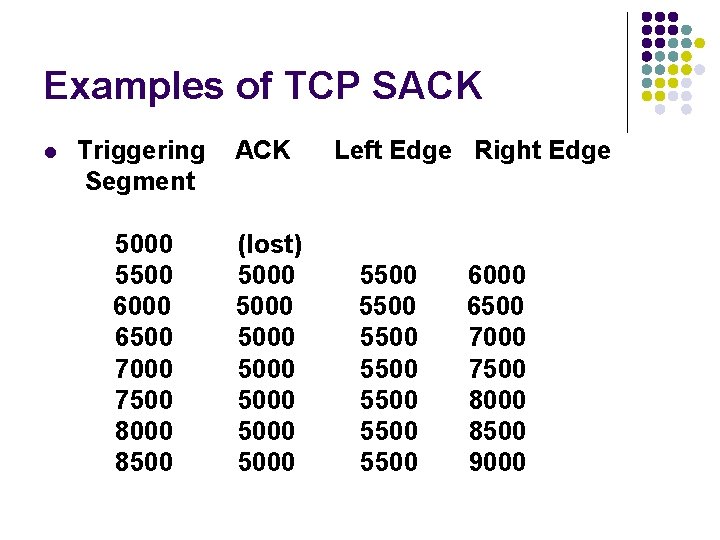
Examples of TCP SACK l l Assume the left window edge is 5000 and that the data transmitter sends a burst of 8 segments, each containing 500 data bytes. Case 1: The first 4 segments are received but the last 4 are dropped. l The data receiver will return a normal TCP ACK segment acknowledging sequence number 7000, with no SACK option.
Examples of TCP SACK l Case 2: The first segment is dropped but the remaining 7 are received. l Upon receiving each of the last seven packets, the data receiver will return a TCP ACK segment that acknowledges sequence number 5000 and contains a SACK option specifying one block of queued data:
Examples of TCP SACK l Triggering Segment ACK 5000 5500 6000 6500 7000 7500 8000 8500 (lost) 5000 5000 Left Edge Right Edge 5500 5500 6000 6500 7000 7500 8000 8500 9000
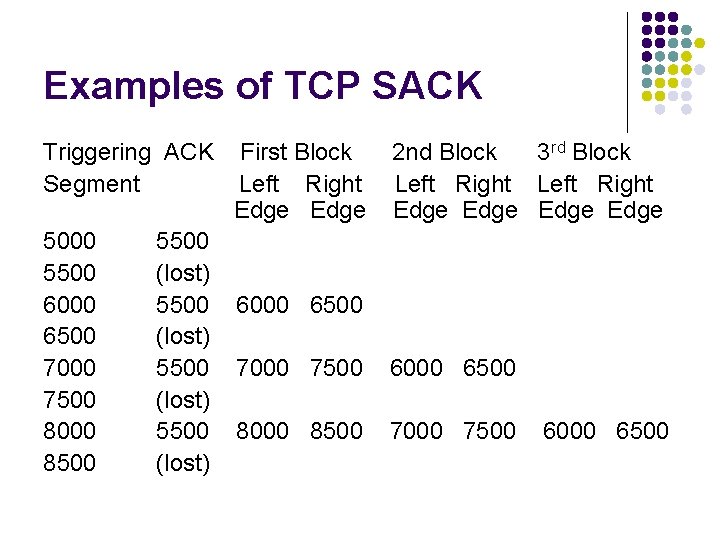
Examples of TCP SACK l Case 3: The 2 nd, 4 th, 6 th, and 8 th (last) segments are dropped. l The data receiver ACKs the first packet normally. The third, fifth, and seventh packets trigger SACK options as follows:
Examples of TCP SACK Triggering ACK Segment 5000 5500 6000 6500 7000 7500 8000 8500 5500 (lost) First Block Left Right Edge 2 nd Block 3 rd Block Left Right Edge 6000 6500 7000 7500 6000 6500 8000 8500 7000 7500 6000 6500
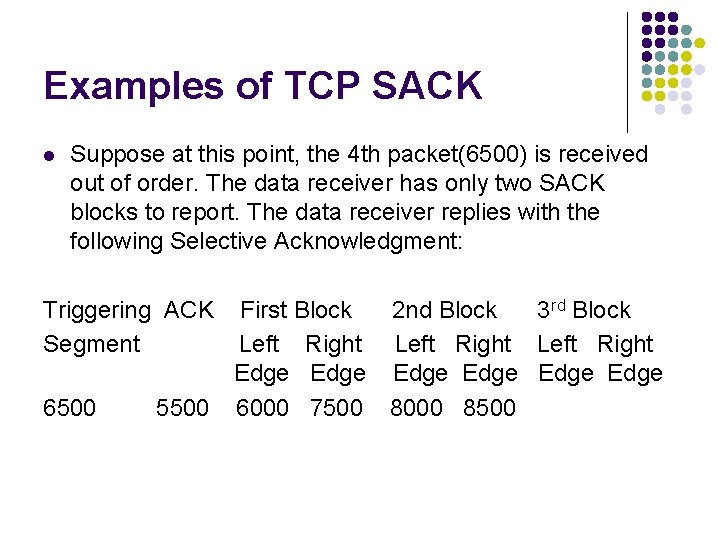
Examples of TCP SACK l Suppose at this point, the 4 th packet(6500) is received out of order. The data receiver has only two SACK blocks to report. The data receiver replies with the following Selective Acknowledgment: Triggering ACK Segment 6500 First Block 2 nd Block 3 rd Block Left Right Edge Edge 5500 6000 7500 8000 8500
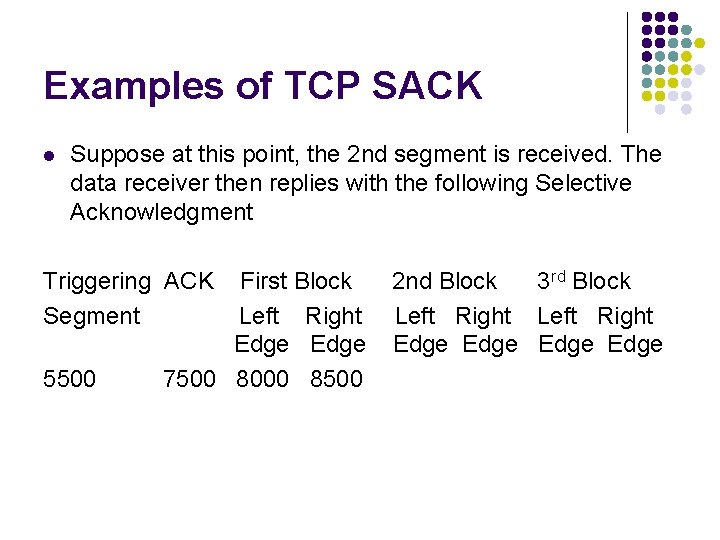
Examples of TCP SACK l Suppose at this point, the 2 nd segment is received. The data receiver then replies with the following Selective Acknowledgment Triggering ACK Segment 5500 First Block Left Right Edge 7500 8000 8500 2 nd Block 3 rd Block Left Right Edge
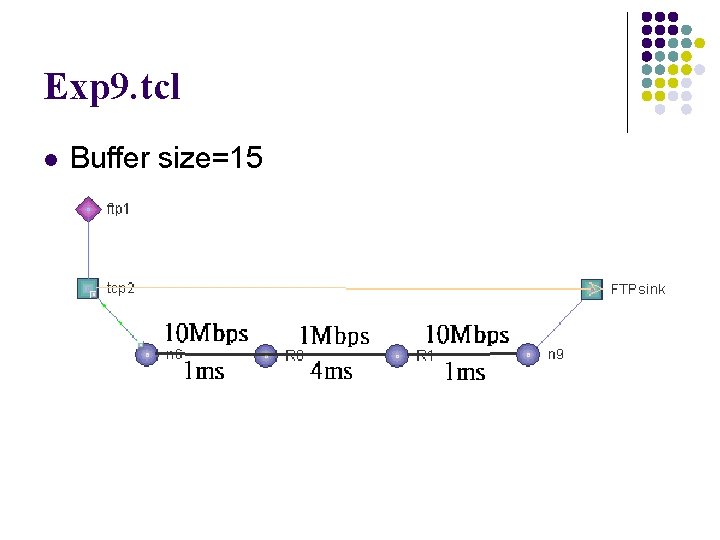
Exp 9. tcl l Buffer size=15
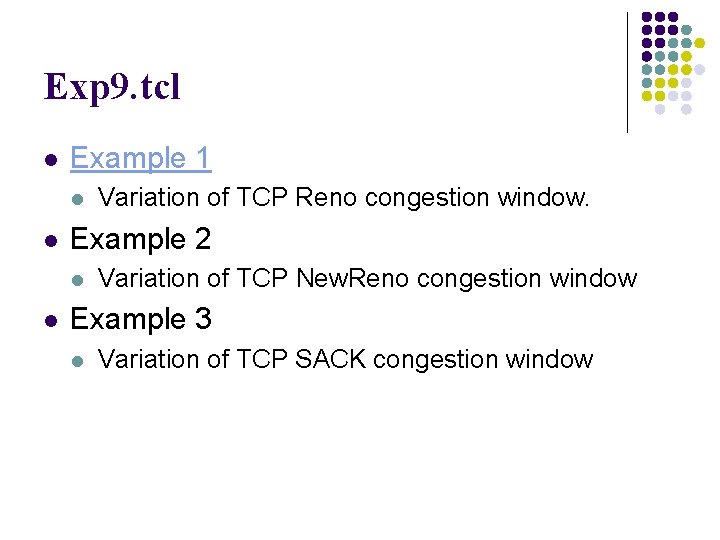
Exp 9. tcl l Example 1 l l Example 2 l l Variation of TCP Reno congestion window. Variation of TCP New. Reno congestion window Example 3 l Variation of TCP SACK congestion window