
TCP Protocol Slides originally from Williamson at Calgary
- Slides: 18
TCP Protocol • Slides originally from Williamson at Calgary • Minor modifications are made 1
The TCP Protocol • Connection-oriented, point-to-point protocol: – – – Connection establishment and teardown phases ‘Phone-like’ circuit abstraction (application-layer view) One sender, one receiver Called a “reliable byte stream” protocol General purpose (for any network environment) • Originally optimized for certain kinds of transfer: – Telnet (interactive remote login) – FTP (long, slow transfers) – Web is like neither of these! 2
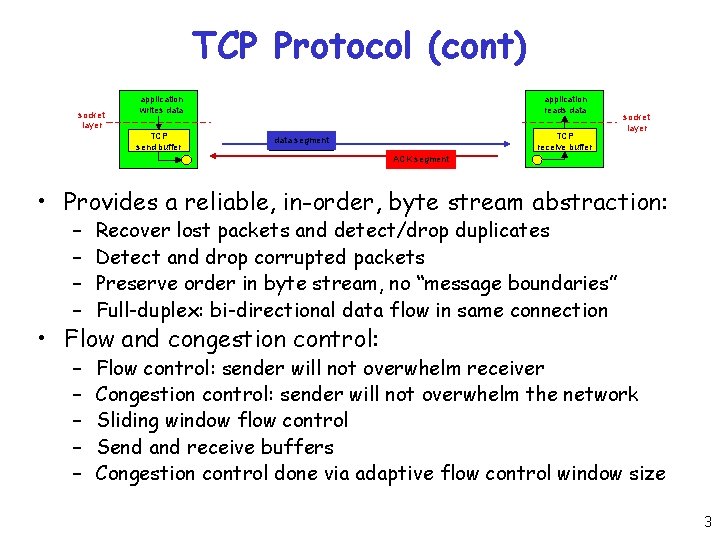
TCP Protocol (cont) socket layer application writes data TCP send buffer application reads data TCP receive buffer data segment socket layer ACK segment • Provides a reliable, in-order, byte stream abstraction: – – Recover lost packets and detect/drop duplicates Detect and drop corrupted packets Preserve order in byte stream, no “message boundaries” Full-duplex: bi-directional data flow in same connection – – – Flow control: sender will not overwhelm receiver Congestion control: sender will not overwhelm the network Sliding window flow control Send and receive buffers Congestion control done via adaptive flow control window size • Flow and congestion control: 3
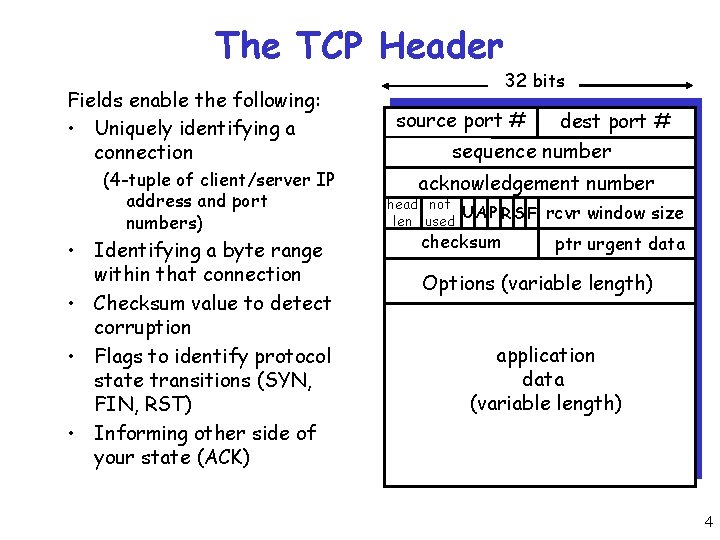
The TCP Header Fields enable the following: • Uniquely identifying a connection (4 -tuple of client/server IP address and port numbers) • Identifying a byte range within that connection • Checksum value to detect corruption • Flags to identify protocol state transitions (SYN, FIN, RST) • Informing other side of your state (ACK) 32 bits source port # dest port # sequence number acknowledgement number head not UA P R S F len used checksum rcvr window size ptr urgent data Options (variable length) application data (variable length) 4
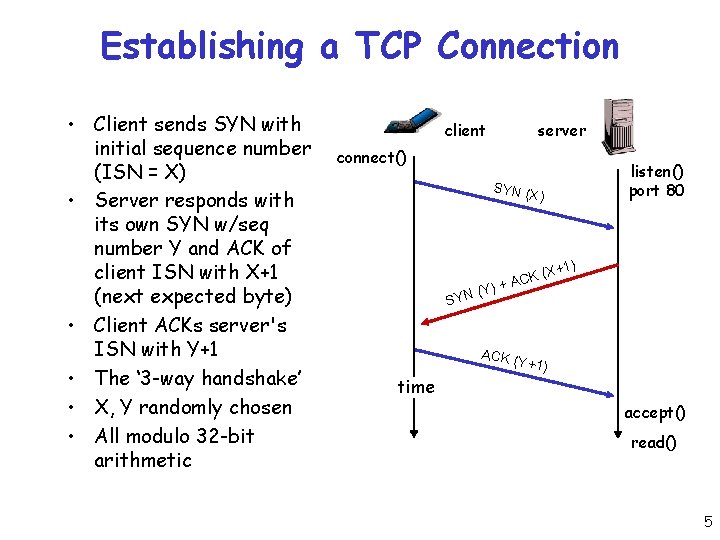
Establishing a TCP Connection • Client sends SYN with initial sequence number (ISN = X) • Server responds with its own SYN w/seq number Y and ACK of client ISN with X+1 (next expected byte) • Client ACKs server's ISN with Y+1 • The ‘ 3 -way handshake’ • X, Y randomly chosen • All modulo 32 -bit arithmetic client server connect() listen() port 80 SYN ( X) Y) + ( SYN (X ACK +1) ACK ( Y time +1) accept() read() 5
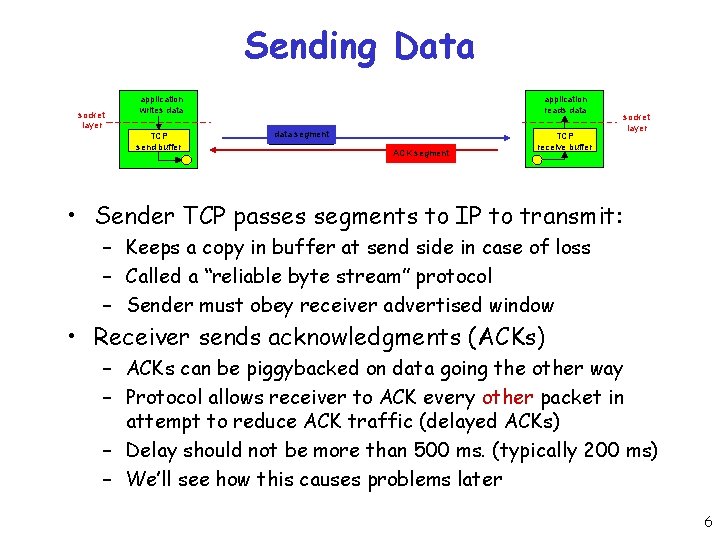
Sending Data socket layer application writes data TCP send buffer application reads data segment ACK segment TCP receive buffer socket layer • Sender TCP passes segments to IP to transmit: – Keeps a copy in buffer at send side in case of loss – Called a “reliable byte stream” protocol – Sender must obey receiver advertised window • Receiver sends acknowledgments (ACKs) – ACKs can be piggybacked on data going the other way – Protocol allows receiver to ACK every other packet in attempt to reduce ACK traffic (delayed ACKs) – Delay should not be more than 500 ms. (typically 200 ms) – We’ll see how this causes problems later 6
Preventing Congestion • Sender may not only overrun receiver, but may also overrun intermediate routers: – No way to explicitly know router buffer occupancy, so we need to infer it from packet losses – Assumption is that losses stem from congestion, namely, that intermediate routers have no available buffers • Sender maintains a congestion window: – Never have more than CW of un-acknowledged data outstanding (or RWIN data; min of the two) – Successive ACKs from receiver cause CW to grow. • How CW grows based on which of 2 phases: – Slow-start: initial state. – Congestion avoidance: steady-state. – Switch between the two when CW > slow-start threshold 7
Congestion Control Principles • Lack of congestion control would lead to congestion collapse (Jacobson 88). • Idea is to be a “good network citizen”. • Would like to transmit as fast as possible without loss. • Probe network to find available bandwidth. • In steady-state: linear increase in CW per RTT. • After loss event: CW is halved. • This is called additive increase /multiplicative decrease (AIMD). • Various papers on why AIMD leads to network stability. 8
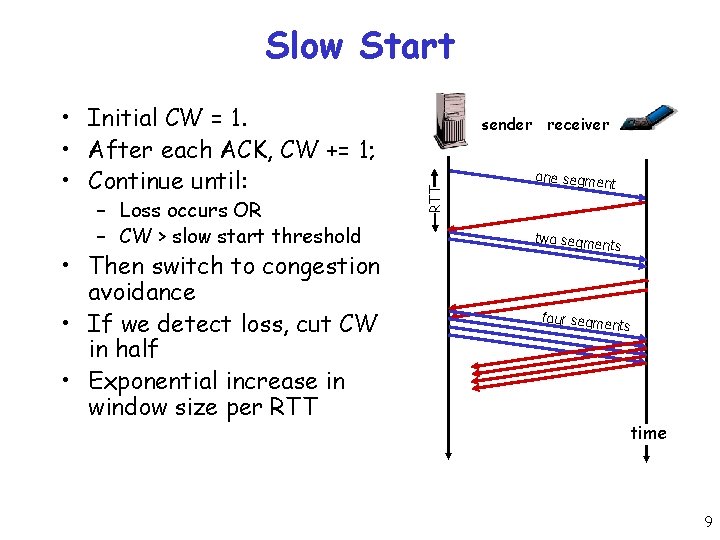
Slow Start – Loss occurs OR – CW > slow start threshold • Then switch to congestion avoidance • If we detect loss, cut CW in half • Exponential increase in window size per RTT sender receiver RTT • Initial CW = 1. • After each ACK, CW += 1; • Continue until: one segme nt two segme nts four segme nts time 9
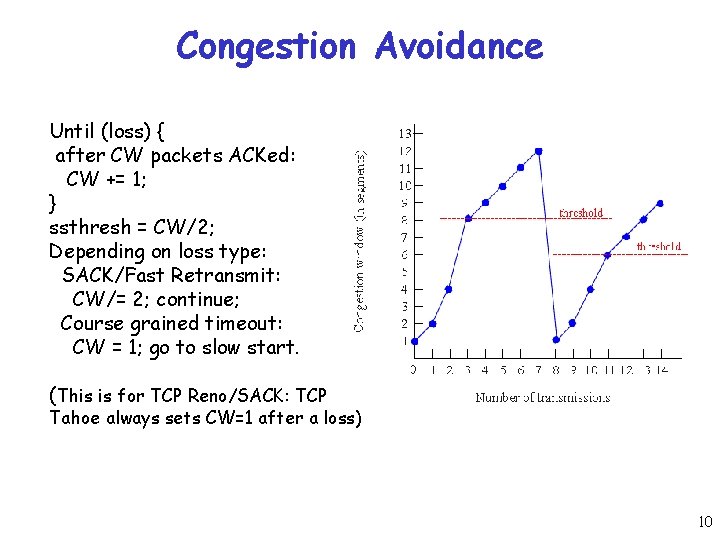
Congestion Avoidance Until (loss) { after CW packets ACKed: CW += 1; } ssthresh = CW/2; Depending on loss type: SACK/Fast Retransmit: CW/= 2; continue; Course grained timeout: CW = 1; go to slow start. (This is for TCP Reno/SACK: TCP Tahoe always sets CW=1 after a loss) 10
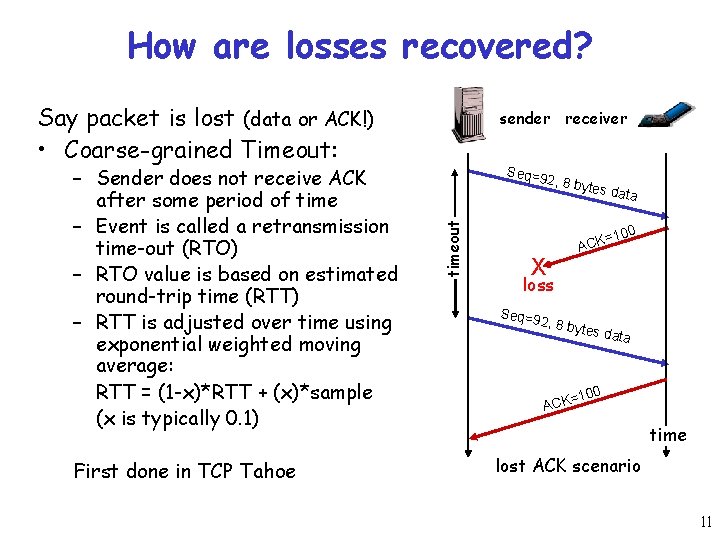
How are losses recovered? Say packet is lost (data or ACK!) • Coarse-grained Timeout: First done in TCP Tahoe Seq=9 2, 8 by timeout – Sender does not receive ACK after some period of time – Event is called a retransmission time-out (RTO) – RTO value is based on estimated round-trip time (RTT) – RTT is adjusted over time using exponential weighted moving average: RTT = (1 -x)*RTT + (x)*sample (x is typically 0. 1) sender receiver tes da ta =100 X ACK loss Seq=9 2, 8 by tes da t a 0 =10 ACK time lost ACK scenario 11
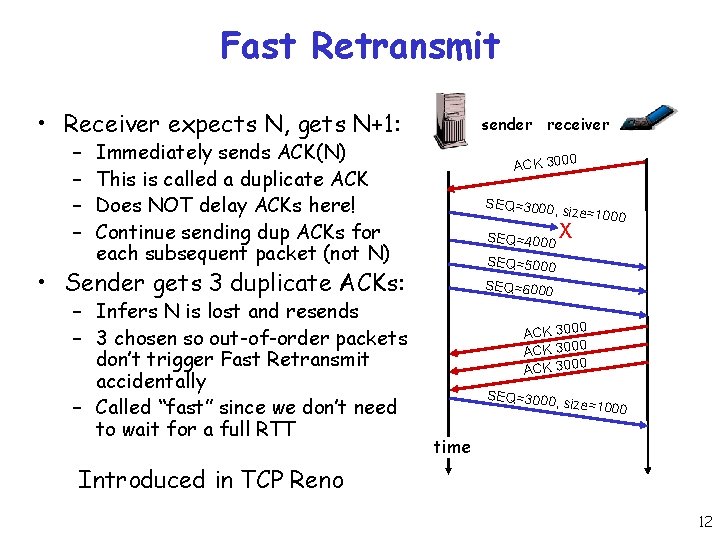
Fast Retransmit • Receiver expects N, gets N+1: – – sender receiver Immediately sends ACK(N) This is called a duplicate ACK Does NOT delay ACKs here! Continue sending dup ACKs for each subsequent packet (not N) ACK 3000 SEQ=3000 , SEQ=4000 X SEQ=5000 • Sender gets 3 duplicate ACKs: – Infers N is lost and resends – 3 chosen so out-of-order packets don’t trigger Fast Retransmit accidentally – Called “fast” since we don’t need to wait for a full RTT size=1000 SEQ=6000 ACK 3000 SEQ=3000 , size=1000 time Introduced in TCP Reno 12
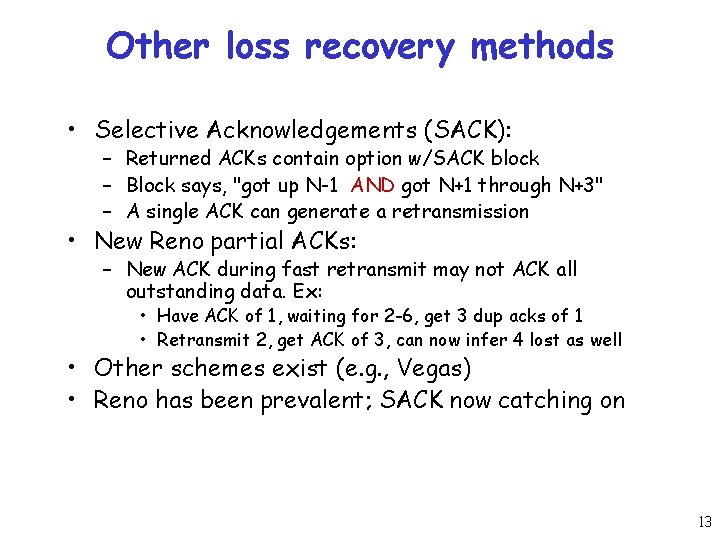
Other loss recovery methods • Selective Acknowledgements (SACK): – Returned ACKs contain option w/SACK block – Block says, "got up N-1 AND got N+1 through N+3" – A single ACK can generate a retransmission • New Reno partial ACKs: – New ACK during fast retransmit may not ACK all outstanding data. Ex: • Have ACK of 1, waiting for 2 -6, get 3 dup acks of 1 • Retransmit 2, get ACK of 3, can now infer 4 lost as well • Other schemes exist (e. g. , Vegas) • Reno has been prevalent; SACK now catching on 13
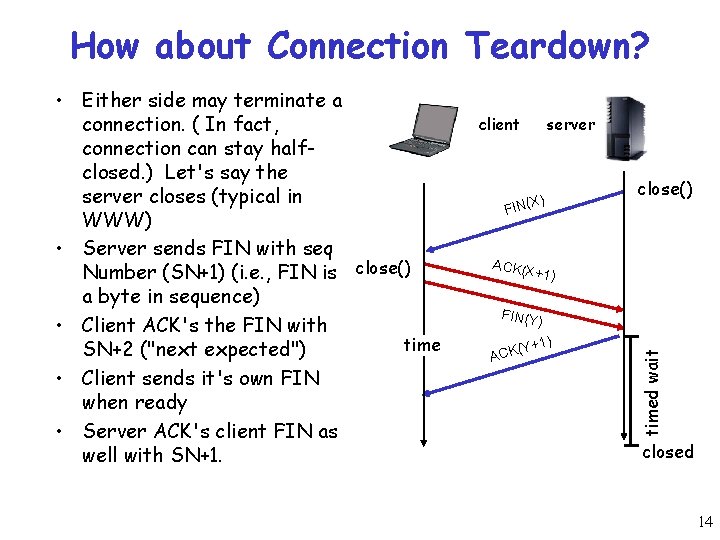
How about Connection Teardown? client server X) FIN( close() ACK(X + 1) FIN(Y) +1) (Y ACK timed wait • Either side may terminate a connection. ( In fact, connection can stay halfclosed. ) Let's say the server closes (typical in WWW) • Server sends FIN with seq Number (SN+1) (i. e. , FIN is close() a byte in sequence) • Client ACK's the FIN with time SN+2 ("next expected") • Client sends it's own FIN when ready • Server ACK's client FIN as well with SN+1. closed 14
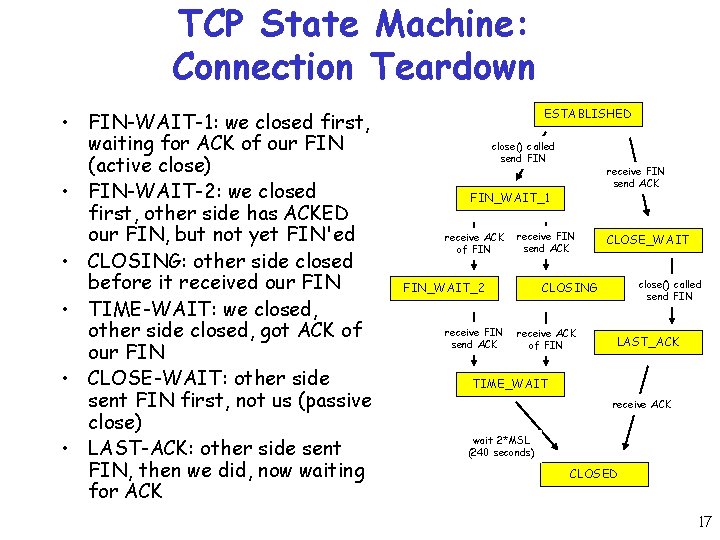
The TCP State Machine • TCP uses a Finite State Machine, kept by each side of a connection, to keep track of what state a connection is in. • State transitions reflect inherent races that can happen in the network, e. g. , two FIN's passing each other in the network. • Certain things can go wrong along the way, i. e. , packets can be dropped or corrupted. In fact, machine is not perfect; certain problems can arise not anticipated in the original RFC. • This is where timers will come in, which we will discuss more later. 15
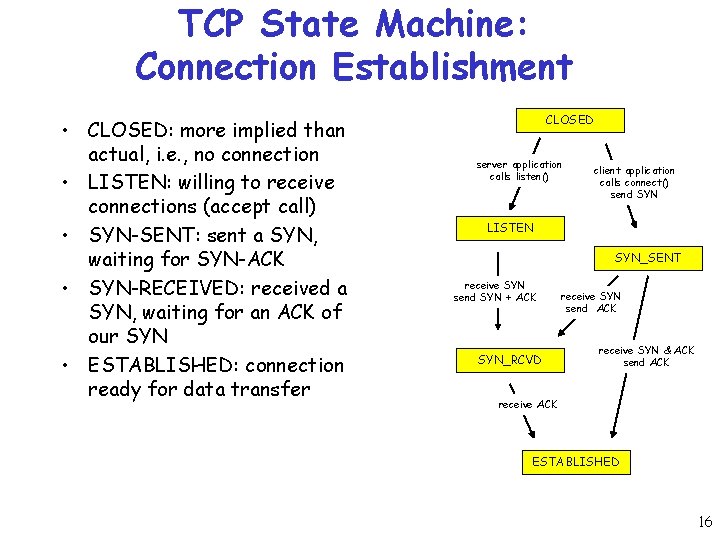
TCP State Machine: Connection Establishment • CLOSED: more implied than actual, i. e. , no connection • LISTEN: willing to receive connections (accept call) • SYN-SENT: sent a SYN, waiting for SYN-ACK • SYN-RECEIVED: received a SYN, waiting for an ACK of our SYN • ESTABLISHED: connection ready for data transfer CLOSED server application calls listen() client application calls connect() send SYN LISTEN SYN_SENT receive SYN send SYN + ACK SYN_RCVD receive SYN send ACK receive SYN & ACK send ACK receive ACK ESTABLISHED 16
TCP State Machine: Connection Teardown • FIN-WAIT-1: we closed first, waiting for ACK of our FIN (active close) • FIN-WAIT-2: we closed first, other side has ACKED our FIN, but not yet FIN'ed • CLOSING: other side closed before it received our FIN • TIME-WAIT: we closed, other side closed, got ACK of our FIN • CLOSE-WAIT: other side sent FIN first, not us (passive close) • LAST-ACK: other side sent FIN, then we did, now waiting for ACK ESTABLISHED close() called send FIN receive FIN send ACK FIN_WAIT_1 receive ACK of FIN receive FIN send ACK FIN_WAIT_2 receive FIN send ACK CLOSE_WAIT close() called send FIN CLOSING receive ACK of FIN LAST_ACK TIME_WAIT receive ACK wait 2*MSL (240 seconds) CLOSED 17
Summary: TCP Protocol • Protocol provides reliability in face of complex network behavior • Tries to trade off efficiency with being "good network citizen" • Vast majority of bytes transferred on Internet today are TCP-based: – – Web Mail News Peer-to-peer (Napster, Gnutella, Free. Net, Ka. Zaa) 18