
TCP IncreaseDecrease Behavior with Explicit Congestion Notification ECN
TCP Increase/Decrease Behavior with Explicit Congestion Notification (ECN) Minseok Kwon and Sonia Fahmy Department of Computer Sciences Purdue University {kwonm, fahmy}@cs. purdue. edu http: //www. cs. purdue. edu/~fahmy 1
Outline • Motivation • Background • ECN( , β): New ECN Response • Performance Analysis • Conclusions 2
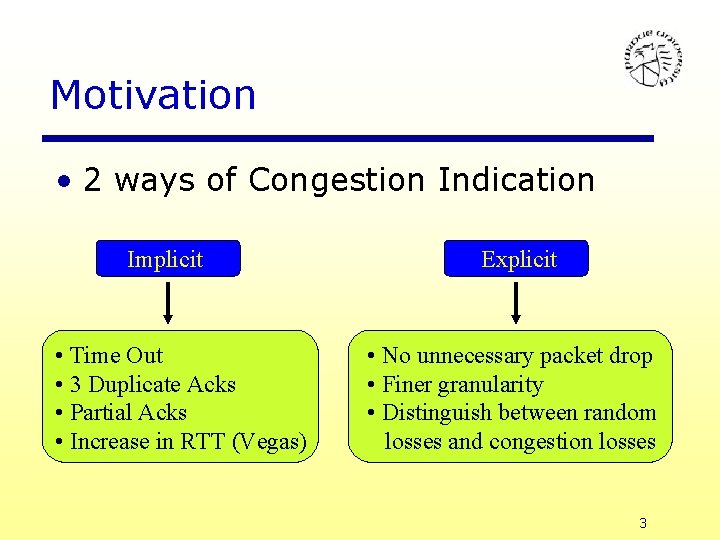
Motivation • 2 ways of Congestion Indication Implicit • Time Out • 3 Duplicate Acks • Partial Acks • Increase in RTT (Vegas) Explicit • No unnecessary packet drop • Finer granularity • Distinguish between random losses and congestion losses 3
Motivation • New TCP response to ECN • How can we use ECN as an early warning sign? • Can TCP response to ECN be more aggressive in the short term while preserving TCP long term behavior? (Note that RFC 3168 does NOT preclude more aggressive short term behavior) • Improved performance gives incentives for hosts to become ECN-compliant. • Small changes to current TCP, compatible with RFCs. 4
Outline • Motivation • Background • ECN( , β): New ECN Response • Performance Analysis • Conclusions 5
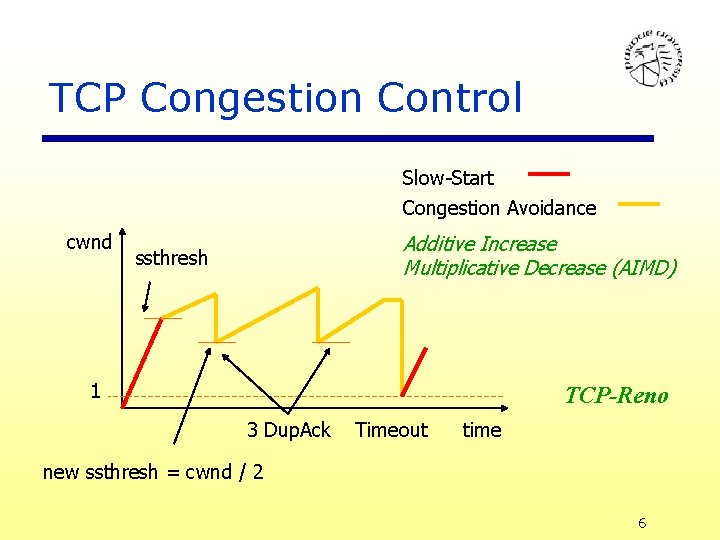
TCP Congestion Control Slow-Start Congestion Avoidance cwnd Additive Increase Multiplicative Decrease (AIMD) ssthresh 1 TCP-Reno 3 Dup. Ack Timeout time new ssthresh = cwnd / 2 6
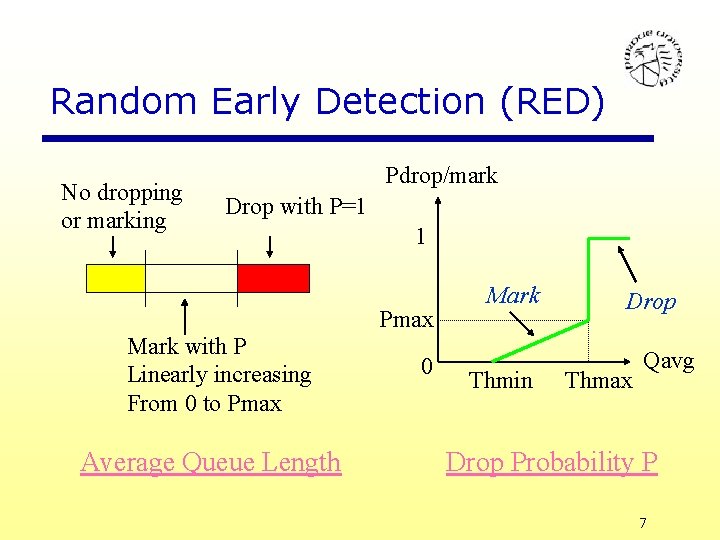
Random Early Detection (RED) No dropping or marking Pdrop/mark Drop with P=1 1 Pmax Mark with P Linearly increasing From 0 to Pmax Average Queue Length 0 Mark Thmin Drop Thmax Qavg Drop Probability P 7
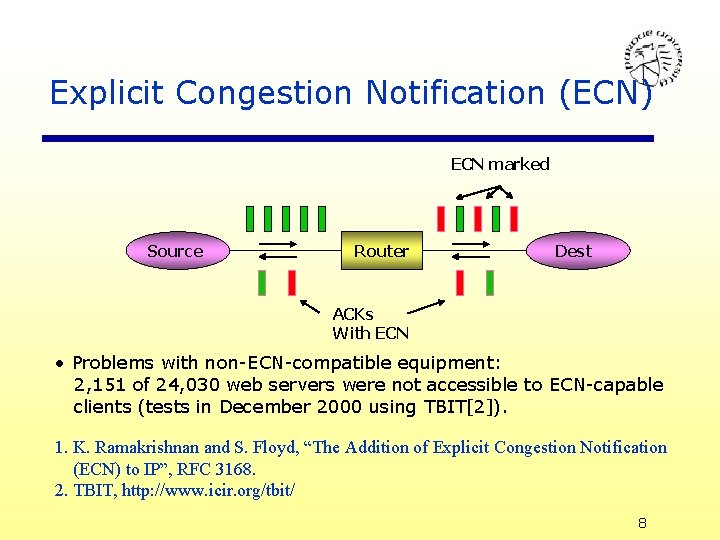
Explicit Congestion Notification (ECN) ECN marked Source Router Dest ACKs With ECN • Problems with non-ECN-compatible equipment: 2, 151 of 24, 030 web servers were not accessible to ECN-capable clients (tests in December 2000 using TBIT[2]). 1. K. Ramakrishnan and S. Floyd, “The Addition of Explicit Congestion Notification (ECN) to IP”, RFC 3168. 2. TBIT, http: //www. icir. org/tbit/ 8
Outline • Motivation • Background • ECN( , β): New ECN Response • Performance Analysis • Conclusions 9
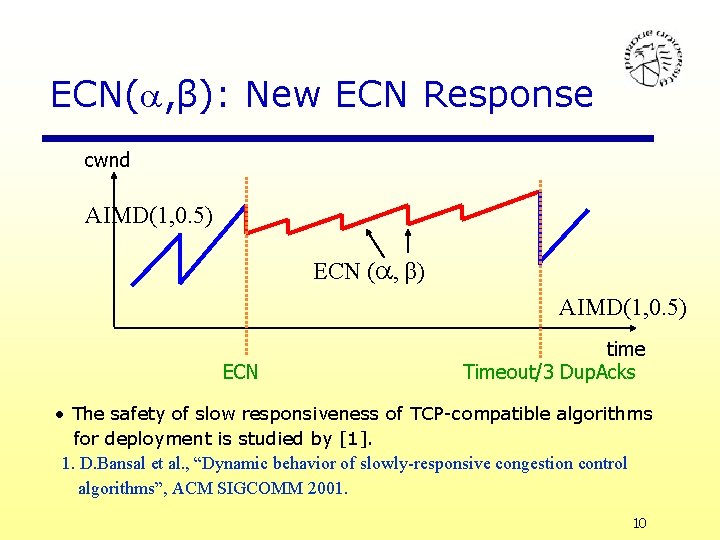
ECN( , β): New ECN Response cwnd AIMD(1, 0. 5) ECN ( , β) AIMD(1, 0. 5) ECN time Timeout/3 Dup. Acks • The safety of slow responsiveness of TCP-compatible algorithms for deployment is studied by [1]. 1. D. Bansal et al. , “Dynamic behavior of slowly-responsive congestion control algorithms”, ACM SIGCOMM 2001. 10
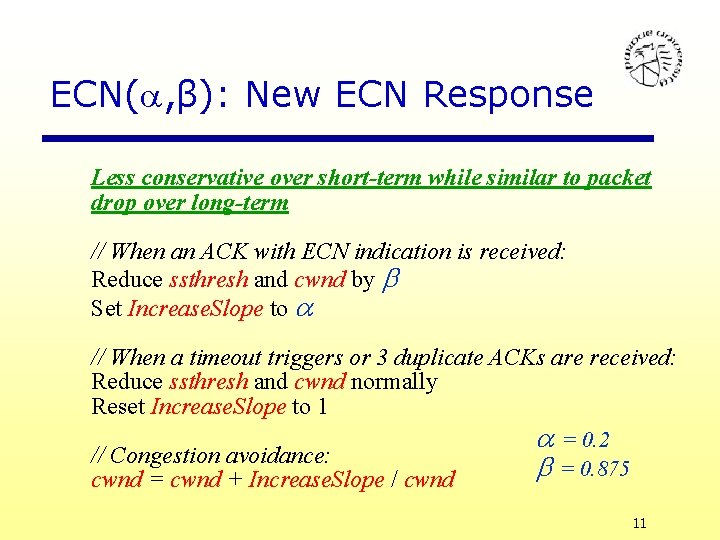
ECN( , β): New ECN Response Less conservative over short-term while similar to packet drop over long-term // When an ACK with ECN indication is received: Reduce ssthresh and cwnd by Set Increase. Slope to // When a timeout triggers or 3 duplicate ACKs are received: Reduce ssthresh and cwnd normally Reset Increase. Slope to 1 // Congestion avoidance: cwnd = cwnd + Increase. Slope / cwnd = 0. 2 = 0. 875 11
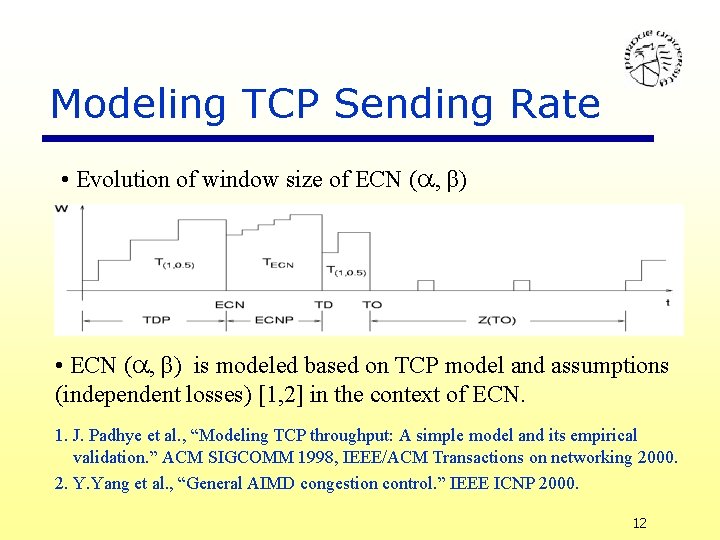
Modeling TCP Sending Rate • Evolution of window size of ECN ( , β) • ECN ( , β) is modeled based on TCP model and assumptions (independent losses) [1, 2] in the context of ECN. 1. J. Padhye et al. , “Modeling TCP throughput: A simple model and its empirical validation. ” ACM SIGCOMM 1998, IEEE/ACM Transactions on networking 2000. 2. Y. Yang et al. , “General AIMD congestion control. ” IEEE ICNP 2000. 12
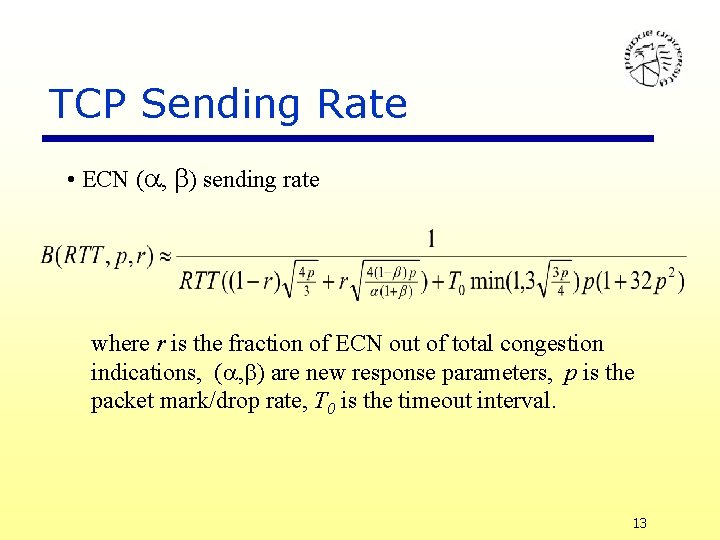
TCP Sending Rate • ECN ( , ) sending rate where r is the fraction of ECN out of total congestion indications, ( , ) are new response parameters, p is the packet mark/drop rate, T 0 is the timeout interval. 13
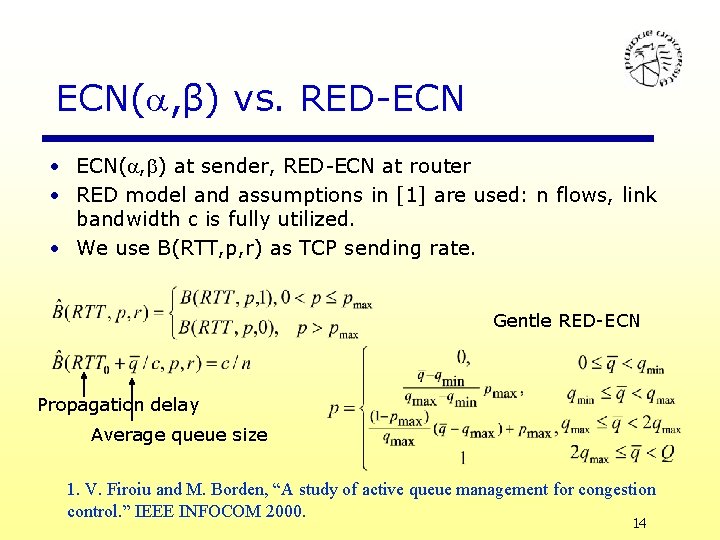
ECN( , β) vs. RED-ECN • ECN( , ) at sender, RED-ECN at router • RED model and assumptions in [1] are used: n flows, link bandwidth c is fully utilized. • We use B(RTT, p, r) as TCP sending rate. Gentle RED-ECN Propagation delay Average queue size 1. V. Firoiu and M. Borden, “A study of active queue management for congestion control. ” IEEE INFOCOM 2000. 14
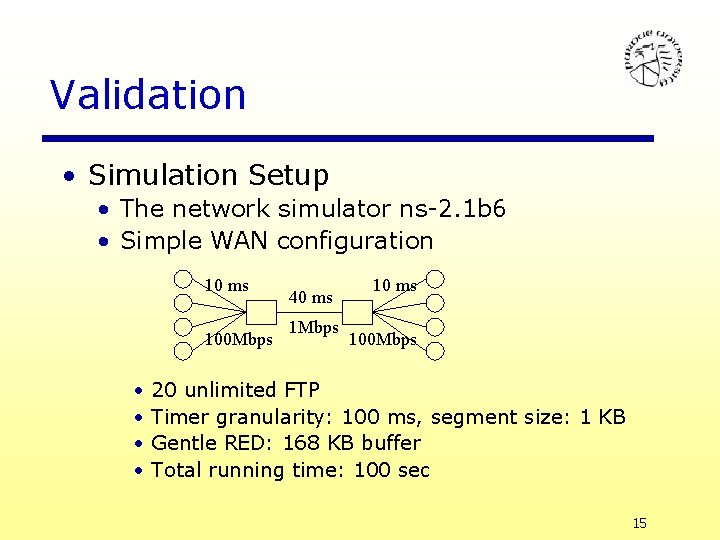
Validation • Simulation Setup • The network simulator ns-2. 1 b 6 • Simple WAN configuration 10 ms 100 Mbps • • 40 ms 1 Mbps 10 ms 100 Mbps 20 unlimited FTP Timer granularity: 100 ms, segment size: 1 KB Gentle RED: 168 KB buffer Total running time: 100 sec 15
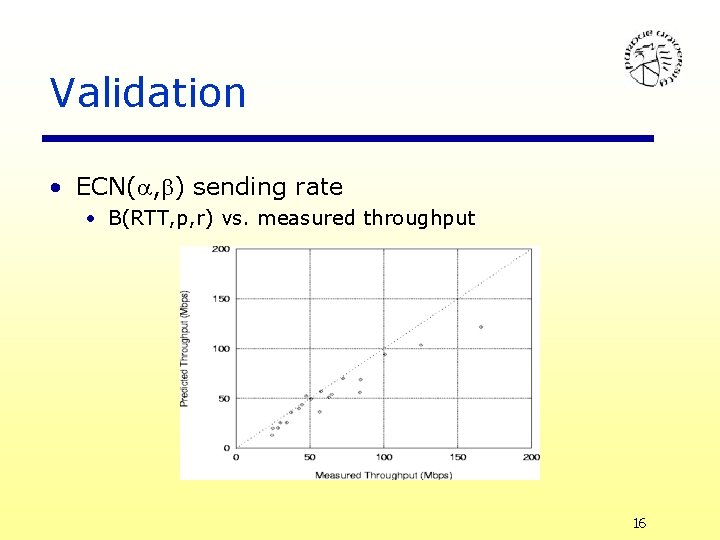
Validation • ECN( , ) sending rate • B(RTT, p, r) vs. measured throughput 16
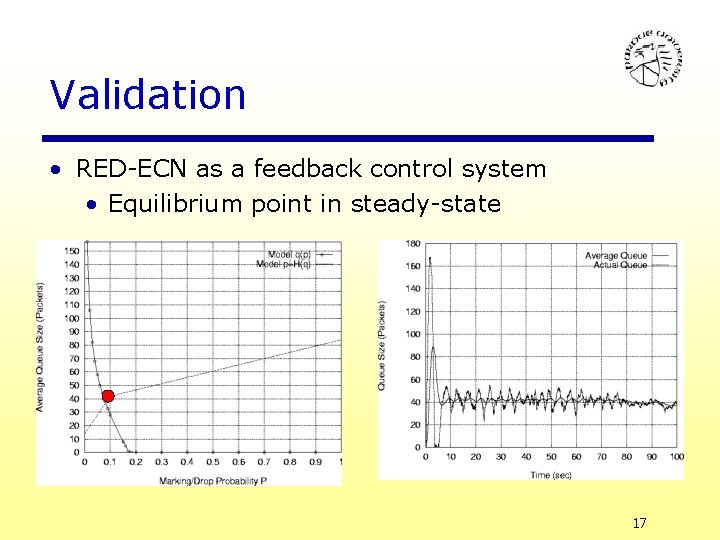
Validation • RED-ECN as a feedback control system • Equilibrium point in steady-state 17
Outline • Motivation • Background • ECN( , β): New ECN Response • Performance Analysis • Conclusions 18
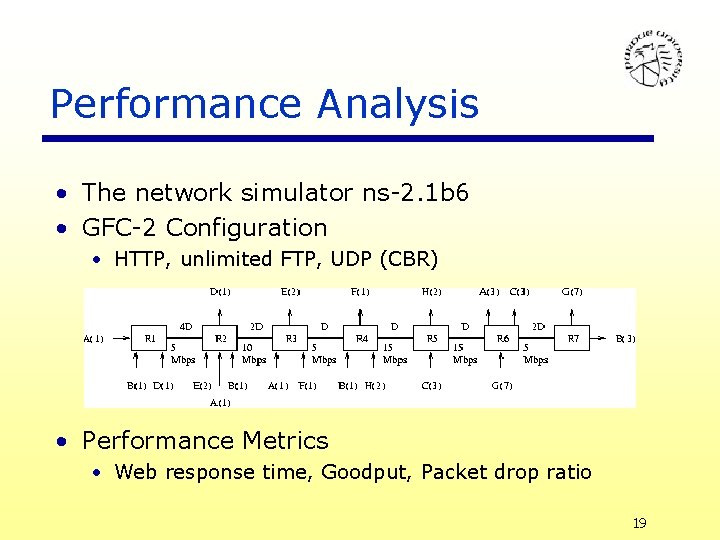
Performance Analysis • The network simulator ns-2. 1 b 6 • GFC-2 Configuration • HTTP, unlimited FTP, UDP (CBR) • Performance Metrics • Web response time, Goodput, Packet drop ratio 19
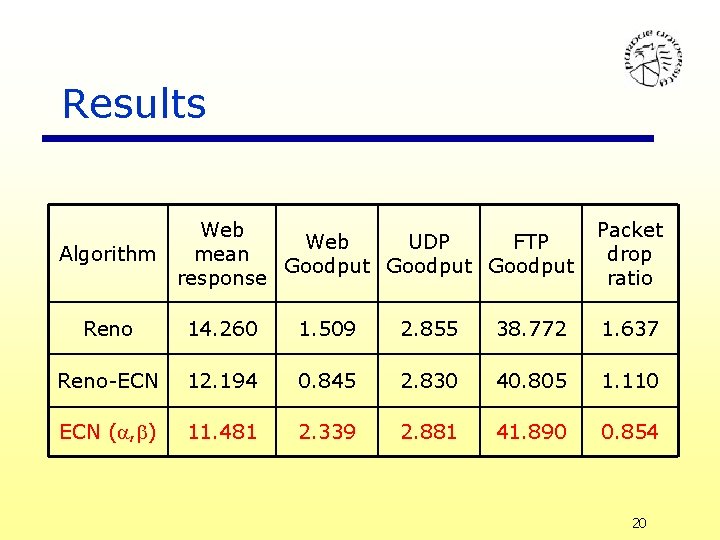
Results Web UDP FTP Algorithm mean Goodput response Packet drop ratio Reno 14. 260 1. 509 2. 855 38. 772 1. 637 Reno-ECN 12. 194 0. 845 2. 830 40. 805 1. 110 ECN ( , ) 11. 481 2. 339 2. 881 41. 890 0. 854 20
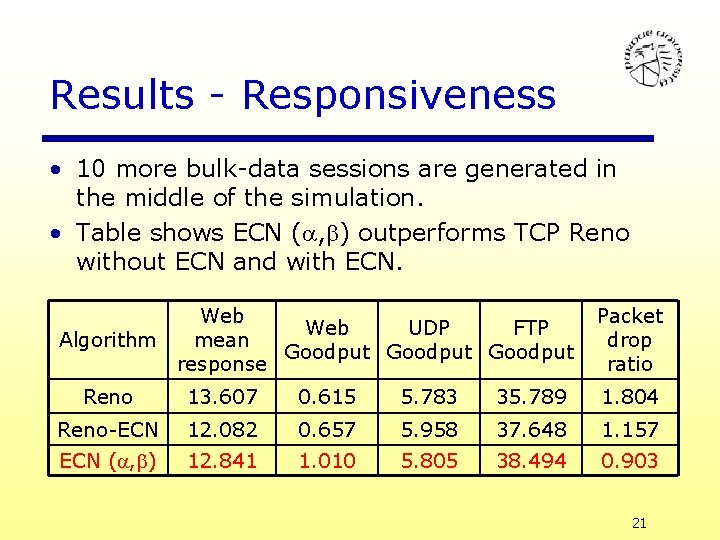
Results - Responsiveness • 10 more bulk-data sessions are generated in the middle of the simulation. • Table shows ECN ( , ) outperforms TCP Reno without ECN and with ECN. Web UDP FTP Algorithm mean Goodput response Packet drop ratio Reno 13. 607 0. 615 5. 783 35. 789 1. 804 Reno-ECN 12. 082 0. 657 5. 958 37. 648 1. 157 ECN ( , ) 12. 841 1. 010 5. 805 38. 494 0. 903 21
Outline • Motivation • Background • ECN( , β): New ECN Response • Performance Analysis • Conclusions 22
Conclusions & Future Work • Small changes to current TCP and compatible with RFCs. • ECN as an early warning sign of congestion. • More aggressive in the short term, preserving TCP long term behavior. • Throughput and steady-state drop/marking probability models for ECN( , ). • Increased goodput, reduced web response time: incentives for host ECN-compliance. • Ongoing work: fairness in heterogeneous configurations. 23
- Slides: 23