
TCP Friendly Rate Control TFRC Protocol Specification RFC
- Slides: 15
TCP Friendly Rate Control (TFRC): Protocol Specification RFC 3448 bis draft-ietf-dccp-rfc 3448 bis-02. txt S. Floyd, M. Handley, J. Padhye, and J. Widmer Testing and simulations from A. Sathiaseelan July 2007, DCCP Working Group
Reported in previous IETFs: • Changes from RFC 3448, in draft-ietf-dccprfc 3448 bis-00. txt • Changes in draft-ietf-dccp-rfc 3448 bis-01. txt • Reported for me in March 2007: – Changes in draft-ietf-dccp-rfc 3448 bis-02 b. txt, (never submitted). – A slide on “things that could be done”.
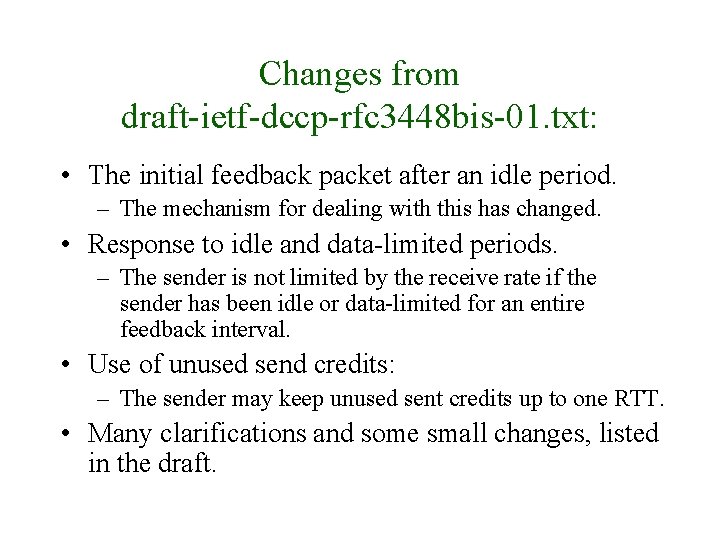
Changes from draft-ietf-dccp-rfc 3448 bis-01. txt: • The initial feedback packet after an idle period. – The mechanism for dealing with this has changed. • Response to idle and data-limited periods. – The sender is not limited by the receive rate if the sender has been idle or data-limited for an entire feedback interval. • Use of unused send credits: – The sender may keep unused sent credits up to one RTT. • Many clarifications and some small changes, listed in the draft.
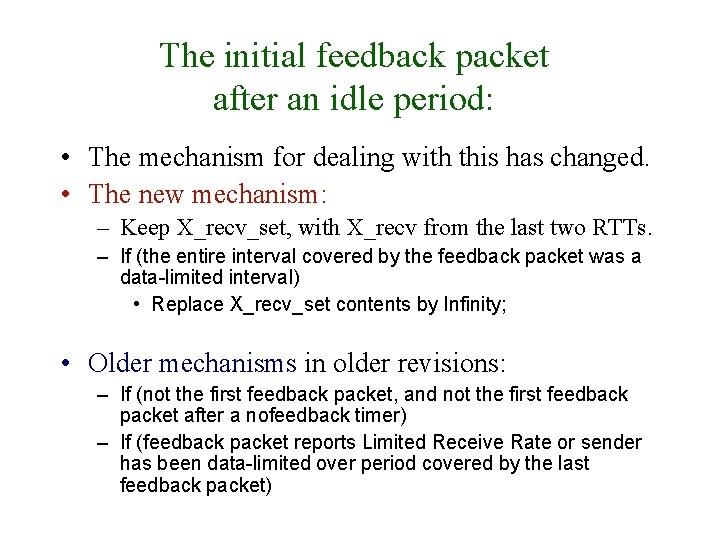
The initial feedback packet after an idle period: • The mechanism for dealing with this has changed. • The new mechanism: – Keep X_recv_set, with X_recv from the last two RTTs. – If (the entire interval covered by the feedback packet was a data-limited interval) • Replace X_recv_set contents by Infinity; • Older mechanisms in older revisions: – If (not the first feedback packet, and not the first feedback packet after a nofeedback timer) – If (feedback packet reports Limited Receive Rate or sender has been data-limited over period covered by the last feedback packet)
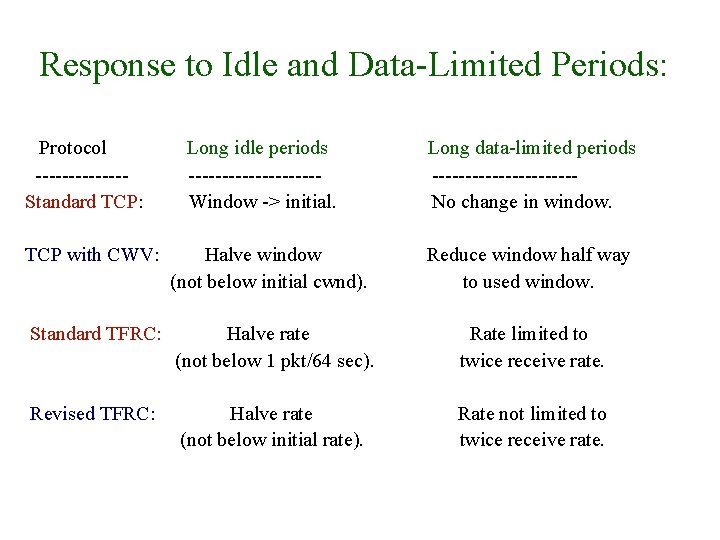
Response to Idle and Data-Limited Periods: Protocol -------Standard TCP: Long idle periods ----------Window -> initial. Long data-limited periods -----------No change in window. TCP with CWV: Halve window (not below initial cwnd). Reduce window half way to used window. Standard TFRC: Halve rate (not below 1 pkt/64 sec). Rate limited to twice receive rate. Revised TFRC: Halve rate (not below initial rate). Rate not limited to twice receive rate.
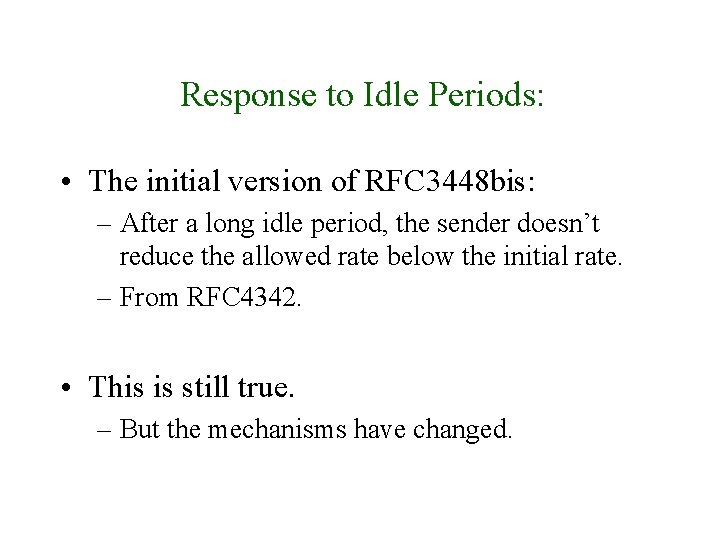
Response to Idle Periods: • The initial version of RFC 3448 bis: – After a long idle period, the sender doesn’t reduce the allowed rate below the initial rate. – From RFC 4342. • This is still true. – But the mechanisms have changed.
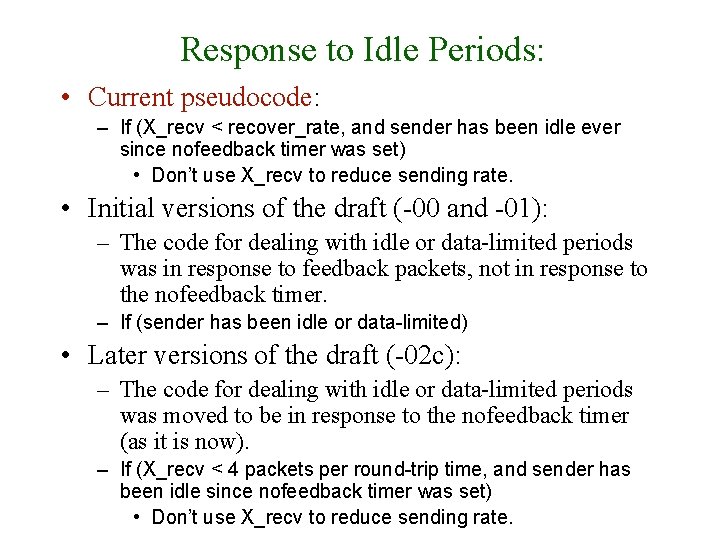
Response to Idle Periods: • Current pseudocode: – If (X_recv < recover_rate, and sender has been idle ever since nofeedback timer was set) • Don’t use X_recv to reduce sending rate. • Initial versions of the draft (-00 and -01): – The code for dealing with idle or data-limited periods was in response to feedback packets, not in response to the nofeedback timer. – If (sender has been idle or data-limited) • Later versions of the draft (-02 c): – The code for dealing with idle or data-limited periods was moved to be in response to the nofeedback timer (as it is now). – If (X_recv < 4 packets per round-trip time, and sender has been idle since nofeedback timer was set) • Don’t use X_recv to reduce sending rate.
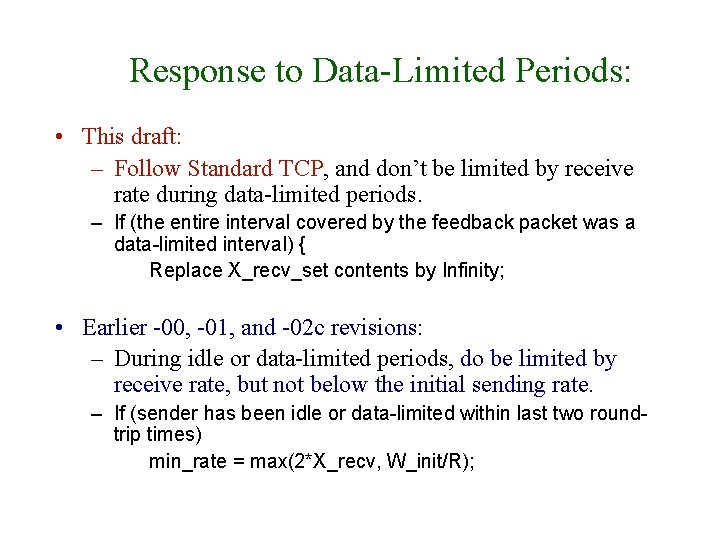
Response to Data-Limited Periods: • This draft: – Follow Standard TCP, and don’t be limited by receive rate during data-limited periods. – If (the entire interval covered by the feedback packet was a data-limited interval) { Replace X_recv_set contents by Infinity; • Earlier -00, -01, and -02 c revisions: – During idle or data-limited periods, do be limited by receive rate, but not below the initial sending rate. – If (sender has been idle or data-limited within last two roundtrip times) min_rate = max(2*X_recv, W_init/R);
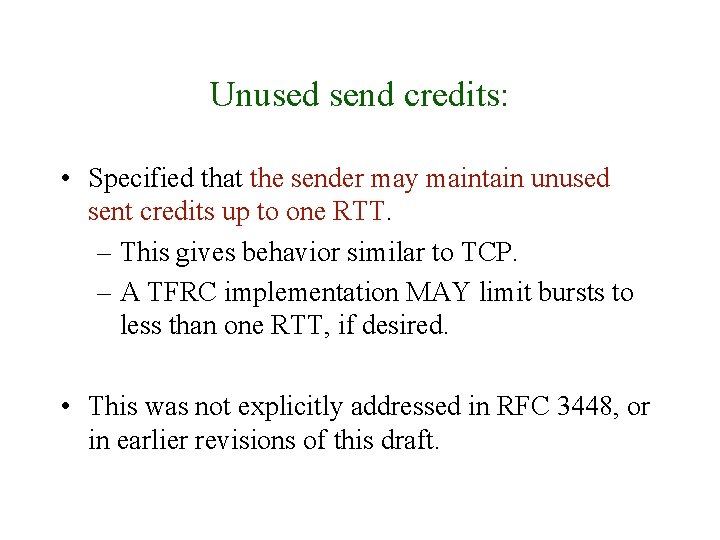
Unused send credits: • Specified that the sender may maintain unused sent credits up to one RTT. – This gives behavior similar to TCP. – A TFRC implementation MAY limit bursts to less than one RTT, if desired. • This was not explicitly addressed in RFC 3448, or in earlier revisions of this draft.
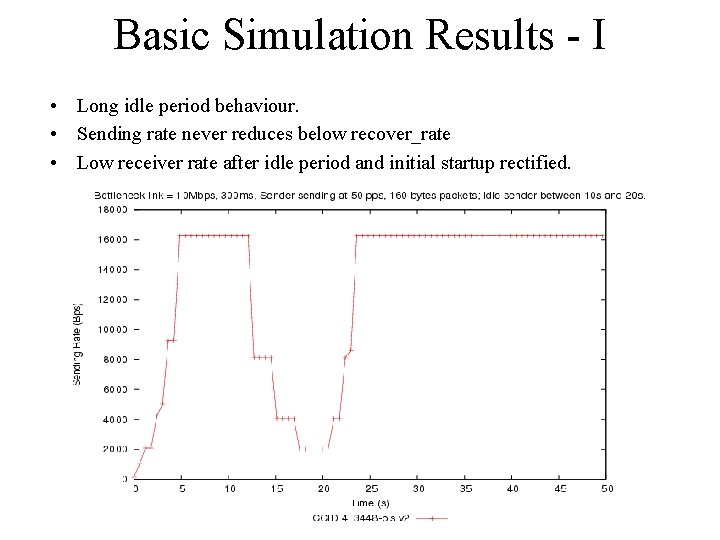
Basic Simulation Results - I • Long idle period behaviour. • Sending rate never reduces below recover_rate • Low receiver rate after idle period and initial startup rectified.
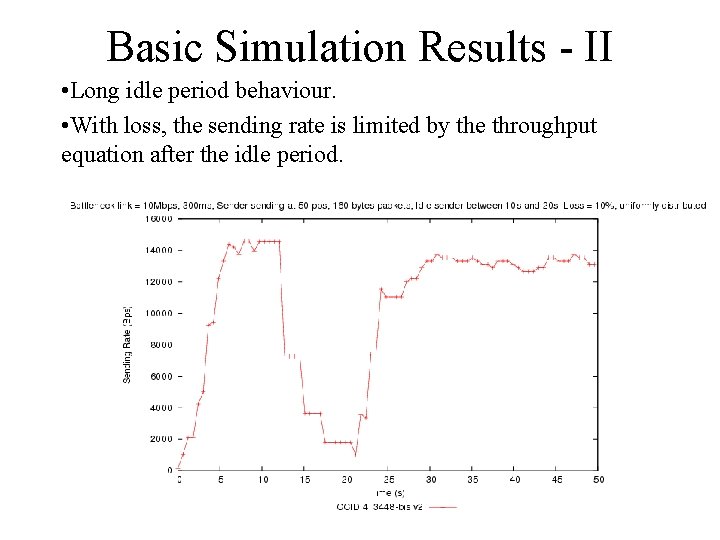
Basic Simulation Results - II • Long idle period behaviour. • With loss, the sending rate is limited by the throughput equation after the idle period.
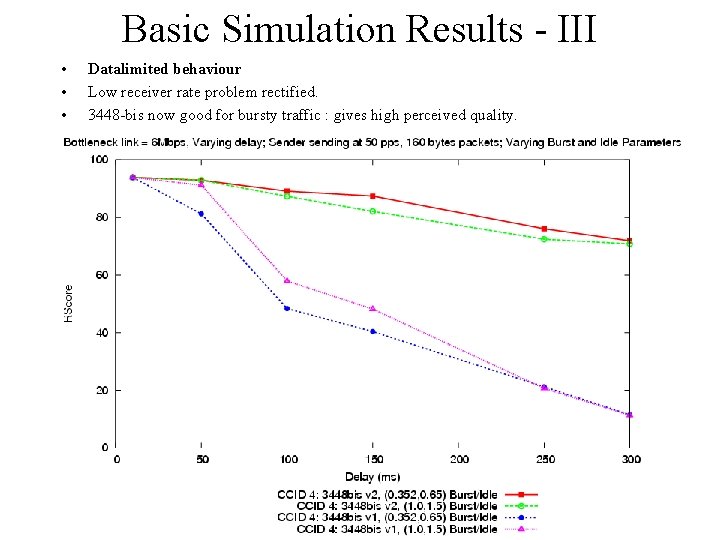
Basic Simulation Results - III • • • Datalimited behaviour Low receiver rate problem rectified. 3448 -bis now good for bursty traffic : gives high perceived quality.
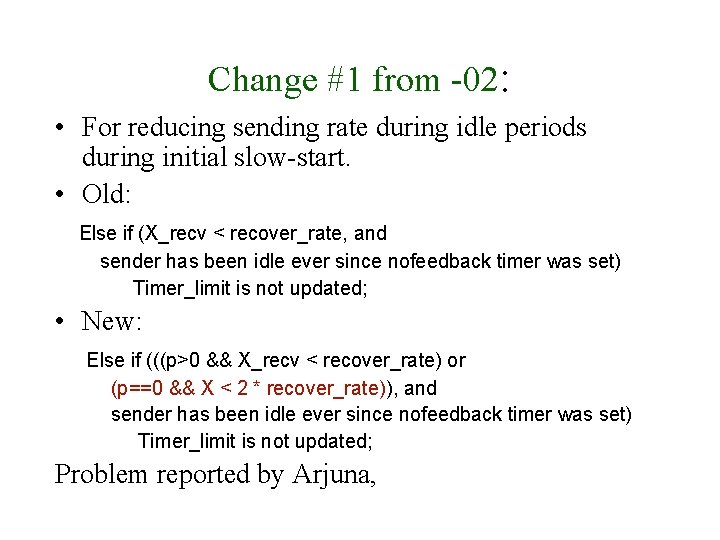
Change #1 from -02: • For reducing sending rate during idle periods during initial slow-start. • Old: Else if (X_recv < recover_rate, and sender has been idle ever since nofeedback timer was set) Timer_limit is not updated; • New: Else if (((p>0 && X_recv < recover_rate) or (p==0 && X < 2 * recover_rate)), and sender has been idle ever since nofeedback timer was set) Timer_limit is not updated; Problem reported by Arjuna,
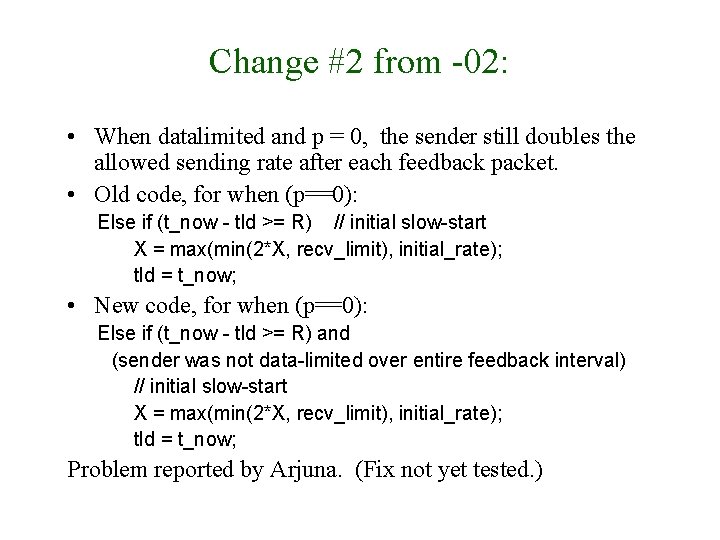
Change #2 from -02: • When datalimited and p = 0, the sender still doubles the allowed sending rate after each feedback packet. • Old code, for when (p==0): Else if (t_now - tld >= R) // initial slow-start X = max(min(2*X, recv_limit), initial_rate); tld = t_now; • New code, for when (p==0): Else if (t_now - tld >= R) and (sender was not data-limited over entire feedback interval) // initial slow-start X = max(min(2*X, recv_limit), initial_rate); tld = t_now; Problem reported by Arjuna. (Fix not yet tested. )
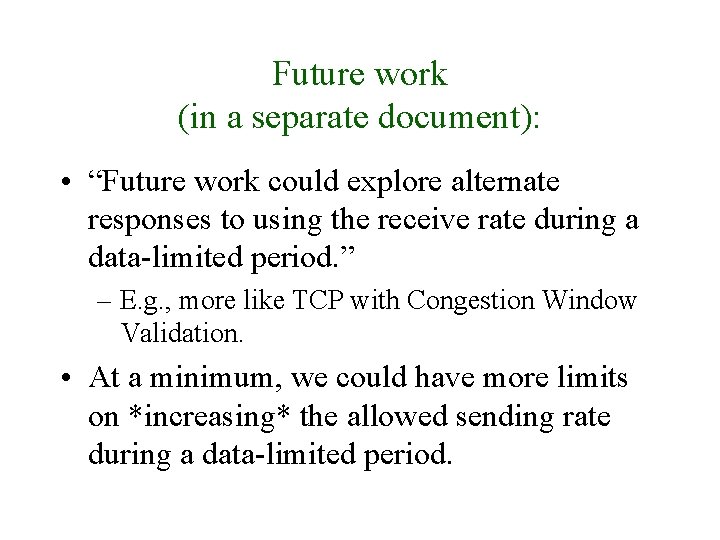
Future work (in a separate document): • “Future work could explore alternate responses to using the receive rate during a data-limited period. ” – E. g. , more like TCP with Congestion Window Validation. • At a minimum, we could have more limits on *increasing* the allowed sending rate during a data-limited period.