
TCP Flow Control an illustration of distributed system
TCP Flow Control – an illustration of distributed system thinking David E. Culler CS 162 – Operating Systems and Systems Programming http: //cs 162. eecs. berkeley. edu/ Lecture 33 Nov 17, 2014 Read: TCP ’ 88

Recall: Connecting API to Protocol Client Server Create Server Socket Create Client Socket time Bind it to an Address (host: port) Connect it to server (host: port) SYN, Seq. Num = x Listen for Connection SYN and ACK, Seq. Num = y and Ack = x + 1 Accept connection ACK, Ack = y + 1 read request write request read response write response Close Client Socket 11/12/14 Connection Socket Close Connection Socket UCB CS 162 Fa 14 L 32 Close Server Socket
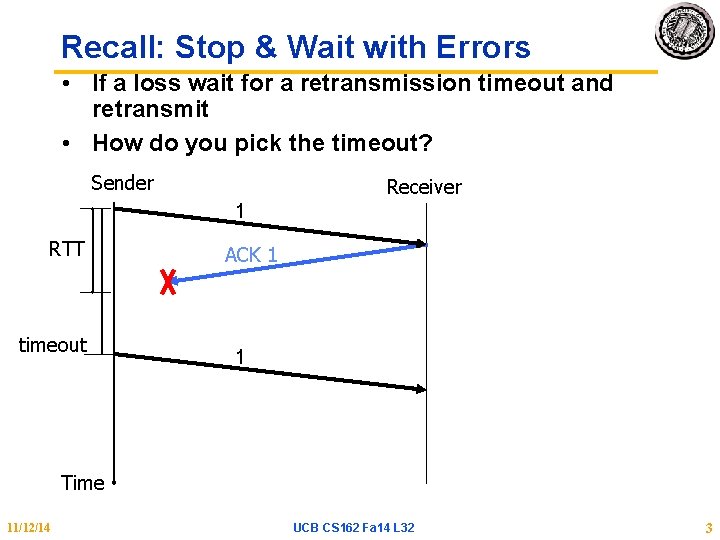
Recall: Stop & Wait with Errors • If a loss wait for a retransmission timeout and retransmit • How do you pick the timeout? Sender Receiver 1 RTT timeout ACK 1 1 Time 11/12/14 UCB CS 162 Fa 14 L 32 3
Where we are • TCP: Reliable Byte Stream – Open connection (3 -way handshaking) – Close connection: no perfect solution; no way for two parties to agree absolutely in the presence of arbitrary message losses (Byzantine General’s Problem) • Reliable transmission – Stop&Wait not efficient for links with large capacity, i. e. , bandwidth-delay product – Sliding window more efficient but more complex • Flow Control – OS on sender and receiver manage buffers – Sending rate adjusted according to acks and losses – Receiver drops to slow sender on over-run 11/12/14 UCB CS 162 Fa 14 L 32 4
Recap: Sliding Window • window = set of adjacent sequence numbers • The size of the set is the window size • Assume window size is n • Let A be the last ACK’d packet of sender without gap; then window of sender = {A+1, A+2, …, A+n} • Sender can send packets in its window • Let B be the last received packet without gap by receiver, then window of receiver = {B+1, …, B+n} • Receiver can accept out of sequence, if in window 11/12/14 UCB CS 162 Fa 14 L 32 5
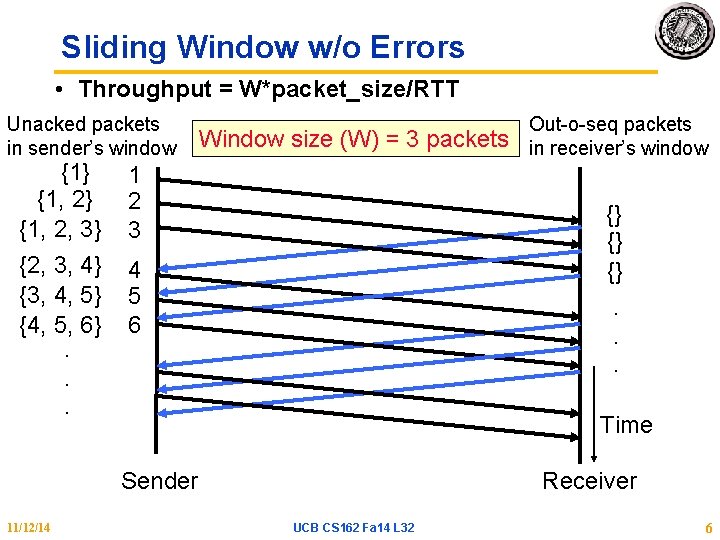
Sliding Window w/o Errors • Throughput = W*packet_size/RTT Unacked packets in sender’s window {1} {1, 2, 3} {2, 3, 4} {3, 4, 5} {4, 5, 6}. . . Window size (W) = 3 packets 1 2 3 {} {} {}. . . 4 5 6 Time Sender 11/12/14 Out-o-seq packets in receiver’s window Receiver UCB CS 162 Fa 14 L 32 6

Example: Sliding Window w/o Errors • Assume – Link capacity, C = 1 Gbps – Latency between end-hosts, RTT = 80 ms – packet_length = 1000 bytes • What is the window size W to match link’s capacity, C? • Solution Bandwidth-Delay Product We want Throughput = C Throughput = W*packet_size/RTT C = W*packet_size/RTT W = C*RTT/packet_size = 109 bps*80*10 -3 s/(8000 b) = 104 packets Window size ~ Bandwidth (Capacity) x delay (RTT/2) Remember Little’s Law ! 11/12/14 UCB CS 162 Fa 14 L 32 7
Sliding Window with Errors • Two approaches – Go-Back-n (GBN) – Selective Repeat (SR) • In the absence of errors they behave identically • Go-Back-n (GBN) – Transmit up to n unacknowledged packets – If timeout for ACK(k), retransmit k, k+1, … – Typically uses NACKs instead of ACKs » Recall, NACK specifies first in-sequence packet missed by receiver 11/12/14 UCB CS 162 Fa 14 L 32 8
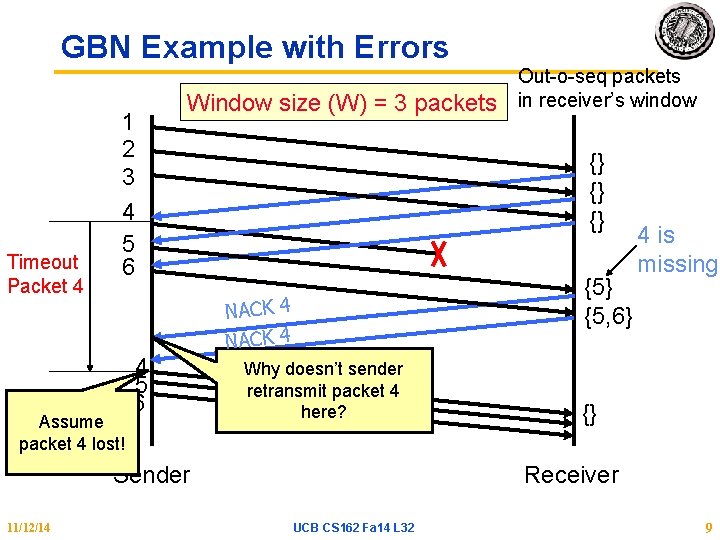
GBN Example with Errors Timeout Packet 4 1 2 3 4 5 6 Assume packet 4 lost! Window size (W) = 3 packets 4 5 6 {} {} {} {5, 6} NACK 4 Why doesn’t sender retransmit packet 4 here? Sender 11/12/14 Out-o-seq packets in receiver’s window 4 is missing {} Receiver UCB CS 162 Fa 14 L 32 9

Selective Repeat (SR) • Sender: transmit up to n unacknowledged packets • Assume packet k is lost • Receiver: indicate packet k is missing (use ACKs) • Sender: retransmit packet k 11/12/14 UCB CS 162 Fa 14 L 32 10
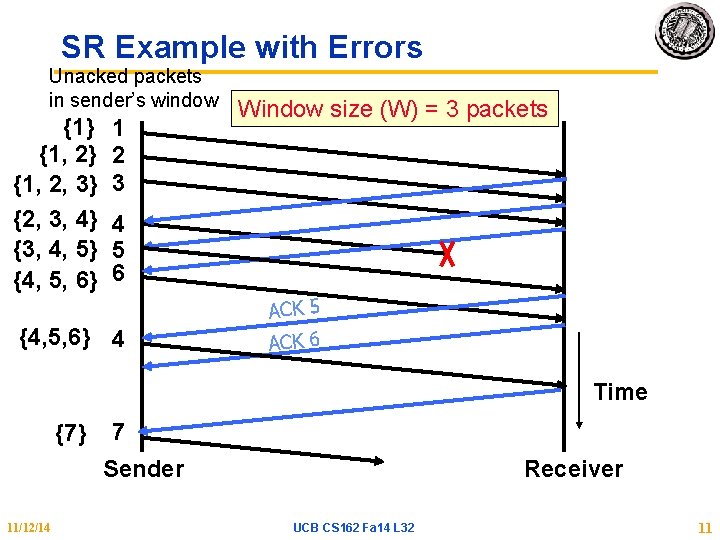
SR Example with Errors Unacked packets in sender’s window {1} {1, 2, 3} {2, 3, 4} {3, 4, 5} {4, 5, 6} 1 2 3 Window size (W) = 3 packets 4 5 6 {4, 5, 6} 4 ACK 5 ACK 6 Time {7} 7 Sender 11/12/14 Receiver UCB CS 162 Fa 14 L 32 11
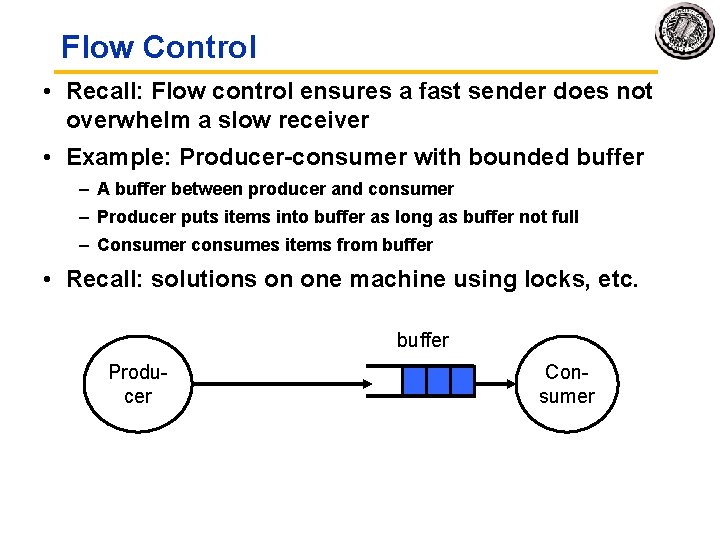
Flow Control • Recall: Flow control ensures a fast sender does not overwhelm a slow receiver • Example: Producer-consumer with bounded buffer – A buffer between producer and consumer – Producer puts items into buffer as long as buffer not full – Consumer consumes items from buffer • Recall: solutions on one machine using locks, etc. buffer Producer Consumer
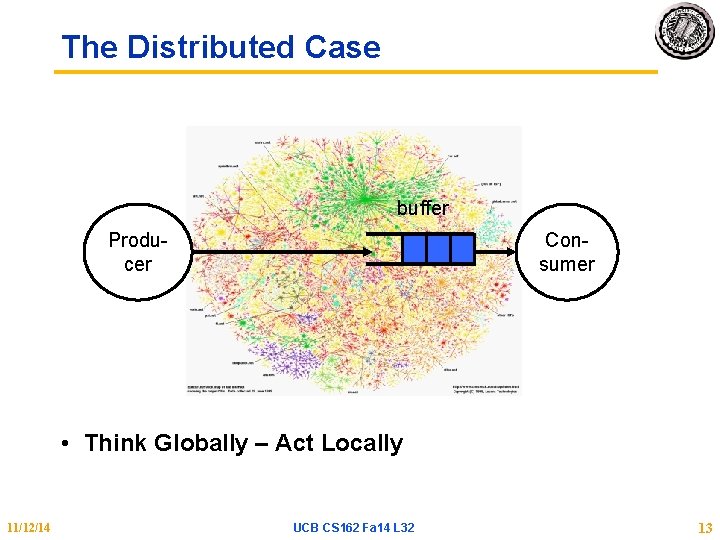
The Distributed Case buffer Producer Consumer • Think Globally – Act Locally 11/12/14 UCB CS 162 Fa 14 L 32 13
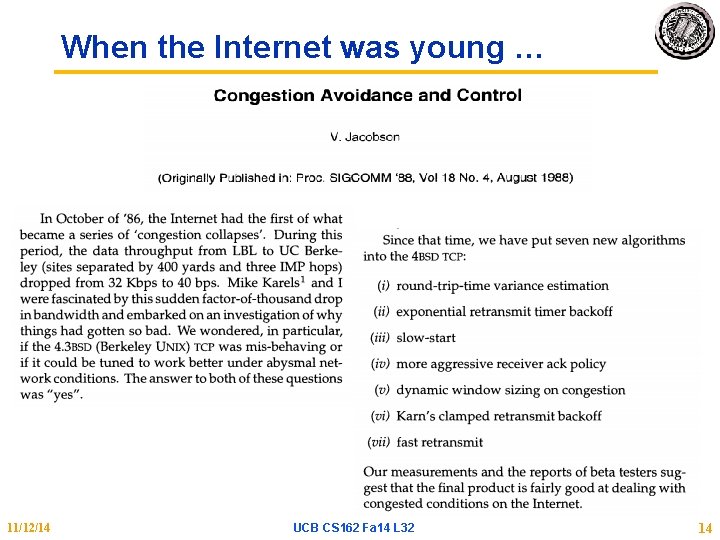
When the Internet was young … 11/12/14 UCB CS 162 Fa 14 L 32 14
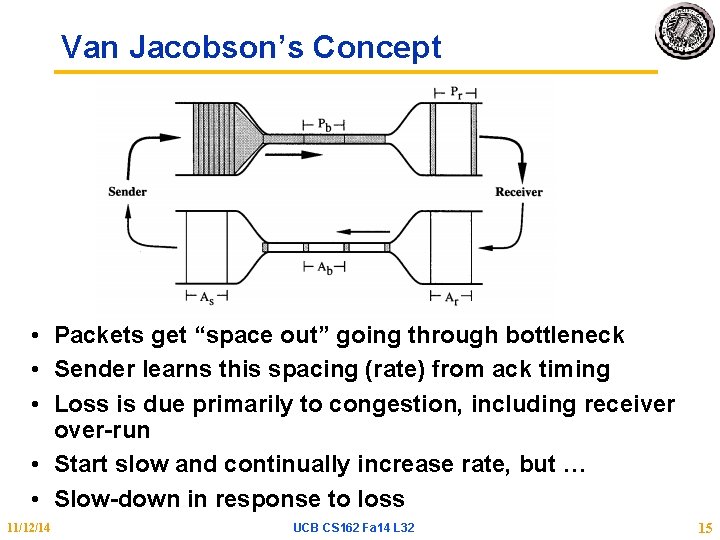
Van Jacobson’s Concept • Packets get “space out” going through bottleneck • Sender learns this spacing (rate) from ack timing • Loss is due primarily to congestion, including receiver over-run • Start slow and continually increase rate, but … • Slow-down in response to loss 11/12/14 UCB CS 162 Fa 14 L 32 15
TCP Flow Control • TCP: sliding window protocol at byte (not packet) level – Go-back-N: TCP Tahoe, Reno, New Reno – Selective Repeat (SR): TCP Sack • Receiver tells sender how many more bytes it can receive without overflowing its buffer – the Advertised. Window • The ACK contains sequence number N of next byte the receiver expects, – receiver has received all bytes in sequence up to and including N-1
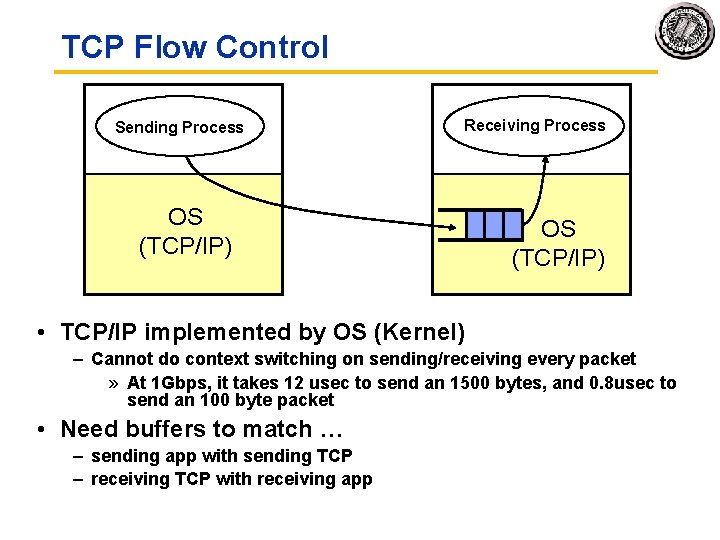
TCP Flow Control Sending Process Receiving Process OS (TCP/IP) • TCP/IP implemented by OS (Kernel) – Cannot do context switching on sending/receiving every packet » At 1 Gbps, it takes 12 usec to send an 1500 bytes, and 0. 8 usec to send an 100 byte packet • Need buffers to match … – sending app with sending TCP – receiving TCP with receiving app
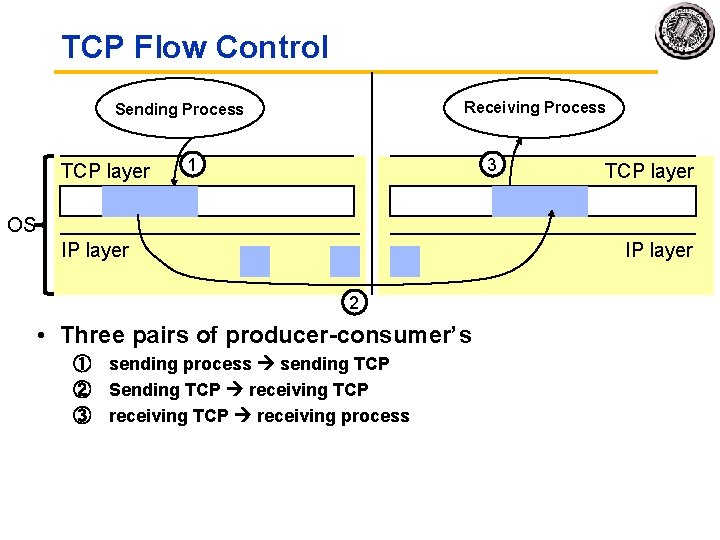
TCP Flow Control Receiving Process Sending Process TCP layer 1 3 TCP layer OS IP layer 2 • Three pairs of producer-consumer’s ① sending process sending TCP ② Sending TCP receiving TCP ③ receiving TCP receiving process
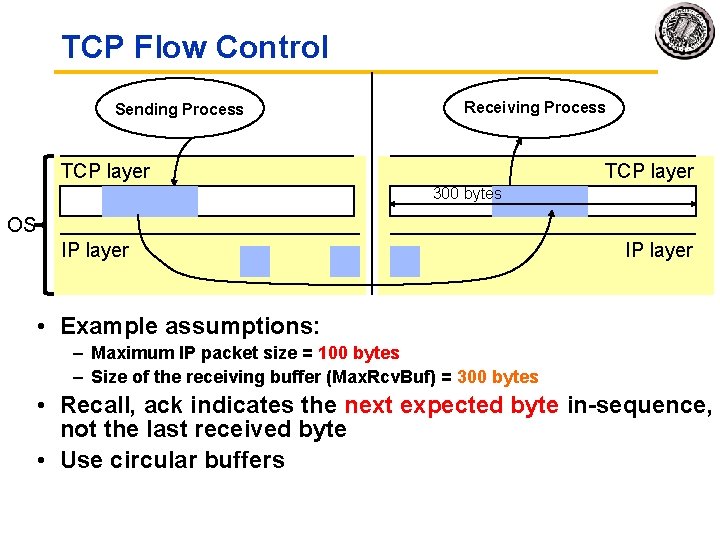
TCP Flow Control Sending Process Receiving Process TCP layer 300 bytes OS IP layer • Example assumptions: – Maximum IP packet size = 100 bytes – Size of the receiving buffer (Max. Rcv. Buf) = 300 bytes • Recall, ack indicates the next expected byte in-sequence, not the last received byte • Use circular buffers
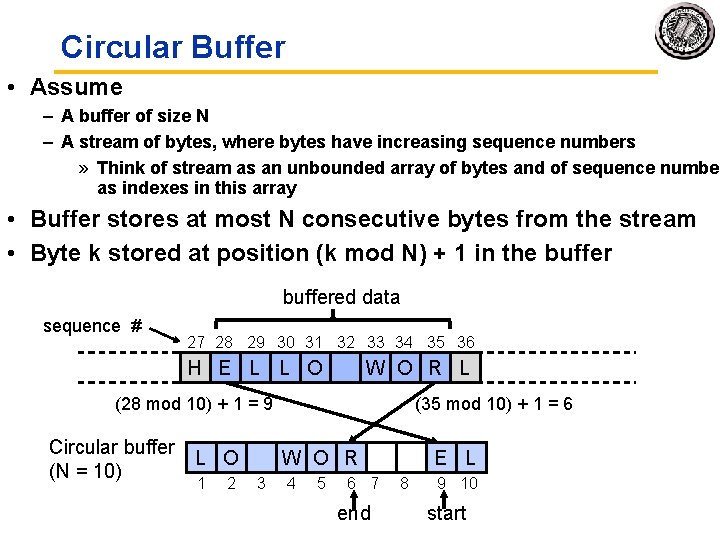
Circular Buffer • Assume – A buffer of size N – A stream of bytes, where bytes have increasing sequence numbers » Think of stream as an unbounded array of bytes and of sequence number as indexes in this array • Buffer stores at most N consecutive bytes from the stream • Byte k stored at position (k mod N) + 1 in the buffered data sequence # 27 28 29 30 31 32 33 34 35 36 H E L L O W O R L (35 mod 10) + 1 = 6 (28 mod 10) + 1 = 9 Circular buffer (N = 10) L O 1 2 W O R 3 4 5 6 7 end E L 8 9 10 start
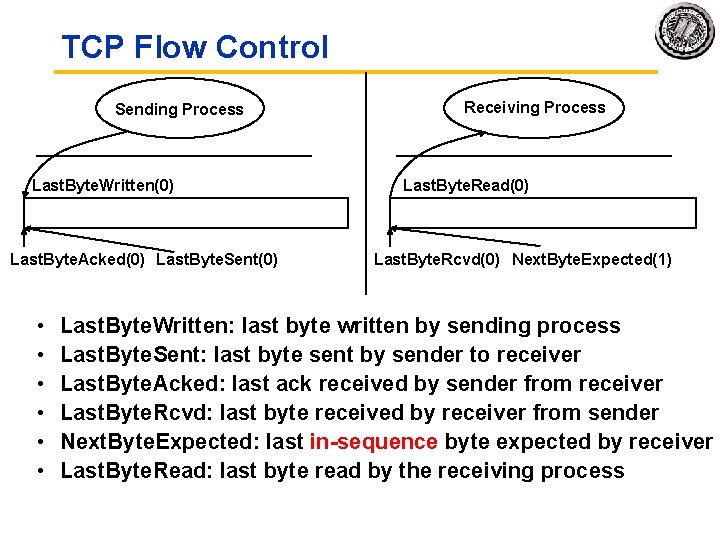
TCP Flow Control Sending Process Last. Byte. Written(0) Last. Byte. Acked(0) Last. Byte. Sent(0) • • • Receiving Process Last. Byte. Read(0) Last. Byte. Rcvd(0) Next. Byte. Expected(1) Last. Byte. Written: last byte written by sending process Last. Byte. Sent: last byte sent by sender to receiver Last. Byte. Acked: last ack received by sender from receiver Last. Byte. Rcvd: last byte received by receiver from sender Next. Byte. Expected: last in-sequence byte expected by receiver Last. Byte. Read: last byte read by the receiving process
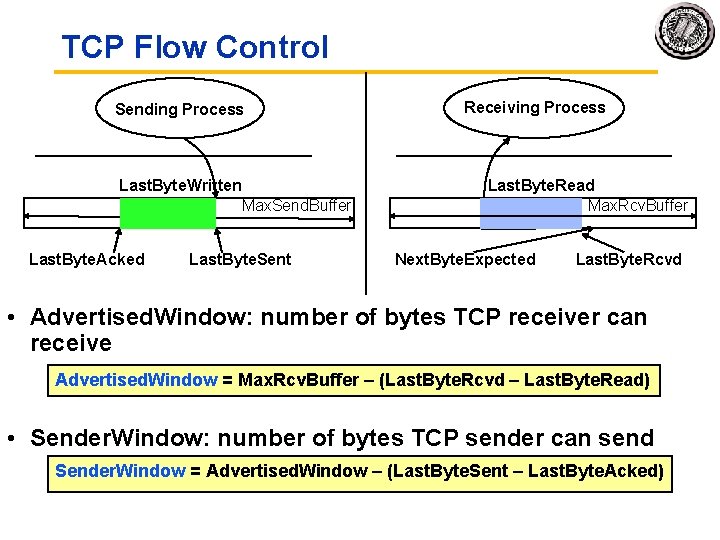
TCP Flow Control Sending Process Last. Byte. Written Max. Send. Buffer Last. Byte. Acked Last. Byte. Sent Receiving Process Last. Byte. Read Max. Rcv. Buffer Next. Byte. Expected Last. Byte. Rcvd • Advertised. Window: number of bytes TCP receiver can receive Advertised. Window = Max. Rcv. Buffer – (Last. Byte. Rcvd – Last. Byte. Read) • Sender. Window: number of bytes TCP sender can send Sender. Window = Advertised. Window – (Last. Byte. Sent – Last. Byte. Acked)
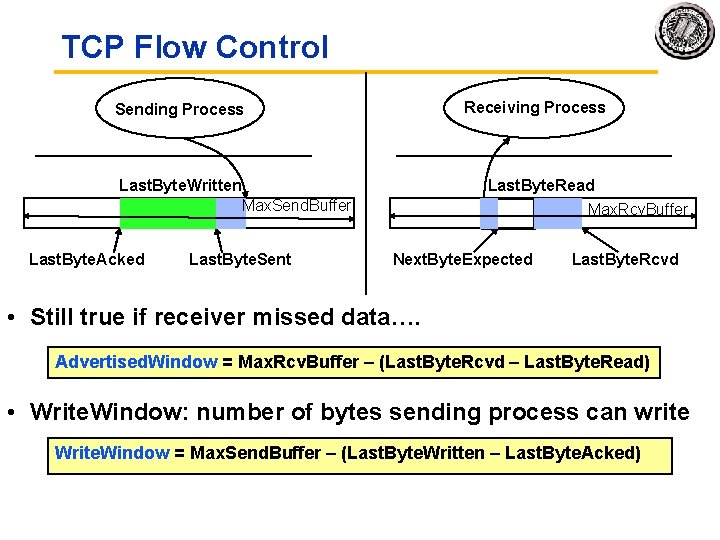
TCP Flow Control Receiving Process Sending Process Last. Byte. Read Max. Rcv. Buffer Last. Byte. Written Max. Send. Buffer Last. Byte. Acked Last. Byte. Sent Next. Byte. Expected Last. Byte. Rcvd • Still true if receiver missed data…. Advertised. Window = Max. Rcv. Buffer – (Last. Byte. Rcvd – Last. Byte. Read) • Write. Window: number of bytes sending process can write Write. Window = Max. Send. Buffer – (Last. Byte. Written – Last. Byte. Acked)
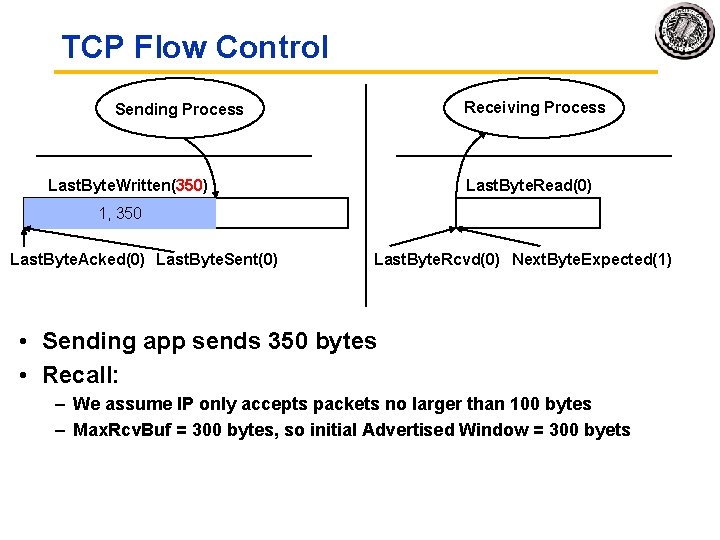
TCP Flow Control Receiving Process Sending Process Last. Byte. Written(350) Last. Byte. Read(0) 1, 350 Last. Byte. Acked(0) Last. Byte. Sent(0) Last. Byte. Rcvd(0) Next. Byte. Expected(1) • Sending app sends 350 bytes • Recall: – We assume IP only accepts packets no larger than 100 bytes – Max. Rcv. Buf = 300 bytes, so initial Advertised Window = 300 byets
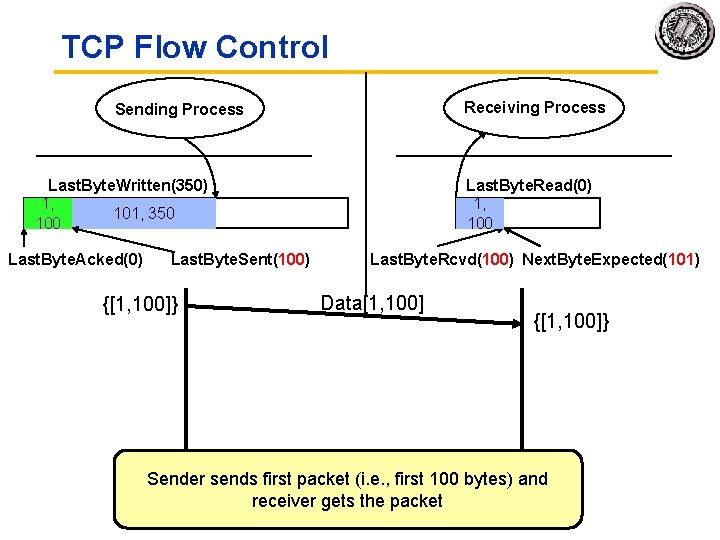
TCP Flow Control Receiving Process Sending Process Last. Byte. Written(350) 1, 1, 101, 350 100 Last. Byte. Acked(0) Last. Byte. Sent(100) time {[1, 100]} Last. Byte. Read(0) 1, 100 Last. Byte. Rcvd(100) Next. Byte. Expected(101) Data[1, 100] {[1, 100]} Sender sends first packet (i. e. , first 100 bytes) and receiver gets the packet
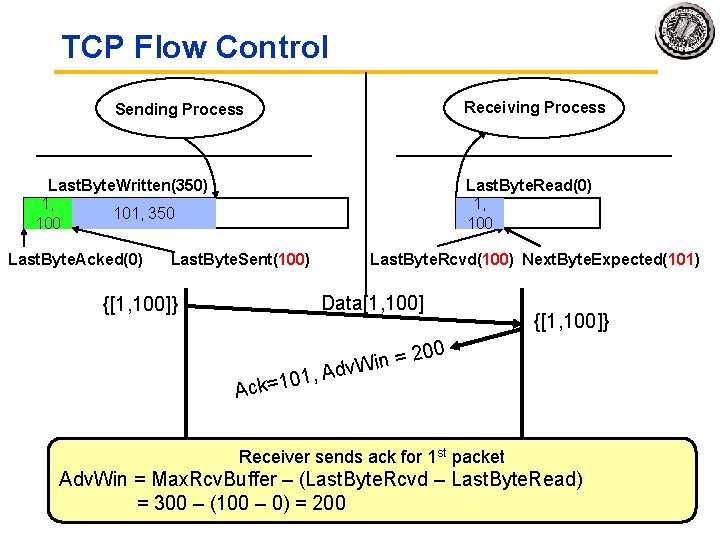
TCP Flow Control Receiving Process Sending Process Last. Byte. Written(350) 1, 1, 101, 350 100 Last. Byte. Acked(0) Last. Byte. Read(0) 1, 100 Last. Byte. Sent(100) Last. Byte. Rcvd(100) Next. Byte. Expected(101) Data[1, 100] {[1, 100]} 0 01, 1 = k c A 20 = n i dv. W A Receiver sends ack for 1 st packet Adv. Win = Max. Rcv. Buffer – (Last. Byte. Rcvd – Last. Byte. Read) = 300 – (100 – 0) = 200
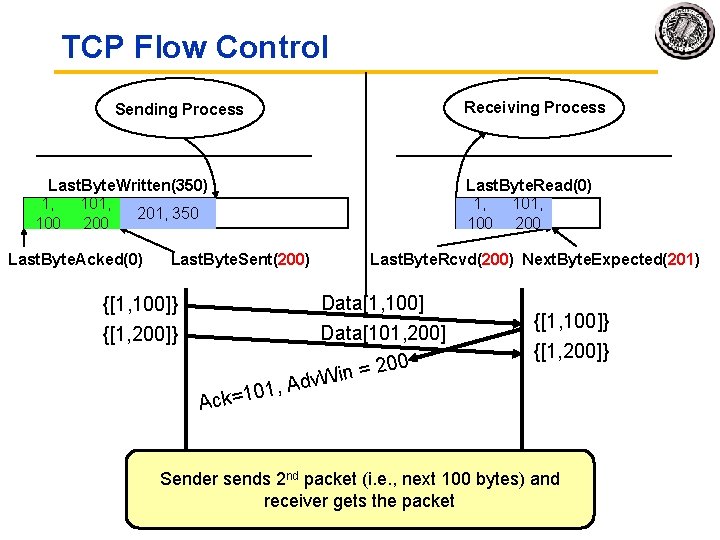
TCP Flow Control Receiving Process Sending Process Last. Byte. Written(350) 1, 101, 201, 350350 100 200 Last. Byte. Acked(0) Last. Byte. Read(0) 1, 100 200 Last. Byte. Sent(200) Last. Byte. Rcvd(200) Next. Byte. Expected(201) Data[1, 100] Data[101, 200] 200 = n i , Adv. W {[1, 100]} {[1, 200]} 1 0 Ack=1 Sender sends 2 nd packet (i. e. , next 100 bytes) and receiver gets the packet
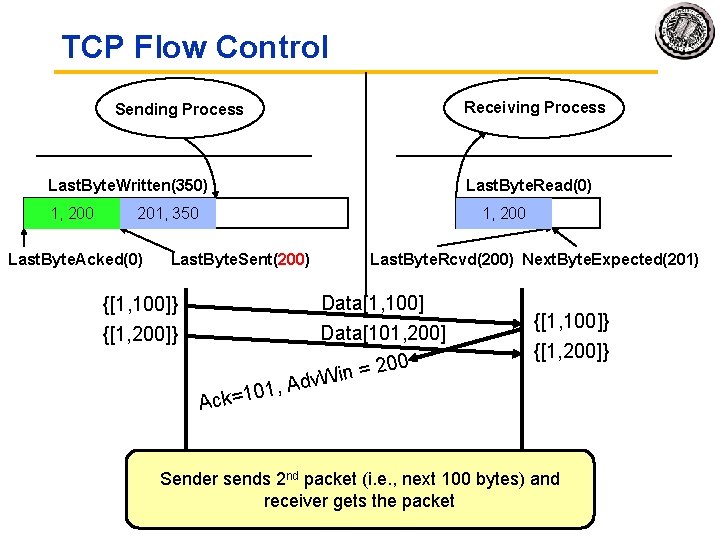
TCP Flow Control Receiving Process Sending Process Last. Byte. Written(350) 1, 200 Last. Byte. Read(0) 101, 201, 350350 Last. Byte. Acked(0) 1, 200 Last. Byte. Sent(200) Last. Byte. Rcvd(200) Next. Byte. Expected(201) Data[1, 100] Data[101, 200] 200 = n i , Adv. W {[1, 100]} {[1, 200]} 1 0 Ack=1 Sender sends 2 nd packet (i. e. , next 100 bytes) and receiver gets the packet
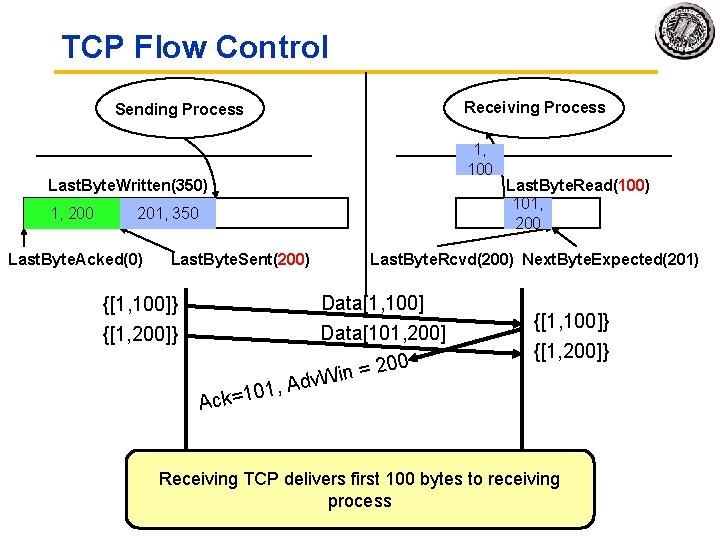
TCP Flow Control Receiving Process Sending Process 1, 100 Last. Byte. Written(350) 1, 200 101, 201, 350350 Last. Byte. Acked(0) Last. Byte. Sent(200) Last. Byte. Rcvd(200) Next. Byte. Expected(201) Data[1, 100] Data[101, 200] 200 = n i , Adv. W {[1, 100]} {[1, 200]} Last. Byte. Read(100) 101, 200 {[1, 100]} {[1, 200]} 1 0 Ack=1 Receiving TCP delivers first 100 bytes to receiving process
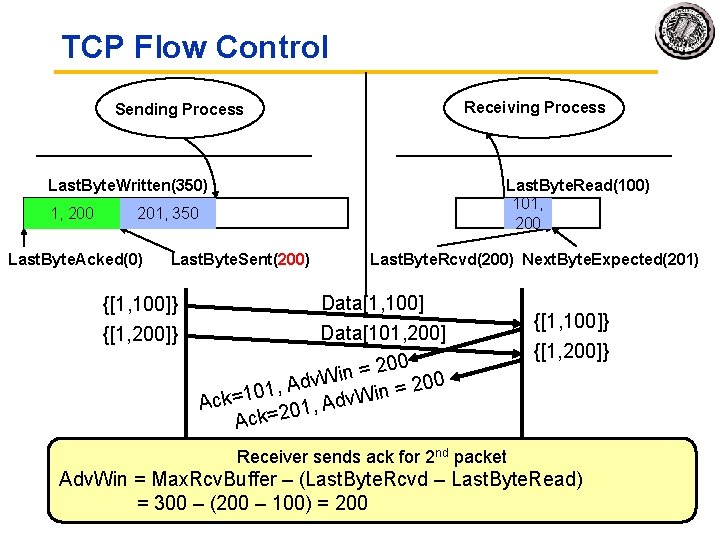
TCP Flow Control Receiving Process Sending Process Last. Byte. Written(350) 1, 200 Last. Byte. Read(100) 101, 200 101, 201, 350350 Last. Byte. Acked(0) Last. Byte. Sent(200) {[1, 100]} {[1, 200]} Last. Byte. Rcvd(200) Next. Byte. Expected(201) Data[1, 100] Data[101, 200] 200 = n i dv. W 00 2 A , = 1 0 n i Ack=1 201, Adv. W Ack= {[1, 100]} {[1, 200]} Receiver sends ack for 2 nd packet Adv. Win = Max. Rcv. Buffer – (Last. Byte. Rcvd – Last. Byte. Read) = 300 – (200 – 100) = 200
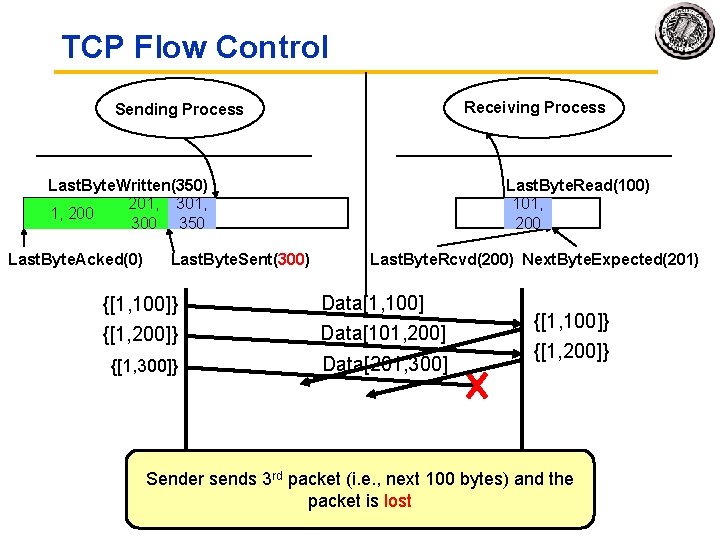
TCP Flow Control Receiving Process Sending Process Last. Byte. Written(350) 201, 301, 1, 200 101, 201, 350350 300 350 Last. Byte. Acked(0) Last. Byte. Sent(300) Last. Byte. Read(100) 101, 200 Last. Byte. Rcvd(200) Next. Byte. Expected(201) {[1, 100]} {[1, 200]} Data[1, 100] Data[101, 200] {[1, 300]} Data[201, 300] {[1, 100]} {[1, 200]} Sender sends 3 rd packet (i. e. , next 100 bytes) and the packet is lost
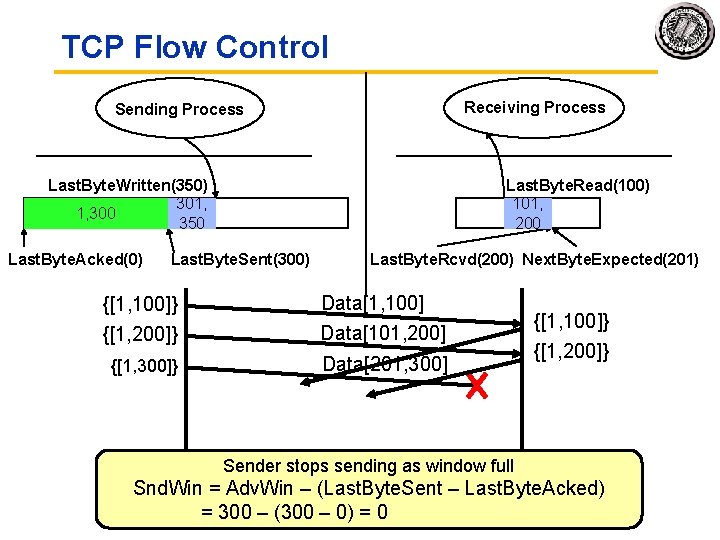
TCP Flow Control Receiving Process Sending Process Last. Byte. Written(350) 301, 1, 300101, 201, 350350 Last. Byte. Acked(0) Last. Byte. Read(100) 101, 200 Last. Byte. Sent(300) Last. Byte. Rcvd(200) Next. Byte. Expected(201) {[1, 100]} {[1, 200]} Data[1, 100] Data[101, 200] {[1, 300]} Data[201, 300] {[1, 100]} {[1, 200]} Sender stops sending as window full Snd. Win = Adv. Win – (Last. Byte. Sent – Last. Byte. Acked) = 300 – (300 – 0) = 0
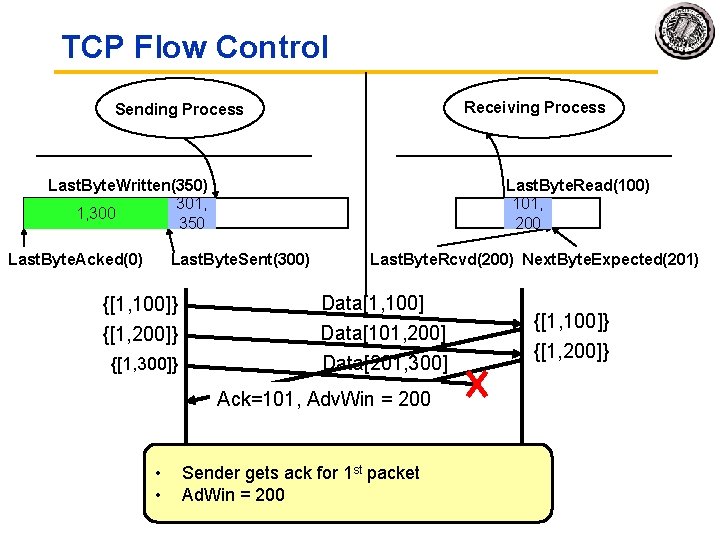
TCP Flow Control Receiving Process Sending Process Last. Byte. Written(350) 301, 1, 300101, 201, 350350 Last. Byte. Acked(0) Last. Byte. Read(100) 101, 200 Last. Byte. Sent(300) {[1, 100]} {[1, 200]} {[1, 300]} Last. Byte. Rcvd(200) Next. Byte. Expected(201) Data[1, 100] Data[101, 200] Data[201, 300] Ack=101, Adv. Win = 200 • • Sender gets ack for 1 st packet Ad. Win = 200 {[1, 100]} {[1, 200]}
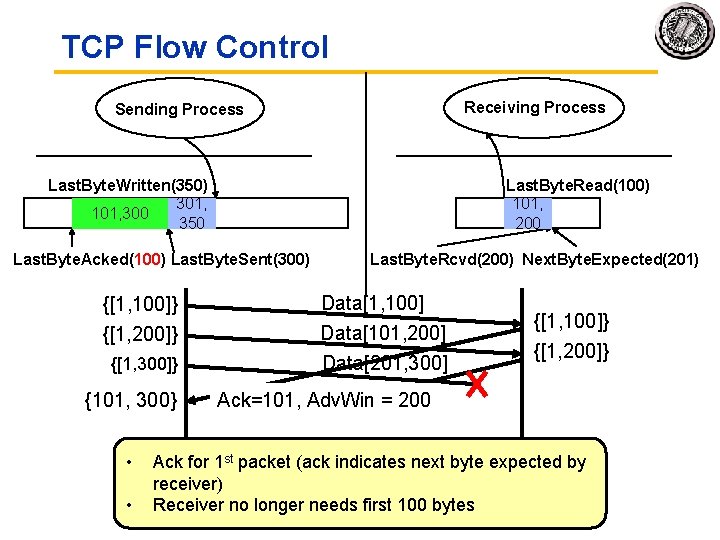
TCP Flow Control Receiving Process Sending Process Last. Byte. Written(350) 301, 101, 300 101, 201, 350350 Last. Byte. Read(100) 101, 200 Last. Byte. Acked(100) Last. Byte. Sent(300) {[1, 100]} {[1, 200]} {[1, 300]} {101, 300} • • Last. Byte. Rcvd(200) Next. Byte. Expected(201) Data[1, 100] Data[101, 200] Data[201, 300] {[1, 100]} {[1, 200]} Ack=101, Adv. Win = 200 Ack for 1 st packet (ack indicates next byte expected by receiver) Receiver no longer needs first 100 bytes
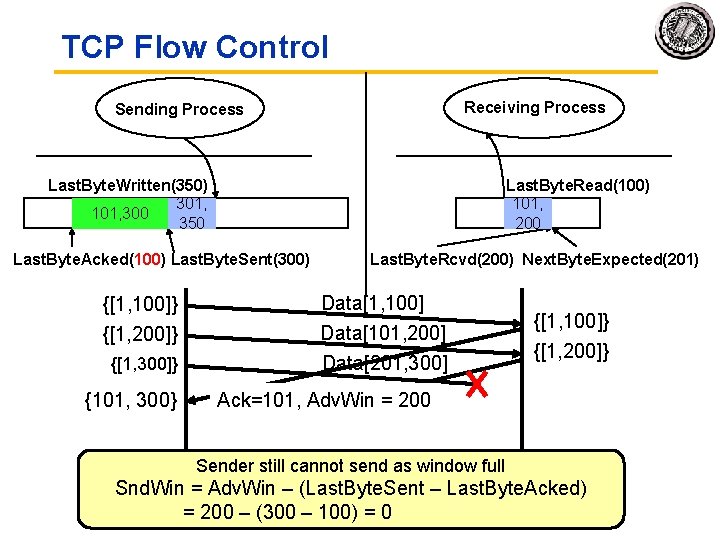
TCP Flow Control Receiving Process Sending Process Last. Byte. Written(350) 301, 101, 300 101, 201, 350350 Last. Byte. Read(100) 101, 200 Last. Byte. Acked(100) Last. Byte. Sent(300) {[1, 100]} {[1, 200]} {[1, 300]} {101, 300} Last. Byte. Rcvd(200) Next. Byte. Expected(201) Data[1, 100] Data[101, 200] Data[201, 300] {[1, 100]} {[1, 200]} Ack=101, Adv. Win = 200 Sender still cannot send as window full Snd. Win = Adv. Win – (Last. Byte. Sent – Last. Byte. Acked) = 200 – (300 – 100) = 0
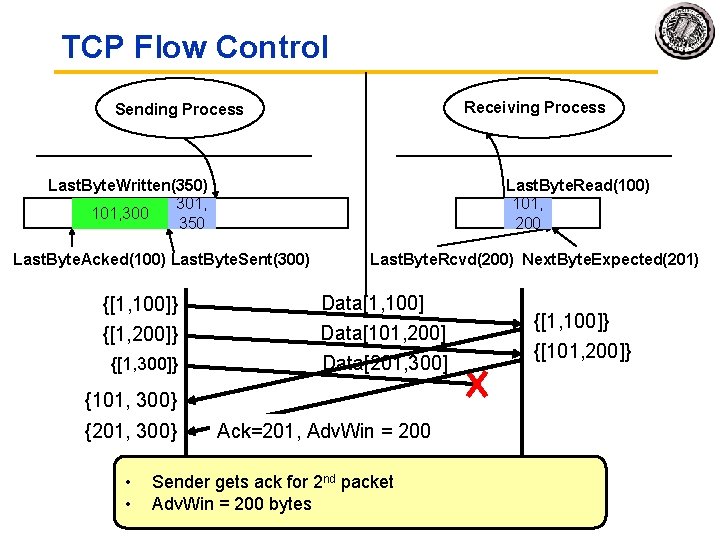
TCP Flow Control Receiving Process Sending Process Last. Byte. Written(350) 301, 101, 300 101, 201, 350350 Last. Byte. Read(100) 101, 200 Last. Byte. Acked(100) Last. Byte. Sent(300) {[1, 100]} {[1, 200]} {[1, 300]} Last. Byte. Rcvd(200) Next. Byte. Expected(201) Data[1, 100] Data[101, 200] Data[201, 300] {101, 300} {201, 300} • • Ack=201, Adv. Win = 200 Sender gets ack for 2 nd packet Adv. Win = 200 bytes {[1, 100]} {[101, 200]}
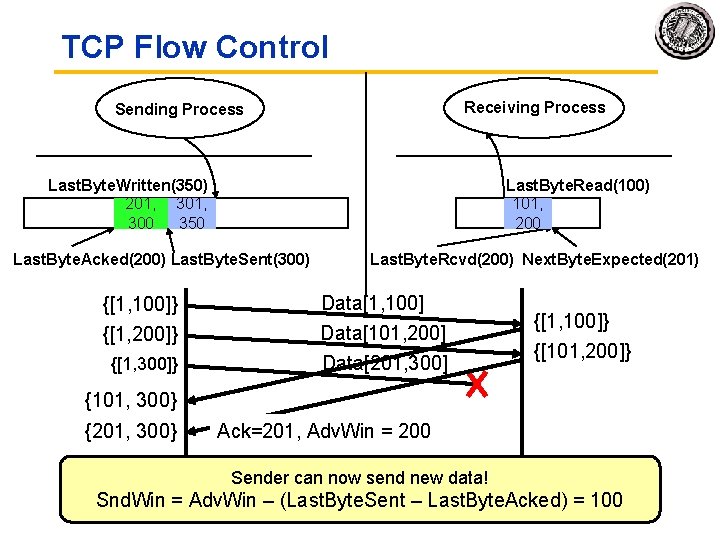
TCP Flow Control Receiving Process Sending Process Last. Byte. Written(350) 201, 301, 101, 201, 350 300 350 Last. Byte. Read(100) 101, 200 Last. Byte. Acked(200) Last. Byte. Sent(300) {[1, 100]} {[1, 200]} {[1, 300]} Last. Byte. Rcvd(200) Next. Byte. Expected(201) Data[1, 100] Data[101, 200] Data[201, 300] {[1, 100]} {[101, 200]} {101, 300} {201, 300} Ack=201, Adv. Win = 200 Sender can now send new data! Snd. Win = Adv. Win – (Last. Byte. Sent – Last. Byte. Acked) = 100
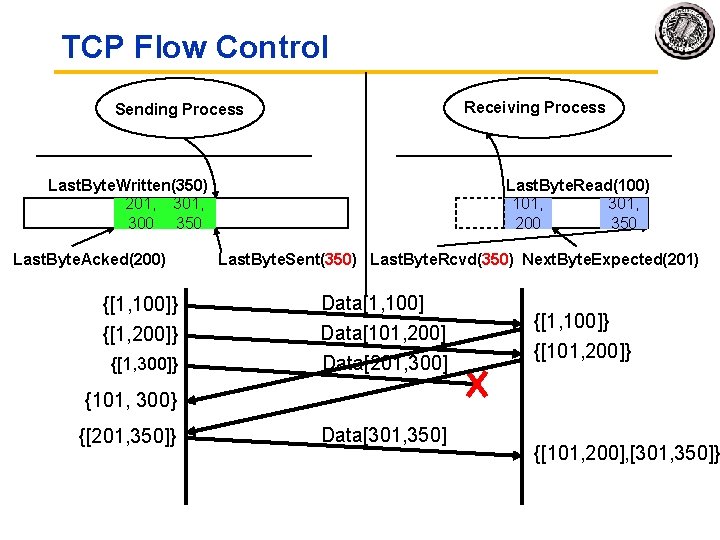
TCP Flow Control Receiving Process Sending Process Last. Byte. Written(350) 201, 301, 101, 201, 350 300 350 Last. Byte. Acked(200) {[1, 100]} {[1, 200]} {[1, 300]} Last. Byte. Read(100) 101, 301, 200 350 Last. Byte. Sent(350) Last. Byte. Rcvd(350) Next. Byte. Expected(201) Data[1, 100] Data[101, 200] Data[201, 300] {[1, 100]} {[101, 200]} {101, 300} {[201, 350]} Data[301, 350] {[101, 200], [301, 350]}
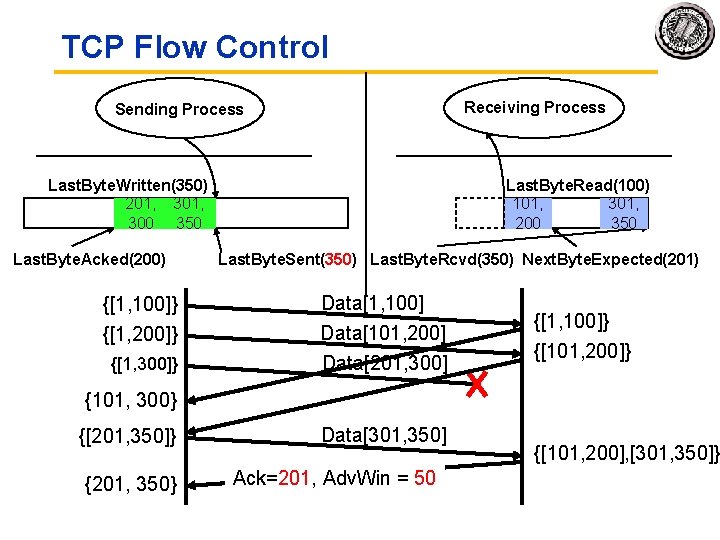
TCP Flow Control Receiving Process Sending Process Last. Byte. Written(350) 201, 301, 101, 201, 350 300 350 Last. Byte. Acked(200) {[1, 100]} {[1, 200]} {[1, 300]} Last. Byte. Read(100) 101, 301, 200 350 Last. Byte. Sent(350) Last. Byte. Rcvd(350) Next. Byte. Expected(201) Data[1, 100] Data[101, 200] Data[201, 300] {[1, 100]} {[101, 200]} {101, 300} {[201, 350]} {201, 350} Data[301, 350] Ack=201, Adv. Win = 50 {[101, 200], [301, 350]}
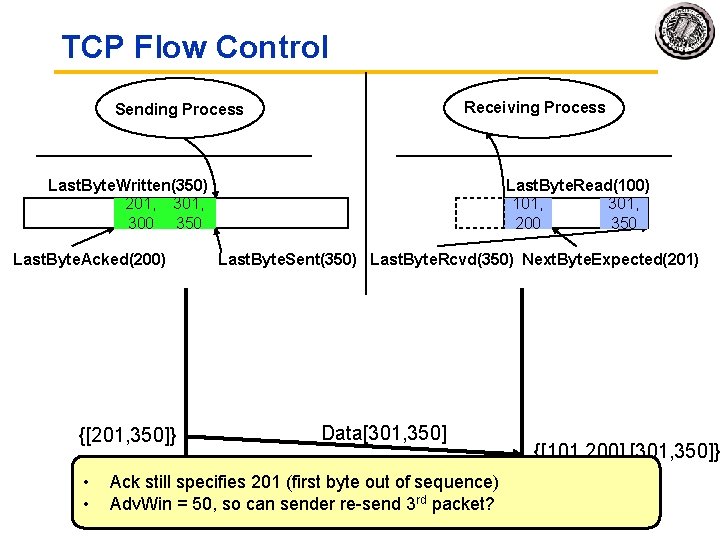
TCP Flow Control Receiving Process Sending Process Last. Byte. Written(350) 201, 301, 101, 201, 350 300 350 Last. Byte. Acked(200) {[201, 350]} Last. Byte. Read(100) 101, 301, 200 350 Last. Byte. Sent(350) Last. Byte. Rcvd(350) Next. Byte. Expected(201) Data[301, 350] Ack=201, = 50 • {201, Ack 350} still specifies 201 (first Adv. Win byte out of sequence) • Adv. Win = 50, so can sender re-send 3 rd packet? {[101, 200], [301, 350]}
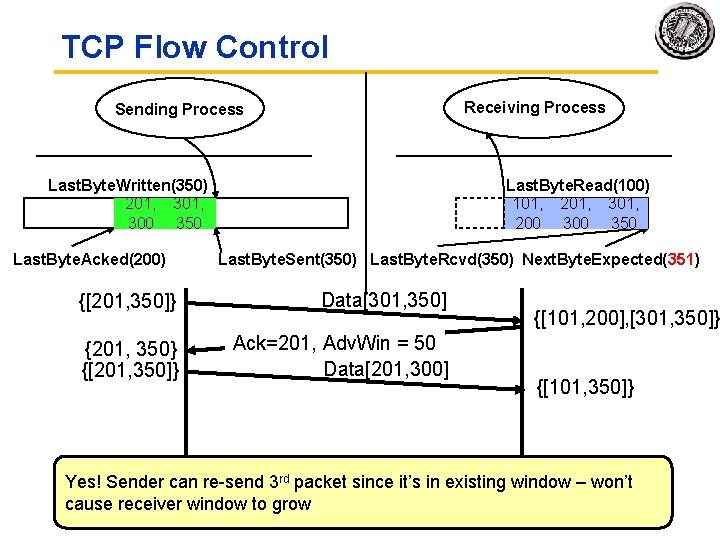
TCP Flow Control Receiving Process Sending Process Last. Byte. Written(350) 201, 301, 101, 201, 350 300 350 Last. Byte. Acked(200) Last. Byte. Read(100) 101, 201, 301, 200 350 Last. Byte. Sent(350) Last. Byte. Rcvd(350) Next. Byte. Expected(351) {[201, 350]} Data[301, 350] {201, 350} {[201, 350]} Ack=201, Adv. Win = 50 Data[201, 300] {[101, 200], [301, 350]} {[101, 350]} Yes! Sender can re-send 3 rd packet since it’s in existing window – won’t cause receiver window to grow
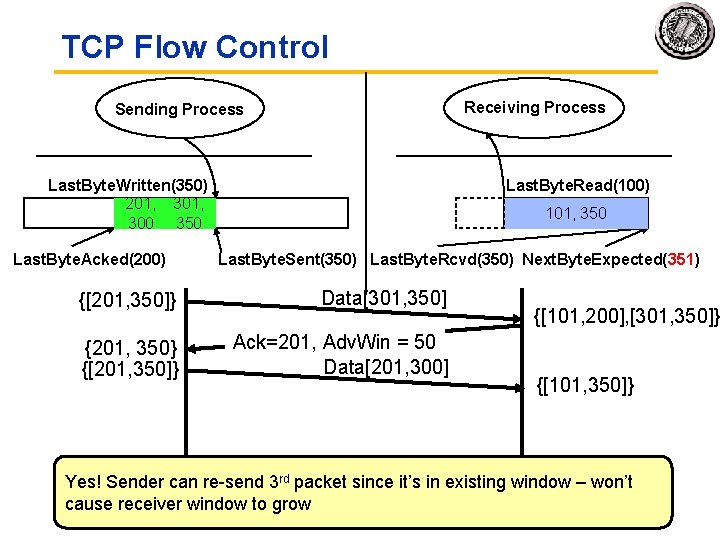
TCP Flow Control Receiving Process Sending Process Last. Byte. Written(350) 201, 301, 101, 201, 350 300 350 Last. Byte. Acked(200) Last. Byte. Read(100) 101, 350 Last. Byte. Sent(350) Last. Byte. Rcvd(350) Next. Byte. Expected(351) {[201, 350]} Data[301, 350] {201, 350} {[201, 350]} Ack=201, Adv. Win = 50 Data[201, 300] {[101, 200], [301, 350]} {[101, 350]} Yes! Sender can re-send 3 rd packet since it’s in existing window – won’t cause receiver window to grow
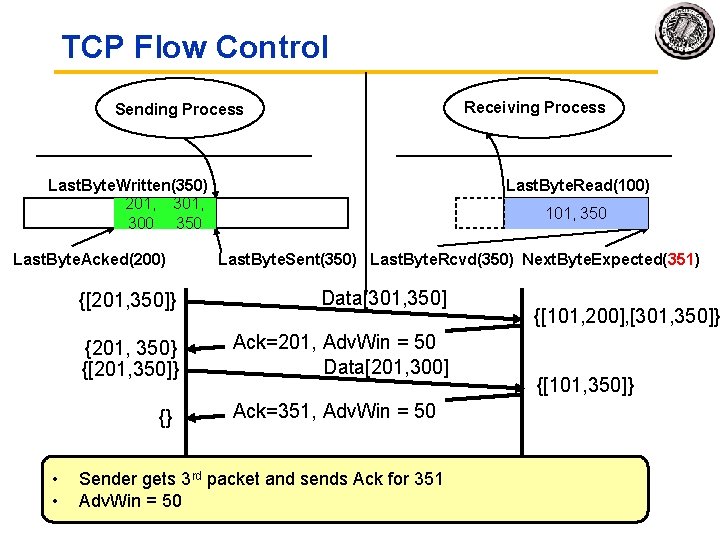
TCP Flow Control Receiving Process Sending Process Last. Byte. Written(350) 201, 300 350 Last. Byte. Acked(200) 101, 350 Last. Byte. Sent(350) Last. Byte. Rcvd(350) Next. Byte. Expected(351) {[201, 350]} Data[301, 350] {201, 350} {[201, 350]} Ack=201, Adv. Win = 50 Data[201, 300] {} • • Last. Byte. Read(100) Ack=351, Adv. Win = 50 Sender gets 3 rd packet and sends Ack for 351 Adv. Win = 50 {[101, 200], [301, 350]} {[101, 350]}
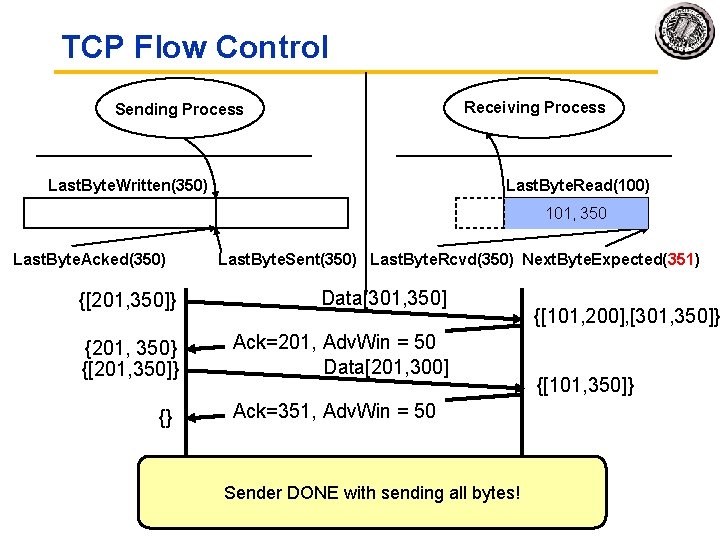
TCP Flow Control Receiving Process Sending Process Last. Byte. Written(350) Last. Byte. Read(100) 101, 350 Last. Byte. Acked(350) Last. Byte. Sent(350) Last. Byte. Rcvd(350) Next. Byte. Expected(351) {[201, 350]} Data[301, 350] {201, 350} {[201, 350]} Ack=201, Adv. Win = 50 Data[201, 300] {} Ack=351, Adv. Win = 50 Sender DONE with sending all bytes! {[101, 200], [301, 350]} {[101, 350]}
Discussion • Why not have a huge buffer at the receiver (memory is cheap!)? • Sending window (Snd. Wnd) also depends on network congestion – Congestion control: ensure that a fast sender doesn’t overwhelm a router in the network – discussed in detail in CS 168 • In practice there is another set of buffers in the protocol stack, at the link layer (i. e. , Network Interface Card)
Summary: Reliability & Flow Control • Flow control: three pairs of producer consumers – Sending process sending TCP – Sending TCP receiving TCP – Receiving TCP receiving process • Advertised. Window: tells sender how much new data the receiver can buffer • Sender. Window: specifies how many more bytes the sending application can send to the sending OS – Depends on Advertised. Window and on data sent since sender received Advertised. Window
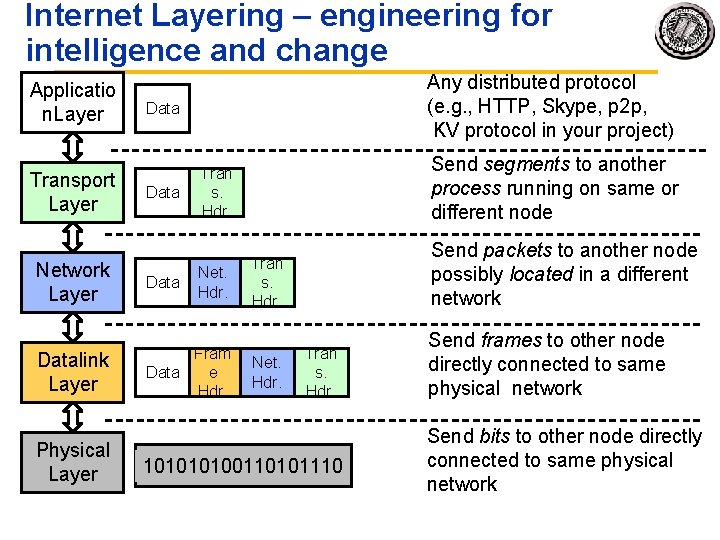
Internet Layering – engineering for intelligence and change Applicatio n. Layer Transport Layer Any distributed protocol (e. g. , HTTP, Skype, p 2 p, KV protocol in your project) Data Network Layer Datalink Layer Fram e Data Hdr. Physical Layer Send segments to another process running on same or different node Tran s. Hdr. Net. Hdr. Send packets to another node possibly located in a different network Tran s. Hdr. Net. Hdr. Tran s. Hdr. 10100110101110 Send frames to other node directly connected to same physical network Send bits to other node directly connected to same physical network
- Slides: 47