
TCP and SCTP RTO Restart drafthurtigtcpmrtorestart03 Michael Welzl




- Slides: 10
TCP and SCTP RTO Restart draft-hurtig-tcpm-rtorestart-03 Michael Welzl michawe@ifi. uio. no TCPM, 85 th IETF Meeting 6. 11. 2012 1
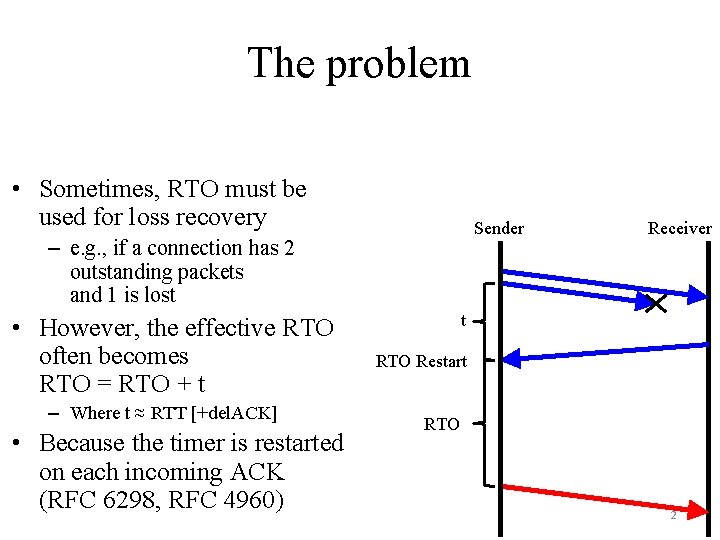
The problem • Sometimes, RTO must be used for loss recovery Sender – e. g. , if a connection has 2 outstanding packets and 1 is lost • However, the effective RTO often becomes RTO = RTO + t – Where t ≈ RTT [+del. ACK] • Because the timer is restarted on each incoming ACK (RFC 6298, RFC 4960) Receiver t RTO Restart RTO 2
TCP and SCTP RTO Restart • To allow retransmissions after exactly RTO seconds, the timer is restarted as RTO = RTO – t – Requires storing the 4 most recent timestamps • The modified restart is only used when – the number of outstanding segments < 4; – and there is no unsent data ready for transmission. – Thus, only flows incapable of FR can use modified RTO restart • Risk of spurious timeout seemed low in initial experiments • Note: this algorithm is still the same – Variations were proposed and discussed, but dismissed 3
RTO restart vs. TLP • RTO restart – focus on thin streams, limited to max. 4 outstanding segments – makes the RTO timer expire after exactly RTO seconds more often • TLP – send up to two "probe segments" when a different (Probe Timeout, PTO) timer fires – PTO timer is set to 2 RTTs, which is sometimes smaller than the RTO • Spurious PTO is not a big deal compared to spurious RTO 4
Example: thin stream • App-limited case – TLP: a "probe segment" is a new segment if new data is available, else a retransmission – PTO applies to max. 2 packets, RTO restart applies to max. 3 packets – PTO fires after 2 RTTs, RTO restart fires after (“correct”) RTO 5
Example: repeated web downloads • End of a larger window – TLP: PTO timer fires after 2 RTTs – Spurious PTO: send up to 2 unnecessary packets – Spurious RTO from RTO restart: impact worse, but: • Unlikely because of RTO variation “safety net” • Spurious RTO’s effect limited if application’s sending pause > RTO (cwnd should become RW anyway) 6
Backup slides 7
What if we use both? • TLP could kick in in situations where RTO restart does not • TLP could overrule (= retransmit packets earlier) RTO restart in cases where (# outstanding segments < 4) and no new segments are available for transmission. • RTO restart reduces the probability that TLP is activated because PTO might be farther than RTO 8
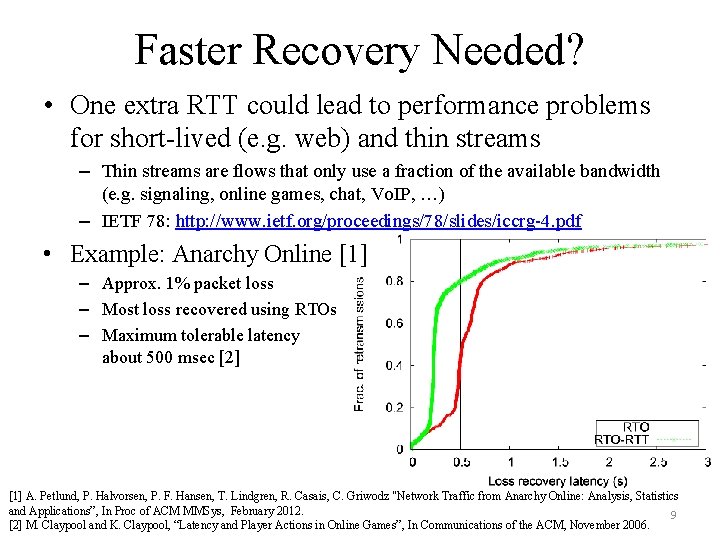
Faster Recovery Needed? • One extra RTT could lead to performance problems for short-lived (e. g. web) and thin streams – Thin streams are flows that only use a fraction of the available bandwidth (e. g. signaling, online games, chat, Vo. IP, …) – IETF 78: http: //www. ietf. org/proceedings/78/slides/iccrg-4. pdf • Example: Anarchy Online [1] – Approx. 1% packet loss – Most loss recovered using RTOs – Maximum tolerable latency about 500 msec [2] [1] A. Petlund, P. Halvorsen, P. F. Hansen, T. Lindgren, R. Casais, C. Griwodz "Network Traffic from Anarchy Online: Analysis, Statistics and Applications”, In Proc of ACM MMSys, February 2012. 9 [2] M. Claypool and K. Claypool, “Latency and Player Actions in Online Games”, In Communications of the ACM, November 2006.
Performance • Initial simulations – Ns-3 (with real Linux TCP) – Short-lived flows – Multiple clients served by one host – Large set of bw’s and delays • Results show that – Loss recovery times are reduced with approximately 1 RTT on average – The amount of spurious RTOs is slightly higher than for regular TCP (<1% more) • New experiments underway Results from 200 concurrent flows with 100 ms RTT – Congestion losses – New RTO management alg. – To investigate burst situations more thoroughly 10