
TC 1 Greetings 7 th Grade Life Scientists
- Slides: 20
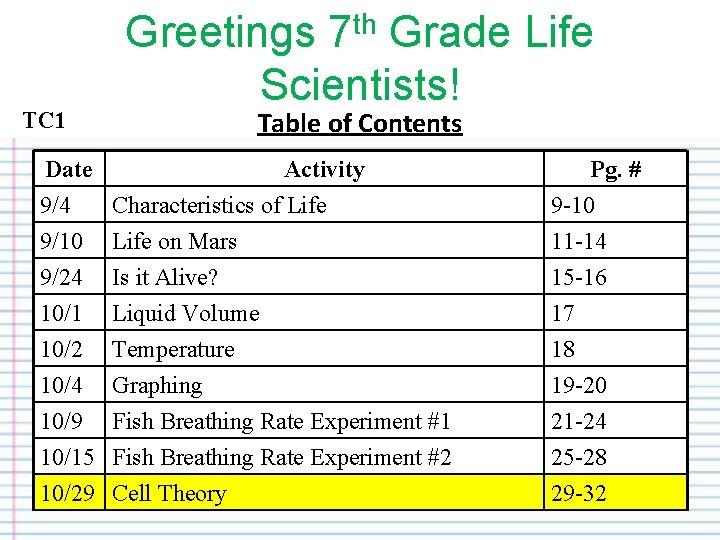
TC 1 Greetings 7 th Grade Life Scientists! Table of Contents Date Activity 9/4 Characteristics of Life 9/10 Life on Mars 9/24 Is it Alive? Pg. # 9 -10 11 -14 15 -16 10/1 10/2 10/4 10/9 10/15 10/29 17 18 19 -20 21 -24 25 -28 29 -32 Liquid Volume Temperature Graphing Fish Breathing Rate Experiment #1 Fish Breathing Rate Experiment #2 Cell Theory
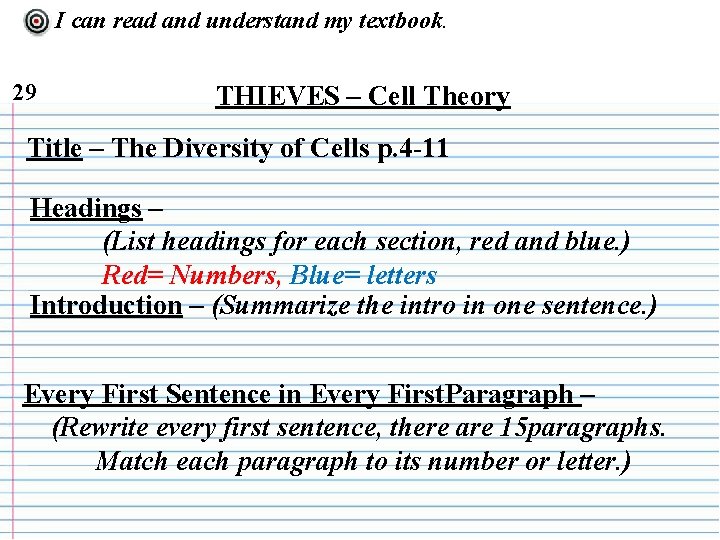
I can read and understand my textbook. 29 THIEVES – Cell Theory Title – The Diversity of Cells p. 4 -11 Headings – (List headings for each section, red and blue. ) Red= Numbers, Blue= letters Introduction – (Summarize the intro in one sentence. ) Every First Sentence in Every First. Paragraph – (Rewrite every first sentence, there are 15 paragraphs. Match each paragraph to its number or letter. )
THIEVES – Cell Theory cont. (Continue: Every First Sentence in a Paragraph) 30
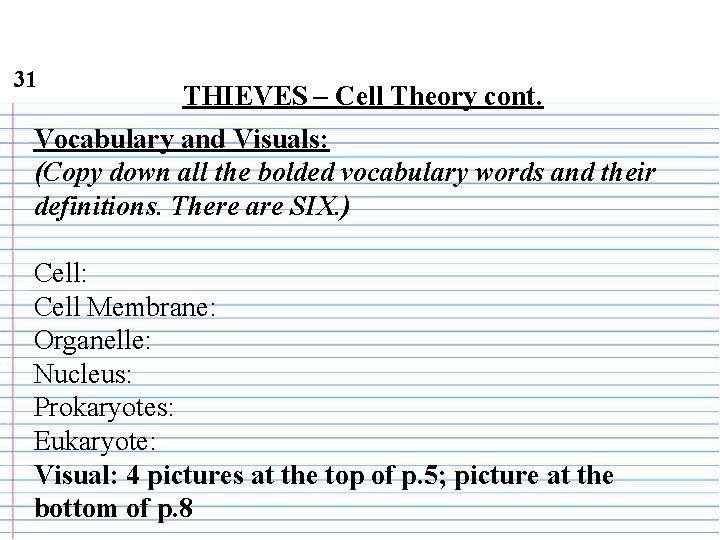
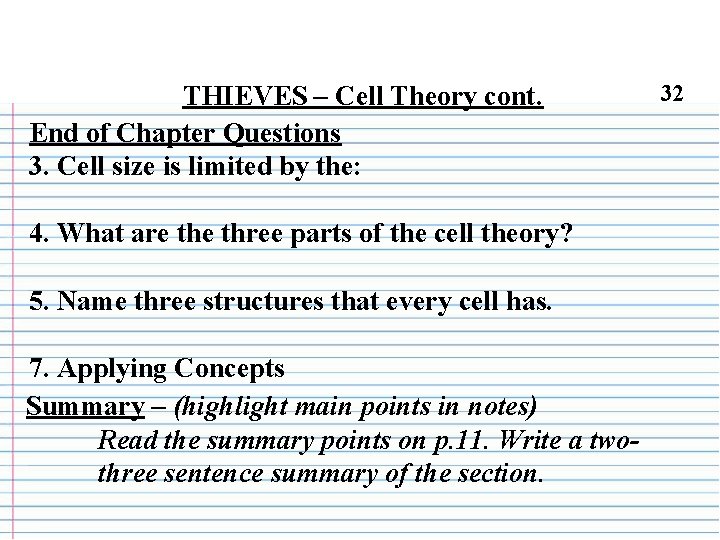
31 THIEVES – Cell Theory cont. Vocabulary and Visuals: (Copy down all the bolded vocabulary words and their definitions. There are SIX. ) Cell: Cell Membrane: Organelle: Nucleus: Prokaryotes: Eukaryote: Visual: 4 pictures at the top of p. 5; picture at the bottom of p. 8
THIEVES – Cell Theory cont. End of Chapter Questions 3. Cell size is limited by the: 4. What are three parts of the cell theory? 5. Name three structures that every cell has. 7. Applying Concepts Summary – (highlight main points in notes) Read the summary points on p. 11. Write a twothree sentence summary of the section. 32
TC 1 Greetings 7 th Grade Life Scientists! Date 10/29 Cell Theory 11/5 Animal Cell 11/5 Plant Cell Table of Contents Activity Pg. # 29 -32 33 -34 35 -36
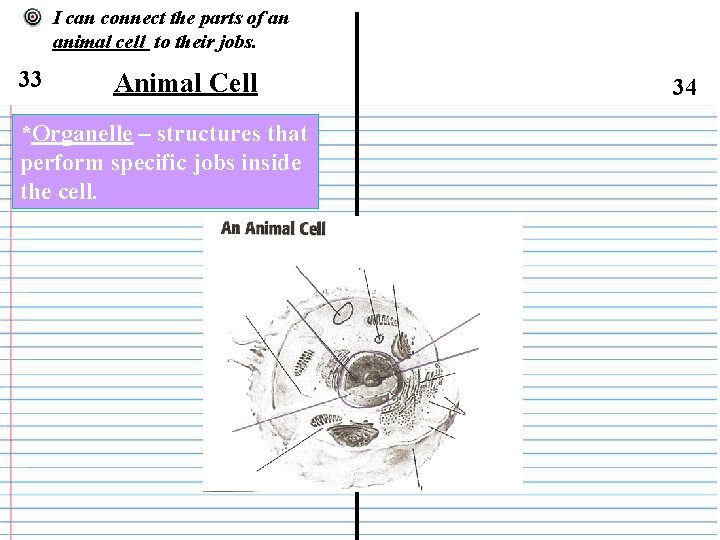
I can connect the parts of an animal cell to their jobs. 33 Animal Cell *Organelle – structures that perform specific jobs inside the cell. 34
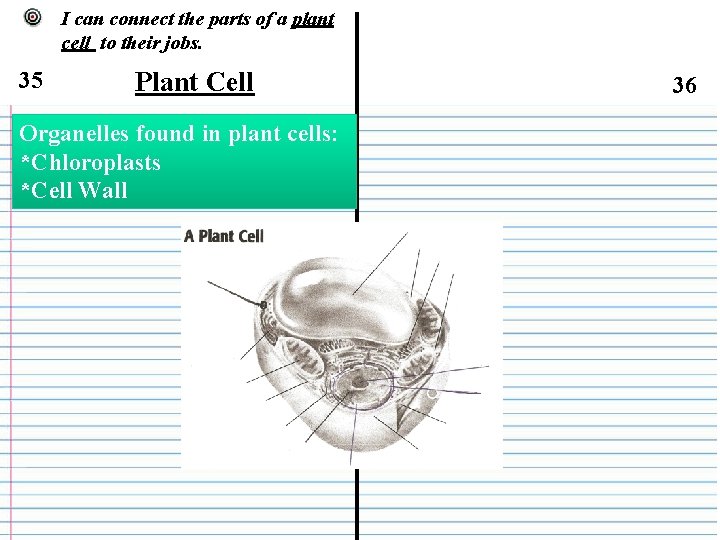
I can connect the parts of a plant cell to their jobs. 35 Plant Cell Organelles found in plant cells: *Chloroplasts *Cell Wall 36
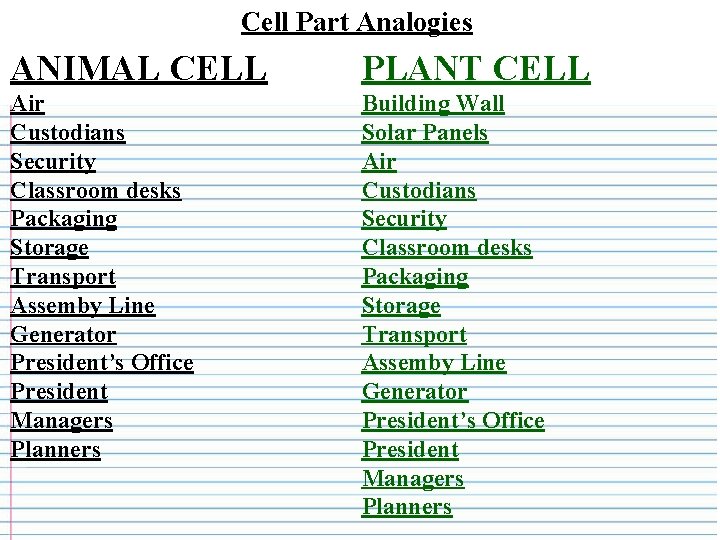
Cell Part Analogies ANIMAL CELL PLANT CELL Air Custodians Security Classroom desks Packaging Storage Transport Assemby Line Generator President’s Office President Managers Planners Building Wall Solar Panels Air Custodians Security Classroom desks Packaging Storage Transport Assemby Line Generator President’s Office President Managers Planners
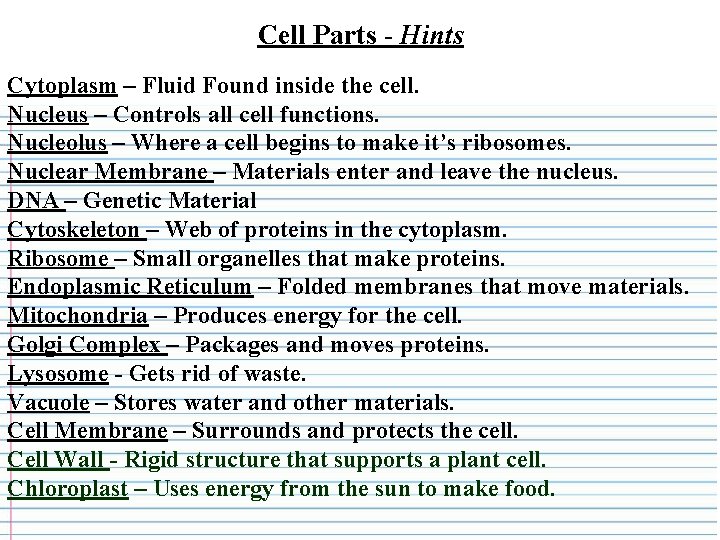
Cell Parts - Hints Cytoplasm – Fluid Found inside the cell. Nucleus – Controls all cell functions. Nucleolus – Where a cell begins to make it’s ribosomes. Nuclear Membrane – Materials enter and leave the nucleus. DNA – Genetic Material Cytoskeleton – Web of proteins in the cytoplasm. Ribosome – Small organelles that make proteins. Endoplasmic Reticulum – Folded membranes that move materials. Mitochondria – Produces energy for the cell. Golgi Complex – Packages and moves proteins. Lysosome - Gets rid of waste. Vacuole – Stores water and other materials. Cell Membrane – Surrounds and protects the cell. Cell Wall - Rigid structure that supports a plant cell. Chloroplast – Uses energy from the sun to make food.
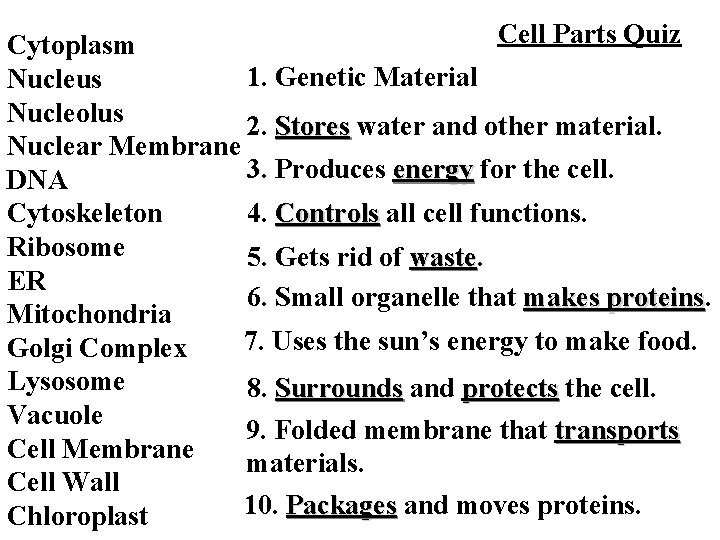
Cell Parts Quiz Cytoplasm 1. Genetic Material Nucleus Nucleolus 2. Stores water and other material. Nuclear Membrane 3. Produces energy for the cell. DNA 4. Controls all cell functions. Cytoskeleton Ribosome 5. Gets rid of waste ER 6. Small organelle that makes proteins Mitochondria 7. Uses the sun’s energy to make food. Golgi Complex Lysosome 8. Surrounds and protects the cell. Vacuole 9. Folded membrane that transports Cell Membrane materials. Cell Wall 10. Packages and moves proteins. Chloroplast
TC 1 Greetings 7 th Grade Life Scientists! Table of Contents Date 10/29 Cell Theory 11/5 Animal Cell 11/5 Plant Cell 11/12 The Microscope Activity Pg. # 29 -32 33 -34 35 -36 37 -38
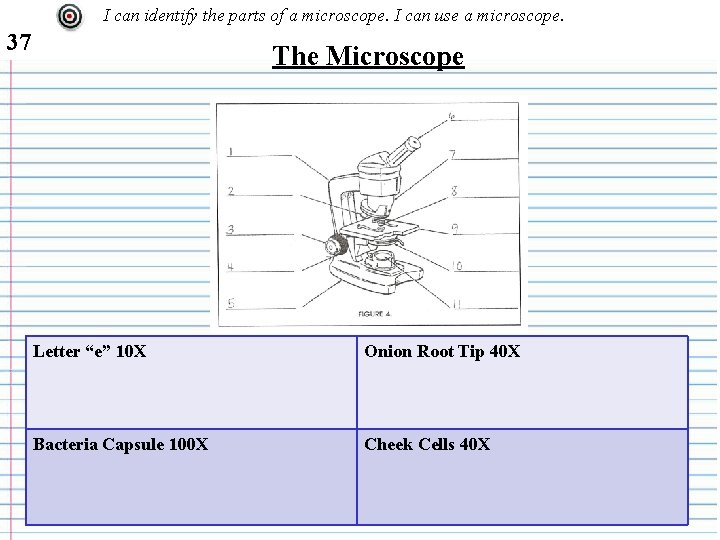
I can identify the parts of a microscope. I can use a microscope. 37 The Microscope Letter “e” 10 X Onion Root Tip 40 X Bacteria Capsule 100 X Cheek Cells 40 X
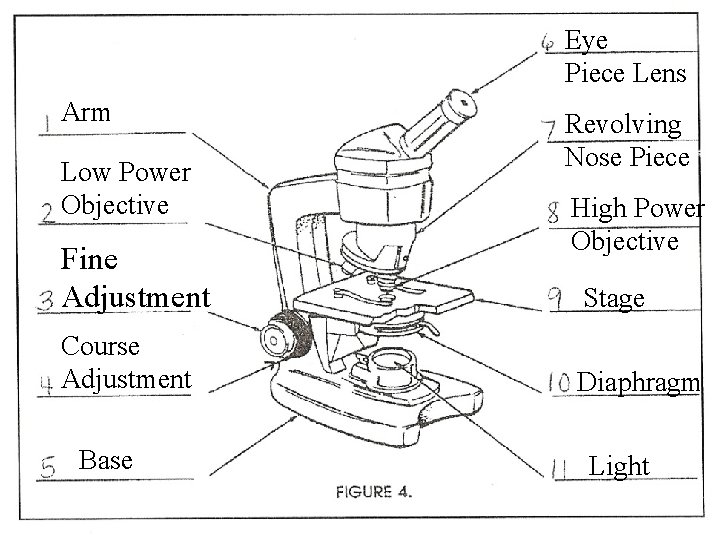
Eye Piece Lens Arm Low Power Objective Fine Adjustment Course Adjustment Base Revolving Nose Piece High Power Objective Stage Diaphragm Light
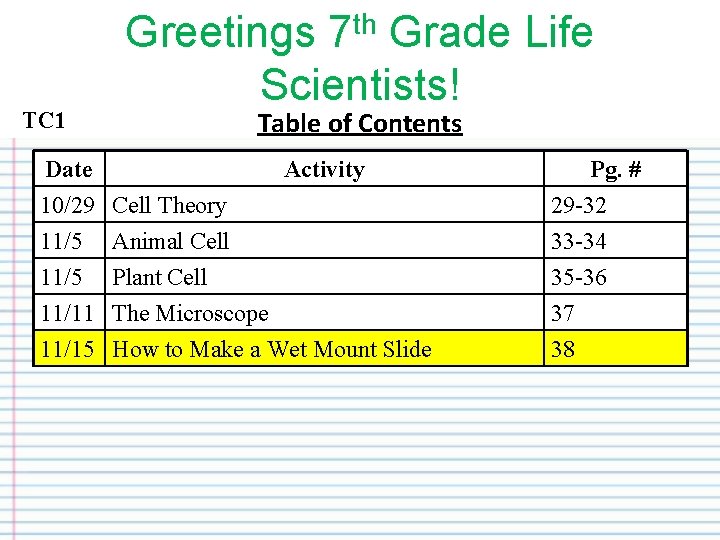
TC 1 Greetings 7 th Grade Life Scientists! Date 10/29 Cell Theory 11/5 Animal Cell 11/5 Plant Cell Table of Contents Activity 11/11 The Microscope 11/15 How to Make a Wet Mount Slide Pg. # 29 -32 33 -34 35 -36 37 38
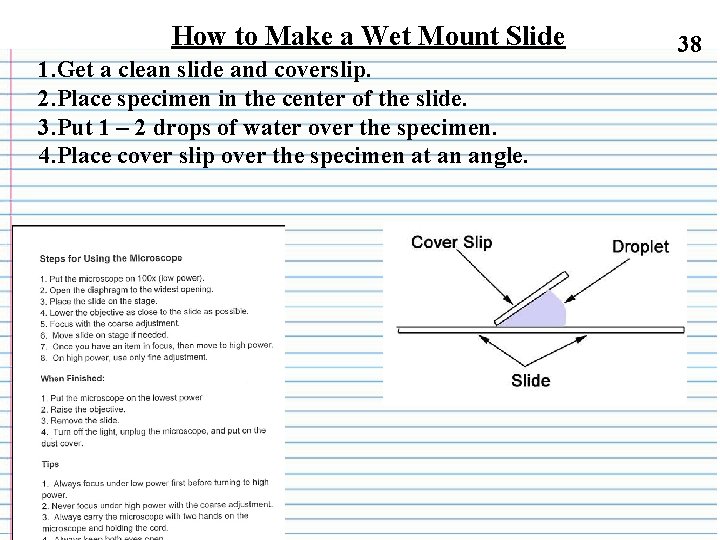
How to Make a Wet Mount Slide 1. Get a clean slide and coverslip. 2. Place specimen in the center of the slide. 3. Put 1 – 2 drops of water over the specimen. 4. Place cover slip over the specimen at an angle. 38
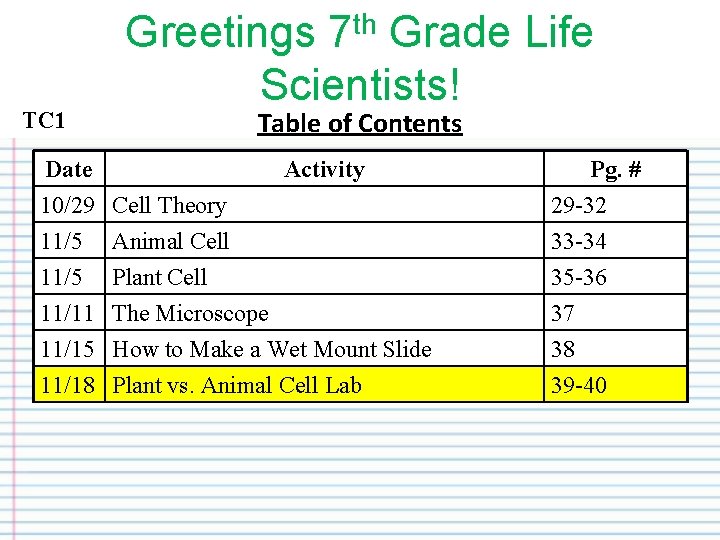
TC 1 Greetings 7 th Grade Life Scientists! Date 10/29 Cell Theory 11/5 Animal Cell 11/5 Plant Cell Table of Contents Activity 11/11 The Microscope 11/15 How to Make a Wet Mount Slide 11/18 Plant vs. Animal Cell Lab Pg. # 29 -32 33 -34 35 -36 37 38 39 -40
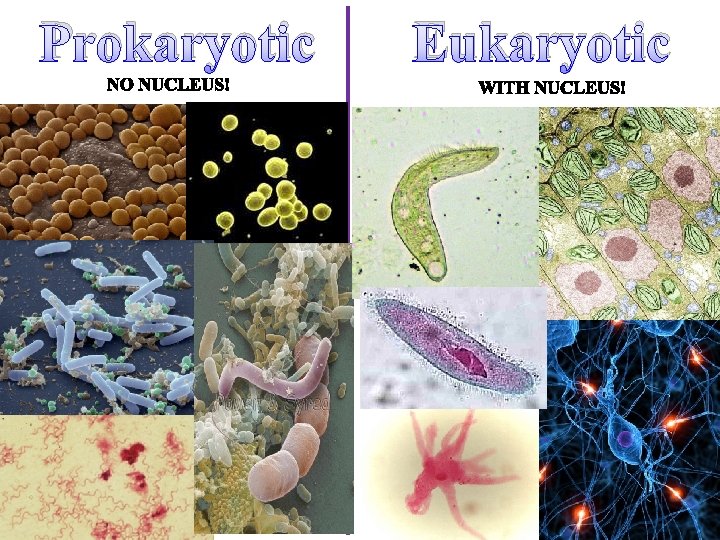
Prokaryotic Eukaryotic
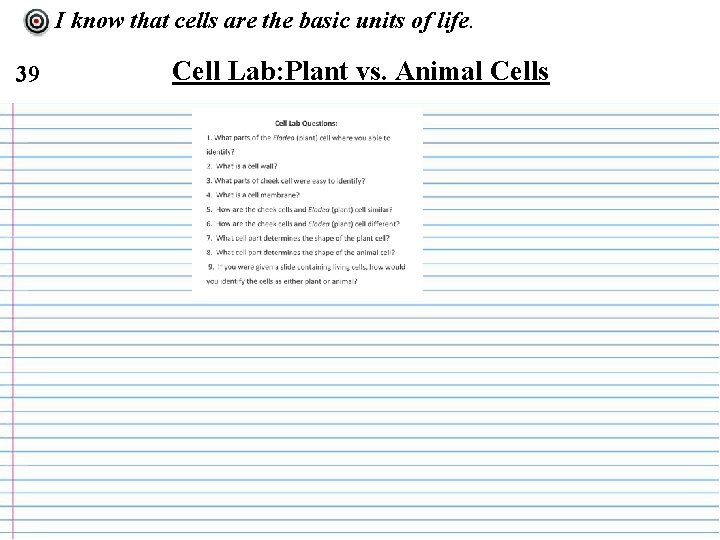
I know that cells are the basic units of life. 39 Cell Lab: Plant vs. Animal Cells
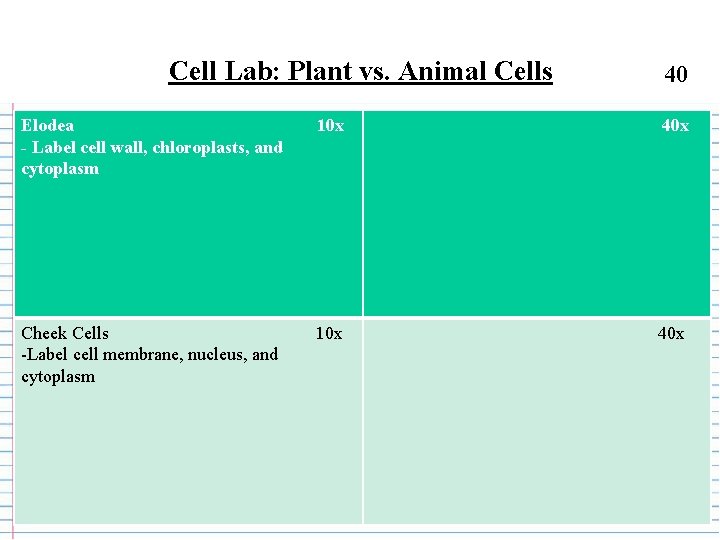
Cell Lab: Plant vs. Animal Cells 40 Elodea - Label cell wall, chloroplasts, and cytoplasm 10 x 40 x Cheek Cells -Label cell membrane, nucleus, and cytoplasm 10 x 40 x