
TBT DATA fitting using MADX Summer student meeting
TBT DATA fitting using MAD-X Summer student meeting August 27, 2007 Sergey Senkin, Moscow Institute of Physics and Technology Supervisor: Eliana Gianfelice-Wendt, APC theory/simulation group
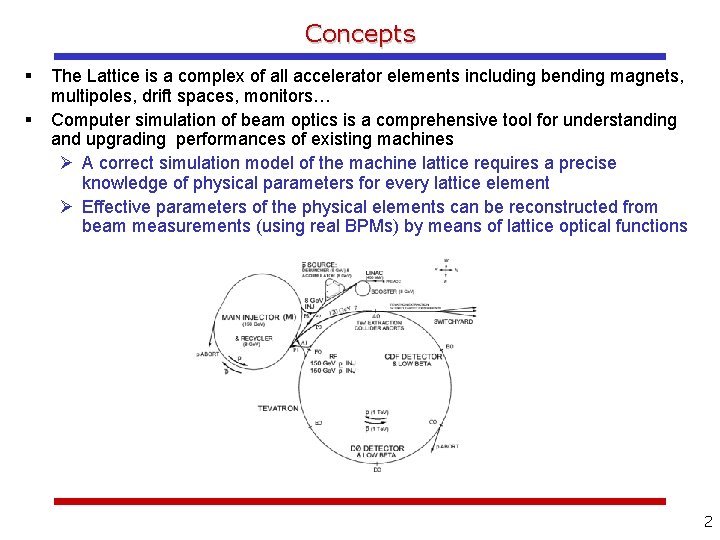
Concepts The Lattice is a complex of all accelerator elements including bending magnets, multipoles, drift spaces, monitors… Computer simulation of beam optics is a comprehensive tool for understanding and upgrading performances of existing machines A correct simulation model of the machine lattice requires a precise knowledge of physical parameters for every lattice element Effective parameters of the physical elements can be reconstructed from beam measurements (using real BPMs) by means of lattice optical functions 2
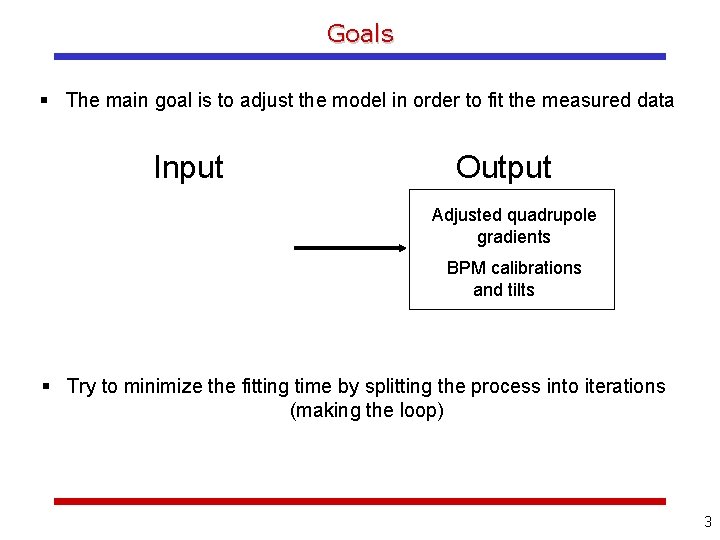
Goals The main goal is to adjust the model in order to fit the measured data Input Output Adjusted quadrupole gradients BPM calibrations and tilts Try to minimize the fitting time by splitting the process into iterations (making the loop) 3
MAD-X is a program (developed by CERN) for accelerator design and simulation Supports various modules and extensions • We use the matching module for obtaining knowledge of physical parameters of the lattice in order to fit real optics Turn-by-turn BPM data provide immediate information on the coupled optics functions at BPM locations The matching code handles the coupled optics case since the working point of most accelerators is close to the diagonal to allow space for various tuneshifts Constructing a lattice and fitting its parameters to the measurement data helps to disentangle the effect of optics perturbation caused by BPM calibration errors and tilts, pinpointing the sources of perturbation 4
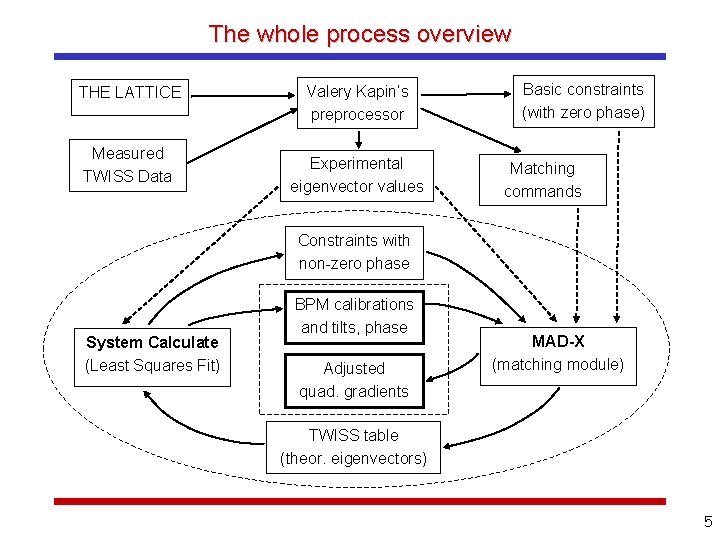
The whole process overview THE LATTICE Measured TWISS Data Valery Kapin’s preprocessor Experimental eigenvector values Basic constraints (with zero phase) Matching commands Constraints with non-zero phase System Calculate (Least Squares Fit) BPM calibrations and tilts, phase Adjusted quad. gradients MAD-X (matching module) TWISS table (theor. eigenvectors) 5

Constraints for the BPMs The example of BPM constraints (horizontal plane) System is overdetermined, Least Squares Fitting is realized by means of Singular Value Decomposition 6
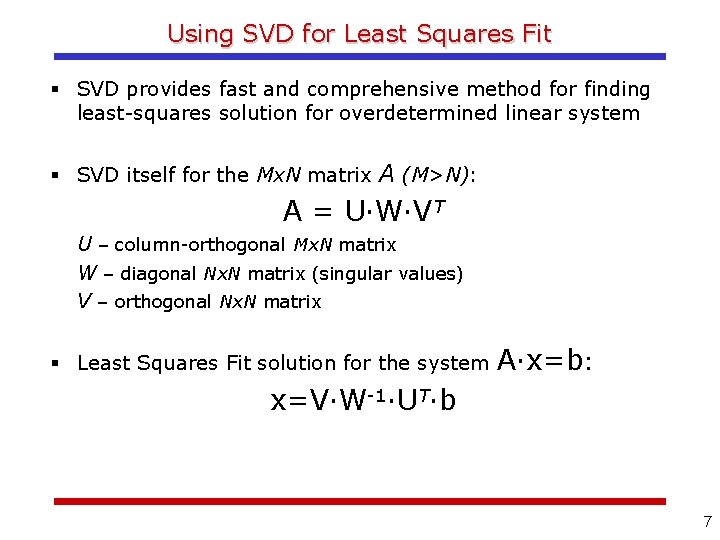
Using SVD for Least Squares Fit SVD provides fast and comprehensive method for finding least-squares solution for overdetermined linear system SVD itself for the Mx. N matrix A (M>N): A = U·W·VT U – column-orthogonal Mx. N matrix W – diagonal Nx. N matrix (singular values) V – orthogonal Nx. N matrix Least Squares Fit solution for the system A·x=b: x=V·W-1·UT·b 7
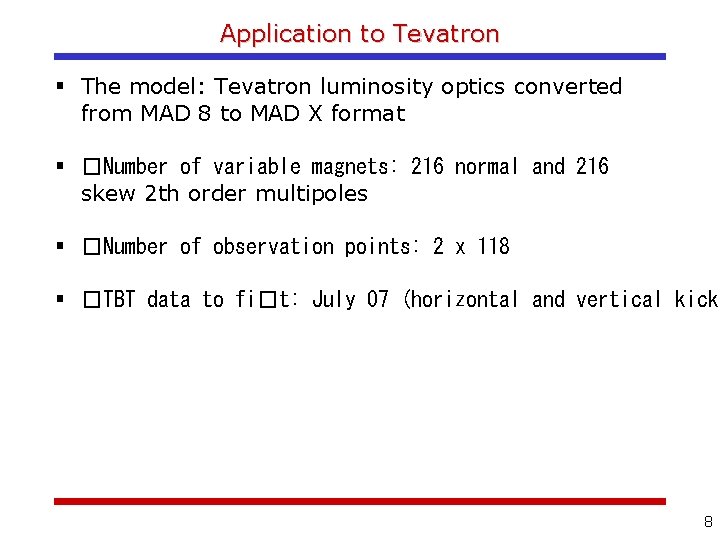
Application to Tevatron The model: Tevatron luminosity optics converted from MAD 8 to MAD X format �Number of variable magnets: 216 normal and 216 skew 2 th order multipoles �Number of observation points: 2 x 118 �TBT data to fi�t: July 07 (horizontal and vertical kick) 8
Conclusion The method of splitting the fit into two parts: less time-consuming calculation of the model’s physical parameters in order to fit real data measured by BPMs is realized Future goals: to decrease the calculation time to be able to make an application for the Control Room to make the code capable for other machines (not only Tevatron) 9
- Slides: 9