
TBM Safety Update Brad MerrillFusion Safety Program TBM

TBM Safety Update Brad Merrill/Fusion Safety Program TBM WG Meeting UCLA, December 12 th -14 th, 2005
Presentation Outline • Overview of TBM licensing process proposal made by J. -Ph. Girard (ITER SE&H Group Leader) at the last two TBWG meetings and what this could mean to TBM Safety and Regulatory Support • Updated Safety and Regulatory Support cost estimates based on recent guidelines from Tom Mann 2

Possible TBM Licensing Scenarios Three TBM licensing scenarios presented by J. -Ph. Girard at the Garching TBWG meeting (July 2005) : 1. TBM is considered analyzed in Initial Safety Files (scenario presently preferred by ITER) TBM is licensed at the same time as ITER, and operation of the TBM needs only ITER internal approval. This option requires detailed input from initial safety documents (Dossier of Options of Safety - DOS + Report Preliminary of Safety - RPr. S) into for Requests for Permits (RPr. C) so that TBM is covered by the appropriate Decrees (Decree Authorizing Creation –DAC). 2. TBM has no extensive description in the Initial Safety Files A description of the anticipated TBM system and enveloping estimates of radioactive wastes and operational/accidental releases is included in the initial safety documents. Licensing will require demonstration to the NSA that the TBM falls within the original envelope, but public review will not be required) 3. Non-scheduled TBM with respect to Initial Safety Files or supporting documents for issued Decrees Full licensing process required including public review 3
Safety reports ITER-IT/PT meeting CN Nov. 2005 J. -Ph. Girard - ITER SE&HGroup Leader 4 4 ITER
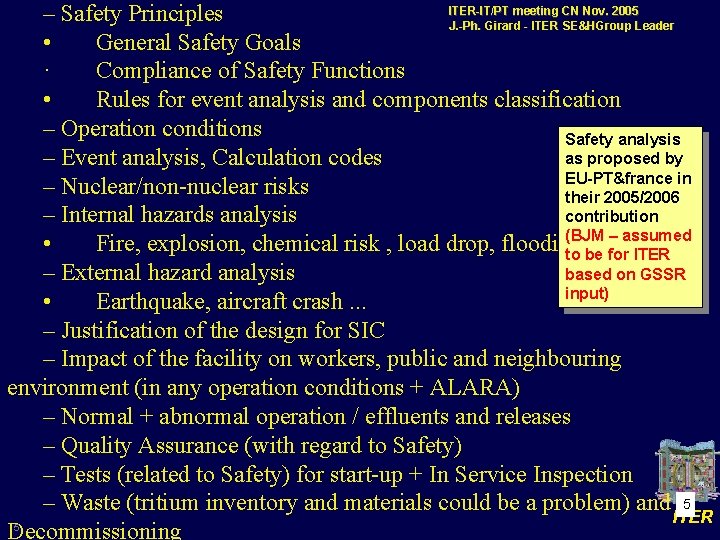
ITER-IT/PT meeting CN Nov. 2005 – Safety Principles J. -Ph. Girard - ITER SE&HGroup Leader • General Safety Goals · Compliance of Safety Functions • Rules for event analysis and components classification – Operation conditions Safety analysis as proposed by – Event analysis, Calculation codes EU-PT&france in – Nuclear/non-nuclear risks their 2005/2006 contribution – Internal hazards analysis (BJM – assumed • Fire, explosion, chemical risk , load drop, flooding to be for ITER based on GSSR – External hazard analysis input) • Earthquake, aircraft crash. . . – Justification of the design for SIC – Impact of the facility on workers, public and neighbouring environment (in any operation conditions + ALARA) – Normal + abnormal operation / effluents and releases – Quality Assurance (with regard to Safety) – Tests (related to Safety) for start-up + In Service Inspection – Waste (tritium inventory and materials could be a problem) and 5 ITER 5 Decommissioning
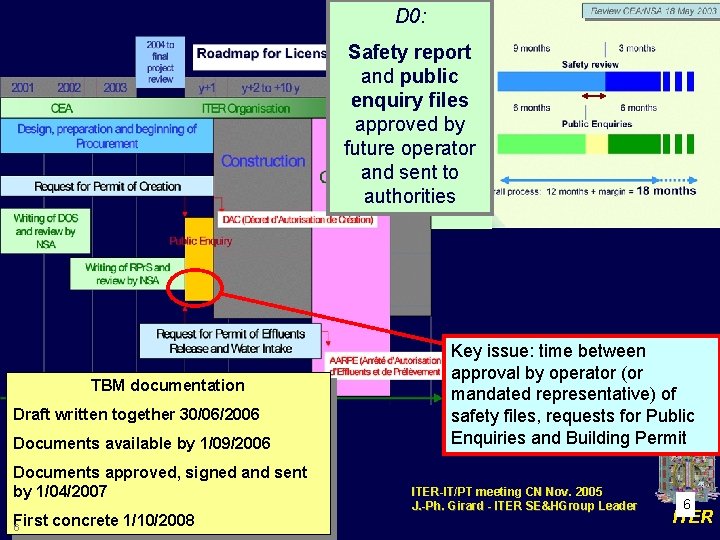
D 0: Safety report and public enquiry files approved by future operator and sent to authorities TBM documentation Draft written together 30/06/2006 Documents available by 1/09/2006 Documents approved, signed and sent by 1/04/2007 First concrete 1/10/2008 6 Key issue: time between approval by operator (or mandated representative) of safety files, requests for Public Enquiries and Building Permit ITER-IT/PT meeting CN Nov. 2005 J. -Ph. Girard - ITER SE&HGroup Leader 6 ITER
ITER Test Blanket Module in EU-France Meet the licensing dead line with consistent, sufficient inputs • • • Description of the experimentation and possible concepts, Inventory at risk Safety analysis: prove that all normal, incident, accident situations are under control, clear views on barriers, fire, explosion, scram, bottom-up analysis, TBM facility, facility TBM Do the TBMs introduces news accidental scenarios? q Do they substancialy increase risk? q Screening of standards incidental and accidental sequences q • • • 7 Codes & Standards (metallic (material), pressure vessel…) Waste Safety tests before start-up (generaly speaking, sequences for TBM experimentation) ITER-IT/PT meeting CN Nov. 2005 J. -Ph. Girard - ITER SE&HGroup Leader 7 ITER
EFDA A proposal could be: To set the next meeting in Cadarache and to have the meeting followed by a workshop to finalise the licensing documentation (main objectives, safety and releases) with this calendar: ITER will ask EU-PT to send the canvas of needed information before 01/02/2006 A coordination officer will be mandate to work with partners on the documentation (02 to 06/2006) Workshop to finalize the job 06/2006 draft documents ready by 15/07/2006 under the coodination of the officer ITER-IT/PT meeting CN Nov. 2005 J. -Ph. Girard - ITER SE&HGroup Leader 8 8 - ITER
Impact of TBM Licensing Scenarios on Cost and Schedule • Safety reporting requirements at this time are not very clear, but what is certain is that: – A safety analysis for the TBM that is comparable to ITER’s GSSR (basis for existing DOS and RPr. S) has not been undertaken – A “bottoms up review” of to determine postulated initiating events (PIE’s) for the DCLL TBM has not be made – There is not enough time to complete these sort of analyses prior to submission of the RPr. C or the issuance of the DAC – All TBM Parties have this same problem based on existing DDD submissions reviewed, but what is the status of the EU DDDs? • The only conclusion that can be drawn is that J. -Ph. Girard believes that the initial analyses can be repackaged with little effort to satisfy DOS and RPr. S requirements for the DAC • Dave Petti will meet with J. -Ph. Girard in January to clarify safety reporting requirements and help set the foundation for proposed licensing workshop to be held in February 06 9

ITER-IT/PT meeting CN Nov. 2005 J. -Ph. Girard - ITER SE&HGroup Leader ITER Test Blanket Module in EU-France QA • Very stringent QA system must be implemented for all safety components • Requirements for this QA system is close to the IAEA 50 SGQ • Translation of the requirement given during meeting 10 10 ITER
Impact of Quality Assurance on TBM on Cost and Schedule • All components of the TBM ancillary loops are safety grade components and will require a Quality Assurance (QA) program to obtain licensing/operating approval • A QA similar to ITER’s (based on IAEA 50 -C/SG-Q, similar to ASME NQA-1 or 10 CFR 50 App B) should be adopted • Necessary parts of ITER QA are: – QA Director and a QA Plan – Document Control – Design to nuclear Standards (e. g. , ASME B&PV Code Section IX on welds, Section V on NDE) – V&V of computer codes used in the design – Vendor certification and contracting • Audits and other oversight activities are required to ITER success, so plan for 10% cost increase for each WBS item 11
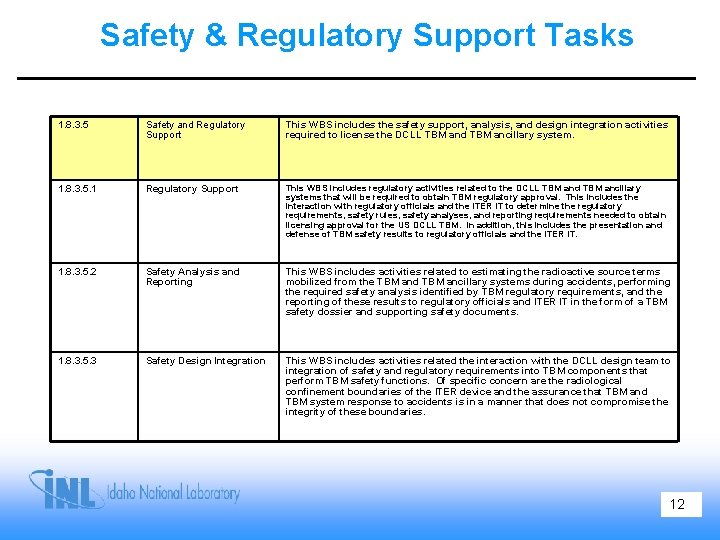
Safety & Regulatory Support Tasks 1. 8. 3. 5 Safety and Regulatory Support This WBS includes the safety support, analysis, and design integration activities required to license the DCLL TBM and TBM ancillary system. 1. 8. 3. 5. 1 Regulatory Support This WBS includes regulatory activities related to the DCLL TBM and TBM ancillary systems that will be required to obtain TBM regulatory approval. This includes the interaction with regulatory officials and the ITER IT to determine the regulatory requirements, safety rules, safety analyses, and reporting requirements needed to obtain licensing approval for the US DCLL TBM. In addition, this includes the presentation and defense of TBM safety results to regulatory officials and the ITER IT. 1. 8. 3. 5. 2 Safety Analysis and Reporting This WBS includes activities related to estimating the radioactive source terms mobilized from the TBM and TBM ancillary systems during accidents, performing the required safety analysis identified by TBM regulatory requirements, and the reporting of these results to regulatory officials and ITER IT in the form of a TBM safety dossier and supporting safety documents. 1. 8. 3. 5. 3 Safety Design Integration This WBS includes activities related the interaction with the DCLL design team to integration of safety and regulatory requirements into TBM components that perform TBM safety functions. Of specific concern are the radiological confinement boundaries of the ITER device and the assurance that TBM and TBM system response to accidents is in a manner that does not compromise the integrity of these boundaries. 12
Safety & Regulatory Support Schedule DOS/RPr. S 13
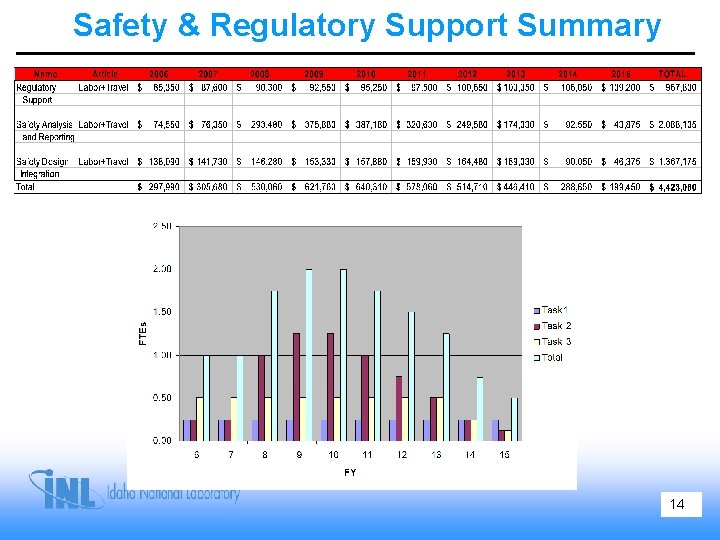
Safety & Regulatory Support Summary 14
- Slides: 14