
TBGS Safeguarding Child Protection Quick Quiz How many
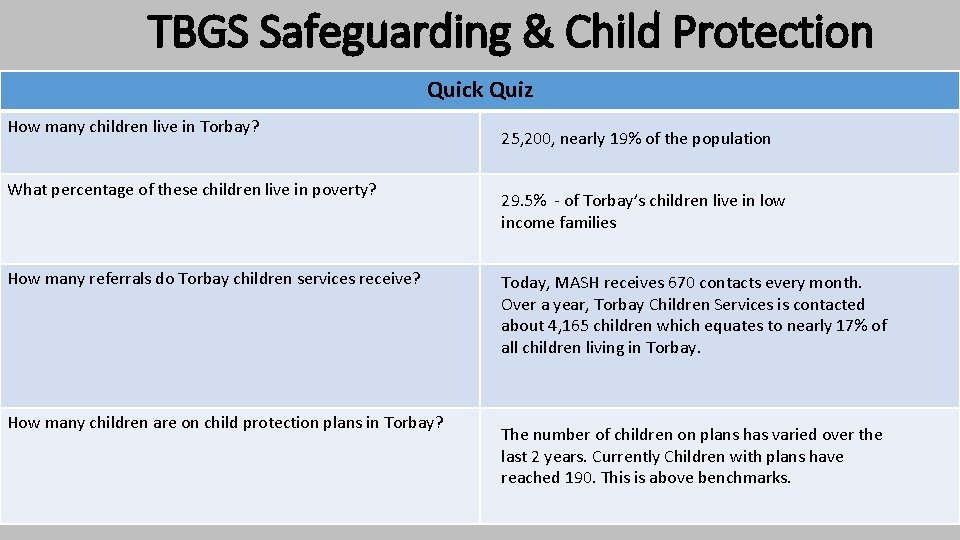
TBGS Safeguarding & Child Protection Quick Quiz How many children live in Torbay? What percentage of these children live in poverty? How many referrals do Torbay children services receive? How many children are on child protection plans in Torbay? 25, 200, nearly 19% of the population 29. 5% - of Torbay’s children live in low income families Today, MASH receives 670 contacts every month. Over a year, Torbay Children Services is contacted about 4, 165 children which equates to nearly 17% of all children living in Torbay. The number of children on plans has varied over the last 2 years. Currently Children with plans have reached 190. This is above benchmarks.

1. ‘It Could Happen Here’
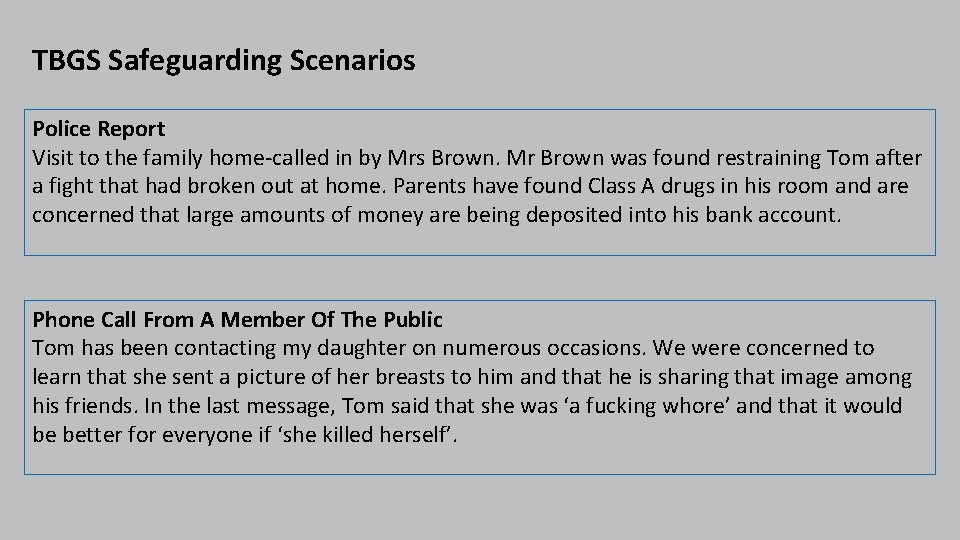
TBGS Safeguarding Scenarios Police Report Visit to the family home-called in by Mrs Brown. Mr Brown was found restraining Tom after a fight that had broken out at home. Parents have found Class A drugs in his room and are concerned that large amounts of money are being deposited into his bank account. Phone Call From A Member Of The Public Tom has been contacting my daughter on numerous occasions. We were concerned to learn that she sent a picture of her breasts to him and that he is sharing that image among his friends. In the last message, Tom said that she was ‘a fucking whore’ and that it would be better for everyone if ‘she killed herself’.
2. ‘It is everyone's responsibility’ Df. E Guidance Keeping Children Safe In Education 2016
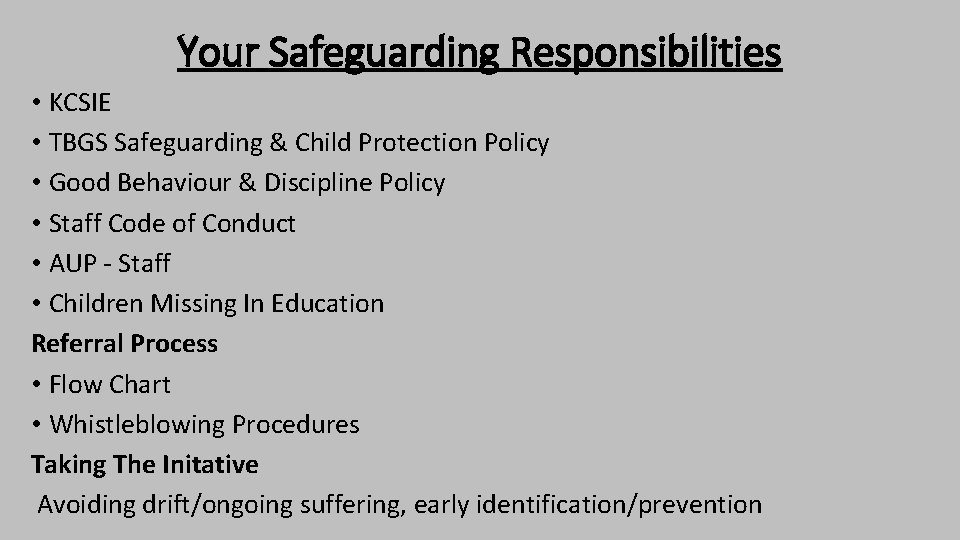
Your Safeguarding Responsibilities • KCSIE • TBGS Safeguarding & Child Protection Policy • Good Behaviour & Discipline Policy • Staff Code of Conduct • AUP - Staff • Children Missing In Education Referral Process • Flow Chart • Whistleblowing Procedures Taking The Initative Avoiding drift/ongoing suffering, early identification/prevention
3. ‘Child Centred Approach' At the heart of our practice… to consider, at all times, what is in the best interests of the child.
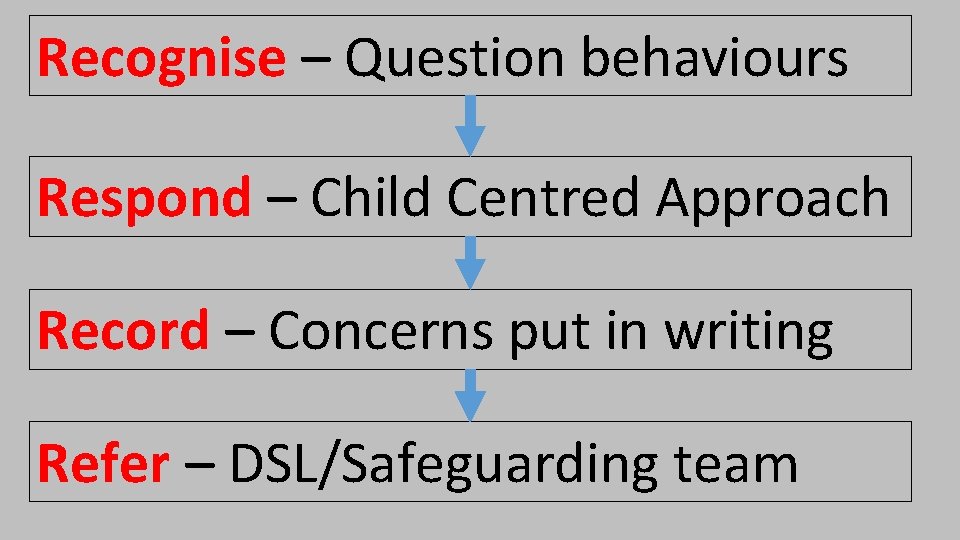
Recognise – Question behaviours Respond – Child Centred Approach Record – Concerns put in writing Refer – DSL/Safeguarding team
Recognise 4 Categories of abuse: • Physical • Sexual • Emotional Abuse • Neglect Would you be able to question worrying behaviours/patterns?
Respond Dealing With A Disclosure • Would you know how to respond when a student confides in you? • What would you say during a disclosure of abuse? • Remember you have copies of our CP policy that can be used as a toolkit in these situations.
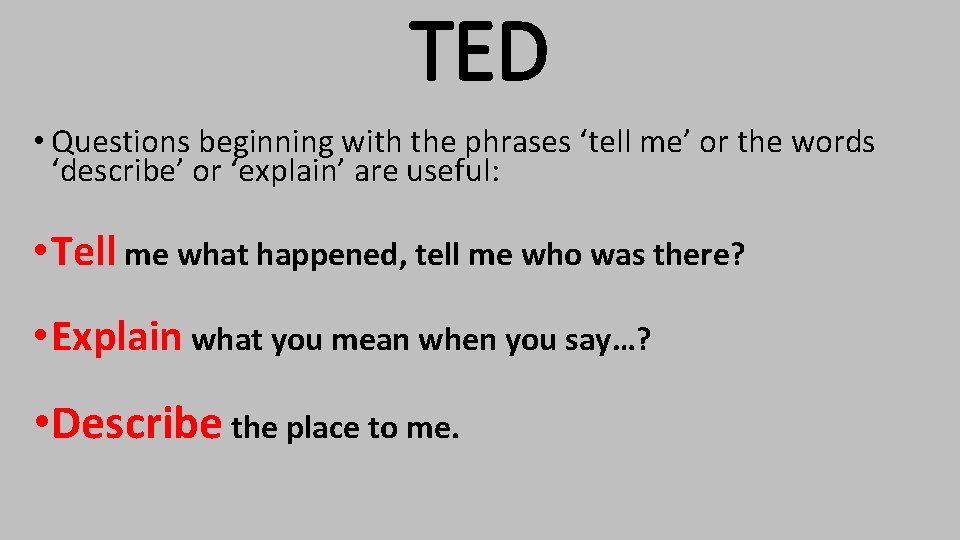
TED • Questions beginning with the phrases ‘tell me’ or the words ‘describe’ or ‘explain’ are useful: • Tell me what happened, tell me who was there? • Explain what you mean when you say…? • Describe the place to me.
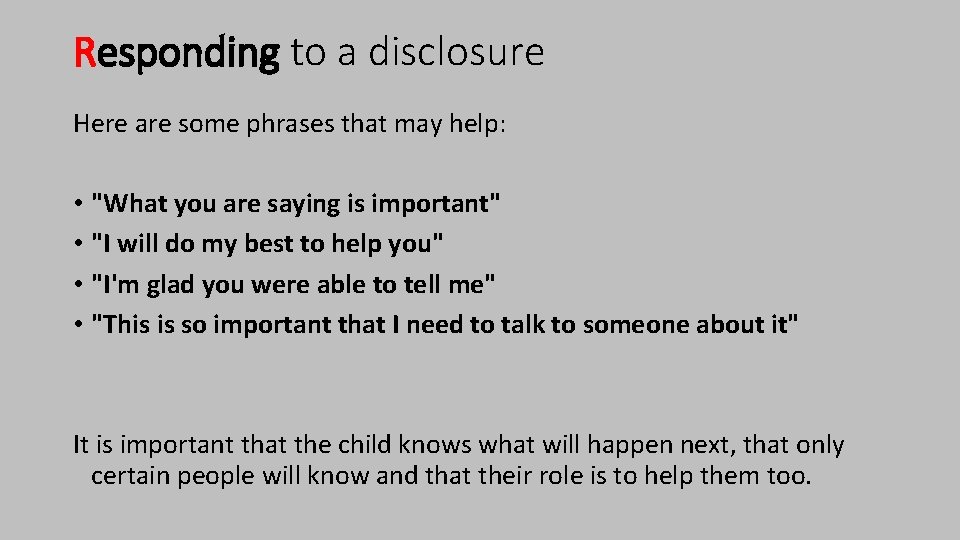
Responding to a disclosure Here are some phrases that may help: • "What you are saying is important" • "I will do my best to help you" • "I'm glad you were able to tell me" • "This is so important that I need to talk to someone about it" It is important that the child knows what will happen next, that only certain people will know and that their role is to help them too.
Record & Refer 1. CPOMS 2. TBGS Flow Chart
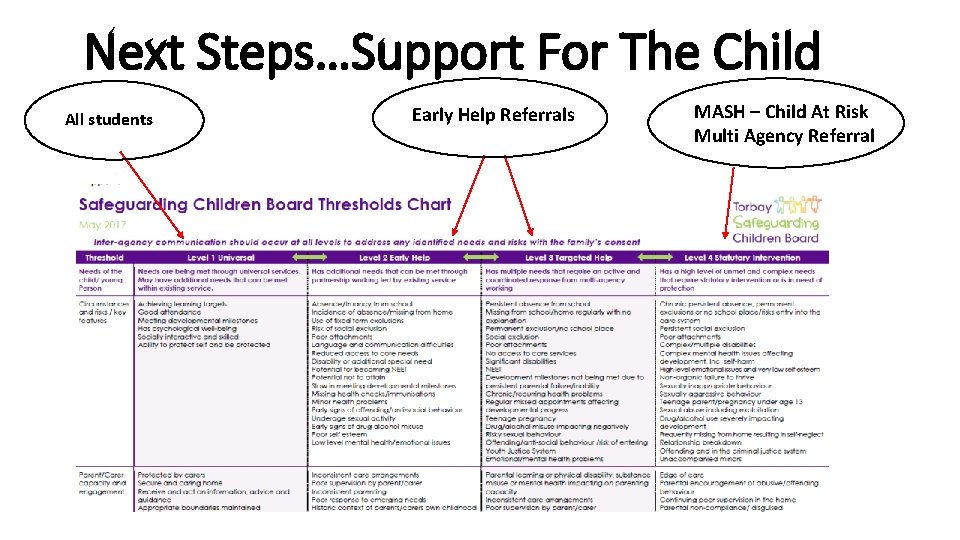
Next Steps…Support For The Child All students Early Help Referrals MASH – Child At Risk Multi Agency Referral
Safer Working Practice…Discuss • You search your students’ names online and realise that many have open profiles or open photo albums on social networking sites. Many have lied about their age. • Students who are about to leave the school are keen to keep in touch with you. They ask to exchange email addresses and contact details. • You are leaving school and notice a student walking in the rain. They know you, so you offer to give them a lift home. • You routinely use the student toilet because it is located in close proximity to your office. The nearest staff toilet is at the other end of the school.
When Might You Be Vulnerable & Why? ‘P ’ t I t os
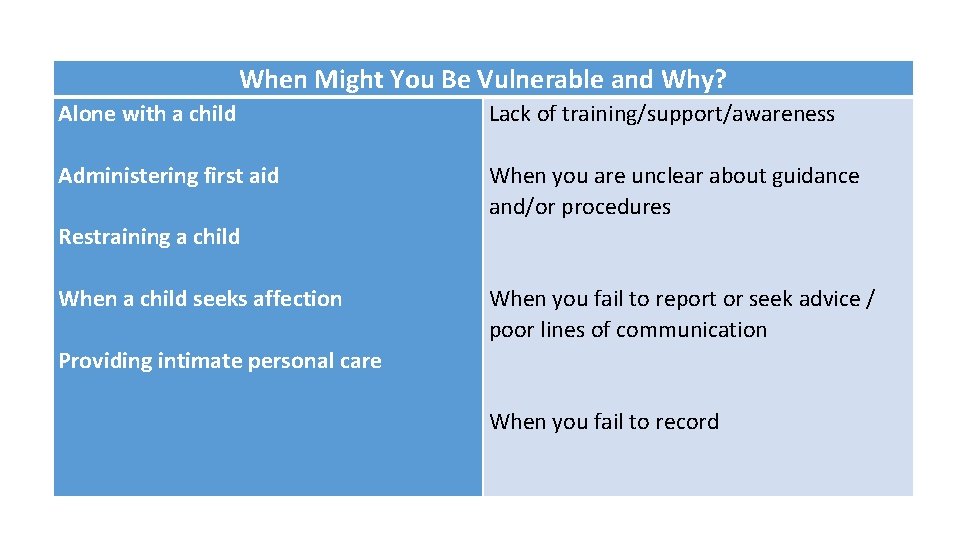
When Might You Be Vulnerable and Why? Alone with a child Administering first aid Restraining a child When a child seeks affection Providing intimate personal care Lack of training/support/awareness When you are unclear about guidance and/or procedures When you fail to report or seek advice / poor lines of communication When you fail to record
Whistle Blowing Concerns About A Colleague • TBGS recognises that children cannot be expected to raise concerns in an environment where staff fail to do so. • All staff and volunteers should be aware of their duty to raise concerns, where they exist, about the management of Child Protection, which may include the actions of colleagues. Any such concerns should be raised with the Head teacher, or the TSCB Designated Officer (LADO), Patrick Duke, Tel 01803 208562. • Complaints or concerns regarding the Head teacher should be made to the Chair /Vice Chair of the Governing Body. • The NSPCC whistleblowing helpline is available for staff who do not feel able to raise concerns regarding child protection failures internally. Staff can call 0800 0285 Monday to Friday 8. 00 am to 8. 00 pm email help@nspcc. org. uk
Why Is All Of This Important? Hillside First School The sexual abuse of children took place in a first school over a number of years prior to disclosure by a child in December 2010. There was a total of 20 pupils who were witnesses to or possible victims of abuse by the teacher. Youngest victim aged 6. At a court hearing in May 2011 Nigel Leat pleaded guilty to 36 sexual offences, including 22 counts of sexually assaulting a child under 13 and eight counts of sexual assault by penetration of a child under 13. The teacher also admitted one count of attempted rape, one charge of voyeurism, one charge of causing or inciting a child under 14 to commit sexual activity and two charges of possessing indecent images of children. In June 2011 was given an indeterminate prison sentence for public protection, having pleaded guilty
• Findings of the Serious Case Review – Hillside Primary School • There were at least 30 incidents of inappropriate conduct which should have been viewed as suspicious • The incidents highlighted in the school management report ranged from indecent touching, inappropriate lesson content, favouritism and over-familiarity with children. • Evidence of only one reference on file and no evidence that a second was sought. • “On a number of occasions in response to these and other incidents colleagues advised Teacher A of the inappropriateness of his behaviour and pointed to the risk that he could be accused of professional misconduct. It is significant however that only 11 of the 30 recorded incidents were reported to the school. "
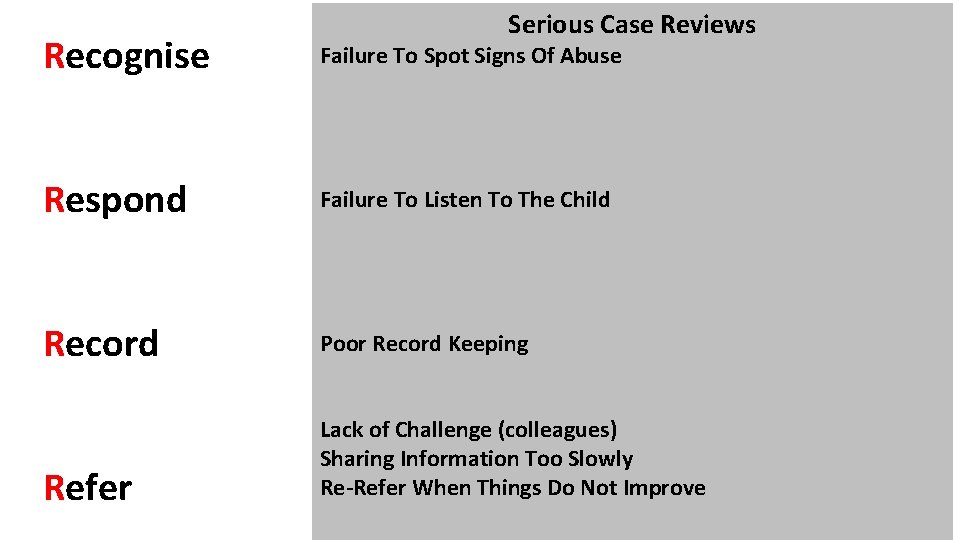
Serious Case Reviews Recognise Failure To Spot Signs Of Abuse Respond Failure To Listen To The Child Record Poor Record Keeping Lack of Challenge (colleagues) Sharing Information Too Slowly Re-Refer When Things Do Not Improve Refer
- Slides: 20