
TBCC Code for DL Control Channels Document Number
TBCC Code for DL Control Channels Document Number: Sides S 80216 m-09/0957 Date Submitted: 2009 -4 -27 Source: Debdeep Chatterjee, Yi Hsuan, Hujun Yin Email: {debdeep. chatterjee@intel. com, yi. hsuan@intel. com, hujun. yin@intel. com} Intel Corporation Venue: IEEE Session #61, Cairo, Egypt. Re: AWD comments/ Area: Chapter 15. 3. 6 (DL-CTRL), “Comments on AWD 15. 3. 6 DL-CTRL” Base Contribution: N/A Purpose: For TGm discussion and adoption of 802. 16 m AWD text. Notice: This document does not represent the agreed views of the IEEE 802. 16 Working Group or any of its subgroups. It represents only the views of the participants listed in the “Source(s)” field above. It is offered as a basis for discussion. It is not binding on the contributor(s), who reserve(s) the right to add, amend or withdraw material contained herein. Release: The contributor grants a free, irrevocable license to the IEEE to incorporate material contained in this contribution, and any modifications thereof, in the creation of an IEEE Standards publication; to copyright in the IEEE’s name any IEEE Standards publication even though it may include portions of this contribution; and at the IEEE’s sole discretion to permit others to reproduce in whole or in part the resulting IEEE Standards publication. The contributor also acknowledges and accepts that this contribution may be made public by IEEE 802. 16. Patent Policy: The contributor is familiar with the IEEE-SA Patent Policy and Procedures: <http: //standards. ieee. org/guides/bylaws/sect 6 -7. html#6> and <http: //standards. ieee. org/guides/opman/sect 6. html#6. 3>. Further information is located at <http: //standards. ieee. org/board/pat-material. html> and <http: //standards. ieee. org/board/pat >. 1
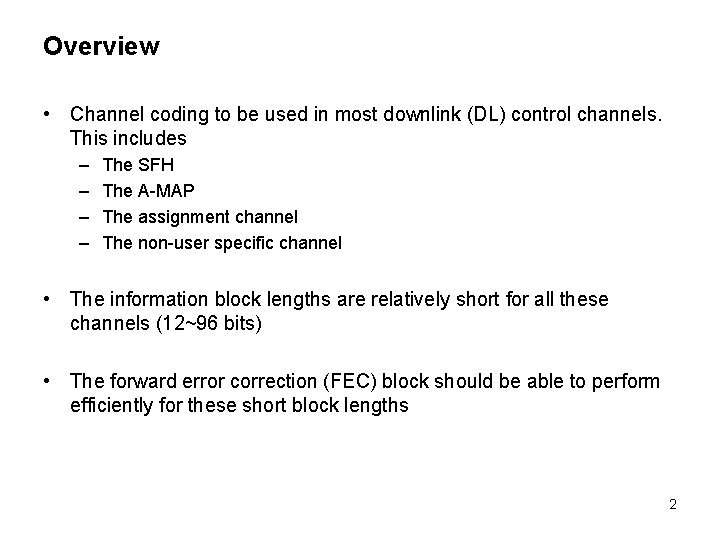
Overview • Channel coding to be used in most downlink (DL) control channels. This includes – – The SFH The A-MAP The assignment channel The non-user specific channel • The information block lengths are relatively short for all these channels (12~96 bits) • The forward error correction (FEC) block should be able to perform efficiently for these short block lengths 2

TBCC Code Rate • Owing to the short IE block lengths, TBCC is a natural choice for the purpose of FEC • We propose the use of ¼ TBCC for the various DL control channels owing to its superior performance when compared to ½ TBCC • Generator polynomials for 16 e ½ TBCC: – 133, and 171 (in Octal number system representation) • Generator polynomials for the proposed ¼ TBCC: – 133, 171, 165, and 117 (in Octal number system representation) • Thus, the proposed TBCC is backward compatible with the previous ½ TBCC – Rate ½ TBCC can be realized using the proposed ¼ TBCC and by puncturing the last two bits 3
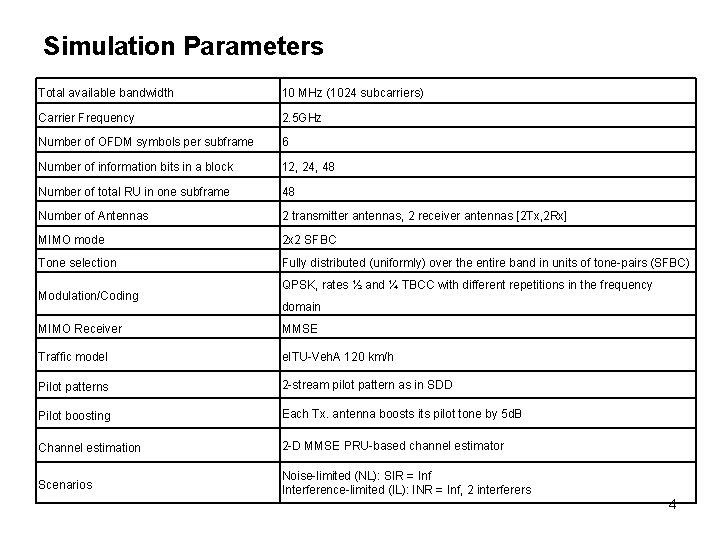
Simulation Parameters Total available bandwidth 10 MHz (1024 subcarriers) Carrier Frequency 2. 5 GHz Number of OFDM symbols per subframe 6 Number of information bits in a block 12, 24, 48 Number of total RU in one subframe 48 Number of Antennas 2 transmitter antennas, 2 receiver antennas [2 Tx, 2 Rx] MIMO mode 2 x 2 SFBC Tone selection Fully distributed (uniformly) over the entire band in units of tone-pairs (SFBC) Modulation/Coding QPSK, rates ½ and ¼ TBCC with different repetitions in the frequency domain MIMO Receiver MMSE Traffic model e. ITU-Veh. A 120 km/h Pilot patterns 2 -stream pilot pattern as in SDD Pilot boosting Each Tx. antenna boosts its pilot tone by 5 d. B Channel estimation 2 -D MMSE PRU-based channel estimator Scenarios Noise-limited (NL): SIR = Inf Interference-limited (IL): INR = Inf, 2 interferers 4
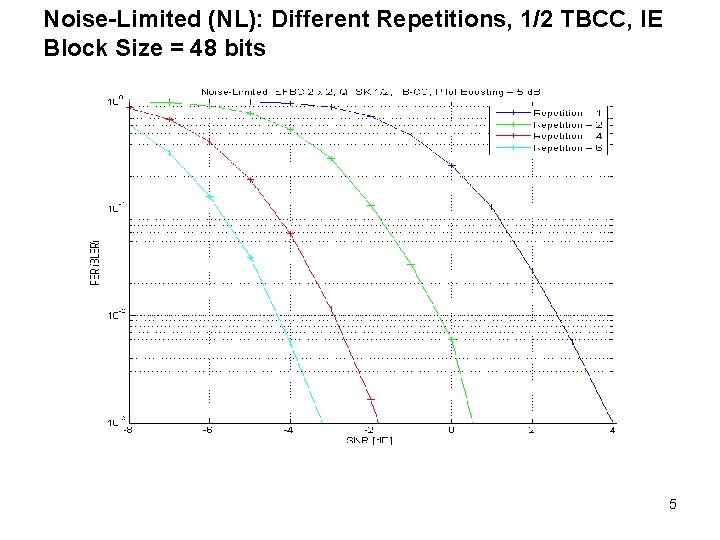
Noise-Limited (NL): Different Repetitions, 1/2 TBCC, IE Block Size = 48 bits 5
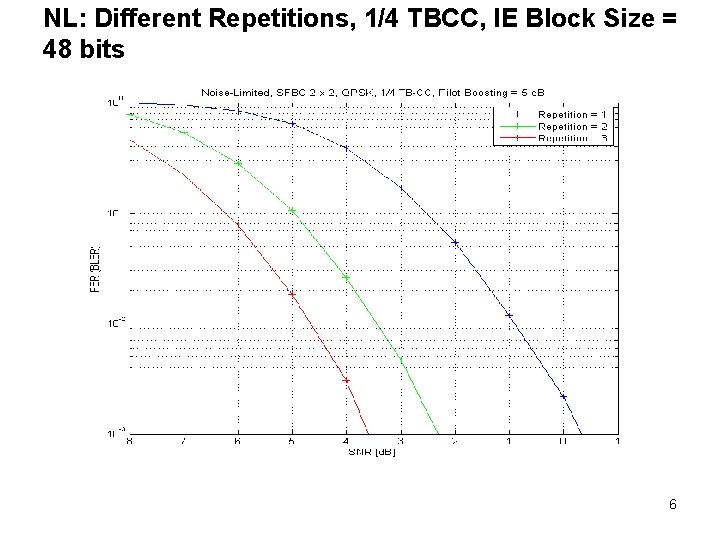
NL: Different Repetitions, 1/4 TBCC, IE Block Size = 48 bits 6
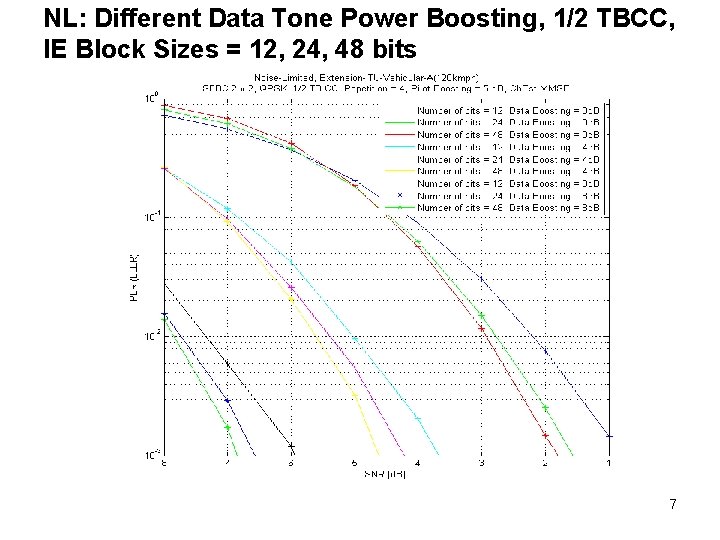
NL: Different Data Tone Power Boosting, 1/2 TBCC, IE Block Sizes = 12, 24, 48 bits 7
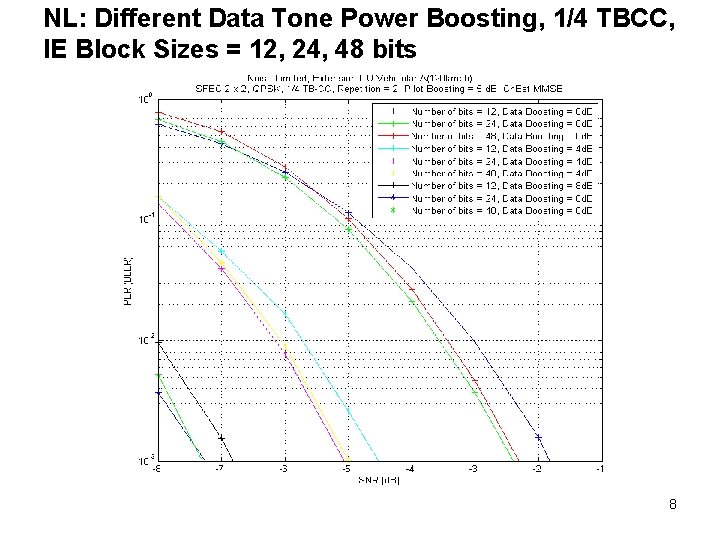
NL: Different Data Tone Power Boosting, 1/4 TBCC, IE Block Sizes = 12, 24, 48 bits 8
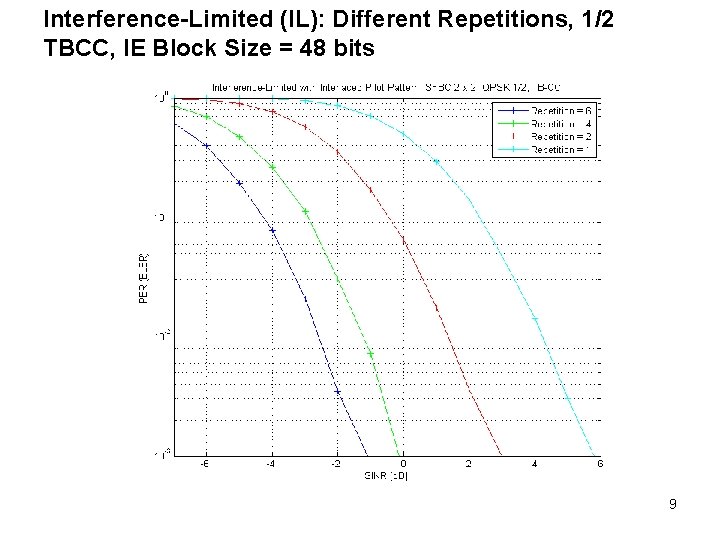
Interference-Limited (IL): Different Repetitions, 1/2 TBCC, IE Block Size = 48 bits 9
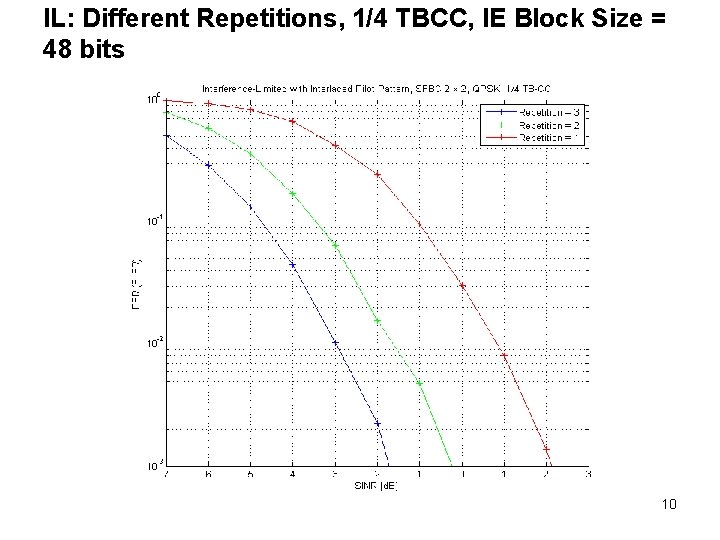
IL: Different Repetitions, 1/4 TBCC, IE Block Size = 48 bits 10
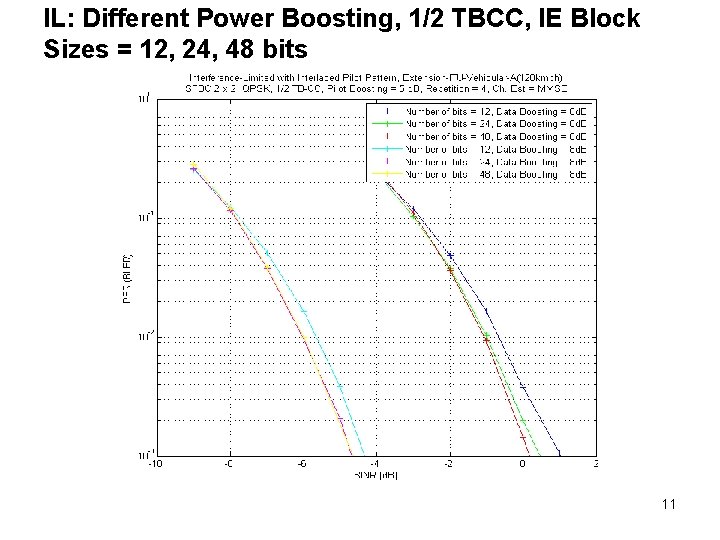
IL: Different Power Boosting, 1/2 TBCC, IE Block Sizes = 12, 24, 48 bits 11
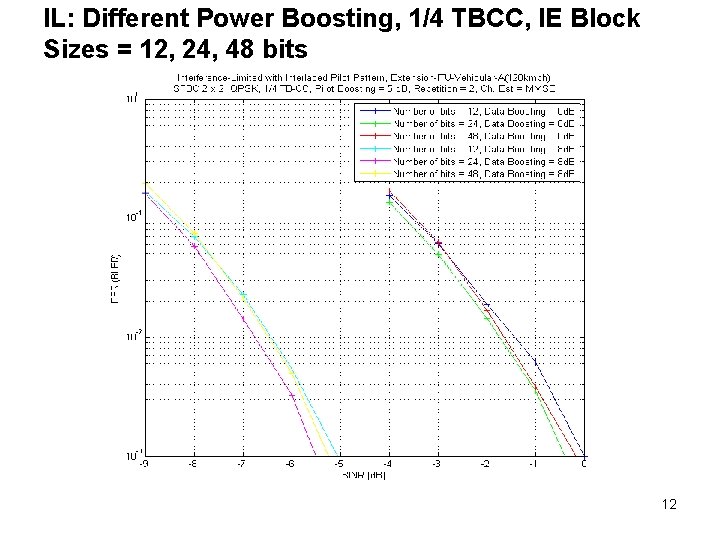
IL: Different Power Boosting, 1/4 TBCC, IE Block Sizes = 12, 24, 48 bits 12
Conclusion • Simulation results for different block sizes and for different scenarios establish that using the proposed ¼ TBCC yields performance improvements that ranges from about 0. 4 d. B to up to 1 d. B depending on the concerned scenario • The gains over ½ TBCC are more pronounced for shorter block sizes, and for lower values of repetition numbers • As expected, there is no significant effect of data tone power boosting on the performance gains • The proposed ¼ TBCC offers performance improvements for both noise-limited and interference-limited scenarios, with the former scenario exhibiting more pronounced gains 13
- Slides: 13