
TB and HIV Dr A L Pozniak Chelsea
TB and HIV Dr A. L. Pozniak Chelsea and Westminster Hospital London, UK
Chemopreventative therapy Treatment and side effects What with… when… IRIS MDRTB
TB and HIV • Chemopreventative therapy • Is it useful in HIV ?
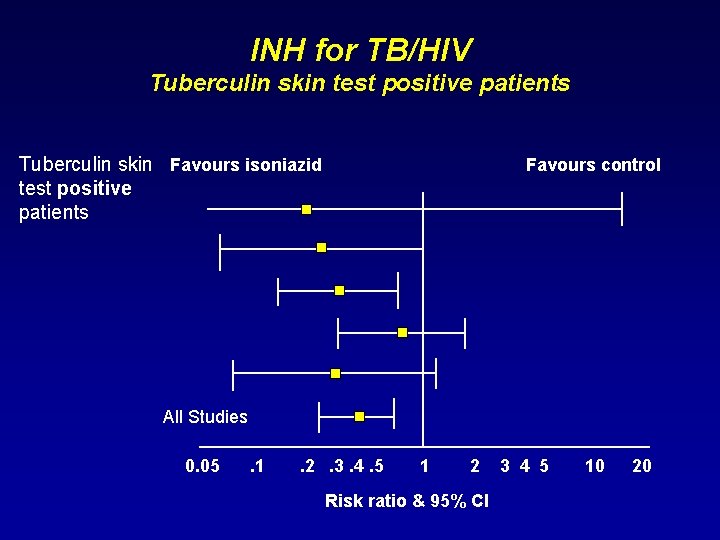
INH for TB/HIV Tuberculin skin test positive patients Tuberculin skin Favours isoniazid test positive patients Favours control All Studies 0. 05 . 1 . 2. 3. 4. 5 1 2 Risk ratio & 95% CI 3 4 5 10 20
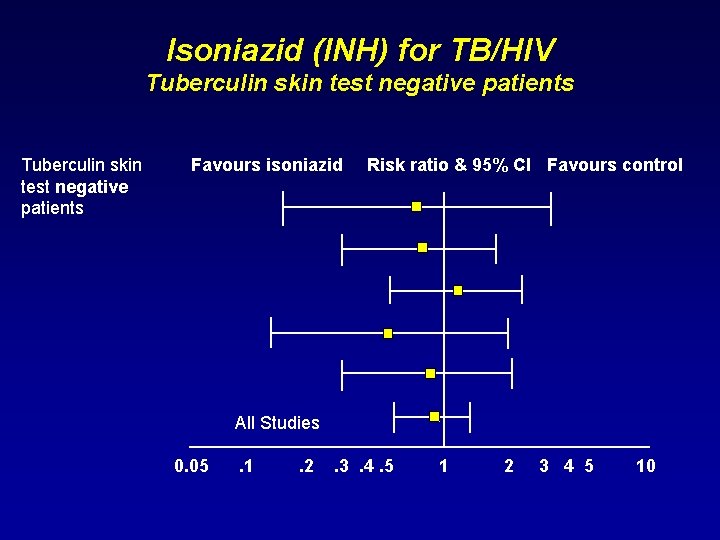
Isoniazid (INH) for TB/HIV Tuberculin skin test negative patients Favours isoniazid Risk ratio & 95% CI Favours control All Studies 0. 05 . 1 . 2 . 3. 4. 5 1 2 3 4 5 10
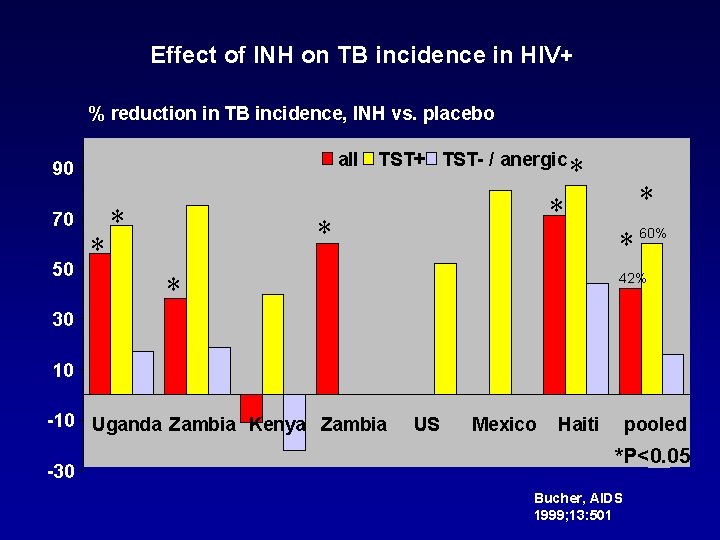
Effect of INH on TB incidence in HIV+ % reduction in TB incidence, INH vs. placebo all 90 70 50 * * TST+ TST- / anergic * * * 60% 42% * 30 10 -10 Uganda Zambia Kenya Zambia -30 US Mexico Haiti pooled *P<0. 05 Bucher, AIDS 1999; 13: 501
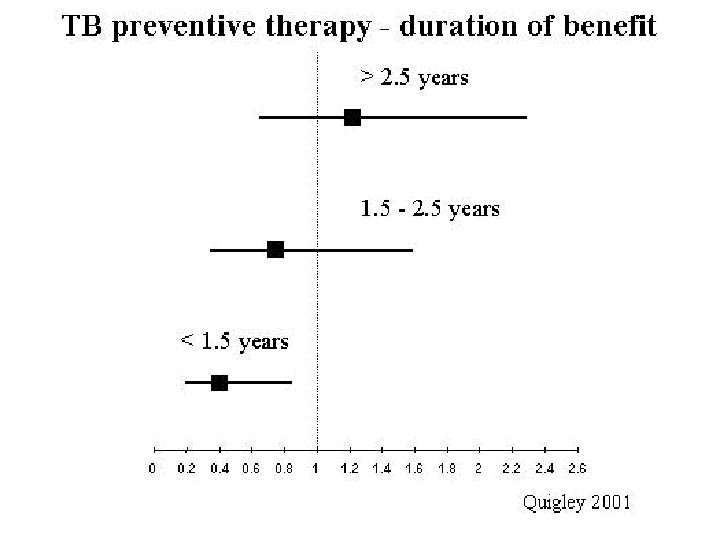
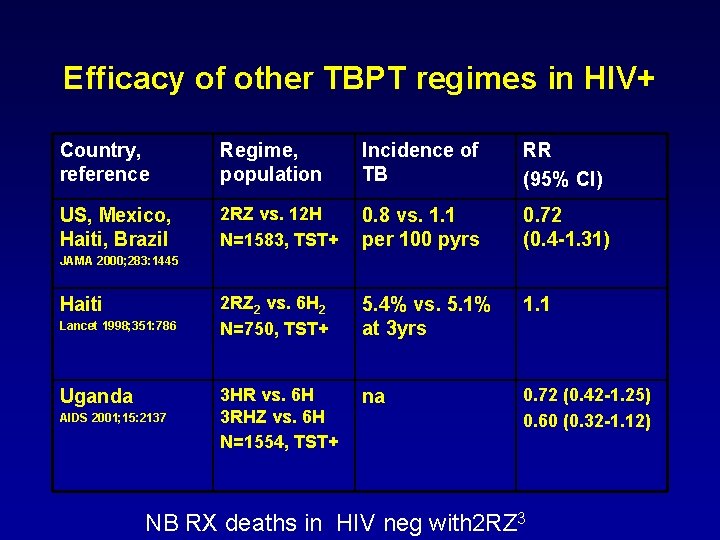
Efficacy of other TBPT regimes in HIV+ Country, reference Regime, population Incidence of TB RR (95% CI) US, Mexico, Haiti, Brazil 2 RZ vs. 12 H N=1583, TST+ 0. 8 vs. 1. 1 per 100 pyrs 0. 72 (0. 4 -1. 31) 2 RZ 2 vs. 6 H 2 N=750, TST+ 5. 4% vs. 5. 1% at 3 yrs 1. 1 3 HR vs. 6 H 3 RHZ vs. 6 H N=1554, TST+ na 0. 72 (0. 42 -1. 25) 0. 60 (0. 32 -1. 12) JAMA 2000; 283: 1445 Haiti Lancet 1998; 351: 786 Uganda AIDS 2001; 15: 2137 NB RX deaths in HIV neg with 2 RZ 3
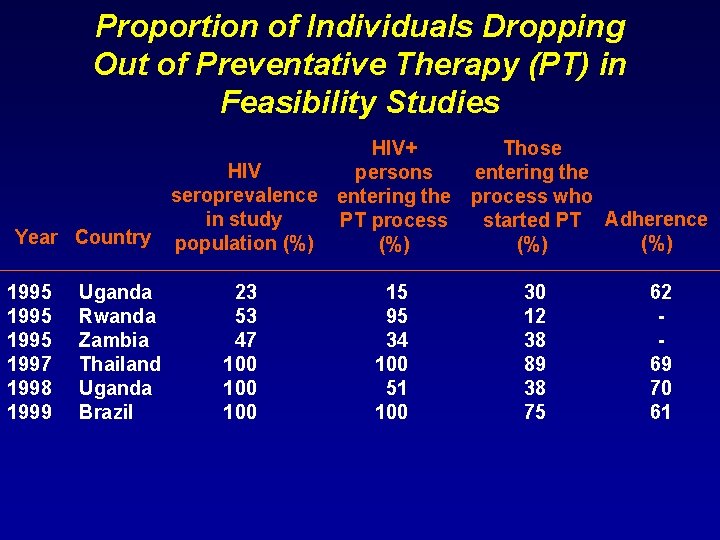
Proportion of Individuals Dropping Out of Preventative Therapy (PT) in Feasibility Studies HIV+ Those HIV persons entering the seroprevalence entering the process who in study PT process started PT Adherence Year Country population (%) (%) 1995 1997 1998 1999 Uganda Rwanda Zambia Thailand Uganda Brazil 23 53 47 100 100 15 95 34 100 51 100 30 12 38 89 38 75 62 69 70 61
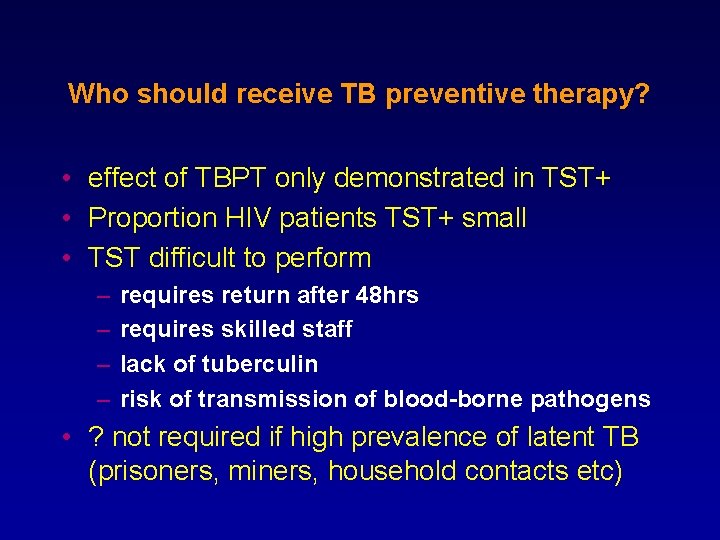
Who should receive TB preventive therapy? • effect of TBPT only demonstrated in TST+ • Proportion HIV patients TST+ small • TST difficult to perform – – requires return after 48 hrs requires skilled staff lack of tuberculin risk of transmission of blood-borne pathogens • ? not required if high prevalence of latent TB (prisoners, miners, household contacts etc)
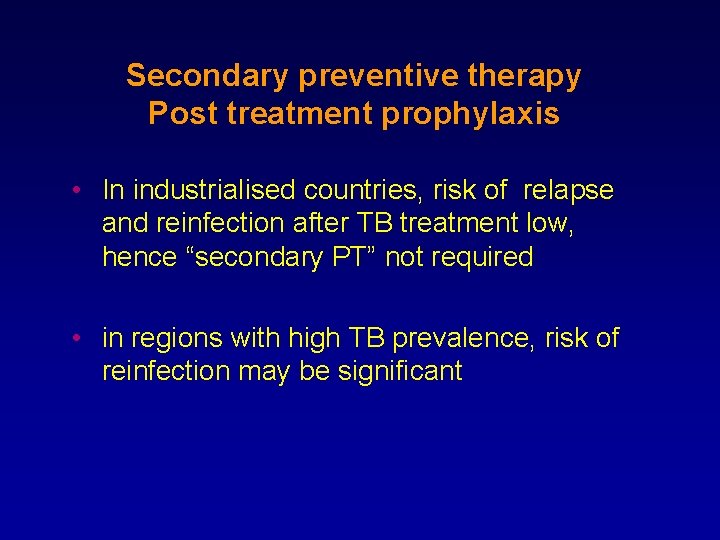
Secondary preventive therapy Post treatment prophylaxis • In industrialised countries, risk of relapse and reinfection after TB treatment low, hence “secondary PT” not required • in regions with high TB prevalence, risk of reinfection may be significant
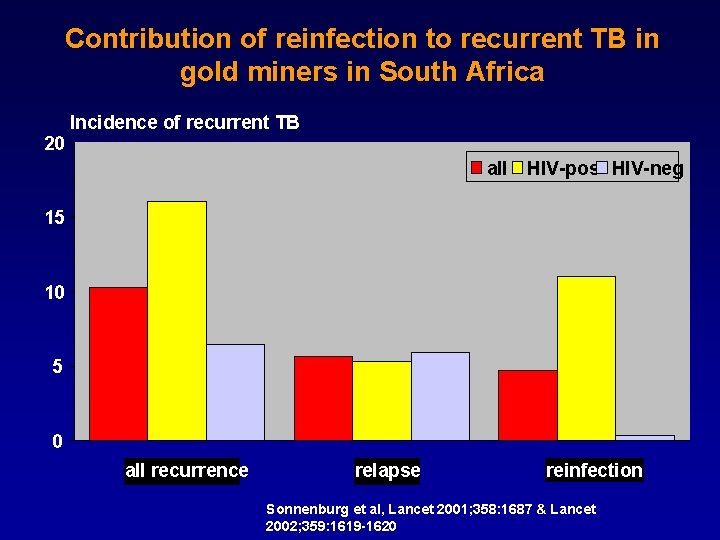
Contribution of reinfection to recurrent TB in gold miners in South Africa 20 Incidence of recurrent TB all HIV-pos HIV-neg 15 10 5 0 all recurrence relapse reinfection Sonnenburg et al, Lancet 2001; 358: 1687 & Lancet 2002; 359: 1619 -1620
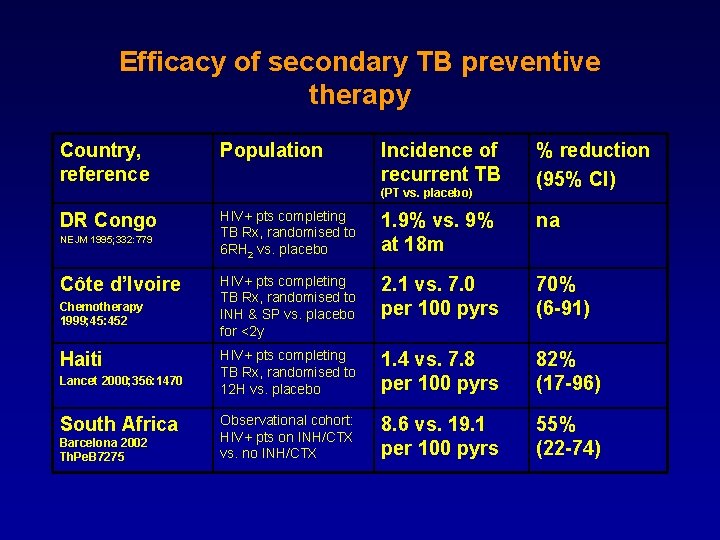
Efficacy of secondary TB preventive therapy Country, reference Population Incidence of recurrent TB (PT vs. placebo) DR Congo NEJM 1995; 332: 779 Côte d’Ivoire Chemotherapy 1999; 45: 452 Haiti Lancet 2000; 356: 1470 South Africa Barcelona 2002 Th. Pe. B 7275 % reduction (95% CI) HIV+ pts completing TB Rx, randomised to 6 RH 2 vs. placebo 1. 9% vs. 9% at 18 m na HIV+ pts completing TB Rx, randomised to INH & SP vs. placebo for <2 y 2. 1 vs. 7. 0 per 100 pyrs 70% (6 -91) HIV+ pts completing TB Rx, randomised to 12 H vs. placebo 1. 4 vs. 7. 8 per 100 pyrs 82% (17 -96) Observational cohort: HIV+ pts on INH/CTX vs. no INH/CTX 8. 6 vs. 19. 1 per 100 pyrs 55% (22 -74)
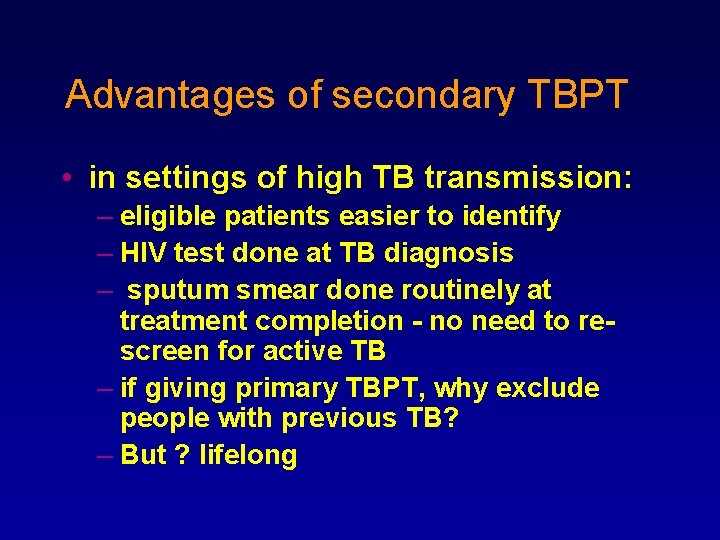
Advantages of secondary TBPT • in settings of high TB transmission: – eligible patients easier to identify – HIV test done at TB diagnosis – sputum smear done routinely at treatment completion - no need to rescreen for active TB – if giving primary TBPT, why exclude people with previous TB? – But ? lifelong
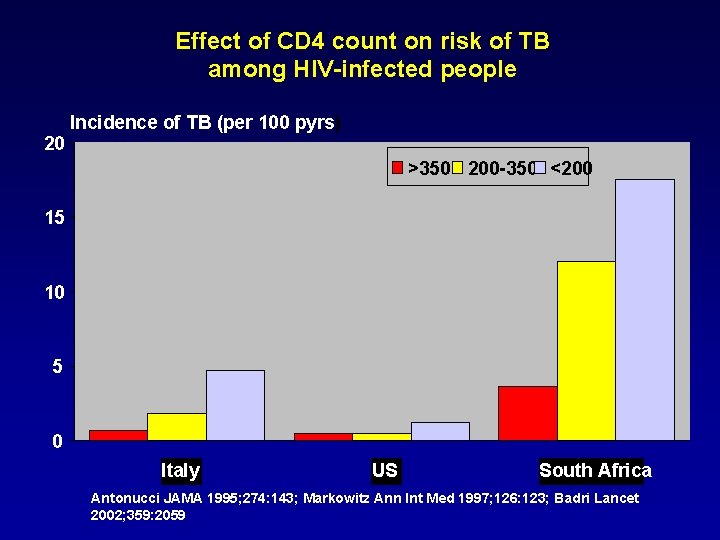
Effect of CD 4 count on risk of TB among HIV-infected people 20 Incidence of TB (per 100 pyrs) >350 200 -350 <200 15 10 5 0 Italy US South Africa Antonucci JAMA 1995; 274: 143; Markowitz Ann Int Med 1997; 126: 123; Badri Lancet 2002; 359: 2059
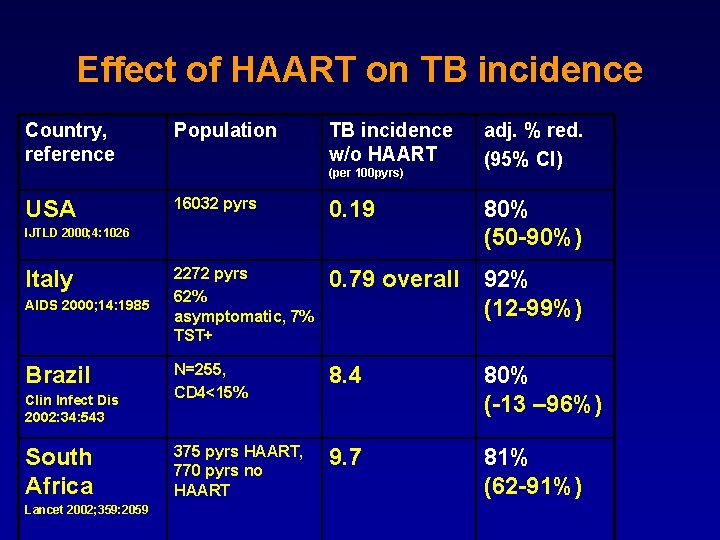
Effect of HAART on TB incidence Country, reference Population TB incidence w/o HAART (per 100 pyrs) adj. % red. (95% CI) 16032 pyrs 0. 19 80% (50 -90%) 0. 79 overall AIDS 2000; 14: 1985 2272 pyrs 62% asymptomatic, 7% TST+ 92% (12 -99%) Brazil N=255, CD 4<15% 8. 4 80% (-13 – 96%) 375 pyrs HAART, 770 pyrs no HAART 9. 7 81% (62 -91%) USA IJTLD 2000; 4: 1026 Italy Clin Infect Dis 2002: 34: 543 South Africa Lancet 2002; 359: 2059
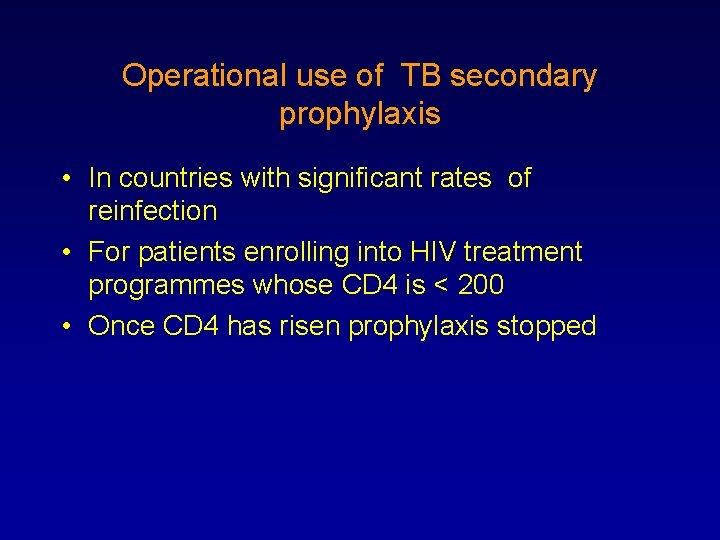
Operational use of TB secondary prophylaxis • In countries with significant rates of reinfection • For patients enrolling into HIV treatment programmes whose CD 4 is < 200 • Once CD 4 has risen prophylaxis stopped
Issues in initiating antiretroviral therapy in HIV patients with TB
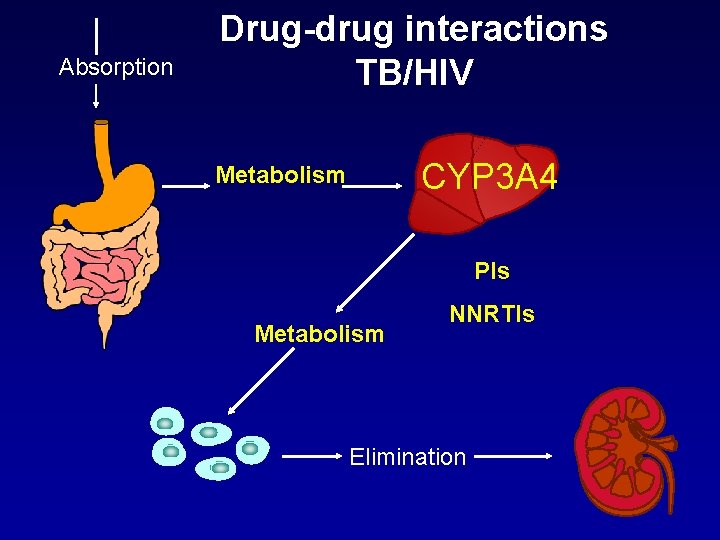
Absorption Drug-drug interactions TB/HIV CYP 3 A 4 Metabolism PIs Metabolism NNRTIs Elimination
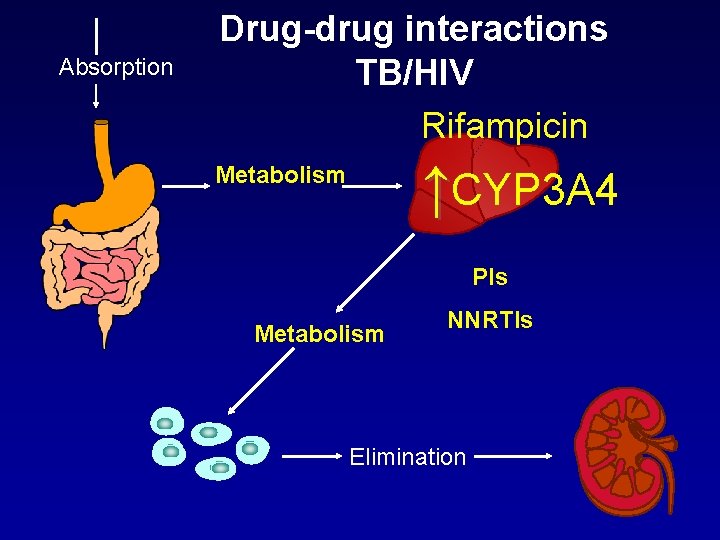
Absorption Drug-drug interactions TB/HIV Rifampicin ↑CYP 3 A 4 Metabolism PIs Metabolism NNRTIs Elimination
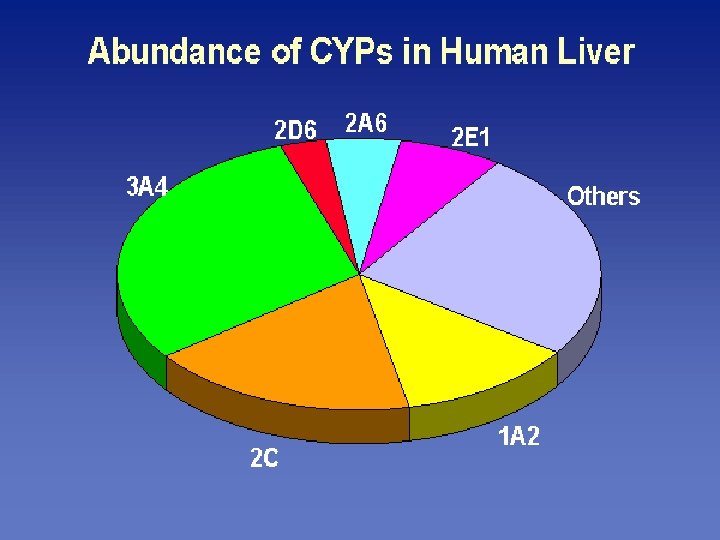
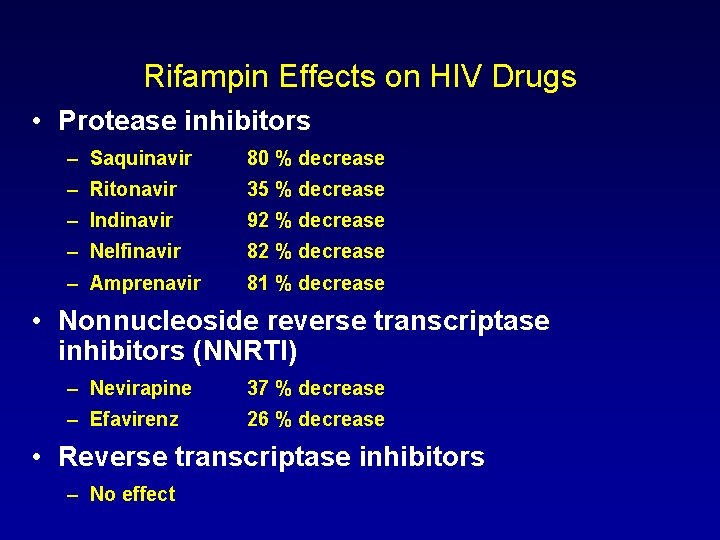
Rifampin Effects on HIV Drugs • Protease inhibitors – Saquinavir 80 % decrease – Ritonavir 35 % decrease – Indinavir 92 % decrease – Nelfinavir 82 % decrease – Amprenavir 81 % decrease • Nonnucleoside reverse transcriptase inhibitors (NNRTI) – Nevirapine 37 % decrease – Efavirenz 26 % decrease • Reverse transcriptase inhibitors – No effect
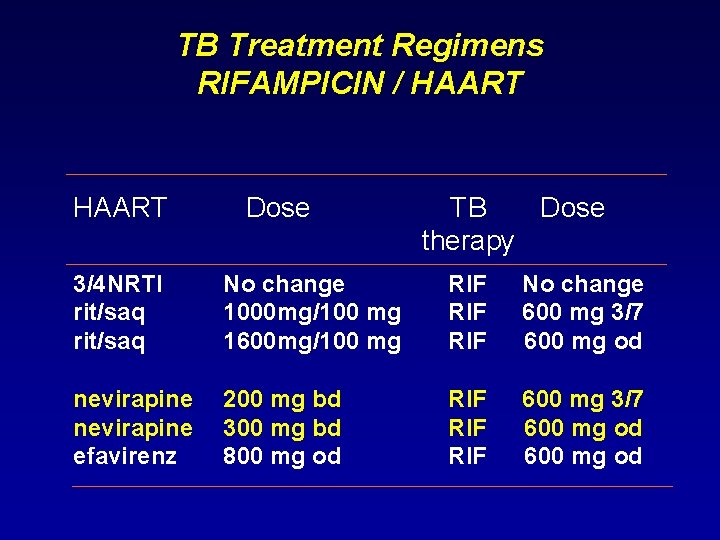
TB Treatment Regimens RIFAMPICIN / HAART Dose TB Dose therapy 3/4 NRTI rit/saq No change 1000 mg/100 mg 1600 mg/100 mg RIF RIF No change 600 mg 3/7 600 mg od nevirapine efavirenz 200 mg bd 300 mg bd 800 mg od RIF RIF 600 mg 3/7 600 mg od
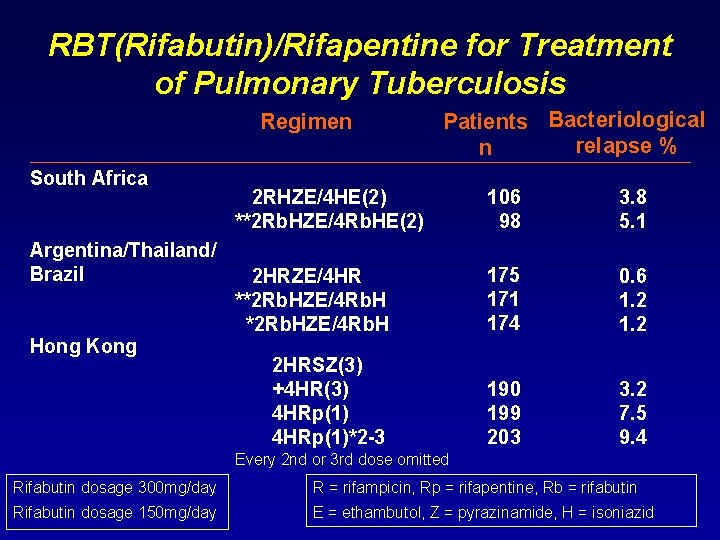
RBT(Rifabutin)/Rifapentine for Treatment of Pulmonary Tuberculosis Regimen South Africa Argentina/Thailand/ Brazil Hong Kong Patients Bacteriological relapse % n 2 RHZE/4 HE(2) **2 Rb. HZE/4 Rb. HE(2) 106 98 3. 8 5. 1 2 HRZE/4 HR **2 Rb. HZE/4 Rb. H 175 171 174 0. 6 1. 2 2 HRSZ(3) +4 HR(3) 4 HRp(1)*2 -3 190 199 203 3. 2 7. 5 9. 4 Every 2 nd or 3 rd dose omitted Rifabutin dosage 300 mg/day R = rifampicin, Rp = rifapentine, Rb = rifabutin Rifabutin dosage 150 mg/day E = ethambutol, Z = pyrazinamide, H = isoniazid

TB Treatment Regimens Rifabutin HAART Dose TB Dose therapy 3/4 NRTI nelfinavir indinavir amprenavir Boosted PI nevirapine efavirenz No change 1750 mg bd 1000 mg tds 1200 mg bd No change 200 mg bd 600 mg od RBT RBT No change 150 mg od 150 mg 2 -3/7 300 mg od 450 mg od
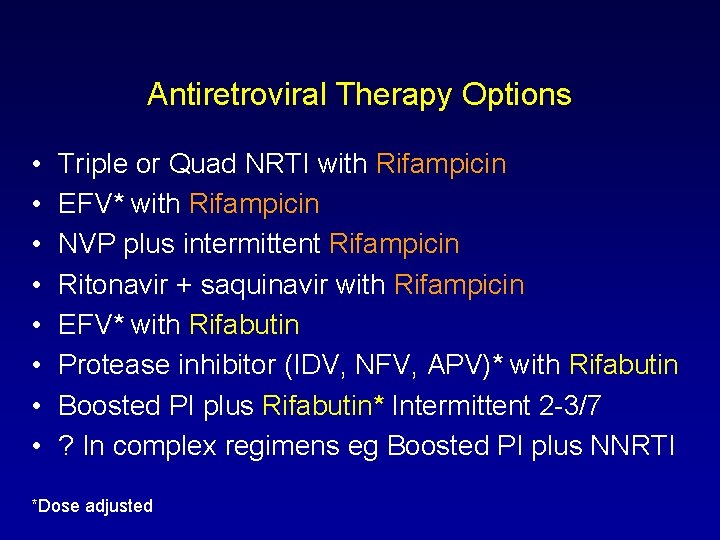
Antiretroviral Therapy Options • • Triple or Quad NRTI with Rifampicin EFV* with Rifampicin NVP plus intermittent Rifampicin Ritonavir + saquinavir with Rifampicin EFV* with Rifabutin Protease inhibitor (IDV, NFV, APV)* with Rifabutin Boosted PI plus Rifabutin* Intermittent 2 -3/7 ? In complex regimens eg Boosted PI plus NNRTI *Dose adjusted
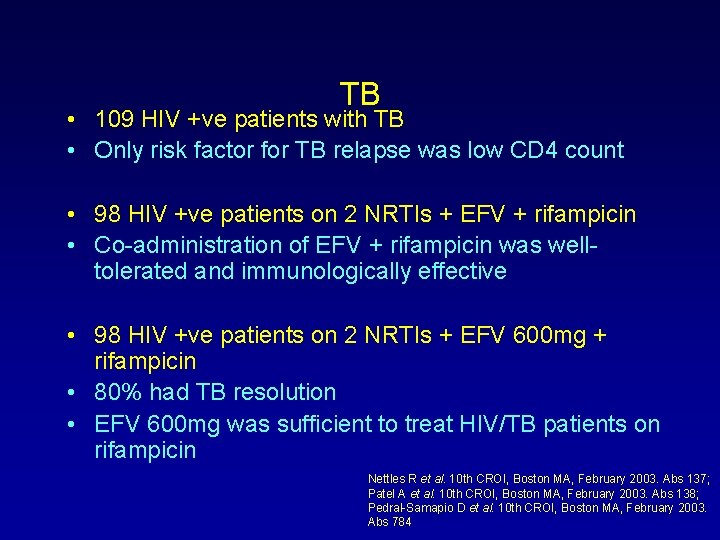
TB • 109 HIV +ve patients with TB • Only risk factor for TB relapse was low CD 4 count • 98 HIV +ve patients on 2 NRTIs + EFV + rifampicin • Co-administration of EFV + rifampicin was welltolerated and immunologically effective • 98 HIV +ve patients on 2 NRTIs + EFV 600 mg + rifampicin • 80% had TB resolution • EFV 600 mg was sufficient to treat HIV/TB patients on rifampicin Nettles R et al. 10 th CROI, Boston MA, February 2003. Abs 137; Patel A et al. 10 th CROI, Boston MA, February 2003. Abs 138; Pedral-Samapio D et al. 10 th CROI, Boston MA, February 2003. Abs 784
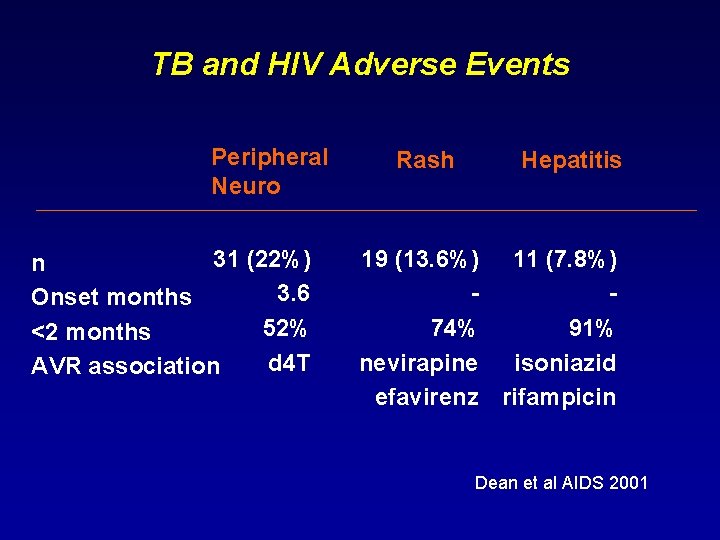
TB and HIV Adverse Events Peripheral Neuro 31 (22%) n 3. 6 Onset months 52% <2 months d 4 T AVR association Rash Hepatitis 19 (13. 6%) 11 (7. 8%) 74% 91% nevirapine isoniazid efavirenz rifampicin Dean et al AIDS 2001
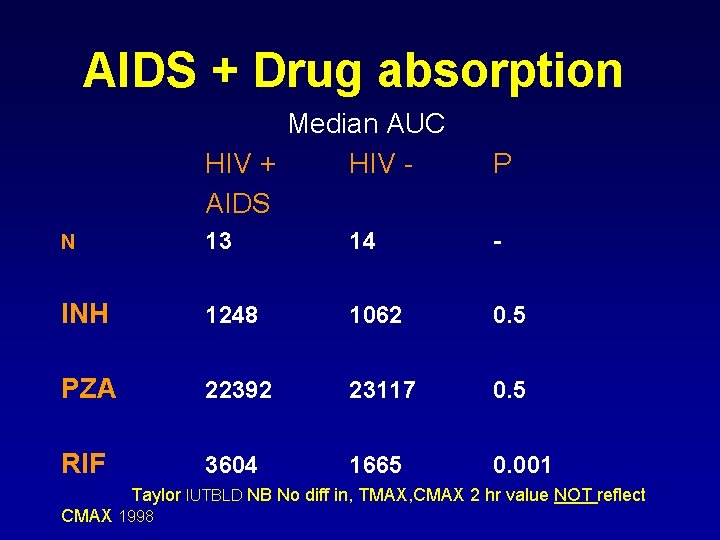
AIDS + Drug absorption Median AUC HIV + HIV AIDS P N 13 14 - INH 1248 1062 0. 5 PZA 22392 23117 0. 5 RIF 3604 1665 0. 001 Taylor IUTBLD NB No diff in, TMAX, CMAX 2 hr value NOT reflect CMAX 1998
How Long to Treat? TB / HIV
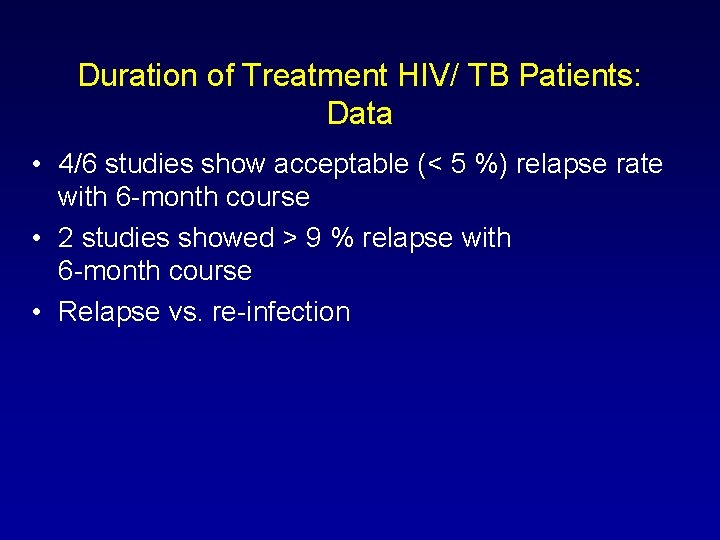
Duration of Treatment HIV/ TB Patients: Data • 4/6 studies show acceptable (< 5 %) relapse rate with 6 -month course • 2 studies showed > 9 % relapse with 6 -month course • Relapse vs. re-infection
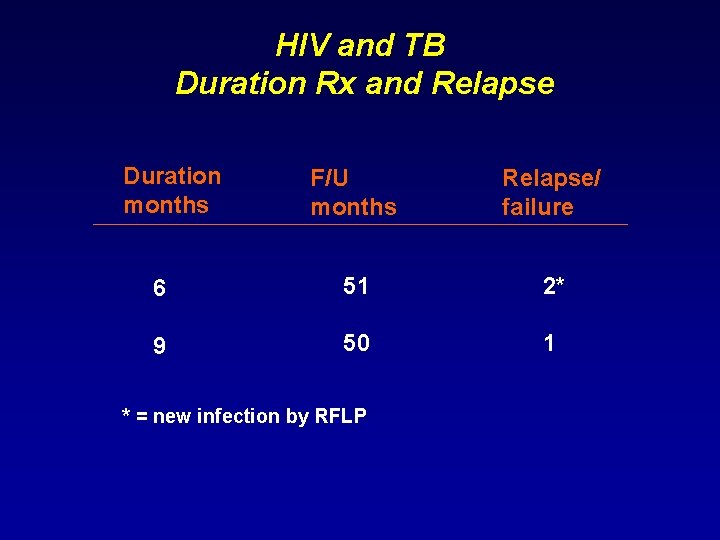
HIV and TB Duration Rx and Relapse Duration months F/U months Relapse/ failure 6 51 2* 9 50 1 * = new infection by RFLP
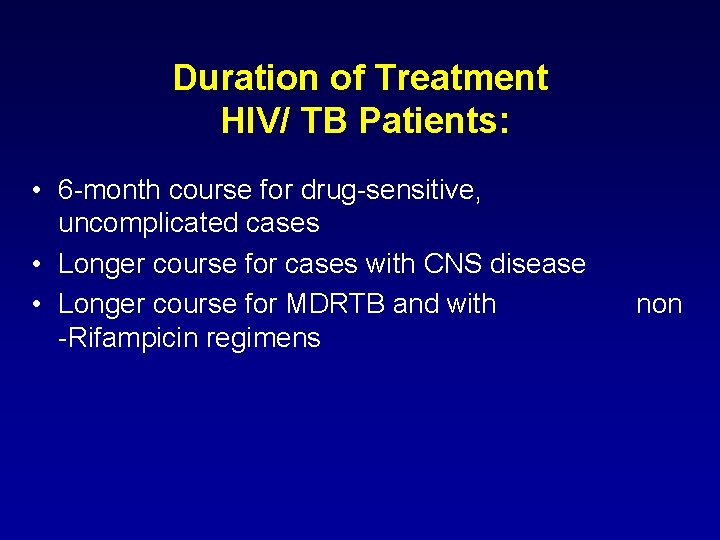
Duration of Treatment HIV/ TB Patients: • 6 -month course for drug-sensitive, uncomplicated cases • Longer course for cases with CNS disease • Longer course for MDRTB and with -Rifampicin regimens non
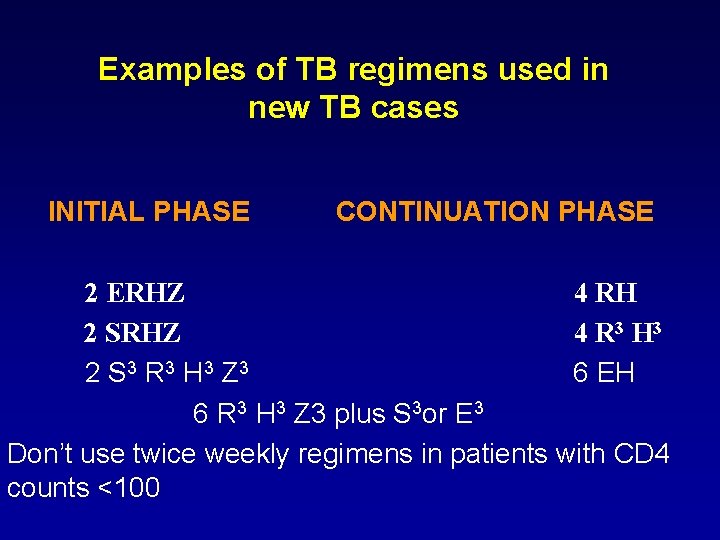
Examples of TB regimens used in new TB cases INITIAL PHASE CONTINUATION PHASE 2 ERHZ 4 RH 2 SRHZ 4 R 3 H 3 2 S 3 R 3 H 3 Z 3 6 EH 6 R 3 H 3 Z 3 plus S 3 or E 3 Don’t use twice weekly regimens in patients with CD 4 counts <100
Antiretroviral Therapy and TB When to start HAART?
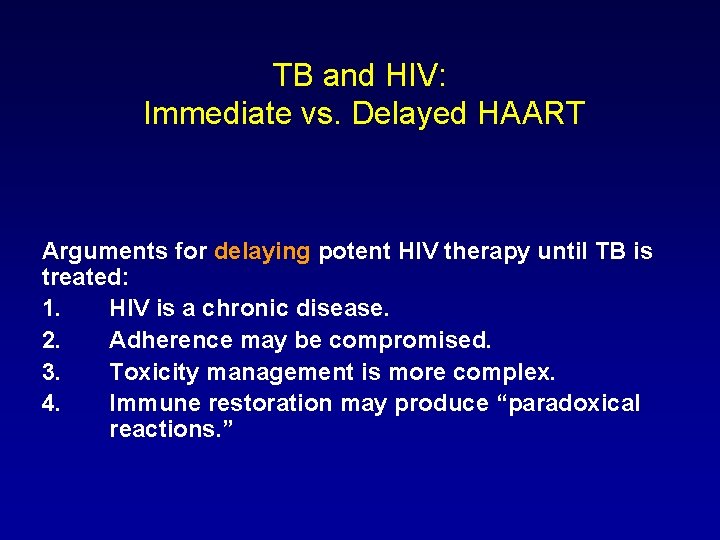
TB and HIV: Immediate vs. Delayed HAART Arguments for delaying potent HIV therapy until TB is treated: 1. HIV is a chronic disease. 2. Adherence may be compromised. 3. Toxicity management is more complex. 4. Immune restoration may produce “paradoxical reactions. ”
TB and HIV: Immediate vs. Delayed HAART Arguments for initiating potent HIV therapy at the onset of TB: 1. TB is associated with immune activation, increased HIV replication, and HIV disease progression. 2. Potent antiretroviral therapy can reduce HIV RNA levels, improve immune function and slow HIV disease progression. 3. HIV therapy reduces risk of developing other opportunistic infections
Don’t Wait till it’s too late Further AIDS 27/188 TB/HIV patients developed further AIDS On HAART =3 Not on HAART= 24 median CD 4 in this group was 70 cells 90% had median CD 4 <100 4 months post TB 16 died only 4 on HAART (3 short term) Dean et al AIDS 2001
TB and HIV: Immediate vs. Delayed HAART • TB treatment must be given urgently. • The urgency of HIV treatment depends on predictors of HIV disease progression especially the CD 4 cell count. • <100 cells/mm 3 HAART ASAP • 100 -200 cells/mm 3 - HAART after 2 months • >200 cells/mm 3 - HAART after TB RX finished
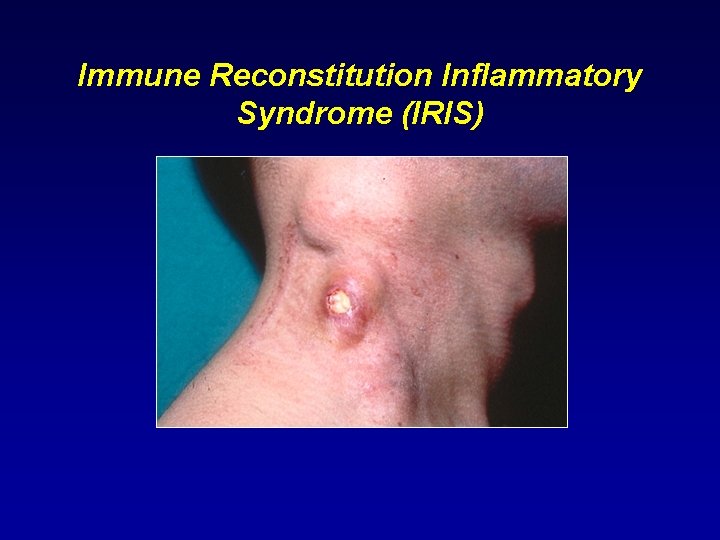
Immune Reconstitution Inflammatory Syndrome (IRIS)
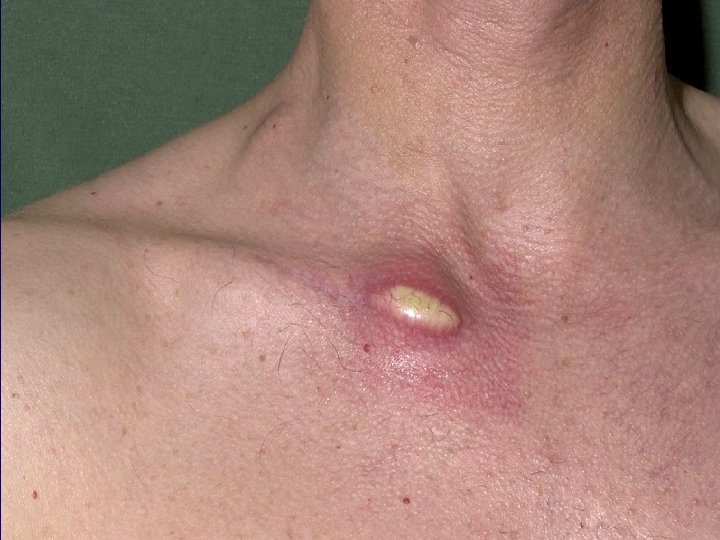
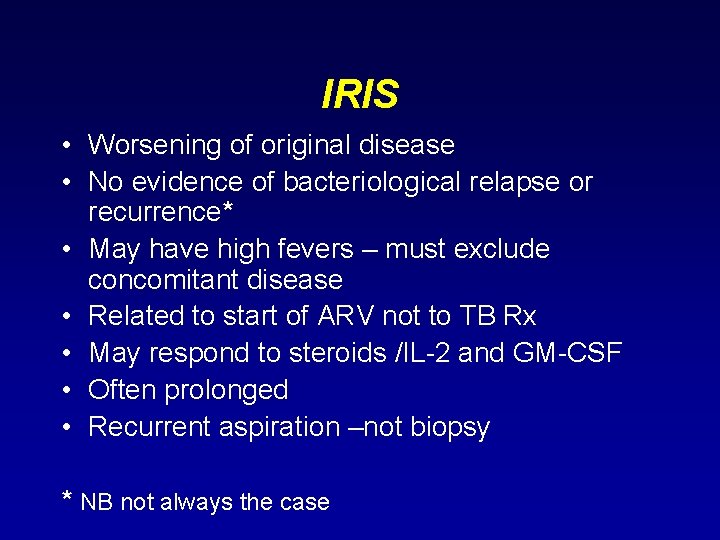
IRIS • Worsening of original disease • No evidence of bacteriological relapse or recurrence* • May have high fevers – must exclude concomitant disease • Related to start of ARV not to TB Rx • May respond to steroids /IL-2 and GM-CSF • Often prolonged • Recurrent aspiration –not biopsy * NB not always the case
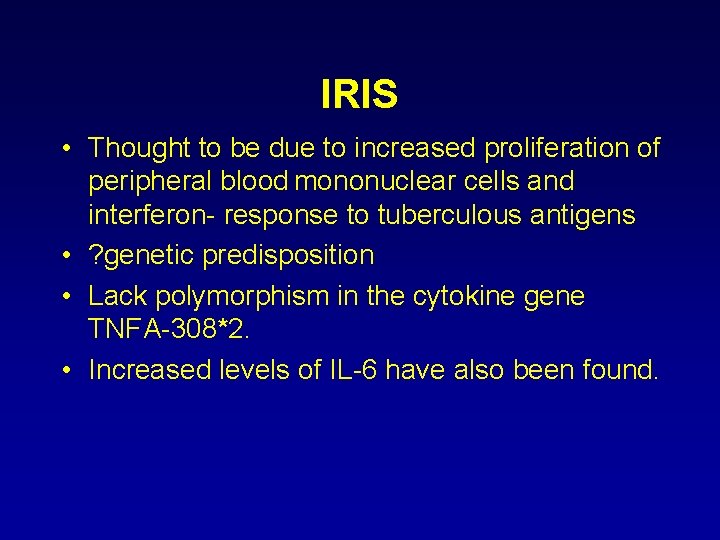
IRIS • Thought to be due to increased proliferation of peripheral blood mononuclear cells and interferon- response to tuberculous antigens • ? genetic predisposition • Lack polymorphism in the cytokine gene TNFA-308*2. • Increased levels of IL-6 have also been found.
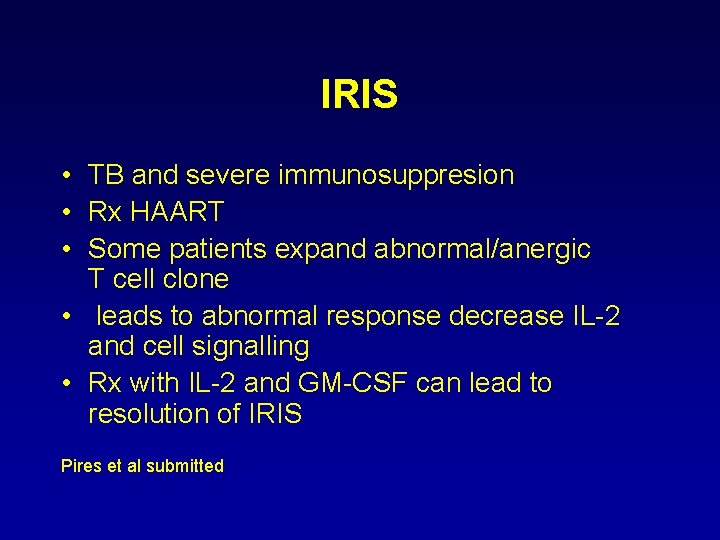
IRIS • TB and severe immunosuppresion • Rx HAART • Some patients expand abnormal/anergic T cell clone • leads to abnormal response decrease IL-2 and cell signalling • Rx with IL-2 and GM-CSF can lead to resolution of IRIS Pires et al submitted
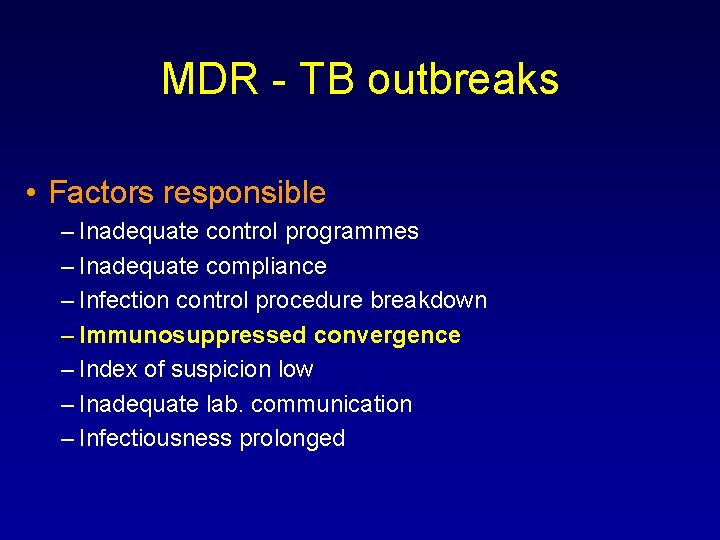
MDR - TB outbreaks • Factors responsible – Inadequate control programmes – Inadequate compliance – Infection control procedure breakdown – Immunosuppressed convergence – Index of suspicion low – Inadequate lab. communication – Infectiousness prolonged
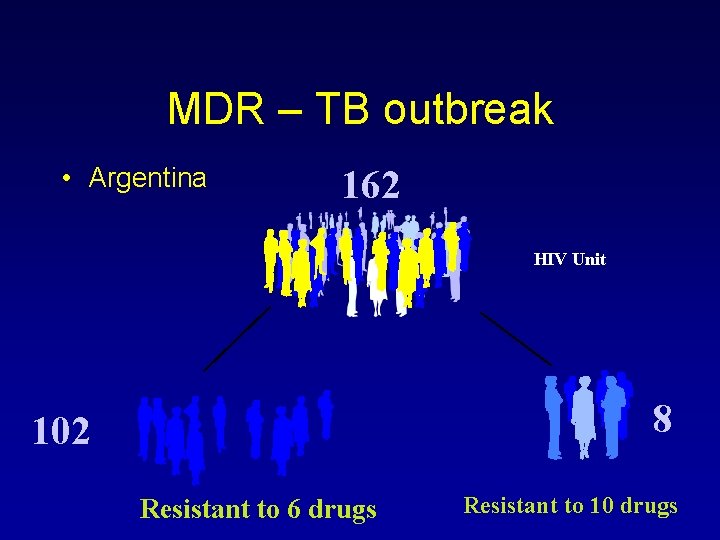
MDR – TB outbreak • Argentina 162 HIV Unit 8 102 Resistant to 6 drugs 8 Resistant to 10 drugs
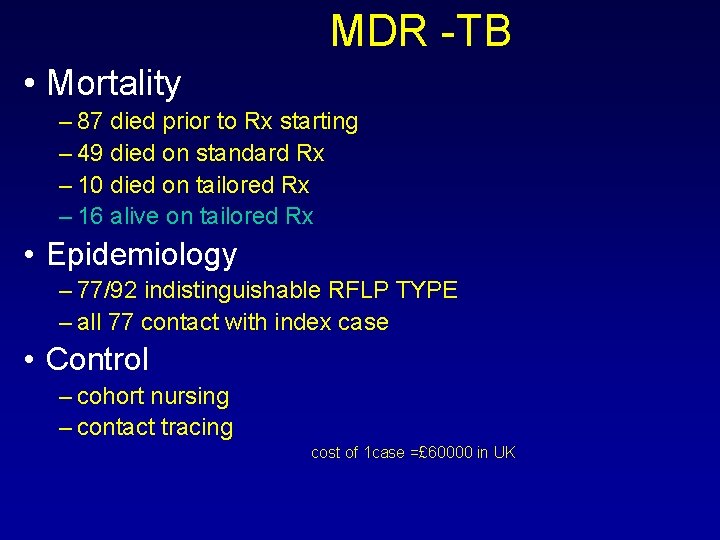
MDR -TB • Mortality – 87 died prior to Rx starting – 49 died on standard Rx – 10 died on tailored Rx – 16 alive on tailored Rx • Epidemiology – 77/92 indistinguishable RFLP TYPE – all 77 contact with index case • Control – cohort nursing – contact tracing cost of 1 case =£ 60000 in UK
HIV and TB Thanks to SE TB research group LSTMH Dr Alison Grant ICSM Dr Imami Chelsea and Westminster Hospital Prof Gazzard
- Slides: 49